
地缘冲突

Search documents
地缘冲突降温,黄金短期调整周期或尚未结束
Sou Hu Cai Jing· 2025-07-01 03:16
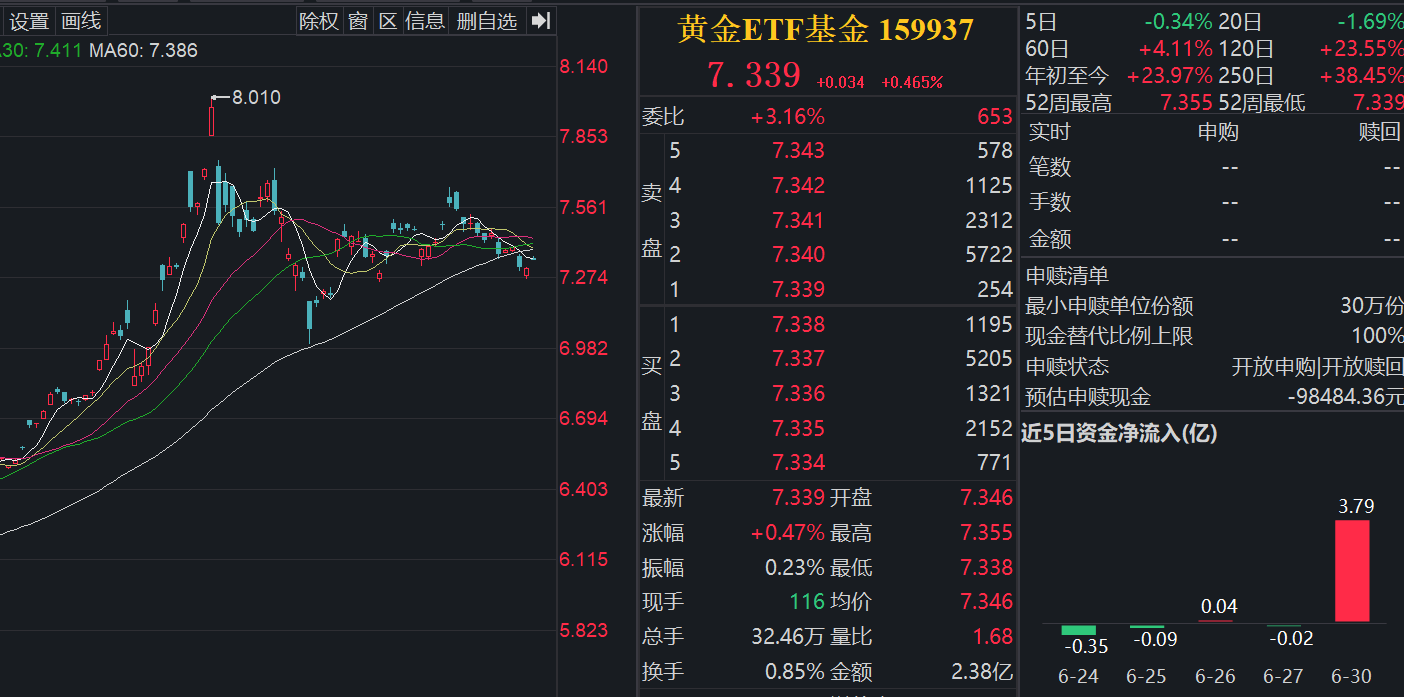
Core Viewpoint - The gold market is experiencing fluctuations influenced by geopolitical tensions, trade negotiations, and changes in U.S. monetary policy, leading to a mixed outlook for gold prices and related investment vehicles [3][4][5]. Group 1: Market Performance - On July 1, the gold ETF fund (159937) rose by 0.47% with a transaction volume of 238 million yuan and a turnover rate of 0.85% [1]. - International spot gold prices have rebounded above $3,300 per ounce, with the latest quote at $3,314.68 per ounce, marking a 0.38% increase [2]. - COMEX gold futures are quoted at $3,327 per ounce, reflecting a 0.59% increase [2]. Group 2: Economic and Geopolitical Influences - The gold market has been under pressure due to easing geopolitical conflicts and rising U.S. stock markets, which have increased risk appetite among investors [3]. - The U.S. Treasury Secretary indicated that trade agreements with multiple countries are expected to be completed by September 1, which may influence market sentiment [3]. - Speculation about the potential appointment of a more dovish Federal Reserve Chair by President Trump could impact monetary policy and, consequently, gold prices [3][4]. Group 3: Investment Strategies and Outlook - Analysts suggest a mixed to bullish long-term outlook for gold, despite short-term technical weaknesses and market adjustments [5]. - The gold ETF fund (159937) and its linked funds offer low-cost, diversified investment opportunities in gold, aligning closely with domestic gold prices [5]. - The long-term value of gold as a hedge against economic downturns and inflation remains significant, with recommendations for investors to consider regular investments in gold ETFs [5].

宝城期货贵金属有色早报-20250701
Bao Cheng Qi Huo· 2025-07-01 02:29
Report Summary 1. Report Industry Investment Rating - No specific industry investment rating is provided in the report. 2. Report's Core View - For gold, the short - term view is weak, with short - term decline and mid - term oscillation. The core logic is the easing of geopolitical conflicts and significant technical pressure on gold prices. Also, market pricing of the Iran - Israel cease - fire and changes in interest - rate cut expectations impact the price [1][3]. - For copper, the short - term view is strong, with both short - term and mid - term upward trends. The core logic is the improvement of market risk appetite at the macro level and the strong overseas copper premium and continuous inventory reduction at the industrial level [1][5]. 3. Summary by Relevant Catalogs Gold - **Price Movement**: Yesterday, the gold price bottomed out and rebounded. The market has fully priced in the short - term Iran - Israel cease - fire, leading to a market correction [3]. - **Market Factors**: The recent increase in market interest - rate cut expectations and the continuous weakening of the US dollar index provide strong support for the gold price. The probability of three interest rate cuts within the year exceeds 50% according to FedWatch Tool data [3]. - **Technical Analysis**: The domestic gold price has fallen below the 60 - day moving average, and the willingness of previous short - sellers to close positions may increase. The overseas gold price is near the 60 - day moving average, with significant differences between bulls and bears. Focus on the 3300 - dollar long - short game of London gold and New York gold [3]. - **Ratio Trend**: The gold - silver ratio is expected to continue to weaken [3]. Copper - **Price Movement**: Yesterday, the copper price continued to oscillate below 80,000, with a slight decrease in the position volume and an increase in the willingness of long - sellers to close positions [5]. - **Macro Factors**: After the Iran - Israel cease - fire last week, market risk appetite improved, causing a general rise in non - ferrous metals. The market cooled down on Monday [5]. - **Industrial Factors**: The overseas LME copper premium has strengthened significantly recently, indicating a shortage of overseas electrolytic copper spot. The domestic Mysteel electrolytic copper social inventory is 123,500 tons, a reduction of 8,400 tons from last week, and the downstream replenishment willingness is strong [5]. - **Technical Analysis**: Pay attention to the long - short game at the 80,000 mark [5].
市场热议金价下行趋势,跌至600元关口可能性偏低
Sou Hu Cai Jing· 2025-06-30 21:57
Core Viewpoint - The likelihood of gold prices dropping to 600 CNY per gram is low, requiring a multi-faceted analysis of various influencing factors [1][3]. Short-term Possibility Analysis (Within 1 Year) - Strong support levels currently restrict price declines, with historical lows indicating a minimum of 620 CNY per gram in early 2025, while current international gold prices suggest a domestic base price of approximately 768 CNY per gram [1]. - If international gold prices fall below 3200 USD per ounce (approximately 760 CNY per gram), a potential drop to 3000 USD (around 700 CNY) could occur, but reaching 600 CNY would necessitate prices falling below 2400 USD, which exceeds current institutional forecasts [1]. Central Bank Gold Purchases - Global central banks are projected to purchase over 1,141 tons of gold in 2024, with the Chinese central bank increasing its holdings for 18 consecutive months, providing long-term price support [2]. Necessary Conditions for Price Drop - A combination of multiple adverse conditions would need to occur for prices to approach 600 CNY, with the probability assessed to be below 10% according to mainstream institutional views [3]. Mid-term Pressure Range - The realistic price range is expected to be between 700-750 CNY, influenced by consumer psychology, with many consumers viewing 600-700 CNY as a psychological buying point [4]. - Increased customer traffic at gold shops in Hangzhou at the 772 CNY level indicates an upward shift in actual support levels [4]. Cost Constraints - The mining cost of gold is estimated to be around 1200-1400 USD per ounce (approximately 500-550 CNY per gram), and sustained prices below this level could lead to production cuts by mining companies, thereby correcting supply and demand [5]. Factors Influencing the 600 CNY Target - The soaring US dollar index (over 120) is suppressing gold prices below 2500 USD, with the current index at 104 and delayed expectations for Federal Reserve rate cuts [6]. - A withdrawal of funds from global risk assets into gold is occurring amidst concerns of economic recession, with ongoing geopolitical tensions in regions like Ukraine and the Middle East [6]. - Technical breakdowns and panic selling could trigger programmed sell-offs, although gold prices are currently holding at the 3250 USD support level [6]. Practical Recommendations for Consumers - For personal use, purchasing gold in the 700-750 CNY range is advisable, as the premium for craftsmanship has decreased [7]. - For asset allocation, a dollar-cost averaging strategy in gold ETFs is recommended, particularly if prices drop to 700 CNY [7]. - For those holding gold, it is suggested to maintain positions until 2026, as forecasts predict a rise to 3700 USD per ounce [7].
合成橡胶成本定价逻辑偏强,关注供给端扰动与去库进度
Guo Mao Qi Huo· 2025-06-30 06:36
投资咨询业务资格:证监许可【2012】31 号 合成橡胶成本定价逻辑偏强,关注供给端扰动与去库进度 | 投资观点: | 短期偏弱震荡,等待下半年反弹机会 | 合成橡胶(BR) | | --- | --- | --- | | 报告日期 | 2025-6-30 | 半年报告 | ⚫ 行情回顾 上半年 BR 期货价格重心偏低,整体波动性减弱。4 月受中美关税升 级及丁二烯供给过剩拖累,价格跌破 12000 元/吨。5 月中因中美关税缓和 预期及恒力装置故障导致丁二烯短缺预期,价格短暂冲高。随后基本面弱 势主导,价格重回底部震荡。近期因地缘冲突推涨原油带动 BR 小幅上 行,但涨幅有限,走势仍与天胶高度相关。 单边:短期盘面偏弱震荡运行,建议投资者观望; 套利:关注多 BR 空 NR/RU 价差回归。 ⚫ 风险提示 地缘冲突升级、关税政策影响、轮胎出口超预期回暖、天然橡胶主 产区极端天气导致价差逻辑反转。 ⚫ 原料端:产油国增产持续推进,地缘局势导致盘面短期冲高上行 原油: 上半年震荡下行,主因 OPEC+持续增产至 7 月及供需宽松预 期强化。短期地缘冲突推高波动,但中长期宽松格局未改。 丁二烯: 上半年价格波动大 ...
黄金、白银期货品种周报2025.06.30-07.04-20250630
Chang Cheng Qi Huo· 2025-06-30 03:07
Group 1: General Information - Report title: Gold, Silver Futures Variety Weekly Report [2] - Report period: June 30 - July 4, 2025 [1] Group 2: Gold Futures 1. Mid - term Market Analysis - Mid - term trend: The overall trend of Shanghai Gold futures is in an upward channel, and it may be at the end of the trend [7] - Trend judgment logic: Last week, gold was affected by geopolitical conflicts, Fed policy divergence, tariff policy nodes, and weak economic data, showing a volatile downward trend. Future gold prices need to focus on the Fed's policy shift timing, the sustainability of global central bank gold purchases, and the inflation path. Geopolitical black - swan events are the biggest upside risk factor [7] - Mid - term strategy: It is recommended to wait and see [8] 2. Variety Trading Strategy - Last week's strategy review: It was expected that the main gold contract 2508 would fluctuate at a high level in the short term. It was recommended to wait and see. The lower support was 766 - 775, and the upper pressure was 800 - 808 [11] - This week's strategy suggestion: The main gold contract 2510 is short - biased in the short term. The lower support is 754 - 760, and the upper pressure is 784 - 790 [12] 3. Relevant Data - The report provides data on Shanghai Gold futures and COMEX gold price trends, SPDR gold ETF holdings, COMEX gold inventory, US 10 - year Treasury yields, US dollar index, US dollar against offshore RMB, gold - silver ratio, Shanghai Gold basis, and gold internal - external price difference [19][21][23] Group 3: Silver Futures 1. Mid - term Market Analysis - Mid - term trend: The overall trend of Shanghai Silver futures is in a sideways movement, and it may be close to the end of the trend [33] - Trend judgment logic: Last week, silver showed a volatile trend affected by supply - demand fundamentals, Fed policy expectations, and geopolitical risks. Future positive factors for silver prices include strengthened Fed rate - cut expectations, global liquidity easing, and a weaker US dollar. The decline in the gold - silver ratio attracts capital inflows, and geopolitical risks increase hedging demand, with an annual supply gap of 3659 tons. Potential pressures are the high US Treasury yields increasing holding costs and weak manufacturing suppressing industrial demand [33] - Mid - term strategy: It is recommended to wait and see [34] 2. Variety Trading Strategy - Last week's strategy review: It was expected that the silver contract 2510 would run strongly. The lower support interval was 8400 - 8500, and the upper pressure was 8900 - 9000 [36] - This week's strategy suggestion: It is expected that the silver contract 2508 will run strongly. The lower support interval is 8300 - 8500, and the upper pressure is 8900 - 9000 [36] 3. Relevant Data - The report provides data on Shanghai Silver futures and COMEX silver price trends, SLV silver ETF holdings, COMEX silver inventory, Shanghai Silver basis, and silver internal - external price difference [43][45][47]
随着中东局势缓和原油迅速回落 燃料油低位震荡运行
Jin Tou Wang· 2025-06-30 02:11
Group 1: Fuel Oil Price Trends - The main futures contract for fuel oil closed at 3002 CNY/ton, a decrease of 361 CNY/ton (-10.73%) from the previous week's closing price [1] - Weekly positions recorded 255,160 contracts with a trading volume of 5.1111 million contracts [1] Group 2: Supply and Demand Fundamentals - The capacity utilization rate of main refineries for atmospheric distillation was 80.74%, up 0.91% week-on-week and 4.45% year-on-year [2] - Independent refineries' capacity utilization for atmospheric distillation was 57.24%, an increase of 0.23 percentage points from the previous week [2] - The transaction volume of low-sulfur residual oil/asphalt for refineries was 31,500 tons, down 6,250 tons (-66.49%) [2] - Inventory rates in Shandong for oil slurry, residual oil, and wax oil increased to 22.8%, 3.0%, and 4.0% respectively [2] Group 3: Market Outlook - Concerns over geopolitical tensions are affecting market sentiment, with potential conflicts in the Middle East impacting oil prices [3] - The market is expected to enter a phase dominated by fundamentals, with narrow fluctuations in fuel oil prices anticipated [3][4] - Short-term fuel oil prices are expected to remain under pressure due to a lack of market stimulus [4]
中辉期货LPG早报-20250627
Zhong Hui Qi Huo· 2025-06-27 07:11
Report Industry Investment Ratings - Not provided in the given content Core Views - Crude oil is in consolidation. The oil price has returned to fundamental pricing, with a consumption peak season against an increase in supply, leading to price consolidation. [1][3] - LPG is expected to rebound with a bearish bias. Geopolitical tensions have eased, leading to a decline in the cost side and putting pressure on liquefied petroleum gas. [1] - L is in a bearish rebound. The inventory pressure in the upstream and mid - stream has significantly decreased, and the cost side of coking coal has rebounded. [1] - PP is in a bearish rebound. The spot market has weak trading volume, and it will follow the cost rebound in the short term. [1] - PVC is in a bearish rebound. The cost support has improved due to a sharp rebound in coking coal at night, but the supply side is under pressure. [1] - PX is bullish. Both domestic and foreign PX plants are operating at a relatively high load, and there is an increase in both supply and demand. [1] - PTA is bullish. The restart of PTA maintenance devices and the launch of new production capacity are expected to increase supply - side pressure, but the cost side still has support. [1] - Ethylene glycol (MEG) is bearish. The device load has increased, but the demand side is expected to weaken, and the supply - demand situation is expected to be loose. [1] - Glass is in a weak rebound. Domestic macro - policies have boosted the market, and the supply side has slightly decreased, but the medium - term demand contraction has not been alleviated. [2] - Soda ash is in an interval rebound. The weekly operating rate and production have decreased, but the high supply and high inventory limit the upside space. [2] - Caustic soda is in an interval rebound. The upstream maintains high - load production, but the demand support is insufficient. [2] - Methanol is expected to rebound with a bearish bias. The comprehensive operating load is still relatively high, and the demand feedback is negative. [2] - Urea is short - term bullish. Although the supply side pressure is large, the agricultural demand peak season and exports are still worth looking forward to. [2] - Asphalt is bearish. Geopolitical tensions have eased, and it has fallen with the cost side in the short term. [2] Summary by Related Catalogs Crude Oil - **行情回顾**: Overnight international oil prices continued to consolidate. WTI rose 0.49%, Brent rose 0.39%, and SC fell 0.65%. [3] - **基本逻辑**: The core driver was the cease - fire agreement between Israel and Iran announced by Trump on June 23, which led to a sharp drop in oil prices and the extrusion of geopolitical risk premiums. In terms of supply, Guyana's oil production increased from 611,000 barrels per day in April to 667,000 barrels per day in May. In terms of demand, OPEC's latest monthly report showed that the global crude oil demand growth rate in 2025 was 1.29 million barrels per day, lower than 1.3 million barrels per day in May. In terms of inventory, as of the week ending June 20, U.S. crude oil inventories decreased by 5.8 million barrels, strategic crude oil reserves increased by 200,000 barrels, gasoline inventories decreased by 2.1 million barrels, and distillate inventories decreased by 4.1 million barrels. [3] - **策略推荐**: In the medium - to - long term, due to the tariff war, the impact of new energy, and the expansion cycle of OPEC +, the oil supply will be in surplus, and the oil price is expected to fluctuate between $60 - 70 per barrel. In the short term, the oil price will be weak and volatile. The strategy is to short with a light position and buy call options for protection. SC is expected to be in the range of [490 - 520]. [3] LPG - **行情回顾**: On June 26, the PG main contract closed at 4,265 yuan/ton, up 0.66% month - on - month. The spot prices in Shandong, East China, and South China remained unchanged from the previous period. [5] - **基本逻辑**: The core driver is the decline in geopolitical risks, and the cost side of oil prices has adjusted after the extrusion of geopolitical premiums. As of June 26, the PDH device profit was - 586 yuan/ton, down 120 yuan/ton month - on - month. The supply of liquefied gas increased, and the demand side showed mixed trends in different sectors. The inventory in refineries and ports increased. [6] - **策略推荐**: In the medium - to - long term, the supply of upstream crude oil is greater than demand, and the central value is expected to continue to decline. The current ratio of LPG to crude oil is at a high level, and the valuation of LPG is high. In the short term, although there is a rebound on the daily line, the upward momentum is weak. The strategy is to short with a light position or buy put options. PG is expected to be in the range of [4200 - 4300]. [7] L (Polyethylene) - **基本逻辑**: In the short term, as the situation in the Middle East eases, the international crude oil price has fallen, weakening the cost support for polyethylene. The supply is expected to increase in the short term due to the restart of some previously maintained devices, while the demand is in the off - season. The inventory pressure in the upstream and mid - stream has decreased, and the cost side of coking coal has rebounded. The North China basis has turned negative, and the willingness to replenish inventory in the off - season is insufficient. [9] - **策略推荐**: The strategy is to be long in the short term and short in the long term. L is expected to be in the range of [7250 - 7400]. [9] PP (Polypropylene) - **基本逻辑**: The cost decline has dampened market sentiment, and the trading atmosphere in the market is weak. The supply - side device maintenance has increased, but the downstream demand is in the off - season. The spot market has weak trading volume, and it will follow the cost rebound in the short term. However, the supply will be under pressure in the medium - to - long term due to the high pressure of device production capacity launch in the third quarter. [11] - **策略推荐**: Treat it as a short - term rebound, and short on rebounds. PP is expected to be in the range of [7050 - 7200]. [11] PVC - **基本逻辑**: Geopolitical conflicts have led to fluctuations in the crude oil market and affected the PVC market. The cost support has improved due to a sharp rebound in coking coal at night, but the supply side is under pressure due to the planned launch of new production capacity in the future. The domestic demand is in the seasonal off - season, while the export still has support. [13] - **策略推荐**: Be bearish on rebounds and do not short in the short term. V is expected to be in the range of [4850 - 5000]. [13] PX - **行情回顾**: On June 20, the spot price of PX in East China was 7,050 yuan/ton (unchanged month - on - month), and the PX09 contract closed at 7,076 yuan/ton (- 18). The 9 - 1 month spread was 232 yuan/ton (- 40), and the basis in East China was - 26 yuan/ton (+ 18). [14] - **基本逻辑**: The profit of PX has continued to improve, and both domestic and foreign plants are operating at a relatively high load. The PXN spread is 270.9 dollars/ton (+ 8.5). The demand side of PTA is expected to improve, and the inventory is decreasing. [15] - **策略推荐**: Pay attention to the opportunity to go long at low prices. PX is expected to be in the range of [6680 - 6790]. [15] PTA - **行情回顾**: On June 20, the PTA price in East China was 5,280 yuan/ton (+ 105), and the TA09 contract closed at 4,978 yuan/ton (- 10). The TA9 - 1 month spread was 180 yuan/ton (- 26), and the basis in East China was 302 yuan/ton (+ 115). [16] - **基本逻辑**: The short - term supply - side pressure is expected to increase due to the restart of maintenance devices and the launch of new production capacity. The demand side is expected to weaken as the downstream polyester starts to maintain a high level, but the terminal weaving start - up load continues to decline. The inventory is generally low, and the cost side has support. [17] - **策略推荐**: Pay attention to the opportunity to go long at low prices. TA is expected to be in the range of [4740 - 4820]. [17] MEG - **行情回顾**: On June 20, the spot price of ethylene glycol in East China was 4,580 yuan/ton (+ 33), and the EG09 contract closed at 4,501 yuan/ton (- 38). The EG9 - 1 month spread was 14 yuan/ton (- 9), and the East China basis was 79 yuan/ton (+ 71). [18] - **基本逻辑**: The device load has increased, but the arrival volume and import volume are low compared to the same period. The demand side is expected to weaken as the downstream polyester starts to maintain a high level, but the terminal weaving start - up load continues to decline. The inventory is decreasing. [19] - **策略推荐**: Be bearish. EG is expected to be in the range of [4270 - 4320]. [20] Glass - **行情回顾**: The spot market quotation is stable, the futures market is in a weak rebound, the basis has expanded, and the number of warehouse receipts remains unchanged. [21] - **基本逻辑**: Domestically, macro - policies have boosted the market, and the supply side has slightly decreased. However, the medium - term demand contraction has not been alleviated. The current coal - based production still has profits, and it is difficult to trigger large - scale cold repairs. The futures price is at a discount to the spot price and is lower than the coal - based cost. [22] - **策略推荐**: The futures price is expected to have a weak rebound, with the 5 - day moving average providing weak support. FG is expected to be in the range of [1010 - 1030]. [22] Soda Ash - **行情回顾**: The spot price of heavy soda ash has been raised, the futures market has stabilized, the main - contract basis has narrowed, the number of warehouse receipts has increased, and the number of effective forecasts has decreased. [24] - **基本逻辑**: Recently, some soda ash plants have reduced their loads, resulting in a slight reduction in overall supply. However, the industry's operating rate is still at a high level, and the pressure of oversupply in the later period remains. The terminal consumption of soda ash is mediocre, and the glass futures price is consolidating at a low level, providing limited support to the upstream. The manufacturer's inventory has continued to accumulate. [25] - **策略推荐**: It is expected to have an interval rebound. SA is expected to be in the range of [1175 - 1205]. [25] Caustic Soda - **行情回顾**: The spot price of caustic soda is stable, the futures market has a weak rebound at a low level, the basis has weakened, and the number of warehouse receipts remains unchanged. [27] - **基本逻辑**: On the supply side, due to good chlor - alkali profits, most upstream plants maintain high - load production, and there is an expectation of new production capacity coming on - stream in June - July, increasing the supply pressure. However, there is also an expectation of inventory reduction during the summer maintenance season. On the demand side, the main downstream, alumina, has a slight decline in start - up and a reduction in metallurgical profits, and the non - aluminum demand is still weak. The cost support has shifted downwards. [28] - **策略推荐**: Pay attention to the weak rebound driven by inventory reduction during maintenance. Short - position holders should reduce their positions. SH is expected to be in the range of [2300 - 2350]. [2] Methanol - **行情回顾**: On June 20, the spot price of methanol in East China was 2,664 yuan/ton (- 12), and the main 09 contract closed at 2,529 yuan/ton (- 14). The East China basis was 135 yuan/ton (+ 2), the port basis was 221 yuan/ton (- 1), the MA9 - 1 month spread was 18 yuan/ton (- 10), and the China - Southeast Asia methanol re - export profit increased to 32 dollars/ton (+ 5). [29] - **基本逻辑**: The methanol plant is under maintenance, but the comprehensive operating load is still relatively high. There is negative feedback on the demand side as the load of coastal MTO plants has decreased, and the order volume of upstream methanol enterprises has declined. The valuation is high, and the social inventory has increased. [2] - **策略推荐**: Pay attention to the opportunity to short the 09 contract and go long on the 01 contract. MA is expected to be in the range of [2380 - 2440]. [2] Urea - **基本逻辑**: The restart of maintenance devices has led to a high daily production, and the supply - side pressure is large. The industrial demand is weak, but the agricultural demand peak season is approaching, and the fertilizer export growth rate is fast. There is still cost support. [2] - **策略推荐**: Hold previous long positions cautiously and pay attention to the opportunity to short at high prices. UR is expected to be in the range of [1710 - 1750]. [2] Asphalt - **基本逻辑**: Geopolitical tensions have eased, and the oil price has extruded the geopolitical premium, causing it to decline with the cost side in the short term. The supply has increased, and the inventory has accumulated. The demand shows a pattern of "strong in the north and weak in the south". [2] - **策略推荐**: Short with a light position. BU is expected to be in the range of [3500 - 3600]. [2]
银河期货燃料油半年报
Yin He Qi Huo· 2025-06-27 04:53
1. Report Industry Investment Rating No information provided. 2. Core Viewpoints of the Report - High - sulfur fuel oil was strong in H1 2025, with support shifting from supply to demand. It's expected to remain strong in Q3 due to peak - season power generation demand and geopolitical policy games, and become looser in Q4 as demand fades and supply returns. Low - sulfur fuel oil is expected to maintain a weak and volatile pattern [3][4][63]. - For investment strategies, it's recommended to stay on the sidelines for single - side trading, focus on FU9 - 1 positive spreads and narrowing high - low sulfur spreads in Q3 for arbitrage, and there are no options recommendations [5][63]. 3. Summary by Relevant Catalogs 3.1 First Part: Preface Summary 3.1.1 Market Review - High - sulfur fuel oil was supported by supply in Q1 2025, with main suppliers like Russia, Iran, and Mexico having supply issues. In Q2, power generation demand increased, and Egypt bought large amounts for power generation. Low - sulfur fuel oil was weak overall, with supply increasing after the stable operation of Al - Zour refinery and the return of South Sudan's heavy low - sulfur raw materials, and demand lacking a clear driving force [3]. 3.1.2 Market Outlook - High - sulfur fuel oil is expected to be strong in Q3 due to power generation demand and geopolitical factors, and become looser in Q4. Low - sulfur fuel oil is expected to maintain a weak and volatile pattern [4]. 3.1.3 Strategy Recommendations - Single - side: Stay on the sidelines. - Arbitrage: Focus on FU9 - 1 positive spreads and narrowing high - low sulfur spreads in Q3. - Options: None [5]. 3.2 Second Part: Fundamental Situation 3.2.1 Market Review - High - sulfur fuel oil was strong in H1 2025, with support shifting from supply to demand. In Q1, supply - side issues in Russia, Iran, and Mexico supported the market. In Q2, power generation demand increased, and supply tightened. Low - sulfur fuel oil was weak, with supply increasing after the stable operation of Al - Zour refinery and the return of South Sudan's heavy low - sulfur raw materials, and demand lacking a clear driving force [9][10]. 3.2.2 Supply Overview - **High - sulfur supply**: - Russia's supply was restricted by sanctions and bombings in H1 2025, and is expected to remain below 300 tons/month in H2. - Mexico's high - sulfur supply returned to the level before the Olmeca refinery's operation and is expected to be stable. - Middle - East high - sulfur exports had a monthly gap of about 400,000 tons in H1 2025 compared to previous years, mainly due to Iran. It's expected to be restricted in Q3 and recover in Q4 [18][22][28]. - **Low - sulfur supply**: - South Sudan's low - sulfur heavy raw material Dar Blend is recovering, and export tenders continue. - Kuwait's Al - Zour refinery has stable supply. - Nigeria's Dangote refinery has unstable gasoline unit operation, with sufficient short - term low - sulfur supply [50][52][54]. 3.2.3 Demand Overview - **High - sulfur demand**: - High - sulfur marine fuel demand is stably supported by the growth of desulfurization tower - equipped ships. - China's refinery high - sulfur feed demand is expected to slightly recover in H2. - High - sulfur power generation demand in summer 2025 exceeded expectations and is expected to remain strong in Q3 [34][38][45]. - **Low - sulfur demand**: - There is no specific driving force for demand, and marine fuel demand is stable. - China's low - sulfur market has abundant quotas, and production is stable [56][58]. 3.2.4 Inventory and Valuation No information provided. 3.3 Third Part: Future Outlook and Strategy Recommendations - High - sulfur fuel oil is expected to be strong before Q3 and become looser in Q4. Low - sulfur fuel oil is expected to maintain a weak and volatile pattern. - Strategy recommendations: - Single - side: Stay on the sidelines. - Arbitrage: Focus on FU9 - 1 positive spreads and narrowing high - low sulfur spreads in Q3. - Options: None [63].
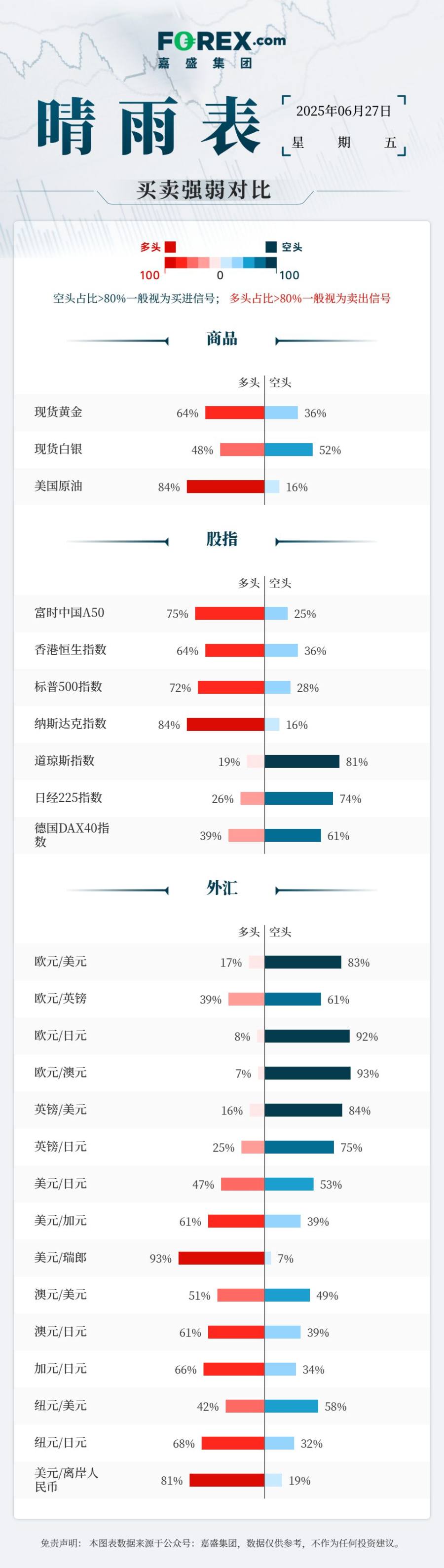
地缘冲突降温,黄金多头占比已较高位下跌;美国PCE数据今晚公布,若显示通胀降温或能提振金价,后市市场情绪如何?欢迎前往“数据库-嘉盛市场晴雨表”查看并订阅(数据每10分钟更新1次)
news flash· 2025-06-27 02:51
Group 1 - The core viewpoint indicates that geopolitical tensions are easing, leading to a decline in the proportion of bullish positions in gold [1] - The upcoming release of the US PCE data is anticipated to impact market sentiment, particularly if it shows a decrease in inflation, which could potentially boost gold prices [1] Group 2 - The data shows a significant disparity in bullish and bearish positions across various indices, with the S&P 500 having 72% bullish and 28% bearish positions, while the Nasdaq has 16% bullish and 84% bearish positions [3] - The Hang Seng Index shows a 36% bullish and 64% bearish split, indicating a more cautious sentiment in the Hong Kong market [3] - The DAX 40 index has 39% bullish and 61% bearish positions, reflecting a similar cautious outlook in the German market [3] Group 3 - In the forex market, the Euro/USD pair shows a strong bearish sentiment with 17% bullish and 83% bearish positions, while the Euro/Yen pair has a significant 92% bearish sentiment [4] - The GBP/USD pair has a notable 84% bullish sentiment, contrasting with the bearish outlook in other currency pairs [4] - The Australian Dollar to Japanese Yen pair shows a 39% bullish and 61% bearish split, indicating a mixed sentiment [4]
国际油价冲高回落,多只原油QDII连发溢价警示
Di Yi Cai Jing· 2025-06-26 12:48
Core Insights - The recent volatility in international oil prices has led to significant fluctuations in the returns of oil QDII funds, prompting several funds to implement purchase restrictions and issue warnings about premium risks [1][2][3] Fund Performance and Restrictions - E Fund's oil LOF announced a suspension of subscription and redemption services effective July 1, following a previous suspension on June 19, due to the fund's net value closely tracking oil price fluctuations [1] - From June 9 to June 26, E Fund's oil LOF saw a cumulative increase of nearly 15% over two weeks, followed by a slight decline of 0.59% as of June 26, with a weekly drop of nearly 9% [1] - Other funds, such as Southern Oil LOF and Harvest Oil LOF, also suspended subscription and redemption services, with Southern Oil LOF issuing four premium risk warnings in June [2] Premium Risks and Market Dynamics - As of June 23, Harvest Oil LOF's premium rate reached 19%, while Southern Oil LOF's premium rate exceeded 8% [2] - The premium rates have since decreased, with Southern Oil LOF and Harvest Oil LOF reporting rates of 2.9% and 3.5% respectively as of June 26 [2] - The volatility in oil QDII fund returns has been significant, with E Fund's oil LOF down 12% year-to-date, while other funds like Huabao Oil and Southern Oil LOF have seen declines of 4.6% and 1.4% respectively [2] Oil Price Fluctuations - International oil prices experienced a "roller coaster" effect, with WTI crude oil futures peaking at over $78 per barrel on June 23 before falling to around $65 per barrel by June 26, marking a decline of over 15% [4] - Analysts suggest that while geopolitical tensions may support short-term oil prices, medium to long-term demand expectations are being revised downward, potentially putting pressure on the market [4] Supply and Demand Factors - Recent data indicates a decrease in U.S. crude oil inventories, with a reported drop of 5.8 million barrels for the week ending June 21, significantly exceeding market expectations [5] - The overall global crude oil inventory is showing a declining trend, despite a slight increase in Asian inventories [5] - As the consumption peak season approaches, there is potential for a rebound in oil demand, which may provide some support for prices [5]