产业趋势

Search documents
资本的热闹,永远不嫌大
Feng Huang Wang Cai Jing· 2025-10-27 09:06
Group 1 - The company has established a presence on Xiaohongshu, aiming to engage with the capital market dynamics [1] - The account will provide continuous output of global market information, trend analysis, and key event interpretations [1] - The content will cover international hotspots, industry trends, and market dynamics [1]
午评:主要股指均显著上涨 通信设备股和煤炭股涨幅靠前
Xin Hua Cai Jing· 2025-10-20 04:33
Market Performance - The Shanghai and Shenzhen stock indices opened significantly higher on October 20, with the ChiNext index rising approximately 3.64% at one point before narrowing its gains [1] - By midday, the Shanghai Composite Index was at 3866.09 points, up 0.69%, with a trading volume of approximately 512.4 billion yuan; the Shenzhen Component Index was at 12863.53 points, up 1.38%, with a trading volume of about 650.7 billion yuan [1] Sector Performance - Technology sector leaders showed a majority of upward movement, with communication equipment and coal stocks leading the gains [1] - Other notable sectors with significant increases included electric motors, brain engineering, composite copper foil, AI mobile PCs, 6G concepts, quantum technology, high-speed copper cable connections, mixed reality, consumer electronics, and components [1] - The precious metals sector experienced a significant adjustment due to the drop in silver and Hunan silver stocks [1] Economic Indicators - China's GDP grew by 5.2% year-on-year in the first three quarters, with a total GDP of 101503.6 billion yuan [4] - The first, second, and third industries saw increases of 3.8%, 4.9%, and 5.4% respectively, indicating stable economic growth [4] - The high-tech manufacturing sector's value added increased by 9.6% year-on-year, with notable production growth in industrial and service robots [6] Investment Insights - Citic Securities suggests that the market is in a bull market consolidation phase, with a focus on structural adjustments and sector rotation, emphasizing the importance of capital market reforms and structural prosperity [2] - Guotai Junan highlights that the current adjustments in Chinese assets are normal and that the true bull market has yet to begin, recommending a focus on domestic industries with recovering demand [3] - The National Bureau of Statistics indicates that new productive forces are accelerating, contributing to high-quality development and providing new growth engines for the economy [5][6]
逆风而行,柳暗花明,自强者胜 - 关税应对三部曲
2025-10-13 01:00
Summary of Conference Call Notes Industry or Company Involved - The discussion primarily revolves around the impact of U.S.-China trade relations on the stock markets, particularly focusing on A-shares, Hong Kong stocks, and U.S. stocks, as well as the broader implications for the technology and resource sectors. Core Points and Arguments 1. **Market Reaction to Trade Tensions** The U.S. threat to increase tariffs has led to significant market pullbacks across A-shares, Hong Kong stocks, and U.S. stocks, with A50 futures and the Hang Seng Tech Index experiencing declines of approximately 4-5% [3][4][6] 2. **Investor Sentiment Improvement** Compared to April, the current market sentiment regarding U.S.-China relations has improved, with investors showing increased confidence in the ongoing negotiations and the resilience of Chinese exports [4][5][6] 3. **Key Upcoming Dates** Important upcoming events include a U.S.-China meeting in the next two weeks and a tariff expiration date in early November, which could influence market dynamics [6][7] 4. **Market Position and Valuation** Current market positions and valuations are higher than in April, but the impact of recent events is expected to be less severe due to the strengthening of the Chinese economy and increased capital support [7][8] 5. **Investment Strategy Recommendations** A contrarian investment strategy is advised, focusing on increasing allocations in the technology sector, particularly in hard tech areas such as AI computing power and energy storage, as well as precious metals like gold and resource metals such as copper and aluminum [8][9] 6. **Short-term and Long-term Focus** In the short term, sectors like telecommunications, coal, oil, and agriculture are recommended for risk mitigation, while long-term excess returns may be challenging. Attention should also be given to sectors with recovering demand, such as certain chemicals, lithium batteries, and base metals [9] Other Important but Possibly Overlooked Content 1. **Trade Friction as a Short-term Disturbance** The current trade friction is viewed as a short-term disturbance rather than a long-term trend, suggesting that the underlying industrial trends and economic recovery should be trusted [2][9] 2. **Potential for Market Recovery** There is an expectation that Trump's negotiation tactics may lead to a retreat from aggressive tariff increases, providing opportunities for market recovery [6][7] 3. **Confidence in Chinese Export Resilience** The resilience of Chinese exports across technology, consumption, and manufacturing sectors has been validated, contributing to a more optimistic outlook [5][6]
解套率创新高
第一财经· 2025-09-30 11:51
Market Overview - The three major A-share indices closed higher, continuing the pre-holiday rebound, with the Shanghai Composite Index supported at the 3800-point level and moving upward, remaining above 3800 points throughout the month, just a step away from 3900 points [3] - The market showed a moderate increase in trading volume, with a total transaction amount exceeding 2 trillion yuan, indicating a significant increase compared to the same period last year, and the trading activity is at a historical high [5] Sector Performance - Among the sectors, storage chips, energy metals, semiconductors, lithium batteries, and military industries performed strongly, while the liquor and automotive service sectors weakened, with banks, insurance, public utilities, and tourism hotels experiencing the largest declines [4] Investor Sentiment - Institutional investors are optimistic, focusing on sectors with industrial trends and policy catalysts, particularly in technology growth areas, while retail investors are actively participating and chasing market hotspots, showing high interest in strong sectors like storage chips and non-ferrous metals [7] - Retail investor sentiment is reported at 75.85%, indicating a generally optimistic outlook [8] Fund Flow - There was a net outflow of 79 billion yuan from institutional funds, while retail investors showed a net inflow, reflecting differing investment strategies between the two groups [6]


774只,翻倍!
Zhong Guo Ji Jin Bao· 2025-09-24 02:15
Group 1 - The A-share market has entered a bull market since September 24, 2024, with major indices significantly rising, such as the North Exchange 50 Index increasing by 158.01% [1] - The average daily trading volume in the market surged from less than 500 billion to over 2 trillion [1] - 13 mutual funds have seen a net value growth rate exceeding 200%, while 774 funds have surpassed 100% [1][2] Group 2 - The performance of equity mixed funds has rebounded, with the index rising by 57.88% since September 24, 2024 [2] - Notable funds include Debon Xinxing Value Mixed Fund, which achieved a net value growth of 280.31% [2] - The strong performance is attributed to the robust market rally and the significant returns from technology stocks [2] Group 3 - Key factors driving the market's rise include ongoing stock market reforms, improved policy expectations, and breakthroughs in various sectors such as innovative drugs and robotics [3] - The market's risk appetite has notably increased, with more retail investors entering the market since June [6][7] Group 4 - The A-share market has shown significant improvement in valuation, liquidity, and investor structure, with the overall valuation rising from 15.63 times to 22.16 times [6] - The market is expected to maintain a "slow bull" trend, supported by continuous policy backing and structural upgrades in industries [7] Group 5 - Investment opportunities are seen in sectors like AI, innovative drugs, and electric new energy, driven by supportive industrial policies and technological breakthroughs [8][9] - The focus on sectors such as AI computing, electric new energy, and innovative pharmaceuticals is expected to yield significant returns [9][10]

华商基金陈夏琼:当下把握三类资产 产业趋势与底部反转机遇并存
Sou Hu Cai Jing· 2025-09-22 04:42
Core Viewpoint - The domestic market is expected to maintain a volatile upward trend, with three asset categories highlighted for investment opportunities: growth-oriented companies that align with industry trends, high-quality stocks with significant alpha, and industries and companies in a bottom reversal phase [1][4]. Group 1: Investment Opportunities - Focus on growth sectors that capture industry trends, particularly in AI-related fields such as upstream materials, AI power equipment, and downstream applications like robotics and autonomous driving [3][4]. - Emphasis on quality factors to identify stocks with global competitiveness, high earnings certainty, and favorable valuations, including companies in the automotive sector with product cycles and autonomous driving capabilities [4][5]. - Targeting bottom reversal opportunities in industries and companies, particularly in energy storage and wind power, as some asset prices remain significantly below their peaks, indicating potential for recovery [4][5]. Group 2: Market Outlook - The domestic market is anticipated to continue its upward trajectory, with ongoing developments in AI applications, energy storage, and power trading expected to drive investment opportunities [5]. - Continuous exploration of high-certainty quality companies will be a priority, aligning with the evolving market landscape [5].

主动权益如何通过组合优化,战胜宽基指数?
点拾投资· 2025-09-17 11:01
Core Viewpoint - The article emphasizes the importance of setting a reasonable and scientific performance benchmark for public funds, particularly in the context of the growing scale of the CSI 300 index. It discusses how active equity funds can consistently outperform benchmarks by managing style and industry deviations effectively [1][17]. Group 1: Benchmark and Performance - The CSI 300 index serves as the primary benchmark, composed of various style factors. Active fund managers primarily focus on quality, prosperity, and momentum factors, while dividend and low valuation factors can lead to underperformance when they are strong [1][17]. - The difficulty of beating benchmarks is a common challenge for asset management institutions globally, with only about 50% of active equity funds in A-shares outperforming their benchmarks over the past 20 years [17][18]. Group 2: Style and Industry Deviation - Controlling style deviation is more critical than controlling industry deviation for fund managers aiming to outperform benchmarks. Excessive deviation can significantly impact performance negatively [3][22]. - Successful fund managers tend to exhibit smaller deviations in style and industry, maintaining a balanced approach regardless of market conditions [5][24]. Group 3: Stock Selection and Market Timing - Stock selection is more impactful on performance than industry selection, with a focus on identifying high-potential stocks rather than frequently rotating industries [26]. - Market timing is debated among fund managers, with evidence suggesting that while many lack timing ability, strategic timing can enhance returns during volatile periods [12][34]. Group 4: Risk Management and Strategy - A U-shaped risk convexity strategy is proposed to enhance the risk-return profile of portfolios, emphasizing the importance of managing volatility in equity assets [27][28]. - The relationship between volatility and returns is highlighted, with low volatility stocks often yielding better returns in the A-share market, contrary to the general belief that higher volatility equates to higher returns [9][29]. Group 5: Future Considerations - The article suggests that in the absence of clear industry trends, public funds must balance their strategies to achieve stable excess returns by leveraging combination management approaches [20][21].

牛市中的震荡如何演绎?
2025-09-15 01:49
Summary of Conference Call Records Industry Overview - The A-share market is currently experiencing a strong oscillation pattern, with limited upward potential and minimal downward risk, influenced by market sentiment, economic data, and Sino-U.S. relations [1][2][5] - The technology growth sector is performing exceptionally well, particularly companies with strong industrial trends. Cyclical industries and previously underperforming growth companies, such as the telecommunications sector, also present opportunities for low-cost positioning [1][3][12] Core Insights and Arguments - Key factors contributing to market oscillation include: 1. High-level financing leading to cooling risks, with a total inflow of nearly 60 billion since September 5, and financing balances exceeding 2.3 trillion, a historical high [5] 2. Economic data from August indicating a weak recovery, with export growth slowing to approximately 4% year-on-year and a decline in new social financing and RMB loans [5] 3. Increased risk from U.S.-China semiconductor sanctions, although ongoing trade negotiations may mitigate long-term impacts [5][10] - Historical patterns suggest that oscillations in bull markets typically end with significant policy changes or external events that positively influence risk appetite [6][12] - Current indicators for the end of the oscillation phase are not fully met: - The valuation percentile of the Shanghai Composite Index is around 66, above the neutral level of 50% [8] - Trading volume has decreased by a maximum of 37%, not exceeding the 50% threshold [8] - The turnover rate remains high at 72%, indicating insufficient cooling [8] Industry Rotation and Opportunities - Industry rotation is incomplete, with consumer and cyclical sectors not showing significant recovery. In the agriculture, forestry, animal husbandry, and fishery sector, only leading stocks have increased, with an average rise of 8.1%, while non-leading stocks only rose by 1.4% [9][12] - Recommended sectors for investment include: 1. Technology, Media, and Telecommunications (TMT) and non-ferrous metals, which are expected to continue their upward trend [13][14] 2. Telecommunications and innovative pharmaceuticals, which may show signs of recovery and potential for upward movement [13][14] Additional Important Insights - The current market sentiment remains relatively high, which could lead to a decrease in potential gains [5] - The overall liquidity environment is favorable, with policies supporting inflows and a low-risk external environment due to ongoing negotiations with the U.S. [11][12] - The short-term economic outlook remains weak, but there are signs of recovery in corporate earnings data, suggesting a potential for gradual improvement [11][12]
兴业证券:健康牛结构比节奏重要 以景气为锚作扩散寻找机会
智通财经网· 2025-09-14 23:38
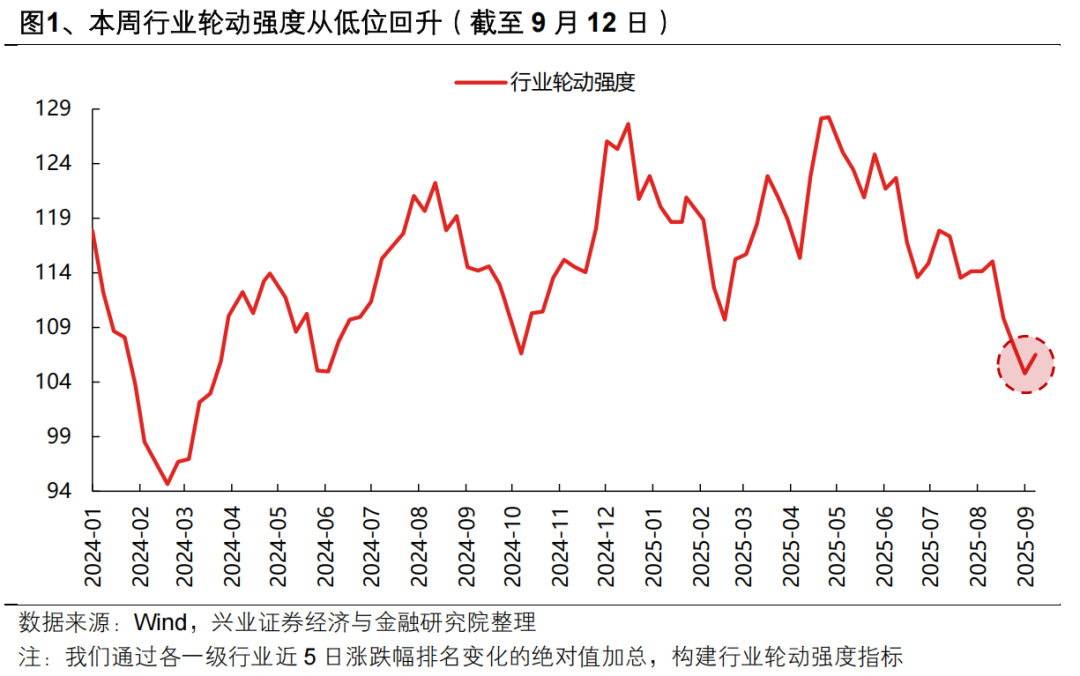
Group 1 - The market is transitioning from extreme differentiation to a phase of rotation and diffusion, with structural changes being more important than rhythm in a healthy bull market [1][4] - The industry rotation intensity indicator has started to recover from previous lows, indicating that the market is seeking opportunities through rotation and diffusion [1][4] - Seasonal patterns suggest that September is a traditional window for industry rotation to increase, providing opportunities for new growth directions [5][8] Group 2 - The focus should be on expanding based on economic and industrial trends rather than merely seeking low positions, enhancing the probability of success [8][10] - The second half of September to October is a period where the effectiveness of economic investments is expected to improve, with stock prices becoming more correlated with performance as the third-quarter reporting period approaches [8][10] Group 3 - Key sectors to focus on include Hong Kong internet, innovative pharmaceuticals, new energy, new consumption, and cyclical industries (non-ferrous metals, chemicals) [15][19] - The Hong Kong internet sector has significant room for rebound due to macroeconomic conditions and industry trends, particularly with the upcoming interest rate cuts and advancements in AI [16][19] - The innovative pharmaceutical sector has seen sufficient emotional digestion, with leading companies like BeiGene and WuXi AppTec showing strong performance [21][22] Group 4 - The new energy sector is expected to attract funds seeking flexible returns, driven by technological breakthroughs and a reversal of previous downturns [23][26] - The new consumption sector is positioned for potential gains due to low crowding and seasonal catalysts from upcoming holidays, making it a promising area for investment [29][32] Group 5 - The cyclical industries (non-ferrous metals, chemicals) are benefiting from overseas monetary easing and a reversal of previous competitive pressures, providing multiple catalysts for growth [35]

天风证券副总裁赵晓光称产业趋势未变,百亿私募坚定慢牛,刘煜辉表示未来三年新高将成常态
Xin Lang Zheng Quan· 2025-09-05 08:07
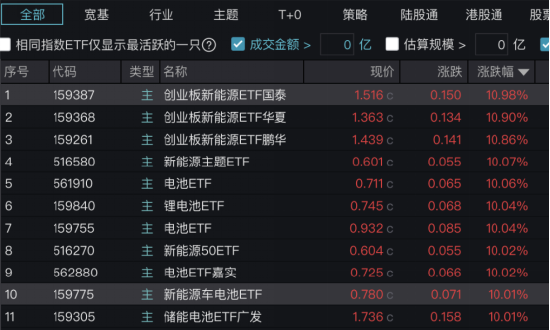
Market Overview - After a three-day adjustment from September 2 to September 4, where the Shanghai Composite Index fell from 3885.31 points to 3732.84 points, the market rebounded significantly on September 5, closing at 3812.51 points with an increase of 1.24% [1] Industry Trends - The renewable energy sector showed a strong rebound, with related products such as battery ETFs and renewable energy ETFs experiencing daily increases exceeding 10% [2] - Despite the volatile market trends, some institutional investors maintained their strategic focus, indicating a level of confidence in the underlying industry fundamentals [2] Analyst Insights - Zhao Xiaoguang, Vice President of Tianfeng Securities, stated that a 20-25% adjustment in a strong industry typically signals a bottom, while a drop exceeding 30% would indicate a fundamental change in industry logic [3] - Wang Yiping, a prominent private equity manager, commented on the market adjustment, suggesting a transition from a "fast bull" to a "slow bull" market, which was interpreted as a confirmation of a stable growth path [5] - Economist Liu Yuhui expressed that the index is likely to reach new highs in September and October, emphasizing the importance of understanding long-term company value over mere index points [6] Market Behavior - Recent market behavior indicates a shift in main investment themes, with previous hot sectors like AI computing and military industries experiencing pullbacks, while new energy vehicles and new materials are gaining traction [6] - The market is currently undergoing a phase of consolidation, with fluctuations around the five-week moving average aimed at stabilizing investor sentiment [6]