
供需基本面

Search documents
长江有色:美就业数据超预期美指反弹 16日镍价或下跌
Xin Lang Cai Jing· 2026-01-16 02:35
Core Viewpoint - The nickel market is experiencing a downturn due to a combination of macroeconomic factors, weak demand from downstream industries, and a shift in supply expectations, leading to a potential short-term weak trading pattern for nickel prices [2][5]. Supply Side - The previous expectations of tightening Indonesian nickel ore quotas have weakened, reducing concerns about supply constraints [3]. - Both domestic and international visible inventories continue to accumulate, indicating that spot supply is not tight, which alleviates fears of resource shortages [3]. Demand Side - Overall demand for nickel from downstream sectors is weak, with stainless steel production hampered by high social inventories and a slow recovery in the real estate sector, leading steel mills to be cautious in raw material procurement [4]. - In the new energy sector, the production of ternary batteries has also seen a month-on-month decline, with first-quarter growth expectations falling [4]. - Both major demand drivers lack strong recovery momentum, making it difficult to support high prices [4]. Industry Chain Status - The nickel industry chain is facing a mismatch in supply and demand rhythms, with upstream nickel ore supply expectations shifting from tight to loose, while the midstream smelting capacity remains excessive [4]. - The recovery pace of demand in downstream stainless steel and new energy vehicles is relatively slow, leading to a concentration of industry chain profits towards the upstream resource end, while the mid and downstream processing and manufacturing sectors have weaker bargaining power [4]. Spot Trading and Price Forecast - The activity level in the spot market has decreased, with buyers showing a strong wait-and-see attitude, and some traders opting to accelerate sales to avoid price volatility risks [5]. - In summary, due to the dual impact of weakened supply contraction expectations and weak downstream demand, nickel prices are likely to maintain a short-term weak trading pattern [5].


中信建投期货:1月16日黑色系早报
Xin Lang Cai Jing· 2026-01-16 01:14
Group 1: Economic Support Measures - The central bank has implemented a "combination punch" to support high-quality economic development, including a 0.25 percentage point reduction in re-lending and rediscount rates, indicating room for further cuts in reserve requirement ratios and interest rates this year [4][17]. Group 2: Trade and Export Statistics - According to customs statistics, China's foreign trade imports and exports are expected to reach 45.47 trillion yuan in 2025, a growth of 3.8%, with exports at 26.99 trillion yuan (up 6.1%) and imports at 18.48 trillion yuan (up 0.5%) [4][17]. - Cumulative steel exports in 2025 are projected to be 11,901.9 million tons, marking a year-on-year increase of 7.5%, setting a new historical high [4][17]. Group 3: Steel Industry Performance - As of January 15, the average cost for 76 independent electric arc furnace construction steel mills was 3,377 yuan per ton, with an average loss of 45 yuan per ton and a profit of 68 yuan per ton from low electricity costs [5][18]. - The profitability rate for 247 steel mills this week is 39.83%, an increase of 2.17 percentage points from the previous week, while daily molten iron production is 2.28 million tons, down by 1.49 million tons from last week [6][20]. Group 4: Steel Supply and Demand Dynamics - This week, the supply of five major steel products reached 8.19 million tons, a slight increase of 0.62 million tons (0.1% growth) week-on-week, while total inventory decreased by 69,100 tons (0.6% decline) to 12.47 million tons [7][20]. - The apparent consumption volume was 8.26 million tons, reflecting a week-on-week increase of 3.7% [20]. Group 5: Specific Steel Products Analysis - Rebar production decreased by 0.74 million tons to 1.903 million tons, with total inventory slightly down by 0.04 million tons to 4.3807 million tons, while demand increased by 15,280 tons to 1.9034 million tons [8][21]. - Hot-rolled coil production increased by 2.85 million tons to 3.0836 million tons, with inventory reduction of 5.8 million tons to 3.6233 million tons, and demand increased by 5.82 million tons to 3.1416 million tons [9][22]. Group 6: Market Outlook and Strategies - The short-term trading range for rebar is suggested to be between 3,100 and 3,200 yuan per ton, while hot-rolled coil is expected to trade between 3,250 and 3,350 yuan per ton [10][23]. - The alloy market is experiencing weak supply and demand, with overall supply remaining low and production slightly decreasing, while cost support remains stable [11][24].


橡胶甲醇原油:多空分歧出现能化震荡整理
Bao Cheng Qi Huo· 2026-01-15 11:21
Report Industry Investment Rating - No information provided in the report Core Views of the Report - On Thursday, the domestic Shanghai rubber futures 2605 contract showed a trend of shrinking volume, reducing positions, fluctuating downward, and slightly closing lower. The price center of the contract during the session slightly moved down to below the 16,000 yuan/ton line, closing down 1.33% at 15,995 yuan/ton. The premium of the May - September spread widened to 30 yuan/ton. Currently, the domestic rubber market is dominated by supply - demand fundamentals, and rubber prices may maintain a moderately strong oscillation pattern [6]. - On Thursday, the domestic methanol futures 2605 contract showed a trend of shrinking volume, increasing positions, fluctuating weakly, and slightly closing lower. The contract price rose to a maximum of 2,318 yuan/ton and fell to a minimum of 2,254 yuan/ton, closing down 0.53% at 2,273 yuan/ton. The premium of the May - September spread converged to 1 yuan/ton. With differences between bulls and bears emerging, methanol futures maintained a stable oscillation pattern [6]. - On Thursday, the domestic crude oil futures 2603 contract showed a trend of increasing volume, increasing positions, fluctuating weakly, and slightly closing lower. The contract price rose to a maximum of 460.5 yuan/barrel and fell to a minimum of 443.4 yuan/barrel, closing down 0.69% at 446.6 yuan/barrel. As the geopolitical risk in the Middle East cooled down, the crude oil market gave back its premium, and the weak supply - demand fundamentals took the lead. In the short term, oil prices maintained an oscillation pattern [6]. Summary by Relevant Catalogs 1. Industry Dynamics Rubber - As of January 4, 2026, the total inventory of natural rubber in bonded and general trade in Qingdao was 548,300 tons, a week - on - week increase of 23,500 tons or 4.48%. Among them, the general trade inventory increased by 16,900 tons to 460,300 tons, a week - on - week increase of 3.80%. The bonded area inventory was 88,100 tons, an increase of 8.16% [8]. - As of January 9, 2026, the capacity utilization rate of China's semi - steel tire sample enterprises was 63.78%, a week - on - week decrease of 2.75 percentage points and a year - on - year decrease of 13.97 percentage points. The capacity utilization rate of all - steel tire sample enterprises was 55.50%, a week - on - week decrease of 2.43 percentage points and a year - on - year decrease of 3.37 percentage points. It is expected that the capacity utilization rate of tire sample enterprises will recover in the next cycle [8]. - In 2025, China's automobile production and sales reached 34.531 million and 34.4 million vehicles respectively, a year - on - year increase of 10.4% and 9.4%. The annual automobile export exceeded 7 million vehicles, reaching 7.098 million vehicles, a year - on - year increase of 21.1%. In December 2025, the sales volume of China's heavy - truck market was about 95,000 vehicles, a month - on - month decrease of about 16% and a year - on - year increase of about 13%. The total sales volume of the heavy - truck market in 2025 reached 1.137 million vehicles, a year - on - year increase of about 26% [9]. Methanol - As of the week of January 9, 2026, the average domestic methanol operating rate was 86.38%, a week - on - week slight decrease of 0.20%, a month - on - month slight increase of 2.64%, and a significant year - on - year increase of 6.72%. The average weekly methanol output was 2.0424 million tons, a week - on - week slight decrease of 8,700 tons, a month - on - month slight increase of 18,900 tons, and a significant year - on - year increase of 139,200 tons [10]. - As of the week of January 9, 2026, the domestic formaldehyde operating rate was 31.05%, a week - on - week slight decrease of 0.65%. The dimethyl ether operating rate was 7.30%, a week - on - week slight increase of 1.51%. The acetic acid operating rate was 81.89%, a week - on - week slight increase of 4.28%. The MTBE operating rate was 58.12%, a week - on - week slight increase of 0.01%. The average operating load of domestic coal (methanol) to olefin plants was 81.65%, a week - on - week slight increase of 0.33 percentage points and a month - on - month slight decrease of 1.17%. The futures profit of domestic methanol to olefin was - 270 yuan/ton, a week - on - week slight recovery of 30 yuan/ton and a month - on - month significant decline of 264 yuan/ton [10]. - As of the week of January 9, 2026, the methanol inventory in ports in East and South China was 1.1593 million tons, a week - on - week slight decrease of 9,300 tons, a month - on - month slight increase of 40,800 tons, and a significant year - on - year increase of 402,300 tons. As of the week of December 31, 2025, the total inland methanol inventory was 422,700 tons, a week - on - week slight increase of 18,600 tons, a month - on - month slight increase of 49,000 tons, and a slight year - on - year increase of 80,500 tons [11]. Crude Oil - As of the week of January 9, 2026, the number of active oil drilling rigs in the United States was 409, a week - on - week slight decrease of 3 and a year - on - year decrease of 70. The average daily crude oil production in the United States was 13.753 million barrels, a week - on - week slight decrease of 58,000 barrels per day and a significant year - on - year increase of 272,000 barrels per day [11]. - As of the week of January 9, 2026, the commercial crude oil inventory in the United States (excluding strategic petroleum reserves) was 422.4 million barrels, a week - on - week significant increase of 3.391 million barrels and a significant year - on - year increase of 9.767 million barrels. The crude oil inventory in Cushing, Oklahoma was 23.585 million barrels, a week - on - week slight increase of 745,000 barrels. The strategic petroleum reserve (SPR) inventory was 413.7 million barrels, a week - on - week slight increase of 214,000 barrels. The refinery operating rate in the United States was 95.3%, a week - on - week slight increase of 0.6 percentage points, a month - on - month slight increase of 0.5 percentage points, and a year - on - year slight increase of 3.6 percentage points [12]. - As of January 6, 2026, the average non - commercial net long positions in WTI crude oil were 57,352 contracts, a week - on - week significant decrease of 7,239 contracts and a slight decrease of 1,419 contracts or 2.41% compared with the December average. The average net long positions of Brent crude oil futures funds were 120,686 contracts, a week - on - week significant decrease of 6,220 contracts and a significant increase of 15,227 contracts or 14.44% compared with the December average [12]. 2. Spot Price Table | Variety | Spot Price | Change from Previous Day | Futures Main Contract | Change from Previous Day | Basis | Change | | --- | --- | --- | --- | --- | --- | --- | | Shanghai Rubber | 15,850 yuan/ton | +0 yuan/ton | 15,995 yuan/ton | - 165 yuan/ton | - 145 yuan/ton | +165 yuan/ton | | Methanol | 2,280 yuan/ton | +0 yuan/ton | 2,273 yuan/ton | - 15 yuan/ton | +7 yuan/ton | +15 yuan/ton | | Crude Oil | 425.4 yuan/barrel | - 0.3 yuan/barrel | 446.6 yuan/barrel | - 1.4 yuan/barrel | - 21.2 yuan/barrel | +1.1 yuan/barrel | [13] 3. Related Charts - The report provides various charts for rubber, methanol, and crude oil, including basis, inventory, and operating rate trends, with data sources from Wind and Baocheng Futures Financial Research Institute [14][16][18]
橡胶甲醇原油:偏多因素提振,能化偏强运行
Bao Cheng Qi Huo· 2026-01-13 11:15
1. Report Industry Investment Rating - No relevant information provided 2. Core Views of the Report - Rubber: On Tuesday this week, the 2605 contract of domestic Shanghai rubber futures showed a trend of increasing volume, reducing positions, surging and then giving back gains, and stabilizing in a volatile manner. The intraday price center slightly moved down to around 15,975 yuan/ton. At the close, the price closed slightly up 0.00% at 15,975 yuan/ton. The premium of the May - September spread widened to 30 yuan/ton. Currently, the domestic rubber market is dominated by supply - demand fundamentals, and rubber prices may maintain a volatile and slightly stronger pattern [6]. - Methanol: On Tuesday this week, the 2605 contract of domestic methanol futures showed a trend of increasing volume, reducing positions, weakening in a volatile manner, and closing slightly lower. The futures price rose to a maximum of 2,295 yuan/ton and dropped to a minimum of 2,229 yuan/ton. At the close, it closed slightly down 0.18% at 2,263 yuan/ton. The discount of the May - September spread widened to 5 yuan/ton. There are differences between long and short positions, and methanol futures maintain a volatile and stable trend [6]. - Crude Oil: On Tuesday this week, the 2603 contract of domestic crude oil futures showed a trend of reducing volume, increasing positions, rebounding again, and closing sharply higher. The futures price rose to a maximum of 446.7 yuan/barrel and dropped to a minimum of 433.3 yuan/barrel. At the close, the price rose sharply 2.27% to 446.7 yuan/barrel. Geopolitical factors have become prominent again and overshadowed the weak supply - demand fundamentals. After a continuous decline in the previous period, short - term oil prices are expected to stabilize in a volatile manner [7]. 3. Summary by Relevant Catalogs 3.1 Industry Dynamics 3.1.1 Rubber - As of January 4, 2026, the total inventory of natural rubber in bonded and general trade in Qingdao was 548,300 tons, a week - on - week increase of 23,500 tons, an increase of 4.48%. The general trade inventory increased by 16,900 tons to 460,300 tons, an increase of 3.80%. The bonded area inventory was 88,100 tons, an increase of 8.16% [9]. - As of January 9, 2026, the capacity utilization rate of China's semi - steel tire sample enterprises was 63.78%, a week - on - week decrease of 2.75 percentage points and a year - on - year decrease of 13.97 percentage points. The capacity utilization rate of all - steel tire sample enterprises was 55.50%, a week - on - week decrease of 2.43 percentage points and a year - on - year decrease of 3.37 percentage points. It is expected that the capacity utilization rate of tire sample enterprises will increase in the next cycle [9]. - In December 2025, China's automobile dealer inventory warning index was 57.7%, a year - on - year increase of 7.5 percentage points and a month - on - month increase of 2.1 percentage points. The inventory warning index was above the boom - bust line, indicating a decline in the prosperity of the automobile circulation industry. In December 2025, China's Logistics Industry Prosperity Index (LPI) was 52.4%, a month - on - month increase of 1.5 percentage points, reaching the highest level of the year [10]. - In December 2025, China's heavy - truck market sold about 95,000 vehicles, a month - on - month decrease of about 16% compared with November 2025 and a year - on - year increase of about 13% compared with 84,200 vehicles in the same period of the previous year. In 2025, the total sales of China's heavy - truck market reached a new high in the past four years, 1.137 million vehicles, a year - on - year increase of about 26% [10]. 3.1.2 Methanol - As of the week of January 9, 2026, the average domestic methanol operating rate was maintained at 86.38%, a slight week - on - week decrease of 0.20%, a slight month - on - month increase of 2.64%, and a significant year - on - year increase of 6.72%. The average weekly methanol production in China reached 2.0424 million tons, a slight week - on - week decrease of 8,700 tons, a slight month - on - month increase of 18,900 tons, and a significant year - on - year increase of 139,200 tons compared with 1.9032 million tons in the previous year [11]. - As of the week of January 9, 2026, the domestic formaldehyde operating rate was maintained at 31.05%, a slight week - on - week decrease of 0.65%. The dimethyl ether operating rate was maintained at 7.30%, a slight week - on - week increase of 1.51%. The acetic acid operating rate was maintained at 81.89%, a slight week - on - week increase of 4.28%. The MTBE operating rate was maintained at 58.12%, a slight week - on - week increase of 0.01%. The average operating load of domestic coal (methanol) to olefin plants was 81.65%, a slight week - on - week increase of 0.33 percentage points and a slight month - on - month decrease of 1.17 percentage points [11]. - As of January 9, 2026, the futures market profit of domestic methanol to olefin was - 270 yuan/ton, a slight week - on - week increase of 30 yuan/ton and a significant month - on - month decrease of 264 yuan/ton [11]. - As of the week of January 9, 2026, the methanol inventory in ports in East and South China was maintained at 1.1593 million tons, a slight week - on - week decrease of 9,300 tons, a slight month - on - month increase of 40,800 tons, and a significant year - on - year increase of 402,300 tons. As of the week of December 31, 2025, the total inland methanol inventory in China reached 422,700 tons, a slight week - on - week increase of 18,600 tons, a slight month - on - month increase of 49,000 tons, and a slight year - on - year increase of 80,500 tons compared with 342,200 tons in the previous year [12][13]. 3.1.3 Crude Oil - As of the week of January 2, 2026, the number of active oil drilling rigs in the United States was 412, a slight week - on - week increase of 3 and a decrease of 70 compared with the same period of the previous year. The average daily crude oil production in the United States was 13.811 million barrels, a slight week - on - week decrease of 16,000 barrels per day and a significant year - on - year increase of 248,000 barrels per day, at a historical high [14]. - As of the week of January 2, 2026, the commercial crude oil inventory in the United States (excluding strategic petroleum reserves) reached 419 million barrels, a significant week - on - week decrease of 3.832 million barrels and a significant year - on - year increase of 4.414 million barrels. The crude oil inventory in Cushing, Oklahoma, reached 22.84 million barrels, a slight week - on - week increase of 728,000 barrels. The Strategic Petroleum Reserve (SPR) inventory reached 413.5 million barrels, a slight week - on - week increase of 245,000 barrels. The refinery operating rate in the United States was maintained at 94.7%, a slight week - on - week increase of 0.1 percentage points, a slight month - on - month increase of 0.2 percentage points, and a slight year - on - year increase of 1.4 percentage points [14]. - As of January 6, 2026, the average non - commercial net long positions in WTI crude oil were maintained at 57,352 contracts, a significant week - on - week decrease of 7,239 contracts and a slight decrease of 1,419 contracts compared with the December average of 58,771 contracts, a decrease of 2.41%. As of January 6, 2026, the average net long positions of Brent crude oil futures funds were maintained at 120,686 contracts, a significant week - on - week decrease of 6,220 contracts and a significant increase of 15,227 contracts compared with the December average of 105,459 contracts, an increase of 14.44% [15]. 3.2 Spot Price Table | Variety | Spot Price | Change from Previous Day | Futures Main Contract | Change from Previous Day | Basis | Change | | ---- | ---- | ---- | ---- | ---- | ---- | ---- | | Shanghai Rubber | 15,800 yuan/ton | +100 yuan/ton | 15,975 yuan/ton | - 155 yuan/ton | - 175 yuan/ton | +255 yuan/ton | | Methanol | 2,275 yuan/ton | - 5 yuan/ton | 2,263 yuan/ton | +0 yuan/ton | +12 yuan/ton | - 5 yuan/ton | | Crude Oil | 411.4 yuan/barrel | - 0.1 yuan/barrel | 446.7 yuan/barrel | +8.1 yuan/barrel | - 35.3 yuan/barrel | - 8.2 yuan/ton | [17] 3.3 Related Charts - Rubber: Includes charts of rubber basis, May - September spread, SHFE rubber futures inventory, Qingdao bonded area rubber inventory, all - steel tire operating rate trend, and semi - steel tire operating rate trend [18][20][22] [25][27][29]. - Methanol: Includes charts of methanol basis, May - September spread, domestic port inventory, inland social inventory, methanol - to - olefin operating rate change, and coal - to - methanol cost accounting [31][33][35] [37][39][41]. - Crude Oil: Includes charts of crude oil basis, SHFE crude oil futures inventory, US crude oil commercial inventory, US refinery operating rate, WTI crude oil net position change, and Brent crude oil net position change [43][45][46] [48][50][52].
沥青:传统淡季迎冲高行情
Zhong Guo Hua Gong Bao· 2026-01-13 03:24
Core Viewpoint - The asphalt market is experiencing a price surge due to international supply disruptions, but this is expected to be temporary as demand remains weak and inventory levels are high [1][4]. Group 1: Price Movements - In late December 2025, the average ex-factory price of 70 asphalt in Shandong was 2900 yuan per ton, which rose to a peak of 3150 yuan by January 5, 2026, marking a significant increase [2]. - The futures market also reflected this trend, with the asphalt 2602 contract rising by 4.4% within a week [2]. - The price fluctuations are linked to a significant reduction in Venezuelan crude oil exports, which have decreased sharply, impacting regional raw material availability [2][3]. Group 2: Supply and Demand Dynamics - The asphalt market is currently constrained by weak demand and high inventory levels, with a reported asphalt production of 553,000 tons in the last week before New Year's, a 14% increase week-on-week [4]. - The operating rate for modified asphalt production was only 20%, continuing a four-week decline, while Shandong's refineries reported a 19% increase in shipments to 148,600 tons [4]. - Social and factory inventories reached 666,000 tons, up 4% week-on-week, indicating a weak fundamental structure in the off-season [4]. Group 3: Future Outlook - Domestic asphalt consumption is projected to reach 30.78 million tons in 2025, an increase of 1.88 million tons or 6.49% year-on-year [5]. - However, the real estate market is expected to slow down, and infrastructure investments will focus more on quality and efficiency, leading to a decline in overall asphalt demand [5]. - The total asphalt supply for the year is estimated at 31.43 million tons, with a supply-demand gap of approximately 880,000 tons, indicating a trend of oversupply [5][6].
碳酸锂期货一字涨停,冲破15万元,两年来首次
2 1 Shi Ji Jing Ji Bao Dao· 2026-01-12 09:26
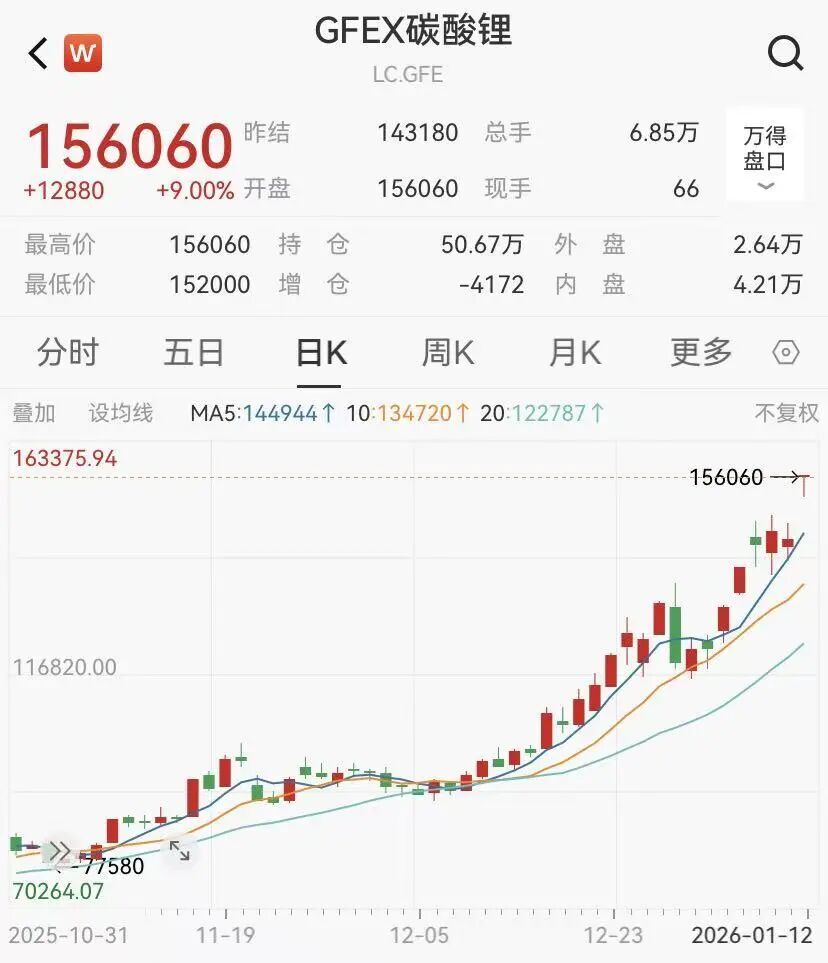
Core Viewpoint - The domestic commodity futures market has shown strong performance, with lithium carbonate prices surging to a record high, driven by export tax policy adjustments and robust demand in the new energy sector [1][5][6]. Price Movement - On January 12, the main contract for lithium carbonate hit the daily limit, increasing by 9% to 156,060 yuan/ton, marking the first time it has surpassed the 150,000 yuan threshold in two years [1]. - Since early December, lithium carbonate prices have risen dramatically, breaking through multiple price barriers and rebounding over 150% from the low point in June of the previous year [1]. Spot Market Performance - On the same day, the average price for battery-grade lithium carbonate was reported at 152,000 yuan/ton, while industrial-grade lithium carbonate averaged 148,500 yuan/ton, both showing significant increases of 8.57% and 8.79% respectively [3]. - The A-share lithium mining index also saw substantial gains, with companies like Dazhong Mining and Jinyuan Co. rising over 6% [3][4]. Policy Impact - The recent adjustment in export tax policy for battery products, effective from April 1, 2026, is expected to create a rush for exports before the tax rate decreases from 9% to 6% and eventually to zero [5]. - Analysts believe this policy change will directly impact corporate profitability and drive a surge in lithium battery exports, contributing to the recent price increases [5]. Demand Dynamics - Demand from the new energy commercial vehicle and energy storage sectors has exceeded expectations, shifting market sentiment from "oversupply" to "tight balance" [6]. - The first quarter of 2025 is anticipated to show significant demand growth compared to the same period in 2024, indicating a strong market outlook for lithium carbonate prices [6]. Market Risks and Concerns - There are concerns that if lithium carbonate prices continue to rise and exceed 200,000 yuan/ton, it could lead to cost pressures across the supply chain, potentially suppressing downstream demand [6]. - Some market participants are worried about speculative trading in lithium carbonate, which may disrupt the supply chain and lead to misallocation of investments, exacerbating long-term oversupply risks [6]. Regulatory Measures - To maintain stability in the lithium carbonate futures market, regulatory bodies have implemented measures such as adjusting trading fees and limits to mitigate potential risks [6].
软商品日报:溢价回落-20260109
Guan Tong Qi Huo· 2026-01-09 13:30
Group 1: Report's Core View - The core contradiction in the cotton textile industry chain lies in the mismatch between the expected tightening of the supply - side and the actual weakness of the demand - side, which determines the uncertainty of the subsequent market trend. In the short - term, Zhengzhou cotton prices may continue to be volatile and strong before the Spring Festival, but in the medium - to - long - term, there is significant pressure for price correction [1]. - The sugar price has recovered some losses, but the possible global sugar market surplus in the 2025/26 season seems to suppress further price increases. The basis between the sugar futures and spot has been basically repaired, and the valuation of the far - month contracts has also been somewhat repaired. The near - month contracts still face large supply pressure, and the short - term upward momentum is weak [2]. Group 2: Cotton Market Summary - Short - term trend: Before the Spring Festival, Zhengzhou cotton prices may continue to be volatile and strong, supported by the expected reduction in planting area, and the average price of domestic 3128B grade lint cotton may reach a maximum of 15,500 yuan/ton [1]. - Medium - to - long - term trend: In the 2025/26 season, the national cotton output is expected to reach 7.46 million tons, a year - on - year increase of 11.34%. The commercial inventory at the end of December has risen to 6.7166 million tons and is expected to reach the annual peak of 6.8532 million tons in January. Supply pressure persists, and factors such as weak downstream order recovery and increased imported cotton volume may trigger price corrections [1]. - Near - term prediction: It is estimated that cotton may adjust next week, with limited downside space, and attention should be paid to the support near the 20 - day moving average [1]. Group 3: Sugar Market Summary - Production forecast: Thailand's sugar production is expected to be 10.3 million tons in the 2025/26 season and will decrease to 10 million tons in the 2026/27 season [2]. - Price situation: The sugar price has recovered some losses, but the possible global sugar market surplus in the 2025/26 season suppresses further price increases. The basis between the sugar futures and spot has been basically repaired, and the valuation of the far - month contracts has also been somewhat repaired [2]. - Short - term trend: Near - month contracts still face large supply pressure, and the short - term upward momentum is weak. The large price difference between the domestic and foreign markets may attract more imports, and attention should be paid to the cost of out - of - quota imports, where one can consider buying at low prices [2].
《有色》日报-20260109
Guang Fa Qi Huo· 2026-01-09 02:43
1. Report Industry Investment Ratings No information about industry investment ratings is provided in the reports. 2. Core Views of the Reports Tin Industry - Short - term tin prices are highly volatile due to macro - sentiment, and it is recommended to be cautious in operations. Tin prices are expected to fluctuate at a high level in the short term [2]. Aluminum Industry - Alumina prices are expected to fluctuate widely around the industry's cash - cost line. The aluminum price will maintain a high - level wide - range shock, with the main contract of Shanghai aluminum operating in the range of 23,000 - 24,200 yuan/ton [5]. Nickel Industry - The nickel price has fallen significantly. The market is affected by Indonesia's unclear nickel - mine quota and geopolitical risks. The short - term price will be in a wide - range shock adjustment, with the main contract referring to the range of 130,000 - 135,000 [6]. Stainless Steel Industry - The stainless - steel market is affected by nickel - mine raw - material expectations. The supply pressure eases slightly, but the demand in the off - season is still insufficient. The short - term price is expected to be in a shock adjustment, with the main contract referring to the range of 13,200 - 14,000 [9]. Aluminum Alloy Industry - The ADC12 price of aluminum alloy is expected to continue to fluctuate in a high - level range in the short term, with the main contract referring to the range of 22,000 - 23,200 yuan/ton [12]. Lithium Carbonate Industry - The lithium - carbonate market's fundamentals are weak in the off - season, but the post - holiday news boosts the sentiment. The price is expected to maintain a relatively strong shock, and attention should be paid to the liquidity risk and regulatory possibility [13]. Copper Industry - The medium - and long - term fundamentals of copper are good, but the short - term price is over - valued irrationally. The short - term price will still maintain a relatively strong trend, and the volatility may increase [15]. Zinc Industry - The zinc price will fluctuate in the short term. The support comes from the tight domestic zinc - mine supply and low zinc - ingot inventory, and the pressure comes from the expected supply of imported ores [17]. Industrial Silicon Industry - The industrial - silicon market is expected to be in a situation of weak supply and demand in January. The price is expected to fluctuate at a low level, with the main range of 8,000 - 9,000 yuan/ton [20]. Polysilicon Industry - The polysilicon market has weak supply - demand fundamentals and high inventory. It is recommended to wait and see, pay attention to the increase in production cuts and the re - distribution of industrial - chain profits [22]. 3. Summaries According to Relevant Catalogs Tin Industry - **Price and Spread**: SMM 1 tin decreased by 0.25% to 355,050 yuan/ton, and the SMM 1 tin premium increased by 128.57% to 800 yuan/ton. The 2601 - 2602 spread increased by 72% to - 350 [2]. - **Fundamentals**: In November, tin - ore imports increased by 29.81%. In December, SMM refined - tin production decreased slightly by 0.06%. SHEF and social inventories decreased [2]. Aluminum Industry - **Price and Spread**: SMM A00 aluminum decreased by 0.58% to 24,000 yuan/ton. The AL 2601 - 2602 spread increased by 70 yuan/ton to 60 yuan/ton [5]. - **Fundamentals**: In December, electrolytic - aluminum production increased by 3.97%. The social inventory of aluminum ingots increased by 8.18% [5]. Nickel Industry - **Price and Spread**: SMM 1 electrolytic nickel decreased by 0.73% to 149,050 yuan/ton. The 2602 - 2603 spread decreased by 310 yuan/ton to - 530 yuan/ton [6]. - **Fundamentals**: China's refined - nickel product output decreased by 9.38%, and imports increased by 30.08%. SHFE and social inventories increased [6]. Stainless Steel Industry - **Price and Spread**: The 304/2B (Wuxi Hongwang 2.0 roll) price decreased by 1.08% to 13,800 yuan/ton. The 2602 - 2603 spread decreased by 30 yuan/ton to - 140 yuan/ton [9]. - **Fundamentals**: China's 300 - series stainless - steel crude - steel production decreased by 2.5%. The net export volume increased by 25.31% [9]. Aluminum Alloy Industry - **Price and Spread**: SMM Southwest ADC12 increased by 0.43% to 23,600 yuan/ton. The 2602 - 2603 spread increased by 35 yuan/ton to - 45 yuan/ton [12]. - **Fundamentals**: In December, the output of recycled aluminum alloy ingots decreased by 6.16%. The recycled - aluminum alloy inventory decreased slightly [12]. Lithium Carbonate Industry - **Price and Spread**: SMM battery - grade lithium carbonate increased by 3.75% to 138,500 yuan/ton. The 2602 - 2603 spread decreased by 100 yuan/ton to - 540 yuan/ton [13]. - **Fundamentals**: In December, lithium - carbonate production increased by 4.04%, and demand decreased by 2.5%. Total inventory decreased by 12.23% [13]. Copper Industry - **Price and Spread**: SMM 1 electrolytic copper decreased by 1.28% to 102,085 yuan/ton. The 2601 - 2602 spread decreased by 10 yuan/ton to - 250 yuan/ton [15]. - **Fundamentals**: In December, electrolytic - copper production increased by 6.8%. The domestic mainstream port copper - concentrate inventory decreased by 16.65% [15]. Zinc Industry - **Price and Spread**: SMM 0 zinc ingot decreased by 0.53% to 24,170 yuan/ton. The 2601 - 2602 spread decreased by 30 yuan/ton to - 45 yuan/ton [17]. - **Fundamentals**: In December, refined - zinc production decreased by 7.24%. The social inventory of zinc ingots increased by 11.69% [17]. Industrial Silicon Industry - **Price and Spread**: East - China oxygen - containing SI5530 industrial silicon remained unchanged at 9,250 yuan/ton. The 2601 - 2602 spread increased by 445 yuan/ton to 440 yuan/ton [20]. - **Fundamentals**: National industrial - silicon production decreased by 1.15%. Xinjiang's production increased by 6.46%. Social inventory decreased by 0.9% [20]. Polysilicon Industry - **Price and Spread**: The main - contract price of polysilicon decreased by 8.04% to 53,610 yuan/ton. The current - month - to - first - continuous spread increased by 1,215 yuan/ton to 1,415 yuan/ton [22]. - **Fundamentals**: Polysilicon production decreased slightly by 0.83% on a weekly basis. The silicon - wafer inventory increased by 13.11% [22].
多晶硅跌停!短期需求淡季、库存难消...政策博弈回归供需基本面
Hua Er Jie Jian Wen· 2026-01-08 08:47
Core Viewpoint - The recent sharp decline in polysilicon futures prices reflects a pessimistic outlook on the supply-demand balance for 2026, driven by market sentiment and reduced trading volumes [3][5][12] Group 1: Market Performance - On the 8th, polysilicon futures fell by 9.00%, closing at 56,024 yuan/ton, a drop of 5,300 yuan from the previous settlement price, with an intraday low of 53,610 yuan/ton [1] - The main contract 2605 also saw a significant decline, dropping over 7% with a minimum price of 54,500 yuan/ton during the day [1] - The trading volume decreased significantly, with a reduction of 4,212 contracts, indicating a notable exit of capital from the market [3] Group 2: Supply and Demand Dynamics - The immediate trigger for the market downturn was a revision of policy expectations regarding the establishment of "Beijing Guanghe Qiancheng Technology Co., Ltd." which was anticipated to clear 1.7 million tons of capacity but has not yet initiated substantial acquisition actions [5][6] - Current demand signals are weak, with downstream component manufacturers showing limited orders and a significant drop in procurement willingness for polysilicon [7] - Forecasts indicate a potential 17% year-on-year decline in global new photovoltaic installations in 2026, with China's expected new installations dropping by 36% [7][10] Group 3: Inventory and Cost Considerations - As of the end of 2025, polysilicon industry inventory exceeded 350,000 tons, exacerbating the supply-demand imbalance [12] - The average complete cost for polysilicon production is approximately 48,000 yuan/ton, with the highest costs reaching 56,000 yuan/ton, suggesting that 42,000 yuan/ton may serve as a critical support level [12] - The market is currently navigating between maintaining high prices through alliances among leading companies and the potential for price collapse due to external competition [12] Group 4: Future Outlook - The first two months of 2026 are expected to be a demand lull, with potential price stabilization or further declines depending on market dynamics post-Spring Festival [14] - March is anticipated to be a crucial observation period, where demand may recover, leading to two possible scenarios: a stable high-price environment or further price declines due to new capacity releases [14] - The expected trading range for polysilicon futures in 2026 is projected to be between 42,000 yuan/ton and 80,000 yuan/ton [14]
热搜第一!镍价狂涨30%后急刹车,印尼控产博弈下谁在狂欢谁在承压?
Xin Lang Cai Jing· 2026-01-08 04:35
Core Viewpoint - The recent volatility in nickel prices, characterized by a sharp rise followed by a significant decline, is driven by a combination of policy expectations and fundamental market realities [1][2]. Group 1: Price Movements and Market Dynamics - Nickel prices surged due to Indonesia's substantial reduction in nickel ore quotas, decreasing from 379 million tons to 250 million tons, a 34% drop, alongside Vale Indonesia's mining operation suspensions [1]. - In a span of three weeks, nickel prices increased by over 36,000 yuan, exceeding 30% [1]. - The London Metal Exchange (LME) nickel inventory rose by 20,000 tons, reaching a peak of 275,600 tons, indicating a supply surplus [1][2]. Group 2: Supply and Demand Factors - The demand for nickel in the new energy battery sector grew less than expected, at under 8%, while stainless steel procurement remained sluggish due to slow real estate recovery [1]. - High inventory levels are projected to persist, with ING estimating a global nickel surplus of 261,000 tons by 2026, contrasting sharply with the optimistic supply tightening expectations from Indonesia [2]. Group 3: Industry Impact and Profitability - Upstream nickel mining and smelting companies benefited from the price surge, with companies like Huayou Cobalt seeing significant profit increases from rising nickel prices [2][3]. - Midstream processing companies face challenges in cost transmission, while downstream stainless steel and battery manufacturers are caught in a dilemma regarding pricing strategies, which could further suppress nickel demand [3]. Group 4: Future Outlook and Investment Strategies - The nickel market is expected to enter a phase of consolidation, with 140,000 yuan per ton identified as a critical support level [3]. - The future price trajectory hinges on the enforcement of Indonesia's production quota policy, with potential supply gaps of 10 to 20 million tons if strictly adhered to [3]. - Investors are advised to shift focus from policy expectations to fundamental realities, monitoring the execution of Indonesia's quota policy and global nickel inventory trends [4].