
信贷

Search documents
高瑞东:低增的信贷和脆弱的债市
Sou Hu Cai Jing· 2025-08-14 14:18
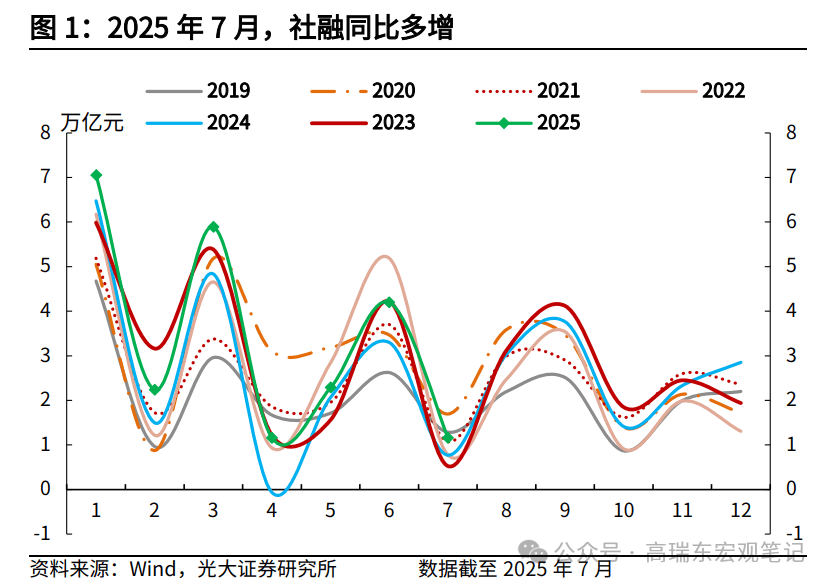
Core Insights - The financial data for July 2025 indicates a stable social financing (社融) environment but weak credit performance, suggesting a potential recovery in credit demand due to upcoming policy effects such as long-term special government bonds and consumer loan interest subsidies [2][10] Group 1: Social Financing and Credit Performance - In July, new social financing amounted to 1.16 trillion yuan, which is 389.3 billion yuan more than the same month last year, but below market expectations. The social financing stock's year-on-year growth rate was 9.0%, up 0.1 percentage points from the previous month [3][9] - The structure of social financing showed a decrease in RMB loans by 4.263 billion yuan, with foreign currency loans also declining by 8.6 billion yuan. Non-standard financing decreased by 166.7 billion yuan [3][4] - Direct financing saw significant contributions, with net financing from government bonds at 1.24 trillion yuan, an increase of 555.9 billion yuan year-on-year, and corporate bonds net financing at 279.1 billion yuan, reflecting a positive trend [3][9] Group 2: Loan Structure and Trends - RMB loans from financial institutions decreased by 500 billion yuan, with long-term loans to households down by 120 billion yuan and corporate long-term loans down by 390 billion yuan [4][10] - The short-term financing for enterprises remained stable, with a year-on-year increase in corporate bill financing by 312.5 billion yuan [4][10] Group 3: Monetary Indicators - The M1 money supply growth rate was 5.6%, up 1.0 percentage points from the previous month, while M2 growth improved to 8.8%, an increase of 0.5 percentage points [7][10] - In July, RMB deposits increased by 500 billion yuan, with a notable decrease in household deposits by 1.11 trillion yuan [7][10] Group 4: Future Outlook - The upcoming policies, including the issuance of long-term special government bonds and consumer loan interest subsidies, are expected to stimulate credit demand [10][13] - The bond market is sensitive to liquidity changes due to low bond yields, and the central bank is likely to maintain liquidity support, which could positively influence the bond market's performance [2][10][13]

7月中国金融数据点评:社融多增与信贷少增?
Huaan Securities· 2025-08-14 04:07
Group 1: Report Overview - Report title: "社融多增与信贷少增?——7月中国金融数据点评20250814" [1] - Report date: August 14, 2025 [2] - Analysts: Yan Ziqi, Hong Ziyan [2] Group 2: Main Views Data Observation - In July, both social financing and credit showed seasonal declines, with a slight negative growth in credit. The new social financing stock scale in July was 1.16 trillion yuan, a year-on-year increase of 0.38 trillion yuan. RMB loans decreased by 0.05 trillion yuan, a year-on-year decrease of 310 billion yuan [2]. - In terms of money supply, the growth rates of M2 and M1 both increased, with a more significant increase in M1, while the growth rate of M0 slowed down slightly. M2 increased by 8.8% year-on-year, up 0.5 pct from the previous month. M1 increased by 5.6% year-on-year, up 1.0 pct from the previous month, showing a significant marginal increase. M0 increased by 11.8% year-on-year, down 0.2 pct from the previous month [2]. Reasons for Social Financing Growth - The seasonal decline in social financing growth in July was still stronger than in previous years, and the increase in government bond issuance remained the core driving force. Due to the faster issuance of government bonds this year, July was still a peak period for government bond supply. Meanwhile, the negative growth of the monthly credit scale this month was lower than in previous years, leading to a further increase in the proportion of government bond issuance in the new social financing this month [3]. Reasons for Credit Shortfall - The new credit in July showed a seasonal decline, and the credit shortfall might be due to seasonal patterns. July is usually a month with the smallest credit increment in a year. Looking back at credit - weak months such as February, April, and May this year, their performance was weaker than in previous years. Therefore, the credit increment in July also continued this trend, reaching the lowest level in recent years. However, according to seasonal patterns, there is still room for recovery next month [4]. - From the supply side, banks' willingness to lend may have shrunk, as the BCI corporate financing environment index dropped to 46.09% (49.12% last month), a significant decline. From the demand side, the PMI index in July dropped to 49.3%, with the new order index shrinking to 49.4% and the procurement index shrinking to 49.5%. Both production demand and procurement willingness were weak, and corporate business expectations were under pressure. In addition, the PMI of small enterprises showed a large decline for two consecutive months, and the industry faced corporate clearance pressure [4]. M2 and M1 Trends - M2 and M1 continued to grow, indicating an abundant total amount of market funds. Since September 2024, M1 has shown an upward trend in the range, and the M2 - M1 gap has been continuously narrowing. In July, M1 continued its rapid upward trend, reaching 5.6% year - on - year, the highest value since March 2023. On the one hand, July is a large month for local government debt financing, and the central bank conducted 1.4 trillion yuan in outright reverse repurchases to guide a loose capital environment. On the other hand, the popularity of the equity market and commodity market continued, facilitating the activation of money in the investment field [5]. Highlights in July Financial Data - In terms of fiscal deposits, the government bond financing volume was higher than in previous years, and the new fiscal deposits were at a relatively high historical level. The difference between the new government bond financing volume and the new fiscal deposits decreased compared with the previous month but was higher than the seasonal level, indicating that the transmission speed of funds from the government sector to the real economy was still faster than in the same period of previous years [6]. - In terms of corporate direct financing by industry, the bond financing of real - sector enterprises increased year - on - year, with significant year - on - year increases in net financing in the energy, optional consumption, and healthcare sectors. Financial financing decreased slightly year - on - year, and real estate net financing showed signs of recovery. Large enterprises with the ability to finance from the bond market still had good net financing performance this month [7][8]. - In terms of bill financing, bill financing took the lead in the new credit in July, showing an obvious shift from short - term loan volume - boosting to bill volume - boosting by banks. Due to the increased corporate operation risks this month, banks, under the pressure of assessment, chose bill financing again to increase the total credit scale, leading to a significant decline in bill interest rates on July 28. In other credit sub - items, both short - term and long - term corporate loans declined significantly, and the suppressed financing demand was transformed into a significant increase in bill financing, and the corporate financing structure developed in a non - benign direction [8]. Future Outlook - In the current economic situation, with the continuous acceleration of government leverage, the money side continues to be activated, but there are still concerns about corporate balance sheets. In terms of money circulation, the M2 - M1 gap continued to narrow, and M1 continued its upward trend, indicating significant capital activation. The year - on - year growth of the total assets and total liabilities of industrial enterprises above the designated size began to recover, and the balance - sheet expansion momentum was restored. However, the equity growth rate was lower than the asset growth rate, reflecting insufficient internal accumulation, and the balance - sheet expansion relied on debt rather than profit support. There is also a contradictory problem of "increased social financing" but "credit contraction" at the corporate level [8]. - The policy is guiding the economy from "over - capacity" to "industry clearance." Recently, multiple measures have been accelerating the clearance of inefficient enterprises, and further standardizing corporate operations through new regulations on social security contributions and housing rent taxes. During this process, the economy may face structural adjustments, and the economic fundamentals may show increased volatility [9]. - Fiscal and monetary policies are coordinated to further strengthen credit supply. On the household side, a consumer loan interest subsidy policy has been introduced, showing the intention to support household leverage. On the corporate side, an operating entity loan interest subsidy policy has been introduced, showing the intention to support small enterprises relying on bank financing and reflecting the principle of "helping in an emergency rather than rescuing the poor." From the perspective of the leverage chain of "government - driven → enterprise - taking - over → household - following," in the second half of the year, the government's leverage - increasing is coming to an end, and it is a critical turning point for enterprises and households to take over. The loose attitude of the monetary side may continue, and the loose financing environment may still be guaranteed [9]. - Regarding interest rate cuts, a dialectical view is needed. Although the recent interest subsidy policies have led to speculation in the market about a lower probability of future interest rate cuts, the weak US non - farm payroll data and the reduced inflation risk have increased the expectation of a Fed interest rate cut in September, providing policy space for China's interest rate cut. There is still a possibility of interest rate cuts both at home and abroad in the second half of the year [9]. - From the perspective of banks' reluctance to lend, the central bank may further guide a loose capital environment to promote the flow of funds to the real economy. To cooperate with government bond issuance, the central bank may still use various tools such as outright reverse repurchases, increased reverse repurchase issuance, restarting treasury bond purchases, and MLF over - renewal to ensure the liquidity of the banking system [10]. - For the bond market, there may still be twists and turns in the process of the fundamentals moving from "capacity clearance" to "demand recovery," which will bring about long - and short - term differences in the market. The volatility of the bond market is expected to increase. It is recommended to pay attention to changes in market sentiment to seize trading opportunities brought about by increased volatility [10][12]
2025年7月金融数据点评:低增的信贷和脆弱的债市
EBSCN· 2025-08-14 02:56
Group 1: Financial Data Overview - In July 2025, new social financing (社融) amounted to 1.16 trillion yuan, a decrease from 4.20 trillion yuan in the previous month, and 3,893 billion yuan higher year-on-year[1] - The year-on-year growth rate of social financing stock was 9.0%, up from 8.9% in the previous month[1] - RMB loans decreased by 50 billion yuan, compared to an increase of 224 billion yuan in the previous month[1] Group 2: Credit and Loan Analysis - Financial institutions reported a decrease of 50 billion yuan in RMB loans, which is 310 billion yuan lower year-on-year[4] - Long-term loans to households decreased by 120 billion yuan year-on-year, while short-term loans saw a reduction of 167.1 billion yuan[4] - Corporate long-term loans decreased by 390 billion yuan year-on-year, while short-term financing remained stable[4] Group 3: Market Trends and Outlook - The bond market is sensitive to changes in market liquidity due to low bond yields, with the 10-year government bond yield rising to 1.73%[14] - The government bond net financing in July was 1.24 trillion yuan, a year-on-year increase of 5,559 billion yuan, indicating a strong contribution to social financing[3] - Future credit demand is expected to improve with the release of policies such as long-term special government bonds and consumer loan interest subsidies[15]
中信证券:7月社融增速上行,信贷或8月回升
Sou Hu Cai Jing· 2025-08-14 02:16
Group 1 - The core viewpoint of the article indicates that the financial data for July 2025 shows an upward trend in social financing due to a low base and accelerated government bond issuance [1] - The article highlights that the Politburo meeting in July called for "accelerating the issuance and use of government bonds," suggesting that the issuance of special bonds in the third quarter may maintain a rapid pace [1] - It notes that under the central bank's criteria, credit data experienced a seasonal decline, with corporate financing demand not showing significant improvement [1] Group 2 - The article mentions that M1 and M2 growth rates have both rebounded, with last year's regulatory halt on manual interest compensation leading to a significant decline in corporate demand deposits [1] - It suggests that the low base effect will continue to support the increase in M1 growth in July, and future base effects are expected to provide ongoing support [1] - The potential impact of personal consumption loans and service industry loan interest subsidy policies is highlighted, which may work in conjunction with previous measures to boost credit from both supply and demand sides [1]

7月金融数据解读:低基数+权益上涨,存款继续修复
Huachuang Securities· 2025-08-14 01:44
1. Report Industry Investment Rating No relevant content provided. 2. Core Viewpoints - In July 2025, new RMB loans decreased by 50 billion yuan, with a year - on - year decrease of 310 billion yuan, and the credit balance growth rate dropped to 6.9%. New social financing scale reached 1.16 trillion yuan, with a year - on - year increase of 389.2 billion yuan, and the stock growth rate of social financing rose from 8.9% to 9%. The year - on - year growth rate of M2 increased from 8.3% to 8.8%, and the growth rate of the new - caliber M1 increased from 4.6% to 5.6%. Overall, July's credit performance was lower than market expectations, with bills being the main support. Among social financing sub - items, government bonds increased by 555.9 billion yuan year - on - year, supporting the social financing growth rate to remain high. In terms of deposits, under the low - base effect, the M1 growth rate continued to rise, and M2 was mainly driven by non - bank deposits [5][8]. 3. Summary by Related Catalogs 3.1 Credit: Both the household and corporate sectors performed mediocrely - **Household Sector**: In July, both short - term and medium - to - long - term loans were relatively weak, with a combined decrease of 489.3 billion yuan. Short - term loans decreased by 382.7 billion yuan, 167.1 billion yuan less than the same period last year, possibly due to the overdraft effect of the June shopping festival. Medium - to - long - term credit decreased by 110 billion yuan, 120 billion yuan less than the same period last year. The year - on - year growth rate of the trading area of commercial housing in 30 large - and medium - sized cities was - 18.6%, and the decline was larger than last month. The trading of second - hand houses was relatively weak, and medium - to - long - term household loans showed negative growth again since April [2][10]. - **Corporate Sector**: In July, corporate medium - to - long - term loans decreased by 260 billion yuan, 390 billion yuan more than the same period last year. The growth rate of the loan balance dropped slightly to 6.9%. Existing policy tools had limited driving effects on corporate loans, and subsequent policy - based financial tools might support corporate medium - to - long - term loans. Corporate short - term loans decreased by 550 billion yuan, basically the same as last year. Bill financing increased by 871.1 billion yuan, 312.5 billion yuan more than the same period last year. With the weak loan issuance, the demand for bills to "fill the gap" increased significantly [2][15][16]. 3.2 Social Financing: Government bonds still provided support, and the willingness to issue corporate bonds continued - **Government Bonds**: In July, the issuance scale of government bonds was large, with a new increase of 1.24 trillion yuan, 555.9 billion yuan more than the same period last year. According to the current issuance plan, government bonds would still support social financing in July, but from August to the end of the year, they might see a year - on - year decrease. If no additional bonds were issued at the end of the year, the peak of the annual social financing growth rate might appear in July [3][17]. - **Corporate Bonds**: In July, the willingness to issue corporate bonds was still strong, with a new increase of 27.91 billion yuan, 7.55 billion yuan more than the same period last year. With relatively low bond yields, the willingness to issue bonds increased seasonally, which might also "siphon" corporate loans. Un - discounted bills decreased by 16.39 billion yuan, close to the same period last year, and off - balance - sheet bills continued to be transferred to on - balance - sheet [3][21]. 3.3 Deposits: The growth rates of M1 and M2 continued to rise - **M1**: In July, the new - caliber M1 decreased by 2.9 trillion yuan, 832.4 billion yuan more than the same period in 2024, which was at a relatively high seasonal level. The wealth effect of the equity market supported the activation of funds to some extent, and the year - on - year reading of M1 increased significantly from 4.6% to 5.6%. - **M2**: Among the sub - items of M2, non - bank deposits were the main support. Driven by the recovery of the equity market, non - bank deposits increased by 2.14 trillion yuan in July, 1.39 trillion yuan more than the same period in 2024. After the cross - quarter in July, corporate deposits showed an outflow state, decreasing by 1.46 trillion yuan, but due to the low - base effect of the general deposit outflow after manual interest compensation in 2024, the decrease was 320.9 billion yuan less year - on - year [3][23][30].
7月末社会融资规模、广义货币增速均保持较高水平 信贷供给总体充裕 有效满足实体经济融资需求
Zhong Guo Zheng Quan Bao· 2025-08-13 22:17
Core Viewpoint - The People's Bank of China (PBOC) has maintained a moderately loose monetary policy, supporting the real economy through high levels of social financing and broad money (M2) growth as of the end of July [1] Group 1: Credit Growth - In the first seven months, RMB loans increased by 12.87 trillion yuan, with a loan balance of 268.51 trillion yuan at the end of July, reflecting a year-on-year growth of 6.9% [2] - The fluctuations in credit data during June and July are attributed to financial institutions' half-year reporting and the settlement period for enterprises, as well as the significant impact of local government debt swaps on loan data [2][3] - The impact of debt resolution and risk mitigation factors on current loan growth exceeds 1 percentage point, with local government debt swaps affecting loans by approximately 2.6 trillion yuan since last November [3] Group 2: Loan Interest Rates - Loan interest rates have remained low, with new corporate loan rates around 3.2% and new personal housing loan rates at approximately 3.1%, both down by about 45 and 30 basis points year-on-year, respectively [4] - The decline in financing costs reflects adequate monetary and credit conditions, indicating that the real economy's financing needs are being met [4] Group 3: Monetary Aggregates - As of the end of July, M2 stood at 329.94 trillion yuan, growing by 8.8% year-on-year, while M1 was 111.06 trillion yuan, with a year-on-year increase of 5.6% [7] - The narrowing gap between M1 and M2 indicates improved liquidity and efficiency in fund circulation, aligning with the recovery of economic activities [7] Group 4: Economic Outlook - The cumulative social financing scale for the first seven months reached 23.99 trillion yuan, exceeding the previous year's figure by 5.12 trillion yuan, with a total stock of 431.26 trillion yuan at the end of July, reflecting a year-on-year growth of 9% [7] - The macroeconomic indicators have performed better than expected in the first half of the year, supporting the reasonable growth of monetary credit and meeting the effective financing needs of the real economy [7]
2025年7月金融数据解读:社融表现积极,对实体经济有较好支撑
Tebon Securities· 2025-08-13 13:41
Group 1: Credit and Financing Performance - In July, new social financing (社融) increased by 1.16 trillion yuan, up by 389.3 billion yuan year-on-year, indicating strong support for the real economy[3] - From January to July 2025, cumulative social financing reached 23.99 trillion yuan, an increase of 5.12 trillion yuan compared to the same period last year[3] - The net financing of government bonds was 8.9 trillion yuan, up by 4.88 trillion yuan year-on-year, reflecting active fiscal policy support[3] Group 2: Credit Data Analysis - In July, new RMB loans showed a decrease of 500 billion yuan, with household short-term and medium-to-long-term loans dropping by 382.7 billion yuan and 110 billion yuan respectively[3] - As of the end of July, the total RMB loan balance was 268.51 trillion yuan, growing by 6.9% year-on-year, with a total increase of 12.87 trillion yuan from January to July[3] - The impact of local government debt replacement on credit performance is noted, with net financing of government bonds affecting credit data[3] Group 3: Monetary Indicators - By the end of July, M2 (broad money) stood at 329.94 trillion yuan, growing by 8.8% year-on-year, an improvement from June's 8.3%[3] - M1 (narrow money) reached 111.06 trillion yuan, with a year-on-year growth of 5.6%, up from June's 4.6%[3] - The continuous improvement in M1 and M2 indicates a relatively ample liquidity environment, supporting macroeconomic operations and corporate profitability[3] Group 4: Risk Considerations - Potential risks include unexpected changes in domestic fiscal and monetary policies, geopolitical risks, and a potential downturn in the real estate market[3]
TPG(TPG) - 2025 Q2 - Earnings Call Transcript
2025-08-06 16:02
Financial Data and Key Metrics Changes - TPG reported GAAP net income attributable to TPG Inc. of $15 million and after-tax distributable earnings of $268 million, or $0.69 per share of Class A common stock, marking a 30% increase year-over-year [5][29] - The company declared a dividend of $0.59 per share of Class A common stock, to be paid on September 2, 2025 [5] - Total assets under management (AUM) reached $261 billion, up 14% year-over-year, driven by $36 billion of capital raised and $21 billion of value creation [27] Business Line Data and Key Metrics Changes - Fundraising grew nearly 80% year-over-year to $11.3 billion, with deployment increasing 36% to $10.4 billion and realizations growing more than 20% to $6.5 billion [7][22] - In private equity, TPG Growth six exceeded its $4 billion target, raising a total of $4.8 billion, a 35% increase over the previous fund [9] - In credit, TPG raised a record $5.4 billion across its strategies during the second quarter [11] Market Data and Key Metrics Changes - The company saw strong early support for its second GP Solutions Fund, which is expected to be significantly larger than its predecessor [10] - Insurance contributed nearly 30% of the credit capital raised in the second quarter, primarily through structured credit and credit solution strategies [13] - The company ended the quarter with record dry powder of $63 billion, representing 43% of fee-earning AUM [21] Company Strategy and Development Direction - TPG is focused on expanding its credit platform and enhancing its capital markets capabilities, which are expected to grow alongside the firm's overall transactional activity [77][78] - The company is actively evaluating broader strategic partnerships and inorganic opportunities within the insurance channel [14] - TPG aims to increase its presence in private wealth and insurance, with TPOP and TCAP providing a strong foundation for growth [24][36] Management's Comments on Operating Environment and Future Outlook - Management expressed confidence in the durability of the private equity asset class as a return driver for institutional accounts, despite broader market challenges [45][61] - The company anticipates a breakout year in 2025 for credit fundraising, driven by strong demand and a robust pipeline [13][24] - Management expects to see a growing pipeline of attractive investment opportunities in real estate, particularly in high-quality assets [21] Other Important Information - TPG completed the acquisition of PepperTree, which is expected to enhance its digital infrastructure strategy [7] - The company has upsized its revolving credit facility from $1.2 billion to $1.75 billion to support growth initiatives [30] - TPG's private equity portfolio appreciated 2% in the quarter and 11% over the last twelve months, indicating strong performance across its investments [31] Q&A Session Summary Question: Insights on Private Equity Performance - Management noted that TPG's performance differs from broader market trends, with strong growth in commitments from existing LPs and new relationships being established globally [44][48] Question: Insurance Strategy and Balance Sheet Considerations - Management emphasized the importance of maintaining FRE centricity and being cautious about assuming liabilities in insurance transactions, focusing on partnerships to enhance distribution capabilities [52][54] Question: Fund Size Expectations and Management Fees - Management indicated that the first close of $9 billion is a strong start, with expectations for continued growth in fund sizes and management fees as new funds are activated [60][64] Question: Capital Markets Growth Potential - Management highlighted the ongoing build-out of capital markets capabilities, which are expected to grow in correlation with the firm's overall growth and transactional activity [76][79] Question: Retail Opportunity and TPOP Expansion - Management discussed plans to broaden distribution for TPOP and the development of new products in credit and real assets, with a focus on expanding into the RIA market [82][85]

美联储主席鲍威尔:目前处于健康水平,信贷表现良好。
news flash· 2025-07-30 19:07
Core Viewpoint - Federal Reserve Chairman Jerome Powell stated that the current economic conditions are at a healthy level and that credit performance is strong [1] Group 1 - The overall economic health is described as robust, indicating positive growth indicators [1] - Credit markets are performing well, suggesting stability in lending and borrowing activities [1]
美国消费行业6月跟踪报告:不确定性仍在,整体继续谨慎
Haitong Securities International· 2025-07-29 13:03
Investment Rating - The report maintains a cautious investment stance on the consumer sector, particularly highlighting concerns over inflation and the impact of tariffs on low-priced consumer goods and durable imports [4]. Core Insights - The consumer confidence index in the U.S. rebounded to 61.8 in July, indicating a slight recovery in consumer sentiment, although it remains significantly lower than historical averages [6][9]. - Retail sales data for June showed a year-on-year increase of 3.9%, reaching $720.11 billion, driven by pre-tariff purchasing behavior [6][9]. - Inflationary pressures are evident, with the June CPI rising to 2.7%, primarily due to increased energy prices and the initial effects of tariffs on imported goods [9][12]. - Employment data showed a strong increase in non-farm payrolls, with 147,000 jobs added in June, although the growth was largely driven by government sectors, while the private sector showed signs of weakness [14][16]. Summary by Sections Macro Overview - Consumer confidence index increased to 61.8 in July, reflecting a two-month rebound [6]. - Retail sales for June reached $720.11 billion, up 3.9% year-on-year, exceeding expectations [6][9]. - Inflation rose to 2.7% in June, with energy prices being a significant contributor [9]. - Non-farm payrolls added 147,000 jobs in June, with a decline in the unemployment rate to 4.1% [14]. Essential Consumption - Beverage sales showed robust growth, with a 5.2% year-on-year increase in May, while tobacco sales slowed down [2][28]. - Alcohol sales in May were $6.31 billion, reflecting a modest growth of 0.8% year-on-year, but overall sales volume continues to decline [2][24]. - Dairy product shipments totaled $13.49 billion in May, with a year-on-year increase of 1.1% [28]. Optional Consumption - Restaurant sales in June reached $98.74 billion, up 6.6% year-on-year, indicating strong consumer spending in this segment [3][32]. - Department store sales were $77.25 billion in June, reflecting a year-on-year increase of 3.2% [3][34]. - Clothing retail sales in June were $26.34 billion, with a year-on-year increase of 3.9% [3][36]. Market Performance - The optional consumption sector outperformed, with a 5.6% increase, while essential consumption saw a decline of 1.5% [4]. - The consumer sector remains under pressure from high valuations and inflationary concerns, particularly affecting low-priced consumer goods [4]. Employment and Credit - The labor market showed mixed signals, with strong overall job growth but significant weakness in the private sector [14][16]. - Consumer credit saw a sharp decline in May, with a 70% drop in growth compared to April, indicating a potential slowdown in consumer spending [20]. PMI and Economic Indicators - The manufacturing PMI for June was 49.0, indicating continued contraction, while the services PMI returned to expansion at 50.8 [22][23].