
大宗商品超级周期

Search documents
板块异动 | 石油石化板块掀涨停潮
Shang Hai Zheng Quan Bao· 2026-01-22 03:33
Core Viewpoint - The oil and petrochemical sector is experiencing a significant surge, with the overall sector up by 2.48% as of 10:42 AM on January 22, 2023, driven by various stocks hitting the limit-up price [1]. Group 1: Sector Performance - Several stocks in the oil and petrochemical sector, including Continental Oil and Gas, Blue Flame Holdings, PetroChina, and Runbei Aviation Technology, have reached their daily limit-up prices [1]. - China National Offshore Oil Corporation (CNOOC) has increased by over 5%, while Sinopec has risen by over 3%, and PetroChina has seen a rise of 1.8% [1]. Group 2: Market Analysis - Western Securities notes that historical patterns during past Kondratiev wave downturns show a distinct rotation in commodity supercycles, with gold typically leading the price increases [1]. - The firm highlights that during Kondratiev downturns, geopolitical uncertainties tend to drive up industrial metal prices due to strategic stockpiling needs from major countries [1]. - Oil prices tend to lag behind other commodities due to supply flexibility and geopolitical disturbances, with agricultural products usually following oil price increases [1]. Group 3: Strategic Insights - Current strategic oil inventories in the U.S. and OECD have dropped to historically low levels, while the gold-oil ratio and copper-oil ratio have risen to historical highs, indicating that oil prices are undervalued relative to other commodities [1]. - A potential easing of the Russia-Ukraine conflict by 2026 could lead to a significant increase in oil prices driven by strategic stockpiling demands [1].
新年抱“矿”富,有色“基”遇正澎湃!有色ETF泰康(159163)正在发行中
Xin Lang Cai Jing· 2026-01-19 03:36
Core Viewpoint - The non-ferrous metals sector is experiencing significant activity in early 2026, driven by global liquidity easing, domestic policy support, and emerging demand, creating a favorable investment window for precious metals [1] Group 1: Macro Environment - The Federal Reserve's expected continuation of easing policies in 2026, following three rate cuts in 2025, is anticipated to lower the cost of holding commodities in a weak dollar environment, benefiting the non-ferrous metals sector [1] - Domestic policies, particularly the "Work Plan for Stabilizing Growth in the Non-Ferrous Metals Industry" issued by eight departments, aim to enhance resource exploration for lithium and nickel and promote breakthroughs in recycled metal production [1] Group 2: Industry Opportunities - According to Western Securities, the non-ferrous metals industry is poised for multiple opportunities, supported by global liquidity easing, increased demand from AI and high-end manufacturing, and geopolitical factors leading to a revaluation of commodity prices [1][2] - The core logic of non-ferrous metals is tied to global re-industrialization and de-dollarization narratives, with expectations of a commodity supercycle driven by the Federal Reserve's quantitative easing [2] Group 3: Index Performance - The China Securities Non-Ferrous Metals Mining Theme Index stands out by focusing on upstream mining sources, covering key non-ferrous products like copper (31%) and gold (14%), and includes 39 listed companies with quality mineral resource reserves [3] - The current valuation of the index is at a favorable level, with a PE ratio of 26.9 and a PB ratio of 3.9, both near five-year lows, while projected ROE is expected to rise from 13.7% in 2024 to 16.9% in 2026, indicating sustained profit growth [3] Group 4: Demand Dynamics - The index has outperformed other indices since the end of 2013, supported by clear policy drivers and strong demand from sectors such as renewable energy, AI, and electric vehicles, confirming a tightening supply-demand dynamic and a potential upward price trend [4] Group 5: Investment Tools - The upcoming Taikang Non-Ferrous ETF, which tracks the Non-Ferrous Mining Index, offers investors a convenient way to gain exposure to the non-ferrous metals sector, employing a strategy aimed at minimal tracking deviation [5] - The ETF is managed by an experienced quantitative team, emphasizing a professional and meticulous approach to investment management [5]
有色金属或迎超级周期,矿业ETF(561330)近20日资金净流入超10亿元
Sou Hu Cai Jing· 2026-01-19 03:19
Group 1 - The core viewpoint of the article highlights that the mining ETF (561330) has seen a net inflow of over 1 billion yuan in the past 20 days, indicating a potential super cycle for non-ferrous metals [1] - Western Securities points out that the underlying logic for commodities and non-ferrous metals is tied to the Federal Reserve's quantitative easing (QE), suggesting that the super cycle in commodities is driven by the excess liquidity of the dollar [1] - By 2026, the acceleration of dollar liquidity due to the Federal Reserve's QE is expected to reinforce the super cycle of commodities, with gold, silver, copper, and lithium being systematically revalued due to their monetary and safety attributes [1] Group 2 - The mining ETF (561330) tracks the non-ferrous mining index (931892), which includes securities from companies involved in the development of copper, aluminum, lead, zinc, and rare metals, reflecting the overall performance of the non-ferrous metal mining industry [1] - According to Wind data, the mining ETF (561330) achieved a year-to-date increase of 106.11% in 2025, ranking first among 10 ETFs in the non-ferrous sector, indicating a concentrated leadership with a higher proportion of gold, copper, and rare earths [2][1]
港股、海外周聚焦(1月第2期):牛熊之辩:如何看待大宗商品“超级周期”?
GF SECURITIES· 2026-01-18 13:29
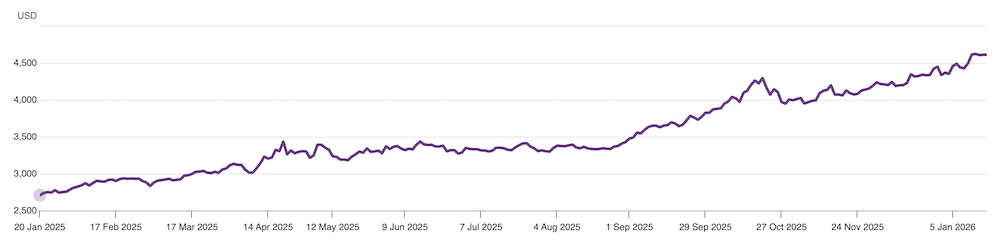
Market Overview - The commodity market has shown significant differentiation since 2025, with precious metals like gold and silver leading the market, increasing by 63% and 111% respectively, while energy and agricultural products have underperformed, with crude oil down 16% and agricultural indices only slightly up by 3% [5][12] - As of early 2026, metals such as gold, silver, copper, and aluminum continue to rise, with smaller metals like nickel and tin experiencing sharp increases, indicating a clear rotation in the market and heightened investor sentiment regarding the potential onset of a new super cycle in commodities [5][12] Historical Super Cycles - Since 1850, there have been five historical super cycles in commodities, characterized by a pattern of "bull short, bear long," with the average upward phase lasting about 13 years and a price increase of approximately 75%, while the downward phase averages 21 years with a price decline of about 47% [5][13][21] - The first cycle (1850-1898) was driven by the spread of the Industrial Revolution and global infrastructure development, while the second cycle (1899-1932) was influenced by the Second Industrial Revolution and World War I, leading to price increases in strategic resources like copper and oil [14][16][21] Bullish Logic: Financial Attributes and Industrial Trends - The bullish argument is primarily based on the safe-haven value and industrial demand, with global monetary easing and fiscal expansion contributing to a noticeable recovery in economic sentiment across major economies [23][25] - The ongoing trend of de-dollarization has positioned commodities as a preferred option for sovereign nations to hedge against credit devaluation, with central banks continuing to increase their gold reserves, indicating a potential rise in commodity ETF allocations [25][30] Bearish Views: Demand Slowdown and Policy Constraints - Bearish concerns focus on the demand side, highlighting a lack of new engines for growth, particularly as emerging economies like India exhibit "dematerialization" growth, leading to lower metal consumption per unit of GDP [64] - Central banks are increasingly prioritizing inflation control, which may lead to a tightening response to rapid commodity price increases, potentially suppressing overall commodity market space [64][66]
BCA Research首席新兴市场策略师:金价年底冲刺5000美元,大宗商品与美元逻辑生变
Di Yi Cai Jing· 2026-01-18 10:28
Core Viewpoint - The article discusses the diverging fates of gold compared to cyclical commodities like copper and oil, predicting a significant rise in gold prices driven by structural demand, U.S. macroeconomic policies, and the need to suppress real interest rates [1][2]. Group 1: Key Drivers of Gold Prices - The first key driver is the structural increase in global demand, particularly from central banks, with China's diversification of foreign reserves significantly impacting the market [4]. - The second driver is the "currency devaluation cycle," where institutional investors favor gold as the U.S. seeks to devalue its currency amid a dual crisis of public debt and fiscal deficits [4]. - The third and most critical variable is the suppression of real interest rates, which the U.S. government aims to achieve to manage public debt repayment pressures [5]. Group 2: Divergence from Other Commodities - The traditional correlation between a weak dollar benefiting all commodities is deemed ineffective, with gold and cyclical commodities like copper and oil heading towards different outcomes [2][6]. - Despite a weak dollar, the correlation logic between the dollar and cyclical commodities is breaking down, indicating that the expected commodity supercycle may not materialize [6][8]. - The article emphasizes that in a period of weak global growth and a declining dollar, emerging markets and cyclical commodities may not perform well, as their key driver is growth rather than currency [8].

西部证券晨会纪要-20260115
Western Securities· 2026-01-15 00:47
Group 1: Oil Market Insights - The report indicates that WTI crude oil has a strong support level at $56, with geopolitical changes expected to drive demand for strategic reserves, leading to potential price increases in 2026 [5][12] - The geopolitical landscape, particularly actions by the U.S. regarding Venezuela, is analyzed, suggesting that while Venezuela has significant oil reserves, its current production is low, limiting short-term impacts on global oil supply [5][6] - The report discusses the implications of Trump's policies on oil prices, noting that low oil prices may not be beneficial for the Republican Party ahead of elections, as they could squeeze profits for oil companies [6][7] Group 2: Strategic Responses and Supply Dynamics - The report highlights that China and other manufacturing countries must enhance cooperation and increase strategic reserves to mitigate supply shocks, especially as energy security becomes more critical [8][10] - It predicts that China's oil reserve expansion could accelerate, with plans to increase reserves from approximately 1.2 billion barrels to 2 billion barrels, creating a demand of about 1.1 million barrels per day [10] - The report suggests that if global economic resilience exceeds expectations, it could lead to a supply-demand gap in the oil market [10] Group 3: Company-Specific Analysis - Baiwei Storage - Baiwei Storage is positioned as a leading player in embedded storage, with projected revenues of 10.935 billion, 14.439 billion, and 18.629 billion yuan for 2025, 2026, and 2027 respectively, alongside net profits of 936 million, 2.028 billion, and 2.289 billion yuan [13] - The company is noted for its unique capability in wafer-level packaging, which is expected to provide a competitive edge in the AI-driven market [13][14] - Baiwei Storage's partnership with META to develop wearable storage modules is highlighted as a significant growth opportunity, particularly in the context of AI applications [14]

资产的信号(20260114):油价的“地缘游戏”
Western Securities· 2026-01-14 13:03
Core Insights - The report indicates that the geopolitical situation surrounding oil prices is complex, with short-term and long-term impacts from events like the Venezuela situation being minimal on oil prices due to low current production levels and high investment risks [1][2][5] - Trump's strategy regarding oil prices is not straightforward, as low oil prices could negatively impact Republican-aligned oil companies, suggesting that a balance is sought to maintain profitability while addressing inflation concerns [2][3] - The new Monroe Doctrine proposed by Trump aims to secure American interests in both the Americas and the Middle East, potentially increasing U.S. control over global oil production, which could reshape market dynamics and influence pricing [3][5] Group 1: Geopolitical Factors - The Venezuelan oil situation is unlikely to significantly alter global oil supply in the short term, as the country’s production is currently less than 1% of global output, despite its large reserves [1][10] - Trump's push for increased investment in Venezuelan oil is complicated by the need for substantial capital and the unstable political environment, which may deter companies from committing to such investments [2][5] - The U.S. aims to control approximately 63% of global oil production if it successfully manages resources in both the Americas and the Middle East, which would enhance its influence over global oil prices [3][7] Group 2: Market Dynamics - The report predicts that the oil market may experience a supply-demand balance in 2026, driven by strategic reserves and potential increases in Chinese oil stockpiling, which could create a demand of up to 1.1 million barrels per day [5][32] - The EIA forecasts a daily supply surplus of 2.26 million barrels in 2026, contingent on various assumptions regarding stockpiling and OPEC production decisions [5][32] - The report suggests that oil prices are likely to rise due to geopolitical tensions and strategic reserve demands, with a strong support level at $56 for WTI crude oil [7][32] Group 3: Commodity Revaluation - The report highlights that oil is expected to undergo a revaluation similar to precious and industrial metals, driven by the expansion of the dollar's credit gap, although the pace may be slower due to the U.S.'s significant production and consumption of oil [6][34] - The historical ratios of gold to oil and copper to oil have reached extreme levels, indicating potential for upward movement in oil prices as market conditions evolve [6][34] - A potential easing of the Russia-Ukraine conflict in 2026 could further stimulate strategic stockpiling needs, leading to a notable increase in oil prices [6][34]
油价连续上攻,洲际油气涨停,油气ETF汇添富(159309)喜提五连涨,强势吸金超1600万元!解密商品超级周期轮动规律,接下来是石油了?
Sou Hu Cai Jing· 2026-01-14 08:44
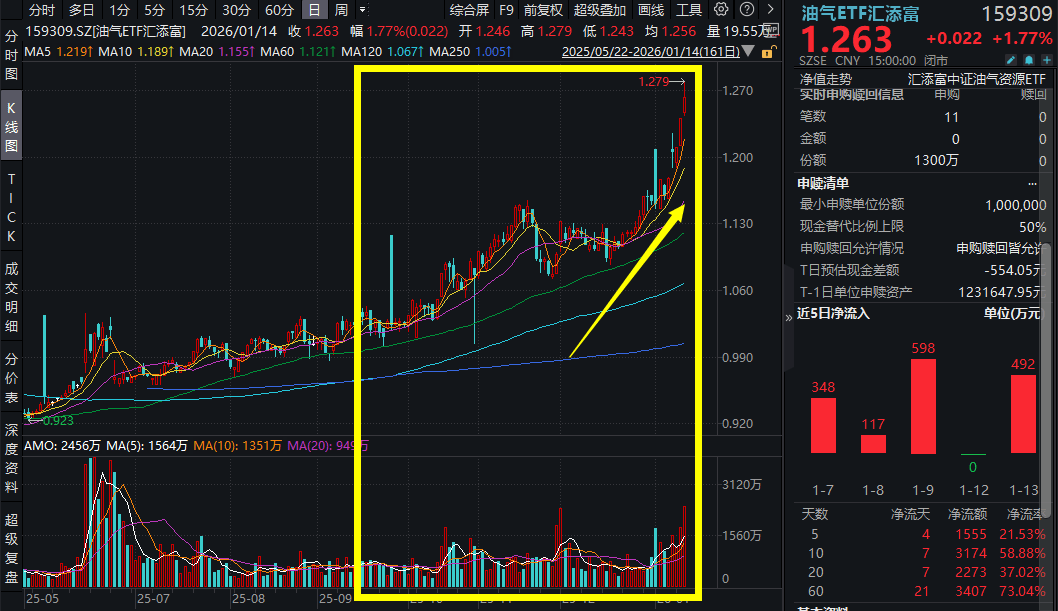
Core Viewpoint - The A-share market experienced fluctuations with the Shanghai Composite Index rising and then retreating, while the oil and gas sector showed strong performance, particularly the oil and gas ETF Huatai-PineBridge (159309), which achieved a five-day consecutive increase and reached a historical high [1][3]. Group 1: Market Performance - The total trading volume in the two markets approached 4 trillion yuan, setting a new historical record [1]. - The oil and gas ETF Huatai-PineBridge (159309) saw a net inflow of over 16 million yuan for the day, accumulating more than 20 million yuan in the last two days [1]. Group 2: Sector Analysis - The majority of the index component stocks for the oil and gas ETF saw price increases, with notable performances including a limit-up for Jerry Holdings and over 4% increase for Continental Oil [3]. - The main oil contracts, including West Texas Intermediate (WTI) and Brent crude, rose by 2.69% and 2.43%, respectively, due to concerns over oil supply amid regional tensions [5]. Group 3: Commodity Market Insights - The commodity market is experiencing a strong trend, with precious and industrial metals reaching new highs, indicating a potential super cycle for commodities driven by economic conditions [5][6]. - Historical patterns during economic downturns suggest that oil prices may rise following increases in gold and industrial metals, with oil being influenced by geopolitical factors [7][8]. Group 4: Strategic Outlook - The oil and gas sector is highlighted as having long-term investment value, with the oil and gas ETF Huatai-PineBridge focusing on the upstream and downstream of the oil and gas industry [8]. - The current low levels of strategic oil reserves in the U.S. and OECD countries, combined with rising commodity ratios, suggest that oil prices are undervalued relative to other commodities [7].




金、银、铜、铝、油、气、米,下一个超级周期如何上车?
2 1 Shi Ji Jing Ji Bao Dao· 2026-01-13 08:02
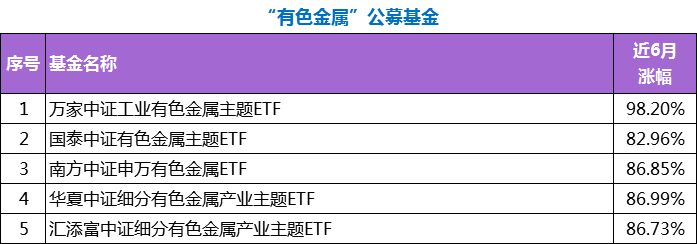
Market Overview - In 2025, the A-share market experienced a comprehensive recovery, with the Shanghai Composite Index closing at 3968.84 points, the ChiNext Index rising by 49.57%, the CSI 300 increasing by 17.66%, the CSI 500 up by 30.39%, and the STAR 50 gaining 35.92% [1] - The most notable performance was in precious metals, with gold and silver entering a historic bull market, leading all asset classes. London spot gold rose by 64.56% throughout the year, nearing $4600 per ounce, while London spot silver surged by 147.79% [1] Precious Metals and Base Metals Cycle - Historical patterns indicate that after gold and silver, base metals like copper and aluminum may enter a super cycle. The sequence of price increases typically follows: gold, silver, copper, aluminum, oil, gas, and agricultural products [2] - By the end of 2025, gold had increased over 60%, closing around $4320 per ounce, while silver prices saw significant increases, particularly in December, breaking through key price levels [2] - International investment banks are bullish on copper and aluminum for 2026, citing a lack of large mining projects coming online and the decline of older mines. Demand is also expected to rise from sectors like AI infrastructure, electric vehicles, and the photovoltaic industry [2] Investment Products in Base Metals - Investment products related to base metals can be categorized into two main types: those that include stocks or ETFs related to base metals and public mutual funds focused on base metals. Unlike precious metals, these products do not directly invest in physical metals [3] - Base metal index funds can be further divided into those tracking stock indices and those tracking futures indices. Examples include the "Wanjia CSI Industrial Base Metals Theme ETF" and "Guotai CSI Base Metals Theme ETF," which invest in stocks of companies related to gold, copper, aluminum, lithium, cobalt, and rare metals [4] Performance of Base Metal Funds - Recent performance data for base metal ETFs shows significant gains, with the "Wanjia CSI Industrial Base Metals Theme ETF" up by 98.20%, "Guotai CSI Base Metals Theme ETF" up by 82.96%, and others also showing strong returns [6] - Some bank wealth management products also allocate a portion of their holdings to precious and base metals to enhance returns, although these products carry higher risks compared to pure bond products [8] Practical Investment Tips - Investors are advised to consider their risk tolerance when investing in precious and base metals. For those with a preference for stability, bank wealth management products may be suitable, while those with higher risk tolerance might explore mining stocks and related funds [9] - In the context of base metals, investors should be cautious about chasing high prices and consider the volatility of silver, platinum, and palladium. It is recommended to select products that hold ETFs related to gold and base metals for more stable investment [10]
贵金属牛市行情火力全开,大宗商品超级周期再确认
Jin Shi Shu Ju· 2026-01-13 06:16
Core Viewpoint - The article highlights the significant rise in gold and silver prices, driven by geopolitical tensions and market reactions to U.S. government actions, indicating a solid continuation of the commodity "supercycle" [1][4]. Group 1: Price Movements - On Monday, gold futures for February delivery rose by 2.5% to $4,614.70 per ounce, reaching a peak of $4,640.50, while March silver futures surged by 7.3% to $85.09, hitting a high of $86.34, both marking historical records [2]. - Gold futures have seen a cumulative increase of over 100% over the past three years, while silver futures have more than doubled in price over the last four years [2]. Group 2: Geopolitical Factors - The ongoing geopolitical tensions, particularly in Iran, Venezuela, and Greenland, are contributing to the rising demand for gold as a safe-haven asset [4][5]. - The escalation of anti-government protests in Iran has resulted in over 500 deaths, adding uncertainty to the market and supporting gold prices [5]. Group 3: Market Sentiment and Future Outlook - Analysts suggest that the current lack of resistance levels in precious metal price charts makes it difficult to predict future price movements, but a target of $5,000 per ounce for gold and $100 for silver is considered reasonable in the coming months [5]. - The potential for a decline in gold prices may only occur if geopolitical issues in Venezuela and Iran are resolved, leading to lower oil prices and inflation levels [5].