
弱美元周期

Search documents
金融市场分析周报-20250711
AVIC Securities· 2025-07-11 03:46
Economic Indicators - China's manufacturing PMI for June is at 49.7%, a slight increase of 0.2 percentage points from the previous month[7] - Non-manufacturing PMI for June stands at 50.5%, also up by 0.2 percentage points[9] - Comprehensive PMI output index for June is 50.7%, rising by 0.3 percentage points compared to May[7] Market Analysis - The Shanghai Composite Index increased by 1.40%, while the Shenzhen Component Index rose by 1.25% during the week[5] - The average daily trading volume decreased to 14,413.96 billion CNY, down by 452.78 billion CNY from the previous week[25] - Financial sector stocks showed strong performance, with a 1.86% increase, while the technology sector faced a decline of 1.28%[5] Monetary Policy and Liquidity - The central bank conducted a net withdrawal of 13,753 billion CNY this week, with a total of 65,522 billion CNY in reverse repos executed[12] - The average weighted repo rate for overnight transactions fell to 1.3606%[12] - The liquidity environment is expected to remain stable in the upcoming week, with limited seasonal impacts anticipated[13] Bond Market Insights - The yield on 10-year government bonds decreased by 0.5 basis points to 1.641%[14] - Credit bond yields across various maturities have generally declined, with 1-year AAA-rated bonds yielding 1.6791%[21] - The net financing amount for credit bonds increased by 851.22 billion CNY, indicating a recovery in the market[17] Investment Outlook - The "Big and Beautiful" U.S. policy is expected to accelerate the weak dollar cycle, potentially leading global capital to seek refuge in Chinese assets[29] - The A-share market is anticipated to experience a gradual upward trend as the economy transitions, with a focus on technology and military sectors for investment opportunities[29] - Risks include potential tightening of monetary policy and unexpected economic recovery that could lead to a significant rebound in bond yields[30]
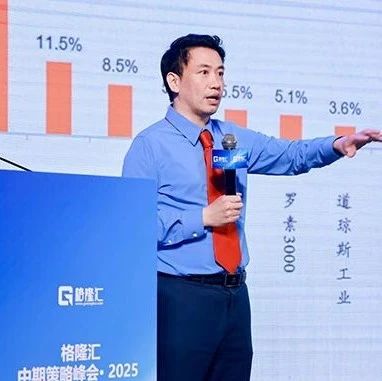
下半年市场怎么走?陈果重磅研判:关注这几个方向!
格隆汇APP· 2025-07-08 09:43
Group 1 - The core viewpoint of the article is that the Chinese capital market is expected to reach new heights in the second half of 2025, with a focus on global macro perspectives and investment opportunities [3][5][11] - The Chinese stock market has shown decent performance in the first half of the year, and major indices are anticipated to reach new highs in the second half [3][5] - A global perspective is essential for identifying investment opportunities, particularly in the context of the ongoing weak dollar cycle, which is expected to create favorable conditions for the Hong Kong stock market [5][12] Group 2 - The article discusses the potential for improved Sino-U.S. relations, which may exceed market expectations, particularly if a trade agreement is reached [8][11] - The impact of U.S. tariff policies on China's economy and exports is highlighted, emphasizing the importance of a stable economic relationship between the two countries [7][11] - The article suggests that a more open and confident China, along with a stable Sino-U.S. relationship, could lead to valuation increases in the Chinese stock market [11][12] Group 3 - Key investment directions for the second half of the year include the acceleration of the engineer dividend, new market opportunities abroad, and the revaluation of traditional industry leaders [14] - The article notes that the number of Chinese PhD graduates in engineering is significantly increasing, which is expected to drive technological advancements and market surprises [14] - Traditional industries that previously faced overcapacity may now present opportunities for revaluation, particularly in the context of current economic adjustments [14]

A股、美股共振:复盘与展望
Minsheng Securities· 2025-07-07 11:22
Group 1: Market Performance - A-shares reached a new high in 2025, while U.S. stocks hit historical highs, indicating a synchronized upward trend[3] - The Shanghai Composite Index increased by 5.9% from April to July 2025, while the S&P 500 rose by 16.1% during the same period[12] - Historical instances of synchronized rises between Chinese and U.S. markets include periods from January to April 2019, March 2020 to February 2021, October 2022 to April 2023, and April 2025 to July 2025[4] Group 2: Economic Drivers - The stock market's rise is driven by three main factors: interest rates, risk appetite, and profit growth[3] - Monetary easing expectations have led to a decrease in interest rates, which supports stock market growth[3] - The U.S. dollar's depreciation is beneficial for liquidity and market expectations, impacting non-U.S. assets positively[3] Group 3: Historical Context - The synchronized rises often follow significant events that lead to improved market sentiment and valuation expectations[4] - The period from January to April 2019 saw a 24.9% increase in the Shanghai Composite Index, driven by easing trade tensions and monetary policy shifts[12] - The period from March 2020 to February 2021 experienced a 46.4% increase in the S&P 500, supported by aggressive policy measures amid the pandemic[12] Group 4: Future Outlook - Trade uncertainty is expected to decrease, which may stabilize market volatility but could also introduce new fluctuations[6] - Short-term economic fundamentals in both countries are unlikely to drive stock market growth, with a focus on policy expectations instead[7] - The anticipated monetary easing in both the U.S. and China is expected to support market confidence until actual policy changes are implemented[7]
港股红利盘中上行,红利港股ETF(159331)涨超1.2%,弱美元周期下港股通高股息资产配置价值受关注
Sou Hu Cai Jing· 2025-07-02 02:40
Group 1 - The core viewpoint is that the Hong Kong Stock Connect high dividend sector has significant allocation value during a weak US dollar cycle, benefiting from liquidity premium and enhanced EPS expectations for Chinese companies [1] - The depreciation of the US dollar reduces foreign exchange risks for foreign investors holding Hong Kong stocks, further elevating risk appetite [1] - In the current market environment, stable dividends remain a core selection, with traditional industry leaders expected to deliver improved dividend yields and ROE due to enhanced competition and weakened capital expenditure [1] Group 2 - The Hong Kong Stock Connect high dividend index, compiled by China Securities Index Co., selects 30 high dividend stocks from eligible Hong Kong-listed companies, focusing on those with good liquidity and consistent dividend payouts [1] - The index primarily covers traditional advantageous industries such as real estate and energy, reflecting the overall performance of high dividend securities in the Hong Kong market [1] - Investors without stock accounts can consider the Cathay China Securities Hong Kong Stock Connect High Dividend Investment ETF linked A (022274) and linked C (022275) [1]
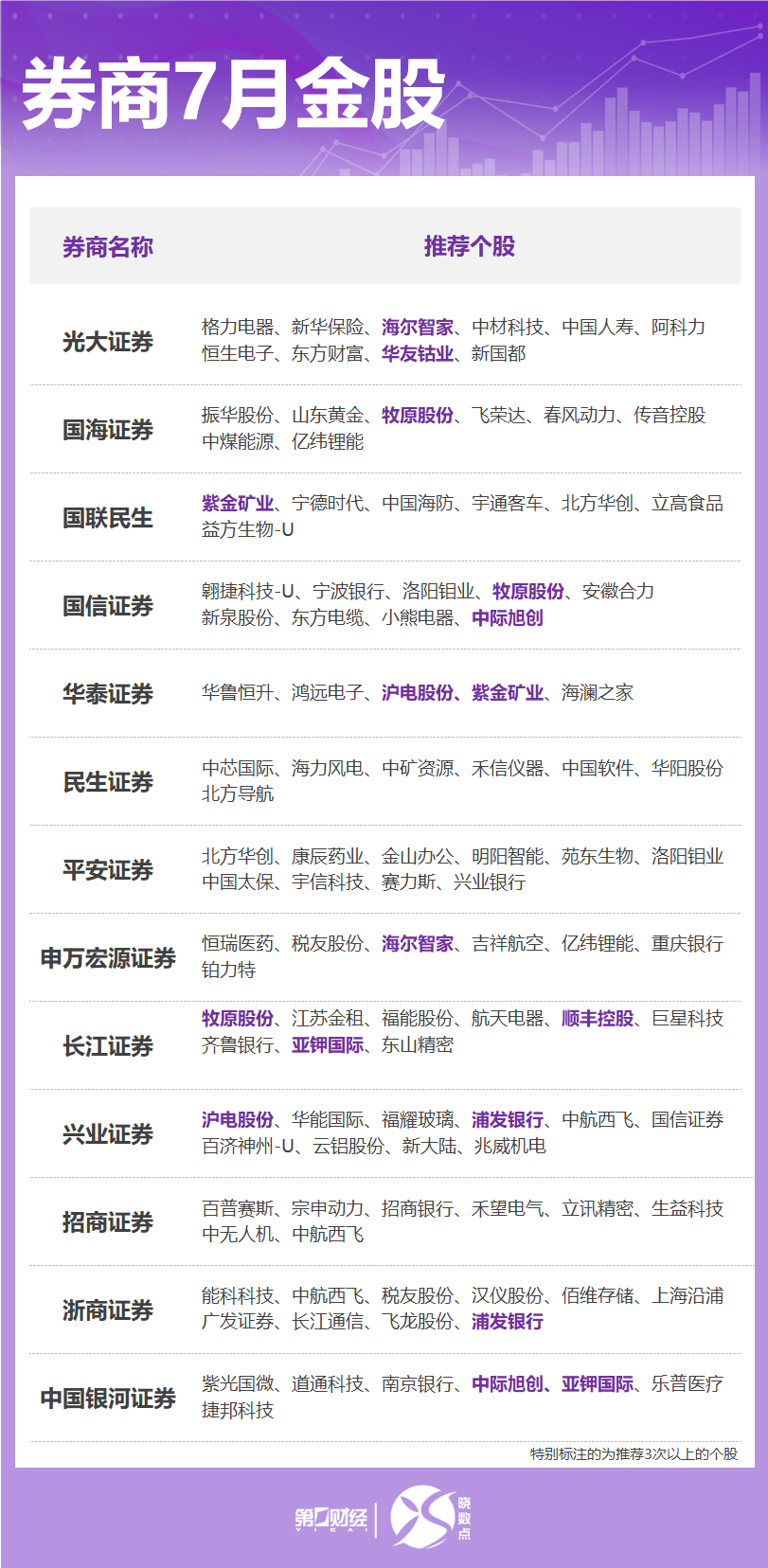
晓数点丨券商7月金股出炉:这些股获力挺,看好科技、证券方向
Di Yi Cai Jing· 2025-07-02 01:59
Group 1 - A-share market shows potential for breakthrough, with focus on technology, brokerage, and sectors with strong earnings during the earnings season [1][6] - Major indices in the A-share market saw significant increases in June, with the Shanghai Composite Index rising by 2.9%, Shenzhen Component Index by 4.23%, and ChiNext Index by 8.02% [1] - Multiple brokerages have released their investment portfolios for July, covering various sectors including consumption, energy, technology, and finance [1] Group 2 - The most frequently recommended stocks include Kaiying Network, which received recommendations from five brokerages, and Huadian Technology, Zijin Mining, Muyuan Foods, and Satellite Chemical, each recommended by four brokerages [4] - Huadian Technology had the highest increase in June, with a rise of over 37%, closing at 44.11 yuan [4][5] - The sectors receiving the most attention include technology, brokerage, and military industries, with a focus on sectors expected to perform well during the earnings season [6][7] Group 3 - The upcoming earnings season is expected to highlight sectors with strong performance, particularly in steel, computers, electric equipment, and national defense industries [7] - Stable assets such as high-dividend stocks and gold are also considered worthy of attention in the current market environment [7]
2025年海外市场中期策略:寻找确定性之锚
Ping An Securities· 2025-07-01 08:39
Market Review - The international environment has become increasingly complex, with gold leading the rise among major asset classes. In the first half of 2025, uncertainties in U.S. policies, global trade, and geopolitical factors have intensified, particularly due to the "America First" policies of the Trump administration, which have significantly disrupted global capital markets. As a result, global asset volatility has increased, with gold leading gains, a weakening dollar, differentiated equity performance, and fluctuations in the bond market [2][10][9]. U.S. Market - The Trump administration's policies are expected to lead to a soft landing for the economy. The labor market is gradually cooling, with limited upward movement in the unemployment rate. Consumer spending is being affected by layoffs, tariffs, and demand exhaustion, but income growth is providing some support. Corporate investment sentiment is weakening, and profit growth is slowing, but the extent is manageable [2][30][36]. - Inflation is facing downward pressure, and the Federal Reserve's interest rate cuts may be delayed. Tariffs are likely to push prices up, particularly in the third quarter. The federal budget expansion will continue, and debt pressure is unlikely to ease significantly [2][30][36]. Dollar Cycle - A weak dollar cycle is expected to begin, leading to a rebalancing of global asset allocation. The dollar is likely to enter a long-term bear market due to interest rate differentials, inflation differentials, and pressures from international capital allocation. Historical data suggests that a new weak dollar cycle would likely lead to higher commodity prices and lower U.S. Treasury yields, with U.S. stocks underperforming emerging market equities [2][30][36]. - In the second half of the year, the dollar may still experience fluctuations due to the soft landing of the U.S. economy, sticky inflation, and delayed interest rate cuts. Geopolitical and trading factors may also drive short-term rebounds in the dollar [2][30][36]. Hong Kong Stock Market - The focus is on profit structure recovery, with expectations for upward potential. The domestic economy is expected to stabilize under supportive policies, leading to continued profit recovery in certain sectors. The liquidity environment is favorable, with foreign capital remaining optimistic about China's economic and policy certainty. The anticipated inflow of southbound capital and the active primary market will create investment opportunities in the secondary market [2][30][36]. - The report suggests a cautious outlook for Hong Kong stocks in Q3, with potential for profit and valuation recovery in Q4 as domestic policy effects become evident and U.S. Treasury yields marginally decline. Key investment themes include technology innovation sectors, quality assets in domestic consumption supported by policy, and stable dividend-paying assets [2][30][36].
2025年中期策略报告:多重角力下的突围选择-20250701
Bank of China Securities· 2025-07-01 01:04
Group 1 - The report emphasizes that under the current weak replenishment cycle, A-shares are expected to outperform other asset classes, with a recommendation to increase the allocation to A-shares while reducing commodity assets [2][24][25] - The report predicts a weak recovery in A-share earnings, with a projected growth rate of 0-5% for the second half of 2025, and a valuation contribution of 0-7%, leading to an expected median increase of 7% in A-shares [39][40] - The report identifies small-cap stocks, strong reversals, high valuations, and high profitability as the dominant market styles for the second half of 2025, with a particular focus on TMT (Technology, Media, and Telecommunications) sectors [46][47][48] Group 2 - The technology sector is highlighted as a high-probability choice for index breakout, supported by stable capital market commitments and sufficient policy reserves [54] - The report outlines two scenarios for industry allocation: one under a fluctuating market and another under a potential upward breakout, indicating the need for strategic planning [54] - The report suggests that the AI and humanoid robotics industries are expected to experience significant growth, with a focus on high-growth and consumption styles in the top ten recommended industries for the second half of 2025 [24][39]
【汇正研究】新兴消费因“情绪价值”增长显著 人形机器人尚处于初级阶段
Xin Hua Cai Jing· 2025-06-30 07:11
Group 1: Economic Trends and Consumer Behavior - The 2025 Mid-Year Strategy Conference highlighted the importance of expanding domestic demand, with policies like special government bonds and consumption vouchers stimulating consumer spending, leading to a recovery in retail sales growth in China [1] - The main consumer demographic is shifting towards the younger generation born after 1995, with a trend towards "pleasure and self-indulgence" consumption, as seen in the significant growth of companies like Pop Mart and Lao Pu Gold, which saw annual increases of nearly 200% and over 300% respectively [1] Group 2: Investment Opportunities in Technology and Robotics - The weak US dollar is driving capital inflows into Hong Kong, benefiting the stock market there, while also impacting the offshore RMB exchange rate; investment focus is expected to remain on consumer sectors and innovative pharmaceuticals [2] - The humanoid robotics sector is gaining attention due to its rich industrial chain and potential breakthroughs in mass production and application scenarios, although it is still in the early stages of development [2][3] - The semiconductor industry is also a key focus, with a market size reaching trillions and a target of 70% domestic self-sufficiency, driven by the demand for AI applications [4] Group 3: IPO Trends and Market Dynamics - The slowdown in A-share IPOs contrasts with the acceleration of IPOs in Hong Kong, with opportunities for mergers and acquisitions in high-quality assets, particularly in AI and high-performance computing sectors [5] - The economic environment is expected to improve in the second half of the year, with a focus on technology innovation, high-end manufacturing, and policy-driven industries, as well as the impact of global liquidity changes on domestic economic recovery [5]

7月度金股:指数搭台,成长唱戏-20250630
Soochow Securities· 2025-06-30 01:33
Core Insights - The report emphasizes a focus on the technology sector for investment opportunities, particularly in growth stocks, as the market index has shown upward momentum [2][6]. - The report outlines a selection of ten key stocks, highlighting their respective industries, market capitalizations, earnings per share (EPS) forecasts, and price-to-earnings (PE) ratios for 2026 and 2027 [2][68]. Group 1: Key Stock Recommendations - **Neway Valve (603699.SH)**: A leading global industrial valve manufacturer, benefiting from a surge in LNG and marine engineering sectors, with expected overseas order growth of over 50% year-on-year in the first half of 2025 [11][12]. - **Yongxing Environmental (601033.SH)**: The sole operator of waste incineration in Guangzhou, with a projected capacity utilization rate of 79% and a commitment to high dividends, expecting a 174% increase in free cash flow in 2024 [17][18]. - **Aerospace Electronics (600879.SH)**: Focused on aerospace electronics and unmanned systems, with anticipated high growth driven by the commercial space industry and demand for satellite communication technologies [26][27]. - **Miaokelando (600882.SH)**: Positioned for long-term growth in the dairy sector, with a focus on product innovation and cost management, expecting significant revenue growth in the upcoming quarters [31][32]. - **Laopu Gold (6181.HK)**: A high-end gold jewelry brand with strong revenue growth, projected to achieve 8.51 billion yuan in revenue in 2024, benefiting from the expanding market for traditional gold products [36][38]. - **Jingzhida (688627.SH)**: Engaged in the semiconductor testing equipment sector, with significant market potential and expected strong performance due to key customer orders [42][43]. - **Shensanda A (000032.SZ)**: Positioned to benefit from the increasing demand for AI infrastructure and applications, with a strong foothold in public data services [47][48]. - **Sanqi Interactive (002555.SZ)**: Anticipating strong performance from new game releases, particularly the upcoming "Douluo Dalu: Hunting Soul World," with high player interest [53][56]. - **CATL (300750.SZ)**: Expected to maintain strong profit growth, with projected net profits of 66.1 billion yuan in 2025, driven by increasing demand for electric vehicle batteries [59][60]. - **Borui Pharmaceutical (688166.SH)**: Forecasted to achieve net profits of 2.6 billion yuan in 2025, with significant potential in the Amylin pipeline, which has attracted substantial investment interest [63][64]. Group 2: Financial Data Overview - The report provides detailed financial forecasts for the ten key stocks, including projected revenues and net profits for 2025 to 2027, highlighting the growth potential across various sectors [68]. - For instance, Neway Valve is expected to generate 74.53 billion yuan in revenue in 2025, with a net profit of 14.49 billion yuan, reflecting strong operational performance [68]. - CATL's projected revenue for 2025 is 472.43 billion yuan, with a net profit forecast of 66.13 billion yuan, indicating robust growth in the electric vehicle battery market [68].


指数突破新高后,市场怎么走?
Soochow Securities· 2025-06-28 12:35
Group 1 - The report identifies three recent market phenomena: the Shanghai Composite Index's three consecutive days of gains reaching a new high, cautious sentiment among institutional investors, and a rapid reversal in investor sentiment leading to a more optimistic outlook after initial profit-taking [1][2][3]. - The core explanation for the recent market movements is attributed to a return to volatility trading, with the annualized volatility of the Shanghai Composite Index dropping to 18.2%, the lowest in nearly a decade, which was largely overlooked by investors [2][4]. - Low volatility reflects a balance of power between bulls and bears, indicating that investors have digested market factors sufficiently, leading to a cautious sentiment among investors [3][4]. Group 2 - The report suggests that a new low in volatility does not guarantee market direction, as future volatility is expected to rise, influenced by whether factors lead to a "Risk-On" or "Risk-Off" environment [4][10]. - Historical patterns show that when volatility falls below 30%, it often leads to a rebound, with past instances resulting in either upward trends or significant corrections depending on the prevailing market conditions [4][5]. - The report emphasizes that the market's direction ultimately depends on key variables that disrupt the current balance of power, with recent positive catalysts including reduced Middle East risks and expectations of interest rate cuts from the Federal Reserve [5][10]. Group 3 - Different types of funds approach volatility trading differently, with quantitative funds utilizing various tools to trade volatility directly, while discretionary funds adjust positions based on directional judgments [8][9]. - The report highlights the importance of distinguishing between short, medium, and long-term trading logic, noting that short-term fluctuations are often misattributed to medium-term fundamentals, overlooking the significance of mean reversion trading [9][10]. - The report concludes that understanding volatility and its implications for trading strategies remains insufficient, with a focus on growth sectors such as AI, cultural media, and innovative pharmaceuticals being recommended for investment [10].