
经济基本面

Search documents
瑞达期货股指期货全景日报-20251119
Rui Da Qi Huo· 2025-11-19 10:25
1. Report Industry Investment Rating - No relevant information provided 2. Core View of the Report - A-share's Q3 reports showed good performance, supporting the market at the bottom However, multiple economic indicators in October weakened, indicating significant downward pressure on the economy and exerting pressure on the stock market After the disclosure of Q3 reports and with no major domestic meetings this month, the market has entered a vacuum period for macro data, performance, and policies Without clear trading guidance, the market is expected to move randomly, and stock index futures will remain volatile [2] 3. Summary by Relevant Catalogs 3.1 Futures Market - **Contract Prices**: IF (2512) at 4565.2 (+22.2), IH (2512) at 3011.0 (+16.6), IC (2512) at 7054.8 (-1.6), IM (2512) at 7298.2 (-31.0); IF (2511) at 4583.4 (+23.4), IH (2511) at 3018.0 (+17.4), IC (2511) at 7116.6 (-15.6), IM (2511) at 7390.4 (-38.6) [2] - **Contract Spreads**: IF - IH spread at 1565.4 (-0.6), IC - IF spread at 2533.2 (-50.0), IM - IC spread at 273.8 (-19.0), IC - IH spread at 4098.6 (-50.6), IM - IF spread at 2807.0 (-69.0), IM - IH spread at 4372.4 (-69.6) [2] - **Quarter - Month Spreads**: IF: -51.2 (-4.6) (current quarter - current month), -94.4 (-1.6) (next quarter - current month); IH: -11.6 (-2.2) (current quarter - current month), -21.8 (-2.4) (next quarter - current month); IC: -241.2 (+14.6) (current quarter - current month), -452.6 (+10.2) (next quarter - current month); IM: -321.6 (+7.2) (current quarter - current month), -551.8 (+6.0) (next quarter - current month) [2] - **Net Positions of Top 20**: IF: -22242.00 (-2488.0), IH: -13615.00 (-598.0), IC: -24823.00 (+1777.0), IM: -34271.00 (+1773.0) [2] 3.2 Spot Market - **Index Prices**: CSI 300 at 4588.29 (+20.1), SSE 50 at 3020.4 (+17.3), CSI 500 at 7122.8 (-28.3), CSI 1000 at 7387.2 (-60.9) [2] - **Basis**: IF basis at -23.1 (-9.9), IH basis at -9.3 (-3.9), IC basis at -67.9 (+3.3), IM basis at -89.0 (+7.3) [2] 3.3 Market Sentiment - **Trading Volume**: A - share trading volume at 17426.66 billion yuan (-2032.93 billion) [2] - **Margin Trading and Short Selling Balance**: 25027.10 billion yuan (+23.76 billion) [2] - **North - bound Trading**: 2181.73 billion yuan (+51.72 billion) [2] - **Repo Operations**: -1955.0 billion yuan (maturity), +3105.0 billion yuan (operation) [2] - **Main Capital Flow**: -993.93 billion yuan (-513.07 billion) [2] - **Rising Stock Ratio**: 21.97% (-1.43%) [2] - **Shibor**: 1.420% (-0.105%) [2] - **Option Prices and Volatility**: IO call option (2511) at 13.80 (-5.00), 13.57% (-2.11%) (implied volatility); IO put option (2511) at 34.20 (-15.20), 13.57% (-2.01%) (implied volatility) [2] - **CSI 300 Volatility**: 14.36% (+0.05%) [2] - **Volume PCR and Position PCR**: 71.29% (+0.08%), 79.93% (+2.07%) [2] 3.4 Market Strength - Weakness Analysis - **All A - shares**: 3.30 (+0.10) [2] - **Technical Aspect**: 2.20 (-0.10) [2] - **Funding Aspect**: 4.50 (+0.50) [2] 3.5 Industry News - Beijing introduced a plan to support and expand consumption, increasing financial support for new - energy vehicle consumption and encouraging credit to service - related businesses [2] - A - share major indices mostly declined, with small and medium - cap stocks weaker than large - cap blue - chips The Shanghai Composite Index rose 0.18%, the Shenzhen Component Index was flat, and the ChiNext Index rose 0.25% Trading volume in the two markets dropped significantly Over 4100 stocks fell, with most industry sectors declining [2] - In October, China's economic indicators such as imports, exports, fixed - asset investment, retail sales, and industrial added - value weakened, and the real estate market continued to decline M1 growth slowed more than M2, ending the five - month upward trend of the M1 - M2 gap [2] - In Q3 reports, the net profit growth rates of CSI 300, SSE 50, and CSI 500 accelerated compared to the semi - annual reports, and the net profit decline of CSI 1000 narrowed [2] 3.6 Key Points to Watch - China's 1 - year and 5 - year LPR on November 20 at 9:00 [3] - US September non - farm payrolls, unemployment rate, and labor participation rate on November 20 at 21:30 [3]

宏观周报(11月第2周):10月基本面继续弱化探底-20251117
Century Securities· 2025-11-17 12:43
Macroeconomic Overview - October fundamentals continued to weaken, with real growth indicators showing significant decline, while price indicators remained supported by base effects and rebounds[2] - New home sales and investment in real estate further weakened, with infrastructure and manufacturing investment growth rates declining more sharply[2] - Social financing in October was 815 billion CNY, significantly below the expected 1,528.4 billion CNY and the previous value of 3,529.6 billion CNY[9] - New credit in October was 220 billion CNY, compared to an expected 460 billion CNY and a previous value of 1,290 billion CNY[9] Economic Data Analysis - Industrial value added in October grew by 4.9%, below the expected 5.5% and previous 6.5%[15] - Retail sales in October increased by 2.9%, slightly above the expected 2.7% but below the previous 3%[15] - Fixed asset investment showed a cumulative year-on-year decline of 1.7%, worse than the expected decline of 0.7%[15] - Real estate development investment fell by 14.7% year-on-year, slightly worse than the expected decline of 14.5%[15] Market Reactions - The stock market experienced a volume decline, with the Shanghai Composite Index down by 0.18% and the Shenzhen Component Index down by 1.40%[8] - Bond yields generally decreased, with the 10-year government bond yield falling by 0.1 basis points[8] - The U.S. stock market initially rose but later fell, with the Dow Jones up by 0.34% and the S&P 500 up by 0.08% before declining[8] - The U.S. dollar index fell by 0.26%, while the offshore RMB appreciated by 251 basis points against the dollar[8]
股指周报:海外扰动加剧,股指冲高回落-20251117
Guo Mao Qi Huo· 2025-11-17 06:21
1. Report Industry Investment Rating - No relevant content provided 2. Core Viewpoints of the Report - The current macro - situation is a mix of positives and negatives. After the overall adjustment of the technology sector, the market lacks a core driving force. With the Shanghai Composite Index reaching the 4000 - point mark, there are differences in the market regarding whether the valuation of technology stocks will further increase and whether the market can shift from a structural to a full - fledged slow - bull market. Given the pressure on the economic data in October, it is necessary to observe whether policies will be implemented in advance for hedging. It is expected that the central Huijin will continue to support the index. The stock index is expected to maintain a volatile pattern with a bottom - support and upward pressure. In the short term, market differences are expected to be gradually digested during the index's volatile adjustment, and a new driving force will bring the index to further rise. The trading strategy is to go long in the long - term, with risks focusing on domestic policies and overseas geopolitical factors [3] 3. Summary According to Related Catalogs 3.1 Part One: Main Viewpoints and Strategy Overview - **Economic and Corporate Earnings**: The economic fundamentals showed a weakening trend in October, with investment growth and real - estate prices accelerating their decline. From January to October, the cumulative year - on - year decline in fixed - asset investment was 1.7%, and the growth rate dropped by 1.2 percentage points compared to September. Among them, real - estate investment decreased by 14.7% year - on - year, infrastructure investment increased by 1.51% year - on - year, and manufacturing investment increased by 2.7% year - on - year. Inflation showed a slight rebound, with the CPI year - on - year growth rate turning positive to 0.2% in October. The central bank's monetary policy remains moderately loose [3] - **Macro Policy**: The overall macro - policy is neutral to slightly positive. Although China's economy has shown structural differentiation this year, the overall level has maintained steady growth, and the pressure to achieve the annual economic target is not significant. Therefore, the necessity of further strengthening monetary policy in the short term is low. The current focus should be on implementing existing policies and making policy reserves for cross - cycle adjustment [3] - **Overseas Factors**: Overseas factors are negative. The Fed's stance on whether to cut interest rates in December is hawkish, and some Fed officials believe that caution is needed when interest rates are close to the neutral level. Additionally, the geopolitical situation around China has become more complex recently [3] - **Liquidity**: Liquidity is neutral. The average daily trading volume of A - shares last week increased by 39.9 billion yuan compared to the previous week [3] - **Investment Viewpoint**: The stock index is expected to be volatile. The trading strategy is to go long in the long - term, with risks focusing on domestic policies and overseas geopolitical factors [3] 3.2 Part Two: Stock Index Market Review - **Stock Index Performance**: Last week, the Shanghai - Shenzhen 300 index fell 1.08% to 4628.1, the Shanghai 50 index remained unchanged at 3038.4, the CSI 500 index dropped 1.26% to 7235.5, and the CSI 1000 index declined 0.52% to 7502.8 [5] - **Industry Index Performance**: Among the Shenwan primary industry indices, the comprehensive (7%), textile and apparel (4.4%), commerce and retail (4.1%), pharmaceutical and biological (3.3%), and food and beverage (2.8%) sectors led the gains last week, while the communication (- 4.8%), electronics (- 4.8%), computer (- 3%), machinery and equipment (- 2.2%), and national defense and military industry (- 2.2%) sectors led the losses [9] - **Futures Volume and Open Interest**: The trading volume of CSI 300 futures was 559,733 lots, with a 2.19% increase; the trading volume of Shanghai 50 futures was 251,251 lots, with a 2.93% increase; the trading volume of CSI 500 futures was 629,685 lots, with a 6.27% decrease; the trading volume of CSI 1000 futures was 1,031,832 lots, with a 5.55% decrease. The open interest of CSI 300 futures was 264,876 lots, with a 2.87% increase; the open interest of Shanghai 50 futures was 97,121 lots, with a 6.79% increase; the open interest of CSI 500 futures was 245,018 lots, with a 1.88% increase; the open interest of CSI 1000 futures was 357,222 lots, with a 0.22% increase [11] - **Contract Premium and Discount**: As of November 14, the annualized discount of the current - month contract IF2511 was 15.93%, IH2511 was 7.59%, IC2511 was 19.79%, and IM2511 was 23.88%. The annualized discount of the next - month contract IF2512 was 6.25%, IH2512 was 2.75%, IC2512 was 14.13%, and IM2512 was 18.17%. The annualized discount of the current - quarter contract IF2603 was 3.49%, IH2603 was 1.2%, IC2603 was 11.03%, and IM2603 was 14.01%. The annualized discount of the next - quarter contract IF2606 was 3.51%, IH2606 was 1.19%, IC2606 was 11.01%, and IM2606 was 13.21% [15] - **Cross - Variety Spread**: The spread between the CSI 300 and the Shanghai 50 was 1589.7, at the 94.3% historical quantile; the spread between the CSI 1000 and the CSI 500 was 267.3, at the 43.8% historical quantile; the ratio of the CSI 300 to the CSI 1000 was 0.6, at the 37.5% historical quantile; the ratio of the Shanghai 50 to the CSI 1000 was 0.6, at the 32.8% historical quantile [19] 3.3 Part Three: Stock Index Influencing Factors - Liquidity - **Funds and Macro - Liquidity**: Next week, 112.2 billion yuan of reverse repurchases in the central bank's open market will mature, and 12 billion yuan of treasury cash fixed - term deposits will mature next Thursday. The central bank will implement a moderately loose monetary policy, aiming to keep social financing conditions relatively loose and promote a reasonable recovery of prices [21] - **Market Liquidity Indicators**: As of November 13, the margin trading balance of A - shares was 2.49864 trillion yuan, an increase of 12.9 billion yuan from the previous week. As of November 13, the proportion of margin trading purchases in the total market turnover was 12.2%, at the 97.7% quantile in the past decade. The average daily trading volume of A - shares last week increased by 39.9 billion yuan compared to the previous week. As of November 14, the risk premium rate of the CSI 300 was 5.21, at the 48.6% quantile in the past decade [32] 3.4 Part Four: Stock Index Influencing Factors - Economic Fundamentals and Corporate Earnings - **Macroeconomic Indicators**: In October, GDP growth was not provided, industrial added - value growth was 4.9%, fixed - asset investment decreased by 1.7% year - on - year, real - estate investment decreased by 14.7% year - on - year, infrastructure investment decreased by 0.1% year - on - year, manufacturing investment increased by 2.7% year - on - year, and the CPI increased by 0.2% year - on - year [35] - **Industry - Specific Data**: In the consumer goods industry, the retail sales of enterprises above the designated size showed different growth rates in various categories in October. In the manufacturing industry, different sub - sectors also had different growth rates in October [39][40] - **PMI Indicators**: In October, the manufacturing PMI was 49.0, a decrease of 0.8 from September, and the non - manufacturing PMI was 50.1, an increase of 0.1 from September [43] - **Earnings Indicators of Major Broad - Based Indexes**: As of September 30, 2025, the year - on - year growth rates of net profit attributable to shareholders of the CSI 300, Shanghai 50, and other indexes showed different trends, and the return on net assets also varied [48] - **Financial Data of Shenwan Primary Industry Indexes**: As of September 30, 2025, the year - on - year growth rates of net profit attributable to shareholders and the return on net assets of different Shenwan primary industry indexes showed significant differences [49] 3.5 Part Four: Stock Index Influencing Factors - Policy Drive - **Recent Macro - Policy Trends**: A series of policies have been introduced, including policies to promote service consumption, allocate special funds for consumer goods replacement, adjust real - estate purchase restrictions, and implement consumer loan fiscal subsidy policies [53][54][55] 3.6 Part Five: Stock Index Influencing Factors - Overseas Factors - **US Economic Data**: In October, the US manufacturing PMI was 48.7%, a decrease of 0.4 from the previous value, and the non - manufacturing PMI was 52.4%, an increase of 2.4 from the previous value. In September, the US PCE and core PCE year - on - year growth rates were 0%, and the CPI and core CPI year - on - year growth rates were 3% [63][66] - **Trump Team's Actions**: Trump has proposed a series of tariff - related measures, including imposing additional tariffs on imports from China, Canada, and Mexico, and threatening to take over the Panama Canal and Greenland [70]
分析人士:多空因素交织 债市保持震荡
Qi Huo Ri Bao· 2025-11-11 03:32
Group 1 - The core viewpoint of the articles indicates that the bond futures market has shown a slight upward trend after a period of weak fluctuations, driven primarily by institutional behavior and sentiment rather than fundamental economic factors [1][2][3] - The People's Bank of China (PBOC) announced a net purchase of 20 billion yuan in government bonds on November 4, which has positively impacted market expectations and supported the bond market [2] - Economic indicators show a mild recovery, with October CPI rising by 0.2% month-on-month and year-on-year, while PPI has turned positive for the first time this year, indicating a gradual price recovery [2][3] Group 2 - Export data for October shows signs of weakness, with a clear trend of marginal slowdown expected in November and December, necessitating strong policy support for domestic demand [3] - The overall economic growth pressure is manageable, with a GDP growth rate of 5.2% for the first three quarters, leading to expectations of continued policy implementation without the necessity for interest rate cuts [3] - The bond market is expected to maintain a volatile trend due to a combination of reasonable liquidity support and the influence of a strong equity market, which may constrain bond market performance [2][3]
200亿的买债规模及其对市场的影响:2025年11月5日利率债观察
EBSCN· 2025-11-05 03:49
Report Industry Investment Rating - Not provided in the content Core Viewpoints - The scale of the central bank's bond purchases in October was significantly less than last year, but the daily average net purchase was not low. The total net purchase in November is likely to exceed that in October [1]. - The scale of the central bank's future bond purchases depends on bond yield changes. The recent decline in interest rates may be due to market trading of the "central bank bond - buying" theme, and bond pricing will eventually return to fundamentals [2]. - There is theoretical downward space for the 10Y Treasury bond yield, but three points need to be noted: the speed of yield decline, the possible change of the "desirable level" over time, and the influence of market internal forces [3]. Summary by Related Catalog 1. Is the 20 - billion bond - buying scale small? - On November 4, 2025, the central bank disclosed a net bond purchase of 20 billion yuan in October, much less than last year's monthly 100 - 30 billion yuan. Using the daily average indicator, the daily net purchase was 50 billion yuan from October 28 - 31, and the November total is likely to exceed October's [1]. - The scale of the central bank's future bond purchases depends on bond yield changes. The 20 - billion purchase may not be the main reason for the 5bp decline in the 10Y Treasury bond yield from October 28 - 31, and bond pricing will return to fundamentals [2]. 2. The downward space of bond yields and three points to note - It is reasonable to think that the central bank's restart of bond - buying indicates that the Treasury bond yield in late October was at a desirable level. There is theoretical downward space for the 10Y Treasury bond yield, similar to the level in mid - June [3]. - Three points to note: the speed of yield decline may be more important than the specific level; the "desirable level" may change over time; the downward space is a theoretical maximum from a policy perspective, and market forces often dominate bond yield trends [3].
10月PMI点评:基本面对债市的定价权再次确认
Changjiang Securities· 2025-11-02 23:30
1. Report Industry Investment Rating No information provided in the given content. 2. Core Viewpoints of the Report - In October 2025, the decline of manufacturing PMI, weaker than the seasonal level and with weakening supply and demand, may indicate certain downward pressure on the Q4 economy [2][7]. - Both domestic and external demands declined, and price indicators did not continue the improvement trend of last month. The differentiated structure of "strong raw material prices and weak finished - product prices" may restrict the repair of corporate profits [2][7]. - The business climate of large enterprises fell below the boom - bust line, and the business climates of high - tech manufacturing and equipment manufacturing industries significantly declined [2][7]. - The business climate of the non - manufacturing industry is mainly driven by holiday service consumption, and the overall expansion strength is still weak [2][7]. - The trading logic of the bond market in Q4 focuses on the weakening economic fundamentals and the expectation of monetary easing, and a repair market may be welcomed. It is expected that the yield of the active 10 - year treasury bond (tax - exempt) may decline to 1.65% - 1.7%, and the yield of the taxable bond may decline to 1.7% - 1.75% [2][7]. 3. Summary by Relevant Catalogs 3.1 Event Description - In October 2025, the manufacturing PMI was 49.0%, a decrease of 0.8 pct from the previous month, lower than the Wind consensus forecast of 50.0%. The non - manufacturing business activity index slightly increased by 0.1 pct to 50.1%, slightly higher than the boom - bust line and lower than the Wind consensus forecast of 50.3%. Among them, the service industry business activity index was 50.2%, an increase of 0.1 pct, and the construction industry business activity index was 49.1%, a decrease of 0.2 pct [5]. 3.2 Event Comment - **Manufacturing PMI and economic pressure**: The manufacturing PMI in October 2025 fell back to a nearly two - year low. The production index and new order index decreased by 2.2 pct and 0.9 pct respectively to 49.7% and 48.8%. The procurement volume index decreased significantly by 2.6 pct to 49.0%, and the difference between the "finished - product inventory - on - hand orders" index widened by 0.6 pct to 3.6 pct. The weak pattern of production and demand was partly due to the pre - release of some demand before the National Day holiday and partly reflected the lack of endogenous momentum, indicating certain downward pressure on the Q4 economy [7]. - **Demand and price situation**: In October, external demand did not continue its resilience, and the new export order index significantly declined by 1.9 pct to 45.9%. The new order index for domestic demand also turned from rising to falling. The main raw material purchase price index and the ex - factory price index both decreased by 0.7 pct, recording 52.5% and 47.5% respectively. The difference between them remained at 5.0 pct, and the main raw material purchase price index was still in the expansion range. The "strong raw material prices and weak finished - product prices" structure may restrict the repair of corporate profits [7]. - **Enterprise and industry changes**: Among enterprises, the PMIs of large and small enterprises both fell by 1.1 pct to 49.9% and 47.1% respectively, and the PMI of medium - sized enterprises slightly fell by 0.1 pct to 48.7%. In terms of industries, the PMIs of high - tech manufacturing and equipment manufacturing industries were 50.5% and 50.2% respectively, a decline of 1.1 pct and 1.7 pct from the previous month. The consumer goods industry remained in the expansion range, slightly falling by 0.5 pct to 50.1%, while the PMI of the basic raw material industry further dropped to 47.3%. The overall market expectation was optimistic, with the production and business activity expectation index at 52.8%, and the expectation indexes of industries such as non - ferrous metals and transportation equipment rising to the high - level boom range above 60% [7]. - **Non - manufacturing industry situation**: In October, the non - manufacturing PMI slightly increased by 0.1 pct to 50.1%, and the service industry PMI rose to 50.2%. The on - hand order index fell by 0.8 pct while the new order index remained flat, indicating that the holiday effect was the main driver. The business activity indexes of industries such as transportation, accommodation, and culture and entertainment were all in the high - level boom range above 60%, but industries such as real estate continued to be sluggish. The construction industry business activity index turned from rising to falling, decreasing by 0.2 pct to 49.1%, possibly dragged down by the slowdown of holiday construction and the decline of post - holiday real estate sales [7]. - **Bond market outlook**: Currently, the endogenous momentum for the repair of production and demand may be limited. On the day when the PMI data was released, the yield of the 10 - year treasury bond active bond decreased by 0.95 BP. The economic fundamentals still face a pattern of weak supply and demand, the pressure on enterprises for passive inventory replenishment continues, and the ex - factory - raw material price gap still restricts the repair of corporate profits. Although 500 billion yuan of new policy - based financial instruments have been put in place and local governments have an additional 200 billion yuan of special bond quotas, the sustainability of the recovery of real estate sales and the transmission effect of policy funds on infrastructure investment still need to be observed. The trading logic of the bond market in Q4 focuses on the weakening economic fundamentals and the expectation of monetary easing, and a repair market may be welcomed. It is expected that the yield of the active 10 - year treasury bond (tax - exempt) may decline to 1.65% - 1.7%, and the yield of the taxable bond may decline to 1.7% - 1.75% [7].
美联储再降息!中国A股却迎来三重利好,全球股民奔向中国市场
Sou Hu Cai Jing· 2025-10-31 11:23
Core Viewpoint - The Federal Reserve is expected to lower interest rates by 25 basis points, bringing the federal funds rate to a range of 3.75%-4.00%, which could significantly impact the market and is particularly relevant for A-share investors [2] Group 1: Impact of Federal Reserve Rate Cut on A-shares - The anticipated rate cut is seen as a positive signal for A-shares, as it is linked to capital flows, policy space, and economic fundamentals, creating a threefold certainty logic [2] - A-shares are increasingly viewed as a "value pit" in the global market, attracting attention due to their unique valuation appeal amidst global capital seeking higher returns [4] - The current price-to-earnings (P/E) ratio of the Shanghai Composite Index is approximately 16 times, compared to the Nasdaq's 32 times, indicating a faster "payback period" for A-shares, which enhances their attractiveness to global investors [7] Group 2: Capital Inflows and Economic Stimulus - Following the first rate cut in September, foreign capital inflows into A-shares reached $4.6 billion, marking a new monthly high since November 2024, demonstrating foreign investors' positive sentiment towards the A-share market [7] - A further rate cut would likely lead to increased foreign capital inflows through channels like the Shanghai-Hong Kong Stock Connect, providing substantial financial support to the market [9] - The easing of monetary policy is expected to stimulate domestic consumption and investment, particularly benefiting sensitive sectors like manufacturing and small enterprises, thereby improving profit expectations and stock prices [11][14] Group 3: Long-term Economic Resilience - The Federal Reserve's rate cut is viewed as a catalyst for activating China's economic resilience, with GDP growth of 5.2% in the first three quarters despite external pressures, indicating strong industrial competitiveness and foreign trade resilience [16] - The combination of increased global liquidity, coordinated fiscal and monetary policies in China, and a potential recovery in foreign trade orders is expected to create a threefold economic driving force: foreign capital inflow, domestic demand stimulation, and foreign trade recovery [17] - The long-term performance of the stock market is fundamentally linked to economic conditions, with the rate cut providing both immediate capital support and opportunities for policy adjustments, ultimately leading to economic recovery [19]

人民币汇率年底或破 7:三因素共振筑牢走强基础
Sou Hu Cai Jing· 2025-10-28 03:24
Core Viewpoint - The recent strengthening of the Chinese yuan against the US dollar is attributed to three main factors: economic fundamentals, differences in monetary policy between China and the US, and improved market confidence [3][4]. Economic Fundamentals - In September, China's export growth reached a six-month high, and there has been a structural recovery in prices, indicating a gradual improvement in domestic demand [3]. - The introduction of 500 billion yuan in new policy financial tools and an additional 500 billion yuan in local government debt limits aims to alleviate existing debt and expand effective investment, providing internal support for the yuan's exchange rate [3]. Monetary Policy Differences - The anticipated reversal in US monetary policy is a significant external driver, with a 98.9% probability of a 25 basis point rate cut by the Federal Reserve in October and a cumulative 50 basis point cut expected by December [3]. - The US dollar index has faced continuous pressure, with an 8.8% decline year-to-date, marking its worst performance since 1973, which has alleviated external pressure on the yuan [3]. Market Confidence - Recent US-China trade negotiations have reached a basic consensus, reducing uncertainties related to trade friction, which has boosted market confidence [4]. - The 20th Central Committee's fourth plenary session outlined an economic development blueprint, enhancing the attractiveness of yuan-denominated assets, leading to a reduction in offshore yuan short positions by some foreign hedge funds [4].
年内人民币中间价涨近千点,年底“破7”概率加大未来以稳为主
Sou Hu Cai Jing· 2025-10-27 23:13
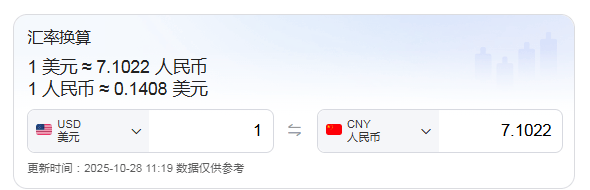
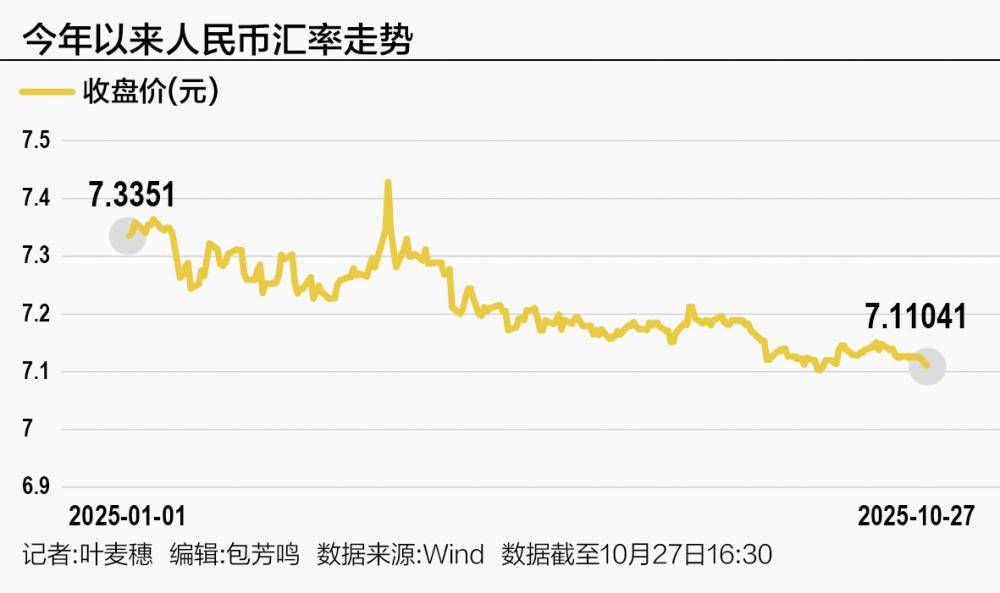
Core Viewpoint - The recent strengthening of the Renminbi (RMB) against the US dollar is attributed to multiple factors, including expectations of US Federal Reserve interest rate cuts, positive domestic economic indicators, and progress in US-China trade negotiations [3][4][6]. Group 1: Currency Exchange Rates - As of October 27, the RMB to USD central parity rate is reported at 7.0881, marking an increase of 47 basis points from the previous day, the highest since October 15, 2024 [1]. - The RMB has appreciated approximately 1000 basis points year-to-date, with the onshore USD/RMB exchange rate down 2.56% and the offshore rate down 3.05% [1]. - The market anticipates that the USD/RMB exchange rate may "break 7" by the end of the year due to the accelerating pace of Fed rate cuts [1][6]. Group 2: Economic Factors Influencing RMB Strength - The recent rise in RMB value is supported by a 9% increase in export growth in September, the structural recovery of prices, and a stable economic foundation [3]. - Progress in US-China trade talks and the positive outlook from the 20th National Congress of the Communist Party of China have bolstered market confidence and the attractiveness of RMB-denominated assets [3][4]. - The Fed's expected rate cut of 25 basis points in October is likely to further weaken the USD, reducing external pressure on the RMB [4][6]. Group 3: Market Sentiment and Future Outlook - Analysts predict that the RMB will continue to operate in a strong position in the short term, with a focus on USD trends and RMB central parity adjustments [6]. - The RMB's potential to test the "7" threshold is supported by a weak USD environment and seasonal demand for currency exchange [7]. - The overall sentiment in the market is optimistic, with projections suggesting that the USD/RMB exchange rate could approach 7.0 by year-end under baseline scenarios [7][8].
就市论市丨沪指冲击4000点在即 新一轮主升浪开启?
Di Yi Cai Jing· 2025-10-27 04:28
Core Viewpoint - The Shanghai Composite Index's approach to the 4000-point mark signifies a new, more dynamic phase for the market, driven by policy support and restored investor confidence [1] Group 1: Market Dynamics - The potential for a sustained upward trend ("main rising wave") depends on solid economic fundamentals and tangible improvements in corporate earnings [1] - Investors are advised to maintain a cautious optimism, focusing on sector rotation and changes in trading volume to prepare for market fluctuations [1] Group 2: Sector Focus - Key sectors to watch include policy beneficiaries such as brokerage firms, state-owned enterprises, high-end manufacturing, and the digital economy [1] - Economic recovery sectors include discretionary consumption (automobiles, home appliances) and certain cyclical products [1] - Long-term investment opportunities are identified in new energy and technology fields like artificial intelligence [1]