
美元流动性

Search documents
现货黄金重回5000美元/盎司丨金银价格
Mei Ri Jing Ji Xin Wen· 2026-02-04 00:59
Core Viewpoint - The recent surge in spot gold and silver prices indicates a strong market response, driven by low buying interest and favorable liquidity conditions in the dollar system [2]. Group 1: Market Performance - As of February 4, spot gold rose to $5002.713 per ounce, increasing over 1% within the day [1]. - On a recent Tuesday, spot gold experienced a significant increase of over 6%, surpassing $4980 per ounce, marking the largest single-day gain since November 2008 [2]. - Spot silver also saw a notable rise, increasing over 10% to reach above $89 per ounce [2]. Group 2: Market Outlook - According to a report from China International Capital Corporation (CICC), the ongoing trends in dollar liquidity and fiscal policies suggest a sustained bull market for global assets [2]. - The report highlights a positive outlook for the Chinese stock market, which is currently underweighted by global active funds, as well as for gold, silver, and copper due to improving dollar liquidity trends [2].


中金:谁当美联储主席都很难撼动资产负债表常态化扩张
Sou Hu Cai Jing· 2026-02-04 00:25
Core Viewpoint - The current structure of the US dollar liquidity system and the constraints from large fiscal trends make it difficult for any new Federal Reserve chair to significantly alter the normalization of the balance sheet expansion [1] Group 1: Liquidity Conditions - The Federal Reserve began expanding its balance sheet at the end of December last year, leading to marginal improvements in liquidity [1] - However, narrow liquidity (reserves) remains well below the lower limit of the "ample level," indicating a tight liquidity state since the pandemic [1] - The indicators for dollar liquidity in terms of quantity and price show that the market is still under significant stress, which is a fundamental reason for the recent panic selling [1] Group 2: Market Outlook - Given the pressures from debt, elections, and financial market stability, the choice of the Federal Reserve chair may not have a substantial impact, suggesting that a trend of liquidity expansion is likely [1] - There is a continued possibility for a bull market in global assets, with a positive outlook for the US and Chinese stock markets, particularly the Chinese market which is significantly underweighted by global active funds [1] - Precious metals like gold and silver, as well as copper, are also expected to benefit from the improving trend in dollar liquidity [1]
中金:沃什难撼扩表
中金点睛· 2026-02-03 23:43
Core Viewpoint - The appointment of Kevin Warsh as the next Federal Reserve Chairman raises concerns about the potential for a reduction in the balance sheet, but the current liquidity dynamics and fiscal trends suggest that the expansion of the balance sheet is likely to continue regardless of leadership changes [1][2]. Group 1: Liquidity and Fiscal Dynamics - The U.S. financial system's stability heavily relies on the Federal Reserve's provision of "ample liquidity," especially in light of increasing fiscal financing needs and the upcoming midterm elections, which make fiscal tightening undesirable for the Trump administration [2][4]. - The Federal Reserve's balance sheet has been on a stair-step upward trend since the 2008 financial crisis, driven by a monetary policy framework that requires a significant amount of short-term liquidity to support financial activities [3][4]. - The current liquidity levels are still below the "ample" threshold, which is estimated to be around 10%-11% of GDP, leading to increased market risks when liquidity approaches this critical level [3][4]. Group 2: Implications of Monetary Policy - The intertwining of fiscal policy and monetary policy creates inherent contradictions, particularly as the U.S. Treasury's debt issuance is crucial for the repo market, which could lead to systemic risks if not properly managed [4][5]. - The likelihood of fiscal tightening is low, especially with the pressures of income inequality and geopolitical competition, suggesting that the Federal Reserve will continue to expand its balance sheet to support the economy [4][5]. - The expectation of continued fiscal and monetary easing is likely to support global risk assets, particularly benefiting emerging markets and commodities like gold and copper [5][6]. Group 3: Future Outlook - The anticipated collaboration between fiscal and monetary policies under Warsh's leadership may lead to a more aggressive approach in supporting the manufacturing sector and alleviating financing burdens for households and small businesses [5][6]. - The ongoing expansion of the balance sheet could stimulate speculative behavior among financial institutions, increasing market volatility and posing challenges for future monetary policy [5][6].

黄金走势处于负值区间 金价跌势仍在延续
Jin Tou Wang· 2026-02-02 06:04
Group 1 - The core viewpoint of the articles indicates that gold prices are experiencing significant volatility, with a notable drop following the nomination of a new Federal Reserve Chair, which has strengthened the US dollar and led to a record single-day decline in gold prices since 1983 [1][2] - Analysts suggest that the recent surge in gold prices, which increased by 24% in January, was followed by a substantial correction, indicating that the market remains volatile and investors should exercise caution [2][3] - The long-term outlook for gold remains positive, with key support levels identified above the 100-day EMA, suggesting potential upward movement despite short-term fluctuations [3] Group 2 - The nomination of Walsh as the next Fed Chair may have limited immediate impact on interest rate cuts but could lead to adjustments in dollar liquidity expectations, affecting speculative assets [1] - The market is currently observing a significant resistance level at $4,885, with potential upward targets towards $5,000, while the first downside target is set at $4,620 [3] - The articles emphasize the importance of monitoring key trend lines and resistance levels, as they will influence future price movements in the gold market [2][3]
黄金跌停,黄金交易所突发公告,六大行曾提前预警
Sou Hu Cai Jing· 2026-02-02 05:07
Core Viewpoint - The domestic precious metals market experienced a historic shock on February 2, 2026, with significant declines in futures and stocks, prompting the Shanghai Gold Exchange to implement emergency risk control measures to stabilize the market [2][3][4]. Market Reaction - On February 2, the main silver futures contract on the Shanghai Futures Exchange hit the limit down, while gold futures fell over 10%, leading to a collective drop in the A-share precious metals sector, with over ten stocks hitting the limit down [2][6][7]. - The spot gold price fell below $4600 per ounce, with an intraday decline of 6.25%, reflecting a broader panic in the market [2][9]. Regulatory Response - The Shanghai Gold Exchange issued an urgent announcement to adjust the margin levels and price fluctuation limits for silver deferred contracts, aiming to curb excessive volatility and maintain market stability [3][4]. - The margin for silver contracts was raised from 20% to 26%, and the price fluctuation limit was increased from 19% to 25% in response to significant price movements [3][4]. Underlying Factors - The recent volatility in the precious metals market was attributed to multiple factors, including external liquidity concerns, changes in Federal Reserve policies, and panic selling among investors [11][12][14]. - The sharp decline in international gold prices, which fell over 12% in a single day, and the extreme volatility in silver prices, which dropped over 36%, were significant contributors to the market's instability [4][11]. Broader Market Impact - The panic in the precious metals market led to a domino effect, causing declines in related sectors such as oil and gas and telecommunications, with many stocks in these sectors also experiencing significant drops [10][11]. - The domestic commodity futures market saw widespread declines, with various precious metal futures hitting limit down, reflecting a broader market retreat [8][10]. Future Outlook - The long-term outlook for precious metals remains influenced by several key variables, including Federal Reserve policy adjustments, global liquidity changes, and geopolitical uncertainties [27][28]. - Despite the short-term volatility, the fundamental drivers for gold's long-term value, such as ongoing monetary easing and strong central bank demand, remain intact [24][25].






美元流动性大退潮开启,A股减仓并留意风格变盘
鲁明量化全视角· 2026-02-01 02:52
Group 1 - The article discusses a significant retreat in dollar liquidity, impacting global asset prices, particularly commodities and cryptocurrencies, with the Shanghai Composite Index showing a weekly decline of 0.44% and the CSI 500 Index down by 2.56% [2] - The new Federal Reserve chair nominee, Kevin Warsh, is expected to lead to a major shift in U.S. monetary policy, including reduced support for the government and potential interest rate cuts, which could negatively affect the U.S. economy and significantly impact global commodity prices [3] - The article notes that the recent surge in gold prices, which rose by 12% mid-week, has been reversed, indicating a potential peak, and suggests that investors in gold should consider exiting positions [3] Group 2 - The article highlights a trend reversal in the market, with a slowdown in state-owned capital reductions and a general retreat of funds, leading to a recommendation for a medium position in the main board and a low position in small-cap stocks [4] - The article emphasizes that the main board is currently favored over small-cap stocks, reflecting a shift in market style preferences [4] - The short-term momentum model suggests focusing on the media industry as a potential area of interest [4]

【环球财经】贵金属市场再现极端行情 后续走势如何?
Xin Hua Cai Jing· 2026-01-31 07:55
贵金属市场出现史诗级下跌。截至31日收盘,现货黄金盘中一度跌破每盎司4700美元,收盘下跌了 9.6%,回到4860美元附近。现货白银价格盘中更是一度暴跌超过30%,收盘则回到每盎司85美元附近。 受到影响,国内金饰价格31日大幅下调,部分品牌金饰克价较前一日跌超100元。其中,周大福足金饰 品报1625元/克,较前一日跌60元,老庙黄金报1546元/克,较前一日跌144元。 从极速拉升到高位跳水 最近一周,国际黄金市场呈现剧烈波动。数据显示,1月26日早盘,现货黄金率先突破5000美元整数关 口,午后再度攀升至5100美元;1月28日黄金持续爆发,早盘突破5200美元,午后冲上5300美元,尾盘 则升至5400美元,单日连破三道关口;1月29日早盘涨势不减,突破5500美元并逼近5600美元这一重要 整数位,4天内完成6道整百关口的突破,创下全球黄金市场短期上涨新纪录。 不过,这一轮上涨势头在巅峰时刻戛然而止。1月29日当天,金价在创下历史新高后急转直下,现货黄 金价格从每盎司5530美元附近跌至每盎司5105.83美元,日内最大跌幅达5.7%,一度跌超400美元。1月 30日,金价呈现单边急速下行,盘中一 ...
X @CZ 🔶 BNB
CZ 🔶 BNB· 2026-01-30 09:20
RT PANews (@PANews)Arthur Hayes:比特币本次下跌与美元流动性收缩同步BitMEX联合创始人Arthur Hayes发文表示,过去几周美元流动性减少约3000亿美元,主要源于美国财政部一般账户(TGA)增加2000亿美元。政府可能在为应对可能出现的停摆而筹集现金储备以保障支出。在此背景下,比特币下跌并不意外,因其与美元流动性收缩同步。 ...
这是港股重回强势的序幕吗?中证港股通互联网指数、恒生科技指数单日分别上涨5.33%、3.10%
Sou Hu Cai Jing· 2026-01-22 17:25
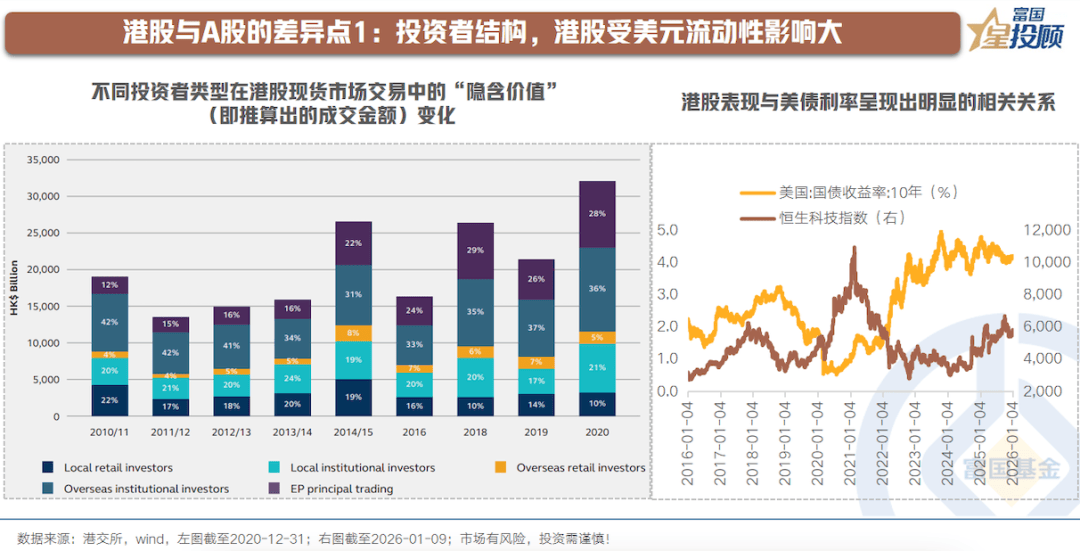
Group 1 - The A-share market has been performing strongly in 2026, with the Shanghai Composite Index approaching 4200 points [1] - In contrast, the Hong Kong stock market has not returned to previous highs, although there was a notable increase on January 12, with the China Securities Hong Kong Stock Connect Internet Index and the Hang Seng Technology Index rising by 5.33% and 3.10% respectively [2] - The article explores whether this marks the beginning of a resurgence for the Hong Kong stock market [3] Group 2 - The investor structure is a key difference between the Hong Kong and A-share markets, with foreign investors accounting for 41% of trading in the Hong Kong market as of the end of 2020, making it more sensitive to U.S. dollar liquidity [4] - The sector composition also differs, with A-shares focusing on technology hardware, high-end manufacturing, and traditional consumption, while Hong Kong stocks are characterized by sectors such as dividends (finance, insurance), internet, innovative pharmaceuticals, and new consumption [7] Group 3 - Three reasons are identified for the weaker performance of the Hong Kong market compared to A-shares: 1. The strong sectors in the A-share market, such as commercial aerospace and AI computing, have not been the focus of the Hong Kong market [11] 2. Limited U.S. dollar liquidity and high U.S. Treasury yields have slowed foreign capital inflow into Hong Kong, despite a vibrant IPO market that raised 286 billion yuan in 2025 [13] 3. The macroeconomic environment has a more pronounced impact on Hong Kong stocks, with expectations for improvement in the real estate sector and consumer policies [14] Group 4 - Three potential catalysts for a stronger Hong Kong market are discussed: 1. The expansion of AI trading into downstream applications, supported by advancements in technology and the need for companies to monetize their investments [16] 2. The relationship between currency fluctuations and corporate profitability, with a strong renminbi historically correlating with higher returns in the Hong Kong market [21] 3. The trend of loose U.S. dollar liquidity, despite short-term market fluctuations, with expectations for two interest rate cuts by the Federal Reserve within the year [25] Group 5 - Investment strategies are suggested based on market conditions: - For aggressive strategies, focus on Hong Kong internet stocks due to their valuation advantages and the shift towards AI applications [30] - For allocation strategies, consider innovative pharmaceuticals, which are expected to see earnings realization [30] - For defensive strategies, dividend stocks are recommended as a hedge against market volatility [30]
金融期权周报-20260119
Guo Tou Qi Huo· 2026-01-19 14:34
1. Report's Industry Investment Rating No information provided in the content about the report's industry investment rating. 2. Core Viewpoints of the Report - The market showed a volatile trend last week, with most indices rising after falling and closing higher on a weekly basis. The Sci - Tech Innovation 50 Index led the gains with a weekly increase of 2.58%. The computer and electronics sectors were outstanding with weekly gains of 3.82% and 3.77% respectively, while the national defense and military industry sector was weak with a weekly decline of about 4.92% [1]. - The market focus last week was on the US dollar liquidity environment and domestic policy dynamics. The strengthening of the US dollar index due to geopolitical situations disturbed global risk - asset prices. Domestically, the central bank introduced a structural relending rate - cut tool, and the market generally interpreted it as aiming to guide liquidity to the real economy more effectively. After the stock indices rose for several consecutive trading days, regulatory authorities took measures such as raising the margin ratio for margin trading to cool the market moderately [1]. - It is expected that the short - term market may change from a smooth upward trend to a relatively strong volatile pattern, and the medium - to - long - term trend remains positive. Attention should continue to be paid to changes in US dollar liquidity and domestic policy signals [1]. - In the options market last week, the implied volatility (IV) of most financial options varieties rebounded slightly and was generally slightly higher than the one - year median. The IV of most financial options' position - volume PCR was in the range of 80% - 110%, showing a slight decline compared with the previous week [2]. - The market may continue to be volatile and relatively strong, and the IV of most financial options has rebounded. Investment strategies include: continuing to hold indices with relatively reasonable valuations such as the CSI 300 and CSI A500, and selling out - of - the - money put options on the corresponding indices; for the Sci - Tech Innovation 50 Index, which has large recent fluctuations and relatively high static valuations, if holding the underlying asset, one can consider buying out - of - the - money put options or selling out - of - the - money call options to reduce exposure risks; if there are substantial spot - market gains, one can consider taking profits on the spot and keeping a small amount of long - term call options to cope with irrational market rallies, such as for the ChiNext Index; for the CSI 1000 - 2603 stock index futures with converging discounts, one can consider moving positions to the 2606 contract with a higher discount to continue a covered - call strategy [3]. 3. Summary by Relevant Catalogs Overview - Market trend: Most indices rose after falling last week, with the Sci - Tech Innovation 50 Index leading the gains at 2.58%. The computer and electronics sectors were strong, while the national defense and military industry sector was weak [1]. - Market focus: US dollar liquidity environment and domestic policy dynamics. The strengthening US dollar index disturbed global risk - asset prices, and the central bank introduced a structural relending rate - cut tool. Regulatory authorities took measures to cool the market [1]. - Market outlook: The short - term market may shift to a volatile pattern, and the medium - to - long - term trend is positive. Attention should be paid to US dollar liquidity and domestic policies [1]. Options Market - Implied volatility: The IV of most financial options varieties rebounded slightly and was generally slightly higher than the one - year median. For example, the IV of the Sci - Tech Innovation 50 options was 29%, and that of the ChiNext Index options was 24%, approaching the one - year median. The IV of 50 and 300 options was in the 13% - 16% range, and the IV of CSI 500 and CSI 1000 options was in the 20% - 22% range [2]. - Position - volume PCR: The position - volume PCR of most financial options was in the 80% - 110% range, showing a slight decline compared with the previous week [2]. Strategy Outlook - Market situation: The market may continue to be volatile and relatively strong, and the IV of most financial options has rebounded [3]. - Investment strategies: Hold reasonable - valued indices and sell out - of - the - money put options on them; for high - volatility and high - valuation indices, take risk - reduction measures; consider taking profits on spot and keeping long - term call options; move positions for stock index futures with converging discounts to continue a covered - call strategy [3]. Market Overview - Multiple tables show the closing prices, price changes, IV, historical quantiles of IV, option trading volumes, and position - volume PCR of various underlying assets such as the SSE 50ETF, CSI 300ETF, and others from January 12 - 15, 2026, providing detailed information on market performance [5].