
金融数据

Search documents
【固收】从两组关系理解10月的金融数据——2025年11月13日利率债观察(张旭)
光大证券研究· 2025-11-13 23:04
Group 1 - The financial data for October shows a year-on-year increase in M1 balance of 6.2%, with new loans amounting to 220 billion and a social financing scale increase of 815 billion, while M2 balance grew by 8.2% [4] - The financial data reflects past conditions, and it is crucial to consider future changes in data. The full utilization of 500 billion new policy financial tools by policy banks is expected to drive project investments exceeding 7 trillion [5][6] - The relationship between surface and underlying data is important. The replacement of local government hidden debts with bonds and the risk management reforms in small financial institutions may slow down credit growth, but these actions are beneficial for economic stability and growth [8] Group 2 - The potential for future increases in new policy financial tools could further stimulate credit, M2, and social financing growth, indicating a more optimistic outlook for financial data [6] - The analysis of financial data should consider both the apparent figures and the underlying logic, particularly the impact of local government debt management and the risk mitigation efforts of small financial institutions [8]



一财首席经济学家调研:信心指数持平50.3,全年5%增速有望实现
Di Yi Cai Jing· 2025-11-05 12:56
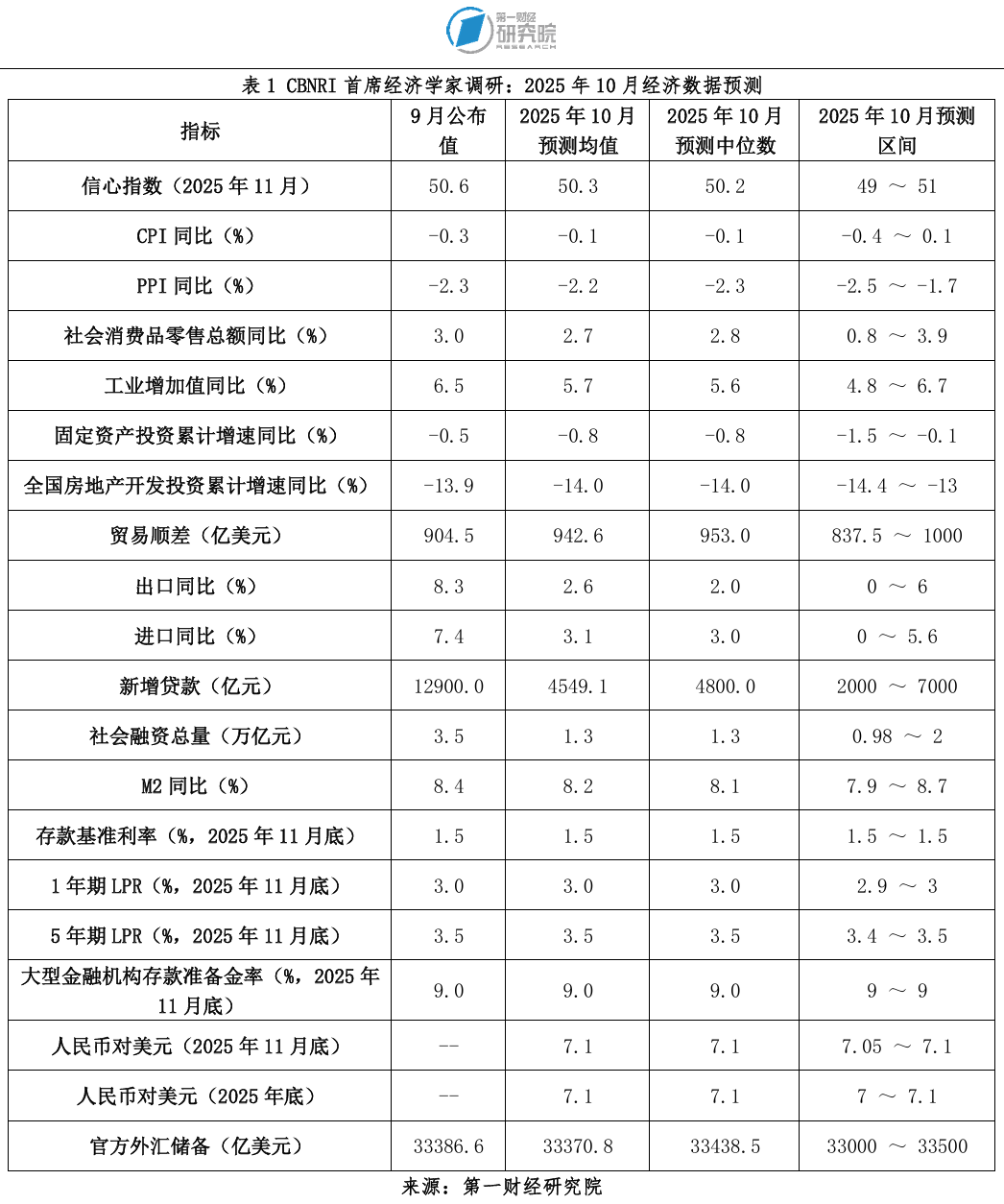
Economic Outlook - The economic confidence index for November 2025 is reported at 50.3, remaining stable compared to the previous month, indicating a steady economic outlook with a target growth rate of 5% for the year [1][4][8] - Economists predict that the external environment will remain complex and variable, emphasizing the need for domestic economic focus on restoring internal demand [1][7] Price Trends - The Consumer Price Index (CPI) for October is forecasted to be -0.1%, showing a slight recovery from the previous month's -0.3% [2][9] - The Producer Price Index (PPI) is expected to be -2.2%, slightly better than the previous month's -2.3% [2][9] Retail and Consumption - The year-on-year growth rate for social retail sales in October is predicted to be 2.7%, down from 3% in the previous month [2][10] - Factors affecting retail growth include a decline in automotive sales and a slowdown in the real estate market, despite positive trends in tourism and online consumption [11][10] Industrial Production - The industrial added value for October is expected to grow by 5.7%, a decrease from the previous month's 6.5% [2][12] - High-frequency data indicates strong production activity, particularly in steel and chemical sectors, suggesting continued robust industrial performance [12] Investment Trends - Fixed asset investment growth is projected to be -0.8%, slightly lower than the previous month's -0.5% [2][13] - Infrastructure investment is anticipated to receive a boost from new fiscal policies, while real estate investment continues to face challenges [14][15] Trade Balance - The trade surplus for October is forecasted to be $94.26 billion, an increase from the previous month's $90.45 billion [2][16][18] - Export growth is expected to be 2.6%, while import growth is projected at 3.1%, both lower than previous figures [18] Financial Indicators - New loans for October are expected to drop to 454.91 billion yuan from 1.29 trillion yuan in September [2][19] - The total social financing amount is predicted to be 1.3 trillion yuan, down from 3.53 trillion yuan in September [20] Monetary Policy - The M2 money supply growth rate is forecasted to be 8.2%, slightly lower than the previous month's 8.4% [21] - Economists expect little change in the LPR and reserve requirement ratios in the near term, with potential for slight adjustments to stimulate domestic demand [22] Currency and Foreign Reserves - The RMB to USD exchange rate is expected to stabilize at 7.1 by the end of November [3][23] - Foreign exchange reserves are projected to remain steady at approximately $333.71 billion [24] Policy Directions - Macroeconomic policies are expected to focus on enhancing infrastructure and social welfare, with an emphasis on "investment in people" to drive sustainable economic growth [26][27][29] - The government aims to improve residents' income and consumption capacity, which is crucial for stimulating domestic demand [31][32]
债市扰动因素逐步弱化,看好四季度债券市场表现
Xin Lang Ji Jin· 2025-10-20 08:19
Core Insights - The financial market is experiencing a marginal easing, with significant fluctuations in the 7-day funding rates and net liquidity operations by the central bank [2] - The Eurozone and Germany's economic sentiment indices have shown a decline, indicating potential economic challenges ahead [3] - Domestic financial data for September 2025 reflects weaker demand, with a notable decrease in both RMB loans and social financing [4] Group 1: Financial Market Overview - The central bank conducted a net withdrawal of 191 billion yuan on October 10, followed by a net injection of 137.8 billion yuan on October 13, indicating a shift towards a more accommodative monetary policy [2] - The DR001 rate remained stable at 1.31% while DR007 increased by 3 basis points to 1.42% as of October 16 [2] Group 2: Economic Indicators - The Eurozone's ZEW economic sentiment index fell to 22.7 in October from 26.1 previously, while Germany's index decreased to 39.3 from 37.3, suggesting a decline in economic optimism [3] - The current situation index for Germany dropped to -80, worse than the expected -74.8, indicating deteriorating economic conditions [3] Group 3: Domestic Financial Data - In September 2025, RMB loans increased by 1.29 trillion yuan, down 300 billion yuan year-on-year, while social financing rose by 3.53 trillion yuan, a decrease of 229.7 billion yuan year-on-year [4] - The M1 growth rate increased to 7.2% from 6.0%, while M2 growth rate decreased to 8.4% from 8.8%, reflecting a mixed picture of liquidity and demand [4] - The bond market is expected to perform well in the fourth quarter, with a potential downward trend in bond yields due to ongoing economic pressures and a low inflation environment [4]
超长债周报:30-10 利差有望阶段性压缩-20251020
Guoxin Securities· 2025-10-20 02:54
Report Industry Investment Rating No relevant content provided. Core Viewpoints - Despite the escalation of Sino-US trade frictions last week, the export data in September remained strong. The inflation rate increased year-on-year in September, while the overall financial data continued to face pressure. Coupled with the sharp decline in the A-share market, the bond market rebounded after bottoming out, and the trading of ultra-long bonds was very active. The term spread of ultra-long bonds narrowed, and the absolute level was low, while the variety spread widened, and the absolute level was also low [1][3][10]. - Considering the economic situation, the probability of a bond market rebound in October is high. With the release of the third-quarter economic data next Monday, it is expected that the GDP growth rate in the third quarter will be 4.5%. Given the weak economy, the monetary policy is expected to continue to be relaxed, and the bond market rebound will continue. It is expected that the 30 - 10 spread will compress periodically, and the variety spread of 20-year China Development Bank bonds will also compress again in the short term [2][3][11]. Summary by Directory Weekly Review Ultra-long Bond Review - Last week, the bond market rebounded after bottoming out due to multiple factors. The trading activity of ultra-long bonds increased slightly, with the term spread narrowing and the variety spread widening [1][10]. Ultra-long Bond Investment Outlook - **30-year Treasury Bonds**: As of October 17, the spread between 30-year and 10-year Treasury bonds was 38BP, at a historically low level. With the expected bond market rebound, the 30 - 10 spread is expected to compress periodically [2][11]. - **20-year China Development Bank Bonds**: As of October 17, the spread between 20-year China Development Bank bonds and 20-year Treasury bonds was 10BP, at a historically extremely low level. The variety spread of 20-year China Development Bank bonds is expected to compress again in the short term [3][12]. Ultra-long Bond Basic Overview - As of September 30, the balance of outstanding ultra-long bonds was 23.7 trillion yuan, accounting for 15.0% of the total bond balance. Local government bonds and Treasury bonds are the main varieties. In terms of remaining maturity, the 30-year variety has the highest proportion [13]. Primary Market Weekly Issuance - Last week (October 12 - 17, 2025), the issuance of ultra-long bonds increased slowly, with a total issuance of 577 million yuan. Treasury bonds accounted for 400 million yuan, and local government bonds accounted for 177 million yuan [20]. This Week's Planned Issuance - The announced ultra-long bond issuance plan for this week totals 1,181 million yuan, all of which are ultra-long local government bonds [26]. Secondary Market Trading Volume - Last week, the trading of ultra-long bonds was very active, with a trading volume of 10,792 billion yuan, accounting for 11.8% of the total bond trading volume. The trading activity increased slightly compared with the previous week [29][30]. Yield - Last week, the yields of various types of ultra-long bonds changed. For example, the yields of 15-year, 20-year, 30-year, and 50-year Treasury bonds changed by -1BP, -2BP, -3BP, and -2BP respectively [37]. Spread Analysis - **Term Spread**: Last week, the term spread of ultra-long bonds narrowed, and the absolute level was low. The spread between 30-year and 10-year Treasury bonds was 38BP, 4BP lower than the previous week [46]. - **Variety Spread**: Last week, the variety spread of ultra-long bonds widened, and the absolute level was low. The spreads between 20-year China Development Bank bonds and Treasury bonds and between 20-year railway bonds and Treasury bonds were 10BP and 15BP respectively [52]. 30-year Treasury Bond Futures - Last week, the main contract of 30-year Treasury bond futures, TL2512, closed at 115.87 yuan, an increase of 1.67%. The total trading volume and open interest increased significantly compared with the previous week [56].
【银行】贷款熨平波动,货币持续活化——2025年9月份金融数据点评(王一峰/赵晨阳)
光大证券研究· 2025-10-16 23:03
Core Viewpoint - The article discusses the trends in China's loan issuance and social financing in September, highlighting a seasonal recovery in loan issuance but a year-on-year decline in growth, indicating ongoing economic challenges and weak demand [4][8]. Group 1: Loan Issuance Trends - In September, new RMB loans amounted to 1.29 trillion, a year-on-year decrease of 300 billion, with a growth rate of 6.6%, down 0.2 percentage points from August [4]. - Cumulatively, from January to September, new RMB loans totaled 14.75 trillion, a year-on-year decrease of 1.27 trillion [4]. - The manufacturing PMI for September was 49.8%, indicating continued contraction in the manufacturing sector, with demand issues persisting [4]. Group 2: Corporate Loan Dynamics - New corporate loans in September reached 1.22 trillion, a year-on-year decrease of 270 billion, accounting for 95% of new loans [5]. - The weighted average interest rate for new corporate loans remained around 3.1%, stable compared to the previous month and at historical lows [5]. - The structure of loans is shifting, with an increase in short-term loans and a decline in bill financing, indicating a need for balance in loan types [5]. Group 3: Household Loan Activity - In September, new household loans totaled 389 billion, a year-on-year decrease of 111 billion, showing some seasonal improvement [6]. - The cumulative household loans for the first three quarters amounted to 1.1 trillion, a year-on-year decrease of 840 billion, reflecting weak consumer demand [6]. - Employment and income variables have not shown substantial improvement, leading to low growth in mortgages, consumer loans, and credit cards [6]. Group 4: Social Financing Overview - New social financing in September was 3.53 trillion, a year-on-year decrease of 229.7 billion, with a growth rate of 8.7%, down 0.1 percentage points from August [7][8]. - The social financing growth rate may continue to decline in the coming months due to high base effects, potentially falling below 8.5% by year-end without new special government bond issuances [8]. Group 5: Monetary Indicators - In September, M2 growth was 8.4%, while M1 growth was 7.2%, with the gap between M2 and M1 narrowing [9]. - New RMB deposits in September were 2.2 trillion, a year-on-year decrease of 1.5 trillion, with a month-end growth rate of 8% [9]. - Cumulatively, from January to September, new deposits reached 22.7 trillion, an increase of 6.1 trillion year-on-year, exceeding the average increase for the same period from 2020 to 2024 [9].

国泰海通 · 晨报1017|固收
国泰海通证券研究· 2025-10-16 12:24
Core Insights - The significant decrease in non-bank deposits in September is attributed to a high base from the previous year and a weak stock market performance in 2025, which contrasts with the strong equity market in 2024 [2][4] Financial Data Summary - Non-bank deposits saw a substantial decline, with a year-on-year decrease of 19,700 million yuan, while resident deposits increased by 7,600 million yuan [4] - The total social financing (社融) in September was 35,338 million yuan, a year-on-year decrease of 2,297 million yuan, primarily due to a high base from government financing [3] - New RMB loans in September amounted to 12,900 million yuan, reflecting a year-on-year decrease of 3,000 million yuan, with short-term loans for residents decreasing by 1,279 million yuan [3] - M1 growth rate increased to 7.2%, while M2 growth rate remained stable at 8.4%, indicating a trend towards more liquid deposits among residents [3]

张瑜:金融数据映射的经济与股市的变化——2025年9月金融数据点评
一瑜中的· 2025-10-16 09:50
Group 1 - The article emphasizes the importance of tracking three financial indicators: M1 year-on-year growth, non-bank deposits, and corporate medium to long-term loans, as they reflect industrial inventory and PPI improvements, market activity, and production investment trends respectively [4][5][6] - In September, M1 year-on-year growth increased by 1.2%, while non-bank deposits decreased by 1.97 trillion, and corporate medium to long-term loans saw a slight decrease of 500 million [4][5] - The decline in non-bank deposits in September is attributed to seasonal factors, particularly the pressure on banks to meet deposit assessments at the end of the quarter, leading to a typical seasonal drop in non-bank deposits [4][5][9] Group 2 - The article discusses the implications of the significant drop in non-bank deposits in September, suggesting it does not necessarily indicate a weakening of the equity market's activity, and further observation of October's data is required [8][9] - The increase in M1 year-on-year is likely driven by a rise in household demand rather than improvements in corporate cash flow, as evidenced by the relatively modest increase in corporate deposits [10][23] - The article highlights that while the new M1 metric is statistically more accurate, historical discrepancies suggest that it may not directly correlate with corporate expectations, necessitating further analysis of traditional M1 metrics [10][24] Group 3 - In September, the total social financing increased by 3.53 trillion, a decrease of 2.3 trillion year-on-year, with a stock growth rate of 8.7% [31][32] - The article notes that corporate medium to long-term loans continued to show a decrease, with a total loan increase of 1.29 trillion, which is 300 billion less than the previous year [27][31] - M2 growth rate fell to 8.4% in September, down 0.4% from the previous month, while new M1 grew by 7.2%, reflecting a mixed trend in liquidity [32][33]

9月金融数据点评:为何M1增速“跳升”?
Shenwan Hongyuan Securities· 2025-10-16 08:13
Group 1: Financial Data Overview - In September 2025, M1 increased by 1.2% year-on-year to 7.2%, while credit balance decreased by 0.2% to 6.6%[1][7] - Social financing stock declined by 0.1% year-on-year to 8.7%[1][7] - New credit in September was 12,900 billion RMB, a decrease of 3,000 billion RMB year-on-year[4][22] Group 2: M1 and Fiscal Policy - The improvement in M1 is attributed to accelerated fiscal spending, with fiscal deposits decreasing by 840 billion RMB, a reduction of 604.2 billion RMB compared to the previous year[2][8] - Corporate deposits saw a significant increase, with a monthly addition of 919.4 billion RMB, up by 149.4 billion RMB year-on-year[2][8] - Non-bank deposits decreased significantly, which may have contributed to the marginal support for M1 growth[2][8] Group 3: Loan Performance - Resident loans added 389 billion RMB in September, down by 111 billion RMB year-on-year, indicating a cautious attitude towards debt[2][10] - Corporate loans remained primarily short-term, with short-term loans and bill financing growth declining by 0.4% to 9.3%[3][13] - Despite a recovery in PPI and PMI indices, corporate investment attitudes have not shifted positively[3][13] Group 4: Future Outlook - The collaboration of fiscal and monetary policies is expected to support the stability of social financing, with 500 billion RMB in new policy financial tools launched to leverage more credit and social capital[3][19] - The new policy tools are designed to enhance project capital and are expected to have a strong leverage effect on credit funding[3][19]
债市日报:10月16日
Xin Hua Cai Jing· 2025-10-16 08:12
Core Viewpoint - The bond market shows a divergence in performance, with long-term bonds rebounding significantly while mid-term bonds remain stable, indicating a "long strong, short weak" trend in the market [1][2]. Market Performance - The closing performance of government bond futures was mixed, with the 30-year main contract rising by 0.42% to 114.96, while the 2-year and 5-year contracts both fell by 0.01% [2]. - The yields on major interbank bonds generally declined, with the 10-year government bond yield down by 0.35 basis points to 1.755% [2]. - The China Convertible Bond Index fell by 0.72% to 478.72 points, with significant declines in several convertible bonds [2]. Overseas Market Trends - In North America, U.S. Treasury yields showed mixed results, with the 10-year yield rising by 0.37 basis points to 4.032% [3]. - In Asia, Japanese bond yields mostly increased, while European bond yields, including French and German bonds, generally decreased [4]. Primary Market Activity - The China Development Bank's financial bonds had lower winning yields than the market estimates, with 1-year, 5-year, and 10-year yields at 1.4929%, 1.7313%, and 1.9749% respectively [5]. Liquidity Conditions - The central bank conducted a 2360 billion yuan reverse repurchase operation, resulting in a net withdrawal of 3760 billion yuan for the day [6]. - The financial statistics report for the first three quarters showed a cumulative social financing scale exceeding 30 trillion yuan, with a year-on-year increase of 4.42 trillion yuan [6]. Institutional Insights - Financial data for September was generally in line with expectations, indicating weak demand in the real economy, with a forecast for a seasonal decline in social financing growth starting in October [8]. - The government bond issuance is expected to slow down, impacting overall financing, while policy financial tools are anticipated to support fixed investment in the fourth quarter [8].
中金点评9月金融数据:政策温和发力 后续有待加码
Zheng Quan Shi Bao Wang· 2025-10-16 00:23
Core Viewpoint - The analysis from China International Capital Corporation (CICC) indicates that while new credit in September showed a year-on-year decrease, the impact of debt adjustments suggests that the credit situation may not be as weak as the data implies. Additionally, the growth rate of M1 significantly exceeded market expectations, indicating a moderate policy response from the government [1]. Group 1: Credit and Financial Data - New credit in September decreased year-on-year, but adjustments for debt replacement may indicate a stronger underlying credit situation [1]. - The growth rate of M1 in September was notably higher than market expectations, suggesting a positive shift in monetary conditions [1]. Group 2: Policy Implications - Recent implementation of policy financial tools, which act as quasi-fiscal policies, has begun to take effect, contributing to the financial landscape [1]. - The rapid increase in fiscal deposits in September and the easing of real estate policies in first-tier cities have supported the resilience of medium to long-term loans for residents [1]. - Future reasonable growth in financial aggregate indicators will depend on further strengthening of fiscal policies [1].