全球流动性

Search documents
12月8日热门路演速递 | 降息、重估、大宗、资金流,五场连击洞见2026
Wind万得· 2025-12-07 22:59
Group 1 - The article discusses the potential impact of the Federal Reserve's interest rate cuts and the upcoming Central Economic Work Conference on the macroeconomic landscape [2][4] - It highlights the expected changes in dollar liquidity and the reasons behind the recent strength of the Renminbi [4][5] - The article emphasizes the anticipated shift in global liquidity favoring AH shares and the revaluation of Renminbi assets, alongside the potential for a bull-bear transition in the US stock market [7][8] Group 2 - The analysis includes projections for the agricultural product market, questioning whether a global upcycle is beginning and identifying trading opportunities in grains, oils, cotton, sugar, and live pigs [10] - It estimates that the reallocation of household assets could bring approximately 5.4 to 12.0 trillion yuan of incremental funds to the A-share market by 2030 [12] - The potential incremental funds from insurance capital entering the A-share market are projected to be around 6.0 to 9.6 trillion yuan by 2026 [13]




比特币突然走弱,技术信号亮红灯,谁在悄悄关水龙头抽走底部支撑
Sou Hu Cai Jing· 2025-12-05 06:16
Group 1 - Bitcoin's price decline reflects broader market sentiment, indicating that it is not merely a speculative asset but a barometer for overall market emotions [1][10] - Despite positive regulatory developments and institutional interest, Bitcoin's price has turned downward from its recent highs, highlighting a disconnect between market information and price action [1][10] - Technical analysis shows a recurring pattern in Bitcoin's price cycles, with significant price movements typically occurring over approximately 150 days from low to high and a year from high to low [3][6] Group 2 - The 50-week moving average serves as a critical support level for Bitcoin, currently around $13,000, and its sustained breach could signal the end of a bull market [8][10] - Global liquidity dynamics are shifting, particularly with Japan's potential interest rate hikes, which could impact risk assets like Bitcoin as funding costs rise [10][12] - The current market environment is characterized by a K-shaped recovery, where high-risk assets are more susceptible to sell-offs as liquidity conditions tighten [12][14] Group 3 - The ongoing debate about Bitcoin's functional role—whether as a pure currency or as a data carrier—reflects deeper concerns about its decentralization and governance [16][17] - A structural shift is occurring as early Bitcoin holders begin to sell their positions, transferring their holdings to institutional investors who are now more interested in Bitcoin as an asset class [17][20] - The recent price decline is seen as a reorganization rather than a collapse, driven by technical signals, liquidity changes, and internal structural shifts within the market [20][22]

12月A股市场展望
Sou Hu Cai Jing· 2025-12-01 04:52
Market Overview - The A-share market has shown a significant downward trend in November, contrasting sharply with the optimistic expectations at the beginning of the month, with the Shanghai Composite Index declining by 1.67% and the ChiNext Index falling by 4.23% [1][2] - Defensive sectors such as banking and textiles performed relatively well, while growth sectors like technology and automotive faced substantial declines, with the computer industry down by 5.26% [1][2] Key Factors Influencing Market Performance - A notable cooling in global artificial intelligence investment themes has directly impacted the performance of growth sectors, initiated by a significant pullback in U.S. tech stocks, with the Nasdaq index experiencing a maximum drop of 7.37% in November [2][3] - Domestic economic recovery momentum remains insufficient, as indicated by a drop in the manufacturing Purchasing Managers' Index (PMI) to 49.0, and a 5.5% year-on-year decline in profits for industrial enterprises [3][4] - The tightening of global liquidity conditions has also exerted pressure on risk assets, with U.S. non-farm payrolls increasing by 119,000 in September, leading to a shift in market expectations regarding the Federal Reserve's interest rate policies [3][4] Market Behavior and Trends - As the year-end approaches, institutional investors are adopting strategies to lock in profits and preserve performance, leading to a shift from high-valuation sectors to low-valuation defensive stocks, resulting in significant market structure differentiation [4][5] - The overall market turnover has decreased from around 2 trillion to approximately 1.7 trillion, indicating reduced liquidity and increased volatility in individual stocks [4][5] Investment Strategy and Outlook - A "defensive + growth" allocation strategy is recommended, balancing stable cash flow from defensive sectors like banking and utilities with increased exposure to high-growth areas such as energy storage and military industries [6][7] - The energy storage sector is expected to grow over 40% due to rising demand and policy support, while the military sector benefits from ongoing national defense modernization efforts [6][7]
华银基金:当前处于“牛市第二阶段”的整固期,12月两大事件将成为破局关键
Sou Hu Cai Jing· 2025-11-27 01:31
Group 1 - The A-share market is experiencing ongoing fluctuations, with the Shanghai Composite Index trading around key levels, leading to cautious investor sentiment [1] - The uncertainty surrounding the Federal Reserve's policy and the impact of U.S. stock market adjustments are key concerns for market direction [1][2] - The upcoming release of the November CPI data on the day of the December Federal Reserve meeting may serve as a critical point for global risk appetite [2] Group 2 - The U.S. job market shows signs of weakness, with slowing job additions and a slight increase in the unemployment rate, while persistent inflation complicates the Federal Reserve's decision-making [2] - The recent adjustment in the U.S. stock market, particularly in the tech sector, has led to a reassessment of AI investment narratives, revealing doubts about capital expenditure effectiveness and valuation pressures [3] - The A-share technology sector is particularly affected by the U.S. market's downturn, with significant declines in semiconductor and AI-related industries [3] Group 3 - The domestic economy is characterized by stronger price recovery than demand improvement, with mixed signals from various economic indicators [4] - Despite some positive signs, such as a rise in October CPI and a halt in PPI's negative growth, there are concerns about the low growth rate of social financing and a decline in real estate sales [4] - The government continues to implement "bottom-line" monetary and fiscal policies, including an expansion of technology innovation loans and early issuance of special bonds, although the overall stimulus expectations remain limited [4] Group 4 - The market outlook suggests continued volatility with a potential for stabilization, awaiting key decisions from the Central Economic Work Conference and clarity on the Federal Reserve's interest rate path [5] - The current market adjustment may provide opportunities for mid-term positioning, especially if the market experiences overshooting [5]
日韩股市深V反弹,A股三大指数翻红,超千股上涨,比特币重回9.2万美元
2 1 Shi Ji Jing Ji Bao Dao· 2025-11-19 03:23
11月19日,日韩股市走出V型走势并飘红,截至10:28,日经225指数涨0.55%,东证指数涨0.73%。 韩国股市19日同样拉升,韩国KOSPI指数跌幅一度扩大至2%,目前涨约0.01%。现代重工跌超3%,SK海力士、三星电子跌约1%。 个股方面,受隔夜美股科技股大跌影响,瑞萨电子跌超4%,爱德万测试、东京电子、任天堂等跟跌,资生堂、味之素等消费股继续走低。软银集团则涨 超2%。 A股方面,主要指数拉升,截至发稿,创业板指涨1.01%,沪指、深成指涨超0.4%,军工、锂矿、保险、水产养殖等方向领涨,沪深京三市上涨个股近 1200只。 虚拟货币方面,近24小时内,比特币涨超1%,价格重回9.2万美元,以太坊涨2.5%,SOL涨5.38%。全市场近11.6万人被爆仓,爆仓总金额为4.15亿美元。 | 名称 | 现价 | 涨跌 | 涨跌幅 | | --- | --- | --- | --- | | 瑞萨电子 | 1789.0d | -83.0 | -4.43% | | 胜高 | 1190.0d | -47.5 | -3.84% | | 斯库林集团 | 12215.0d | -315.0 | -2.51% | | ...
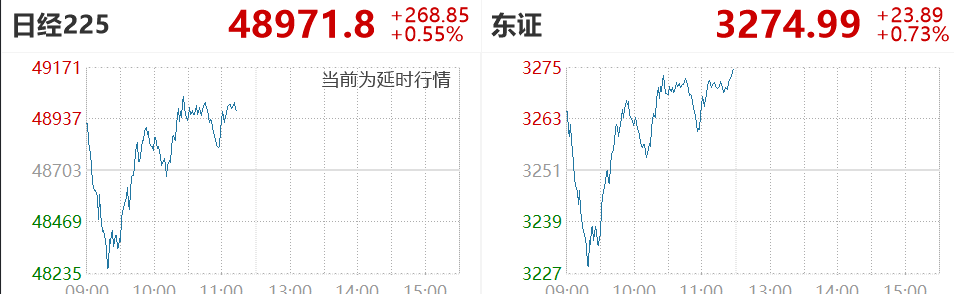
日韩股市深V反弹,A股三大指数翻红,超千股上涨,比特币重回9.2万美元
21世纪经济报道· 2025-11-19 03:23
Market Overview - Japanese and Korean stock markets showed a V-shaped recovery, with the Nikkei 225 index rising by 0.55% and the TOPIX index increasing by 0.73% as of 10:28 AM [1] - The KOSPI index in South Korea initially dropped by 2% but later recovered to a gain of approximately 0.01% [6] Individual Stocks Performance - Renesas Electronics fell over 4% due to the impact of a significant drop in US tech stocks, with other companies like Advantest, Tokyo Electron, and Nintendo also experiencing declines [3] - SoftBank Group saw an increase of over 2% [3] Bond Market Dynamics - Japan's new 10-year government bond yield rose to 1.76%, the highest since June 2008, while the 20-year yield reached 2.815%, the highest since June 1999 [4] - The increase in long-term interest rates is attributed to concerns over Prime Minister Fumio Kishida's expansionary fiscal policies potentially worsening the fiscal situation [5] Global Liquidity Impact - The rapid rise in Japanese government bond yields is closely linked to global liquidity, affecting capital flows, yen carry trades, and cross-market spillover effects [5] - Japan's net foreign assets amount to $3.7 trillion, and its government bond market exceeds $7.8 trillion, indicating a significant influence on global capital [5] Cryptocurrency Market - In the cryptocurrency sector, Bitcoin increased by over 1%, reaching a price of $92,000, while Ethereum rose by 2.5% and SOL by 5.38% [7] - The market experienced a liquidation event with approximately 116,000 individuals facing liquidation, totaling $415 million [7]

投顾晨报:震荡整固看风格,中盘蓝筹谋先机-20251118
Orient Securities· 2025-11-18 14:12
Market Strategy - The current market is expected to experience limited index growth, with a judgment of "fluctuating up and down, sideways consolidation, slightly strengthening" [7] - Mid-cap blue chips are anticipated to rise again after four years, presenting investment opportunities in manufacturing, consumption, and cyclical sectors [7] - Related ETFs include 中证 500ETF (159922) and 中证 1000ETF (512100) [7] Chemical Industry - Global chemical supply is expected to contract due to high costs and aging equipment, leading to a structural adjustment in the supply chain [7] - European chemical sales account for approximately 13% of the global market, but high energy costs and punitive carbon taxes are causing continued capacity exit [7] - Domestic production progress has slowed, and with the implementation of "anti-involution" policies, the chemical sector is likely to enter a new prosperity cycle [7] - Related stock: 万华化学 (600309, Buy) [7] - Related ETF: 化工 ETF (159870/516020) [7] Financial Technology - Hong Kong's "FinTech 2030" strategy marks a shift from application-focused development to a more systemic, forward-looking, and ecological approach [7] - This strategy emphasizes the collaborative development of data, AI, resilience, and tokenization, providing valuable insights for the high-quality development of mainland financial technology [7] - Related ETFs include 金融科技 ETF (159851/515720/159103) and 香港证券 ETF (513090) [7]

两只“黑天鹅”,突袭
Zheng Quan Shi Bao· 2025-11-18 06:51
Group 1: Market Overview - Global market sentiment has rapidly deteriorated, with significant declines across major indices including a drop of over 3% in the Nikkei 225 and more than 2% in the MSCI Asia-Pacific index [1] - The cryptocurrency market has also been severely impacted, with Bitcoin falling below $90,000 and Ethereum dropping below $3,000 [1] Group 2: U.S. Interest Rate Expectations - Market expectations have shifted from anticipating no rate cuts in December to a belief that there will be no cuts in the first half of next year, influenced by internal disagreements within the Federal Open Market Committee (FOMC) [3] - The likelihood of a rate cut in December is now estimated at 50%, with inflation risks remaining a primary concern for the Federal Reserve [3] Group 3: Japan's Economic Impact - Japan's 10-year government bond yield has surged above 1.75%, nearing its highest level since 2008, due to expectations of a large-scale fiscal stimulus plan from Prime Minister Fumio Kishida [5][7] - Kishida's proposed stimulus plan could exceed 17 trillion yen, raising concerns about Japan's already high public debt levels [7] - Japan's economy contracted by 1.8% in the third quarter, marking its first negative growth in six quarters, primarily due to a decline in exports influenced by U.S. tariffs [7] Group 4: Global Liquidity Concerns - The rise in Japanese government bond yields is closely linked to global liquidity, affecting capital flows and potentially leading to increased global borrowing costs [8] - Analysts warn that sustained increases in Japanese bond yields could lead to a "global financial apocalypse," tightening liquidity and dragging global growth down to 1% [8]

伦敦金陷区间震荡 四千美元阻力难破
Jin Tou Wang· 2025-11-06 03:11
Group 1 - The core viewpoint indicates that gold prices are closely linked to geopolitical and economic conditions, with upward trends often driven by geopolitical turmoil and weak U.S. economic performance [2] - Current downward risks for gold prices include improvements in the U.S. economy, a hawkish shift in Federal Reserve policy, strengthened fiscal discipline in the U.S., easing geopolitical tensions, and global central banks selling gold, but these risks are not currently significant [2] - Long-term, gold is expected to benefit from increased global liquidity and market preference amid a trend of de-globalization [2][3] Group 2 - The current gold market is in a state of fluctuation, with the $4000 level acting as a strong resistance barrier, making significant breakthroughs unlikely in the short term [4] - Technical analysis shows a bearish pattern in the 1-hour moving averages, adding downward pressure to gold prices, and a downward breakout has occurred after a period of consolidation [4] - The $3990-$4000 range remains a critical resistance area, and investors are advised to consider short positions if prices rebound and remain below $4000 [4]
黄金逆袭暗藏玄机!美联储提前停止缩表,全球流动性紧张超预期
Sou Hu Cai Jing· 2025-11-04 16:07
Group 1: Market Reactions and Trends - The financial market experienced an unusual reaction in late October, with gold prices rising despite positive trade developments between China and the U.S. [1][3] - Gold prices surged over 3% within three trading days following the trade announcement, breaking the $2900 per ounce mark, contrary to traditional expectations [3][5] - The rise in gold prices is attributed to its role as a warning signal regarding potential risks in the monetary credit system, rather than just geopolitical tensions [5][7] Group 2: Federal Reserve Actions - The Federal Reserve announced an unexpected early termination of its balance sheet reduction, moving the date from January 2026 to December 2025, indicating rising liquidity pressures in the market [9][11] - The reduction in bank reserves, which fell to $2.93 trillion in October, approached the Fed's lower threshold of $2.5-3 trillion, prompting the decision to halt the balance sheet reduction [11][13] - The Fed's actions reflect lessons learned from past financial crises, aiming to prevent a repeat of liquidity issues experienced in 2019 [13][15] Group 3: Financial System Vulnerabilities - The tightening liquidity environment has exposed vulnerabilities within the financial system, with rising non-performing loan rates among regional banks [15][17] - The U.S. Treasury's increased issuance of short-term debt to cover fiscal deficits has further strained bank reserves, contributing to a cycle of rising financing costs and reduced risk tolerance among smaller banks [17][19] - The Fed's strategy to shift funds from mortgage-backed securities to short-term Treasury bonds aims to enhance the stability of the financial system while preparing for potential future liquidity needs [19][21] Group 4: Global Market Implications - The Fed's decision to halt balance sheet reduction has provided relief to emerging markets, with a decrease in the dollar index and a narrowing of dollar bond spreads [21][23] - However, commodity markets have shown mixed reactions, with gold prices rising due to ongoing demand for currency credit hedging, while oil and industrial metals remain under pressure from weak global economic recovery expectations [21][25] - The ongoing adjustments in monetary policy and market dynamics suggest a need for investors to focus on long-term trends amidst short-term volatility [25]