
实际利率

Search documents
日本央行加息至30年最高利率水平,日元、日债难两全
Di Yi Cai Jing· 2025-12-19 04:10
Group 1 - The Bank of Japan (BOJ) unanimously decided to raise the benchmark interest rate to 0.75%, the highest level in 30 years, indicating a shift towards tightening monetary policy amid persistent inflation pressures [1][3] - The core consumer price index (CPI) in Japan rose by 3% year-on-year in November, remaining above the 2% inflation target for 44 consecutive months, signaling ongoing price pressures [1][3] - Prime Minister Fumio Kishida faces challenges due to rising living costs, leading to the introduction of various relief measures, including winter electricity subsidies and cash payments for children [1] Group 2 - Economists predict that the BOJ will continue to raise interest rates, with over two-thirds expecting rates to reach at least 1.0% by September next year, although there is significant disagreement on the timing and pace of future hikes [3] - The market anticipates that the next rate hike could occur as early as April 2026 if the yen weakens significantly, while others suggest a later date in October 2026 [3] - The BOJ's communication strategy will be crucial in managing market expectations and maintaining a delicate balance as it navigates the tightening cycle [6] Group 3 - The USD/JPY exchange rate fluctuated around 155.59, with concerns about Japan's fiscal situation and the potential for direct intervention to stabilize the currency [4] - Analysts suggest that while the BOJ's rate hike may provide some support for the yen, it could also exacerbate Japan's debt burden, with government debt exceeding 1,333.6 trillion yen, over 260% of GDP [5] - Rising interest rates could lead to increased borrowing costs for the Japanese government, with projections indicating that interest payments could rise significantly by 2028 [5] Group 4 - The market has already priced in the risks associated with the BOJ's rate hike, leading to a sell-off in Japanese bonds and a decline in the Nikkei 225 index [6] - Concerns exist that the BOJ's actions could reignite yen carry trade unwinding, impacting global market liquidity, although the anticipated impact is expected to be less severe than previous unexpected rate hikes [6]


日本央行:若经济和物价走势与预测一致 将继续上调政策利率
Sou Hu Cai Jing· 2025-12-19 03:35
日本央行一致通过政策决议。日本央行表示,预计实际利率将维持在显著低位。若经济和物价走势与预 测一致,并随着经济和物价改善,将继续上调政策利率。经济已温和复苏,尽管仍存在一些疲软迹象。 将从可持续、稳定实现2%通胀目标的角度出发,适时实施货币政策。工资和通胀很可能继续温和同步 上升。劳动力市场状况持续紧张,企业利润总体上仍处于高位。日本经济增长很可能较为温和。实现基 准情景的可能性一直在上升。即使在加息之后,实际利率仍处于深度负值区间。鉴于劳资双方在春季工 资谈判中考虑了相关因素,企业明年极有可能继续稳步加薪。即使在利率变动后,货币环境依然宽松, 支持经济。 ...
实现“物价回升”等目标,或需要更重视降息
Sou Hu Cai Jing· 2025-12-18 03:47
(本文作者阮加,北京交通大学中国金融研究中心主任) 刚刚结束的中央经济工作会议指出,"要继续实施适度宽松的货币政策。把促进经济稳定增长、物价合 理回升作为货币政策的重要考量,灵活高效运用降准降息等多种政策工具,保持流动性充裕,畅通货币 政策传导机制,引导金融机构加力支持扩大内需、科技创新、中小微企业等重点领域。" 结合两年政策部署来看,2024年中央经济工作会议强调"保持就业、物价总体稳定";2025年会议明确提 出"把促进经济稳定增长、物价合理回升作为货币政策的重要考量",这也是今年会议的新提法。据国家 统计局数据显示,2025年1—11月平均,全国居民消费价格与上年同期持平。既契合上年政策目标,也 为朝着新目标实现进一步上升预留了空间。 货币政策的主要任务是总需求管理,维持合理的物价则是达成这一任务的重要基础。通货膨胀率如同经 济体温,不能太高或太低。 适度通货膨胀率是经济活力的基础,也是经济增长、充分就业的基础。发达国家多将2%作为目标通胀 率,高增长发展中国家的通货膨胀率多高于3%。1992-2010年中国高增长时期年均通货膨胀率约为 5.2%,扣除物价因素后,同期实际GDP年均增长率约为10.32% ...
2026年中国货币政策展望:如何理解适度宽松
Zhong Xin Qi Huo· 2025-12-17 06:28
Investment consulting business qualification:CSRC License [2012] No. 669 投资咨询业务资格:证监许可【2012】669 号 中信期货国际化研究 | CITIC Futures International Research 2025-12-17 China Monetary Policy Outlook: Moderate Easing 2026 年中国货币政策展望:如何理解适度宽松 | 张 陆 | Zhang Lu | | 从业资格号 Qualification No:F03105230 | 投资咨询号 Consulting No.:Z0021341 | | --- | --- | --- | --- | --- | | 程小庆 | | Cheng Xiaoqing | 从业资格号 Qualification No:F3083989 | 投资咨询号 Consulting No.:Z0018635 | | 张菁 | Zhang Jing | | 从业资格号 Qualification No:F3022617 | 投资咨询号 Consulti ...
美国非农来袭 黄金多头能否守住阵地?
Jin Tou Wang· 2025-12-15 02:11
Group 1 - The core viewpoint is that gold prices have shown a strong upward trend, reaching historical highs, despite a slight pullback in late October, with an overall trend of oscillating upward [1] - In November, global physical gold ETFs saw an inflow of $5.2 billion, marking the sixth consecutive month of net inflows, indicating strong investor interest in gold [2] - The Federal Reserve's recent interest rate cut to a range of 3.50% to 3.75% has effectively lowered the opportunity cost of holding gold, providing strong support for gold prices [2] Group 2 - The increase in risk aversion and central bank gold purchases are reinforcing the characteristics of the gold market, which is marked by high volatility and an upward shift in price levels [2] - Employment data directly influences market perceptions of inflation persistence and monetary policy direction, impacting gold prices through the "dollar index - U.S. Treasury yields - real interest rates" transmission chain [2] - If employment data and wage growth significantly exceed expectations, it may enhance high interest rate expectations, potentially exerting downward pressure on gold prices [2] Group 3 - In the context of a confirmed interest rate cut cycle and loose market liquidity, the mid-term pricing anchor for gold is more inclined towards declining real interest rates and rising risk aversion [3] - There remains a divergence between the Federal Reserve's rate cut pace and market pricing, which could lead to a significant pullback in gold prices if subsequent data indicates a "slowdown or pause" in rate cuts [3] Group 4 - Last Friday, gold prices experienced a pullback after reaching highs, closing around 4300 due to profit-taking, but the overall strong trend remains intact [4] - The bullish logic for gold remains solid, suggesting a low-buy strategy with a focus on buying opportunities around 4283, setting a stop loss at 4270, and targeting resistance levels at 4316 and 4340 [4]
宏观:黄金定价的终极属性是什么?
2025-12-15 01:55
Summary of Key Points from Conference Call Industry Overview - The discussion revolves around the **gold market** and its pricing dynamics, particularly in the context of macroeconomic factors and historical trends. Core Insights and Arguments - **Gold Pricing Attributes**: Gold pricing is influenced by its three attributes: commodity, financial, and monetary, which correspond to inflation, opportunity cost, and credit system risk. The dominant factors vary across different periods [1][2][4] - **Historical Context**: The historical evolution of gold as a safe-haven asset is highlighted, with significant events such as the establishment of the gold standard, the Bretton Woods system, and the subsequent shift to floating exchange rates impacting its valuation [2][3][6] - **Current Market Dynamics**: In the current low-growth, high-debt environment, the risk-free status of the dollar and U.S. Treasuries is being questioned, enhancing gold's appeal as a safe-haven asset [1][7][8] - **Gold Bull Markets**: Three major gold bull markets are identified: - The first (2001-2012) was driven by global risk events and liquidity expansion, with gold prices increasing nearly sixfold [3] - The second (2007-2011) was fueled by the subprime mortgage crisis and subsequent quantitative easing, peaking at $1,900 per ounce [3] - The third (2018-present) is influenced by U.S.-China trade tensions, de-dollarization trends, and geopolitical conflicts, leading to significant increases in central bank gold purchases [3][8] Additional Important Content - **Investment Strategy Shifts**: Post-World War II, non-U.S. economies have shifted their strategies regarding gold and U.S. Treasuries, reflecting a declining trust in the dollar. This suggests a potential return to gold as a universal currency [6] - **Inflation and Gold**: Historical correlations between gold prices and inflation rates are noted, particularly during high inflation periods in the 1970s and 1980s, where gold served as a hedge against inflation [5] - **Future Outlook**: The current geopolitical landscape suggests that gold may be a more favorable investment choice compared to traditional risk-free assets, as the global power dynamics are in transition and technological advancements are still in early stages [7][8]
经济学家:日本央行下周加息“板上钉钉”,焦点转向未来路径与中性利率线索
Zhi Tong Cai Jing· 2025-12-12 01:01
Core Viewpoint - The Bank of Japan is expected to raise its policy interest rate to 0.75% next week, marking the first rate hike since January, as all 50 surveyed economists anticipate this change [1] Group 1: Interest Rate Expectations - The Bank of Japan is set to restart its rate hike cycle after pausing for several months to assess the impact of Donald Trump's tariff policies [1] - Approximately two-thirds of analysts believe the central bank will raise rates about every six months starting this month, while 20% expect only one hike per year [1] - The median forecast for the terminal rate of this rate hike cycle has risen to 1.25%, indicating expectations for two additional hikes after the initial increase [1] Group 2: Currency and Economic Factors - A significant 81% of economists attribute the weak yen as a primary factor prompting the Bank of Japan to signal a rate hike [3] - The yen's depreciation has raised concerns about further inflation due to more expensive imports, leading to increased pressure on the central bank to act [2] - The Prime Minister's government has not opposed the rate hike, with 98% of respondents indicating that the yen's exchange rate is a key factor preventing pressure on the Bank of Japan to halt rate increases [3] Group 3: Market Reactions and Concerns - The 10-year government bond yield is hovering around 2%, the highest level since 2006, raising concerns about Japan's fiscal health and increasing government debt servicing costs [4] - Approximately 71% of economists believe that a new economic plan, which allocates 17.7 trillion yen (approximately 113 billion USD) to mitigate inflation, is overly ambitious [4] - Analysts warn that if the 10-year yield continues to rise, the Bank of Japan may become hesitant to pursue further rate hikes [4]
中国11月外汇储备规模环比上涨0.09%,央行连续第13个月增持黄金
Sou Hu Cai Jing· 2025-12-07 02:35
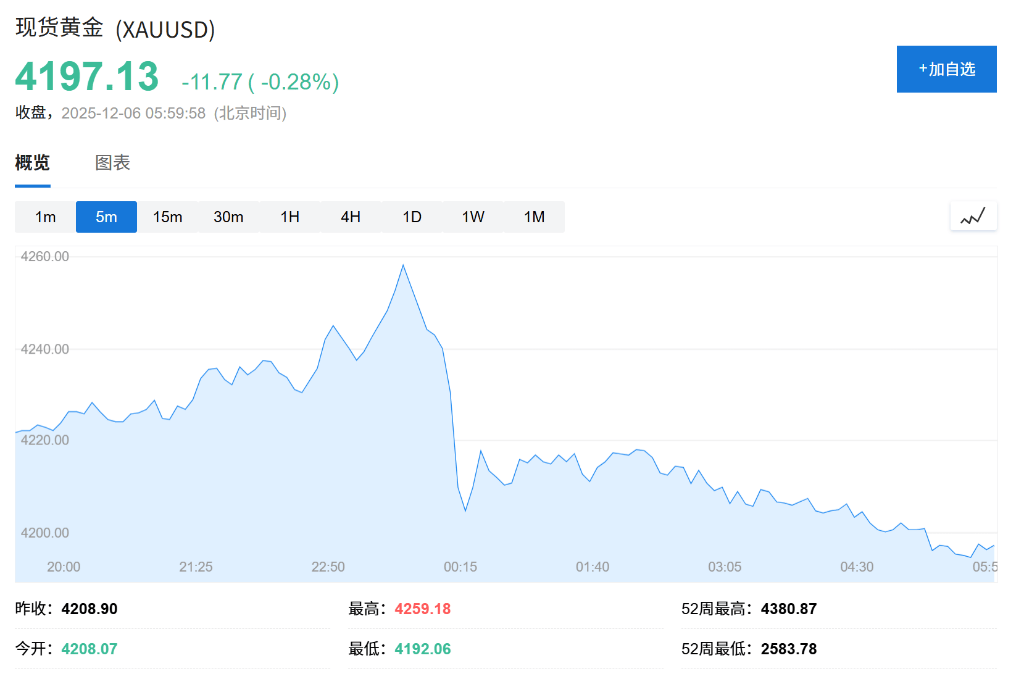
Group 1: Foreign Exchange Reserves - As of November 2025, China's foreign exchange reserves reached $33,464 billion, an increase of $30 billion from the end of October, representing a growth rate of 0.09% [1] - The increase in foreign exchange reserves is attributed to factors such as macroeconomic data from major economies and expectations regarding monetary policy, which led to a decline in the US dollar index and mixed performance in global financial asset prices [1] - China's economy is maintaining a stable and progressive development trend, which supports the stability of foreign exchange reserves [1] Group 2: Gold Reserves - As of the end of November, China's gold reserves stood at 7,412 million ounces (approximately 2,305.39 tons), with a month-on-month increase of 3,000 ounces (about 0.93 tons), marking the 13th consecutive month of gold accumulation [2] - The current spot gold price has decreased by 0.28% to $4,197 per ounce [2] Group 3: Gold Market Dynamics - Gold has entered its third upward cycle since 2019, with a cumulative increase of 219% over six years, indicating potential for further growth compared to previous cycles [3] - The rise in gold prices is supported by three attributes: monetary (challenges to the US dollar credit system), commodity (average annual growth of central bank gold purchases from 2020 to 2024 at 44%), and financial (the pricing framework of real interest rates partially failing in a high inflation environment) [3] - Key variables influencing future gold prices include geopolitical risks, growth in gold reserves, and changes in real interest rates [3] Group 4: Future Gold Demand and Price Projections - Official demand for gold is expected to replace price-sensitive consumer demand, with projections indicating a rebound to 1,053 tons per year by 2026 [4] - The normalization of inflows into gold ETFs has led to a significant upward revision of the average price target for 2026 from $4,000 per ounce to $4,450 per ounce [4]
疯狂反转白银暴跌释放什么信号
Jin Tou Wang· 2025-12-05 04:02
Core Viewpoint - The recent volatility in silver prices is attributed to profit-taking after reaching record highs, indicating a potential market correction phase [1][2]. Group 1: Market Dynamics - On December 4, silver prices fell sharply by nearly 3% after hitting a historical high of $58.96, reflecting aggressive profit-taking by traders [1]. - The current silver price is reported at $57.42 per ounce, showing a slight increase of 0.57% despite the recent downturn [1]. - The market is expected to test the 50% retracement level at $53.81, with the 50-day moving average at $50.45 serving as a key trend indicator [1]. Group 2: Economic Influences - The recent sell-off in silver is linked to strong U.S. economic data and comments from Federal Reserve officials that downplay aggressive rate cuts, which could negatively impact non-yielding assets like silver [2]. - The U.S. Treasury market saw a decline, with the 10-year yield rising by 5.2 basis points to 4.108%, indicating a shift in investor sentiment ahead of the Federal Reserve meeting [1]. Group 3: Technical Analysis - Silver prices are currently oscillating below trendline resistance, with bullish momentum weakening but still supported by various moving averages [3]. - Key support levels to watch for silver prices are $56.45 and $55.70, while resistance levels are at $57.65 and $58.00 [3].
美初请数据创三年新低 获利了结施压白银
Jin Tou Wang· 2025-12-05 02:38
Group 1 - The core viewpoint of the articles indicates that silver prices are experiencing fluctuations, with a recent slight increase observed, while market sentiment remains sensitive to strong U.S. economic data and Federal Reserve officials' comments [1][2] - Silver prices reached a peak of $57.27 per ounce and a low of $56.85 per ounce, with a current price of $57.22 per ounce, reflecting a 0.22% increase [1] - The recent sell-off in silver was attributed to profit-taking after a significant price surge to record highs, leading to a 2.32% drop to $57.09 per ounce [1] Group 2 - The U.S. Labor Department reported that initial jobless claims unexpectedly fell to 191,000, the lowest level in over three years, significantly below the economists' expectation of 220,000, indicating a decrease of 27,000 claims [2] - The unadjusted claims dropped nearly 50,000 to 197,221, exceeding model expectations, particularly in states like California, Texas, and New York [2] - Continuing claims also decreased by 4,000 to 1.939 million, suggesting that the labor market is maintaining stability and not facing stagnation risks [2]