
政策调控

Search documents
房子跌价了快一半,还有机会涨回来吗?
Sou Hu Cai Jing· 2025-08-11 11:38
Core Viewpoint - The potential for housing prices to rebound after a nearly 50% decline depends on various macroeconomic and market factors, with a low likelihood of a short-term surge, although certain local areas or prime locations may still have upward potential [1]. Group 1: Policy Regulation - Policy easing, such as the cancellation of purchase restrictions and relaxed loan conditions, could stimulate market recovery, but this is contingent on whether residents can bear the current high leverage ratios [4]. - Currently, high leverage ratios limit the space for significant price increases [4]. Group 2: Population Flow Trends - In the long term, the continuous migration of the population towards urban core areas will create supply shortages in certain locations, driving prices up; however, this is dependent on the technology cycle and economic growth momentum [4]. Group 3: Market Adjustment Demand - The removal of market bubbles, such as a 30-40% drop in housing prices, could activate genuine demand and increase transaction volumes; however, the overall surplus issue constrains rapid rebounds [4]. - The opportunity for housing price recovery mainly exists in areas with population inflows, requiring support from inflation or technological breakthroughs; investors should pay attention to policy trends and regional differences [4].


多晶硅:供需失衡矛盾扩大,PS2511区间震荡
Sou Hu Cai Jing· 2025-08-06 12:13
Core Viewpoint - The monthly supply-demand imbalance in the polysilicon market is widening, with potential changes in market dynamics depending on policy adjustments regarding export tax rebates [1] Group 1: Supply and Demand Dynamics - The supply-demand imbalance in the polysilicon market is becoming more pronounced, although the fundamental feedback remains limited [1] - If policy measures effectively promote capacity clearance, it could reverse the current fundamental market conditions [1] Group 2: Market Sentiment and Trading - The increase in warehouse receipts and sufficient factory inventory enhances the attractiveness of hedging, leading to a gradual increase in warehouse receipt volume, although it remains limited [1] - The market sentiment is reflected in high positions and low warehouse receipts, indicating a potential struggle between these factors [1] Group 3: Price Levels and Market Trends - The "anti-involution" theme shows no actual progress in capacity storage details, compounded by policy adjustments at the trading level [1] - The price of PS2511 faces significant pressure around 54,000 yuan/ton, with clear support near 48,000 yuan/ton, suggesting a potential range-bound trading pattern [1] - Attention is drawn to the sentiment transmission of the main "anti-involution" variety, coking coal, emphasizing the need for position risk control [1]
氧化铝 中期追涨风险较大
Qi Huo Ri Bao· 2025-07-30 01:54
Group 1 - The recent inspection of outdated capacity in the petrochemical industry has reinforced market expectations for alumina production cuts, with 45% of alumina production facilities being over 10 years old [1] - Despite the clear oversupply in the alumina industry and the necessity for capacity clearance, the actual scale of capacity exit is expected to be limited due to high integration among enterprises and a long-term pricing model [1][4] - The alumina industry is still in an expansion phase, with new capacity expected to exceed 13 million tons in 2025, despite the implementation of stricter capacity approval processes [1][2] Group 2 - The Guinean government has suspended aluminum ore exports from EGA and revoked mining licenses, but the main goal is to regulate mining activities rather than to prohibit them [2] - The Guinean mining policy emphasizes "resource for industry," requiring mining companies to build alumina refineries locally and mandating that 50% of bauxite exports be transported by local shipping companies [2] - The impact of Guinean policies on bauxite export volumes is expected to be limited in the short term, with local alumina capacity anticipated to materialize mainly after 2026 [2] Group 3 - China's dependence on imported bauxite is approximately 75%, with 70% of imports coming from Guinea, making changes in Guinean policy significant for domestic supply [3] - Despite seasonal fluctuations in bauxite shipments during the rainy season, domestic inventory levels remain high, with port inventories reaching 28.44 million tons, sufficient to meet four months of consumption [3] - The increase in domestic bauxite inventory is expected to offset the impact of seasonal shipment declines from Guinea, maintaining stable raw material supply and cost prices [3] Group 4 - The continuous increase in spot inventory and the decline in warehouse receipts are contributing to the rise in alumina prices, with recent futures price increases likely to enhance registration willingness for warehouse receipts [4] - As of July 18, domestic alumina inventory reached 3.989 million tons, continuing an upward trend, while production is also on the rise [4] - Short-term bullish factors for alumina are concentrated, but the medium-term outlook remains uncertain due to the persistent oversupply situation in the industry [4]
碳酸锂连续第二日大幅下跌!但反内卷举措尚未结束,后市仍需关注价格反弹机会?
Jin Shi Shu Ju· 2025-07-29 11:35
恒银期货:碳酸锂价格或维持弱势震荡,需关注库存去化及反内卷政策落地情况 全球锂资源供应格局也在发生变化。非洲锂矿加速投放市场,6月中国锂辉石进口中非洲占比已达 48%,且512.9美元/吨的均价较澳矿低27%,直接压制国内锂云母提锂成本。紫金天风期货指出:"随着 锂矿收紧的口径开始放松,即江西电池大厂自有锂矿或能实现续证,叠加反内卷情绪稍有降温,锂价开 启了加速下跌。"需求端表现分化:呈现"淡季不淡"但增量有限的特点 需求方面呈现"淡季不淡"但增量有限的特点。乘联会数据显示,7月新能源乘用车零售量预计达101万 辆,渗透率达54.6%,但总销量185万辆,环比下降11.2%。 储能市场成为需求亮点,全球储能电池出货量同比增长45%,但磷酸铁锂电池对碳酸锂单耗较动力电池 低30%,实际拉动有限。消费电子领域,华为、三星等旗舰机型采用镁合金替代部分锂材,进一步削弱 了3C领域的需求弹性。紫金天风期货数据显示,截至7月24日,磷酸铁锂库存环比-168吨至94878吨,显 示下游采购仍显谨慎。库存压力持续累积:供需失衡是压制价格的核心因素 碳酸锂库存持续攀升至14.32万吨,对价格形成明显压制。具体来看,上游环节减少 ...
从政策 环保 猪价 三个维度演绎生猪板块持续性
2025-07-22 14:36
Summary of Key Points from Conference Call Industry Overview - The conference call focuses on the pig farming sector, particularly the impact of policies, environmental regulations, and market dynamics on the industry [1][2][3]. Core Insights and Arguments - **Policy Impact**: Government policies aim to stabilize pig prices and CPI through measures like production limits and environmental regulations, which may extend the industry's profitability cycle [1][2][3]. - **Environmental Regulations**: Nationwide environmental rectification is being implemented, requiring companies to meet compliance standards to avoid penalties or shutdowns. Compliance is crucial for sustainable development [1][5]. - **Price Forecast**: Future pig prices are expected to fluctuate between 14-16 RMB/kg, influenced by breeding increments, weight reduction effects, market demand, and frozen meat indicators. Effective production limits could extend the profitability cycle into next year [1][6]. - **Company Performance**: Companies like DeKang, Muyuan, and Bangji Technology are performing well under current conditions. DeKang has cost and volume advantages, Muyuan is reducing costs and exceeding profit expectations, while Bangji is expanding its industry chain [1][7]. - **Industry Transition**: Pig farming enterprises should actively adjust and transform by utilizing idle capacity, optimizing production structures, and enhancing environmental compliance to adapt to new policies and improve competitiveness [1][8]. Additional Important Content - **Agricultural Sector Growth**: Recent surges in agricultural stocks and futures are attributed to intensified policy support aimed at eliminating inefficient production capacity and stabilizing the industry [2]. - **Current Pig Cycle**: The current pig cycle began in March 2024, with a peak in August 2024. The cycle has been compressed due to African swine fever, but limited production increases and ongoing de-capacity efforts may prolong profitability [3][9]. - **Innovative Models**: The industry is seeing innovative models such as partnerships with farmers, family farm arrangements, and light-asset models, which are becoming standardized and cost-effective [10][11]. - **Core Competitiveness**: Cost control is identified as the core competitiveness for pig farming enterprises, with a focus on seed resources, management levels, feed quality, and innovative models [12]. - **Company Recommendations**: DeKang is highlighted for its robust gene pool and policy alignment, with a potential market space of 500-1,000 billion RMB. Muyuan is noted for its strong innovation and profitability, while Bangji Technology is expected to grow its market value significantly [13][15]. - **Future Price Trends**: The pig farming sector is expected to see stock price increases in the next three months, driven by strong policy support and company innovations [16]. - **Environmental Policy Trends**: The ongoing environmental policies are expected to continue shaping the industry, with gradual implementation rather than abrupt shutdowns [19]. - **Market Dynamics**: The slight increase in the number of breeding sows aligns with market trends, and the sector's performance is influenced by policy and environmental factors rather than solely by breeding dynamics [21]. Company-Specific Insights - **DeKang's Growth Potential**: DeKang is projected to have a market potential exceeding 1,000 billion RMB, with significant growth in output expected in the coming years [26][29]. - **Muyuan's Profitability**: Muyuan's strong profitability and dividend potential make it a suitable candidate for investment, especially as the industry consolidates [20]. - **Bangji's Strategic Development**: Bangji is focused on establishing a complete industry chain, with significant growth potential in both feed and pig farming sectors [14][15][22]. This summary encapsulates the critical insights and developments within the pig farming industry as discussed in the conference call, highlighting the interplay between policy, environmental factors, and company performance.


黑色建材日报:市场情绪缓和,黑色震荡转强-20250710
Hua Tai Qi Huo· 2025-07-10 05:09
Report Industry Investment Rating No relevant information provided. Core Viewpoints - The market sentiment has eased, and the black market has shifted from a volatile to a stronger trend. The steel market is facing weak demand during the off - season, which suppresses steel prices. The iron ore market shows a short - term rebound but a long - term supply - demand loosening pattern. The coking coal and coke market has tightened supply, leading to upward price movements. The thermal coal market has short - term price fluctuations and a long - term supply - loose situation [1][3][5][7]. Summary According to Related Catalogs Steel - **Market Analysis**: The futures prices of rebar and hot - rolled coils are 3063 yuan/ton and 3190 yuan/ton respectively. The spot steel market has general transactions, with rebar being weak and prices remaining stable. The national building materials transaction volume is 8.9 tons. The steel production and demand have decreased, and the total inventory has increased. The hot - rolled coil production has slightly increased, consumption has decreased, and inventory has slightly increased. The export of plates remains high, but there are concerns about future consumption. The market sentiment has been boosted by the meeting of the Central Financial and Economic Commission, but the lack of speculative demand and off - season weak demand will continue to suppress steel prices [1]. - **Strategy**: The unilateral strategy is to expect a volatile market, and there are no strategies for inter - period, inter - variety, spot - futures, and options trading [2]. Iron Ore - **Market Analysis**: The futures price of iron ore has a slight increase, with the main 2509 contract closing at 736.5 yuan/ton, a 0.68% increase. The spot price of imported iron ore in Tangshan Port has a slight increase, and the market trading sentiment is not good. The total transaction volume of iron ore in major ports is 94.2 tons, a 5.71% decrease from the previous day, and the forward - spot transaction volume is 156.0 tons. The global iron ore shipment has temporarily declined, and the molten iron production has decreased but is still at a relatively high level. In the short term, the iron ore price has rebounded, and the discount on the futures market has been significantly repaired. In the long term, the supply - demand pattern is loose [3]. - **Strategy**: The unilateral strategy is to expect a volatile market, and there are no strategies for inter - period, inter - variety, spot - futures, and options trading [4]. Coking Coal and Coke - **Market Analysis**: The prices of coking coal and coke in the futures market have increased. The spot price of coking coal in the main production areas is stable, and the terminal procurement is on - demand. The import market is stable and strong. The supply of coking coal has tightened, and the industry inventory is at a low level. The demand for coke has certain support, and the port inventory has been decreasing. Policy expectations also support the market [5][6]. - **Strategy**: The unilateral strategy for coking coal and coke is to expect a volatile market, and there are no strategies for inter - period, inter - variety, spot - futures, and options trading [6]. Thermal Coal - **Market Analysis**: The price of thermal coal in the main production areas is volatile. The procurement of chemical and large - scale terminal users is stable, and the port market is stable. The market sentiment is fluctuating, and the trade volume has decreased. The port inventory is declining, and the high - quality supply has a firm price. The high temperature in the south has increased the power demand, and the price has a certain support. The high - calorie Australian coal has a price inversion, while the low - calorie Indonesian coal has a cost - effective advantage. In July, the coal production capacity is gradually released, and the demand is expected to increase in the short term. In the long term, the supply is loose [7]. - **Strategy**: No strategy is provided [7].
地产图谱|上半场北上广深杭蓉“撑场”,改善型楼盘热度高
Bei Ke Cai Jing· 2025-07-08 13:28
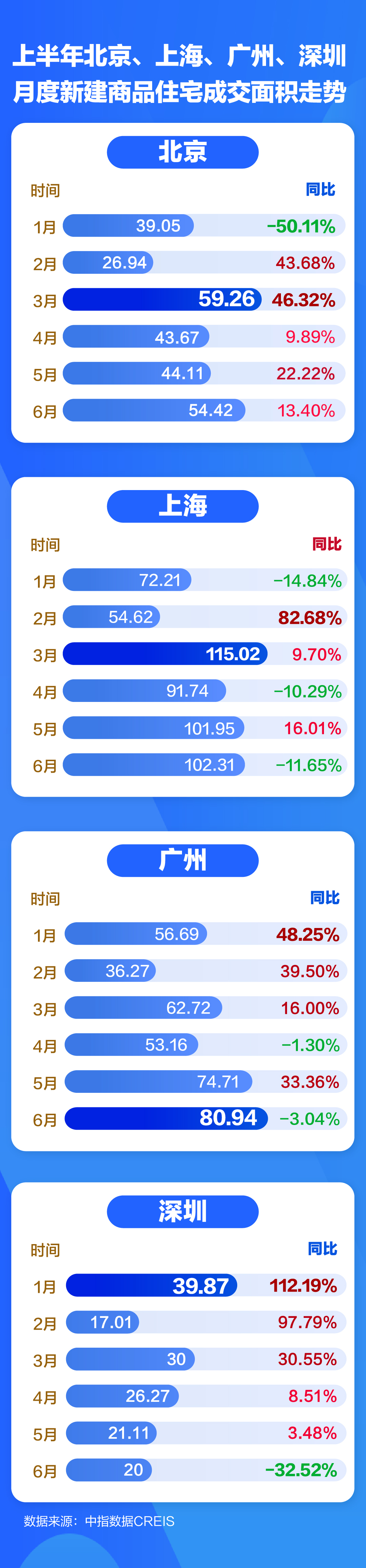
Market Overview - The real estate market in 2025 is experiencing a significant divergence, with a recovery trend in the first quarter followed by a weakening in the second quarter [1] - First-tier and strong second-tier cities are showing stable performance, while third and fourth-tier cities are generally declining [1] New Housing Market - In the new housing market, the transaction area of 120-144 square meter units in 30 cities has reached 30% for the first time [2] - Major cities like Beijing and Shanghai saw slight year-on-year growth in new residential sales, while Guangzhou and Shenzhen experienced over 15% growth [2] - The supply of new homes is decreasing, leading to a shorter clearing cycle as the market continues to deplete inventory [2] - High-priced improvement projects are performing well in cities like Beijing, Shanghai, Nanjing, and Chengdu, indicating a strong demand for upgraded housing [2] Second-Hand Housing Market - The second-hand housing market remains active, with Shenzhen seeing over 30% year-on-year growth, while Beijing, Shanghai, and Guangzhou experienced around 20% growth [6] - However, since May, the market has shown signs of cooling, with a decline in transaction volumes in June for first-tier cities [7] Price Trends - New housing prices have seen a slight increase of 1.16% in the first half of 2025, while second-hand housing prices have dropped by 3.60% [14] - The average price of second-hand residential properties has been in continuous decline for 38 months, with a 0.75% drop in June [14] Future Outlook - The real estate market is expected to continue its divergence, with policy factors playing a crucial role [19] - Supply in July is projected to decrease by 30% year-on-year, particularly affecting first-tier cities [19] - The market is likely to maintain low transaction volumes, but a potential narrowing of year-on-year declines is anticipated due to last year's low base [19] - The performance of high-quality projects is expected to stabilize the new housing market in core cities, but overall market conditions remain weak [24]
黄瑜:总结上半年市场形势,预判下半年市场变化
Sou Hu Cai Jing· 2025-07-07 00:20
Core Insights - The Chinese real estate market is experiencing a mixed performance in 2025, with a decline in second-hand housing prices and a slight increase in new housing prices driven by demand for improved housing options [4][6][13]. Market Overview - The China Real Estate Index System has been tracking market changes since 1994, providing semi-annual summaries and forecasts to guide the industry [4]. - In the first half of 2025, the average price of second-hand homes in 100 cities fell by 3.60%, while new home prices increased by 1.16% due to the release of demand for improved housing [4][13]. - Nationally, new residential sales area decreased by 2.9% year-on-year from January to May 2025, although the decline was less severe compared to the previous year [5][14]. Sales Performance - The top 100 real estate companies saw a sales revenue decline of 11.8% in the first half of 2025, indicating ongoing pressure on sales performance [5][31]. - The proportion of new homes sold in key cities remains stable, with a notable increase in the sales of larger units (120-144 square meters) [5][20]. Land Market Dynamics - In the first half of 2025, the land transfer revenue for residential land in 300 cities increased by 27.5%, despite a 5.5% decrease in transaction area [4][28]. - The top 20 cities accounted for 68% of the national land transfer revenue, indicating a concentration of land market activity in major urban centers [4][28][29]. Policy and Future Outlook - Government policies are expected to play a crucial role in stabilizing the real estate market, with initiatives aimed at activating demand and optimizing supply [6][34]. - The forecast for total new residential sales in 2025 is approximately 900 million square meters, with market differentiation expected to become more pronounced [6][39]. - Companies are advised to focus on high-quality projects and adapt to new market conditions to ensure sustainable growth [7][42].

买菜大妈一番话,道破“楼市真相”,众人坦言:多数人都没她清醒
Sou Hu Cai Jing· 2025-06-30 05:10
Core Viewpoint - The Chinese real estate market is undergoing a significant transformation, moving from a period of rapid growth and investment to a phase characterized by price declines and oversupply, indicating the potential end of the housing bubble [1][4]. Market Situation - The current average housing price in China has decreased from 11,000 yuan per square meter in the first half of 2021 to 9,560 yuan per square meter by the end of June 2023, reflecting a substantial drop in property values [1]. - Many provincial capital cities, such as Zhengzhou, Tianjin, and Shijiazhuang, have experienced notable price declines, with some prices reverting to levels seen three to five years ago [1]. - The market is facing a stark contrast between the influx of new and second-hand homes and the shrinking demand for purchases, driven by the retreat of investment demand, the end of large-scale urban renewal projects, a slowdown in urbanization, and an aging population [1]. Historical Context - At its peak, 96% of Chinese households owned at least one property, with 41.5% owning two or more, fueled by rising property prices and the social importance of real estate for residency, education, and marriage [3]. - From 1998 to the first half of 2021, housing prices surged from 2,000 yuan per square meter to 11,000 yuan per square meter, a staggering increase of 5.5 times, significantly outpacing the growth of household income during the same period [3]. Future Outlook - The government is implementing a series of policies to regulate the real estate market, including the gradual introduction of property taxes, which will increase the holding costs for multiple property owners and may lead to further market supply increases [6]. - The construction of affordable housing is accelerating, providing more options for low- and middle-income families, thereby reducing pressure on the demand for commercial housing [6]. - Overall, the Chinese real estate market is experiencing a profound adjustment, with price declines, oversupply, regulatory measures, and increased affordable housing pointing towards a gradual deflation of the housing bubble and a trend of returning housing prices to their fundamental residential value [6].

东兴证券:关注交运基本面和政策调控带来变化 重视周期底部行业价格弹性
智通财经网· 2025-06-13 02:43
Core Viewpoint - The transportation sector faces both challenges and opportunities in the second half of the year, with a pessimistic market outlook for some cyclical industries presenting potential investment opportunities [1] Group 1: Express Delivery Sector - Intense price competition in the express delivery sector, particularly among leading companies Zhongtong and Yuantong, is likely to impact future pricing levels [2] - The overall performance of the express delivery industry has seen profit declines due to heightened price wars, with volume growth not fully offsetting the drop in per-package profitability [2] - The current low market expectations for the express delivery sector suggest it is at a cyclical bottom, but a shift towards "anti-involution" and high-quality development is anticipated, making it a sector worth monitoring [2] Group 2: Aviation Sector - Despite pressure on profits in the first quarter, the aviation industry is expected to rebalance supply and demand, aided by the Civil Aviation Administration's guidance [3] - The upcoming peak season is projected to show strong upward elasticity for airline stocks, with potential price increases driven by high load factors and effective supply management [3] - Current valuations for the aviation sector are near historical lows, indicating potential for recovery and profit improvement [3] Group 3: Highway Sector - The valuation of the highway sector in A-shares is relatively high, prompting a shift in investment focus towards Hong Kong stocks [4] - A-share prices for highway companies are trading at over a 50% premium compared to their H-share counterparts, with H-shares showing better performance year-to-date [4] - Long-term benefits from a declining interest rate environment are expected for the highway sector, which is characterized by stable earnings and a strong dividend payout [4]
