
社会融资规模

Search documents
金融数据超预期修复——6月金融数据点评
Sou Hu Cai Jing· 2025-07-19 03:06
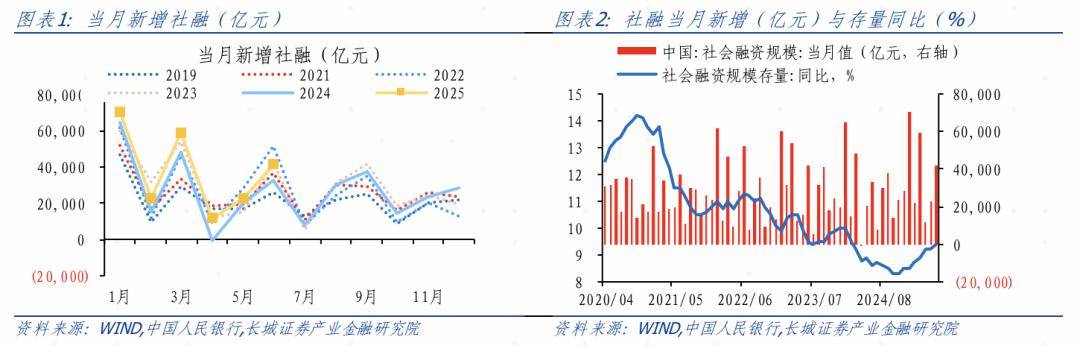
Core Viewpoint - The financial data for June indicates a significant increase in M1 and M2 growth rates, reflecting heightened liquidity and economic activity, primarily driven by government financing and seasonal factors, while consumer confidence remains cautious [1][2][3]. Group 1: Monetary Data - In June, the new social financing scale reached 4.2 trillion yuan, an increase of 900 billion yuan year-on-year, with a year-on-year growth rate of 8.9% for the social financing stock, up from 8.7% [1][2]. - M1 growth accelerated from 2.3% in May to 4.6% in June, while M2 increased from 7.9% to 8.3%, indicating improved liquidity and economic activity [1][3]. - The M2-M1 gap narrowed to 3.7% from 5.6% in the previous month, suggesting a more optimistic market outlook and enhanced production and consumption investment intentions [1][3]. Group 2: Financing Data - Government bond issuance remains robust, with net financing of 1.3548 trillion yuan in June, a year-on-year increase of 507.2 billion yuan, contributing to a total issuance of 7.66 trillion yuan in the first half of the year, which is 65% of the annual target [2][4]. - Corporate loan demand showed signs of recovery, with new corporate loans in June totaling 1.77 trillion yuan, an increase of 140 billion yuan year-on-year, indicating a strong seasonal performance [4][5]. - Resident loans increased moderately, with short-term loans rising due to seasonal consumption patterns, but overall performance remains weak compared to historical averages [5].

6月金融数据点评:新增社融及信贷均超预期
Tai Ping Yang Zheng Quan· 2025-07-18 02:43
Group 1: Financial Data Overview - In June, China's social financing scale increased by 41,993 billion RMB, exceeding the expected 37,051 billion RMB and the previous value of 22,870 billion RMB[6] - New RMB loans in June amounted to 22,400 billion RMB, surpassing the expected 18,447 billion RMB and the previous value of 6,200 billion RMB[6] - M2 growth in June was 8.3%, higher than the expected 8.1% and the previous value of 7.9%[4] Group 2: Credit and Financing Trends - New credit in June was 22,400 billion RMB, with a year-on-year increase of 1,100 billion RMB, although still below seasonal averages[11] - Short-term loans contributed significantly to the increase, with a year-on-year rise of 1,334 billion RMB[16] - Government bond financing in June reached 13,508 billion RMB, a year-on-year increase of 5,032 billion RMB, supporting overall social financing[35] Group 3: M1 and M2 Analysis - M1 increased by 4.6% year-on-year, a significant rise of 2.3 percentage points from the previous month[37] - Total deposits in June increased by 32,100 billion RMB, with a year-on-year increase of 7,500 billion RMB[37] - Resident deposits rose by 3,300 billion RMB year-on-year, while non-financial corporate deposits increased by 7,773 billion RMB[37]
瑞达期货国债期货日报-20250716
Rui Da Qi Huo· 2025-07-16 11:47
1. Report Industry Investment Rating - No relevant information provided 2. Core View of the Report - The current core combination of "weak economic recovery + low inflation" remains unchanged, and the loose liquidity continues, which still provides positive support for the bond market. In the short term, the upside and downside space of yields is limited, and it is expected that Treasury bond futures will continue to fluctuate. Given that there is no directional turn in the policy environment and fundamentals, investors are advised to maintain a certain position [2] 3. Summary According to Relevant Catalogs 3.1 Futures Disk - T, TF, and TL main contract closing prices decreased by 0.05%, 0.01%, and 0.05% respectively, while the TS main contract closing price increased by 0.01%. The trading volumes of T, TF, TS, and TL main contracts decreased by 1203, 616, 81, and 2014 respectively [2] 3.2 Futures Spreads - The spreads of TL2512 - 2509, T2512 - 2509, TF2512 - 2509 increased by 0.01, 0.04, and 0.02 respectively, while the spread of TS2512 - 2509 remained unchanged. The spreads of T09 - TL09 remained unchanged, and the spreads of TF09 - T09, TS09 - T09, TS09 - TF09 increased by 0.03, 0.06, and 0.03 respectively [2] 3.3 Futures Positions - The main contract positions of T, TF, TS, and TL decreased by 2732, 3823, 718, and 2238 respectively. Among the top 20 long - positions, T and TS decreased by 1044 and 793 respectively, while TF and TL increased by 603 and 412 respectively. Among the top 20 short - positions, T decreased by 184, TF decreased by 730, TS decreased by 25, and TL increased by 170. The net short - positions of T and TS increased by 860 and 768 respectively, while those of TF and TL decreased by 1333 and 242 respectively [2] 3.4 CTD (Clean Price) - The clean prices of 250007.IB, 240020.IB, 210014.IB decreased by 0.0380, 0.0175, 0.0832 respectively, while the clean prices of 220010.IB, 250006.IB, 240010.IB, 210005.IB increased by 0.0168, 0.0262, 0.0090, 0.0637 respectively [2] 3.5 Active Treasury Bond Yields - The yields of 3y, 5y, 7y, 10y decreased by 1.25bp, 1.30bp, 1.65bp, 1.11bp respectively, while the 1y yield remained unchanged [2] 3.6 Short - term Interest Rates - The silver - pledged overnight rate increased by 17.02bp, while the Shibor overnight rate decreased by 6.90bp. The silver - pledged 7 - day and 14 - day rates decreased by 4.43bp and increased by 2.00bp respectively, and the Shibor 7 - day and 14 - day rates decreased by 4.20bp and 2.00bp respectively [2] 3.7 LPR Rates - The 1y and 5y LPR rates remained unchanged [2] 3.8 Open Market Operations - The issuance scale was 520.1 billion yuan and 444.6 billion yuan, and the maturity scale was 75.5 billion yuan, with an interest rate of 1.4% for 7 - day [2] 3.9 Industry News - In June, the industrial added value of large - scale industries increased by 6.8% year - on - year, and the total retail sales of consumer goods was 4228.7 billion yuan, a year - on - year increase of 4.8%. In the first half of 2025, the national fixed - asset investment (excluding rural households) was 24865.4 billion yuan, a year - on - year increase of 2.8%, and the fixed - asset investment in June decreased by 0.12% month - on - month. From January to June, the national real estate development investment was 4665.8 billion yuan, a year - on - year decrease of 11.2%. In the first half of the year, the total value of China - US imports and exports was 2.08 trillion yuan, a year - on - year decrease of 9.3%, among which exports decreased by 9.9% and imports decreased by 7.7%. The China - US trade turned from a year - on - year increase in the first quarter to a year - on - year decrease in the second quarter, with a decline of 20.8% [2] 3.10 Market Performance - On Wednesday, Treasury bond cash bonds showed mixed trends. The yields of 1 - 3Y bonds decreased by about 0.25 - 0.85bp, the yields of 5 - 7Y bonds increased by about 0.50bp, and the yields of 10Y and 30Y bonds increased by about 0.30bp and 0.50bp respectively. Most Treasury bond futures declined, with the TS main contract rising by 0.01%, and the TF, T, TL main contracts falling by 0.01%, 0.05%, 0.05% respectively [2] 3.11 Domestic Fundamentals - In June, industrial added value and retail sales showed a slight recovery, the scale of fixed - asset investment continued to shrink, and the unemployment rate remained the same as the previous month. In terms of financial data, social financing increased more than expected, credit demand improved marginally, and the activity of deposits increased. In June, affected by the progress of China - US trade negotiations, imports and exports increased significantly year - on - year. The price level continued to be under pressure, with CPI improving marginally and PPI falling into deflation for 7 consecutive months [2] 3.12 Overseas Situation - In June, the US core CPI was continuously lower than expected, but due to the recent US tariff policy, inflation risks continued to rise. There were greater differences within the Fed regarding the impact of tariffs on the inflation path, but the policy tone remained cautious and wait - and - see, and there was no consensus on the expectation of interest rate cuts [2]

银行行业观察:信贷同比多增1.1万亿,M1增速跃升2.3个百分点
Sou Hu Cai Jing· 2025-07-16 06:25
Group 1: Social Financing and Credit - In June, the social financing scale increased by 4.2 trillion yuan, a year-on-year increase of 901.6 billion yuan, primarily supported by government bonds and short-term corporate loans [1] - Net financing of government bonds reached 1.35 trillion yuan, a year-on-year increase of 507.2 billion yuan, indicating sustained fiscal policy efforts [1] - New RMB loans amounted to 2.36 trillion yuan, with corporate loans contributing significantly, particularly short-term loans which increased by 1.16 trillion yuan, a year-on-year increase of 490 billion yuan [1] Group 2: Household Credit and Demand - Household loans increased by 597.6 billion yuan, a year-on-year increase of only 26.7 billion yuan, reflecting slow recovery in household credit [2] - Real estate sales remain under pressure, with new home transaction area in 30 cities down by 2.15% year-on-year and second-hand home prices down by 7.26% [2] - The weak growth in household medium and long-term loans is mainly due to early repayment of mortgages, with leverage willingness still needing policy stimulation [2] Group 3: Loan Rates and Financial Structure - The weighted average interest rate for new corporate loans was approximately 3.3%, showing limited decline since the beginning of the year, while personal housing loan rates remained at 3.1% [3] - There was a year-on-year decrease of 371.6 billion yuan in bill financing, as banks actively compressed low-yield assets, leading to gradual optimization of the credit structure [3] Group 4: Money Supply and Liquidity - M1 growth rate significantly rebounded to 4.6%, driven by last year's low base and improved corporate liquidity [4] - New corporate demand deposits increased by 1.7 trillion yuan, a year-on-year increase of 975.5 billion yuan, indicating enhanced operational cash flow efficiency [4] - The reduction of fiscal deposits by 820 billion yuan, along with the seasonal return of wealth management funds, contributed to the increase in deposits from residents and enterprises [4] Group 5: Savings and Consumption Trends - In the first half of the year, household deposits increased by 10.77 trillion yuan, with a savings-to-loan ratio of 9.21, reflecting conservative consumption and investment sentiment [5] - Despite a slight rebound in short-term loans due to consumption scenarios, new loans from the household sector remained at a historical low of 1.17 trillion yuan [5] - Policy measures are needed to further unleash consumption potential, with declining deposit rates potentially encouraging a shift from savings to consumption [5] Group 6: Policy Outlook and Market Expectations - The third quarter is expected to see a peak in government bond issuance, providing continued support for social financing growth [6] - The central bank may maintain reasonable liquidity through reserve requirement ratio cuts and interest rate reductions, focusing on "moderate easing" and structural tools [6] - Overall, June's financial data reflects a balance between active fiscal support and weak recovery in real demand, necessitating ongoing policy efforts to stabilize expectations, promote consumption, and optimize credit structure [6]
国债期货日报:资金面宽松,国债期货全线收涨-20250716
Hua Tai Qi Huo· 2025-07-16 05:23
Report Industry Investment Rating No information provided. Core Viewpoints - The overall capital situation is loose, and with the central bank's 1.4 - trillion repurchase, the bond yields decline. The bond market will continue the short - term volatile pattern, and maintain the bull - market foundation in the medium and long term supported by the weak economic recovery and loose policies. However, attention should be paid to the fluctuations caused by macro data and overseas negotiation progress and the necessity of adjusting the duration [2]. - For the 2509 contract, it is neutral as the repurchase rate rebounds and the bond futures prices fluctuate. Attention should be paid to the widening of the basis. Short - sellers can use far - month contracts for appropriate hedging due to the medium - term adjustment pressure [3]. Summary by Directory 1. Interest Rate Pricing Tracking Indicators - Price indicators: China's CPI (monthly) has a month - on - month change of - 0.10% and a year - on - year change of 0.10%; China's PPI (monthly) has a month - on - month change of - 0.40% and a year - on - year change of - 3.60% [8]. - Economic indicators (monthly update): The social financing scale is 430.22 trillion yuan, with a month - on - month increase of 4.06 trillion yuan and a growth rate of 0.95%; M2 year - on - year is 8.30%, with an increase of 0.40% and a growth rate of 5.06%; the manufacturing PMI is 49.70%, with an increase of 0.20% and a growth rate of 0.40% [8]. - Economic indicators (daily update): The US dollar index is 98.64, with an increase of 0.53 and a growth rate of 0.54%; the offshore US dollar - to - RMB exchange rate is 7.1751, with an increase of 0.005 and a growth rate of 0.07%; SHIBOR 7 - day is 1.55, with an increase of 0.03 and a growth rate of 2.05%; DR007 is 1.57, with an increase of 0.03 and a growth rate of 2.19%; R007 is 1.68, with an increase of 0.04 and a growth rate of 2.35%; the 3 - month inter - bank certificate of deposit (AAA) is 1.56, with a decrease of 0.02 and a decline rate of 1.06%; the AA - AAA credit spread (1Y) is 0.06, with an increase of 0.00 and a decline rate of 1.06% [9]. 2. Overview of the Treasury Bond and Treasury Bond Futures Market - Multiple charts show the closing price trend, price change rate, maturity yield trend, valuation change, precipitation funds trend, position ratio, net position ratio (top 20), long - short position ratio (top 20), trading - to - position ratio, bond lending turnover and total position of treasury bond futures, as well as the spread between national development bonds and treasury bonds and the treasury bond issuance situation [6][7]. 3. Overview of the Money Market Capital Situation - Multiple charts show the interest rate corridor, central bank open - market operations, Shibor interest rate trend, inter - bank certificate of deposit (AAA) maturity yield trend, inter - bank pledged repurchase transaction statistics, and local bond issuance situation [31][33][36]. 4. Spread Overview - Multiple charts show the inter - term spread trend of treasury bond futures and the term spread of spot bonds and cross - variety spread of futures [40][43][44]. 5. Two - Year Treasury Bond Futures - Multiple charts show the implied interest rate and treasury bond maturity yield, IRR and capital interest rate, and the three - year basis and net basis trends of the TS main contract [46][48][55]. 6. Five - Year Treasury Bond Futures - Multiple charts show the implied interest rate and treasury bond maturity yield, IRR and capital interest rate, and the three - year basis trends of the TF main contract [54][57]. 7. Ten - Year Treasury Bond Futures - Multiple charts show the implied interest rate and treasury bond maturity yield, IRR and capital interest rate, and the three - year basis and net basis trends of the T main contract [62][65]. 8. Thirty - Year Treasury Bond Futures - Multiple charts show the implied interest rate and treasury bond maturity yield, IRR and capital interest rate, and the three - year basis and net basis trends of the TL main contract [70][73][76].
赵锡军:广义货币增速大于狭义货币,货币活力的提升空间很大
Sou Hu Cai Jing· 2025-07-16 04:55
Core Viewpoint - Despite facing significant pressures and challenges, the financial sector has shown strong performance, supported by effective financial policies implemented in September 2022 and May 2023 [2][3]. Economic Performance - In the first half of 2023, China's GDP reached 66,053.6 billion yuan, reflecting a year-on-year growth of 5.3% [3]. - Monetary indicators showed steady growth, with broad money supply increasing by 8.3%, RMB loans growing by 7.1%, and social financing scale rising by 8.9% [3]. Interest Rates and Financial Support - The cost of funds has been decreasing, with the weighted average interbank lending rate falling from 1.86% in January to 1.46% in June, and the pledged repo rate decreasing from 2.16% to 1.5% during the same period [3]. - The structure of policies is improving, with increased credit support for inclusive finance, green finance, and technology innovation finance, all showing loan growth rates higher than the overall loan growth [3]. Market Confidence - The capital market has been recovering, with the Shanghai Composite Index recently surpassing 3,500 points, indicating improved market confidence and expectations [3]. Challenges and Pressures - Despite the positive performance in the financial sector, challenges remain, particularly in the monetary realm where the growth rate of broad money exceeds that of narrow money, indicating potential for increased monetary vitality [4]. - While RMB deposits increased significantly, corporate investment and consumer spending still face considerable pressure [4]. - The social financing scale showed a year-on-year growth of 8.9% by the end of June, largely driven by government bond financing, highlighting the need for effective coordination and utilization of funds [4].

短贷助推信贷改善——6月金融数据点评(申万宏观·赵伟团队)
赵伟宏观探索· 2025-07-15 15:16
Core Viewpoint - The improvement in credit is primarily driven by the rapid growth of short-term loans from enterprises, with a monthly year-on-year increase of 490 billion [3][46] - In June, total new credit reached 2.24 trillion, with a year-on-year increase of 110 billion, where enterprise loans increased by 1.4 trillion, mainly from short-term loans [3][46] - The cautious attitude of enterprises towards long-term investments is reflected in the decline of the PMI business expectation index from 53.3 to 52.0 [3][46] Credit and Loan Analysis - In June, household loans showed a mild improvement, largely attributed to operational loans rather than consumer or housing loans, with operational loans accounting for 73.7% of new household loans [3][13] - The total household loans increased by 1.17 trillion in the first half of the year, with operational loans rising by 923.9 billion [3][13] - The slow growth in consumer loans may be linked to current employment prospects, as indicated by the BCI employment expectation index at 49.1 [3][13] Social Financing and Government Bonds - The year-on-year increase in social financing scale has expanded, primarily due to net financing from government bonds, with a total increase of 4.7 trillion in the first half of the year [4][47] - The net financing from government bonds contributed 4.3 trillion to the social financing increase, but this rapid improvement phase may be coming to an end [4][47] - Moving into the third quarter, the high base of government bond net financing may lead to a more stable growth rate in social financing [4][47] Monetary Policy Outlook - The monetary policy will be adjusted based on domestic and international economic conditions, with a focus on the timing and intensity of policy implementation [4][22] - The People's Bank of China indicated that the effects of already implemented monetary policies will continue to manifest over time [4][22] - New policy financial tools introduced in the second half of the year may help stimulate credit growth and stabilize the economy [4][22] Regular Monitoring of M1 and M2 - In June, new credit totaled 2.24 trillion, with a year-on-year increase of 110 billion, mainly driven by the enterprise sector [5][48] - The structure of loans shows that short-term loans increased by 1.16 trillion, while medium and long-term loans saw a smaller increase of 400 billion [5][48] - The M2 growth rate rose by 0.4 percentage points to 8.3%, while M1 increased by 2.3 percentage points to 4.6% [5][49]

短贷助推信贷改善——6月金融数据点评(申万宏观·赵伟团队)
申万宏源宏观· 2025-07-15 14:13
Core Viewpoint - The improvement in credit is primarily driven by the rapid growth of short-term loans from enterprises, with a monthly year-on-year increase of 490 billion [3][46] - In June, total new credit reached 2.24 trillion, with a year-on-year increase of 110 billion, where enterprise loans increased by 1.4 trillion, mainly from short-term loans [3][46] - The cautious attitude of enterprises towards long-term investments is reflected in the decline of the PMI production expectation index from 53.3 to 52.0 [3][46] Credit and Loan Data - In June, new loans to residents amounted to 597.6 billion, showing a mild improvement, primarily from operational loans rather than consumption or housing needs [3][13] - The increase in household loans was 1.17 trillion in the first half of the year, with operational loans contributing 923.9 billion [3][13] - The BCI employment outlook index was at 49.1, indicating a challenging employment environment affecting consumer loans [3][13] Social Financing and Government Bonds - The year-on-year increase in social financing expanded, mainly due to net financing from government bonds, with a total increase of 4.7 trillion in the first half of the year [4][47] - Government bond net financing contributed 4.3 trillion to the social financing increase, but the rapid improvement phase may be coming to an end [4][47] - Future social financing growth may stabilize as government bond financing levels remain high [4][47] Monetary Policy Outlook - The People's Bank of China indicated that the effects of monetary policy will take time to manifest, with new policy tools expected to stimulate credit growth and stabilize the economy in the second half of the year [4][22] - The implementation of monetary policy will be adjusted based on domestic and international economic conditions [4][22] M1 and M2 Growth - In June, new credit totaled 2.24 trillion, with a year-on-year increase of 110 billion, primarily from the enterprise sector [5][48] - M2 increased by 0.4 percentage points to 8.3%, while M1 rose by 2.3 percentage points to 4.6% [5][49] - The structure of deposits showed an increase in household deposits by 2.47 trillion and enterprise deposits by 1.78 trillion, while fiscal deposits decreased [5][49]

6月金融数据点评:短贷助推信贷改善
Shenwan Hongyuan Securities· 2025-07-15 09:42
Group 1: Credit Improvement - Credit balance remained stable year-on-year at 7.1% as of June 2025[1] - Social financing stock increased by 0.2 percentage points to 8.9% year-on-year[1] - M2 growth rose by 0.4 percentage points to 8.3% year-on-year[1] Group 2: Short-term Loans - Significant improvement in credit driven by a rapid increase in short-term loans, with a monthly year-on-year increase of 490 billion RMB[2] - Total new credit in June was 2.24 trillion RMB, an increase of 110 billion RMB year-on-year[2] - Corporate loans increased by 1.77 trillion RMB, with short-term loans contributing 1.16 trillion RMB, a year-on-year increase of 490 billion RMB[4] Group 3: Government Debt and Social Financing - New social financing increased by 4.7 trillion RMB year-on-year in the first half of 2025, primarily due to government bond net financing, which rose by 4.3 trillion RMB[3] - The rapid improvement phase of fiscal financing may be nearing its end as government bond net financing remains high[3] Group 4: Household Loans - Household loans showed moderate improvement, with an increase of 597.6 billion RMB, a year-on-year rise of 26.7 billion RMB[10] - Business loans accounted for 73.7% of new household loans, indicating a shift towards operational needs rather than consumption[10] Group 5: Economic Outlook - Future monetary policy will adapt to domestic and international economic conditions, with potential new policy tools to stabilize the economy[15] - The effectiveness of implemented monetary policies is expected to manifest further in the second half of the year[15]
瑞达期货沪锡产业日报-20250715
Rui Da Qi Huo· 2025-07-15 09:37
1. Report Industry Investment Rating - No information provided 2. Core Viewpoints of the Report - The resumption progress of tin mines in Wa State, Myanmar has great uncertainty, and Thailand prohibits the transit of tin ore from Myanmar, restricting the import supply of tin ore; the Bisie mine in Congo plans to resume production in stages, and currently the tin ore processing fee remains at a historically low level [3] - In the smelting sector, Yunnan is facing a shortage of raw materials and cost pressure, while Jiangxi's waste recycling system is under pressure and the operating rate remains at a low level [3] - In the demand sector, after the rush to install photovoltaic equipment ended, the operating rate of some producers decreased; the electronics industry entered the off - season with a strong wait - and - see sentiment [3] - Recently, tin prices have been widely adjusted. Downstream buyers mainly purchase at low prices, the domestic inventory has decreased slightly, and overseas inventory continues to decline with an increase in LME cancelled warrants [3] - Technically, there is a divergence between long and short positions at a low position, and the price is adjusted widely within the range. Attention should be paid to the support of MA60. It is recommended to wait and see for now, with a reference range of 262,000 - 270,000 yuan/ton [3] 3. Summary According to Relevant Catalogs 3.1 Futures Market - The closing price of the main futures contract of Shanghai Tin is 266,720 yuan/ton, up 2,780 yuan; the closing price of the 3 - month LME tin is 33,565 US dollars/ton, up 115 US dollars [3] - The closing price of the August - September contract of Shanghai Tin is 20 yuan/ton, up 150 yuan; the position of the main contract of Shanghai Tin is 25,204 lots, up 1,054 lots [3] - The net position of the top 20 in futures of Shanghai Tin is 435 lots, down 467 lots; the total LME tin inventory is 1,970 tons, down 45 tons [3] - The inventory of tin in the Shanghai Futures Exchange is 7,097 tons (weekly), down 101 tons; the LME tin cancelled warrants are 570 tons, down 25 tons [3] - The warehouse receipts of tin in the Shanghai Futures Exchange are 6,605 tons (daily), down 26 tons [3] 3.2 Spot Market - The spot price of SMM 1 tin is 266,500 yuan/ton, down 200 yuan; the spot price of 1 tin in the Yangtze River Non - ferrous Market is 266,180 yuan/ton, down 640 yuan [3] - The basis of the main contract of Shanghai Tin is - 220 yuan/ton, down 2,980 yuan; the LME tin premium (0 - 3) is - 251.8 US dollars/ton, down 274.01 US dollars [3] 3.3 Upstream Situation - The import volume of tin ore and concentrates is 12,100 tons (monthly), down 2,900 tons; the average processing fee of 40% tin concentrate is 10,500 yuan/ton, unchanged [3] - The average price of 40% tin concentrate is 254,700 yuan/ton, down 600 yuan; the average price of 60% tin concentrate is 258,700 yuan/ton, down 600 yuan [3] - The average processing fee of 60% tin concentrate is 6,500 yuan/ton, unchanged [3] 3.4 Industry Situation - The monthly output of refined tin is 14,000 tons, down 1,600 tons; the monthly import volume of refined tin is 3,762.32 tons, up 143.24 tons [3] 3.5 Downstream Situation - The price of 60A solder bar in Gejiu is 173,330 yuan/ton, unchanged; the cumulative output of tin - plated sheets (strips) is 1.6014 million tons (monthly), up 144,500 tons [3] - The monthly export volume of tin - plated sheets is 14,070 tons, down 3,390 tons [3] 3.6 Industry News - In June in China, the social financing increment was 420 billion yuan, new RMB loans were 224 billion yuan, and the M2 - M1 gap narrowed [3] - The EU is prepared to impose counter - tariffs on US imports worth about 84 billion US dollars if the US - EU trade negotiation fails [3] - The resumption progress of tin mines in Wa State, Myanmar is uncertain, and Thailand prohibits the transit of tin ore from Myanmar, restricting the import supply of tin ore; the Bisie mine in Congo plans to resume production in stages, and currently the tin ore processing fee remains at a historically low level [3]