
宏观政策

Search documents
8月工业利润大增20.4%,下阶段走势如何
Di Yi Cai Jing· 2025-09-27 03:21
Core Viewpoint - The industrial profit growth in China has turned positive in the first eight months of the year, reversing a declining trend since May, driven by macroeconomic policies and low base effects from the previous year [2] Group 1: Industrial Profit Growth - From January to August, profits of large-scale industrial enterprises increased by 0.9% year-on-year, compared to a 1.7% decline in the first seven months [2] - In August alone, profits of large-scale industrial enterprises saw a significant increase of 20.4%, recovering from a 1.5% decline in July [2] - The chief statistician of the National Bureau of Statistics noted that the recovery in profits was supported by effective macro policies and the deepening of a unified national market [2] Group 2: Revenue Growth - The revenue of large-scale industrial enterprises grew by 2.3% year-on-year from January to August, maintaining the same growth rate as in the first seven months [4] - In August, industrial revenue increased by 1.9%, accelerating by 1.0 percentage point compared to July [4] - The manufacturing sector experienced a growth of 7.4%, while the electricity, heat, gas, and water production and supply sector grew by 9.4% [4] Group 3: Sector Performance - The equipment manufacturing sector played a crucial role, with profits increasing by 7.2% from January to August, contributing 2.5 percentage points to the overall profit growth of large-scale industrial enterprises [4] - The raw materials manufacturing sector saw a profit increase of 22.1%, significantly accelerating from the previous month, with the steel industry turning profitable with total profits of 83.7 billion [4] - The consumer goods manufacturing sector also showed improvement, with profits turning from a 2.2% decline in the first seven months to a 1.4% increase in the first eight months [5] Group 4: Profit Improvement by Enterprise Size - Profits of medium and small-sized enterprises increased by 2.7% and 1.5% respectively, showing improvement compared to the first seven months [6] - Private enterprises experienced a profit growth of 3.3%, surpassing the average growth rate of large-scale industrial enterprises by 2.4 percentage points [6] - The cost situation for large-scale industrial enterprises improved, with costs per 100 yuan of revenue decreasing by 0.20 yuan, marking the first year-on-year decrease since July 2024 [6] Group 5: Future Outlook - Analysts expect a continued moderate recovery in industrial profits, supported by the normalization of supply and demand dynamics and improved market competition [7] - The policy emphasis on sustained efforts and timely adjustments is anticipated to bolster profit quality and support ongoing recovery [7]

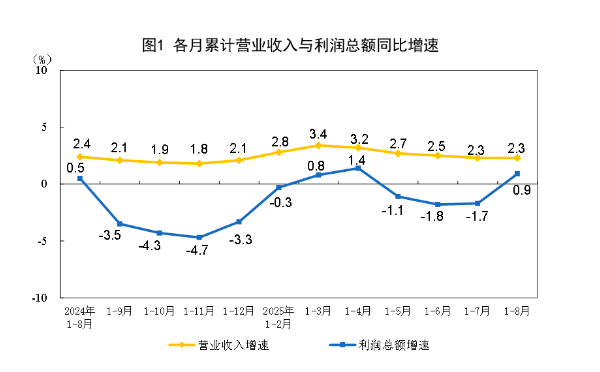
宏观政策发力叠加低基数效应,前8个月工业利润同比由负转正
Xin Lang Cai Jing· 2025-09-27 02:27
Core Viewpoint - In August, profits of industrial enterprises above designated size turned from a decline of 1.5% in the previous month to a growth of 20.4% year-on-year, indicating a recovery in the industrial sector driven by macro policies and a low base from the previous year [1] Group 1: Industrial Profit Trends - From January to August, profits of industrial enterprises increased by 0.9% year-on-year, compared to a decline of 1.7% in the previous month [1] - The manufacturing sector saw a profit growth of 7.4%, accelerating by 2.6 percentage points compared to January-July [1] - The electricity, heat, gas, and water production and supply sector experienced a profit growth of 9.4%, accelerating by 5.5 percentage points [1] - The mining sector faced a decline of 30.6%, but the rate of decline narrowed by 1.0 percentage points [1] Group 2: Sector-Specific Performance - In the equipment manufacturing sector, profits grew by 7.2%, contributing 2.5 percentage points to the overall profit growth of industrial enterprises, marking it as one of the strongest sectors [1] - Among the eight industries in the equipment manufacturing sector, seven reported profit growth, with the railway, shipbuilding, and aerospace industries seeing significant increases of 37.3% and 11.5% respectively [3] - The raw materials manufacturing sector saw a profit increase of 22.1%, accelerating by 10.0 percentage points, contributing 2.5 percentage points to overall industrial profit growth [3] - The steel industry turned from loss to profit, achieving a total profit of 83.7 billion yuan, while the non-ferrous industry profits grew by 12.7%, accelerating by 5.8 percentage points [3] Group 3: Consumer Goods Sector - The consumer goods manufacturing sector turned from a decline of 2.2% in January-July to a growth of 1.4% in January-August, with the beverage and agricultural products industries showing rapid profit growth of 19.9% and 11.8% respectively [4] - These sectors collectively contributed 1.0 percentage point to the overall profit growth of industrial enterprises [4] Group 4: Economic Outlook - Analysts expect a continued moderate recovery in industrial profits, supported by improved market conditions and policy measures aimed at sustaining demand [4] - The emphasis on "sustained efforts and timely reinforcement" in policy is expected to support profit quality through improved market competition and cost distribution mechanisms [4] - However, the sustainability of profit growth remains contingent on effective demand and reasonable recovery of industrial product prices [4]
黑色建材日报:市场预期乐观,钢价震荡运行-20250926
Hua Tai Qi Huo· 2025-09-26 02:13
Report Summary 1. Investment Ratings - Glass: Neutral (expected to trade in a range) [3] - Soda Ash: Neutral (expected to trade in a range) [3] - Silicomanganese: Neutral (expected to trade in a range) [5] - Ferrosilicon: Neutral (expected to trade in a range) [5] 2. Core Views - **Glass & Soda Ash**: The trading sentiment is high, and prices are expected to be volatile. Glass consumption is affected by speculative demand and downstream restocking, while soda ash faces supply - demand contradictions, especially with the ignition of Yuanxing's Phase II project [1][2]. - **Silicomanganese & Ferrosilicon**: Market sentiment has improved, and alloys are expected to trade in a wide range. The supply - demand situation for both is relatively loose, and prices are likely to follow the sector's fluctuations [4]. 3. Market Analysis Glass - **Futures**: The glass futures on the previous day oscillated upward, with the main 2601 contract rising 3.08%, and near - month contracts rising more than far - month contracts [1]. - **Spot**: Spot trading was mainly for pre - holiday restocking. With the price increase, glass production and sales improved month - on - month. This week, the operating rate of float glass enterprises was 76.01%, and the manufacturer's inventory was 59.355 million heavy cases, a month - on - month decrease of 2.55% [1]. - **Supply - Demand Logic**: Glass supply is generally stable. Consumption is affected by speculative demand and downstream restocking, with limited overall inventory changes. The large premium on the futures market stimulates spot - futures purchases. The fundamentals still suppress prices, and attention should be paid to macro - policies and peak - season demand [1]. Soda Ash - **Futures**: The soda ash futures on the previous day oscillated upward, with the main 2601 contract rising 1.15%, and all contracts rising to varying degrees [1]. - **Spot**: Spot trading was mainly for pre - holiday rigid - demand restocking. This week, domestic soda ash production was 776,900 tons, a month - on - month increase of 4.19%; inventory was 1.6515 million tons, a month - on - month decrease of 2.61% [1]. - **Supply - Demand Logic**: Supply - demand contradictions in soda ash still exist. With the ignition of Yuanxing's Phase II project, future supply pressure will increase. Attention should be paid to whether speculative demand weakens, which may intensify the supply - demand contradiction. The current premium on the futures market suppresses prices, and attention should be paid to new capacity production progress and inventory changes [2]. Silicomanganese - **Futures**: The main contract of silicomanganese futures closed at 5,938 yuan/ton on the previous day, up 22 yuan/ton from the previous day [4]. - **Spot**: The silicomanganese spot market performed averagely. The price in the northern market was 5,650 - 5,700 yuan/ton, and in the southern market was 5,680 - 5,730 yuan/ton [4]. - **Supply - Demand Logic**: This week, silicomanganese production decreased month - on - month, while hot metal production increased slightly. Downstream demand for silicomanganese still has resilience, and the inventory of silicomanganese alloy enterprises has increased. In the long term, supply - demand is relatively loose, and prices are expected to follow the sector's fluctuations. Attention should be paid to regional policies and electricity price changes [4]. Ferrosilicon - **Futures**: The main contract of ferrosilicon futures closed at 5,786 yuan/ton on the previous day, up 44 yuan/ton from the previous day [4]. - **Spot**: The ferrosilicon spot market sentiment was average, and the trading atmosphere needed to be strengthened. The ex - factory price of 72 - grade ferrosilicon natural lumps in the main production areas was 5,300 - 5,400 yuan/ton, and the price of 75 - grade ferrosilicon was 5,900 - 6,200 yuan/ton [4]. - **Supply - Demand Logic**: This week, ferrosilicon production remained flat, demand declined, and factory inventory decreased month - on - month. The supply - demand in the ferrosilicon industry is still relatively loose. Without industrial policies, profits are still suppressed. Prices are expected to follow the sector's fluctuations, and attention should be paid to regional policies and electricity price changes [4]. 4. Strategies - **Glass**: Expect price oscillations [3] - **Soda Ash**: Expect price oscillations [3] - **Silicomanganese**: Expect price oscillations [5] - **Ferrosilicon**: Expect price oscillations [5] - **Inter - period Spread**: No strategy [3] - **Inter - commodity Spread**: No strategy [3]
FICC日报:“924”一周年A股飘红,矿难冲击推升铜价-20250925
Hua Tai Qi Huo· 2025-09-25 05:19
FICC日报 | 2025-09-25 "924"一周年A股飘红,矿难冲击推升铜价 市场分析 国内政策预期升温。国内8月经济压力边际增加,一是中国8月经济数据有所转弱,显现"工业缓、投资弱、消费淡" 等特征;另一方面是外部关税压力有所增加,墨西哥拟对贸易伙伴加征关税,据英国《金融时报》和路透社披露, 特朗普鼓动欧盟对中国和印度加征"二级关税";为了应对边际增加的外部压力,国内近期频提稳增长政策。9月10 日,财政部长明确表示,"持续发力、适时加力实施更加积极有为的宏观政策";发改委也表示"不断释放内需潜力""推 进重点行业产能治理"。关注后续更具体的政策内容。中美双方在西班牙马德里举行经贸会谈,就以合作方式妥善 解决TikTok问题、减少投资障碍、促进有关经贸合作等达成了基本框架共识。9月19日晚,中美元首通电话,就当 前中美关系和共同关心的问题坦诚深入交换意见,就下阶段中美关系稳定发展作出战略指引。国务院召开新闻发 布会,介绍"十四五"时期金融业的发展情况,此次会议不涉及短期政策调整,关于"十五五"以及下一步金融改革内 容,将在中央统一部署后做进一步沟通。商务部会同中央网信办、财政部等8部门印发了《关于促进 ...
华宝期货晨报铝锭-20250925
Hua Bao Qi Huo· 2025-09-25 04:00
Group 1: Report Industry Investment Ratings - No specific industry investment ratings are provided in the report. Group 2: Core Views - The price of finished products is expected to move in a volatile and consolidating manner, with its center of gravity shifting downward and showing a weak performance [1][3] - The price of aluminum ingots is expected to remain high in the short term, with the market's supply - demand pattern improving marginally and social inventory decreasing due to pre - holiday stocking [3][4] Group 3: Summary by Related Catalogs Finished Products - Yungui region's short - flow construction steel producers will have a shutdown and maintenance period from mid - January, with a resumption around the 11th to 16th day of the first lunar month, affecting a total output of 741,000 tons. In Anhui, 1 out of 6 short - flow steel mills stopped production on January 5, and most others will stop around mid - January, with a daily output impact of about 16,200 tons [2][3] - From December 30, 2024, to January 5, 2025, the transaction area of newly built commercial housing in 10 key cities was 2.234 million square meters, a 40.3% decrease from the previous period and a 43.2% increase year - on - year [3] - The price of finished products continued to decline with a new low, and the market sentiment was pessimistic under the weak supply - demand pattern and lackluster winter storage [3] Aluminum - Macroscopically, there are increasing differences within the Fed on future monetary policy, and a balance needs to be struck between high inflation and a weak employment market [2] - The supply of the aluminum market has a slight increase due to the ramping - up of replacement capacity, and the supply - demand pattern is improving marginally. As of last Thursday, the national metallurgical - grade alumina's total built - in capacity is 110.32 million tons/year, and the total operating capacity is 92.33 million tons/year, with the weekly operating rate up 0.92 percentage points to 83.69% [3] - The overall aluminum consumption is warming up, with stable growth in the automotive industry, growth expectations in the power industry, and marginal improvement in the construction industry. The operating rate of processed materials is rising steadily [3] - On September 25, the inventory of electrolytic aluminum ingots in major domestic consumption areas was 617,000 tons, a decrease of 21,000 tons from Monday and last Thursday [3]
黑色金属早报-20250924
Yin He Qi Huo· 2025-09-24 09:49
Report Summary 1. Investment Ratings No investment ratings for the industry are provided in the report. 2. Core Views - The steel market is expected to remain volatile and weak in the short - term, but there may be a demand recovery after the holiday and a potential inventory inflection point. The "15th Five - Year Plan" and peak season demand will affect the price trend [4]. - The coking coal and coke market is currently in short - term shock adjustment with unclear drivers. In the medium - term, there are policy disturbances on the supply side, so a strategy of buying on dips is recommended, but caution is needed regarding the upside potential [9][10]. - The iron ore market has seen prices oscillate. The price may be under pressure at high levels as the market may not have priced in the rapid weakening of terminal demand in the third quarter [15]. - The ferroalloy market has high supply pressure. For both silicon iron and manganese silicon, it is recommended to short on rebounds [20][21]. 3. Summary by Commodity Steel - **Related Information**: If the South Korean K - steel bill is implemented, China's medium - thick plate and hot - rolled coil exports to South Korea may be severely affected. In August, the national electricity consumption reached 1015.4 billion kWh, a year - on - year increase of 5%. Spot prices of rebar and hot - rolled coil in major regions declined [3]. - **Logic Analysis**: The black - metal sector was weak and volatile last night. Construction steel trading volume on the 23rd was 92,000 tons. There was a production divergence among the five major steel products last week. Currently in the off - season, demand recovery is average. After the parade, steel demand followed the seasonal pattern. Iron - water production is expected to remain high this week. Steel demand may recover after the holiday [4]. - **Trading Strategies**: Unilateral: maintain a volatile and weak trend; Arbitrage: hold long 1 - 5 spreads and short the spread between hot - rolled coil and rebar; Options: wait and see [5]. Coking Coal and Coke - **Related Information**: During the National Day and Mid - Autumn Festival, Mongolian coal ports will be closed for 7 days. Recently, the coking coal spot price has generally risen, and coke has a price increase expectation. Various coke and coking coal warehouse - receipt prices are provided [8]. - **Logic Analysis**: The night - session continued to oscillate. The market has digested the expectation of pre - holiday raw material restocking. The spot price is still rising. In the long - run, coal production may be restricted by policies, but the upside of coking coal prices is limited by steel demand and profits [9]. - **Trading Strategies**: Unilateral: short - term shock adjustment, medium - term buy on dips with caution about the upside [10][12]. Iron Ore - **Related Information**: The OECD predicts that the global economic growth rate will be 3.2% in 2025 and 2.9% in 2026. In August, the national electricity consumption reached 1015.4 billion kWh, a year - on - year increase of 5%. From September 15th - 21st, the transaction area of new and second - hand houses in 10 key cities increased year - on - year. Iron ore spot prices in Qingdao Port declined [14]. - **Logic Analysis**: Iron ore prices oscillated last night. This week, the price first rose and then fell. The third - quarter supply of major mines improved, and non - mainstream mines maintained high shipments. Terminal steel demand in China weakened in the third quarter, while overseas steel demand remained high. The price may be under pressure at high levels [15]. - **Trading Strategies**: Unilateral: mainly hedge at high spot prices; Arbitrage: wait and see; Options: mainly use circuit - breaker accumulative put options [16][18]. Ferroalloy - **Related Information**: On the 23rd, the prices of different manganese ores in Tianjin Port were reported. The probability of the Fed keeping interest rates unchanged in October is 7%, and the probability of a 25 - basis - point rate cut is 93% [19]. - **Logic Analysis**: For silicon iron, the spot price fluctuated on the 23rd. Supply is at a high level, and demand may decline in the future. It can be shorted near the resistance range of 5700 - 5800. For manganese silicon, the manganese ore spot price was weak, and the supply was still high. It can be shorted near the resistance range of 5900 - 6000 [20]. - **Trading Strategies**: Unilateral: short on rebounds due to high supply pressure; Arbitrage: wait and see; Options: sell straddle option combinations [21].
国泰海通证券梁中华:宏观政策将保持积极
Zhong Guo Zheng Quan Bao· 2025-09-23 15:07
Core Viewpoint - The domestic macroeconomic fundamentals have significantly exceeded expectations this year, with particularly strong growth in the first half despite external uncertainties [1] Economic Structure - There is a notable divergence in economic structure: the supply side is performing well, while the demand side requires further policy support, especially in real estate and consumption sectors [1] - The economic total is experiencing high growth, but price indicators remain low, indicating a disparity between total economic growth and pricing [1] Policy Outlook - Future domestic policy direction is expected to remain positive, with increased efforts in both monetary and fiscal policies [1] - There is potential for further reductions in reserve requirement ratios and interest rates, with various policy rates likely to continue decreasing [1] - The central bank is anticipated to maintain a loose monetary policy environment to support the recovery of domestic demand [1] - Narrow fiscal policy (budgetary fiscal) is unlikely to see significant additional deficits in the coming months, while broad fiscal policy will become a focal point for action [1] - Domestic policies will concentrate on stimulating the demand side of the economy through coordinated monetary and fiscal efforts to achieve more balanced and stable growth [1]

华宝期货有色金属周报-20250923
Hua Bao Qi Huo· 2025-09-23 11:35
Report Overview - Report Title: [Huabao Futures] Non-ferrous Metals Weekly Report [1] - Report Date: September 23, 2025 [2] 1. Report Industry Investment Rating - No relevant content provided 2. Core Viewpoints of the Report - Aluminum prices are expected to fluctuate at a high level recently, and attention should be paid to the guidance of peak-season inventory consumption on price direction [9][10] - Zinc prices are expected to have a slight weak adjustment in the short term, with support in the peak season but medium- to long-term supply increase putting pressure on the upside [12][13] - Tin prices are expected to have a strong adjustment in the short term under the situation of weak supply and demand [16] 3. Summary by Relevant Catalogs 3.1. Non-ferrous Weekly Market Review - **Copper**: The closing price of the futures main contract on September 19 was 79,910 yuan, a weekly decrease of 1,150 yuan or -1.42%; the spot price was 79,970 yuan, a weekly decrease of 1,020 yuan or -1.26% [7] - **Aluminum**: The closing price of the futures main contract on September 19 was 20,795 yuan, a weekly decrease of 325 yuan or -1.54%; the spot price was 20,840 yuan, a weekly decrease of 210 yuan or -1.00% [7] - **Zinc**: The closing price of the futures main contract on September 19 was 22,045 yuan, a weekly decrease of 260 yuan or -1.17%; the spot price was 22,082 yuan, a weekly decrease of 154 yuan or -0.69% [7] - **Tin**: The closing price of the futures main contract on September 19 was 268,770 yuan, a weekly decrease of 5,180 yuan or -1.89%; the spot price was 269,250 yuan, a weekly decrease of 4,000 yuan or -1.46% [7] - **Nickel**: The closing price of the futures main contract on September 19 was 121,500 yuan, a weekly decrease of 480 yuan or -0.39%; the spot price was 123,020 yuan, a weekly decrease of 410 yuan or -0.33% [7] 3.2. This Week's Non-ferrous Market Forecast Aluminum - **Logic**: Last week, aluminum prices adjusted at a high level. After the Fed cut interest rates by 25 basis points, many Fed officials released hawkish signals, leading to a slight price correction. Fundamentally, the alumina market remains in an oversupply situation. The domestic alumina operating capacity remains at a high level, the import window is open, and domestic inventories are high. On the demand side, the开工 rate of domestic aluminum downstream processing leading enterprises increased slightly by 0.1 percentage points to 62.2% last week, down 1.3 percentage points compared with the same period last year [9] - **Viewpoint**: After the previous macro factors were settled, the price adjusted slightly after rising. It is expected to fluctuate at a high level recently, and attention should be paid to the guidance of peak-season inventory consumption on price direction [10] Zinc - **Logic**: Last week, zinc prices adjusted weakly. The SMM Zn50 domestic weekly TC average price remained flat at 3,850 yuan/metal ton, and the SMM imported zinc concentrate index increased by $12.5/dry ton to $111.25/dry ton. The Shanghai-London ratio fell to around 7.5, and the zinc ingot import window remained closed. On the demand side, the galvanizing开工率 reached 58.05%, up 1.99 percentage points from the previous week. Zinc ingot inventories increased slightly. The die-casting zinc alloy开工率 was 53.78%, down 0.21 percentage points from the previous week. As of September 22, the total inventory of SMM seven places was 15.70 tons, a decrease of 0.36 tons compared with September 15 [12] - **Viewpoint**: In the short term, the macro benefits have basically been released, and the price has a slight weak adjustment. There is still support in the peak season, but the medium- to long-term supply increase puts pressure on the upside [13] Tin - **Logic**: The Fed's 25-basis-point interest rate cut did not exceed market expectations, and there was some pressure on tin prices in the short term. In July, China's tin ore imports were 10,200 tons (equivalent to about 4,335 metal tons), a month-on-month decrease of 13.71% and a year-on-year decrease of 31.79%. From January to July, the cumulative imports were 72,400 tons, a cumulative year-on-year decrease of 32.32%. After Myanmar completed the mining license approval, the progress was slow, and ore production will continue until at least the fourth quarter. The tight supply situation promoted tin prices. Currently, the raw materials in Yunnan are in short supply, and the inventory is less than 30 days; the scrap tin in Jiangxi is also tight, resulting in a significant decline in the开工率 of smelters in the two provinces. Downstream demand is average, and although the data of consumer electronics and new energy vehicles are good, there are signs of a market slowdown. The market shows a situation of weak supply and demand in the short term [16] - **Viewpoint**: In the short term, supply and demand are both weak, and tin prices are strongly adjusted [16] 3.3. Variety Data Aluminum - **Bauxite**: The price of domestic high-grade bauxite in Henan remained unchanged at 650 yuan/ton; the price of domestic low-grade bauxite in Henan remained unchanged at 580 yuan/ton; the average price of imported bauxite index was $75.1/ton, a decrease of $0.38 compared with the previous week. The port arrival volume was 3.4174 million tons, a decrease of 837,100 tons compared with the previous week; the port departure volume was 4.6711 million tons, a decrease of 200 tons compared with the previous week [20][23] - **Alumina**: The domestic price in Henan was 3,020 yuan/ton, a decrease of 30 yuan compared with the previous week; the full cost was 2,890.2 yuan/ton, a decrease of 11.8 yuan compared with the previous week; the profit in Shanxi was -8.43 yuan/ton, a decrease of 46.82 yuan compared with the previous week [26] - **Electrolytic Aluminum**: The total cost was 16,335.29 yuan/ton, a decrease of 71.95 yuan compared with the previous week; the regional price difference between Foshan and SMM A00 aluminum was -50 yuan/ton, unchanged compared with the previous week. The开工率 of aluminum cables remained unchanged at 65.2; the开工率 of aluminum foil remained unchanged at 71.9; the开工率 of aluminum plates and strips decreased by 0.4 to 68.2; the开工率 of aluminum profiles increased by 0.6 to 54.6; the开工率 of primary aluminum alloy decreased by 0.2 to 57.2; the开工率 of recycled aluminum alloy increased by 0.4 to 55.9. The bonded area inventory in Shanghai was 67,800 tons, a decrease of 1,700 tons compared with the previous week; the total bonded area inventory was 90,800 tons, a decrease of 1,700 tons compared with the previous week; the social inventory was 638,000 tons, an increase of 1,000 tons compared with the previous week; the weekly outbound volume of aluminum ingots in major consumption areas was 122,300 tons, an increase of 14,700 tons compared with the previous week. The SHFE inventory was 127,734 tons, a decrease of 765 tons compared with the previous week; the LME inventory was 513,900 tons, an increase of 28,625 tons compared with the previous week [28][33][39][40] - **Spot and Basis**: The SMM A00 aluminum basis for the current month was 0 yuan/ton, a decrease of 25 yuan compared with the previous week; the basis for the main contract was 0 yuan/ton, an increase of 75 yuan compared with the previous week; the basis for the third consecutive contract was 5 yuan/ton, an increase of 55 yuan compared with the previous week. The price difference between the current month and the main contract was 5 yuan/ton, an increase of 100 yuan compared with the previous week; the price difference between the current month and the third consecutive contract was 5 yuan/ton, an increase of 80 yuan compared with the previous week [45][46] Zinc - **Zinc Concentrate**: The domestic zinc concentrate price was 16,654 yuan/metal ton, a decrease of 224 yuan compared with the previous week; the domestic zinc concentrate processing fee remained unchanged at 3,850 yuan/metal ton; the imported zinc concentrate processing fee was $111.25/dry ton, an increase of $12.5 compared with the previous week. The enterprise production profit was 3,686 yuan/metal ton, a decrease of 192 yuan compared with the previous week; the import profit and loss was -2,001.32 yuan/ton, an increase of 147.85 yuan compared with the previous week; the imported zinc concentrate inventory in Lianyungang was 150,000 physical tons, a decrease of 10,000 tons compared with the previous week [53][56] - **Refined Zinc**: The SMM seven-place zinc ingot social inventory was 157,000 tons, a decrease of 3,600 tons compared with the previous week; the zinc ingot bonded area inventory was 8,000 tons, unchanged compared with the previous week; the SHFE refined zinc inventory was 99,315 tons, an increase of 4,666 tons compared with the previous week; the LME zinc inventory was 46,825 tons, a decrease of 3,325 tons compared with the previous week [59] - **Galvanizing**: The output was 337,400 tons, an increase of 5,055 tons compared with the previous week; the开工率 was 58.05, an increase of 1.99 percentage points compared with the previous week; the raw material inventory was 13,910 tons, an increase of 50 tons compared with the previous week; the finished product inventory was 366,800 tons, a decrease of 8,900 tons compared with the previous week [62] - **Zinc Basis and Price Difference**: The SMM 0 zinc ingot basis for the current month was -55 yuan/ton, a decrease of 35 yuan compared with the previous week; the basis for the main contract was -65 yuan/ton, an increase of 60 yuan compared with the previous week; the basis for the third consecutive contract was -90 yuan/ton, an increase of 15 yuan compared with the previous week. The price difference between the current month and the main contract was -10 yuan/ton, an increase of 65 yuan compared with the previous week; the price difference between the current month and the third consecutive contract was -40 yuan/ton, an increase of 55 yuan compared with the previous week [65][68] Tin - **Refined Tin**: The combined output of Yunnan and Jiangxi provinces was 1,450 tons, an increase of 70 tons compared with the previous week; the combined开工率 was 29.92%, an increase of 1.44 percentage points compared with the previous week [73] - **Tin Ingot Inventory**: The SHFE tin ingot total inventory was 6,988 tons, a decrease of 909 tons compared with the previous week; the Chinese regional tin ingot social inventory was 8,453 tons, a decrease of 936 tons compared with the previous week [76] - **Tin Concentrate Processing Fee**: The tin concentrate processing fee in Yunnan (40%) remained unchanged at 12,000 yuan/ton; the tin concentrate processing fee in Guangxi, Hunan, and Jiangxi (60%) remained unchanged at 8,000 yuan/ton [78] - **Tin Ore Import Profit and Loss**: The tin ore import profit and loss level was 14,948.1 yuan/ton, an increase of 6,105.3 yuan compared with the previous week [79] - **Spot Price**: The average price of 40% tin concentrate in Yunnan was 257,300 yuan/ton, a decrease of 4,600 yuan compared with the previous week; the average price of 60% tin concentrate in Guangxi, Hunan, and Jiangxi was 261,300 yuan/ton, a decrease of 4,600 yuan compared with the previous week [83]
华宝期货晨报铝锭-20250923
Hua Bao Qi Huo· 2025-09-23 03:36
Group 1: Report Industry Investment Ratings - No relevant content found Group 2: Core Views -成材震荡整理运行 后期关注宏观政策和下游需求情况 [4] -铝锭预计价格短期偏弱调整 关注宏观情绪和矿端消息 [5] Group 3: Summary by Related Catalogs 成材 -云贵区域短流程建筑钢材生产企业春节停产预计影响总产量74.1万吨 安徽省6家短流程钢厂部分已停产或计划1月中旬左右停产 日度影响产量1.62万吨左右 [3][4] -2024年12月30日 - 2025年1月5日 10个重点城市新建商品房成交面积环比下降40.3% 同比增长43.2% [4] -成材昨日震荡下行 价格创近期新低 供需双弱格局下市场情绪悲观 价格重心下移 今年冬储低迷 对价格支撑不强 [4] 氧化铝 -氧化铝基本面维持过剩格局 供应端国内运行产能高位 进口窗口开启 库存高位 需求端国内铝下游加工龙头企业开工率较上周小幅增加0.1个百分点至62.2% 与去年同期相比下降1.3个百分点 [4] -截至上周四 全国冶金级氧化铝建成总产能11032万吨/年 运行总产能9233万吨/年 全国氧化铝周度开工率较上周上调0.92个百分点至83.69% [4] 铝锭 -9月22日国内主流消费地电解铝锭库存63.8万吨 持平于上周四库存 较上周一上涨0.1万吨 9.16 - 9.21期间国内铝锭出库量共计12.23万吨 环比增加1.47万吨 [4] -宏观降息预期兑现 关注国内政策推进 当下过渡到金九银十 宏观与基本面带来支撑 宏观靴子落地 预计价格短期持高位整理 后续关注库消走势 [5]
【股指周报(IF&IH&IC&IM)】:股指震荡运行,大金融领跌-20250922
Guo Mao Qi Huo· 2025-09-22 05:54
Report Industry Investment Rating No relevant content provided. Core Viewpoints of the Report - The economic growth momentum in China slowed down in August, with multiple indicators such as prices, investment, and consumption weakening, increasing the necessity for policy support. Policy is guiding the further growth of "service consumption". There are expectations for policies from the upcoming "922" press conference. The overseas situation is positive, with positive signals from the China-US economic and trade talks and the Fed's first interest rate cut this year. However, the domestic economic data is poor, and there is a need for policies to promote consumption, stabilize the real estate market, and expand fiscal spending. The stock index trend remains bullish, but the policy aims for a "slow bull" pattern. It is recommended to adjust and go long, and control positions before the holiday [3]. Summary by Relevant Catalogs Part One: Main Views and Strategy Overview - **Influence Factors and Logic** - **Economic and Corporate Earnings**: In August, China's economic growth slowed, with industrial production, investment, and consumption weakening. The year-on-year growth of the added value of industrial enterprises above the designated size was 5.2%, the year-on-year growth of total retail sales of consumer goods was 3.4%, and the year-on-year growth of national fixed - asset investment (excluding rural households) from January to August was 0.5%. Policy support for the economy is necessary [3]. - **Macro Policy**: The policy is guiding the growth of service consumption, with over 30 policies already introduced and more to come. The "922" press conference has raised policy expectations, similar to the "924" policy "combination punch" last year [3]. - **Overseas Factors**: The China-US Madrid economic and trade talks had a positive tone. The Fed cut interest rates by 20bp in September 2025, and the dot - plot shows possible further rate cuts [3]. - **Liquidity**: As of September 18, the margin trading balance of A - shares was 23946.9 billion yuan, an increase of 509.9 billion yuan from the previous week. The proportion of margin trading purchases in the total market turnover was 13.2%, at the 99.7% quantile level in the past decade. The average daily trading volume last week increased by 1609 billion yuan compared to the previous week [3]. - **Investment View and Strategy** - **View**: Control positions before the holiday, adjust and go long, and expect a "slow bull" pattern in the A - share market [3]. - **Strategy**: Control positions unilaterally before the holiday, and pay attention to domestic policies and overseas geopolitical factors [3]. Part Two: Stock Index Market Review - **Index Performance**: Last week, the CSI 300 fell 0.44% to 4501.9; the SSE 50 fell 1.98% to 2909.7; the CSI 500 rose 0.32% to 7170.3; the CSI 1000 rose 0.21% to 7438.2 [5]. - **Industry Index Performance**: Among the Shenwan primary industry indices, power equipment (3.1%), electronics (3%), automobiles (3%), machinery and equipment (2.2%), and social services (1.7%) led the gains, while banking (-4.2%), non - ferrous metals (-4%), non - bank finance (-3.7%), steel (-3%), and agriculture, forestry, animal husbandry, and fishery (-2.7%) led the losses [9]. - **Futures Volume and Open Interest**: The trading volumes of CSI 300, SSE 50, CSI 500, and CSI 1000 futures increased by 17.61%, 18.63%, 12.92%, and 11.24% respectively, while the open interests decreased by 7.73%, 4.25%, 8.04%, and 2.08% respectively [11]. - **Cross - Variety Spread**: The CSI 300 - SSE 50 was at 1592.2, at the 94.9% historical quantile level; the CSI 1000 - CSI 500 was at 267.8, at the 43.9% historical quantile level; the CSI 300/CSI 1000 was at 0.6, at the 32.7% historical quantile level; the SSE 50/CSI 1000 was at 0.6, at the 26.6% historical quantile level [16]. Part Three: Stock Index Influence Factors - Liquidity - **Central Bank Operations**: This week, the central bank's open - market operations had a net injection of 11923 billion yuan. Next week, 18268 billion yuan of reverse repurchases will expire, and 3000 billion yuan of MLF will expire on September 25 [22]. - **Market Liquidity Indicators**: As of September 18, the A - share margin trading balance was 23946.9 billion yuan, an increase of 509.9 billion yuan from the previous week. The proportion of margin trading purchases in the total market turnover was 13.2%, at the 99.7% quantile level in the past decade. The average daily trading volume last week increased by 1609 billion yuan compared to the previous week. As of September 19, the risk premium rate of the CSI 300 was 5.29, at the 51.8% quantile level in the past decade [29]. Part Four: Stock Index Influence Factors - Economic Fundamentals and Corporate Earnings - **Macroeconomic Indicators**: In August, various economic indicators showed different trends. For example, the year - on - year growth of industrial added value was 5.2%, the year - on - year growth of total retail sales of consumer goods was 3.4%, and the year - on - year growth of fixed - asset investment from January to August was 0.5%. The CPI was - 0.4%, and the PPI was - 2.9% [32]. - **Industry - Specific Indicators**: Different industries such as real estate, consumption, manufacturing, and infrastructure construction also had their own performance trends. For example, in the real estate industry, the year - on - year decline in real estate investment continued; in the manufacturing industry, the manufacturing PMI was 49.4% [32][34][37]. - **Corporate Earnings**: The earnings of major broad - based indices and Shenwan primary industry indices showed different growth rates and ROE levels. For example, the year - on - year growth rate of the net profit attributable to the parent of the CSI 300 in Q2 2025 was 2.49%, and the ROE (TTM) was 9.71% [44][45]. Part Four: Stock Index Influence Factors - Policy Drive - **Recent Policy Movements**: A series of policies have been introduced, including policies to promote service consumption, optimize real estate policies, and provide fiscal subsidies for personal consumption loans. For example, on September 17, the Ministry of Commerce announced policies to promote service consumption; on September 5, Shenzhen optimized real estate policies [49][50]. Part Five: Stock Index Influence Factors - Overseas Factors - **US Economic Data**: In August, the US manufacturing PMI was 48.7%, the non - manufacturing PMI was 52%, the consumer confidence index was 55.4, the unemployment rate was 4.3%, and the number of new non - farm payrolls was 22000. The year - on - year growth of PCE was 0%, and the year - on - year growth of CPI was 2.9% [59][62]. - **Trump Team's Actions**: Trump has proposed and implemented a series of tariff policies, including tariffs on imports from China, Canada, and Mexico, which have led to trade frictions and counter - measures [66][68].