
反内卷

Search documents
量化观市:量化视角下如何把握春节前躁动?
SINOLINK SECURITIES· 2026-01-27 03:12
- The report highlights the performance of eight major stock selection factors across different stock pools (All A-shares, CSI 300, CSI 500, and CSI 1000). Among these, the value factor (17.88%) and size factor (11.88%) showed strong IC mean performance, while reversal and quality factors performed relatively weaker[54][55][66] - Small-cap value style dominated the market, with the small-cap size factor performing strongly across the entire market. Value factors also showed positive performance, indicating a market preference for low valuation stocks. Additionally, technical and low-volatility factors performed well, while consensus expectation factors weakened due to reduced focus on high-performance expectation sectors[54][55][66] - The report provides detailed definitions for various factors, such as size (logarithm of market capitalization), value (e.g., book-to-price ratio, earnings-to-price ratio), growth (e.g., net income growth), quality (e.g., ROE, gross margin), consensus expectation (e.g., changes in expected EPS), technical (e.g., volume skewness), volatility (e.g., 60-day return standard deviation), and reversal (e.g., 20-day return)[66][67] - The report also tracks the performance of convertible bond selection factors, which are constructed based on the relationship between convertible bonds and their underlying stocks. Factors include stock consensus expectation, stock value, and convertible bond valuation (e.g., parity premium rate). Among these, stock consensus expectation and stock value factors achieved higher IC mean values in the past week[59][60][62]
ETF周度配置指南2026.01.23(总03期)
申万宏源证券上海北京西路营业部· 2026-01-27 02:26
Market Overview - The market experienced a mild increase this week, with the average daily trading volume in the Shanghai and Shenzhen markets significantly declining, yet remaining at a historical high of approximately 2.7 trillion [1][3] - A-shares have escaped short-term emotional fluctuations and returned to a rational operational track, supporting a steady and gradual bull market trend [1][3] - Market activity remains high, indicating numerous investment opportunities [1][3] Investment Strategy - The company anticipates that the market will exhibit a "slow bull" characteristic until the Chinese New Year, with rapid theme rotations [1][3] - A long-term investment strategy is recommended, focusing on selecting stocks with favorable long-term trends while avoiding short-term speculation [1][3] Long-term Focus Areas 1. The repeated TACO (Trade Adjustment and Cooperation Agreement) by the U.S. may lead countries to accelerate self-sufficiency in defense, resources, finance, and supply chains, intensifying resource competition and indicating an upward cycle for commodities [1][3] 2. The intensifying global technology competition is driving the domestic strategy for technological self-reliance, presenting dual development opportunities in the A-share technology growth sector through domestic substitution and industrial upgrading [1][3] Industry Performance - In the past week, the construction materials, oil and petrochemicals, and steel industries performed notably well, with respective increases of +9.23%, +7.71%, and +7.31% [14]

跟踪指数创近29个月新高!华宝中证光伏产业指数基金今起火热开售
Xin Lang Cai Jing· 2026-01-27 01:05
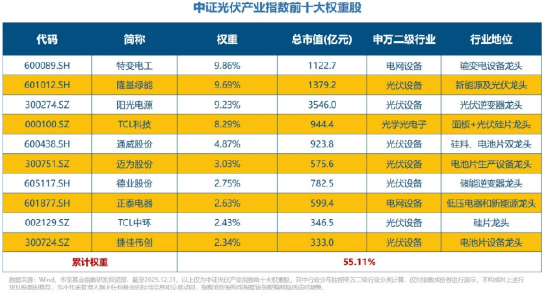
Core Insights - The current wave of investment in the photovoltaic (PV) sector is unexpectedly driven by commercial aerospace, with significant market potential identified for low Earth orbit satellites and space computing [1][9] - The PV industry is facing five major investment opportunities: anti-involution, technological iteration, overseas demand, energy storage demand, and space photovoltaics, making it an attractive sector for investors [1][9] Investment Opportunities - The Chinese PV industry chain is the most competitive globally, with various investment opportunities across different segments, including PV battery components, inverters, and silicon materials [2][10] - The newly launched Huabao CSI Photovoltaic Industry Index Fund (code: 026754) tracks the CSI Photovoltaic Industry Theme Index, covering a wide range of segments from upstream to downstream in the PV industry [2][10] - The CSI Photovoltaic Industry Index includes 50 constituent stocks, with the top five stocks accounting for 41.9% and the top ten for 55.11%, indicating a balanced structure of leading and supporting companies [2][10] Performance Metrics - From the index's inception on April 22, 2019, to December 31, 2025, the CSI Photovoltaic Industry Index has achieved a cumulative return of 47.48% and an annualized return of 6.67%, outperforming the CSI 300 Index and other related indices [3][13] - The index's annualized volatility is lower than that of comparable indices, indicating a favorable risk-return profile [4][13] Market Trends - The CSI Photovoltaic Industry Index has shown significant upward movement, reaching a new high of 3444 points on January 26, 2024, marking the highest level in nearly 29 months [5][15] - The index's price-to-book (PB) ratio is 2.52, indicating a low valuation and high elasticity, which enhances its investment appeal [5][15] Future Outlook - The fund manager of the Huabao CSI Photovoltaic Industry Index Fund anticipates focusing on anti-involution and new growth opportunities in the first half of 2026, while emphasizing the importance of industry profit recovery in the second half [6][16] - The manager highlights that recent price increases in the industry and the alignment of customer bases between energy storage systems and PV components present significant growth potential [17][16]
华西证券:A股“慢牛”趋势有望延续
Di Yi Cai Jing· 2026-01-27 00:16
Group 1 - The core viewpoint is that the current market is in the mid-stage of a "slow bull" trend, which is expected to continue based on comparisons with previous bull markets in A-shares [1] Group 2 - Industry allocation recommendations include focusing on sectors where the technology industry is expanding, such as AI computing power, AI applications, robotics, space photovoltaics, storage, and Hong Kong internet [1] - Sectors benefiting from "de-involution" and price increases, such as chemicals and non-ferrous metals, are also highlighted [1] - Industries with high growth forecasts for annual report performance, including electronics, machinery, and pharmaceuticals, are suggested for attention [1]

交通运输行业周报:即时零售再起势,重视顺丰同城布局机会,航空量价环比回升预热春运
Guolian Minsheng Securities· 2026-01-26 13:20
Investment Rating - The report maintains a "Buy" rating for key companies in the transportation sector, including SF Holding, YTO Express, and Spring Airlines, among others [2][3]. Core Insights - The instant retail industry is experiencing rapid expansion, with China's market expected to reach CNY 1.2 trillion by 2026 and over CNY 2 trillion by 2030, driven by a CAGR of 43.6% from 2018 to 2026 [8][10]. - Alibaba's commitment to the instant retail sector is strong, with significant investments leading to a peak order volume of 120 million for Taobao Flash Sales in December 2025, indicating a robust growth trajectory [12][15]. - SF Express is positioned as a leading independent third-party instant delivery service, benefiting from the industry's rapid growth and increasing demand for delivery services [30][18]. Summary by Sections Instant Delivery Industry - The instant retail market in China is projected to grow significantly, with a CAGR of 43.6% from 2018 to 2026, reaching CNY 1.2 trillion by 2026 and over CNY 2 trillion by 2030 [10][12]. - Alibaba's strategic investments in instant retail are evident, with a focus on expanding beyond food delivery to a broader range of products, resulting in substantial order growth [13][15]. - SF Express is highlighted as a key player in the instant delivery market, with a 49% revenue growth in H1 2025 and a significant increase in order volume [18][21]. Aviation Sector - The aviation industry is recovering from a seasonal downturn, with domestic flight volumes increasing by 1.4% week-on-week, and ticket prices showing a year-on-year increase of 8.4% [32][43]. - The cargo segment is also seeing a recovery, with stable freight rates and increased demand expected as the Chinese New Year approaches [50][57]. - Recommendations include focusing on major airlines such as China Eastern Airlines and Spring Airlines, which are expected to benefit from improved demand and pricing [57][61]. Express Delivery Sector - The express delivery industry has shown resilience, with a 6.5% year-on-year increase in total revenue for 2025, despite challenges in pricing [61][75]. - The report notes a stabilization in single-package pricing, with significant growth in market share for companies like SF Express and YTO Express [75][81]. - The ongoing "anti-involution" trend is expected to lead to improved profitability for express delivery companies as competition becomes more structured [81][82].






交通运输行业周报:即时零售再起势,重视顺丰同城布局机会,航空量价环比回升预热春运-20260126
Guolian Minsheng Securities· 2026-01-26 13:04
Investment Rating - The report maintains a "Buy" rating for key companies in the transportation sector, including SF Holding, YTO Express, and Eastern Airlines Logistics, among others [2][3]. Core Insights - The instant retail industry is experiencing rapid expansion, with China's market expected to reach 1.2 trillion yuan by 2026 and over 2 trillion yuan by 2030, reflecting a CAGR of 43.6% from 2018 to 2026 [8][10]. - Alibaba's commitment to the instant retail sector is strong, with significant investments aimed at expanding beyond food delivery into a full range of instant retail services, evidenced by a peak of 120 million daily orders on Taobao Flash Purchase [12][15]. - SF Express is highlighted as a leading independent third-party instant delivery service, benefiting from the industry's growth and increasing demand for delivery services [30][18]. - The airline industry is recovering from a seasonal downturn, with domestic flight numbers increasing by 1.4% week-on-week, and ticket prices showing a year-on-year increase of 8.4% [32][43]. - The air cargo sector is also seeing a recovery, with stable freight rates and increased demand expected as the Chinese New Year approaches [50][57]. - The express delivery industry is stabilizing, with a slight increase in average revenue per package, and major players like SF Express and YTO Express gaining market share [61][75]. Summary by Sections Instant Delivery Industry - The instant retail market in China is projected to grow significantly, with a CAGR of 43.6% from 2018 to 2026, reaching 1.2 trillion yuan by 2026 and over 2 trillion yuan by 2030 [10][18]. - Alibaba's strategic investments in instant retail are reshaping the market, with a focus on expanding beyond traditional food delivery [12][15]. - SF Express is positioned as a key player in the instant delivery sector, benefiting from rapid growth and increased order volumes [30][18]. Airline Industry - The airline sector is showing signs of recovery, with domestic flight operations increasing and ticket prices rising [32][43]. - The air cargo market is stabilizing, with expectations of increased demand leading up to the Chinese New Year [50][57]. Express Delivery Industry - The express delivery market is stabilizing, with slight improvements in revenue per package and market share gains for major companies [61][75]. - The report emphasizes the ongoing trend of "anti-involution" in the industry, which is expected to lead to improved profitability for express delivery companies [81].
黑色金属日报-20260126
Guo Tou Qi Huo· 2026-01-26 13:03
| | | 【焦煤】 | Millio | 国投期货 | 黑色金属日报 | | --- | --- | --- | | | 操作评级 | 2026年01月26日 | | 螺纹 | な女女 | 曹颖 首席分析师 | | 热卷 | ☆☆☆ | F3003925 Z0012043 | | 铁矿 | ☆☆☆ | 何建辉 高级分析师 | | 焦炭 | ☆☆☆ | F0242190 Z0000586 | | 焦煤 | 女女女 | | | 證硅 | ★☆☆ | 韩惊 高级分析师 | | 硅铁 | な女女 | F03086835 Z0016553 | | | | 李啸尘 高级分析师 | | | | F3054140 Z0016022 | | | | 010-58747784 | | | | gtaxinstitute@essence.com.cn | 【钢材】 今日盘面震荡为主。淡季螺纹表需环比下滑,产量有所回升,库存逐步累积。热卷需求、产量均小幅回落,库存继续下降,因 力逐步缓解。钢厂利润欠佳,下游承接能力不足,高炉复产放缓,铁水产量趋稳。从下游行业看,地产投资降幅继续扩大,基 建、制造业投资增速持续回落,内需整体依然偏弱 ...
2026年总量与政策年度展望:风至势起,进而有为
Guoyuan Securities· 2026-01-26 11:11
Group 1 - The core viewpoint of the report emphasizes the need for a systematic reshaping of macro governance paradigms through "three rebalances," aiming to establish a new starting point for high-quality development in 2026, which is the first year of the 14th Five-Year Plan [1] - The report identifies the main contradiction in the economy as "strong supply and weak demand," highlighting the necessity for policies to focus on expanding domestic demand while addressing structural issues [2][3] - The macroeconomic policy framework for 2026 is expected to prioritize internal demand, reform, and innovation, aiming for high-quality development while balancing external and internal factors [3] Group 2 - In 2025, the economic operation showed a steady improvement supported by proactive macro policies, with industrial production demonstrating resilience and a shift towards high-tech industries [2][12] - The report notes that the external demand has been stronger than internal demand, with exports playing a significant role in supporting economic stability [3][33] - The investment landscape remains challenging, particularly in real estate, while manufacturing investment is buoyed by equipment renewal policies [2][3] Group 3 - The economic outlook for 2026 suggests a moderate GDP growth target of around 5%, with growth driven by improvements in domestic demand and supply efficiency [4] - Price indicators are expected to show a mild upward trend, with PPI likely to recover due to improved supply-demand dynamics and global manufacturing inventory cycles [4][33] - The market dynamics are shifting from liquidity-driven growth to profit-driven growth, particularly in the midstream manufacturing sector, which is expected to see significant profit recovery [4][33]
交通运输行业周报(2026年1月19日-2026年1月25日):民航春运有望景气,快递格局分化延续-20260126
Hua Yuan Zheng Quan· 2026-01-26 10:32
Investment Rating - The investment rating for the transportation industry is "Positive" (maintained) [5] Core Views - The express delivery sector shows resilient demand, with a "de-involution" trend driving price increases and releasing profit elasticity for companies. The e-commerce express delivery market is expected to see healthy competition opportunities in the medium to long term [20] - The aviation sector is anticipated to benefit from the upcoming Spring Festival travel peak, with a sustainable recovery in demand and a tightening supply situation [20] - The shipping market is expected to improve due to OPEC+ production increases and the Federal Reserve's interest rate cuts, enhancing the elasticity of VLCC freight rates [20] - The shipbuilding sector is in the early stages of a green upgrade cycle, with demand driven by shipping market recovery and environmental regulations [20] - The logistics supply chain is expected to see improved performance due to the transformation of logistics parks and a favorable competitive landscape [20] Summary by Sections Express Delivery - In December 2025, the express delivery industry volume reached 18.21 billion pieces, a year-on-year increase of 2.3%. Major companies like YTO, Shentong, and Yunda saw varying growth rates, with YTO and Shentong leading in volume growth [7][36] - The average revenue per piece for YTO, Shentong, and Yunda was 2.25, 2.33, and 2.15 yuan respectively, with Shentong showing a significant year-on-year increase of 15.4% [7][36] Aviation - The national civil aviation passenger transport volume during the Spring Festival is expected to reach 95 million, with a daily average of 2.38 million passengers, reflecting a year-on-year growth of approximately 5.3% [11] - Eastern Airlines plans to operate an average of 3,200 flights daily during the Spring Festival, with 14 C919 aircraft in service [11] Shipping - The BDTI index for crude oil transportation increased by 12.03% to 1594 points, indicating a positive trend in freight rates [15][52] - The overall shipping market is expected to benefit from geopolitical uncertainties in the Middle East, enhancing VLCC freight rate elasticity [20] Logistics Supply Chain - The logistics sector is experiencing a favorable competitive landscape, with companies like Debang and Aneng Logistics showing improved profitability due to strategic transformations [20] - The chemical logistics market is expected to grow, with significant opportunities for leading companies due to increasing demand [20] Ports - The total cargo throughput at Chinese ports from January 12 to January 18, 2026, was 261.32 million tons, with container throughput increasing by 0.58% [82]
日度策略参考-20260126
Guo Mao Qi Huo· 2026-01-26 05:59
Report Industry Investment Ratings - Not provided in the given content Core Views - Policy cools market speculative sentiment, leading to stock index oscillations, but short - term adjustment space is limited, and long - term bulls can enter the market at appropriate times. Asset shortage and weak economy benefit bond futures, but the central bank warns of interest - rate risks. With the US suspending key mineral taxes, copper prices are oscillating strongly. Various factors influence different commodities, and specific trading strategies are recommended for each [1]. Summary by Industry and Variety Macro - finance - **Stock Index**: Policy cools speculative sentiment, causing oscillations. Short - term adjustment space is small, and long - term bulls can enter at opportune moments [1]. - **Treasury Bonds**: Asset shortage and weak economy are favorable, but the central bank warns of short - term interest - rate risks, and attention should be paid to the Bank of Japan's interest - rate decision [1]. Non - ferrous Metals - **Copper**: With the US suspending key mineral taxes, short - term concerns ease, and copper prices are oscillating strongly [1]. - **Alumina**: Industry drive is limited, but macro sentiment improves. Domestic supply is strong and demand is weak, and prices are expected to oscillate around the cost line [1]. - **Zinc**: The cost center is stable, and prices fluctuate in a range. Look for high - selling and low - buying opportunities [1]. - **Nickel**: Supply concerns persist due to various factors, and prices are strong in the short term. Long - term high inventory may have a suppressing effect. Short - term buying on dips is recommended [1]. - **Stainless Steel**: Supply concerns persist, raw material prices rise, and social inventory decreases slightly. Futures are at a high level, and there is a risk of a short squeeze. Short - term low - buying is recommended [1]. - **Tin**: Market sentiment improves. Although there is a negative news, supply increase in the first quarter is limited, and there is upward potential [1]. Precious Metals and New Energy - **Precious Metals**: Geopolitical risks and strong fundamentals support prices, but there is a risk of profit - taking during the Fed's meeting [1]. - **Platinum and Palladium**: Macro factors support prices in the short term, but fluctuations are large. In the long term, platinum has a supply - demand gap, and palladium tends to have a loose supply. Unilateral low - buying of platinum or a [long platinum, short palladium] arbitrage strategy is recommended [1]. - **Industrial Silicon and Polysilicon**: Northwest production increases, and Southwest production decreases. December production schedules for polysilicon and organic silicon decline [1]. - **Lithium Carbonate**: There are factors such as the off - season for new energy vehicles, strong energy - storage demand, and battery export rush [1]. Black Metals - **Rebar**: Expectations are strong, but spot is weak, and the rally momentum is insufficient. Unilateral long positions should be closed, and positive - spread positions can be considered [1]. - **Hot - Rolled Coil**: High production and inventory suppress price increases. Unilateral long positions should be closed, and positive - spread positions can be considered [1]. - **Iron Ore**: There is a sector rotation, but there is obvious upward pressure, and chasing long is not recommended [1]. - **Glass and Soda Ash**: There is a mix of weak reality and strong expectations. Supply may be affected by energy - consumption control and anti - involution. Short - term sentiment is warm, but medium - term supply is excessive [1]. - **Coking Coal and Coke**: The market is pessimistic about the coking coal 05 contract. After the first round of coke price increase fails, the price breaks through key supports, and the previous low - buying strategy may change [1]. Agricultural Products - **Palm Oil**: Main consumer countries start purchasing, and there may be production cuts and inventory reduction in the origin. It is expected to be strongly oscillating [1]. - **Soybean Oil**: Fundamentals are strong, and long - position allocation in oils is recommended. Consider the long Y - short O1 spread [1]. - **Rapeseed Oil**: There are negative factors, but it is difficult to fall smoothly due to the strength of soybean and palm oils. It is recommended to wait and see [1]. - **Cotton**: There is production expectation, and the purchase price supports the cost. Downstream demand has rigid replenishment needs. The market is in a state of "supported but lacking drive" [1]. - **Sugar**: There is a global surplus and increased domestic supply. There is a consensus on short - selling, and cost support is strong if prices fall [1]. - **Corn**: The selling progress in Northeast China is fast, and there is inventory - replenishment demand before the festival. The price is expected to oscillate [1]. - **Soybeans**: Brazil's harvest may bring selling pressure, and Argentina's dry weather may cause short - term speculation. The M05 is expected to be weakly oscillating [1]. - **Paper Pulp**: Affected by the macro decline, it falls but does not break the oscillation range. It is recommended to wait and see [1]. - **Logs**: Spot prices rebound, and the downward space for futures is limited. It is expected to oscillate between 760 - 790 yuan/m³ [1]. - **Hogs**: Spot prices stabilize, demand supports, and production capacity needs further release [1]. Energy and Chemicals - **Crude Oil**: OPEC+ suspends production increase, geopolitical tensions in the Middle East rise, and US cold weather boosts demand [1]. - **Asphalt**: Short - term supply - demand contradiction is not prominent, following crude oil. The "14th Five - Year Plan" construction demand may be false, and supply is sufficient, with high profits [1]. - **Natural Rubber**: There is strong raw - material cost support, and the synthetic - rubber price increase drives the sector [1]. - **BR Rubber**: There is strong support for butadiene, and the market's price - support atmosphere strengthens. It operates with high开工 and high inventory [1]. - **PTA and Short - Fibre**: The PX market drives the rise of chemicals, and there is a large inflow of funds. PTA production increases, and short - fibre prices follow costs [1]. - **Ethylene Glycol**: Overseas prices rebound, and Middle - East exports decrease. There is an increase in speculative demand [1]. - **Styrene**: The supply - demand fundamentals improve, and prices rebound. The price spread between styrene and benzene widens, and inventory decreases [1]. - **Urea**: Export sentiment eases, and there is limited upward space, but there is support from anti - involution and cost [1]. - **Methanol**: Import is expected to decrease due to the Iranian situation, but there is obvious downstream negative feedback. There are multiple factors in a multi - empty situation [1]. - **PVC**: Global production is expected to be low in 2026, but the fundamentals are poor. There may be a rush for exports, and capacity may be cleared [1]. - **Caustic Soda**: Macro sentiment fades, and the market focuses on fundamentals. Fundamentals are weak, and there is inventory - building pressure [1]. - **LPG**: February CP is expected to rise, and there is cost support. Inventory decreases, and the heating market is expected to start [1]. Others - **Container Shipping on European Routes**: It is expected to peak in mid - January. Airlines are cautious about resuming flights, and there is pre - festival inventory - replenishment demand [1].