
资产配置

Search documents
渤海证券研究所晨会纪要(2025.12.31)-20251231
BOHAI SECURITIES· 2025-12-31 00:33
Macro and Strategy Research - The core support for A-share performance in 2026 is expected to come from price stability rather than volume growth, with PPI showing signs of recovery in October and November 2025, indicating a potential narrowing of year-on-year declines in 2026 [3][4] - The "anti-involution" policy is anticipated to provide significant price support in 2025, with ongoing efforts to regulate capacity in key industries, which may stabilize prices and reduce the risk of PPI turning negative [4][5] - External factors, including potential interest rate cuts by the Federal Reserve ahead of the 2026 midterm elections, could positively influence PPI recovery and global commodity prices [5] Fixed Income Research - The report discusses how bond ETFs' premiums and discounts affect the underlying securities' prices, particularly during market adjustments, where investor confidence impacts ETF net asset values [6][7] - The liquidity of underlying assets is significantly affected during deep discounts, leading to increased market pressure and potential price discovery issues [8] - The report emphasizes the importance of understanding the relationship between ETF pricing and underlying bond performance, particularly in the context of market fluctuations and liquidity constraints [9] Industry Research - In the steel sector, demand is expected to weaken seasonally, leading to increased inventory pressure, while macroeconomic conditions remain supportive for price stability [19][21] - The copper market is facing supply constraints due to incidents at major mines, which may support prices despite weak demand; the sector is expected to benefit from increased demand in electric vehicles and infrastructure [22] - The aluminum industry is projected to see stable profits due to strict production limits and potential demand growth from new energy sectors, with the "anti-involution" policy expected to improve the supply landscape [22] - Gold prices are influenced by geopolitical risks and U.S. economic data, with long-term trends favoring gold as a hedge against economic instability [22] - The rare earth sector is poised for growth due to strategic export controls and increasing demand from high-tech industries, suggesting a positive outlook for related companies [23]
中信建投:香港住宅市场止跌回升趋势确立 商办市场现结构性改善
智通财经网· 2025-12-30 23:56
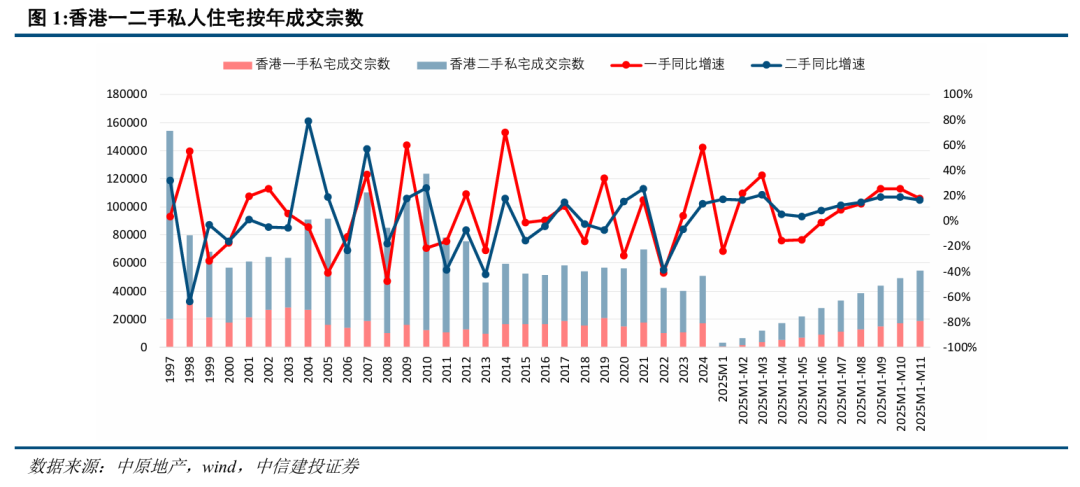
Core Viewpoint - Hong Kong's residential transaction volume and prices are expected to rebound significantly starting from March 2025, with total transactions projected to exceed 60,000 for the year, marking the second highest level in nearly 13 years, following 2021 [1][2][7] Residential Market - In the first 11 months of 2025, Hong Kong's total transactions for new and second-hand private residential properties reached 54,669, representing a year-on-year increase of 17.0% [2] - The second-hand residential prices confirmed a bottoming out from March to May 2025, with prices rising by 6.2% since the low point in late May, and an expected annual growth of 4.5% for 2025 [2][7] - The share of high-value properties (over 5 million HKD) in transactions has rebounded for the first time since 2022, indicating an increase in investment demand [2][7] Factors Driving Demand - The primary driver for the rebound in residential volume and prices is the increased asset allocation demand in the context of the Federal Reserve's interest rate cuts [7] - Contributing factors include the stabilization of the HKD/USD to RMB exchange rate, capital repatriation amid declining USD credit, and a strong wealth effect from rising Hong Kong stock prices [7] - Additional supportive elements include favorable talent attraction policies, an increase in international students, a rising housing demand, and a controlled supply from the government [7] Commercial and Office Market - The commercial office market in Hong Kong is under overall pressure but shows structural improvements, with increased transaction activity driven by domestic enterprises expanding their operations [14] - The rental rates for office spaces are still declining, with vacancy rates around 17%, but there is a trend of converting office spaces into student accommodations to address high vacancy rates [14] - Retail properties in core areas are experiencing improved rental conditions despite overall pressure, supported by an increase in inbound tourists and retail sales growth [14]


国泰海通|策略:新年初迎配置窗口,建议超配风险资产——国泰海通资产配置月度方案(202601)
国泰海通证券研究· 2025-12-30 14:28
Core Viewpoint - The report suggests that the Federal Reserve is expected to lower interest rates as anticipated and may exceed expectations in expanding its balance sheet, which could reduce policy uncertainty and market volatility for investors, presenting opportunities in global equities and commodities. The recommendation is to overweight AH shares and US stocks, as well as gold and industrial commodities by January 2026 [1]. Group 1: Strategic Asset Allocation (SAA) - The company has developed an "all-weather" asset allocation framework consisting of Strategic Asset Allocation (SAA), Tactical Asset Allocation (TAA), and Major Event Review Adjustments to guide investment decisions [1]. - SAA aims to diversify macro risks and set long-term allocation benchmarks to ensure portfolio stability [1]. Group 2: Tactical Asset Allocation (TAA) - TAA employs quantitative methods to identify assets with superior short-term risk-return characteristics and adjusts portfolio weights accordingly to enhance returns [1]. Group 3: Equity Allocation - The company is relatively optimistic about equities, recommending a 47.50% equity allocation for January 2026, with specific allocations: 10.00% to A-shares, 10.00% to Hong Kong stocks, 17.50% to US stocks, 2.50% to European stocks, 5.00% to Japanese stocks, and 2.50% to Indian stocks [2]. - Factors supporting Chinese equity performance include an upcoming economic work conference, expected expansion of the fiscal deficit, and a more proactive economic policy [2]. - The "Goldilocks" scenario is emerging, favoring US stock performance, with resilient economic conditions and decreasing inflationary pressures supporting corporate earnings expectations [2]. Group 4: Bond Allocation - The company maintains a neutral stance on bonds, recommending a 37.50% bond allocation for January 2026, with allocations: 10.00% to long-term government bonds, 10.00% to short-term government bonds, 7.50% to long-term US Treasuries, and 10.00% to short-term US Treasuries [3]. - The bond market may see renewed interest as risk appetite increases, despite existing imbalances in financing demand and credit supply [3]. - The Federal Reserve's cautious monetary policy guidance suggests that US Treasury yields may fluctuate, with a potential moderate decline in yield levels [3]. Group 5: Commodity Allocation - The company is optimistic about commodities, recommending a 15.00% commodity allocation for January 2026, with allocations: 8.00% to gold, 2.00% to oil, and 5.00% to industrial commodities [4]. - Gold is recommended for overweighting due to its strong resilience and safe-haven attributes amid rising geopolitical uncertainties and ongoing central bank purchases [4]. - Industrial commodities are expected to benefit from improved demand forecasts and sustained trading momentum, particularly driven by sectors like construction, electric grids, and electric vehicles [4].

ETF总规模突破6万亿元大关,指数投资的黄金时代已经到来!
市值风云· 2025-12-30 10:11
Core Insights - The ETF market in China has reached a historic milestone, with total assets surpassing 6 trillion yuan by the end of December 2025, marking a rapid growth trajectory in the capital market [5][17] - Index-based investment, represented by ETFs, has transitioned from a niche tool to a mainstream asset allocation choice, significantly altering the investment landscape for millions of ordinary investors [6][17] Market Growth Drivers - The explosive growth of the ETF market is attributed to a combination of policy support, market conditions, and investor demand. The China Securities Regulatory Commission (CSRC) has issued a plan to promote high-quality development of index-based investment, simplifying product registration processes and encouraging fund companies to diversify their offerings [7] - The strong performance of the A-share market since the "9.24" rally has led to a significant increase in the net asset value and scale of stock ETFs, with an average increase of 67% for 785 stock ETFs since September 24, 2024 [7][8] Investor Demand and ETF Features - ETFs effectively address key challenges faced by investors, such as stock selection, timing, and risk management. They offer a cost-effective solution with lower management fees compared to actively managed funds, which is crucial for long-term investors seeking average market returns [11] - The transparent nature of ETFs, which track specific indices and disclose holdings daily, alleviates concerns about fund manager style drift and ensures clarity for investors [11] - ETFs provide a stable investment style, allowing investors to focus on specific sectors without worrying about changes in investment strategies due to fund manager turnover [11] Market Characteristics and Future Outlook - The 6 trillion yuan ETF market exhibits distinct characteristics, with the top 20 non-money market ETFs dominated by core broad-based products, indicating strong investor confidence in equities and gold [12][14] - The rapid development of ETFs has expanded their coverage from traditional broad indices to thematic sectors and fixed-income tools, establishing ETFs as a comprehensive asset allocation toolbox [16] - China has surpassed Japan to become the largest ETF market in Asia, with ongoing innovations and investor education expected to enhance the role of ETFs as a critical infrastructure in the capital market [17]

投资进化论丨ETF、LOF的溢价率变高了,还能入场吗?
Jin Rong Jie· 2025-12-30 10:10
Core Viewpoint - Recent increases in trading prices of certain ETFs and LOFs in the secondary market have led to rising premium rates, prompting questions about the feasibility of entering the market at this time [1] Group 1: Causes of Premium - Premium arises primarily from the supply and demand dynamics in the secondary market, applicable only to funds like ETFs and LOFs that can be traded on exchanges [2] - These funds have two prices: the net asset value (NAV) calculated daily by the fund company, representing the true intrinsic value, and the market trading price determined by investor supply and demand [2] - When demand for a fund significantly exceeds supply, its trading price can rise above its NAV, resulting in a premium [2] - Premium rates can vary; for instance, a fund with a unit NAV of 1 yuan trading at 1.1 yuan has a premium of 0.1 yuan, equating to a premium rate of 10% [2] - Historical data shows that premiums are not uncommon, especially in QDII ETFs, with rates typically ranging from 2% to 5%, and extreme cases reaching over 43% [2] Group 2: Risks of High Premiums - Investing in high-premium ETFs or LOFs carries two main risks: value regression risk and NAV decline risk [3] - Value regression risk indicates that market prices will eventually align with NAV, and high premiums may lead to losses if market sentiment cools [3] - NAV decline risk suggests that entering the market at high premiums exposes investors to both emotional premiums and potential declines in NAV, leading to compounded losses [3] Group 3: Perspective on Premium Phenomenon - High premiums reflect market sentiment and short-term supply-demand imbalances, with potential for rapid price corrections if sentiment shifts [4] - The emergence of premiums also indicates growing investor interest in overseas and commodity assets, suggesting a diversification in asset allocation strategies [4] - ETFs and LOFs serve as convenient asset allocation tools, with their trading rules differing from traditional funds, leading to greater volatility and rapid premium adjustments [4] - Investors are advised to remain calm and assess value and risk rationally when premiums deviate significantly from normal ranges [4]
金融工程专题:宏观因子的周期轮动与资产配置
BOHAI SECURITIES· 2025-12-30 09:53
Quantitative Models and Construction Methods 1. Model Name: HP Filter - **Model Construction Idea**: The HP filter is used to decompose a time series into trend and cyclical components, aiming to remove long-term trends and short-term noise from macroeconomic factors[10][9] - **Model Construction Process**: The HP filter solves the following optimization problem to balance trend smoothness and data fit: $$\operatorname*{min}\left\{\sum_{t=1}^{T}(y_{t}-g_{t})^{2}+\lambda\sum_{t=2}^{T-1}[(g_{t+1}-g_{t})-(g_{t}-g_{t-1})]^{2}\right\}$$ - \(y_t\): Original time series data - \(g_t\): Trend component - \(\lambda\): Smoothing parameter, where larger \(\lambda\) results in a smoother trend In this report, a larger \(\lambda\) is used to remove long-term trends, and a smaller \(\lambda\) is applied to filter out noise, resulting in a mid-cycle series for further analysis[10] - **Model Evaluation**: The HP filter aligns with classical macroeconomic analysis frameworks but suffers from endpoint bias and cannot identify different frequency cycles[3][42] 2. Model Name: Fourier Transform - **Model Construction Idea**: Fourier Transform decomposes a time series into a combination of sine waves with different frequencies, amplitudes, and phases, enabling the identification of dominant cycles in macroeconomic data[25][26] - **Model Construction Process**: The Fourier Transform is defined as: $$F(f)=\int_{-\infty}^{\infty}f(x)e^{-i2\pi f(x)}\,\mathrm{d}x$$ - \(f(x)\): Time series data - \(F(f)\): Frequency domain representation Since most macroeconomic data are non-stationary, the HP filter is first applied to remove long-term trends, producing a stationary series. The Fourier Transform is then used to extract the main cycles and fit the periodic series[25][26] - **Model Evaluation**: Suitable for analyzing historical data and identifying economic cycle patterns, but assumes constant periodic structures over time, which may reduce short-term fit[3][42] 3. Model Name: Hybrid Filtering - **Model Construction Idea**: Combines the strengths of HP filtering and Fourier Transform to achieve both extrapolation capability and flexibility in cycle fitting[42] - **Model Construction Process**: - Apply Fourier Transform to identify periodic patterns in macroeconomic data - Use HP filtering to observe short-term trends in macroeconomic factors - Combine the results to create a series that retains both periodicity and trend information[42] - **Model Evaluation**: Balances the advantages of both methods, providing better adaptability for macroeconomic data analysis[42] 4. Model Name: Merrill Lynch Clock Model - **Model Construction Idea**: Divides the economic cycle into four phases based on economic growth and inflation, using PMI YoY growth as a proxy for economic growth and PPI YoY growth for inflation[68][72] - **Model Construction Process**: - Recovery: PMI YoY up, PPI YoY down → 60% stocks, 40% bonds - Expansion: PMI YoY up, PPI YoY up → 60% commodities, 40% stocks - Stagflation: PMI YoY down, PPI YoY up → 60% cash, 40% commodities - Recession: PMI YoY down, PPI YoY down → 60% bonds, 40% cash[72] - **Model Evaluation**: Achieves higher returns and Sharpe ratio compared to a balanced allocation model, with a monthly win rate of 56.49%[68][70] 5. Model Name: Monetary-Credit Model - **Model Construction Idea**: Adapts the Merrill Lynch Clock for the Chinese market by focusing on monetary and credit conditions, using M2 YoY growth for monetary policy and social financing YoY growth for credit conditions[76] - **Model Construction Process**: - Loose Monetary & Loose Credit: M2 YoY up, social financing YoY up → 60% stocks, 40% commodities - Tight Monetary & Loose Credit: M2 YoY down, social financing YoY up → 60% commodities, 40% stocks - Tight Monetary & Tight Credit: M2 YoY down, social financing YoY down → 60% cash, 40% bonds - Loose Monetary & Tight Credit: M2 YoY up, social financing YoY down → 60% bonds, 40% stocks[76] - **Model Evaluation**: Slightly lower annualized returns than the Merrill Lynch Clock but demonstrates more stable excess returns since 2020[76][85] --- Model Backtesting Results 1. HP Filter - **Annualized Excess Return**: 1.43%-3.16% for stock index timing[57][58] - **Annualized Excess Return**: 4.84%-9.91% for stock-bond timing[60][61] 2. Fourier Transform - **Core Cycle**: Identified a 38-44 month cycle across all macroeconomic factors, suggesting a 3-4 year mid-cycle pattern[26][83] 3. Merrill Lynch Clock Model - **Annualized Return**: 11.71% - **Annualized Excess Return**: 5.82% - **Sharpe Ratio**: 1.037 - **Monthly Win Rate**: 56.49%[68][70] 4. Monetary-Credit Model - **Annualized Return**: 9.93% - **Annualized Excess Return**: 4.04% - **Sharpe Ratio**: 0.589 - **Monthly Win Rate**: 56.90%[76][79] --- Quantitative Factors and Construction Methods 1. Factor Name: PMI YoY Growth - **Construction Idea**: Represents economic growth trends[9][83] - **Construction Process**: Derived from the year-over-year growth rate of the Purchasing Managers' Index (PMI)[9][83] 2. Factor Name: PPI YoY Growth - **Construction Idea**: Represents inflation trends[9][83] - **Construction Process**: Derived from the year-over-year growth rate of the Producer Price Index (PPI)[9][83] 3. Factor Name: M1 YoY Growth - **Construction Idea**: Reflects changes in narrow money supply[9][83] - **Construction Process**: Derived from the year-over-year growth rate of M1[9][83] 4. Factor Name: M2 YoY Growth - **Construction Idea**: Reflects changes in broad money supply[9][83] - **Construction Process**: Derived from the year-over-year growth rate of M2[9][83] 5. Factor Name: Social Financing YoY Growth - **Construction Idea**: Represents credit supply conditions[9][83] - **Construction Process**: Derived from the year-over-year growth rate of total social financing[9][83] 6. Factor Name: 1-Year Treasury Yield YoY Difference - **Construction Idea**: Reflects interest rate trends[9][83] - **Construction Process**: Calculated as the year-over-year difference in 1-year treasury yields[9][83] 7. Factor Name: Industrial Production YoY Growth - **Construction Idea**: Represents industrial output trends[9][83] - **Construction Process**: Derived from the year-over-year growth rate of industrial production[9][83] 8. Factor Name: Corporate Profit YoY Growth - **Construction Idea**: Reflects corporate profitability trends[9][83] - **Construction Process**: Derived from the year-over-year growth rate of corporate profits[9][83] --- Factor Backtesting Results Stock Index Timing - **Annualized Excess Return**: 1.43%-3.16% for factors like M1 YoY, PPI YoY, and PMI YoY[57][58] Stock-Bond Timing - **Annualized Excess Return**: 4.84%-9.91% for factors like M1 YoY, PPI YoY, and PMI YoY[60][61]
策略快评:2026年1月各行业金股推荐汇总
Guoxin Securities· 2025-12-30 05:55
Core Insights - The report recommends key stocks across various industries for January 2026, highlighting potential investment opportunities based on market trends and company performance [2][3]. Industry Summaries Construction - Shenghui Integration (603163.SH) is a Taiwanese cleanroom engineering service provider and a core supplier for Google's TPU supply chain, poised to benefit from TSMC's expansion in the U.S. with potential orders from TSMC Arizona and multiple North American data centers [2]. Social Services - China Duty Free Group (601888.SH) is expected to benefit from a new cycle in domestic duty-free sales, with a boost from the upcoming consumption peak during the New Year and Spring Festival, leading to improved performance expectations [2]. Electronics - Lante Optics (688127.SH) is experiencing significant growth in its optical prism product line and is collaborating with multiple waveguide manufacturers for AR glasses, indicating strong profit elasticity and expansion potential [2]. Utilities and Environmental Protection - China General Nuclear Power (003816.SZ) is set to benefit from the normalization of nuclear power approvals and improvements in market pricing mechanisms, with expected production increases in Guangdong province [2]. Nonferrous Metals - Zijin Mining (601899.SH) is a leading player in the nonferrous sector, with high profit contributions from gold and copper, and is entering a rapid growth phase in lithium production, making it a highly valued investment opportunity for 2026 [2]. Agriculture, Forestry, Animal Husbandry, and Fishery - Youran Dairy (9858.HK), a global leader in dairy farming, is expected to benefit from rising milk prices and beef price increases, leading to significant performance recovery [2]. Internet - Tencent Holdings (0700.HK) is well-positioned for the AI era, leveraging its ecosystem advantages, with potential growth from e-commerce and AI agent capabilities not yet reflected in current profit forecasts [2]. Pharmaceuticals - WuXi AppTec (603259.SH) is supported by strong performance, order growth, and capital expenditure, with favorable regulatory changes expected to enhance the valuation of the CXO sector [2]. Light Industry - Sun Paper (002078.SZ) is entering a new capacity release phase with significant production increases expected, making it a compelling investment with reasonable valuation metrics [2]. Textiles and Apparel - Anta Sports (2020.HK) is anticipated to benefit from the performance of its premium sports brands, with a favorable valuation and upcoming catalysts from Q4 operational disclosures and the Spring Festival consumption peak [2].






从“基金买手”到“资产管家”,FOF产品该如何穿越波动?
聪明投资者· 2025-12-30 03:57
Core Viewpoint - The article emphasizes that in a low-interest, high-volatility market environment, diversified asset allocation remains the only "free lunch" for investors, with FOF (Fund of Funds) evolving from a "fund buyer" to an "asset manager" to help investors navigate market fluctuations and reduce allocation difficulties [2][5]. Group 1: FOF Development and Strategy - FOF scale has seen positive growth for three consecutive quarters, reaching a three-year high by September 30, 2025 [2][4]. - The article discusses the unique value of FOF in the context of low interest rates and market uncertainty, highlighting the need for FOF managers to create products that cater to the majority of investors [5]. - The FOF manager's role is likened to that of a chef, where understanding client preferences (risk-return goals) is crucial for selecting and combining suitable funds (ingredients) to achieve investment objectives [6][8]. Group 2: Multi-Asset Allocation Approach - The article notes that 64% of low-volatility FOF products with performance benchmarks between 10%-13% have adopted multi-asset allocation strategies, indicating market acceptance and practicality [9]. - The FOF team employs a "three-tier allocation logic," starting with macro analysis to determine asset allocation benchmarks, followed by industry and style selection, and finally identifying fund managers with unique alpha capabilities [9][10]. - The upcoming WanJia QiTai Stable FOF product exemplifies this multi-asset allocation philosophy, combining low-correlation assets like dividend low-volatility stocks, S&P indices, bonds, and gold to achieve dynamic balance amid market fluctuations [10]. Group 3: Research and Team Collaboration - The FOF management system emphasizes systematic collaboration and specialization within the team, enhancing decision-making efficiency and precision [11][12]. - The team conducts regular research meetings to discuss key dimensions such as style stability and risk-return characteristics, maintaining a long-term perspective to avoid being misled by short-term market fluctuations [11]. - The research framework integrates macro, meso, and micro-level analyses, ensuring comprehensive coverage from economic cycles to fund manager capabilities [12]. Group 4: Performance and Future Outlook - The article highlights the performance of two FOF products managed by the team, with returns exceeding benchmarks, showcasing the effectiveness of their collaborative approach [13]. - The upcoming WanJia QiTai Stable FOF will continue to leverage team strengths, with a focus on multi-asset strategies and risk control [13]. - The article concludes that the true competitive advantage lies in a systematic, evolving approach to multi-asset allocation, ensuring steady returns for investors [13][14].

粤海·云上启幕:以标杆产品力重塑广州高端人居格局,引领新范式
Sou Hu Cai Jing· 2025-12-30 02:06
Core Insights - The launch of the Yuehai Yunshang project in Guangzhou's Baiyun New Town represents a significant evolution in the high-end residential market, offering a comprehensive solution for modern living and rational asset allocation [1][25][27] - The project is positioned as a benchmark for high-end residential value in Guangzhou, emphasizing the integration of urban resources and lifestyle [1][8][25] Group 1: Project Overview - Yuehai Yunshang features cloud-level apartments ranging from approximately 213 to 571 square meters, marking a new standard in high-end living [1][28] - The project occupies a prime location in Baiyun New Town, which serves as a hub for political, economic, cultural, ecological, and transportation functions, enhancing its appeal [3][5][7] Group 2: Unique Selling Points - The project combines natural and cultural elements, offering views of the Baiyun Mountain and proximity to major cultural landmarks, thus creating a balanced living environment [5][12] - A comprehensive transportation network, including dual metro lines and rapid airport connections, enhances commuting efficiency [5][12] Group 3: Architectural and Design Features - The building's design integrates advanced architectural aesthetics and technology, featuring a height of approximately 190 meters and a custom glass curtain wall system that improves insulation and noise reduction [9][19] - The project includes a unique homecoming experience with a thoughtfully designed entrance that filters urban noise and creates a serene atmosphere [12][19] Group 4: Community and Lifestyle Amenities - Yuehai Yunshang offers a resort-style garden and a private clubhouse of over 3,000 square meters, catering to various lifestyle needs such as fitness, socializing, and business meetings [14][25] - The project promotes a mixed-use environment where residential, commercial, and recreational spaces are seamlessly integrated, enhancing the quality of life for residents [14][25] Group 5: Innovative Living Concepts - The project emphasizes privacy and efficiency with a rare 3-lift, 2-unit configuration, ensuring a distinct separation between private and service areas [17][19] - Flexible living spaces are designed to adapt to changing family needs, with options for expansion and multifunctional areas [21][23] Group 6: Market Positioning and Future Outlook - Yuehai Yunshang advocates for a balanced asset strategy, promoting a "core holding + flexible allocation" approach to real estate investment [25][27] - The project's completion signifies the transformation of Baiyun New Town into a high-end urban integration demonstration area, attracting urban elites and enhancing regional vitality [25][27]
中信期货晨报:国内商品期市收盘涨跌参半,铂、钯跌停-20251230
Zhong Xin Qi Huo· 2025-12-30 00:30
1. Report Industry Investment Rating - No specific industry investment rating is provided in the report [1][2][3] 2. Core Viewpoints of the Report - **Overseas Macro**: The US economic aggregate in Q3 exceeded expectations, but growth momentum showed signs of marginal slowdown. The consumer confidence index in December dropped to 89.1, lower than the market expectation of 91.0. The Fed is likely to adopt a more cautious and accommodative approach. Factory orders in the manufacturing sector recovered moderately, and the differentiation in high - end manufacturing deepened [6] - **Domestic Macro**: In November, demand recovery was slow, with consumption and investment under pressure, and the year - on - year decline in industrial profits widened. However, the cumulative profits from January to November still showed a slight positive growth, indicating the economy is "stabilizing at a low level" with policy support. There are industry differentiations, with the equipment manufacturing industry leading the growth (+7.2%, some industries with high growth), the raw material manufacturing industry accelerating (+22.1%), the consumer goods industry turning positive, and the automobile industry slightly weakening (-0.3%). Profit improvement mainly relies on supply contraction and price recovery, and may be constrained in the future if demand fails to pick up and the base increases [6] - **Asset Views**: The macro environment is still favorable for the precious metals and non - ferrous metals sectors, but short - term risks need to be watched out for. In the precious metals sector, the risk of volatility in silver increases after a sharp rise, and further corrections are possible. In the non - ferrous metals sector, there are opportunities to buy on dips for commodities with more supply disruptions, such as copper, aluminum, and tin. Attention should also be paid to lithium carbonate with good supply - demand performance. For the domestic equity sector, a defensive strategy is recommended at the end of the year and during the policy window period [6] 3. Summary by Relevant Catalogs 3.1 Financial Market - **Stock Index Futures**: The CSI 300 futures, SSE 50 futures, CSI 500 futures, and CSI 1000 futures all had negative daily and weekly fluctuations, but different monthly, quarterly, and annual changes. For example, the CSI 300 futures had a daily decline of 0.61%, a weekly decline of 0.61%, a monthly increase of 3.08%, a quarterly decline of 0.17%, and an annual increase of 17.58% [2] - **Treasury Bond Futures**: Most Treasury bond futures had negative daily and weekly fluctuations. For example, the 2 - year Treasury bond futures had a daily decline of 0.07%, a weekly decline of 0.07%, etc [2] - **Foreign Exchange**: The US dollar index was flat, and different currency pairs had various changes. For example, the euro - US dollar exchange rate had no change in pips, and the US dollar - Japanese yen exchange rate was flat daily but had other period - specific changes [2] - **Interest Rates**: Various interest rates such as the 7 - day inter - bank pledged repo rate, 10Y Chinese Treasury bond yield, and 10Y US Treasury bond yield had different fluctuations [2] 3.2 Hot Industries - Different industries in the CITIC industry index had different price changes. The comprehensive finance, national defense and military industry, and petroleum and petrochemical industries had positive daily and weekly changes, while the pharmaceutical, food and beverage, and power equipment and new energy industries had negative daily and weekly changes [2] 3.3 Overseas Commodities - **Energy**: NYMEX WTI crude oil had a daily increase of 2.52%, while ICE Brent crude oil had a daily decline of 2.44%. NYMEX natural gas had a daily increase of 3.00%, and ICE UK natural gas was flat [2] - **Precious Metals**: COMEX gold and silver had significant increases, with COMEX gold having an annual increase of 72.85% and COMEX silver having a large annual increase [2] - **Non - Ferrous Metals**: LME copper, zinc, lead, etc. showed different price trends. LME copper had a flat daily price but positive changes over other periods [2] - **Agricultural Products**: CBOT soybeans, wheat, and other agricultural products had different price fluctuations. For example, CBOT soybeans had a daily decline of 0.37% [2] 3.4 Domestic Main Commodities - Different domestic commodities such as shipping (container shipping to Europe), precious metals (gold and silver), non - ferrous metals, black building materials, energy, chemicals, and agricultural products had various daily, weekly, monthly, and annual price changes. For example, container shipping to Europe had a daily decline of 0.09%, and gold had a daily decline of 0.90% [3] 3.5 Viewpoints Summary - **Financial**: The stock market is waiting for a main line, and the bond market has disturbing factors. Stock index futures are expected to rise in a volatile manner, stock index options to fluctuate, and Treasury bond futures to fluctuate [7] - **Precious Metals**: They are expected to rise in a volatile manner, with silver having greater elasticity [7] - **Shipping**: Attention should be paid to the resumption of voyages in the far - month contracts of container shipping to Europe [7] - **Black Building Materials**: The real - world pressure exists, and the disk performance is under pressure, with most varieties expected to fluctuate [7] - **Non - Ferrous Metals and New Materials**: Wait for the macro - level to become clearer, with basic metals in a state of shock and consolidation [7] - **Energy and Chemicals**: The pattern of strong aromatics and weak olefins remains unchanged, and different chemical varieties have different short - term outlooks, mostly in a state of shock [9] - **Agriculture**: The market is worried about the supply, with different agricultural products having different short - term trends, such as soybean meal leading the near - month contracts to rise [9]