反内卷

Search documents
守住公平竞争的航道
Jing Ji Ri Bao· 2026-01-20 22:02
Core Viewpoint - The antitrust investigation serves as a critical opportunity for the overall transformation of the platform economy, emphasizing the need for technological innovation to reduce costs and improve efficiency while ensuring fair profit distribution among all stakeholders in the platform ecosystem [1][4]. Group 1: Antitrust Investigation Context - The first antitrust case of 2026 targets Ctrip, with prior indications of issues such as "choose one from two" and technical price intervention being flagged by market regulators [2]. - The investigation suggests that Ctrip's business practices may have already been deemed problematic, raising concerns about potential penalties and their impact on future profitability and business models [2]. Group 2: Policy Implications - Ctrip's situation highlights a conflict between high platform profits and the "real economy first" directive, as platforms often profit from merchants rather than users, leading to a concerning trend of cost transfer from users to merchants [3]. - Ctrip's net profit for the first three quarters of 2025 reached 29 billion yuan, while the total net profit of the entire A-share tourism chain was approximately 19 billion yuan, illustrating the stark contrast between platform profits and the struggles of traditional businesses [3]. Group 3: Market Dynamics and Future Directions - The use of pricing tools by platforms like Ctrip creates a vicious cycle for merchants, forcing them into price wars that undermine profitability, which is contrary to the goal of fostering a healthy competitive environment [4]. - The investigation is not only about antitrust but also addresses the issue of "involution" in competition, aiming to create a new ecosystem where all parties can share development benefits through genuine value creation and fair profit distribution [4].

智能化迈出“破冰”行动 汽车产销再创历史新高
Jing Ji Ri Bao· 2026-01-20 19:59
Core Insights - In 2025, China's automotive industry demonstrated remarkable resilience and vitality, achieving record production and sales figures of 34.53 million and 34.40 million vehicles, respectively, marking year-on-year growth of 10.4% and 9.4% [1] - The year marked a significant shift in the market, with new energy vehicles (NEVs) surpassing 50% of domestic new car sales, establishing themselves as the mainstream product in the automotive market [2][3] - The automotive export volume exceeded 7 million units, with NEV exports reaching 2.615 million units, reflecting a strong competitive edge in international markets [11] NEV Market Dominance - NEVs accounted for 50.8% of domestic new car sales in 2025, indicating that for every two new cars sold, one was an NEV [3] - NEV production and sales reached 16.626 million and 16.49 million units, respectively, with year-on-year growth of 29% and 28.2%, maintaining a global leadership position for 11 consecutive years [3] - The competitive landscape has shifted, with domestic brands capturing nearly 70% of the passenger car market share, reversing the dominance of joint venture brands [3][4] Technological and Policy Support - The growth of NEVs is attributed to supportive policies, technological advancements, and a robust supply chain, with over 11.5 million vehicles replaced under the trade-in policy, generating sales exceeding 1.6 trillion yuan [5] - Technological innovations have led to significant improvements in vehicle performance, such as a 30% reduction in battery costs and a 40% increase in battery lifespan [6] - The establishment of a comprehensive supply chain has positioned China as a leading supplier of battery materials and power batteries globally, with 70% and 60% market shares, respectively [6] Smart Driving Developments - The approval of the first L3-level conditional autonomous driving models in December 2025 marked a pivotal moment in China's autonomous driving industry, transitioning from technology validation to mass production [7] - The penetration rate of vehicles equipped with L2-level driving assistance features reached 64%, with a year-on-year growth of 21.2% in the first three quarters of 2025 [9] - The integration of AI technologies into smart driving systems has accelerated advancements, with new models emerging that enhance driving experiences and product forms [9][10] International Expansion and Localization - In response to intensified domestic competition, Chinese automakers are accelerating their international expansion, with exports reaching 7.098 million units in 2025, a 21.1% increase [11] - Localization strategies are being implemented in key markets such as Southeast Asia and Europe, with several Chinese brands establishing manufacturing bases to enhance competitiveness [12] - Collaborations with multinational companies are facilitating the entry of Chinese automotive supply chains into global markets, strengthening China's position in the global automotive value chain [12] Market Competition Restructuring - The introduction of compliance guidelines aims to curb price wars and establish a more orderly competitive environment in the automotive industry [13] - Measures to address "involution" in the market have begun to take effect, with a shift from price competition to a focus on technology, quality, and service [13][14] - The automotive industry is transitioning from a phase of scale expansion to one of quality enhancement, necessitating a comprehensive approach to market regulation and competition [15]

每日投行/机构观点梳理(2026-01-20)
Jin Shi Shu Ju· 2026-01-20 13:55
Group 1 - Westpac's commodity research head Robert Rennie indicates that global financial markets are underestimating the seriousness of the situation regarding Greenland, particularly in light of the Trump administration's attempts to exert control over the territory [1] - The market is awaiting Trump's speech at the Davos Forum and the results of an emergency European summit to better understand the severity of the situation [1] Group 2 - Bank of America reports that global investor sentiment has reached its highest level since July 2021, with a significant drop in cash holdings to a historical low of 3.2% [2] - The bank's bull-bear indicator has surged to an "ultra-bull" level of 9.4, with 38% of surveyed fund managers expecting economic strength and concerns about recession at a two-year low [2] - Liquidity conditions are the best since 2021, and nearly half of respondents have no hedging measures against a significant stock market decline [2] Group 3 - BlackRock CEO Larry Fink warns that global capitalism is losing public trust as prosperity is not benefiting a wide population, suggesting that success should be measured by people's ability to perceive and feel it [3] - Fink expresses concerns that artificial intelligence could exacerbate inequality, urging Davos to listen more to the voices of ordinary people rather than just the elite [3] Group 4 - Goldman Sachs predicts that emerging market equities will be the most attractive investment destination globally over the next one and five years, with an expected base return rate of 8% [4] - The probability of emerging market returns exceeding expectations is estimated at 20%, while the chance of experiencing low single-digit negative returns is 25% [4] Group 5 - Citigroup's Japan market head, Akira Hoshino, suggests that if the yen continues to weaken, the Bank of Japan may raise interest rates three times in 2026, potentially doubling the current rate [5] - Hoshino indicates that if the USD/JPY exchange rate exceeds 160, a rate hike could occur as early as April, with further hikes possible in July and by the end of the year [5] Group 6 - Tokyo State Street Asset Management's senior fixed income strategist, Masahiko Loo, states that the "high market trade" strategy remains effective, with shorting the yen being the simplest strategy [6] - Loo notes a significant herd effect in the Japanese market, leading banks to refrain from buying until the Bank of Japan raises rates [6] Group 7 - CICC reports that recent strengthening of the RMB exchange rate is partly due to seasonal increases in settlement demand, particularly in December and January [7] - The report highlights that historically, the RMB has appreciated by 0.5% and 0.8% against the USD in December and January, respectively, with probabilities of appreciation at 75% and 67% [7] Group 8 - Guotai Junan Securities indicates that AI and anti-involution themes may become the main lines of the A-share market in 2026, with AI-driven trends extending from upstream infrastructure to downstream applications [8] - The report notes that AI's contribution to improving PPI is primarily reflected in the prices of non-ferrous metals and technology sectors [8] Group 9 - Galaxy Securities expresses optimism about the dividend value of the banking sector, citing structural monetary policy tools and improving credit demand as supportive factors [9] - The report anticipates that the first batch of listed banks will show stable recovery in performance, with ongoing policy effects expected to be released [9] Group 10 - CITIC Securities sees high certainty in the development of computing power and anticipates significant investment opportunities in domestic computing chips and system-level manufacturers by 2026 [10] - The report emphasizes the importance of AI applications in various sectors, suggesting a focus on office, coding, agent, and multi-modal AI applications [10] Group 11 - CITIC Securities notes a cooling of market speculation, with record outflows from the ETF market, while technology and cyclical sector ETFs continue to attract funds [11] - The report suggests that a multi-dimensional comparative allocation strategy is more prudent in the current environment, recommending attention to various ETFs in sectors like new energy and healthcare [11]
高盛首席中国股票策略师刘劲津:看好AI、“反内卷”、出海等题材
Zheng Quan Ri Bao Wang· 2026-01-20 13:29
Group 1 - Goldman Sachs maintains a positive outlook on Chinese stocks for 2026, expecting southbound capital to reach a new high of $200 billion and northbound capital to achieve a net inflow of $20 billion, driven by demand for physical AI and a stronger RMB [1] - The growth drivers identified include artificial intelligence, "anti-involution," and overseas expansion, which are expected to push the earnings per share growth rate between 10% and 15% [1] - China's strong export performance is anticipated to increase market share for Chinese companies, with overseas revenue share rising from 12% in 2015 to 16% currently, and projected to reach 20% by the end of 2030 [1] Group 2 - Chinese listed companies' cash returns are expected to reach a new high of approximately 4 trillion yuan in 2026, with net buybacks enhancing earnings per share growth [2] - The two main investment themes for 2026 and beyond are policy support and AI, which are expected to reshape sector allocations [2] - The technology hardware sector has been upgraded to overweight due to its diverse product supply chain, with a focus on smartphones, AI servers, data centers, semiconductors, and physical AI stocks, which are seen as key enablers and beneficiaries of AI development in China [2]

证券研究报告、晨会聚焦:地产由子沛:美国次贷危机下的房地产市场-20260120
ZHONGTAI SECURITIES· 2026-01-20 12:47
Core Insights - The report discusses the causes of the U.S. subprime mortgage crisis, highlighting factors such as the issuance of subprime loans due to low interest rates, rapid home price increases, and the role of financial innovation in spreading debt through securitization [3] - It outlines the U.S. government's response to the crisis, emphasizing the effectiveness of fiscal policies over traditional monetary policies, and the shift in leverage from households to the government [3] - The report indicates that U.S. housing prices are expected to stabilize and recover over time, with a projected timeline of approximately 5-10 years for full recovery from the crisis [3] Summary by Sections Causes of the Subprime Mortgage Crisis - The crisis was driven by increased household leverage due to low interest rates, rapid home price appreciation beyond actual value, speculative behavior in certain cities, and the impact of rising interest rates that burst the housing bubble [3] Government Response - Traditional monetary policy measures, such as interest rate cuts, were less effective compared to substantial fiscal policies that directly stimulated demand and unconventional monetary policies like quantitative easing (QE) that intervened in troubled assets [3] Housing Market Recovery - Long-term interest rates in the U.S. are on a downward trend, providing support for housing prices. The report notes that when the rental-to-price ratio exceeds the mortgage rate, housing price growth is expected to stabilize, with a recovery timeline of about 4.5 years post-crisis [3]
有机硅价格回暖,合盛硅业乘“反内卷”东风迎行业反转
Zheng Quan Shi Bao Wang· 2026-01-20 12:25
Core Viewpoint - The organic silicon DMC market is experiencing a significant price increase due to tightening supply and rising demand from high-end sectors such as new energy and electronics, with prices reaching approximately 13,700 to 14,000 yuan per ton as of January 15 [1] Group 1: Market Dynamics - The organic silicon DMC price has risen from about 11,300 yuan per ton at the end of October 2025 to around 13,200 yuan per ton by mid-November, marking a monthly increase of approximately 20% [2] - The average operating rate in the organic silicon industry is currently around 66%, with no significant inventory pressure, and supply is expected to tighten further in January [3] - The organic silicon industry is projected to face supply-demand gaps of -1.9 million tons, -29.4 million tons, and -18.4 million tons from 2025 to 2027, respectively, due to mismatches caused by expansion cycles [4] Group 2: Policy and Industry Changes - The "anti-involution" policy initiated in November 2025 aims to reduce industry overcapacity, with a consensus among industry leaders to lower operating rates by 30% [2] - The adjustment of export tax policies for primary polysiloxane products starting April 1, 2026, is expected to guide the industry towards higher-end product development and production [5] - The implementation of strict policies regarding "double carbon" and environmental safety is accelerating the exit of outdated production capacities, benefiting leading companies like Hoshine Silicon Industry [7] Group 3: Company Performance and Outlook - Hoshine Silicon Industry is identified as a leading player in the organic silicon sector, with a significant recovery in profitability, reporting a net profit of 262 million yuan in the third quarter, marking a turnaround from previous losses [6][8] - Forecasts suggest that Hoshine's net profits will increase to 2.651 billion yuan, 4.381 billion yuan, and 5.132 billion yuan from 2026 to 2028, reflecting the company's strong market position and operational advantages [8]

政策催化持续,化工板块迎“戴维斯双击”?化工ETF(516020)午后拉升摸高1.7%再创近3年新高!
Xin Lang Cai Jing· 2026-01-20 11:32
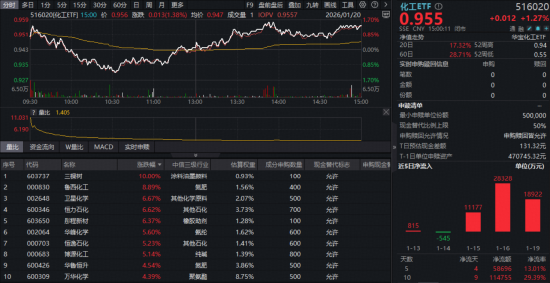
Group 1 - The chemical sector continues to show strong performance, with the chemical ETF (516020) reaching a closing price that marks a new high since August 2022, closing up 1.27% on January 20, 2026 [1][9] - Notable individual stocks within the sector include Sanhe Tree, which hit the daily limit, and Luxi Chemical, which surged by 8.89%, while Satellite Chemical, Hengli Petrochemical, and Tongcheng New Materials all rose over 6% [1][10] - Since the beginning of 2025, the chemical ETF has seen a cumulative increase of 54.34%, significantly outperforming major indices such as the Shanghai Composite Index (22.73%) and the CSI 300 Index (19.92%) [1][13] Group 2 - The chemical ETF has attracted significant capital inflow, with over 5.8 billion yuan in net subscriptions over the last five trading days and more than 11 billion yuan over the last ten trading days [4][12] - A recent policy from the Ministry of Industry and Information Technology aims to promote zero-carbon factory construction by 2030, which may lead to stricter regulations on new chemical projects and limit new capacity in the petrochemical sector [4][12] - Analysts suggest that the chemical industry is currently in a weak performance phase, but certain sub-sectors, such as lubricants, have exceeded expectations, indicating potential investment opportunities in glyphosate, fertilizers, and high-dividend assets [5][14] Group 3 - The chemical ETF (516020) tracks the CSI Sub-Industry Chemical Theme Index, with nearly 50% of its holdings concentrated in large-cap leading stocks like Wanhua Chemical and Salt Lake Industry, while the other half includes leading stocks in various sub-sectors [5][14] - The ETF provides a more efficient way to invest in the chemical sector, especially for those looking to capitalize on the sector's rebound [5][14]


黑色金属日报-20260120
Guo Tou Qi Huo· 2026-01-20 11:03
Industry Investment Ratings - **Thread Steel**: ★★★, indicating a clearer upward trend and a relatively appropriate investment opportunity currently [1] - **Hot - Rolled Coil**: ★★★, suggesting a clearer upward trend and a relatively appropriate investment opportunity currently [1] - **Iron Ore**: ★☆☆, representing a bullish/bearish bias, with a driving force for price movement but poor operability on the trading floor [1] - **Coke**: ★☆☆, showing a bullish/bearish bias, with a driving force for price movement but poor operability on the trading floor [1] - **Coking Coal**: ★☆☆, indicating a bullish/bearish bias, with a driving force for price movement but poor operability on the trading floor [1] - **Silicon Manganese**: ★☆☆, suggesting a bullish/bearish bias, with a driving force for price movement but poor operability on the trading floor [1] - **Silicon Iron**: ★☆☆, representing a bullish/bearish bias, with a driving force for price movement but poor operability on the trading floor [1] Core Views - The overall demand for steel is weak, with the steel price following the cost center down and mainly fluctuating within a range. The iron ore is expected to be weakly volatile in the short - term. Coke and coking coal are likely to follow a weakening trend. Silicon manganese and silicon iron need to pay attention to the "anti - involution" impact and cost support [2][3][4][5][7][8] Summary by Category Steel - The steel market is weak. The profit of steel mills has been marginally repaired, but the resumption of blast furnace production has slowed down. The overall domestic demand is weak, and steel exports remain high. The steel price mainly fluctuates within a range [2] Iron Ore - The global iron ore shipping volume has decreased month - on - month, while the domestic arrival volume has declined but is much higher than last year. The port inventory is increasing. The terminal demand has improved in the off - season, and the iron ore is expected to be weakly volatile in the short - term [3] Coke - The coke price has declined in an oscillatory manner. The coking profit is average, and the inventory has slightly increased. With sufficient carbon element supply and weak downstream demand, it is likely to follow a weakening trend [4] Coking Coal - The coking coal price has declined in an oscillatory manner. The production of coking coal mines has increased significantly, and the terminal inventory has increased substantially. It is likely to be weakly volatile due to sufficient supply and weak downstream demand [5] Silicon Manganese - The silicon manganese price has rebounded after hitting the bottom. The spot price of manganese ore has increased. The demand for silicon manganese has decreased seasonally, and attention should be paid to the "anti - involution" impact and cost support [7] Silicon Iron - The silicon iron price has rebounded after hitting the bottom. Affected by policies, the supply has decreased significantly, and the demand remains resilient. Attention should be paid to the "anti - involution" impact and cost support [8]
化工板块继续上攻,化工行业ETF易方达、化工50ETF、化工ETF上涨
Ge Long Hui A P P· 2026-01-20 09:46
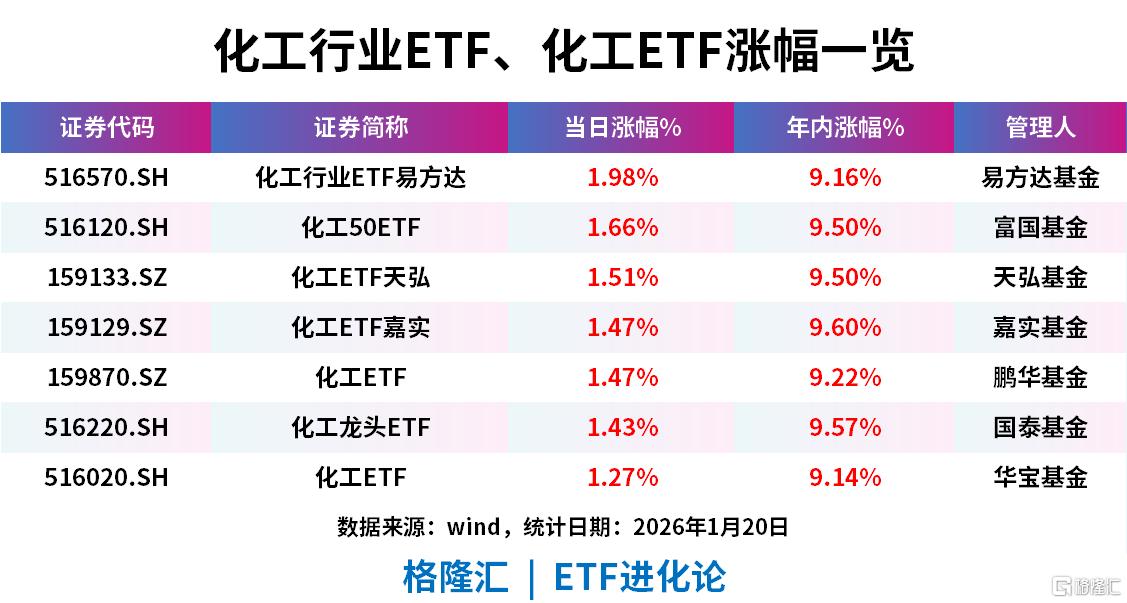
Core Viewpoint - The chemical industry is experiencing price increases and production adjustments, driven by global giants and domestic market dynamics, indicating potential investment opportunities in leading companies and sectors within the industry [4][5][6]. Group 1: ETF Performance - Several chemical ETFs have shown positive daily and year-to-date performance, with the highest daily increase of 1.98% for the E Fund Chemical Industry ETF and a year-to-date increase of 9.60% for the Jiashi Chemical ETF [2]. Group 2: Market Trends - The chemical ETFs track the CSI Sub-Industry Chemical Theme Index, with nearly 50% of their holdings concentrated in large-cap leading stocks such as Wanhua Chemical and Salt Lake Potash, benefiting from strong market trends [4]. - Recent price increases in key chemical products include a 7.9% weekly rise in epoxy propane and a general upward trend in organic silicon intermediates, reflecting a positive market sentiment [4]. Group 3: Production Adjustments - Domestic polyester filament factories have reduced production by 6% starting January 14, leading to a cumulative reduction of 15%, driven by high raw material costs and seasonal demand patterns [5]. - The reduction in production is expected to help deplete inventories, potentially enhancing profitability for leading companies during the upcoming peak season [5]. Group 4: Industry Outlook - According to Huatai Securities, the chemical industry is facing a challenging period with weak demand and supply-side pressures, predicting a profitability low point for bulk chemicals in the second half of 2025 [6]. - The industry is currently at a turning point regarding capacity and inventory cycles, with expectations of recovery in demand by 2026, which may lead to an upward trend in profitability [6]. - Investment opportunities are suggested in sectors such as glyphosate, fertilizers, import substitution, domestic demand, and high-dividend assets, despite the overall weak performance in the industry [6].
A股尾盘,多股逆势拉升封板,6股获巨额资金抢筹
Zheng Quan Shi Bao· 2026-01-20 09:39
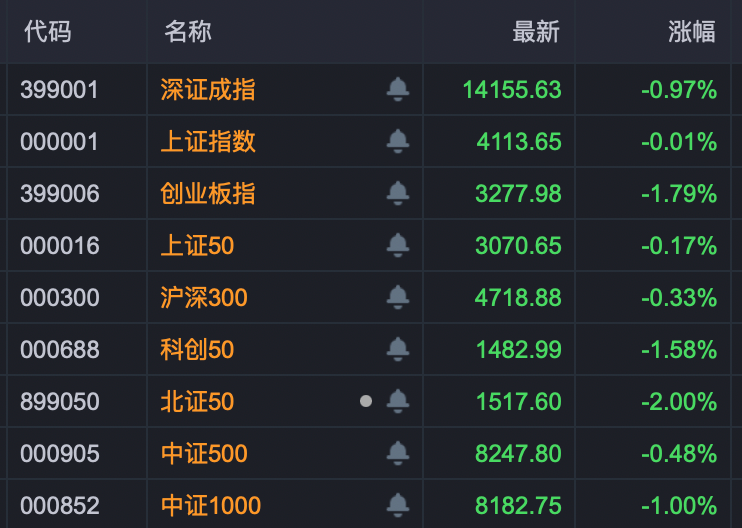
Market Overview - On January 20, the A-share market experienced fluctuations, with the Shanghai Composite Index barely holding above 4100 points and the ChiNext Index falling below 3300 points, while the Shenzhen Component, CSI 300, and CSI 500 all closed with small bearish candles. The market turnover reached 2.8 trillion yuan [1]. Index Performance - The Shenzhen Component Index closed at 14155.63, down 0.97% - The Shanghai Composite Index closed at 4113.65, down 0.01% - The ChiNext Index closed at 3277.98, down 1.79% - The CSI 300 Index closed at 4718.88, down 0.33% - The CSI 500 Index closed at 8247.80, down 0.48% [2]. Sector Performance - Chemical, precious metals, real estate, and aviation sectors showed the highest gains, while aerospace equipment, photovoltaic equipment, communication devices, and glass fiber sectors experienced the largest declines [2]. Fund Flow Analysis - The public utilities sector saw a net inflow of over 3.7 billion yuan, while the construction and decoration sector received over 3.6 billion yuan. Real estate, banking, basic chemicals, and building materials sectors each gained over 2 billion yuan in net inflows. Transportation and retail sectors also saw net inflows exceeding 1 billion yuan. Conversely, electronics, power equipment, communications, defense, and computer sectors experienced net outflows exceeding 10 billion yuan [3]. Notable Stocks - China XD Electric (601179) saw a net inflow of 1.561 billion yuan, with a price increase of 8.84% - Shanzhi High-Tech (000981) had a net inflow of 1.423 billion yuan, with a price increase of 6.69% - Zhejiang Wenhu (600986) had a net inflow of 1.318 billion yuan, with a price increase of 10.04% - China Power Construction (601669) had a net inflow of 1.305 billion yuan, with a price increase of 7.02% [4]. Market Outlook - According to Yingda Securities, the Shanghai Composite Index is expected to oscillate around the 4100-point mark, indicating a market cooling period. This does not suggest a deep correction but rather a healthy consolidation after rapid gains. Investors are advised to take profits on short-term high-flying stocks while looking for value opportunities in underperforming sectors with solid fundamentals [4]. Future Predictions - Zhongyin International predicts that by 2026, the core broad-based indices of the Chinese stock market may see an overall increase of over 40%, driven by nearly 20% profit growth and 20% valuation improvement. Key sectors expected to lead include technology manufacturing, biomedicine, national defense, and non-ferrous metals, while sectors like communications, internet, brokerage insurance, new consumption, and real estate may have potential for catch-up gains [5]. Commodity Trends - Precious metals stocks surged in the afternoon, with the sector index reversing from an early drop of over 3% to a gain of 3.5%, reaching a historical high. Notable stocks include Hunan Silver and Zhaojin Gold, which quickly hit the daily limit [5][6]. - International gold and silver prices continued to rise, with London spot gold surpassing $4700 per ounce, marking a historical high. The trend of central banks purchasing gold is expected to support gold prices amid ongoing geopolitical tensions [6]. Chemical Industry Insights - The chemical sector showed strong performance, with various sub-sectors like daily chemicals and petrochemicals experiencing significant gains. The recent global price surge in chemicals has been noted, with major companies like BASF and Dow increasing prices across multiple regions [7][9]. - Recent data indicates that chemical product prices have generally increased, with synthetic rubber seeing the highest rise of 11.7% [9].