
关税战

Search documents
深观察丨欧盟:我们不怕与美国打关税战
Sou Hu Cai Jing· 2025-06-26 13:33
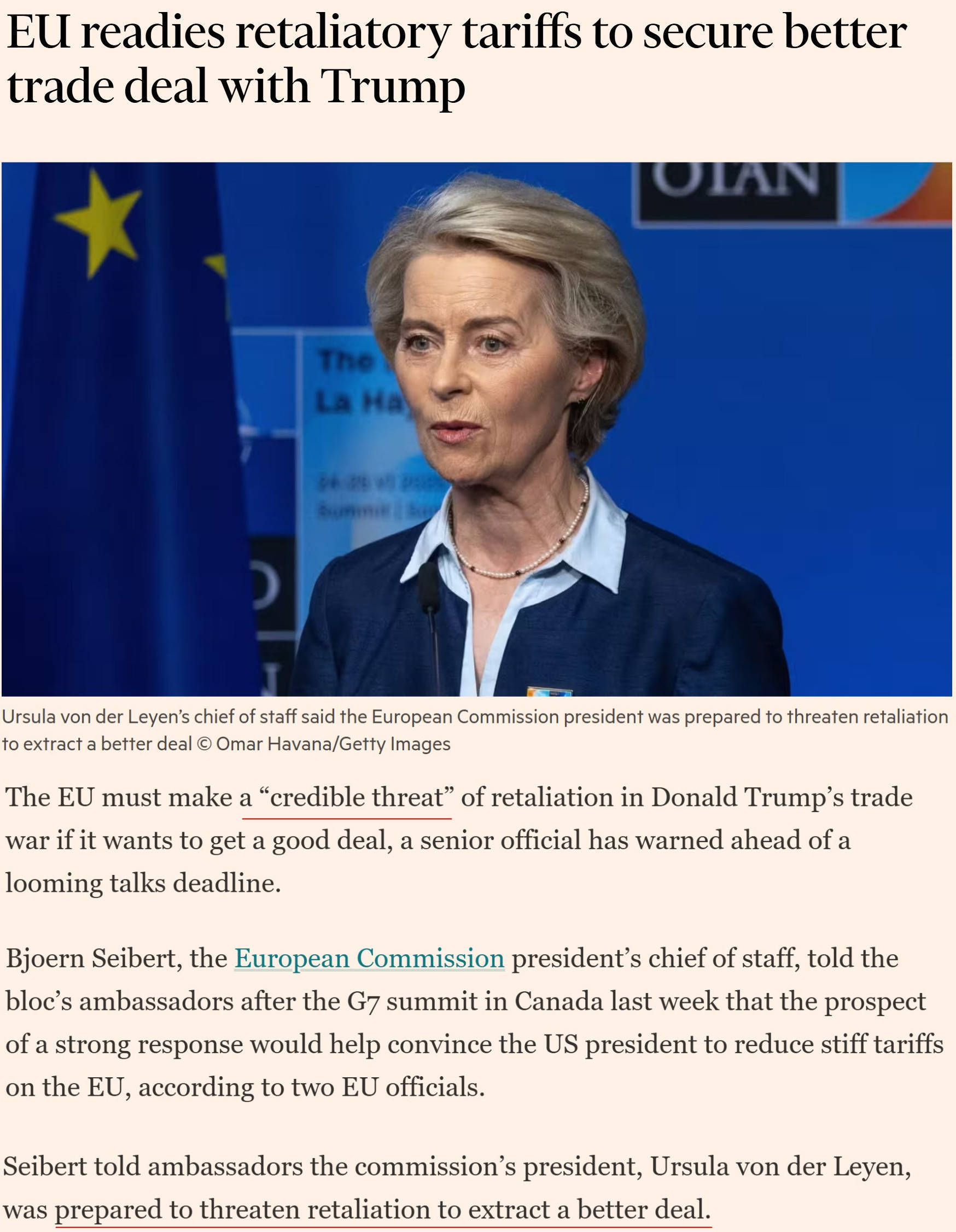
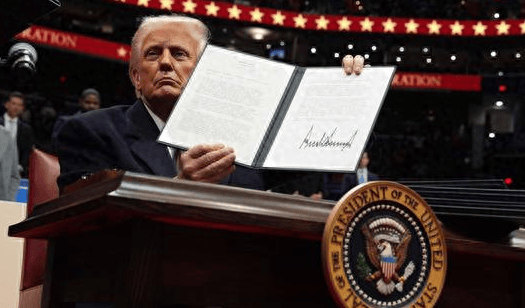
眼下距离7月9日这一美国政府暂停征收"对等关税"90天的截止期限仅剩十来天,欧盟与美国的关税谈判仍进展殊微。 而面对美国的咄咄逼人,欧盟再次亮明了态度。 欧盟委员会主席冯德莱恩的办公室主任比约恩·塞伯特日前强调,在最后期限到来之前,欧盟内部须统一立场,随时准备反制美国的关税措施。如果欧盟想 达成一项"好协议",就必须在美国挑起的贸易战中发出"可信的威胁"。 △英国《金融时报》报道截图 "欧盟正在为各种可能性做准备" 塞伯特是在加拿大七国集团(G7)峰会结束后不久,对欧盟各国驻布鲁塞尔大使做出上述提醒的。 欧盟原指望能借这次会议之机与美国总统特朗普就关税问题当面沟通,但特朗普提前离场回国,令欧盟大为失望。 不仅如此,特朗普还在回国途中向欧盟发出新的威胁:要么向美方提出一个"合理的协议",要么"按我们的要求支付更高关税"。 △法新社报道截图 作为美国最大的贸易伙伴之一,欧盟目前被美方加征的关税除了"对等关税"缓征期间10%的"基准关税"外,还有25%的汽车关税和50%的钢铝关税。 欧盟一直希望通过谈判与美国达成一份"双赢"的新贸易协议,但在谈判过程中,美国政府的反复无常却让欧盟越来越无所适从: 就在美欧同意"加快 ...

风险月报 | 不确定性交织带来情绪与预期的折返跑
中泰证券资管· 2025-06-26 07:22
Core Viewpoint - The market is experiencing a mixed sentiment with a slight recovery in risk scores, driven by policy support and economic recovery expectations, but still facing global uncertainties and internal structural divergences [2][5]. Group 1: Market Risk Assessment - The risk score for the CSI 300 index increased to 45.39 from 42.04, indicating a moderate low-risk level [2]. - The valuation of the CSI 300 rose to 46.58 from 43.53, reflecting a reassessment of economic recovery and corporate profit expectations [2]. - There is significant valuation divergence among industries, with sectors like steel and real estate above the historical 60th percentile, while others like agriculture and non-bank financials are below the 10th percentile [2]. Group 2: Market Sentiment and Expectations - Market sentiment improved to 42.89 from 34.07, indicating increased trading activity but remaining in a cautious zone [3]. - The public fund issuance score rebounded to a historical medium level, suggesting a recovery in retail fund inflows [3]. - Market expectations declined to 48.00 from 55.00, with analysts noting that economic growth still requires policy support and expressing concerns over the impact of U.S. tariff policies on domestic manufacturing investment [2][3]. Group 3: Economic Data Insights - May economic data showed a decline in supply and a divergence in demand, with retail sales growth reaching a year-to-date high of 6.4%, supported by old-for-new subsidies [9]. - Fixed asset investment, infrastructure, real estate, and manufacturing investment all saw declines, with respective year-on-year growth rates of 3.7%, 10.4%, -10.7%, and 8.5% [9]. - The industrial output growth rate slowed to 5.8%, down 0.3 percentage points from April, indicating a cooling in industrial activity [9]. Group 4: Sector-Specific Risk Points - The black commodity sector's risk score is at 38.8, categorized as low risk, with stable production and declining demand entering the off-season [12]. - Potential risks for the real estate sector include recovery exceeding expectations and geopolitical tensions affecting market stability [14][18].

2025年中期家用电器行业投资策略报告:内有支撑,外有应对-20250626
Wanlian Securities· 2025-06-26 04:35
Core Insights - The home appliance industry is expected to benefit from the "old-for-new" policy, which is anticipated to drive significant sales growth in Q4 2024 and continue into 2025, supported by the gradual release of special bond quotas [1][2] - The real estate sector's post-cycle recovery is expected to bolster demand for appliance upgrades, with a notable increase in second-hand home transactions contributing to sales support [1][2] - Despite challenges from tariff wars, China's home appliance exports are projected to maintain growth due to the country's position as the world's largest producer and seller, with a low dependency on the U.S. market [1][2] Market Review - In H1 2025, the home appliance sector experienced a decline of 3.2%, underperforming compared to the Shanghai and Shenzhen 300 index, which fell by 1.55% [14] - The total market capitalization of public funds in the home appliance sector was approximately 120.37 billion yuan at the end of Q1 2025, remaining stable compared to Q4 2024, but showing a slight decrease in allocation ratio [15] - The current price-to-earnings (P/E) ratio for the home appliance index is at 13.58, indicating a historically low valuation level, suggesting a high cost-performance ratio for investors [19] Domestic Sales - The demand for new appliance configurations is expected to weaken due to a decline in housing completions, while upgrade demand is anticipated to drive domestic sales growth [26][29] - The real estate market is showing signs of stabilization, with policies aimed at supporting the sector expected to positively impact downstream demand for home appliances [29] - The penetration rate of major appliances is high, with many units entering their replacement cycle, further supporting sales [39] Export Market - In 2024, the export volume and value of home appliances increased by 20.8% and 14.1% year-on-year, respectively, with a continued upward trend in early 2025 due to the "export rush" effect [9] - The export growth is expected to remain resilient despite tariff uncertainties, as China's home appliance exports have a low dependency on the U.S. market and are supported by rising demand in emerging markets [9][42] Investment Recommendations - The report suggests focusing on leading white goods companies with stable operations and global layouts, as well as opportunities for valuation recovery in companies related to the real estate sector as risks ease [1][2]
特朗普上任不到6个月,美国对中国出现了3次重大误判?信号强烈
Sou Hu Cai Jing· 2025-06-25 16:46
Group 1 - The article highlights the misjudgment of the U.S. strategy towards China, particularly in the context of trade and tariffs, as evidenced by the extension of the TikTok ban [1][3] - The U.S. believed that imposing tariffs would lead to China's economic collapse, but the reality showed China's resilience and ability to retaliate effectively [1][3] - The U.S. underestimated China's complete industrial chain and large domestic market, leading to significant losses in the trade war [1][3] Group 2 - Trump's approach to trade with China was based on a simplistic view, failing to recognize the multifaceted nature of the conflict, which includes technology and supply chain issues [3][5] - The U.S. initially had the potential to leverage its allies in the trade conflict, but Trump's indiscriminate tariffs alienated these allies, pushing them closer to China [5][7] - There is a prevailing outdated perception in U.S. politics regarding China's technological advancements, which hinders a realistic assessment of China's capabilities and intentions [5][7] Group 3 - The political environment in the U.S. discourages open criticism of the current strategy towards China, leading to a lack of corrective measures and worsening misjudgments [7] - The repeated actions by the U.S., such as the TikTok ban and tariff increases, reveal a consistent pattern of strategic miscalculations regarding China [7] - The article concludes that for the U.S. to avoid greater costs from these errors, it must adopt a more objective view of China and its developments [7]
美国关税背景下中日经贸发展契机展望|宏观经济
清华金融评论· 2025-06-25 10:30
Core Viewpoint - The article discusses the ongoing trade tensions between the US and China, highlighting the impact of high tariffs on consumer goods and the potential for Japanese companies to explore opportunities in the US market while mitigating risks by diversifying their supply chains [1][4]. Summary by Sections US-China Trade Relations - Despite recent agreements to lower tariffs, the current rates remain significantly higher than before the Trump administration, with the US imposing tariffs as high as 145% on Chinese goods, temporarily reduced to 30% under a 90-day agreement [2][4]. - The actual tariff rate for the US on Chinese goods is approximately 51.3%, while China's effective tariff rate on US goods is around 37.5%, indicating a mutual escalation of tariffs that negatively impacts both economies [4][5]. Impact on the US Economy - The high tariffs have led to shortages of consumer goods in the US, contributing to rising prices and empty shelves, while US exports have decreased significantly, with a reported 30% drop in export volumes at the Port of Los Angeles [5][6]. - The temporary nature of the tariff suspension creates uncertainty for businesses, particularly small and medium enterprises, which struggle to plan for the future amid fluctuating trade policies [5][6]. Japan's Trade Dynamics - Japan's trade has been affected by global economic cycles, with exports experiencing fluctuations due to the pandemic and geopolitical tensions, leading to a trade deficit in recent months [9][10]. - Japan's export structure is heavily reliant on high-value products such as automobiles and semiconductors, while its imports are primarily raw materials and energy, making it vulnerable to global price changes [9][10]. Japan-US Trade Negotiations - The US has imposed a 10% base tariff on all Japanese goods, with specific tariffs of 25% on automobiles and parts, which are critical to Japan's economy [14][15]. - Japan is actively seeking the removal of these tariffs, emphasizing the importance of the automotive sector in its export economy, which constituted 28.3% of total exports to the US in 2024 [14][15]. Recent Trends and Challenges - Japan's exports to the US have seen a decline, with a 1.8% drop reported in April 2025, marking the first decrease in four months, primarily driven by reduced automobile exports [17]. - The strengthening of the yen and the depreciation of the dollar have further complicated Japan's export competitiveness, contributing to the trade imbalance [17][12].
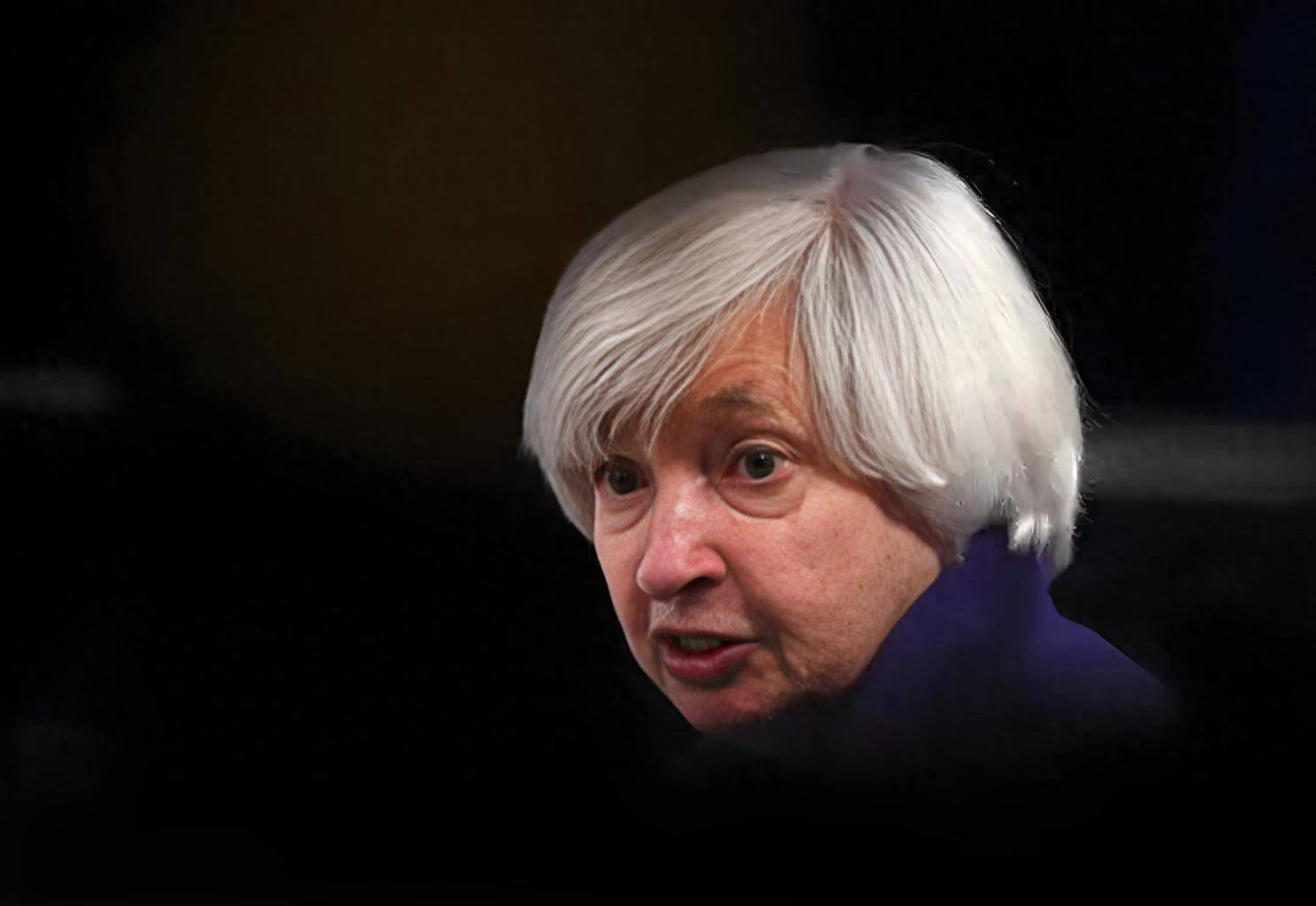
耶伦早就发出过警告,特朗普还是想多了,美联储拒绝执行降息计划
Sou Hu Cai Jing· 2025-06-25 07:54
特朗普的算盘看似精明,用关税保护就业,用油价压制通胀,用军事实力吓唬盟友。实则埋下更多雷。 为什么原油价格下降,能缓解美国的通胀危机?因为美国CPI篮子中能源类商品(如汽油、电力)权重约为7%,油价每下跌10美元,将直接降低能源分项价 格。例如,布伦特原油从80美元跌至70美元时,汽油价格可能下降10%-15%,直接拉动CPI下降约0.3个百分点。叠加物流、工业用电等间接成本下降,整体 通胀可被压低0.5%。 短期看,美国经济像打了止疼药,勉强维持;长期看,关税撕裂全球供应链推高成本,中东随时可能再爆冲突,而美元霸权松动带来的危机远超想象。 正如美国前财长耶伦所说:"我们正用19世纪的工具应对21世纪的挑战。"当保护主义的围墙越筑越高,困在墙内的或许不是别人,正是美国自己。 特朗普还是高估了美国,贸然在全球发起关税战。表面上是为了保护美国企业,结果却像回旋镖一样扎回了自己人身上。你看纽约那个做男士护理品的小老 板埃斯纳尔,从中国进了3000美元的货,关税账单居然高达4600美元,比他进货的钱还多一半!逼得他要么涨价吓跑顾客,要么裁员让员工喝西北风。 NTS 2 还有此前媒体爆出的西雅图港口,以前是集装箱船排着 ...
北京IB活动邀请 | 线下研讨会:关税战背景下中国企业并购的机遇和挑战
Refinitiv路孚特· 2025-06-24 06:39
Group 1: Event Background - Since 2025, the global trade landscape has undergone profound changes, with tariff wars and geopolitical factors significantly impacting Chinese companies' "going out" strategy [1] - In the context of overseas mergers and acquisitions, issues such as policy compliance, financing costs, and transaction structures have become core topics for cross-border M&A [1] - Despite the challenges, opportunities remain in cross-border M&A projects that possess industrial synergy, technological complementarity, and market expansion potential [1] - The London Stock Exchange Group (LSEG) will hold an offline seminar in Beijing to discuss the challenges and potential opportunities faced by Chinese companies in M&A processes in 2025 [1] Group 2: Event Information - The seminar is scheduled for July 10, 2025, from 15:00 to 17:00 at the LSEG Beijing office [2] - The agenda includes a review of the Chinese M&A market in the first half of the year, discussions on capital sensing amid global tariff conflicts, and new opportunities for listed companies in cross-border M&A [2] Group 3: Key Speakers - Liu Chengwei, a partner at Global Law Firm, specializes in M&A restructuring, private equity investment, and capital markets, and has authored a popular book on acquisition solutions [3] - Feng Kai, a senior investment banking data manager at LSEG, has 16 years of experience in transaction data and is responsible for M&A data in mainland China and Taiwan [4] - Ling Yufeng, a senior client learning manager at LSEG Academy, has nearly 20 years of experience providing financial information solutions training and consulting [6] - Xu Chang, the sales head for data business in China at LSEG, has been with Reuters since 2007 and focuses on data solutions for asset management and investment banking clients in mainland China [7]

私募圈大事件!张军、张维、但斌、裘慧明……行业大咖齐聚,周四相约武汉!
券商中国· 2025-06-24 00:37
一年一度的私募界盛会——"金长江"奖颁奖典礼即将开幕! 6月26日(周四),由证券时报主办、长江证券协办的"第十届中国金长江私募基金发展高峰论坛"将在武汉正 式举行。2015年至2025年,金长江走过了十年星光,始终以专业为炬、以公正为尺,丈量中国私募基金行业的 奔腾浪潮。 本届论坛可谓大咖云集。复旦大学经济学院院长张军、基石资本董事长张维、东方港湾董事长但斌、明汯投资 创始人裘慧明、中欧瑞博董事长吴伟志、银叶投资首席投资官许巳阳、茂源量化创始人郭学文、景林资产合伙 人田峰、高毅资产合伙人韩海峰、凯丰投资董事长吴星等数十位重量级嘉宾出席。 自"9·24"行情以来,受一系列重磅政策的刺激,大量长期资金进场。2025年开年,DeepSeek横空出世,一举扭 转了中国AI落后的悲观预期;4月初,关税战一度震动全球市场,仅40天后峰回路转,中国资产重受青睐,市 场信心再度增强。 在这样的背景下,A股市场情绪有所升温,两市日均成交额在1.2万亿元上方,沪指在3400点附近蓄势待发,私 募基金有望迎来一轮赚钱机遇。 为了让更多人能够聆听中国私募基金行业领袖的真知灼见,本届论坛主办方特别安排了线上直播,参与直播的 平台包括 ...

本周热点前瞻2025-06-23
Guo Tai Jun An Qi Huo· 2025-06-23 02:52
Report Core Information Report Industry Investment Rating - Not mentioned in the report Report Core View - The report provides a weekly preview of hot topics, including important events and data releases that may impact the futures market, and analyzes the potential effects of these events on different types of futures prices [2][3] Summary by Related Catalogs This Week's Key Focus - From June 24th to 27th, the 16th Session of the 14th National People's Congress Standing Committee will be held in Beijing [2] - On June 24th at 22:00, Federal Reserve Chairman Powell will testify on the semi - annual monetary policy report before the House Financial Services Committee [2] - On June 26th at 20:30, the US Department of Commerce will release the final value of Q1 2025 GDP [2] - On June 27th at 09:30, the National Bureau of Statistics will announce the industrial enterprise profits for May [2] - On June 28th at 20:30, the US Department of Commerce will release the May PCE price index [2] This Week's Hot Topic Preview June 23rd - S&P Global will release the preliminary value of the Eurozone's June SPGI manufacturing PMI at 16:00, with an expected value of 49.8 and a previous value of 49.4. A slightly higher value may slightly boost non - ferrous metals, crude oil and related commodity futures prices but slightly suppress gold and silver futures prices [3] - S&P Global will release the preliminary value of the US June SPGI manufacturing PMI at 21:45, with an expected value of 51.2 and a previous value of 52. A slightly lower value may slightly suppress non - ferrous metals, crude oil and related commodity futures prices but slightly boost gold and silver futures prices [4] - The National Association of Realtors will release US May existing - home sales at 22:00. The expected annualized total is 3.97 million units (previous 4 million), and the expected monthly rate is - 1.3% (previous - 0.5%). Lower sales may suppress non - ferrous metals futures prices but boost gold and silver futures prices [5] June 24th - The National Bureau of Statistics will release the market prices of important production materials in the circulation field in mid - June at 9:30, covering 9 categories and 50 products [8] - The 16th Session of the 14th National People's Congress Standing Committee will be held from June 24th to 27th, with multiple draft laws on the agenda [9] - IFO will release Germany's June IFO business climate index at 16:00, with an expected value of 88.3 and a previous value of 87.5 [10] - Federal Reserve Chairman Powell will testify on the semi - annual monetary policy report before the House Financial Services Committee at 22:00 [11] - The Conference Board will release the US June consumer confidence index at 22:00, with an expected value of 99.8 and a previous value of 98. A higher value may boost non - ferrous metals, crude oil and related futures prices but suppress gold and silver futures prices [12] - The 16th Annual Meeting of the New Champions (Summer Davos Forum) will be held from June 24th to 26th in Tianjin, with the theme of "Entrepreneurship in the New Era" [13] - The NATO Summit will be held from June 24th to 25th in The Hague, and Trump will attend [14] June 25th - Federal Reserve Chairman Powell will testify on the semi - annual monetary policy report before the Senate Committee at 22:00 [15] - The US Department of Commerce will release US May new - home sales at 22:00. The expected seasonally - adjusted annualized total is 692,000 units (previous 743,000), and the expected monthly rate is - 6.5% (previous 10.9%). Higher sales may boost non - ferrous metals futures prices but suppress gold and silver futures prices [16] - EIA will release the change in US EIA crude oil inventories for the week ending June 20th at 22:30. A continued significant decline may boost crude oil and related commodity futures [17] June 26th - The US Department of Labor will release the initial jobless claims for the week ending June 21st at 20:30, with an expected value of 245,000 (previous 245,000) [18] - The US Department of Commerce will release the final value of Q1 2025 GDP at 20:30. The expected annualized quarterly rate of real GDP is - 0.2% [19] - The US Department of Commerce will release the preliminary value of the May durable goods orders at 20:30, with an expected monthly rate of 8.5% (previous - 6.3%). A significantly higher value may boost non - ferrous metals futures but suppress gold and silver futures [20] - The National Association of Realtors will release the US May seasonally - adjusted pending home sales index at 22:00, with an expected monthly rate of 0% (previous - 6.3%) [21] June 27th - The National Bureau of Statistics will announce China's May industrial enterprise profits at 09:30. The cumulative year - on - year growth from January to April was 1.4%, and in April it was 3% [22] - Eurostat will release the Eurozone's June economic sentiment index and industrial sentiment index at 17:00. The expected economic sentiment index is 95.3 (previous 94.8), and the expected industrial sentiment index is - 9.8 (previous - 10.3) [24] June 28th - The US Department of Commerce will release the May PCE price index at 20:30. The expected annual rate of the PCE price index is 2.3% (previous 2.1%), and the expected annual rate of the core PCE price index is 2.6% (previous 2.5%). Slightly higher values may delay the expected start of Fed rate cuts from September to November or December [25] - The US Department of Commerce will release May consumer spending at 20:30. The expected monthly rate is 0.1% (previous 0.2%). A slightly lower value may slightly suppress non - ferrous metals, crude oil and related commodity futures prices but slightly boost gold and silver futures prices [26]
美股美债美元分别在定价什么?
2025-06-23 02:09
Summary of Key Points from Conference Call Records Industry or Company Involved - The discussion primarily revolves around the U.S. stock market (美股), U.S. Treasury bonds (美债), and the U.S. dollar (美元) Core Insights and Arguments 1. **Recent Stock Market Trends**: The U.S. stock market has rebounded recently, driven by retail investor sentiment and capital, particularly in small-cap tech stocks, while institutional investors remain cautious due to concerns over AI technology slowdown, wealth disparity, and fiscal issues [1][3][4] 2. **Foreign vs. Domestic Investor Sentiment**: Foreign investors are more cautious than U.S. investors, as they face currency risk in addition to stock performance and valuation risks. U.S. investors focus more on asset class rotation and are less concerned about currency fluctuations [5][6] 3. **Short-term vs. Long-term Pricing Mechanisms of U.S. Treasuries**: Short-term pricing reflects recession and rate cut expectations, while long-term pricing is influenced by concerns over fiscal sustainability and the impact of trade wars on dollar credibility. The yield curve has steepened, indicating differing market expectations for economic conditions over time [7][9] 4. **Economic Data Impact**: Recent mixed economic data suggests a weakening labor market and declining consumer sentiment, which may lead to reduced economic activity and affect short-term pricing of U.S. Treasuries [8][10] 5. **Tariff Wars and Their Effects**: The ongoing tariff wars have led to increased long-term premiums on U.S. Treasuries due to concerns over fiscal sustainability and dollar credibility. However, these tariff threats are expected to diminish around August [9][12] 6. **Federal Reserve Policy Outlook**: The Federal Reserve may consider rate cuts in response to signs of economic weakening, with expectations of two or more cuts in the second half of the year [10][11] 7. **Long-term Challenges for the U.S. Economy**: The U.S. economy faces challenges such as a weak labor market, declining consumer willingness to spend, and potential recession risks, compounded by trade disputes and tariff threats [11][12] 8. **Predictions for the Dollar**: There is a prevailing market expectation that the dollar will enter a long-term weakening cycle, potentially dropping to around 70, reflecting skepticism about the current administration's ability to address fiscal sustainability [17][25] 9. **Impact of Trump's Policies**: Trump's policies have raised concerns about the long-term sustainability of U.S. debt and the dollar's value, with market sentiment leaning towards a bearish outlook on his reforms [13][25] 10. **Emerging Trends in Currency**: The trend of de-dollarization is accelerating, particularly since early 2025, as the dollar is increasingly used as a bargaining chip in trade negotiations [14][15][28] Other Important but Possibly Overlooked Content 1. **Behavioral Differences Between Retail and Institutional Investors**: Retail investors are engaging in short-term speculative trading, while institutional investors are more focused on long-term issues and risk management [6][22] 2. **Role of Stablecoins**: Stablecoins are gaining traction as a digital currency alternative, but they do not fundamentally resolve underlying issues related to U.S. debt and fiscal sustainability [16][19] 3. **Gold as an Alternative Asset**: Gold is viewed as a potential beneficiary of the dollar's weakening, although its long-term prospects remain uncertain due to various economic factors [26][27] 4. **Internationalization of the Renminbi**: The process of renminbi internationalization is accelerating, with expectations of appreciation due to China's growing economic significance [28] This summary encapsulates the key points discussed in the conference call records, providing insights into the current state and future outlook of the U.S. stock market, Treasury bonds, and the dollar.