
反内卷

Search documents
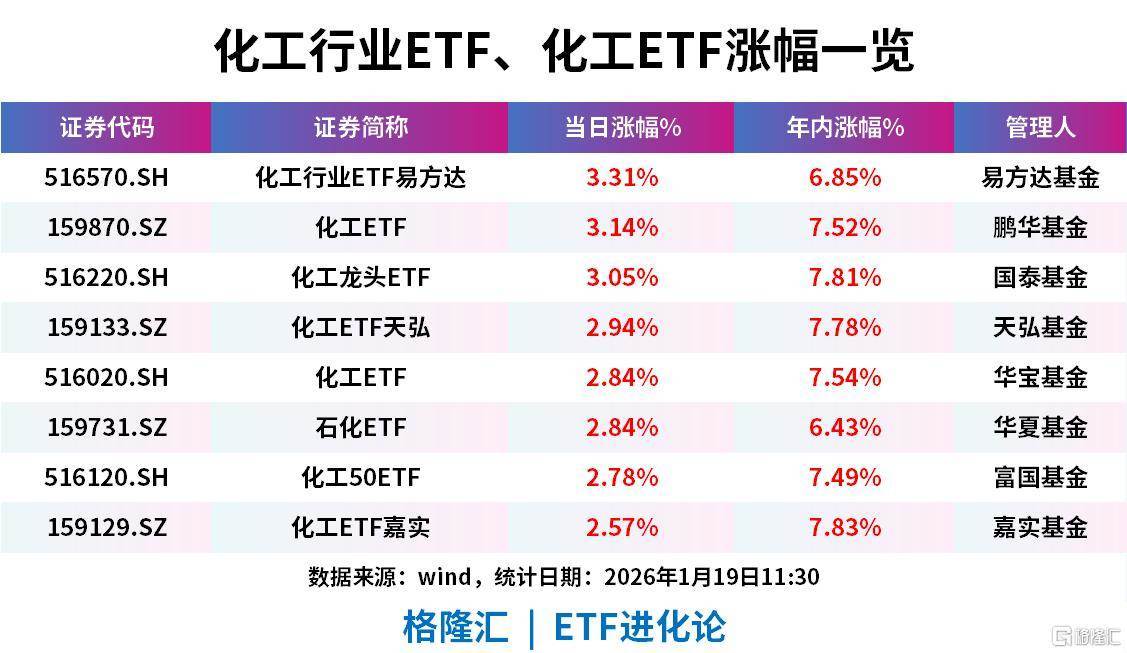
化工行业ETF易方达、化工ETF、化工龙头ETF涨超3%,化工ETF、化工50ETF强势吸金
Sou Hu Cai Jing· 2026-01-19 05:48
Group 1 - The chemical sector ETFs have shown positive performance, with the top performers being the Chemical Industry ETF by E Fund, which increased by 3.31% on the day and 6.85% year-to-date, and the Chemical ETF by Penghua, which rose by 3.14% and 7.52% respectively [2] - In the past 10 trading days, significant net inflows were observed in the chemical sector, totaling 45.71 billion yuan for the Chemical ETF and 15.23 billion yuan for the Chemical 50 ETF [4][6] - The Chemical ETF tracks the CSI Sub-Industry Chemical Theme Index, with nearly 50% of its holdings concentrated in large-cap leading stocks, including Wanhua Chemical and Salt Lake Industry, while the remaining 50% is diversified across various sub-sectors [8] Group 2 - The chemical industry is expected to experience a recovery in profitability by 2026, following a period of bottoming out in earnings and valuations, with supply-demand rebalancing as a new starting point [8] - According to Tianfeng Securities, the chemical industry is entering a phase of capacity release, with a potential reversal in supply-demand dynamics expected by 2026 [8] - Huatai Securities indicates that the chemical raw materials and products sector is at a turning point, transitioning from active destocking to passive restocking, with a recovery in domestic and international demand anticipated in 2026 [9]

日度策略参考-20260119
Guo Mao Qi Huo· 2026-01-19 05:27
Industry Investment Ratings - Macrofinance: Index (Long-term bullish, short-term shock adjustment), Treasury bonds (Shock), Copper (Shock), Aluminum (Shock), Alumina (Shock), Zinc (Shock), Nickel (High-level shock), Stainless steel (High-level shock), Tin (Potential for increase), Precious metals (High-level wide-range shock), Industrial silicon and polysilicon (Bearish), Lithium carbonate (No clear rating), Rebar (Shock), Iron ore (Shock), Coke (Shock), Coking coal (Bullish), Anthracite (Bullish), Palm oil (Shock), Soybean oil (Bullish), Rapeseed oil (Bearish), Cotton (Shock), Sugar (Bearish), Corn (Shock), Soybeans (Bearish), Pulp (Shock), Logs (Shock), Live pigs (Shock), Fuel oil (Shock), Bitumen (Shock), BR rubber (Bullish), PTA (Shock), Ethylene glycol (Shock), Styrene (Bearish), Urea (Shock), PF (Shock), PVC (Shock), LPG (Bullish), Container shipping European line (Shock) [1] Core Views - The policy aims for a "slow bull" in the stock index rather than suppressing the market. The short-term shock adjustment space is expected to be limited, and long-term bulls can choose opportunities to layout. Asset shortages and a weak economy are beneficial to bond futures, but the central bank has recently warned of interest rate risks. The downstream demand is relatively pressured, and with the US suspending the tax on key minerals, the short-term concern about copper hoarding has eased, causing copper prices to fall from high levels. The supply of nickel ore remains tight, but the continuous accumulation of global nickel inventories may restrict the rise of nickel prices. The prices of precious metals are expected to shift to high-level wide-range shocks. The prices of industrial silicon and polysilicon are bearish. The prices of black metals are affected by weak reality and strong expectations. The prices of agricultural products are affected by various factors such as supply and demand, policies, and weather. The prices of energy and chemical products are affected by factors such as supply and demand, geopolitical situations, and cost support [1] Summary by Directory Macrofinance - Index: The stock index rose strongly in the first half of the week and then adjusted with policy regulation. The short-term shock adjustment space is limited, and long-term bulls can choose opportunities to layout [1] - Treasury bonds: Asset shortages and a weak economy are beneficial to bond futures, but the central bank has recently warned of interest rate risks. Pay attention to the interest rate decision of the Bank of Japan [1] Non-ferrous Metals - Copper: The downstream demand is relatively pressured, and with the US suspending the tax on key minerals, the short-term concern about copper hoarding has eased, causing copper prices to fall from high levels [1] - Aluminum: The recent industrial drive is limited, and the macro sentiment has weakened, causing aluminum prices to fall from high levels [1] - Alumina: The alumina production capacity still has a large release space, and the industrial side weakens the price. However, the current price is basically near the cost line, and the price is expected to fluctuate [1] - Zinc: The cost center of the zinc fundamentals is stable, but the inventory pressure is obvious. The current price has insufficient fundamental support, and the zinc price fluctuates in a range under the repeated macro sentiment [1] - Nickel: The supply of nickel ore remains tight, but the continuous accumulation of global nickel inventories may restrict the rise of nickel prices. The short-term nickel price fluctuates at a high level and is still affected by the resonance of the non-ferrous metal sector. It is recommended to pay attention to the policy changes in Indonesia, the macro sentiment, and the futures positions [1] - Stainless steel: The price of raw material nickel iron continues to rise, the social inventory of stainless steel decreases slightly, and the steel mill's production schedule in January increases. Pay attention to the actual production situation of the steel mill. The stainless steel futures fluctuate at a high level, and it is recommended to go long at low levels in the short term [1] - Tin: The short-term macro sentiment is repeated, and the tin price has corrected. However, the supply vulnerability of tin ore still exists, and it still has the driving force to rise. Pay attention to the opportunity of low absorption [1] - Precious metals: The geopolitical situation has cooled down, and the rise of precious metal prices has slowed down. The silver price has fallen under pressure. The short-term gold and silver prices are expected to shift to high-level wide-range shocks. In the long term, it is recommended to allocate platinum at low levels or choose the arbitrage strategy of [long platinum, short palladium] [1] Black Metals - Rebar: The expectation is strong, but the spot is weak, and the sentiment transmission to the spot is not smooth. The continuous rise kinetic energy is insufficient. Unilaterally long orders should leave the market and wait and see; participate in the positive arbitrage position in the spot and futures [1] - Iron ore: The sector rotates, but the upper pressure of iron ore is obvious. It is not recommended to chase long at this position. The weak reality and strong expectation are intertwined. The actual supply and demand continue to be weak, and the energy consumption double control and anti-involution may disturb the supply [1] - Coke: The short-term market sentiment warms up, and the supply and demand are supported, but the medium-term supply and demand continue to be surplus, and the price is under pressure [1] - Coking coal: If the expectation of "capacity reduction" continues to ferment and the spot replenishes the inventory before the Spring Festival, coking coal may still have room to rise, but the actual rise space is difficult to judge, and the volatility increases after a large rise. It is necessary to be cautious [1] - Anthracite: The logic is the same as that of coking coal [1] Agricultural Products - Cotton: The domestic new crop production expectation is strong, but the purchase price of seed cotton supports the cost of lint. The downstream start-up maintains a low level, but the yarn mill inventory is not high, and there is a rigid replenishment demand. The cotton market is currently in a situation of "supported but no driving force." Pay attention to the tone of the No. 1 Central Document on direct subsidy prices and cotton planting areas in the first quarter of next year, the intention of cotton planting areas next year, the weather during the planting period, and the peak season demand from March to April [1] - Sugar: The global sugar is in surplus, and the domestic new crop supply increases. The short consensus is relatively consistent. If the disk continues to fall, the lower cost support is strong, but the short-term fundamentals lack continuous driving force. Pay attention to the changes in the capital side [1] - Corn: The grain sales progress of Northeast corn is relatively fast, the port inventory is low, and the middle and lower reaches have a certain replenishment demand before the festival. The short-term spot is still relatively strong, and the disk is expected to fluctuate in a range [1] - Soybeans: With the progress of the Brazilian harvest, the Brazilian CNF premium is expected to reflect the selling pressure of the soybean harvest. Coupled with the pressure on the rapeseed sector from the Sino-Canadian easing, the MO5 is expected to be under pressure, and the MO5 - M09 is expected to be in a reverse arbitrage [1] - Pulp: The pulp fell today due to the decline of the commodity macro. The overall did not break through the shock range. The short-term commodity sentiment fluctuates greatly. It is recommended to wait and see cautiously [1] - Logs: The spot price of logs has recently shown a certain sign of bottoming out and rebounding. It is expected that the further decline space of the futures price is limited. However, the external quotation in January still shows a slight decline, and the spot and futures markets of logs lack driving factors for rising. It is expected to fluctuate in the range of 760 - 790 yuan/m³ [1] - Live pigs: The spot and futures of live pigs gradually stabilize. The demand support and the unsold slaughter weight, and the production capacity still needs to be further released [1] Energy and Chemical Products - Fuel oil: OPEC+ suspends production increase until the end of 2026. The uncertainty of the Russia-Ukraine peace agreement affects. The US sanctions the Venezuelan crude oil export. The short-term supply and demand contradiction is not prominent, and it follows the crude oil. The demand for the 14th Five-Year Plan rush work is likely to be falsified, and the supply of Ma Rui crude oil is not short. The asphalt profit is high [1] - Bitumen: The raw material cost support is strong. The spot-futures price difference rebounds greatly. The intermediate inventory increases [1] - BR rubber: The disk position decreases, and the new warehouse receipts increase. The BR increase slows down periodically. The spot leads the rise to repair the basis, and the BR continues to pay attention to the upward driving force above 12,000. The BD/BR listing price continues to be raised, and the processing profit of butadiene rubber narrows. The overseas cracking device capacity is cleared, which is beneficial to the long-term export expectation of domestic butadiene. The naphtha tax also has a positive support for the butadiene price. Fundamentally, butadiene rubber maintains high operation and high inventory, and the transaction center is average. Styrene-butadiene rubber is relatively better than butadiene rubber [1] - PTA: The PX market has experienced a rapid rise, and this round of rise is not due to a fundamental change. The PX fundamentals are indeed supported, and the market is expected to continue to tighten in 2026, driven by the new PTA production capacity in India and the organic growth of demand. The domestic PTA maintains high operation. The gasoline price difference is still at a high level, which supports the aromatics [1] - Ethylene glycol: The market spreads the news that two sets of MEG devices in Taiwan, China, with a total annual production capacity of 720,000 tons, plan to stop production next month due to efficiency reasons. Ethylene glycol rebounded rapidly during the continuous decline due to the stimulation of supply-side news. The current polyester downstream start-up rate maintains above 90%, and the demand performance slightly exceeds expectations [1] - Styrene: The Asian styrene market is generally stable. The suppliers are reluctant to reduce prices due to continuous losses, while the buyers insist on pressing prices due to the weak downstream polymer demand and profit compression. Although the downstream demand is weak, the domestic market has a bullish sentiment due to the export support. The market is in a weak balance state, and the short-term upward driving force needs to pay attention to the drive of the overseas market [1] - Urea: The export sentiment eases slightly, and the domestic demand is insufficient. The upper space is limited. The lower has the support of anti-involution and the cost side [1] - PF: The geopolitical conflict intensifies, and the crude oil has a rising risk. The maintenance decreases, and the operation load is at a high level. The long-distance arrival increases the supply. The downstream demand operation weakens. The price returns to a reasonable range [1] - PVC: There is less global production in 2026, and the future expectation is optimistic. The fundamentals are poor. The export tax rebate is cancelled, and there may be a phenomenon of rushing to export later. The differential electricity price in the northwest region is expected to be implemented, forcing the PVC production capacity to be cleared [1] - LPG: The January CP rises unexpectedly, and the cost support of imported gas is strong. The geopolitical conflict in the Middle East escalates, and the short-term risk premium rises. The EIA weekly C3 inventory accumulation trend slows down, and it is expected to gradually turn to destocking. The domestic port inventory also decreases [1] - Container shipping European line: It is expected to peak in mid-January. The airlines are still cautious in their tentative re-navigation. The pre-festival replenishment demand still exists [1]
固态电池迈向工程化验证关键期
Zhong Guo Neng Yuan Wang· 2026-01-19 04:57
Market Performance - The electric equipment and new energy sector increased by 0.79% this week, with industrial automation rising by 4.19%, the new energy vehicle index up by 1.44%, the photovoltaic sector up by 0.87%, and the nuclear power sector up by 0.66%. Conversely, the power generation equipment fell by 2.27%, the lithium battery index decreased by 3.55%, and the wind power sector dropped by 4.74% [1][3]. Industry Insights - In the new energy vehicle sector, global sales are expected to grow rapidly, with projections of 16.49 million units sold in 2025, a year-on-year increase of 28.2%, and 19 million units in 2026, a 15.2% growth [4]. - The domestic power battery cumulative installation is projected to reach 769.7 GWh by 2025, reflecting a 40.4% year-on-year growth [4]. - The solid-state battery technology is approaching a critical engineering verification phase, with companies like BYD bidding for GWh-level solid-state battery equipment [4]. - The photovoltaic sector is expected to benefit from regulatory measures aimed at controlling upstream silicon material prices, which may enhance profitability in downstream battery components [2][4]. - Wind power demand is anticipated to continue growing, with government support for new projects [2][4]. Company Highlights - Tianji Co. expects a net profit of 70 million to 105 million yuan in 2025, marking a return to profitability [5]. - Siyuan Electric anticipates a net profit of 3.163 billion yuan in 2025, a 54.35% increase year-on-year [5]. - TCL Zhonghuan forecasts a net loss of 8.2 billion to 9.6 billion yuan in 2025 and plans to invest in new energy to accelerate its integrated strategy [5]. - Rongbai Technology signed a procurement agreement with CATL for lithium iron phosphate materials, with total sales expected to exceed 120 billion yuan [5].

招商期货-期货研究报告:商品期货早班车-20260119
Zhao Shang Qi Huo· 2026-01-19 02:58
1. Report Industry Investment Rating The report does not provide an overall industry investment rating. 2. Core Viewpoints of the Report The report analyzes the market performance, fundamentals, and provides trading strategies for various commodity futures including precious metals, base metals, black industries, agricultural products, and energy chemicals. It suggests different trading approaches such as long - positions, short - positions, or waiting and seeing based on the specific situation of each commodity [2][3][4]. 3. Summary by Relevant Categories 3.1 Precious Metals - Gold: Market performance shows London gold at $4600/oz. Fundamentals involve geopolitical and Fed - related news. Domestic gold ETF inflow is 0.8 tons. Suggested strategy is to go long as the price is rising steadily [2]. - Silver: London silver price is stable at $90/oz. There are inventory changes and speculation factors. It is recommended to participate with caution due to high speculation sentiment [2]. 3.2 Base Metals - Aluminum: The electrolytic aluminum contract price dropped by 1.85%. Supply capacity increased slightly, demand improved marginally. Short - term price may remain high - level volatile [3]. - Alumina: The price fell 1.36%. Supply is stable, demand from electrolytic aluminum is high. The price is expected to be weak in the short - term [3]. - Industrial Silicon: The price decreased by 1.43%. Supply decreased in some areas, demand has reduction expectations. The price is expected to oscillate between 8400 - 9200, and short positions can be considered at high prices [3][4]. - Lithium Carbonate: The price dropped significantly. Supply increased slightly in the short - term but may decline in January. Demand from battery materials is expected to decrease. The price is expected to correct with support at 120,000 [4]. - Polysilicon: The price increased by 3.14%. Supply decreased, demand from some downstream sectors declined. The market may shift from loose to tight balance [4]. 3.3 Black Industry - Rebar: The price dropped. Supply - demand is neutral - weak, with structural differences. It is recommended to hold short positions in the RB05 contract [5]. - Iron Ore: The price fell. Supply - demand is neutral. It is advisable to wait and see, with a reference range of 805 - 835 [6]. - Coking Coal: The price rose slightly. Supply - demand is weak. It is recommended to wait and see, and aggressive investors can short the JM05 contract [6]. 3.4 Agricultural Products - Soybean Meal: CBOT soybeans rose slightly. Supply is loose in the near - term and large in the long - term. The US soybeans are seeking a bottom, and the domestic far - month contracts are under pressure [7]. - Corn: Futures prices are strong, spot prices are rising. Supply is not under pressure, and short - term prices are expected to be strong. The futures price is expected to oscillate [7]. - Oils: The market is volatile. Supply is in weak seasonal reduction, demand for exports improved. It is expected to be volatile, and mid - term attention should be paid to production and bio - diesel policies [7]. - Sugar: The price of the SR05 contract dropped. International and domestic sugar markets are under pressure. It is recommended to short in the futures market and sell call options [7][8]. - Cotton: ICE cotton prices rose slightly. US cotton exports are good, Brazilian planting area decreased. It is recommended to buy at low prices with a reference range of 14400 - 14900 [8]. - Eggs: Futures prices rebounded, spot prices are stable. Supply is sufficient, and the price increase is limited. Futures prices are expected to be weak [8]. - Pigs: Futures prices are strong in the near - term and weak in the long - term, spot prices rose. Supply pressure is small in the short - term, and prices are expected to be strong but may correct later [8]. 3.5 Energy Chemicals - LLDPE: The contract price oscillated slightly. Supply pressure eases, demand is weak in the agricultural film season. Short - term oscillation, long - term long positions can be considered at low prices [10]. - PVC: The price dropped 0.4%. Supply is high, demand is weak seasonally. It is recommended to do reverse arbitrage [10][11]. - PTA: PX and PTA supply are high, demand is weak in the off - season. PX can be long - term long, and the 05 contract of PTA can be used to long the processing fee [11]. - Glass: The price rose 0.5%. Supply is decreasing, demand is weak. It is recommended to long glass and short soda ash [11]. - PP: The contract price dropped slightly. Supply pressure increases, demand is stable. Short - term oscillation, long - term short positions can be considered at high prices [11]. - MEG: Supply is high, demand is weak in the off - season. It is recommended to short at high prices [11]. - Crude Oil: Prices fluctuated this week. Supply is high, demand is in the off - season. It is recommended to short at high prices [12]. - Styrene: The contract price rose slightly. Supply and demand of pure benzene are weak, styrene inventory is normal. Short - term oscillation, long - term long positions of styrene or reverse arbitrage of pure benzene can be considered [12]. - Soda Ash: The price rose 1%. Supply is large, demand is weak. It is recommended to short or long glass and short soda ash [12].
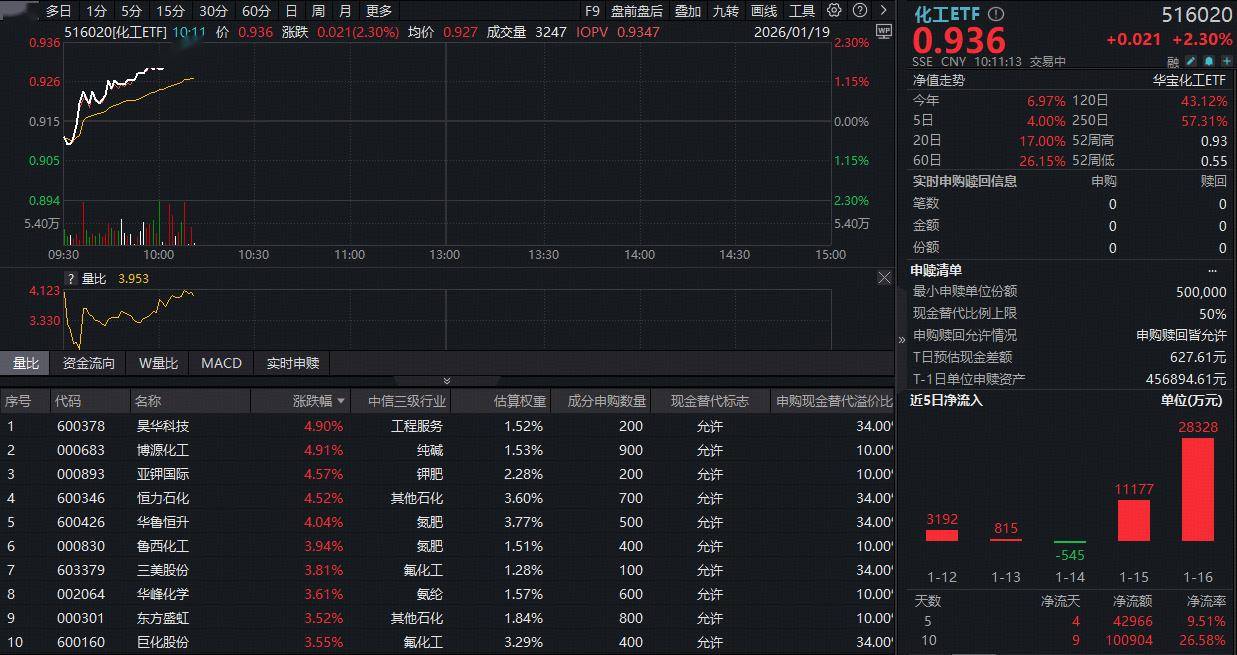
ETF盘中资讯|直线暴拉!化工ETF(516020)涨超2%,主力资金狂涌!机构高呼“盈利底+估值底”或现
Sou Hu Cai Jing· 2026-01-19 02:41
Group 1 - The chemical sector is experiencing a strong rally, with the chemical ETF (516020) rising by 2.3% after a slight opening dip [1] - Key stocks in the sector, including Haohua Technology, Yara International, and Hengli Petrochemical, have seen significant gains, with increases exceeding 4% [1] - The basic chemical sector has attracted substantial capital, with a net inflow of over 4.2 billion yuan in the last five trading days for the chemical ETF [3] Group 2 - The total export of power and energy storage batteries from China reached 305.0 GWh in 2022, marking a year-on-year growth of 50.7% [3] - Power batteries accounted for 189.7 GWh of the total exports, with a year-on-year increase of 41.9%, while energy storage batteries reached 115.3 GWh, growing by 67.9% [3] Group 3 - Analysts predict a recovery in profitability for the chemical industry in 2026, as the sector is at a new starting point for supply-demand rebalancing [4] - The current phase of the chemical sector is characterized by a bottoming out of profitability cycles and an end to the expansion cycle, suggesting potential upward movement in valuations [4] - The chemical ETF (516020) is recommended for investors looking to capitalize on the rebound opportunities in the chemical sector, with a focus on large-cap leading stocks and sectors undergoing changes [4]


反内卷逐步推进
Nan Hua Qi Huo· 2026-01-19 02:41
Report Investment Rating - Not provided in the content Core Viewpoints - Recently, there have been signs of adjustment in non-ferrous varieties, with selling pressure emerging at higher levels. The strong upward trend in non-ferrous metals and precious metals is essentially driven by the new economic logic, specifically the demand logic of related commodities driven by the new energy and AI economies. However, their valuations are slightly high. The anti-involution logic of low-valuation varieties is gradually advancing. The daily melting volume of glass has dropped to 150,000 tons, approaching the low limit in 2015. The national policy is determined to rectify involution-style competition and adjust the dynamic adjustment ability of the supply side. It is believed that anti-involution may play a role in the theme market in 2026 [2][5] - The hot spots in the commodity market in the past week still revolved around non-ferrous and precious metal varieties. As prices rose, risks also accumulated, and exchanges at home and abroad introduced corresponding measures to control risks. After the decline of the non-ferrous hot spots, the anti-involution theme may be able to take over [4] Summary by Directory Market Overview - The hot spots in the commodity market in the past week centered on non-ferrous and precious metal varieties. As prices increased, the risks also grew, and exchanges at home and abroad took steps to manage risks. The market's hot money may look for the next theme market [4] Variety Analysis - **Precious Metals**: Gold coins have been falling continuously in recent months, breaking below the 50 mark, and gold has shown continuous stagnant growth, so adjustments need to be watched out for [4] - **Agricultural Products**: It is rumored that the initial agreement on Sino-Canadian trade was reached on Friday, and the tariff on rapeseed may be lowered. The market has already priced in this expectation, causing rapeseed oil and rapeseed meal to open significantly lower on Friday night. The global soybean supply and demand pattern remains weak, but the support around 1000 for US soybeans is still effective [4] - **Chemical Industry**: In 2026, the chemical industry will generally operate within the anti-involution framework. The national policy emphasizes the supply and demand adjustment of the petrochemical sector. The production capacity of glass has declined significantly recently, and the valuation of chemical products is at the limit [4] - **Black Sector**: Steel is one of the key varieties for anti-involution, and the downward space for coal is also limited, and the supply guarantee market is coming to an end [4] Data Tables - **Plate Capital Flow**: The total capital was 8.809 billion. The precious metal sector had 9.738 billion, a decrease of 1.862 billion in the non-ferrous sector, an increase of 1.281 billion in the black sector, a decrease of 189 million in the energy sector, a decrease of 213 million in the chemical industry, an increase of 281 million in the feed breeding sector, an increase of 1.308 billion in the oil and fat sector, and a decrease of 587 million in the soft commodity sector [9] - **Black and Non-ferrous Weekly Data**: It includes the price percentile, inventory percentile, valuation percentile, position percentile, position difference percentile, and annualized basis of various black and non-ferrous varieties such as iron ore, rebar, and gold [9] - **Energy and Chemical Weekly Data**: It shows the price percentile, inventory percentile, valuation percentile, position percentile, position difference percentile, and annualized basis of various energy and chemical varieties such as fuel oil, low-sulfur oil, and asphalt [11] - **Agricultural Product Weekly Data**: It presents the price percentile, inventory percentile, valuation percentile, position percentile, position difference percentile, and annualized basis of various agricultural products such as soybean meal, rapeseed meal, and soybean oil [12] Graphs - There are graphs showing the capital flow of black varieties, olefin varieties, polyester varieties, other chemical varieties, oil and fat varieties, energy varieties, agricultural and sideline varieties, and non-ferrous plate varieties [13][15][18]

最新研判,夏俊杰:2026年有五大投资机遇,但要警惕这一最大的潜在风险
3 6 Ke· 2026-01-19 02:36
Core Viewpoint - The company anticipates five major investment opportunities for 2026 while warning of three significant risks [1][2]. Investment Opportunities - **Systematic Revaluation of Low-Valuation Stocks**: The company believes that low-valuation stocks are due for a systematic revaluation, as the risk-free interest rate in China has declined rapidly over the past three years, yet valuations have not adjusted accordingly. With a significant amount of household deposits maturing in 2026, some funds are expected to flow into low-valuation sectors, similar to the valuation recovery seen in the South Korean stock market [2]. - **AI Sector Transition**: The company predicts that the AI sector will shift from a focus on computing power to applications and edge computing. It plans to invest in long-term opportunities such as autonomous driving and AI healthcare, while also exploring new terminal devices like smart glasses [2][3]. - **Stabilization of Consumer Spending**: Following a decline in household wealth due to the real estate downturn in 2025, the company expects consumer wealth to stabilize in 2026, supported by growth in deposits and other assets. Early signs of recovery are already visible in high-end consumption and luxury goods [2]. - **Selective Opportunities in "Anti-Competition" Trends**: The company suggests focusing on industries with simple competitive landscapes and fewer players, as opposed to sectors like photovoltaics and certain chemical sub-industries, which may experience delayed effects from anti-competition measures [3]. - **Local Market Development for Export Companies**: Companies that focus on local market service and job creation will likely see sustainable growth. Southeast Asia is highlighted as a key area due to its large population and cost advantages [3]. Risks - **Reversal of AI Trends**: The company identifies the potential reversal of trends in the AI industry as a significant risk for 2026. If application development does not progress, the investment logic in computing power may collapse, leading to volatility in global tech stocks [3]. - **Valuation Reversion in Small and Micro-Cap Stocks**: There is a risk of valuation reversion in small and micro-cap stocks, which currently have a transaction share far exceeding international norms. This could lead to concentrated releases of valuation pressure in the future [3]. - **Exchange Rate Fluctuation Risks**: The company warns of potential increased volatility in global currency exchange rates in 2026, which could erode returns from overseas investments due to currency losses [3].
寒潮叠加供应扰动,煤价春节前或易涨难跌
East Money Securities· 2026-01-19 01:47
Investment Rating - The report maintains an "Outperform" rating for the coal industry, indicating a projected performance that exceeds the broader market [2][14]. Core Insights - The coal prices are expected to rise before the Spring Festival due to a combination of cold weather and supply disruptions, making it difficult for prices to decline [7]. - The demand for coal remains relatively stable, with supply-side uncertainties increasing, particularly from Indonesia and Australia, which may lead to a tighter supply-demand balance [7]. - The report highlights that the average daily coal consumption has decreased slightly, but the upcoming cold wave is likely to push prices upward as demand increases [7]. Summary by Sections Supply and Demand Dynamics - A significant drop in temperatures is expected across many regions in China, which may impact coal consumption and prices [7]. - In December, coal imports reached 58.6 million tons, showing a year-on-year increase of 11.9%, but the total annual imports are projected to decline by 9.6% [7]. - Supply disruptions from Indonesia and Australia are anticipated, with Indonesian coal exports expected to drop significantly in January [7]. Price Trends - As of January 16, coal prices at Qinhuangdao port were reported at 697 RMB/ton, reflecting a slight increase compared to the previous week [7]. - The report notes that while daily coal consumption has decreased, the overall price trend is expected to be upward due to seasonal demand and supply constraints [9]. Recommendations - The report suggests focusing on companies such as Lu'an Huanneng, Yanzhou Coal, and Shanxi Coal International, which are expected to benefit from the anticipated price increases [9]. - For the long term, companies like China Coal Energy and Shenhua Group are recommended due to their robust dividend policies and operational stability [9].
国际油价小幅上涨,丁二烯、环氧丙烷价格上涨 | 投研报告
Sou Hu Cai Jing· 2026-01-19 01:41
Core Viewpoint - The report highlights the current trends in the chemical industry, focusing on price movements, supply-demand dynamics, and investment opportunities in undervalued leading companies amid a backdrop of strong downstream demand and geopolitical tensions [1][3][7]. Industry Dynamics - In the week of January 12-18, 49 out of 100 tracked chemical products saw price increases, while 20 experienced declines, and 31 remained stable. The average price of 49% of products rose month-on-month, while 39% fell [2]. - The average price of WTI crude oil futures increased by 0.54% to $59.44 per barrel, and Brent crude oil futures rose by 0.66% to $63.76 per barrel during the same week [3]. - As of January 9, U.S. crude oil production averaged 13.753 million barrels per day, a decrease of 58,000 barrels from the previous week but an increase of 2.72 million barrels compared to the same period last year [3]. Price Movements - The price of butadiene rose to 9,663 yuan per ton, up 4.04% week-on-week and 25.98% month-on-month, although it is down 20.8% year-on-year [4]. - Epoxy propane prices increased to 8,620 yuan per ton, reflecting an 8.84% rise week-on-week and a 9.88% increase year-on-year [5][6]. Investment Recommendations - As of January 18, the price-to-earnings (P/E) ratio for the basic chemical sector is 14.68, while the oil and petrochemical sector stands at 13.44, indicating potential investment opportunities in undervalued leading companies [7]. - The report suggests focusing on sectors benefiting from strong downstream demand, including electronic materials and certain new energy materials companies, as well as companies that are well-positioned amid supply-side reforms [7]. - Recommended stocks include Wanhua Chemical, Hualu Hengsheng, and others, with a focus on companies in emerging fields such as semiconductor materials and OLED materials [7][8].
中原证券晨会聚焦-20260119
Zhongyuan Securities· 2026-01-19 00:24
Core Insights - The report highlights the ongoing adjustments in the commercial real estate loan policies by the People's Bank of China, setting the minimum down payment ratio at 30% for commercial properties, including mixed-use properties [4][8] - The domestic battery and energy storage sectors are experiencing significant growth, with a reported cumulative production of 1,755.6 GWh and sales of 1,700.5 GWh in 2025, marking year-on-year increases of 60.1% and 63.6% respectively [5][8] - The semiconductor industry is witnessing a robust performance, with a 5.11% increase in the semiconductor sector index in December 2025, outperforming the broader market indices [16][17] - The food and beverage sector is under pressure, with a 4.05% decline in the sector index in December 2025, driven by poor performance in traditional categories like liquor and meat products [19][20] Market Performance - The A-share market has shown signs of volatility, with the Shanghai Composite Index closing at 4,101.91, down 0.26%, while the Shenzhen Component Index closed at 14,281.08, down 0.18% [3] - The semiconductor sector is highlighted as a leading performer, with significant increases in both production and sales, indicating strong demand and growth potential [16][17] - The food and beverage sector is facing challenges, with a notable decline in traditional product categories, while emerging categories like snacks and health products continue to show growth [19][20] Industry Analysis - The chemical industry is experiencing a slowdown in price declines, particularly in sectors like pesticides and polyester filament, suggesting a stabilization in pricing dynamics [14][15] - The gaming industry is reported to be growing steadily, with animation films leading box office growth, indicating a positive trend in entertainment consumption [23][26] - The new materials sector is projected to continue its growth trajectory, driven by increasing demand from manufacturing and technological advancements [30][31] Investment Recommendations - The report suggests focusing on sectors with strong growth potential, such as semiconductor equipment, storage modules, and battery technologies, as they are expected to benefit from ongoing technological advancements and market demand [17][18] - In the food and beverage sector, investment opportunities are recommended in soft drinks, health products, and baked goods, which are showing resilience despite overall sector challenges [20][21] - The report emphasizes the importance of monitoring macroeconomic indicators and policy changes that could impact market dynamics and investment strategies [12][13]