
结构性降息

Search documents
年内首次结构性“降息”落地
财联社· 2026-01-19 00:35
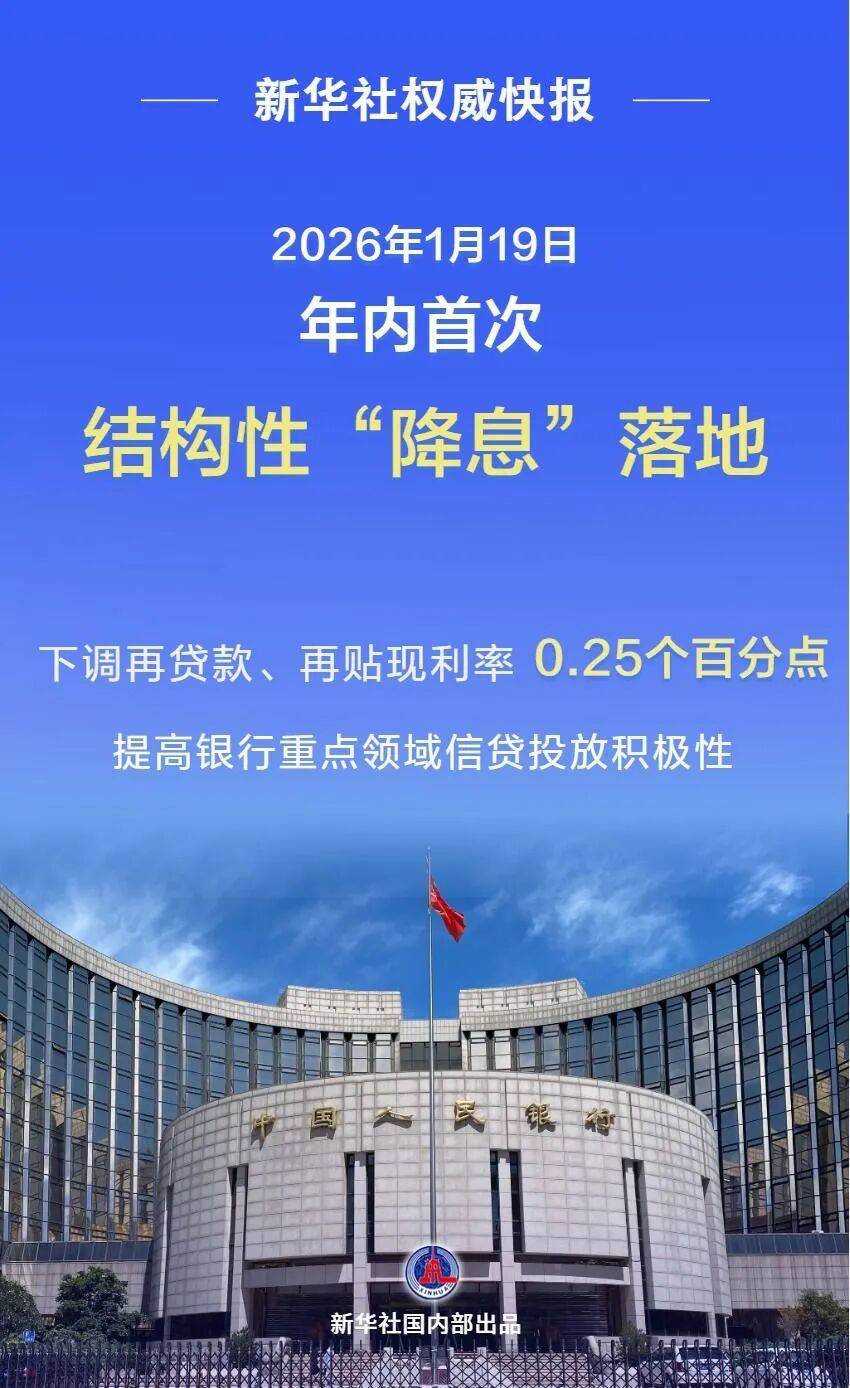
年内首次结构性"降息"落地。中国人民银行日前发布消息, 决定自2026年1月19日起,下调再贷款、再贴现利率0.25个百分点。 这意味 着,银行从中国人民银行"借钱"更便宜,有助于提高重点领域信贷投放的积极性,进一步助力经济结构转型优化。 下调后,3个月、6个月和1年期支农支小再贷款利率分别为0.95%、1.15%和1.25%,再贴现利率为1.5%,抵押补充贷款利率为1.75%, 专项结构性货币政策工具利率为1.25%。 ...

年内首次结构性“降息”落地,央行:1月19日起,下调再贷款、再贴现利率0.25个百分点
Sou Hu Cai Jing· 2026-01-19 00:16
年内首次结构性"降息"落地。中国人民银行日前发布消息,决定自2026年1月19日起,下调再贷款、再贴现利率0.25个百 分点。这意味着,银行从中国人民银行"借钱"更便宜,有助于提高重点领域信贷投放的积极性,进一步助力经济结构转 型优化。 下调后,3个月、6个月和1年期支农支小再贷款利率分别为0.95%、1.15%和1.25%,再贴现利率为1.5%,抵押补充贷款利 率为1.75%,专项结构性货币政策工具利率为1.25%。 来源 | 新华社 编辑 | 杜小溪 监制 | 柳璐 ...
宏观与大类资产周报:汇率强则港股强-20260118
CMS· 2026-01-18 12:03
证券研究报告 | 宏观点评报告 2026 年 1 月 18 日 汇率强则港股强 ——宏观与大类资产周报 频率:每周 国内方面,12 月出口增速录得 6.6%,显著好于我们此前的预期,"一带一路" 出口红利延续,我们预计下半年到明年或为出口转弱的窗口期,届时,决策层 大概率出台大规模扩大内需特别是地产相关政策。 海外方面,1)鲍威尔被传讯令美联储独立性受到质疑,但暂不影响降息节 奏,1 月大概率不降息。2)美国 12 月 CPI 与核心 CPI 低于预期,但伊朗问题 对油价形成支撑。 资产方面,1)央行对汇率的态度有所转变,中间价最快本月破 7。央行选择 "结构性降息"而非全面降息,此外表态不会为了出口压制汇率,表明央行对汇 率升值容忍度提升。2)11 月下旬离岸人民币加速升值令恒生止跌,若美元再 度转弱或离岸人民币进一步升值,港股上行趋势将被彻底打开。 货币流动性跟踪(1 月 12 日——1 月 16 日) 央行维持净投放,但资金价格整体上行 ❑ 流动性复盘: 公开市场操作方面,1 月 12 日—1 月 16 日期间,7 天逆回购投放 9515 亿元, 到期 1387 亿元,净投放 8128 亿元;央行进行 ...
宏观量化经济指数周报20260118:多举措支持下经济“开门红”的可能性进一步提升-20260118
Soochow Securities· 2026-01-18 12:00
Economic Indicators - As of January 18, 2026, the weekly ECI supply index is 49.96%, up 0.01 percentage points from last week, while the demand index is 49.84%, also up 0.01 percentage points[6] - The ECI investment index is 49.83%, down 0.01 percentage points from last week, and the consumption index is 49.66%, down 0.01 percentage points[6] - The ECI export index is 50.20%, up 0.03 percentage points from last week, indicating a slight recovery in exports[6] Monetary Policy - The ELI index as of January 18, 2026, is -0.79%, down 0.64 percentage points from last week, reflecting a structural "rate cut" aimed at supporting economic growth[11] - The People's Bank of China reported that the average interest rate for new corporate loans and personal housing loans was approximately 3.1% in Q4 2025, indicating continued loose financing conditions[15] Industrial Production - The operating rate for full steel tires is 62.93%, up 4.91 percentage points from last week, while the half steel tire operating rate is 73.44%, up 7.55 percentage points[16] - The national high furnace operating rate is 78.82%, down 0.51 percentage points from last week but up 1.66 percentage points year-on-year[16] Consumer Trends - The average daily sales of passenger cars for the week ending January 11, 2026, is 29,818 units, down 9,196 units year-on-year, with total retail sales for the first 11 days of January at 328,000 units, a 32% decline from the previous year[24] - The textile price index recorded 105.72 points, a slight increase of 0.31 points from the previous week[25] Export Performance - The cumulative cargo throughput at ports from January 5 to January 11, 2026, is 26,275.1 million tons, reflecting a 3.06% increase week-on-week[37] - The SCFI index for container shipping is 1,574.12 points, down 73.27 points from the previous week, while the CCFI index is 1,209.85 points, up 14.96 points[42] Inflation Trends - The average wholesale price of pork is 18.00 yuan/kg, up 0.08 yuan/kg from the previous week, while the average price of 28 monitored vegetables is 5.52 yuan/kg, down 0.08 yuan/kg[43]
金融行业周报(2026、01、18):央行宣布结构性降息,衍生品交易监管更规范-20260118
Western Securities· 2026-01-18 11:43
Investment Rating - The report does not explicitly state an overall investment rating for the financial industry, but it provides specific recommendations for various sectors and companies within the industry [3][21]. Core Insights - The financial industry experienced a decline this week, with the non-bank financial index down by 2.63%, underperforming the CSI 300 index by 2.06 percentage points. The banking sector saw a decline of 3.03%, also underperforming the CSI 300 index by 2.46 percentage points [1][9]. - The report highlights a structural interest rate cut by the central bank, which is expected to impact various financial sectors, particularly banks and insurance companies. The insurance sector is viewed as being in a critical window for performance and valuation recovery [3][21]. - Regulatory measures have been introduced to stabilize the derivatives market, which is expected to benefit well-capitalized and compliant brokerage firms [2][17]. Summary by Sections 1. Weekly Performance and Sector Insights - The non-bank financial index decreased by 2.63%, with the securities, insurance, and diversified financial indices down by 2.21%, 3.59%, and 1.83% respectively [1][9]. - The banking sector's performance was notably poor, with state-owned banks, joint-stock banks, city commercial banks, and rural commercial banks experiencing declines of 2.20%, 4.08%, 2.40%, and 2.20% respectively [1][9]. 2. Insurance Sector Insights - The insurance sector's index fell by 3.59%, underperforming the CSI 300 index by 3.02 percentage points. The report indicates that regulatory cooling measures have created short-term pressure on the insurance sector, but the long-term outlook remains positive due to asset growth and interest margin recovery [1][13][15]. - Key companies such as China Pacific Insurance, China Life, and New China Life are recommended for investment due to their strong fundamentals and recovery potential [3][16]. 3. Brokerage Sector Insights - The brokerage sector saw a decline of 2.21%, with the report emphasizing the potential benefits of new regulatory measures aimed at enhancing the derivatives market. The focus is on larger, well-capitalized firms that can navigate the evolving regulatory landscape [2][17]. - Recommendations include major brokerages like Guotai Junan and Huatai Securities, which are expected to benefit from the anticipated recovery in profitability and valuation [2][18]. 4. Banking Sector Insights - The banking sector's index fell by 3.03%, with the central bank's recent interest rate cut expected to support the sector's performance in the long run. The report suggests that banks may see a gradual recovery in net interest income and profitability [3][21][22]. - Specific banks such as Hangzhou Bank and Ningbo Bank are highlighted as potential investment opportunities, particularly those with previously undervalued positions [3][22].




周观:结构性降息后,债市将如何表现?(2026年第3期)
Soochow Securities· 2026-01-18 10:28
Report Industry Investment Rating No information about the report industry investment rating is provided in the content. Core Viewpoints of the Report - This week (2026.1.12 - 2026.1.16), the yield of the 10 - year active treasury bond decreased by 4.3bp from 1.886% last Friday to 1.843% this Friday. The bond market recovered due to the increase in the entry sentiment of allocation disks, the moderation of the stock - bond seesaw effect, and the central bank's support for liquidity. Structural interest rate cuts are beneficial for precise policy implementation, and there is still room for reserve requirement ratio cuts and interest rate cuts this year, with the former likely to occur earlier [1][11][16]. - Overseas, gold continued to rise this week. In the medium - and long - term, considering the global geopolitical situation and the unchanged structure of fiscal policy and monetary policy, the view of bullishness on gold remains. Attention should be paid to the crowding - out effect of the AI strong capital cycle on traditional sectors, and look for structural allocation opportunities by combining price and volume [2]. - For the US economic data, the initial jobless claims decreased in the short - term while the continued claims remained at a high level, the trade deficit narrowed, and the probability of the Fed cutting interest rates in January is 4.4%, indicating a low likelihood of a rate cut [4]. Summary According to Relevant Catalogs 1. One - Week Viewpoints - **Analysis of Yield Changes in the 10 - Year Active Treasury Bond**: The yield of the 10 - year active treasury bond decreased by 4.3bp this week. The daily fluctuations were affected by factors such as fiscal policies, central bank operations, stock market trends, and economic data releases [1][11][12]. - **Reasons for Bond Market Recovery**: The bond market recovered because the yield of the 10 - year active treasury bond reached 1.9%, leading to an increase in the entry sentiment of allocation disks; the over - heating of the stock market was regulated, making the stock - bond seesaw effect more moderate; the central bank's over - renewal of repurchase agreements and structural interest rate cuts indicated support for liquidity [15][16]. - **Understanding of Structural Interest Rate Cuts and "Room for Reserve Requirement Ratio Cuts and Interest Rate Cuts This Year"**: Structural interest rate cuts can precisely meet the financing needs of the real economy and avoid excessive liquidity. To stabilize the net interest margin of banks, measures such as waiting for the maturity of high - interest deposits, structural interest rate cuts, and reserve requirement ratio cuts can be taken. Reserve requirement ratio cuts are likely to come earlier than interest rate cuts [17]. - **Outlook for Next Week**: The release of the 2025 annual economic data is expected to provide limited incremental information. Next week, attention should be paid to the impact of the stock market on the bond market. Even if the expectation of reserve requirement ratio cuts and interest rate cuts in the first quarter intensifies, the downward pressure on interest rates may be limited [18]. - **Analysis of US Economic Data and Bond Yields**: Gold continued to rise overseas. In the short - term, the path of interest rate cuts is disordered, and in the medium - and long - term, due to the geopolitical situation, the view of bullishness on gold remains. For the US economic data, the initial jobless claims decreased while the continued claims remained high, the trade deficit narrowed, and the probability of the Fed cutting interest rates in January is low [2][23][26]. 2. Domestic and Overseas Data Summaries 2.1. Liquidity Tracking - **Open - Market Operations**: From 2026/1/12 to 2026/1/16, the total net investment through open - market operations was 8128 billion yuan, mainly through reverse repurchase operations [35]. - **Interest Rate Changes**: The money market interest rates showed certain changes, and the yields of treasury bonds, policy - bank bonds, and other bonds also changed to varying degrees [40][48]. 2.2. Domestic and Overseas Macroeconomic Data Tracking - **Commodity Prices**: The prices of steel products generally increased, while the official futures prices of LME non - ferrous metals showed mixed trends. The prices of coal, oil, and other commodities also fluctuated [61][71]. - **Stock Market and Other Market Indexes**: In the period from 2026/1/12 to 2026/1/16, copper led the rise, and the VIX panic index led the decline. The Shanghai Composite Index also showed an upward trend [74][77]. 3. One - Week Review of Local Government Bonds 3.1. Primary Market Issuance Overview - **Issuance Scale and Structure**: This week, 15 local government bonds were issued in the primary market, with a total issuance amount of 748.41 billion yuan, including 520.85 billion yuan of refinancing bonds and 227.56 billion yuan of new special bonds. The net financing amount was 655.70 billion yuan, mainly invested in comprehensive, strategic development, and shantytown renovation projects [89]. - **Issuing Regions**: Four provinces and municipalities issued local government bonds this week, namely Liaoning, Ningbo, Hubei, and Hunan. Three provinces and municipalities issued local special refinancing special bonds for replacing hidden debts, with a total issuance amount of 388.76 billion yuan [92][93]. - **Early Redemption of Urban Investment Bonds**: The total scale of early redemption of urban investment bonds this week was 13.00 billion yuan, involving Chongqing, Xinjiang, and Jiangxi [98]. 3.2. Secondary Market Overview - **Trading Volume and Turnover Rate**: The stock of local government bonds this week was 54.80 trillion yuan, with a trading volume of 3547.12 billion yuan and a turnover rate of 0.65%. The top three provinces with the most active trading were Shandong, Hubei, and Zhejiang, and the top three active trading terms were 10Y, 30Y, and 20Y [101]. - **Yield Changes**: The yields of local government bonds generally declined this week [107]. 3.3. This Month's Local Government Bond Issuance Plan The issuance plans of local government bonds for some provinces and municipalities in January 2026 are provided, including Zhejiang, Gansu, Fujian, Guizhou, and Sichuan [108]. 4. One - Week Review of the Credit Bond Market 4.1. Primary Market Issuance Overview - **Total Issuance and Net Financing**: This week, 334 credit bonds were issued in the primary market, with a total issuance amount of 2882.43 billion yuan, a total repayment amount of 2482.55 billion yuan, and a net financing amount of 399.88 billion yuan, which decreased by 911.61 billion yuan compared with last week [110]. - **Issuance by Bond Type**: Urban investment bonds had a net financing deficit of 353.99 billion yuan, while industrial bonds had a net financing surplus of 753.88 billion yuan. By bond type, short - term financing bonds had a net financing of 293.68 billion yuan, medium - term notes had a net financing of - 86.56 billion yuan, enterprise bonds had a net financing of - 69.92 billion yuan, corporate bonds had a net financing of 353.18 billion yuan, and private placement notes had a net financing of - 90.45 billion yuan [111][116]. 4.2. Issuance Interest Rates The actual issuance interest rates of various bond types this week showed different changes. The issuance interest rate of short - term financing bonds decreased by 4.25bp, that of medium - term notes decreased by 14.60bp, that of enterprise bonds decreased by 8.00bp, and that of corporate bonds increased by 6.10bp [125]. 4.3. Secondary Market Trading Overview - **Trading Volume by Bond Type**: The total trading volume of credit bonds in the secondary market this week was 6101.17 billion yuan. Among them, the trading volume of medium - term notes was the largest, followed by short - term financing bonds, corporate bonds, private placement notes, and enterprise bonds [127]. 4.4. Yield to Maturity The yields of various bonds generally showed a downward trend this week, including national development bonds, short - term financing bonds, medium - term notes, enterprise bonds, and urban investment bonds [128][129][131]. 4.5. Credit Spreads The credit spreads of short - term financing bonds, medium - term notes, enterprise bonds, and urban investment bonds showed a differentiated trend this week [134][138][142]. 4.6. Rating Spreads The rating spreads of short - term financing bonds, medium - term notes, enterprise bonds, and urban investment bonds also showed different trends, with the rating spreads of enterprise bonds generally narrowing and those of urban investment bonds generally widening [144][148][152]. 4.7. Trading Activity - **Top Five Active Bonds by Bond Type**: The report lists the top five most actively traded bonds for each type of credit bond this week [158]. - **Industry Trading Volume**: The industrial industry had the largest weekly trading volume of bonds, followed by public utilities, finance, materials, and optional consumption [158]. 4.8. Subject Rating Changes There were no bonds with upgraded ratings or outlooks this week [159].
——策略周专题(2026年1月第2期):节前坚守稳健布局,静待节后新动能释放
EBSCN· 2026-01-18 09:27
Group 1 - The report suggests that investors should maintain a steady allocation strategy before the Spring Festival, anticipating the release of new momentum after the holiday [3][21] - The report highlights that the A-share market experienced a narrow fluctuation, with the Shanghai Composite Index slightly declining while the ChiNext and other indices showed gains [1][11] - The report indicates that the current valuation levels of the Sci-Tech 50 and the Wind All A indices are relatively high, with their PE(TTM) percentile ranks exceeding 90% as of January 16, 2026 [1][12] Group 2 - The report emphasizes the importance of monitoring the electronic, power equipment, and non-ferrous metals industries, which are expected to perform well in the upcoming market conditions [3][32] - The report notes that if the market style leans towards growth, the top-scoring industries in the five-dimensional industry comparison framework include electronics, power equipment, and communication [3][32] - In a defensive market style scenario, the top industries include non-bank financials, electronics, and power equipment, indicating a similarity in high-scoring industries across both growth and defensive styles [3][32] Group 3 - The report continues to focus on the commercial aerospace sector, which has shown signs of adjustment after a strong performance, suggesting that the sector may transition to a phase of consolidation [4][33] - The report warns of potential short-term profit-taking pressures in the commercial aerospace sector due to its previous high cumulative gains, but it remains optimistic about long-term growth driven by favorable industry policies [4][33]
单边行情纠偏,股指行稳致远
Dong Zheng Qi Huo· 2026-01-18 09:14
Report Industry Investment Rating - The rating for stock index trends is "Volatility" [4] Core View of the Report - The domestic stock market showed dramatic changes this week. With multiple trading days hitting record high trading volumes, regulatory actions to cool down the market were evident, suppressing stock performance. The stock index opened high and closed low, showing signs of a phased peak. From a capital perspective, ETFs such as the CSI 300 experienced net redemptions, which directly affected index prices. The CSRC's 2026 system work conference emphasized preventing market fluctuations and controlling the market rhythm. Therefore, the long - term slow - bull market pattern remains unchanged, but in the short term, market volatility will increase, and it still needs to accumulate upward momentum [2][10] Summary by Relevant Catalogs 1. One - Week View and Macro Key Event Overview - **Next - week view**: The regulatory measures are cooling down the market, leading to increased stock market volatility. The long - term slow - bull pattern remains, but short - term market shocks will intensify, and it needs to accumulate upward momentum [2][10] - **This - week key event focus**: - On January 12th, four departments jointly issued regulations on the operation of government investment funds, and the NDRC introduced evaluation and management methods for fund investment directions, supporting the cultivation of emerging and future industries [11] - On January 14th, the Shanghai, Shenzhen, and Beijing stock exchanges raised the margin ratio for margin trading to 100%; three departments issued tax incentives for home - buying replacement; China's December exports and imports both exceeded expectations [12][13][14] - On January 15th, the central bank implemented a 25BP structural interest rate cut, increased various re - loan quotas, and adjusted the minimum down - payment ratio for commercial real estate loans; at the end of 2025, China's social financing increased by 8.3% year - on - year [15][16] - On January 16th, the CSRC emphasized counter - cyclical adjustment to prevent market fluctuations; China and Canada reached a series of economic and trade agreements; the State Council executive meeting studied measures to promote consumption [17][18][19] 2. One - Week Market Quotes Overview - **Global stock market weekly overview**: From January 12th to 16th, global stock markets denominated in US dollars rose. The MSCI Global Index increased by 0.33%, with emerging markets (+2.25%) > frontier markets (+0.89%) > developed markets (+0.09%). The South Korean stock market rose 4.29%, outperforming the world, while the French stock market fell 1.47%, the worst - performing globally [1][21] - **Chinese stock market weekly overview**: From January 12th to 16th, most Chinese equity assets rose, with Hong Kong stocks > A - shares > Chinese concept stocks. The average daily trading volume of the Shanghai, Shenzhen, and Beijing stock exchanges was 34653 billion yuan, an increase of 6131 billion yuan compared to last week. A - share broad - based indices were divided, with the STAR 50 Index rising 2.58% and the SSE 50 Index falling 1.74% [1][24] - **Weekly overview of GICS primary industries in Chinese and foreign stock markets**: Most global GICS primary industries rose this week, with real estate leading (+3.53%) and consumer discretionary falling the most (-1.39%). In the Chinese market, information technology had the largest increase (+3.37%), and real estate lagged (-3.66%) [27] - **Weekly overview of China's A - share CITIC primary industries**: Among China's A - share CITIC primary industries this week, 10 rose (28 last week) and 20 fell (2 last week). The computer industry had the largest increase (+4.31%), and the national defense and military industry fell the most (-5.66%) [1][29] - **Weekly overview of China's A - share styles**: Small - cap growth stocks outperformed this week [33] 3. Index Valuation and Earnings Forecast Overview - **Broad - based index valuation**: The report provides PE and PB data for various broad - based indices this week, at the beginning of the year, and their changes, as well as the eight - year percentile [43] - **Primary industry valuation**: The report provides PE and PB data for various primary industries this week, at the beginning of the year, and their changes, as well as the eight - year percentile [44] - **Broad - based index equity risk premium**: The ERP of the CSI 300, CSI 500, and CSI 1000 decreased slightly this week [45][49] - **Consensus expected earnings growth rate of broad - based indices**: The expected earnings growth rate of the CSI 300 in 2025 was adjusted down to 8.64% and in 2026 to 9.32%; for the CSI 500, it was adjusted down to 26.39% in 2025 and up to 22.70% in 2026; for the CSI 1000, it was adjusted down to 28.29% in 2025 and up to 23.27% in 2026 [51] 4. Liquidity and Capital Flow Tracking - **Interest rates and exchange rates**: This week, the 10Y and 1Y interest rates declined, and the spread widened. The US dollar index was 99, and the offshore RMB exchange rate was 6.96 [60] - **Trading - type capital tracking**: This week, the average daily trading volume of northbound funds increased by 740 billion yuan compared to last week, and the margin trading balance increased by 981 billion yuan [59] - **Tracking of funds flowing in through ETFs**: There are 30 on - exchange ETFs tracking the CSI 300, 29 tracking the CSI 500, 15 tracking the CSI 1000, and 40 tracking the CSI A500. This week, the shares of ETFs tracking the CSI 300 decreased by 21.4 billion, those tracking the CSI 500 decreased by 1.7 billion, those tracking the CSI 1000 decreased by 2.7 billion, and those tracking the CSI A500 decreased by 7.7 billion [62][63][65] 5. Tracking of China's Macro High - Frequency Data - **Supply side**: Tire production rates recovered after the Spring Festival [68] - **Consumption side**: Second - hand housing transactions increased seasonally [77] - **Inflation observation**: Producer prices rebounded, while agricultural product prices adjusted [88]
国债期货周报-20260118
Guo Tai Jun An Qi Huo· 2026-01-18 07:50
Group 1: Report Industry Investment Rating - Not provided Group 2: Core Viewpoints of the Report - The Treasury bond futures market showed a slight recovery this week, with the TL contract facing pressure above the MA20. In the medium term, due to reasons such as the relatively restrained monetary policy of the central bank, changes in inflation expectations, the orientation of medium - and long - term funds entering the market, and the inability to falsify the 15th Five - Year Plan policy expectations, the overall view remains that of a sideways and slightly bearish trend. The short - term is resilient, and the long - term may see a slight recovery recently, but the TL contract has pressure above the 20 - day moving average. It is recommended to conduct 30 - 10 spread compression trading and long substitution in the short term, and continue to recommend hedging on rallies, long - term spread trading, and cash - and - carry arbitrage in the medium term [1][4][6] Group 3: Summary by Relevant Catalogs 1. Weekly Focus and Market Tracking - This week, the Treasury bond futures market showed a pattern of oscillating downward, recovered on Thursday, and closed down overall after wide - range oscillations during Friday's session. On January 15, the central bank cut the interest rates of various structural monetary policy tools by 0.25 percentage points. The central bank may have considered the relatively small spillover depreciation pressure on CNY, the limited need to stimulate exports through full - scale interest rate cuts, and the need to support the real economy and reduce bank interest - paying costs. After the structural interest rate cut, the market sentiment fluctuated briefly, and the 10Y Treasury bond yield rebounded after a short - term decline of about 2BP. It is expected that there may be 1 - 2 full - scale interest rate cuts in 2026, each with a 10BP reduction, and a 50BP reserve requirement ratio cut if the RMB exchange rate stabilizes. The bond market fluctuations are concentrated in the ultra - long - term, and the A - share market is expected to maintain a stable growth trend in 2026 [3][4] - The market showed a differentiated pattern this week, with the short - term resilience strengthening and the long - term recovery momentum being weak. Policy expectations and capital - level fluctuations dominated the market sentiment [6] 2. Liquidity Monitoring and Curve Tracking - Not provided 3. Seat Analysis - In terms of the daily change in net long positions by institutional type, private funds decreased by 2.62%, foreign capital increased by 0.77%, and wealth management subsidiaries increased by 0.46%. In terms of the weekly change, private funds increased by 5.53%, foreign capital increased by 7.13%, and wealth management subsidiaries increased by 4.85% [11]
国债周报:结构性降息后,降准降息空间仍存-20260117
Wu Kuang Qi Huo· 2026-01-17 15:06
结构性降息后,降准降息空间仍存 国债周报 2025/01/17 蒋文斌(宏观金融组) 0755-23375128 jiangwb@wkqh.cn 从业资格号:F3048844 交易咨询号:Z0017196 程靖茹(联系人) chengjr@wkqh.cn 从业资格号:F03133937 CONTENTS 目录 01 周度评估及策略推荐 04 流动性 02 期现市场 05 利率及汇率 03 主要经济数据 01 | 国债基本面评估 | 估值 驱动 | | | | | | --- | --- | --- | --- | --- | --- | | | 基差 经济 | 价格 | 政策 | 流动性 | 贴水 | | 多空评分 | -1 0 | 0 | 0 | 1 | -1 | | 简评 | 基本面改善仍需观 净基差偏低 察 | 价格适中 | 政策空档期 | 流动性压力有望缓 解 | 贴水偏低 | | | 近期经济数据显示内需仍有待修复,外需在关税扰动下有所承压。当前债市向下调整空间有限,往后看资金面有望延续宽 | | | | | | 小结 | 松,随着关税扰动及外需的不确定性增强,后续经济稳增长压力仍存。宽货币政策的方 ...