
贸易战

Search documents
特朗普让步,中美成最大赢家?欧盟加拿大日本,被中方下重手反制
Sou Hu Cai Jing· 2025-08-19 13:12
Group 1 - The core point of the article is the recent decision by Trump to extend the tariff suspension on certain Chinese goods for 90 days, indicating a shift in the U.S. stance amid economic pressures [1][3] - The U.S. manufacturing data is declining, consumer prices are rising, and there is significant inventory buildup, leading to concerns about unemployment potentially exceeding 1.2% [3] - The bilateral trade between the U.S. and China has surpassed $450 billion in the first half of the year, making the tariff suspension beneficial for Chinese exporters [3] Group 2 - The U.S. stock market rose by 1.5% on the day the tariff suspension was announced, providing a respite for Chinese exporters [5] - The negotiations in Stockholm between the U.S. and China covered critical issues such as chips and energy, suggesting a more pragmatic approach to future competition and cooperation [5][7] - The geopolitical context includes Trump's recent meeting with Putin and the weakening of NATO alliances, making a prolonged trade war with China less favorable [5] Group 3 - China initiated anti-dumping investigations against Canadian canola seeds, with a preliminary ruling indicating a dumping margin of 75.8%, impacting Canadian agriculture significantly [8][10] - China also imposed anti-dumping measures on Japanese halogenated butyl rubber, affecting Japan's supply chains and economic interests [10] - The Chinese government retaliated against the EU by implementing sanctions on two financial institutions, highlighting the use of legal measures alongside economic tools [10][11] Group 4 - The trade war reflects a profound change in the global trade landscape, with tariffs imposed by the U.S. on various countries, leading to retaliatory measures and economic strain on allies [11][12] - The EU, Canada, and Japan are facing economic challenges due to U.S. tariffs, prompting them to seek alternative markets and partnerships [14] - The ongoing negotiations between the U.S. and China during the 90-day period may reshape the global trade system, with China taking actions to protect its interests [14][15]


特朗普关税最新消息,最高 250%!美联储主席大消息,贝森特退出!
Sou Hu Cai Jing· 2025-08-19 10:08
Group 1: Trade Policy Changes - Trump announced a significant increase in tariffs on imported pharmaceuticals, starting with a small amount and potentially rising to 250% within a year and a half, aiming to encourage pharmaceutical companies to relocate production to the U.S. [3][4] - The new tariffs on pharmaceuticals are expected to drastically increase costs, impacting major companies like Pfizer, Johnson & Johnson, and Merck, which have been warned to lower drug prices by the end of September [3][4]. - In the semiconductor sector, Trump plans to introduce new tariffs, emphasizing the need for domestic production, which could disrupt the global supply chain and lead to price fluctuations in AI chips [4][10]. Group 2: Broader Tariff Adjustments - On July 31, Trump signed an executive order imposing tariffs on 67 countries, effective August 7, with Brazil facing a 50% tariff, Switzerland 39%, the UK 10%, the EU and Japan 15%, and India 25% [6]. - India is particularly targeted due to its oil purchases from Russia, which Trump claims indirectly supports the Russian economy; India has responded by asserting its energy security needs [6][8]. - The overall tariff strategy aligns with Trump's "America First" policy, which has already shown some effects, such as a 16% reduction in the U.S. trade deficit in June [8]. Group 3: Federal Reserve Developments - The resignation of Federal Reserve Governor Adriana Kugler and the withdrawal of Bessent from the Fed chair competition have created uncertainty regarding future monetary policy [12][14]. - Trump's potential nominees for the Fed chair position could influence the central bank's independence and its approach to interest rates, especially as he pressures for rate cuts [12][14]. - The changes in Fed leadership may have significant implications for the U.S. economy and financial markets, as the new chair could steer policy in a direction aligned with Trump's economic agenda [12][14]. Group 4: Market Reactions - Trump's complaints about discrimination from major banks like JPMorgan and Bank of America have led to volatility in their stock prices, reflecting underlying tensions in the U.S. financial market [16]. - The broader implications of Trump's trade and monetary policies are expected to resonate globally, affecting supply chains and economic stability beyond the U.S. [18].
瑞达期货集运指数(欧线)期货日报-20250819
Rui Da Qi Huo· 2025-08-19 09:05
Report Summary 1. Report Industry Investment Rating No relevant information provided. 2. Report's Core View - Trade war uncertainties remain, demand for the Container Shipping Index (European Line) is weak, and the futures price fluctuates significantly. Investors are advised to be cautious, pay attention to operation rhythm and risk control, and track geopolitical, shipping capacity, and cargo volume data in a timely manner [1]. 3. Summary by Relevant Catalogs 3.1 Futures Market Data - EC主力收盘价为1370.300,较前值下降11.1;EC次主力收盘价为1775,较前值下降7.3 [1]. - EC2510 - EC2512价差为 -404.70,较前值上升11.90;EC2510 - EC2602价差为 -165.10,较前值下降0.30 [1]. - EC合约基差为809.87,较前值下降52.51 [1]. - EC主力持仓量为52799手,较前值下降383手 [1]. 3.2 Spot Market Data - SCFIS(欧线)(周)为2180.17,较前值下降55.31,环比下降2.5%;SCFIS(美西线)(周)为1106.29,较前值下降24.15 [1]. - SCFI(综合指数)(周)为1460.19,较前值下降29.49;集装箱船运力为1227.97万标准箱,较前值下降0.04 [1]. - CCFI(综合指数)(周)为1193.34,较前值下降7.39;CCFI(欧线)(周)为1790.47,较前值下降8.58 [1]. - 波罗的海干散货指数(日)为2044.00,较前值下降22.00;巴拿马型运费指数(日)为1622.00,较前值上升8.00 [1]. - 平均租船价格(巴拿马型船)为13956.00,较前值下降44.00;平均租船价格(好望角型船)为25535.00,较前值上升662.00 [1]. 3.3 Industry News - 国务院总理李强强调提升宏观政策效能,稳定市场预期,激发消费潜力,扩大有效投资,巩固房地产市场止跌回稳态势 [1]. - 全球金融市场关注杰克逊霍尔全球央行年会,野村、美银、大摩对美联储主席鲍威尔讲话有不同预期 [1]. - 面对特朗普威胁对印商品加征50%关税,印度总理莫迪拟进行商品及服务税改革 [1]. - 德国政府发言人表示美国需降低对欧汽车关税才能敲定贸易协定书面文本 [1]. 3.4 Key Points to Follow - 8月20日09:00公布中国至8月20日一年期贷款市场报价利率 [1]. - 8月20日14:00公布德国7月PPI月率、英国7月CPI月率、英国7月零售物价指数月率 [1]. - 8月20日17:00公布欧元区7月CPI年率终值 [1].

美国大豆市场遭重创,特朗普喊话无效,中国迟迟不下订单,豆农撑不住了!
Sou Hu Cai Jing· 2025-08-19 06:12
Core Viewpoint - The current situation in the U.S. soybean industry is described as a "multiple disaster," with farmers facing unprecedented challenges due to trade policies, climate issues, and rising costs [1][3][5]. Trade Policy Impact - Since the trade war with China began in 2018, U.S. soybean exports to China have plummeted, with only 22.13 million tons expected in 2024 compared to China's total soybean imports of 105 million tons [1][3]. - The U.S. soybean association has highlighted that no other market can match China's demand, emphasizing the critical role of China in U.S. soybean exports [3]. Climate Challenges - Extreme weather conditions have exacerbated the difficulties faced by U.S. soybean farmers, with persistent rainfall leading to severe pest and disease issues [3][5]. - Farmers in states like Indiana and Ohio have reported significant seed losses due to flooding, forcing them to invest more in pest control [3]. Economic Pressures - The overall decline in the U.S. agricultural market, coupled with rising costs for seeds, fertilizers, and land, has created a dual pressure on farmers, making it difficult for many small farms to operate sustainably [5]. - Many farmers are reducing their investments in hopes of survival, which threatens future yield and quality, leading to a vicious cycle in the agricultural supply chain [5]. Government Response - The Trump administration's response to the crisis has been criticized as ineffective, with calls for China to resume soybean purchases lacking substantive measures to address the underlying issues [5][6]. - Reports indicate that Brazil is strengthening its agricultural cooperation with China, further jeopardizing the position of U.S. soybean farmers in the market [5]. Future Outlook - The future of U.S. agriculture, particularly for soybean farmers, is uncertain, with climate change and inadequate trade policies posing long-term challenges [6]. - There is a pressing need for practical policies and deeper international cooperation to address the agricultural crisis, which is vital for the overall economy [6].
美方喊停和印度谈判,巨额关税不可避免,莫迪抵制美国货,不要麦当劳不要iPhone
Sou Hu Cai Jing· 2025-08-19 02:21
Group 1 - The trade tensions between the US and India have escalated, with the US imposing a 50% tariff on Indian goods, impacting local businesses and triggering a nationalist sentiment among Indian consumers [1][3][9] - Indian exporters are feeling the immediate effects, with many orders stuck and factories facing reduced operations, leading to concerns about the sustainability of their businesses under such high tariffs [3][4] - There is a growing movement among Indian citizens and businesses to support local products and brands, with calls to boycott American companies like McDonald's and Coca-Cola [6][8] Group 2 - The Indian government acknowledges that the tariff increase could disrupt not only US-India trade but also global trade growth [3][4] - The sentiment of self-reliance is echoed by Indian Prime Minister Modi, who emphasizes the need for Indian companies to focus on domestic demands [4][8] - India's diplomatic stance appears to be shifting, as it seeks to strengthen ties with China and Russia in response to US actions, indicating a potential pivot in trade relationships [6][8]
川普巧施连环计,库克怒掏7000亿
3 6 Ke· 2025-08-18 23:25
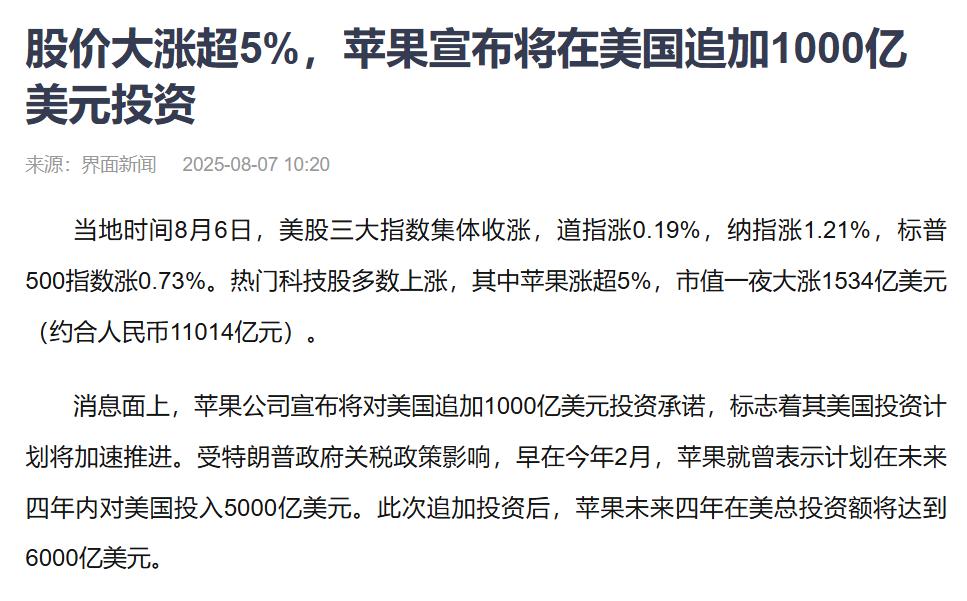
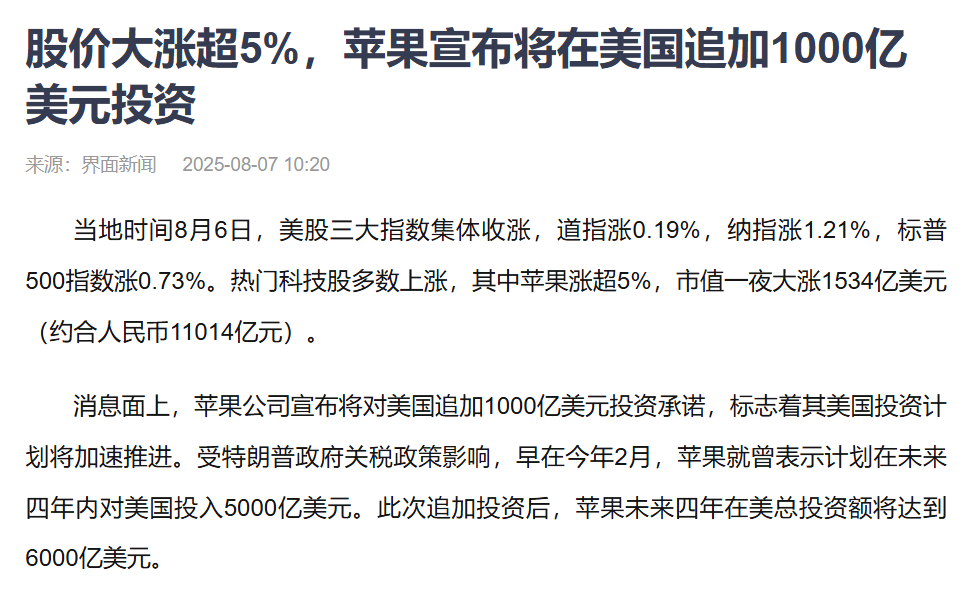
Core Viewpoint - Apple is set to invest a total of $700 billion in the U.S., which includes $600 billion for domestic construction and an additional $100 billion for the American Manufacturing Program (AMP), leading to a significant increase in its stock price and a boost for the U.S. manufacturing sector [2][4][22] Investment Details - The investment will be spread over four years, averaging about $175 billion per year, which exceeds Apple's annual net profit of approximately $100 billion and accounts for nearly half of its total revenue [4][19] - The AMP plan includes procurement and investment in suppliers, which are essential for Apple's operations, thus much of this investment may not represent new spending but rather a reallocation of existing expenses [15][19] Political and Economic Context - The investment is seen as a "protection fee" to secure favorable treatment amid trade tensions, particularly with India, which has become a major source of iPhone exports to the U.S. [6][10] - The move is also politically beneficial for former President Trump, as it showcases significant investment in the U.S. economy, potentially creating jobs and providing political capital [20][22] Historical Precedents - Apple has a history of making large investment commitments in response to government pressures, having previously pledged $350 billion and later $430 billion in investments during Trump's and Biden's administrations, respectively [17][22] Financial Implications - Analysts estimate that only 15% to 25% of the announced investment may represent actual new cash outlay, suggesting that the bulk of the investment may be reclassified existing expenditures [19][22] - If Apple were to lose tariff exemptions, it could face annual profit losses of approximately $2 billion due to increased tariffs on imports from China and India [19][22]

关税“休战”助力资本跨境,政策举措增强市场信心,外媒剖析中国股市走高背后动能
Huan Qiu Shi Bao· 2025-08-18 22:56
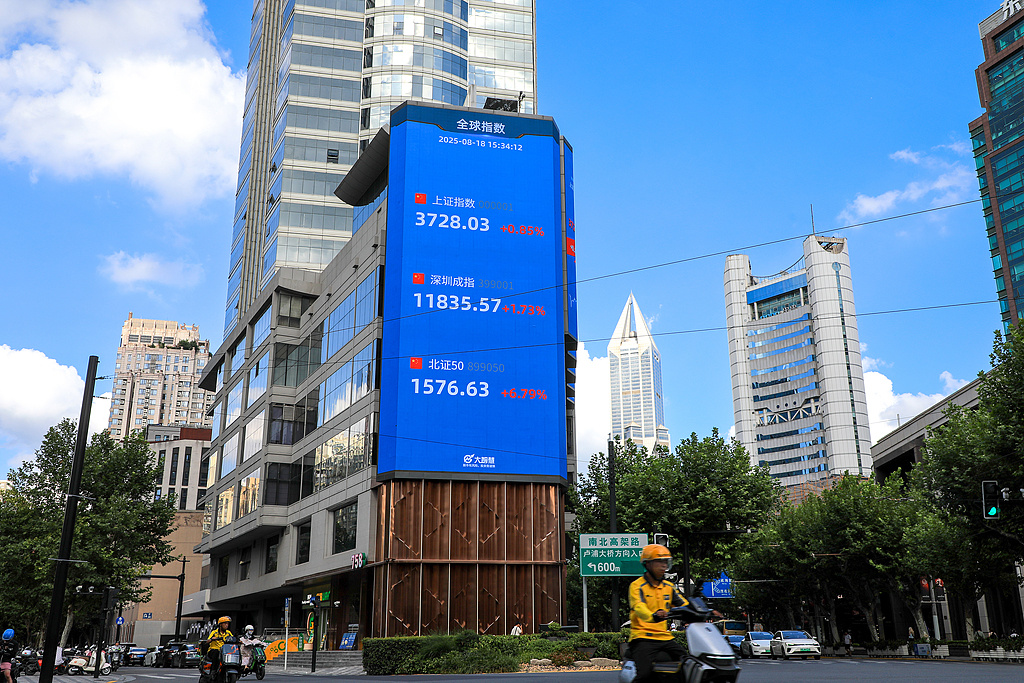
Market Performance - A-shares experienced a significant rise, with the Shanghai Composite Index reaching a nearly ten-year high of 3745.94 points, marking a 1% increase during the day [1] - The total market capitalization of A-shares surpassed 100 trillion yuan, setting a historical record [1] - The ChiNext Index saw a nearly 4% increase, breaking through the 2600-point mark [1] Market Drivers - Multiple positive factors, including cyclical resilience, policy expectations, and market rotation, are driving the upward momentum in the Chinese stock market [1][3] - Ample liquidity in the market and support from national policies have alleviated investor concerns [3] - The recent trend indicates a recovery in corporate earnings, with an average profit growth of 11% reported by 31 companies in the Hang Seng Index [3] Investor Sentiment - The stock market's recovery has boosted investor enthusiasm for trading in the Chinese capital market, with a 20% rebound since the sell-off triggered by US-China trade tensions in April [4] - Retail investors are shifting record savings from the bond market to the stock market, supported by government policies that enhance market confidence [4] - The recent positive sentiment in the stock market suggests a quiet recovery in the over 10 trillion USD market [4] Economic Outlook - The current bull market is characterized by strong policy support, a favorable funding environment, and sustained foreign capital inflows [5] - The focus of market investments is shifting towards core areas of economic transformation, particularly in finance and technology sectors [5] - The humanoid robotics sector is gaining attention, with potential applications expanding as intelligent systems improve [5]

川普巧施连环计,库克怒掏7000亿。
Sou Hu Cai Jing· 2025-08-18 16:15
Core Viewpoint - Apple is set to announce a significant investment of $700 billion in the U.S., which includes $600 billion for domestic construction and an additional $100 billion for the American Manufacturing Program (AMP) [2][4]. Group 1: Investment Details - The $700 billion investment will be spread over four years, averaging about $175 billion per year, which exceeds Apple's annual net profit of approximately $100 billion and accounts for nearly half of its total revenue [4][19]. - The AMP plan includes procurement and investment in suppliers, which are essential for Apple's operations, thus much of this investment may not represent new spending but rather a reallocation of existing expenses [15][19]. Group 2: Strategic Implications - This investment can be seen as a "protection fee" to secure favorable treatment from the U.S. government amid ongoing trade tensions, particularly with China and India [5][10]. - Apple's production in India has surged, with Indian-assembled smartphones accounting for 44% of U.S. imports, and iPhone exports from India increasing by 240% year-on-year [8][10]. Group 3: Political and Economic Context - The investment serves multiple purposes: it provides political capital for the Trump administration, creates jobs in the U.S., and allows Apple to maintain its global supply chain stability [20][22]. - Previous commitments by Apple to invest in the U.S. have typically resulted in only 15% to 25% of the promised amounts being new cash investments, indicating that the actual financial impact may be less than the headline figure suggests [19][22].
美国这次彻底孤立无援?8月17日,对华关税政策传来新消息
Sou Hu Cai Jing· 2025-08-18 07:02
Core Viewpoint - The trade war initiated by the Trump administration against China has been characterized as a "self-indulgent farce," ultimately failing to achieve its intended goals and revealing the resilience of China in the face of pressure [1][10]. Group 1: Trade War Dynamics - Trump's initial threats included imposing tariffs as high as 200% on Chinese goods, aiming to force China to comply with U.S. trade rules [1]. - The negotiations between the U.S. and China resulted in a 90-day "truce," which did not meet Trump's expectations and dampened his ambitions [3]. - U.S. Treasury Secretary Steven Mnuchin's plans to implement high tariffs on China were met with silence from G7 and EU nations, highlighting their reluctance to align with U.S. actions against China due to significant economic ties [5]. Group 2: Impact on India - Following setbacks with China, Trump shifted focus to India, increasing tariffs from an initial 25% to potentially 250%, targeting India's pharmaceutical exports [7]. - The trade protectionist measures taken by the Trump administration have not only failed to enhance its reputation but have also caused significant harm to the U.S. economy, leading to rising prices and declining purchasing power [7]. Group 3: China's Response and Global Implications - China maintained a principled stance, demonstrating its importance in the global supply chain by tightening rare earth exports, which affected U.S. industries [8]. - The trade war has resulted in the U.S. losing not only economic benefits but also moral standing and global support, as countries recognize the futility of following U.S. unilateral actions [8][10]. - The conclusion of the trade war suggests a shift towards a more multipolar and rule-based global trade system, with China positioned as a key player in promoting fairness and justice in international trade [10].

懂王关税大棒乱舞,半导体税率或达300%!
Sou Hu Cai Jing· 2025-08-18 05:54
Group 1: Tariff Implications - The Trump administration announced an expansion of tariffs on steel and aluminum imports, increasing the tariff rate to 50% on 407 product codes due to their steel and aluminum content, effective August 18 [2] - There are concerns that these tariffs could disrupt global trade and lead to increased production costs for U.S. manufacturing, potentially resulting in structural shortages [2] - Trump plans to announce semiconductor tariffs within two weeks, with rates potentially reaching 300%, aimed at incentivizing semiconductor manufacturers to relocate production to the U.S. [2] Group 2: U.S.-India Trade Relations - The trade relationship between the U.S. and India has deteriorated, with Trump imposing high tariffs on India as a punishment for its oil purchases from Russia [3] - A planned visit by U.S. trade representatives to India has been canceled, delaying negotiations for a bilateral trade agreement and increasing uncertainty in U.S.-India trade relations [2][3] Group 3: Federal Reserve and Economic Outlook - Discussions around potential interest rate cuts by the Federal Reserve are a focal point for capital markets, with expectations of a 25 basis point cut next month and possibly another by year-end [4] - Economists suggest that the Fed should adopt a more aggressive easing approach to prevent labor market slowdowns, despite rising inflation pressures indicated by the July PPI [4] - The upcoming Jackson Hole conference will feature a speech by Powell, which is anticipated to influence market expectations regarding future rate decisions [4][5]