
反内卷

Search documents
“反内卷”政策引导下化工行业景气度或将止跌回升,化工ETF嘉实(159129)有望持续受益
Xin Lang Cai Jing· 2026-01-12 05:51
Group 1 - The chemical sector experienced a reversal in early trading on January 12, 2026, with the CSI Chemical Industry Theme Index (000813) down by 0.63% as of 11:25 AM [1] - Key stocks in the sector showed mixed performance, with Guangwei Composite leading gains at 8.12%, followed by Bluestar Technology at 4.77% and Zhongjian Technology at 4.52%. Hebang Bio led the declines, with Sanmei Co. and Juhua Co. also falling [1] - The Ministry of Industry and Information Technology emphasized four key areas for 2026: "stability," "expansion," "innovation," and "growth," focusing on stabilizing growth in key industries such as steel, non-ferrous metals, and petrochemicals [1] Group 2 - CITIC Construction pointed out that despite rising short-term technical correction risks in the chemical sector, investment opportunities still exist. The outlook remains positive for the cross-year market, focusing on future industry hotspots, AI, semiconductors, and the resource price increase chain [1] - Guohai Securities noted that under the "anti-involution" policy, supply-side expansion in China's chemical industry is expected to slow significantly, potentially leading to a recovery in industry prosperity. The curtailment of disorderly capacity expansion may benefit leading companies with cost and efficiency advantages, marking a long-term upward trend in performance [1] - As of December 31, 2025, the top ten weighted stocks in the CSI Chemical Industry Theme Index included Wanhua Chemical, Salt Lake Industry, and Cangge Mining, accounting for a total of 45.31% of the index [2] Group 3 - Investors can also explore investment opportunities in the chemical sector through the Chemical ETF Link Fund (013527) [3]
锂电池出口退税调整对碳酸锂品种的影响
Hua Tai Qi Huo· 2026-01-12 05:37
锂电池出口退税调整对碳酸锂品种的影响 研究院 新能源&有色组 研究员 期货研究报告|新能源专题报告 2026-01-12 陈思捷 师橙 021-60828513 shicheng@htfc.com 从业资格号:F3046665 投资咨询号:Z0014806 封帆 投资咨询号:Z0014660 从业资格号:F03149704 投资咨询业务资格: 证监许可【2011】1289 号 报告摘要 2026 年 1 月 8 日,国家财政部和税务总局公布了《财政部 税务总局关于调整光伏等产 品出口退税政策的公告》,其中提到自 2026 年 4 月 1 日起至 2026 年 12 月 31 日,将电 池产品的增值税出口退税率由 9%下调至 6%;2027 年 1 月 1 日起,取消电池产品增值 税出口退税。该政策是针对新能源行业"反内卷"的最新要求,再次强调了国家对锂电行 业未来发展的重视程度。本次分析将就退税调整政策及"反内卷"对锂电行业及碳酸锂品 种的影响进行探讨。 2025 年以后,我国锂电行业进入新的阶段,一方面国内企业市场占比不断提升,技术方 面全球领先,但另一方面国内企业竞争白热化,利润率不足,因此为了行业的长期 ...
反内卷是长跑
Nan Hua Qi Huo· 2026-01-12 03:20
Report Industry Investment Rating - Not provided in the content Core Viewpoints of the Report - The market currently revolves around two major themes: the strong upward trend of non-ferrous and precious metals, driven by the demand logic of related commodities in the new energy and AI economies; and the anti-involution logic of low-valued varieties, which is gradually advancing. In 2026, the anti-involution theme may play a significant role in the market [2][5] - The overall volatility of the commodity market has increased this week. Adjustments were mainly affected by events such as the anti-monopoly of polysilicon and the cancellation of export tax rebates for some commodities, but this will not affect the anti-involution process [4] Summary by Relevant Catalogs Market Theme Analysis - The strong upward trend of non-ferrous and precious metals is essentially driven by the demand logic of related commodities in the new energy and AI economies. The anti-involution logic of low-valued varieties is gradually advancing, with the glass production showing an obvious decline, and the current daily melting volume at 150,000 tons, approaching the low limit in 2015 [2][5] Weekly Market Review - **Precious Metals**: Gold has shown a divergence and stagnant rise recently, and the gold-silver ratio is at a historically low level. Copper, aluminum, nickel and other metals have strong trends, and after a brief technical adjustment last week, they have strengthened again [4] - **Agricultural Products**: The overall trend is still expected to be volatile, with limited downside space but lacking the fundamental elements for a continuous upward trend. The global soybean supply and demand pattern remains weak, but the support for US soybeans above 1000 is still effective [4] - **Chemical Industry**: In 2026, it will generally operate within the anti-involution framework. The national policy emphasizes the supply and demand adjustment of the petrochemical sector, which is a key area. The production capacity of glass has declined significantly recently, and PTA has set an example, and other varieties may follow. The valuation of chemical products has reached the limit [4] - **Black Sector**: Steel is one of the key varieties for anti-involution, and the downside space for coal is also limited. The supply guarantee market is coming to an end. The supply guarantee is a short-term logic, while anti-involution is a more long-term logic [4] Data Tables - **Table of Plate Capital Flows**: The total capital flow is 56.114 billion yuan. The capital flows of precious metals, non-ferrous metals, black metals, energy, chemicals, feed breeding, oilseeds, and soft commodities are 2.326 billion yuan, 11.281 billion yuan, 4.278 billion yuan, 958 million yuan, 2.506 billion yuan, 2.745 billion yuan, 3.683 billion yuan, and 1.241 billion yuan respectively [9] - **Table of Black and Non-ferrous Weekly Data**: It shows the price percentile, inventory percentile, valuation percentile, position percentile, position difference percentile, and annualized basis of various black and non-ferrous varieties [9] - **Table of Energy and Chemical Weekly Data**: It shows the price percentile, inventory percentile, valuation percentile, position percentile, position difference percentile, and annualized basis of various energy and chemical varieties [11] - **Table of Agricultural Product Weekly Data**: It shows the price percentile, inventory percentile, valuation percentile, position percentile, position difference percentile, and annualized basis of various agricultural products [12]
招银国际每日投资策略-20260112
Zhao Yin Guo Ji· 2026-01-12 03:08
Group 1: Market Overview - The Hang Seng Index closed at 26,232, up 0.32% for the day and 2.35% year-to-date [1] - The Shanghai Composite Index rose by 0.92% to 4,120, with a year-to-date increase of 3.82% [1] - The US markets showed positive performance, with the Dow Jones up 0.48% and the S&P 500 up 0.65% [1] Group 2: Sector Performance - In the Hong Kong market, the financial sector increased by 0.20%, while the real estate sector rose by 0.32% [2] - Chinese stocks saw gains in materials, consumer discretionary, and integrated enterprises, while consumer staples and utilities declined [3] - The MSCI China Healthcare Index has risen by 11.8% since the beginning of 2026, outperforming the MSCI China Index which increased by 9.1% [5] Group 3: Economic Indicators - China's CPI growth has slightly increased, reaching a near two-year high, driven by rising food and gold jewelry prices [4] - The US non-farm payrolls for December fell short of expectations, indicating a weakening job market, with the unemployment rate dropping to 4.4% [4] - The basic medical insurance expenditure in China showed a recovery with a 0.5% growth in 2025, compared to a 5.5% increase in 2024 [9] Group 4: Pharmaceutical Industry Insights - The market size for patented drugs in China is estimated to be around 300-400 billion RMB, with domestic innovative drugs accounting for about 1/3 of this market [6] - The global pharmaceutical market is projected to reach 1.74 trillion USD, with China's market size at 166 billion USD, representing only 9.5% of the global market [7] - The trend of Chinese innovative drugs going overseas is expected to continue, with a significant increase in BD (business development) transactions projected for 2025 [8]
讹酒店的时代,快结束了?
3 6 Ke· 2026-01-12 02:23
去年,一个00后女孩在上海住了十几晚酒店,每次退房都说:皮肤过敏、房间不干净、影响睡眠,堪称 酒店界皮肤科豌豆公主,外加研究酒店羊毛的爱因斯坦。 01 周末,我刷到一条新闻,大致内容是国内开始规制恶意索赔,防止经营者合法权益受侵害。 结果怎么样?家家中招,十几家酒店房费全退,最终因为一张病历单被保洁人员捡到,这才戳破了她的 伪装。但如果没有被发现呢?这大概率会是一趟愉快、顺利、零成本的免费旅程。 而类似的事情,并不罕见。 去年9月,据上观新闻报道,一名男子凌某在一个月内多次购买多家高档酒店的月饼礼盒,随后统一反 馈月饼中藏有塑料片。 市场监管总局明确提出,不得滥用投诉举报权利牟取不正当利益。 背景则并不复杂,近年来,滥用投诉举报制度的索赔行为明显增多,一小部分人以打假为名行碰瓷之 实,刻意追求小错大赔、小过重罚,不少中小商家因此不堪其扰,甚至被迫关门停业。 针对这一现象,监管部门要求投诉人提供真实身份信息和相应事实依据,对虚假材料、冒用他人名义、 拒不配合核验身份的投诉不予受理,并明确对敲诈勒索、骗取赔偿等违法索赔终止调解,依法移送公安 机关处理。 看到这条新闻,我的第一反应是这些年酒店行业同样不堪其扰,甚至 ...

招商期货-期货研究报告:商品期货早班车-20260112
Zhao Shang Qi Huo· 2026-01-12 01:53
1. Report Industry Investment Ratings No industry investment ratings are provided in the report. 2. Core Views of the Report - The gold price is expected to rise steadily, and it is recommended to go long; the silver market has strong speculative sentiment and large fluctuations, so it is recommended to wait and see [1]. - For copper, it is recommended to buy on dips due to the tight supply of copper mines and the narrowing of the domestic spot discount [1]. - The electrolytic aluminum market is expected to maintain high - level volatility in the short term due to the combination of positive and negative factors [1]. - Alumina is expected to show weak volatility as the market is in a state of supply surplus [1]. - Industrial silicon is expected to oscillate in the range of 8400 - 9200 yuan/ton, and it is recommended to wait and see [2]. - Lithium carbonate prices are expected to be supported and are likely to rise rather than fall [2]. - Polysilicon is expected to have a deep decline in the market, but there is still an expectation of fundamental improvement [2]. - Tin is recommended to be bought on dips due to the tight supply and the decline of global visible inventory [2][3]. - For black and agricultural products: - Soybean meal is expected to be volatile in the short term and needs to find a bottom in the medium term [4]. - Corn futures prices are expected to oscillate in a range [4]. - Oils are expected to be slightly stronger in oscillation [4]. - Sugar is recommended to go short in the futures market and sell call options [4]. - Cotton is recommended to wait and see within the price range of 14300 - 14800 yuan/ton [5]. - Eggs and pork futures prices are expected to oscillate [5]. - Apples are recommended to wait and see [5]. - For energy and chemical products: - LLDPE is expected to be slightly stronger in the short term and it is recommended to buy on dips in the medium term [6][7]. - PVC is recommended to go long on the 05 contract and short on the 09 contract [7]. - PTA is recommended to pay attention to the opportunity of going long on the processing fee of the 05 contract [7]. - Rubber is recommended to hold short positions cautiously [7]. - Glass is recommended to buy glass and sell soda ash [7]. - PP is expected to be slightly stronger in the short term and oscillate in the medium - long term, and it is recommended to go short on highs [8]. - MEG is recommended to go short on highs [8]. - Crude oil is recommended to be used as a short - side allocation, and pay attention to shorting opportunities on rebounds [8]. - Styrene is expected to oscillate in the short term and it is recommended to go long on lows or conduct reverse spreads in the second quarter [8]. - Soda ash is recommended to be short - side allocated [9]. 3. Summary by Related Catalogs Precious Metals - **Gold**: - Market performance: On Friday, precious metal prices rebounded, with the London gold price reaching $4500 per ounce [1]. - Fundamentals: The non - farm payroll data was mixed. The domestic gold ETF had a small inflow of 0.3 tons, and the COMEX gold inventory decreased by 2.3 tons to 1129.3 tons [1]. - Trading strategy: It is recommended to go long as the gold price is rising steadily [1]. - **Silver**: - Market performance: The London silver price was close to $80 per ounce [1]. - Fundamentals: The COMEX silver inventory decreased by 85.2 tons to 13675.9 tons, and the iShares silver ETF position increased by 93 tons to 16308 tons [1]. - Trading strategy: It is recommended to wait and see due to strong speculative sentiment and large fluctuations [1]. Basic Metals - **Copper**: - Market performance: Copper prices continued to strengthen on Friday [1]. - Fundamentals: Despite the stronger US dollar index, copper prices still rose. The supply of copper mines remained tight, and the domestic spot discount narrowed [1]. - Trading strategy: It is recommended to buy on dips [1]. - **Electrolytic Aluminum**: - Market performance: The closing price of the electrolytic aluminum main contract increased by 2.55% to 24330 yuan/ton on Friday [1]. - Fundamentals: The electrolytic aluminum plants maintained high - load production, and the weekly aluminum product start - up rate increased slightly [1]. - Trading strategy: It is expected to maintain high - level volatility in the short term [1]. - **Alumina**: - Market performance: The closing price of the alumina main contract decreased by 0.70% to 2843 yuan/ton on Friday [1]. - Fundamentals: The operating capacity of alumina plants remained stable, and electrolytic aluminum plants maintained high - load production [1]. - Trading strategy: It is expected to show weak volatility [1]. Industrial Metals - **Industrial Silicon**: - Market performance: The main 05 contract closed at 8535 yuan/ton, down 445 yuan/ton from the previous trading day, a decline of 4.96% [2]. - Fundamentals: The number of open furnaces remained the same as last week. The social inventory increased slightly, and the demand side was affected by anti - monopoly events in the polycrystalline silicon and organic silicon industries [2]. - Trading strategy: It is recommended to wait and see as the market is expected to oscillate in the range of 8400 - 9200 yuan/ton [2]. - **Lithium Carbonate**: - Market performance: LC2605 closed at 143,420 yuan/ton, down 1.9% [2]. - Fundamentals: The supply increased slightly in the short term, but the demand for lithium - battery materials decreased in January. The inventory is expected to increase in Q1 [2]. - Trading strategy: Prices are expected to be supported and are likely to rise rather than fall [2]. - **Polysilicon**: - Market performance: The main 05 contract closed at 51330 yuan/ton, down 4.31% from the previous trading day [2]. - Fundamentals: The market was affected by regulatory interviews and anti - monopoly events. The supply decreased slightly, and the demand for some downstream products decreased [2]. - Trading strategy: There is an expectation of fundamental improvement, but the market is expected to have a deep decline [2]. - **Tin**: - Market performance: Tin prices continued to strengthen on Friday [2][3]. - Fundamentals: The supply was tight, and the global visible inventory decreased by 858 tons on a weekly basis [2][3]. - Trading strategy: It is recommended to buy on dips [2][3]. Black and Agricultural Products - **Soybean Meal**: - Market performance: CBOT soybeans rose slightly last Friday, and the market was quiet before the USDA report [4]. - Fundamentals: The supply was loose in the near - term, and the global supply - demand pattern was expected to be loose [4]. - Trading strategy: It is expected to be volatile in the short term and needs to find a bottom in the medium term [4]. - **Corn**: - Market performance: Corn futures prices were strong, and spot prices rose slightly [4]. - Fundamentals: The grain - selling progress slowed down, and the demand from downstream feed and processing enterprises was weakening [4]. - Trading strategy: Futures prices are expected to oscillate in a range [4]. - **Oils**: - Market performance: The Malaysian palm oil market rose slightly last Friday [4]. - Fundamentals: The production in Malaysia decreased seasonally in December, but the export also decreased, and the inventory was expected to rise [4]. - Trading strategy: Oils are expected to be slightly stronger in oscillation [4]. - **Sugar**: - Market performance: ICE raw sugar and Zhengzhou sugar futures both rose last week [4]. - Fundamentals: International raw sugar was under pressure from Indian production, and the domestic sugar market had slow sales progress [4]. - Trading strategy: It is recommended to go short in the futures market and sell call options [4]. - **Cotton**: - Market performance: ICE US cotton futures oscillated narrowly, and Zhengzhou cotton futures oscillated downward [5]. - Fundamentals: The export of Brazilian cotton and the import of Vietnamese cotton increased in December 2025. The domestic cotton commercial inventory increased [5]. - Trading strategy: It is recommended to wait and see within the price range of 14300 - 14800 yuan/ton [5]. - **Eggs**: - Market performance: Egg futures prices continued to rebound, and spot prices rose in some areas [5]. - Fundamentals: The laying - hen inventory decreased, and the demand increased due to the Spring Festival stocking [5]. - Trading strategy: Futures prices are expected to oscillate in a range [5]. - **Pork**: - Market performance: Pork futures prices oscillated narrowly, and spot prices rose over the weekend [5]. - Fundamentals: The supply in January is expected to be low at the beginning and high at the end, and the demand will gradually increase at the end of the month [5]. - Trading strategy: Futures prices are expected to oscillate slightly stronger [5]. - **Apples**: - Market performance: The main contract rose 6.24% last week [5]. - Fundamentals: The total apple production decreased, the quality was poor, and the sales pressure was high [5]. - Trading strategy: It is recommended to wait and see [5]. Energy and Chemical Products - **LLDPE**: - Market performance: The main contract rebounded slightly on Friday [6]. - Fundamentals: The domestic supply pressure increased but at a slower pace, and the demand was weak in the agricultural film season [6]. - Trading strategy: It is expected to be slightly stronger in the short term and it is recommended to buy on dips in the medium term [6][7]. - **PVC**: - Market performance: V05 closed at 4777, down 1.8% [7]. - Fundamentals: Affected by the reduction of export tax rebates, the supply was high, and the demand decreased seasonally. The inventory was at a high level [7]. - Trading strategy: It is recommended to go long on the 05 contract and short on the 09 contract [7]. - **PTA**: - Market performance: The PX CFR China price was $892 per ton, and the PTA East - China spot price was 5035 yuan/ton [7]. - Fundamentals: The supply of PX and PTA was at a high level, and the demand from downstream polyester factories decreased [7]. - Trading strategy: It is recommended to pay attention to the opportunity of going long on the processing fee of the 05 contract [7]. - **Rubber**: - Market performance: RU2605 oscillated weakly and closed at 16030 yuan/ton, down 0.96% [7]. - Fundamentals: The raw - material prices were supported, but the downstream demand weakened, and the inventory increased seasonally [7]. - Trading strategy: Hold short positions cautiously [7]. - **Glass**: - Market performance: fg05 closed at 1125, down 1.6% [7]. - Fundamentals: Production cuts increased, sales improved, and the inventory decreased from a high level. The demand from the real - estate market was weak [7]. - Trading strategy: It is recommended to buy glass and sell soda ash [7]. - **PP**: - Market performance: The main contract rebounded slightly on Friday [8]. - Fundamentals: The domestic supply increased slightly, and the export window opened. The downstream demand increased [8]. - Trading strategy: It is expected to be slightly stronger in the short term and oscillate in the medium - long term, and it is recommended to go short on highs [8]. - **MEG**: - Market performance: The East - China spot price was 3697 yuan/ton [8]. - Fundamentals: The supply was at a high level, and the demand from the polyester industry decreased. The inventory is expected to increase in the medium term [8]. - Trading strategy: Go short on highs [8]. - **Crude Oil**: - Market performance: Oil prices strengthened last week due to geopolitical risks [8]. - Fundamentals: The supply was high, and the demand was in the off - season. The inventory was above the five - year average [8]. - Trading strategy: Use as a short - side allocation and pay attention to shorting opportunities on rebounds [8]. - **Styrene**: - Market performance: The main contract rebounded slightly yesterday [8]. - Fundamentals: The inventory of pure benzene and styrene was at a relatively high level, and the demand was in the off - season [8]. - Trading strategy: It is expected to oscillate in the short term and it is recommended to go long on lows or conduct reverse spreads in the second quarter [8]. - **Soda Ash**: - Market performance: sa05 closed at 1225, unchanged [9]. - Fundamentals: The supply increased, and the demand from the photovoltaic glass industry decreased. The inventory was at a high level [9]. - Trading strategy: Short - side allocation is recommended [9].
光大期货:1月12日有色金属日报
Xin Lang Cai Jing· 2026-01-12 01:34
Group 1: Macro Overview - The US non-farm employment population increased by 50,000 in December 2025, below the expected 60,000 and the previous value of 64,000 [18] - The unemployment rate decreased to 4.4%, compared to the expected 4.5% and the previous 4.6% [18] - The Federal Reserve report indicates that consumers expect prices to rise by 3.4% over the next year, up from 3.2% in November [18] Group 2: Copper Market Fundamentals - Domestic TC quotes for copper concentrate remain at historical lows, maintaining tight supply sentiment, supported by the ongoing strike at the Mantoverde copper mine in Chile [19] - January electrolytic copper production is estimated at 1.1636 million tons, a month-on-month decrease of 1.2% but a year-on-year increase of 14.7% due to tight copper concentrate supply [19] - In November, net imports of refined copper decreased by 58.16% year-on-year to 161,700 tons, while scrap copper imports increased by 5.87% month-on-month to 208,100 tons [19] Group 3: Inventory and Demand Dynamics - As of January 9, global visible copper inventory increased by 48,000 tons to 961,000 tons, with LME inventory decreasing by 8,450 tons to 138,975 tons [19] - Domestic refined copper social inventory increased by 34,900 tons week-on-week to 273,800 tons, indicating cautious purchasing behavior from downstream enterprises [19] - The copper price has risen again, but downstream enterprises are purchasing cautiously, focusing on essential needs [19] Group 4: Policy Impact on Market - The Ministry of Finance and the State Administration of Taxation announced the cancellation of VAT export rebates for photovoltaic products starting April 1, 2026, and a reduction in the VAT export rebate rate for battery products from 9% to 6% [20] - The market anticipates a rush to export in the first quarter, which may temporarily boost demand for certain commodities, making it difficult for prices to sustain a downward trend [20] - Overall, the market is expected to remain in a volatile upward trend before the Spring Festival, with a focus on feedback regarding the new policy [20]

对近期重要经济金融新闻、行业事件、公司公告等进行点评:晨会纪要-20260112
Xiangcai Securities· 2026-01-12 01:32
Macro Strategy - The macro short cycle shows slight signs of turning, but it is still uncertain whether the current cycle has completed its bottoming process. December PPI year-on-year was -1.90%, showing improvement from November's -2.20%, while CPI was 0.80%, remaining in positive territory for the third consecutive month. However, the absolute value is low, keeping the annual CPI growth at 0% [2][3] - The macro short cycle composite index, derived from PMI, PPI, CPI, and 10-year government bond yields, indicates a slight turning point in December, but further observation is needed to confirm the bottoming of the current cycle [2] Stock Market - A-shares achieved a "good start" in the first week of 2026, with major indices showing gains: Shanghai Composite Index up 3.82%, Shenzhen Component Index up 4.40%, and ChiNext Index up 3.89%. The market's positive performance is attributed to early policy support in the "two new" sectors and improving macro indicators [3][4] - The primary industry sectors saw more gains than losses, with aerospace equipment II and wind power equipment leading the way with increases of 24.49% and 20.01%, respectively. The banking sector was the only one to decline, down 1.90% [5] Investment Recommendations - For the long term, 2026 is the starting year of the "14th Five-Year Plan," with a supportive policy environment for industrial upgrades. The market is expected to maintain a "slow bull" trend, with a focus on sectors related to "anti-involution," insurance, securities, and aerospace as guided by the "14th Five-Year Plan" [6] - The new cycle in 2026 is anticipated to benefit upstream cyclical industries, with a positive outlook for sectors such as artificial intelligence and aerospace [6] Vaccine Industry - Recent developments in the vaccine industry include significant progress in multiple pipelines. Notable advancements include the approval of a 24-valent pneumococcal polysaccharide conjugate vaccine by CanSino and the initiation of clinical trials for various vaccines by other companies [9] - The vaccine sector is actively pursuing product iteration and technological advancements, with a focus on filling market gaps and expanding mRNA technology pipelines. This innovation trend supports the long-term construction of product lineups [9] - The vaccine industry is currently facing performance pressures, with a high proportion of Me-too pipelines leading to intense competition and price declines. Companies are adjusting their pipeline strategies to focus on innovative vaccines and multi-valent products [13][14]
光伏、电池产品出口退税政策调整,影响几何?
Sou Hu Cai Jing· 2026-01-12 01:27
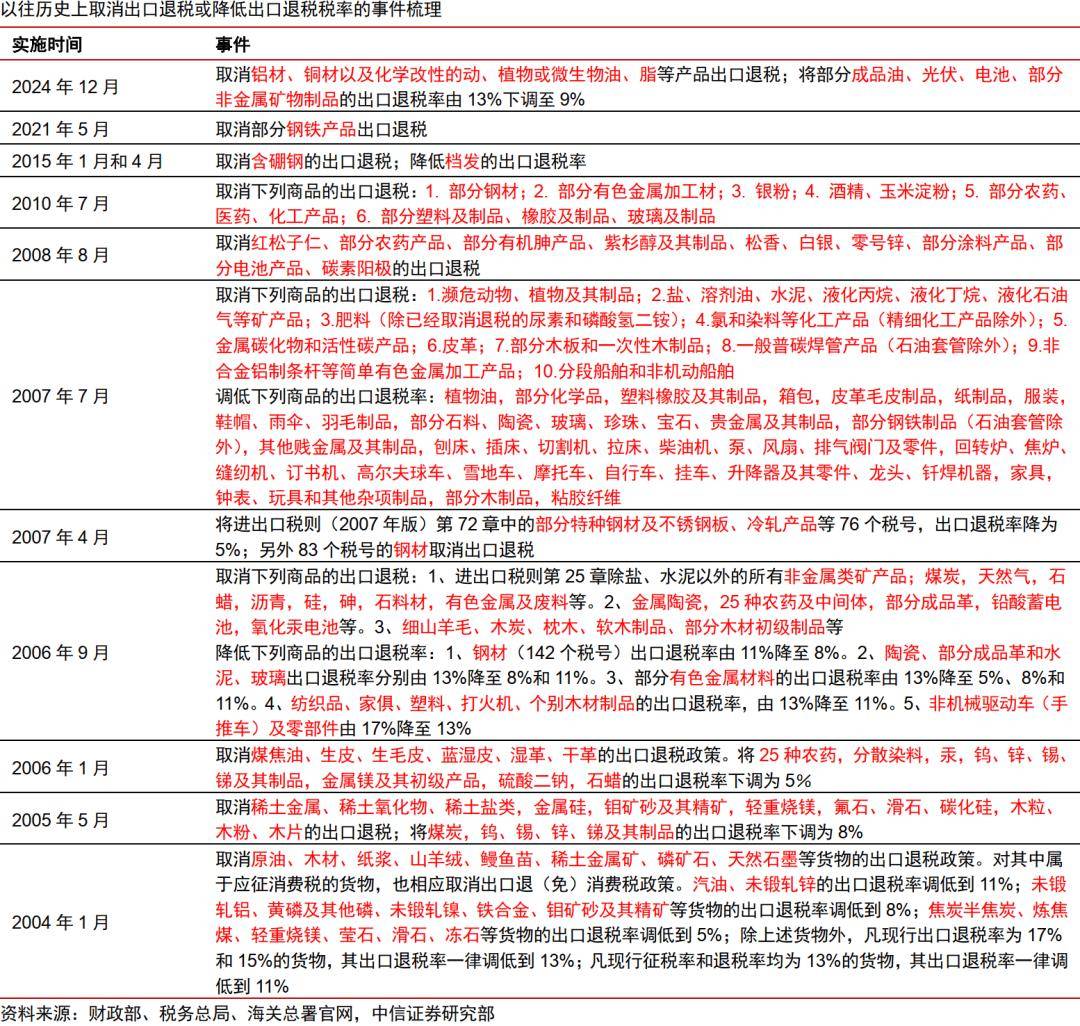
Macro - The Ministry of Finance and the State Taxation Administration announced adjustments to export tax rebate policies for photovoltaic and battery products on January 9, aimed at reducing trade friction and supporting industrial upgrades, which may bolster export growth for related products in Q1 2026 [1][6] - The PPI in December 2025 slightly exceeded market expectations, while the CPI has shown a continuous recovery for four months, reaching +0.8% year-on-year, with core CPI remaining at a high of +1.2%, aligning with market expectations [1][9] Battery Industry - The adjustment of export tax rebate policies for battery products is seen as a measure to prevent "involution" and enhance the profitability of export products, with a structured decline in tax rates and a transition period [2][11] - The tax rebate for battery products will decrease from 9% to 6% starting April 1, 2026, and will be eliminated entirely from January 1, 2027, affecting lithium-ion batteries and nickel-hydrogen batteries [11][12] - The estimated impact on export tax rebates is approximately $22 million for 2026 and $66 million for 2027, with the potential for a "rush to export" scenario due to the structured decline in tax rates [12][13] - The policy is expected to favor Chinese battery companies with overseas production capacity, enhancing their global competitiveness and market share [2][12][13] Trade Policy - Mexico's recent tariff adjustments are primarily aimed at countries like China and South Korea, affecting about 45% of China's exports to Mexico, which could impact overall Chinese exports by approximately 1% [3][4] - The tariff adjustments are interpreted as a gesture towards the U.S., indicating potential follow-up actions from other developed economies, particularly Canada, in response to U.S. trade policy [4][5]
山金期货黑色板块日报-20260112
Shan Jin Qi Huo· 2026-01-12 01:27
投资咨询系列报告 山金期货黑色板块日报 一、螺纹、热卷 更新时间:2026年01月12日08时26分 报告导读: 供需方面,上周的数据显示螺纹产量回升,整体库存继续回落,螺纹表观需求有所下降,五大品种表观需求整体回落,库存增加,产量小幅回升。 由于钢厂毛利大幅回落,且市场整体处于消费淡季,钢厂产量仍有可能延续下降的趋势 。整体来看,在消费淡季,供需双弱,冬储仍需要一段时间 才能到来,股市强势上攻以及政策面的乐观预期提振信心 , 但市场监管总局约谈光伏协会及相关企业导致对 "反内卷"预期有所回落,对市场情绪有 一定影响。 操作建议: 多单继续持有,中线交易。不可以追涨杀跌 表1:螺纹、热卷相关数据 | 表2:铁矿石相关数据 | 数据类别 | 指标 | 单位 | 最新 | 较上日 | 较上周 | | | | | | | | | | | | | | | | | | | | | | | | | --- | --- | --- | --- | --- | --- | --- | --- | --- | --- | --- | --- | --- | --- | --- | --- | --- | --- | --- | ...