
利率下行

Search documents
债券研究周报:贸易摩擦与利率机会-20251013
Guohai Securities· 2025-10-13 13:50
1. Report Industry Investment Rating No relevant content provided. 2. Core Views of the Report - After the holiday, the bond market strengthened. With the recent escalation of Sino - US trade frictions, on October 11, interest rates declined, and the long - term bond yields of 10Y and 30Y national bonds fell below 1.75% and 2.10% respectively, increasing the market's long - buying expectations [5][11]. - In the case of tariff war escalation, interest - rate bonds are more cost - effective overall, followed by perpetual secondary bonds. The impact of tariff shocks on the bond market is mostly one - time, presenting mainly trading opportunities. If priced within 2 trading days, the overall benefit is within 5bp [5][11]. - Recent institutional behaviors support a wave of long - buying opportunities for interest rates. Banks are continuously buying bonds on the left side, funds have emptied their ultra - long bond positions, and securities firms are closing their positions, all of which are positive for the bond market [5][12]. - Large banks are extending the duration of their bond investments. Their increased buying of 7 - 10Y national bonds since the end of September reduces the upward space for interest rates [5][12]. - Compared with the tariff shock in April, the current funds are looser. The long - short term spread has opened up the downward space for interest rates. If the central bank's trading of national bonds is implemented, the interest - rate center may decline overall [5][13]. 3. Summary According to Relevant Catalogs 3.1 Trade Frictions and Interest - Rate Opportunities 3.1.1 Opportunities in Interest Rates under Tariff War Escalation - In the tariff war escalation scenario, from an odds perspective, interest - rate bonds are more cost - effective, followed by perpetual secondary bonds. The impact of tariff shocks on the bond market is mainly trading - oriented, and if priced within 2 trading days, the benefit is within 5bp [5][11]. - Institutional behaviors support long - buying opportunities for interest rates. Banks are buying on the left side, funds have "nothing left to sell", and securities firms are closing positions [5][12]. - Large banks are extending the duration of their bond investments, reducing the upward space for interest rates. The current funds are looser, and the long - short term spread has opened up the downward space for interest rates [5][12][13]. 3.1.2 Yield Curve - Compared with September 26, as of October 10, the yields of national bonds and China Development Bank bonds declined overall. For national bonds, the 1Y - 15Y yields mostly declined, while the 30Y yield rose. For China Development Bank bonds, the 1Y - 10Y yields mostly declined, and the 15Y and 30Y yields rose [14][15][16]. 3.1.3 Term Spread - Compared with September 26, as of October 10, the spreads of national bonds (1Y - DR001, 1Y - DR007) increased, and the spreads of China Development Bank bonds showed a differentiated trend. The short - term term spread narrowed, and the long - term spread widened [17]. 3.2 Bond Market Leverage and Funding Situation 3.2.1 Leverage Ratio - From September 29 to October 10, the leverage ratio fluctuated and declined. As of October 10, it dropped to 107.07% [19]. 3.2.2 Repurchase Transaction Volume - From September 29 to October 10, the average daily trading volume of pledged repurchase was 6.3 trillion yuan, with an average daily overnight trading volume accounting for 68.96%. Compared with the week from September 22 to September 26, both the overall volume and the overnight volume decreased [23][24]. 3.2.3 Funding Situation - From September 29 to October 10, the funds lent by banks first decreased and then increased. The net lending of large and policy banks on October 10 was 4.6 trillion yuan, and the net borrowing of joint - stock, city, and rural commercial banks was 0.95 trillion yuan. The main borrowing party was securities firms, and the lending of money market funds fluctuated and increased. DR007 and R007 declined, and 1YFR007 and 5YFR007 first decreased and then increased [27]. 3.3 Duration of Medium - and Long - Term Bond Funds 3.3.1 Median Duration of Bond Funds (Including Leverage) - As of October 10, the median duration of medium - and long - term bond funds (including leverage) dropped to 2.66 years, and the median duration (excluding leverage) was 2.60 years. Both were lower than those on September 26 [40][41]. 3.3.2 Median Duration of Interest - Rate Bond Funds (Including Leverage) - As of October 10, the median duration of interest - rate bond funds (including leverage) dropped to 3.48 years, and the median duration of credit bond funds (including leverage) dropped to 2.39 years. The median durations (excluding leverage) of interest - rate and credit bond funds also decreased compared with September 26 [46]. 3.4 Comparison of Generic Strategies 3.4.1 Sino - US Interest - Rate Spread - As of October 10, the Sino - US interest - rate spread showed a narrowing trend, and the inversion of the spread between the 10Y Chinese national bond and the 10Y US national bond improved [49]. 3.4.2 Implied Tax Rate - As of October 10, the implied tax rate (the spread between China Development Bank bonds and national bonds) generally widened, and the spread between the 10Y China Development Bank bond and the 10Y national bond rose to 19bp [50]. 3.5 Changes in Bond Lending Balances - As of October 10, the bond lending balance of the 10Y national bond 250011.IB recovered, and the bond lending balance of the 30Y national bond 2500002.IB maintained a volatile trend [51].
悲观者聪明而乐观者赚钱!高盛交易员:AI争论还要好几个季度才能出结果,别跟资本开支对着干
Hua Er Jie Jian Wen· 2025-10-07 11:57
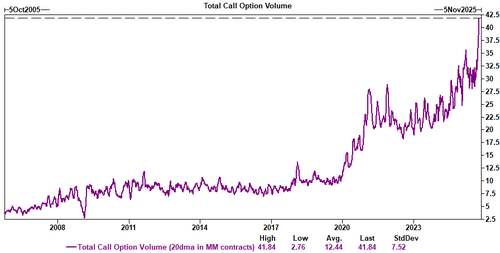
Core Viewpoint - The article emphasizes the importance of maintaining optimism in the market despite signs of bubbles, particularly driven by significant capital expenditures related to AI. It suggests that understanding the long-term narrative of AI and ignoring short-term noise is crucial for investors [1]. Group 1: Market Trends - The U.S. stock market has shown remarkable resilience, with the S&P 500 and Nasdaq indices trading above their 50-day moving averages for over 100 consecutive days, reaching new historical highs [1]. - Retail investors have been net buyers for 21 out of the last 24 weeks, and ETFs have seen net inflows for 183 out of the last 185 trading days, indicating strong market enthusiasm [1]. - The "most shorted" and "unprofitable tech stocks" have experienced rapid gains, alongside sectors like nuclear energy, quantum computing, drones, and artificial intelligence [3]. Group 2: Capital Expenditure and AI - A report predicts that capital expenditures by "hyperscale computing companies" will reach $2.8 trillion by 2029, with total global related capital expenditures amounting to $5.5 trillion during the same period [7]. - The article argues that the substantial capital inflow related to AI is a powerful trend that cannot be easily countered, suggesting that premature bearishness could be detrimental for investors [7]. Group 3: Key Market Drivers - Three main drivers supporting the market are identified: declining interest rates, corporate profits, and employment dynamics [8]. - The expectation of lower U.S. interest rates is seen as a likely scenario, which would provide additional support to capital markets [8]. - AI is expected to enhance corporate profit margins either by directly reducing costs through efficiency or by compelling companies to improve productivity to showcase their AI investments [8]. Group 4: Market Sentiment and Indicators - Current market sentiment indicators are at extreme levels, with daily trading volumes of call options reaching an average of 40 million contracts, double the volume from three years ago [9]. - Despite the S&P 500 and Nasdaq reaching historical highs, a significant percentage of their constituent stocks have declined, indicating a divergence in market performance [9]. - Technology and tech-related stocks now account for 56% of the total market capitalization in the U.S., while defensive stocks have dropped to 16%, the lowest recorded level [10]. Group 5: Currency Valuation and Asset Performance - The current bull market reflects a "devaluation trade" of fiat currency, with the Nasdaq index rising 165% and the S&P 500 index rising 102% when measured in U.S. dollars since the pandemic [11]. - However, when measured in gold, the Nasdaq index has only increased by 7%, and the S&P 500 has decreased by 18%, highlighting the importance of the currency used for asset valuation [11]. - This suggests that non-dollar-denominated assets, such as Bitcoin and gold, have seen faster appreciation, emphasizing the need for investors to consider the currency in which they evaluate asset returns [11].


现在小盘股也不便宜了
Guo Ji Jin Rong Bao· 2025-09-29 12:01
Group 1 - The small-cap stock bubble is raising alarms as they have outperformed large-cap stocks in Q3 2025, driven by a rally in technology stocks [1][2] - The Russell 2000 index has seen a gain of over 10% as of September 29, 2025, surpassing the S&P 500's approximately 7% increase [2][4] - Small-cap stocks have historically performed best during periods of Federal Reserve easing and economic recovery, but their recent performance contrasts sharply with earlier in the year [4] Group 2 - The technology sector, particularly semiconductors, has led the recent surge in small-cap stocks, with notable performers like Astera and Credo seeing gains of over 100% and 60% respectively in Q3 [5][10] - Despite the strong performance, concerns arise as the rebound is driven by a limited number of growth and tech stocks, leading to questions about overall value [11] - The forward P/E ratio for the iShares Russell 2000 ETF has reached 24.64, indicating that small-cap stocks may no longer offer the value they once did [11][12] Group 3 - The iShares Russell 2000 Growth ETF has an alarming forward P/E ratio of 36.38, suggesting a bubble similar to large-cap tech stocks [12] - Some small-cap stocks, like Oklo, have seen significant price increases without generating any revenue, raising further concerns about valuation sustainability [12] - Defensive sectors such as consumer staples and healthcare are recommended for small-cap investments, as cyclical sectors may struggle without substantial interest rate cuts [14]
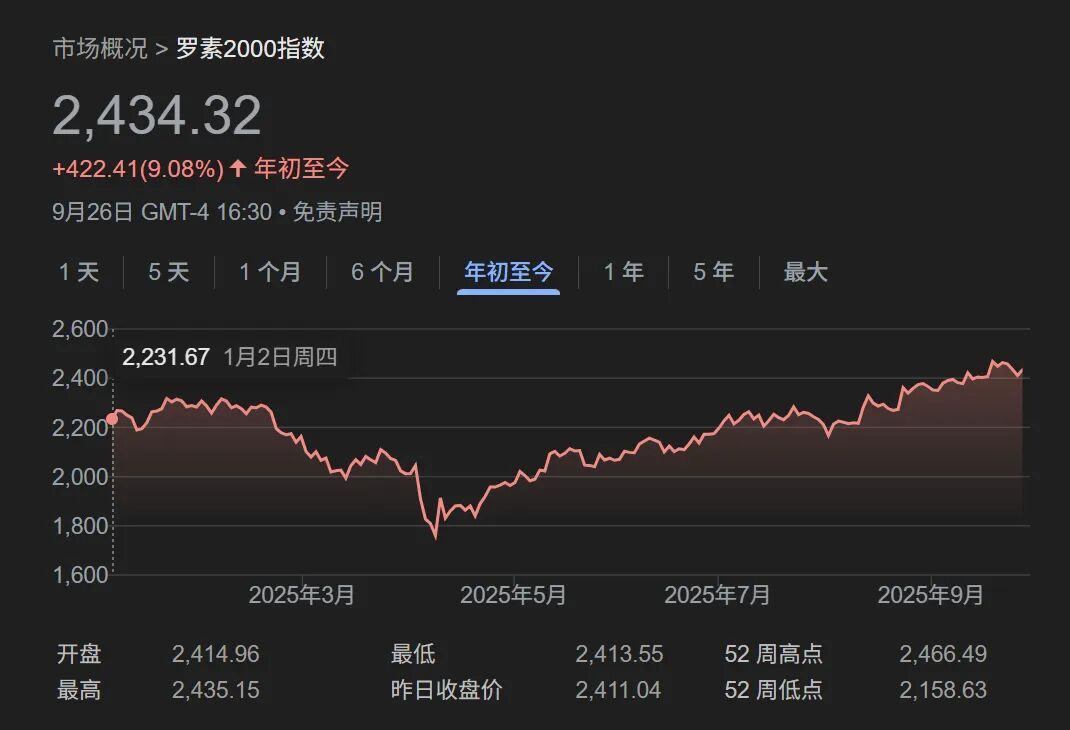
前8月保险业原保险保费收入4.8万亿元,人身险保费增长11.3%
Huan Qiu Wang· 2025-09-28 05:22
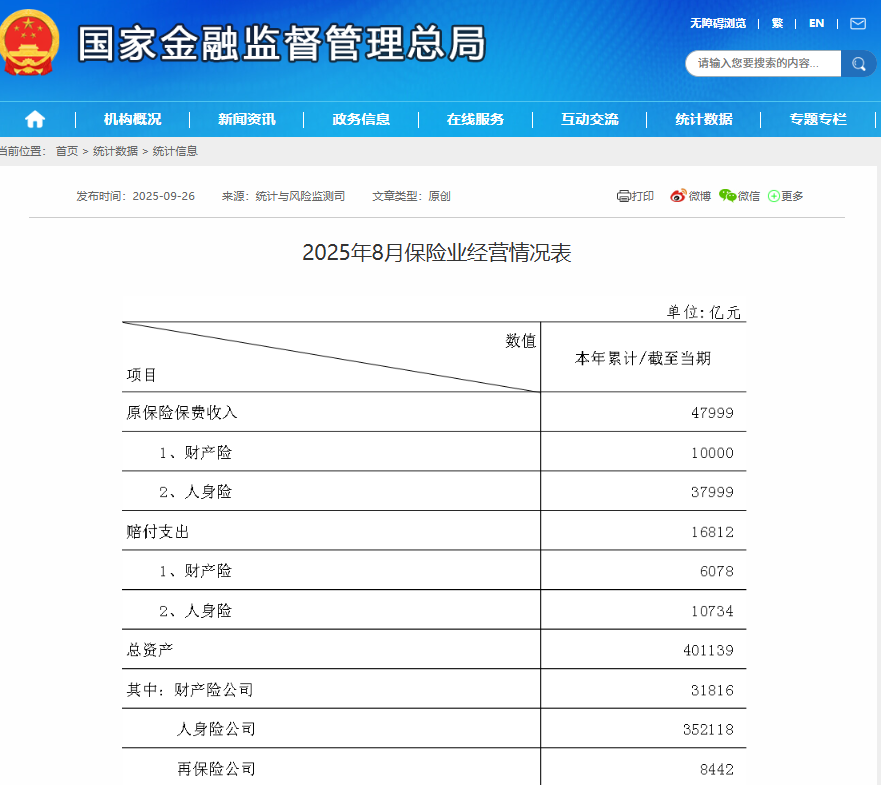
Group 1 - The core viewpoint of the article highlights the growth in China's insurance industry, with a total original insurance premium income of 4.8 trillion yuan, representing a year-on-year increase of 9.63% in the first eight months of the year [1][2] - Property insurance premium income reached 1 trillion yuan, showing a year-on-year growth of 3.65%, while life insurance premium income was 3.8 trillion yuan, with a significant year-on-year increase of 11.32% [1][2] - The total assets of the insurance industry amounted to 401.139 billion yuan, with life insurance companies holding 352.118 billion yuan and property insurance companies holding 31.816 billion yuan [2] Group 2 - Life insurance premium income specifically saw a rise of 14.05% year-on-year, totaling 2.97 trillion yuan, while new policyholder investment contributions remained stable at 458.8 billion yuan [2][3] - The insurance product structure is undergoing adjustments, with a notable increase in the proportion of participating insurance products due to the continuous decline in preset interest rates [3] - In the first quarter, over 170 new life insurance products were launched, with nearly 40% being participating and universal life insurance, indicating a shift towards more flexible and potentially higher-yielding products [3]
国债ETF5至10年,让安全感与财富温柔相守
Sou Hu Cai Jing· 2025-09-18 01:47
Core Viewpoint - The article discusses the recent movements in bond yields, particularly focusing on the impact of anticipated interest rate cuts by central banks, including the Federal Reserve and the Reserve Bank of New Zealand, on the bond market and related ETFs [1][2]. Interest Rate Movements - New Zealand's 2-year government bond yield has decreased by 10 basis points due to expectations of a rate cut by the Reserve Bank of New Zealand, with forecasts suggesting a drop to 2.5% in October and 2.25% in November [1]. - The U.S. 10-year Treasury yield fell from 4.04% to below 4.01%, while gold prices fluctuated between $3696.67 and $3654.44 [1]. - The Federal Reserve announced a 25 basis point rate cut, bringing the federal funds rate target range to 4.00%-4.25% [2]. Bond Market Performance - The 10-year government bond yield is approaching 1.75%, with a recent decline of approximately 7 basis points [3]. - The China Government Bond ETF (511020) for 5-10 years has seen a 0.24% increase, with a recent price of 116.99 yuan, and a weekly increase of 0.39% [4]. Fund Flows and Size - The China Government Bond ETF (511020) has reached a size of 1.509 billion yuan, marking a six-month high, with net inflows remaining balanced recently [5]. - Over the past five years, the ETF has recorded a net value increase of 21.44% [5]. Historical Performance Metrics - The ETF has a maximum drawdown of 1.09% over the past six months, with a historical profitability rate of 100% over three years [6][5]. - The ETF's management fee is 0.15%, and the custody fee is 0.05% [7]. Tracking Accuracy - The ETF closely tracks the China 5-10 Year Government Bond Active Index, with a tracking error of 0.038% over the past month [8].
宝城期货资讯早班车-20250917
Bao Cheng Qi Huo· 2025-09-17 01:53
1. Industry Investment Rating No industry investment rating information is provided in the report. 2. Core Viewpoints - The commodity futures market has seen significant capital inflows due to positive domestic fundamentals and increased trading themes, with the total capital amount reaching a record high of 4736.5 billion yuan on September 16 [2]. - The precious metals market is in a bull - run, potentially accelerating due to factors such as expectations of a Fed policy shift, increased避险 demand, and supply - demand imbalances [4][5]. - The bond market is affected by multiple factors, with short - term fluctuations and a possible gradual recovery in an oscillatory manner. Long - term bond yields may decline more smoothly in the latter half of the fourth quarter [25]. 3. Summary by Directory 3.1 Macro Data - GDP in the second quarter of 2025 had a year - on - year growth rate of 5.2%, slightly lower than the previous quarter but higher than the same period last year [1]. - In August 2025, the manufacturing PMI was 49.4%, slightly up from the previous month; the non - manufacturing PMI for business activities was 50.3%, also slightly up [1]. - In August 2025, the year - on - year growth rates of M0, M1, and M2 were 11.7%, 6.0%, and 8.8% respectively. The financial institution's RMB loan increased by 590 billion yuan in the month [1]. - In August 2025, CPI decreased by 0.4% year - on - year, and PPI decreased by 2.9% year - on - year [1]. - In August 2025, the cumulative year - on - year growth rate of fixed - asset investment (excluding rural households) was 0.5%, and that of total retail sales of consumer goods was 4.64% [1]. - In August 2025, the year - on - year growth rates of export and import values were 4.4% and 1.3% respectively [1]. 3.2 Commodity Investment 3.2.1 Comprehensive - Nine departments including the Ministry of Commerce issued policies to expand service consumption, proposing 19 measures in five aspects [2]. - On September 16, the total capital in the commodity futures market reached a record high of 4736.5 billion yuan, with 11 varieties having over 10 billion yuan in capital, and the capital in Shanghai gold futures reaching 106 billion yuan [2]. 3.2.2 Metals - On September 16, COMEX gold futures reached a new high, and Shanghai gold futures had a cumulative increase of 7.37% since September. Silver prices also continued to rise [4][5]. - On September 15, zinc, copper, and aluminum inventories decreased, while lead and nickel inventories increased. Tin, aluminum alloy, and cobalt inventories remained stable [5]. - As of September 16, the position of SPDR Gold Trust increased by 0.32% (3.15 tons) to 979.95 tons [5]. 3.2.3 Coal, Coke, Steel, and Minerals - The US government is discussing setting up a $5 billion mining investment fund, and plans to expand the strategic uranium reserve [6]. 3.2.4 Energy and Chemicals - On September 16, international oil prices rose due to geopolitical conflicts and a larger - than - expected decline in US crude oil inventories [7]. - Two wells in Sinopec's Ziyang shale gas field in the Sichuan Basin set a new record for shale gas production, with one well having a daily output of 1.407 million cubic meters [7]. - OPEC + representatives will discuss production capacity this week, and the EU is about to propose the 19th round of sanctions targeting cryptocurrencies, banks, and energy [7][8]. 3.2.5 Agricultural Products - On September 18, 15,000 tons of central reserve frozen pork will be put up for auction [9]. - During the 14th Five - Year Plan period, China's grain output exceeded 1.4 trillion catties in 2024, and the high - standard farmland area exceeded 1 billion mu. The agricultural science and technology progress contribution rate reached 63.2% [9]. - Coffee futures prices rose due to concerns about drought in Brazil, and the price of Arabica coffee beans reached $4.21 per pound [9]. 3.3 Financial News 3.3.1 Open Market - On September 16, the central bank conducted 287 billion yuan of 7 - day reverse repurchase operations, with a net investment of 40 billion yuan [11]. 3.3.2 Important News - Nine departments including the Ministry of Commerce issued policies to expand service consumption [12]. - The central bank governor proposed to adjust the share ratio of the International Monetary Fund [12]. - The so - called "cancellation of the overseas individual housing purchase limit" is a misinterpretation [13]. - The CSRC is soliciting opinions on the regulations for the management of public offering fund sales fees, which may affect short - term bond funds [13]. - Some local governments are accelerating the resolution of implicit debts, and 82 districts and counties have completed the zero - clearing of implicit debts [14]. - The Beijing Financial Court has explored a dispute - resolution model to help enterprises in debt crises [14]. - The Fed is expected to restart the interest - rate cut process, but there are internal differences [15]. - The World Bank issued $1.75 billion of sustainable development bonds [16]. - Alibaba issued $3.2 billion of zero - coupon convertible preferred notes [16]. - Tencent issued bonds worth about 9 billion yuan [16]. 3.3.3 Bond Market Summary - The bond market first declined and then rose. The yield of the 30 - year treasury bond "25 Super Long Special Treasury Bond 02" decreased by 1.5bp [18]. - The CSI Convertible Bond Index decreased by 0.18%, and the Wind Convertible Bond Equal - Weighted Index increased by 0.18% [19]. - Most money market interest rates and bond - related rates increased [19][20]. - European bond yields rose, and US bond yields fell [21][22]. 3.3.4 Foreign Exchange Market - The on - shore RMB against the US dollar rose by 65 points, and the RMB central parity rate against the US dollar was raised by 29 points [23]. - The US dollar index fell by 0.73%, and most non - US currencies rose [23]. 3.3.5 Research Report Highlights - Yangtze River Fixed Income believes that the timing for restarting treasury bond trading may be approaching [24]. - CITIC Securities believes that the scale of bank wealth management has continued to grow, and the new regulations on fund redemption fees may change the investment logic of wealth management funds [24]. - Guosheng Fixed Income believes that the bond market may recover gradually in an oscillatory manner [25]. - Guoxin Fixed Income suggests paying attention to structural opportunities in the equity market and individual convertible bonds [26]. - Huatai Fixed Income believes that the bond market may take a short - term break [26]. - CITIC Construction Investment believes that the economic data in August is generally stable but still under pressure [26]. 3.4 Stock Market - A - share indices fluctuated and closed higher, with robot concept stocks leading the rise and rare earth, breeding, and insurance stocks falling [29]. - The Hong Kong Hang Seng Index fell slightly, with robot concept stocks performing strongly and pharmaceutical stocks generally falling [29].
非银存款环比少增加近万亿元,居民入市脚步在放缓?
Hua Xia Shi Bao· 2025-09-17 01:38
Core Insights - The article discusses the trend of residents' deposits decreasing while non-bank deposits are increasing, indicating a shift of funds towards financial products and capital markets [2][3] - In August, despite a strong A-share market, the growth of non-bank deposits slowed down, raising questions about the sustainability of this trend [2][4] Group 1: Deposit Trends - In July, residents' deposits decreased by 1.1 trillion yuan, while non-bank deposits increased by 2.14 trillion yuan, indicating a significant shift of funds [2] - In August, non-bank deposits increased by 1.18 trillion yuan, which is a year-on-year increase of 0.55 trillion yuan but a month-on-month decrease of nearly 1 trillion yuan [2][4] - The trend of residents moving deposits to non-bank financial institutions is continuing but at a slower pace, suggesting potential changes in investor behavior [2][5] Group 2: Market Performance - The A-share market saw a rise from 3,562 points on August 1 to 3,871 points on August 26, leading many to believe that the market had entered a bull phase [3] - Despite the bullish market, the slowdown in non-bank deposit growth raises questions about investor confidence and potential profit-taking behavior [5][6] Group 3: Financial Products and Investment Behavior - The scale of bank wealth management products remained stable, with a slight increase in August, indicating continued interest in these investment vehicles [4][5] - The majority of bank wealth management investments are still in bonds, which have experienced volatility, yet there remains a preference for stable investment products among residents [5][6] - The overall trend of decreasing deposit rates is expected to continue, which may further encourage the movement of funds into the stock market over the long term [6]

全球经济进入“低增长时代”:普通人该如何守住财富?
Sou Hu Cai Jing· 2025-09-15 01:48
Group 1 - Global economic growth is slowing down, entering a "low growth era" due to factors like aging population, de-globalization, and restructuring of international supply chains [2][9] - Traditional wealth accumulation methods, such as real estate investment, are losing effectiveness, with stagnant property prices in many cities [5][8] - The stock market is experiencing structural differentiation, making it difficult for investors to achieve significant returns [5][6] Group 2 - A new wealth preservation logic is emerging, emphasizing cash flow management, diversified asset allocation, and a global investment perspective [6][9] - There is a growing need for individuals to acquire professional knowledge and rational planning to navigate the changing investment landscape [8][9] - The focus is shifting from wealth accumulation to wealth protection, ensuring that assets can keep pace with inflation [8][9]

2025年,财富分化加速:穷人拼命存钱,富人悄悄在配置
Sou Hu Cai Jing· 2025-09-12 08:19
Group 1 - The core observation is the growing wealth gap between ordinary people who prefer saving money in banks and the wealthy who diversify their assets into stocks, gold, overseas funds, and emerging assets [1][12] - Saving money has become a form of "chronic depreciation" due to continuously declining interest rates, making it less effective as a stable investment strategy [3][4] - The wealthy focus on making their money work for them, emphasizing asset liquidity and diversification, which allows them to thrive amid market fluctuations [5][6] Group 2 - The difference between the rich and the poor is not merely the amount of capital but rather their mindset and cognitive approach to wealth [8][9] - Ordinary individuals are encouraged to change their thinking to seize opportunities, such as not solely relying on savings and understanding the balance of risk and reward [10] - Practical steps for ordinary people include diversifying investments, maintaining liquidity, adopting a long-term perspective, and considering allocations in gold or overseas assets [10]

中金:全球政府债务持续扩张背景下的国债曲线牛陡化趋势
智通财经网· 2025-09-07 02:13
Group 1 - Concerns regarding sovereign debt risks in major developed economies are rising, driven by increased government spending and fiscal expansions in the US, Europe, and the UK [2][3] - The yield curves of major economies are steepening due to long-term concerns about sovereign debt, reflecting higher credit risk premiums [3] - Global debt leverage is likely to decline, which may constrain future economic growth and point towards a downward trend in interest rates [4] Group 2 - The potential for gradual interest rate cuts by the Federal Reserve may open up further space for monetary policy easing by the People's Bank of China [5] - A decrease in short-term interest rates could lead to a corresponding decline in medium to long-term rates, potentially steepening the yield curve [5][6] - The supply of government bonds is expected to decrease in the coming months, which may also contribute to a decline in long-term interest rates [5]