
降息预期

Search documents
贵金属有色金属产业日报-20251119
Dong Ya Qi Huo· 2025-11-19 09:22
1. Report Industry Investment Rating No relevant content provided. 2. Core Views of the Report - In the precious metals market, although central bank gold purchases and growing investment demand will push up the price center of precious metals in the long - term, short - term macro uncertainties about December interest rate cuts may lead to continued volatile adjustments. It is recommended to pay attention to the retracement of the 60 - day moving average [3]. - In the copper market, concerns about non - farm data affecting interest rate cuts have led to capital reduction and price drops. Inventory increases and narrowing premiums reflect fundamental pressures, with limited short - term repair space [17]. - In the aluminum market, Shanghai aluminum is expected to maintain a long - term oscillatory upward trend, but short - term weak fundamentals and a lower probability of December interest rate cuts may lead to profit - taking by previous funds, resulting in subsequent oscillatory consolidation. Alumina is in an oversupply situation, and the expiration of a large number of warehouse receipts will exacerbate the imbalance between supply and demand [36]. - In the zinc market, the cooling of interest rate cut expectations and a significant drop in November TC due to intense competition for ore in the smelting sector have increased the willingness of smelters to reduce or halt production in November. There is a possibility of inventory reduction, and there are significant differences between bulls and bears [59]. - In the nickel and stainless - steel market, nickel - iron prices have been declining due to weak downstream demand. The downside space for nickel and stainless - steel is greater than the upside space. Stainless - steel spot sales face pressure, and downstream demand remains weak [75]. - In the tin market, due to limited resumption of production in Wabang, refined tin concentrate imports have sharply decreased, and supply is weaker than demand. Shanghai tin is expected to maintain high - level oscillations, with support around 276,000 yuan [88]. - In the lithium carbonate market, strong demand from the new energy vehicle and energy storage sectors, combined with a slowdown in supply growth, may lead to a short - term strong and oscillatory trend in lithium prices, but position fluctuations should be watched out for [104]. - In the silicon industry chain, the supply - demand pattern of industrial silicon is generally weak, with wide - range oscillations. The polysilicon industry chain is experiencing production cuts and inventory accumulation, with a weak fundamental outlook and wide - range, weak oscillations [116]. 3. Summary by Relevant Catalogs Precious Metals - **Price Outlook**: In the short term, due to unclear prospects of December interest rate cuts, precious metals may continue to oscillate and adjust. In the long term, central bank gold purchases and growing investment demand will push up prices [3]. - **Price Charts**: Include SHFE gold and silver futures main - continuous prices, COMEX gold prices and gold - silver ratios, SHFE and SGX gold and silver futures - spot price differences, gold and US Treasury real interest rates, gold long - term fund holdings, and SHFE and COMEX gold and silver inventories [4][12][16]. Copper - **Price Outlook**: Market concerns about non - farm data and inventory increases have led to price drops, with limited short - term repair space [17]. - **Price Data**: Spot prices from various sources (Shanghai Non - ferrous, Shanghai Wumaoyi, etc.) have small daily increases. Futures prices of Shanghai copper and London copper show different trends, with Shanghai copper rising and London copper falling [22][23]. - **Inventory Data**: Shanghai copper warehouse receipts and LME copper inventories show different changes, with some warehouse receipts decreasing and LME copper inventories increasing [32][34]. Aluminum - **Price Outlook**: Shanghai aluminum may oscillate and consolidate in the short term, while alumina is in an oversupply situation [36]. - **Price Data**: Aluminum and alumina futures and spot prices show different trends, with some rising and some falling [38][45]. - **Inventory Data**: Shanghai aluminum and LME aluminum inventories show different changes, and alumina warehouse receipts increase slightly [53]. Zinc - **Price Outlook**: Cooling interest rate cut expectations and a drop in November TC have increased the willingness of smelters to cut production. There is a possibility of inventory reduction, and there are significant differences between bulls and bears [59]. - **Price Data**: Shanghai zinc and LME zinc prices show different trends, with Shanghai zinc rising and LME zinc falling slightly [60]. - **Inventory Data**: Shanghai zinc warehouse receipts decrease, and LME zinc inventories increase [72]. Nickel and Stainless - Steel - **Price Outlook**: Nickel - iron prices decline due to weak downstream demand, and the downside space for nickel and stainless - steel is greater than the upside space. Stainless - steel spot sales face pressure [75]. - **Price Data**: Nickel and stainless - steel futures prices show different trends, with some rising and some falling [76]. - **Inventory Data**: Nickel warehouse receipts decrease [76]. Tin - **Price Outlook**: Due to limited resumption of production in Wabang, refined tin concentrate imports have sharply decreased, and supply is weaker than demand. Shanghai tin is expected to maintain high - level oscillations [88]. - **Price Data**: Shanghai tin and London tin futures prices show different trends, with Shanghai tin rising and London tin falling slightly [89]. - **Inventory Data**: Shanghai tin warehouse receipts decrease, and LME tin inventories remain unchanged [99]. Lithium Carbonate - **Price Outlook**: Strong demand and slow supply growth may lead to a short - term strong and oscillatory trend in lithium prices, but position fluctuations should be watched out for [104]. - **Price Data**: Lithium carbonate futures and spot prices show an upward trend [105][109]. - **Inventory Data**: Guangzhou Futures Exchange warehouse receipts increase slightly, and social and downstream inventories decrease [114]. Silicon Industry Chain - **Price Outlook**: The supply - demand pattern of industrial silicon is generally weak, with wide - range oscillations. The polysilicon industry chain is experiencing production cuts and inventory accumulation, with a weak fundamental outlook [116]. - **Price Data**: Industrial silicon and polysilicon - related product prices show different trends, with some remaining stable and some changing slightly [116]. - **Inventory Data**: Industrial silicon social inventory and polysilicon total inventory show different trends [134][143].
AvaTrade爱华每日市场报告 2025年11月19日
Sou Hu Cai Jing· 2025-11-19 09:12
AvaTrade爱华每日市场报告:周二,全球金融市场被浓厚的避险情绪所笼罩。对科技股与人工智能领域 估值过高的担忧成为市场主线,叠加投资者对美联储推迟降息的预期升温,导致全球主要股指普遍承 压。美国三大股指全线收跌,欧洲与亚洲市场也紧随其后,唯有小盘股代表罗素2000指数逆势微涨,暗 示市场内部可能出现轮动迹象。与此同时,美元走强与国债收益率的波动,共同勾勒出一幅投资者在不 确定性中转向防御的图景。 1. 前一天摘要 – 2025年11月18日,星期二 美国主要指数 美国股市于 11月18日星期二 收低,广泛避险情绪笼罩市场。随着科技和人工智能估值高企,尤其是英 伟达等大型股价,卖压加剧,这些股价支撑着主要指数。人们对美联储可能下调进一步降息预期的担忧 加深,这削弱了投资者的乐观情绪。标普500指数再次下跌,连续第四天下跌。道琼斯指数下跌1%,受 包括家得宝、亚马逊和Microsoft在内的股东拖累。纳斯达克综合指数下跌,受大型股科技股广泛疲软影 响。罗素2000指数逆势而上,收盘为绿色,暗示股将转向小市值股。主要驱动因素包括AI股票高估担 忧、降息希望减弱以及全球股市回调。 波动率与收益率 • VIX:±1 ...



分析人士:市场围绕降息预期展开博弈
Qi Huo Ri Bao· 2025-11-19 08:36
本周金银价格重心继续下移,周二,国际金价围绕4000美元/盎司震荡,国际白银价格重心已经下破50 美元/盎司关口。 东证衍生品研究院贵金属研究员徐颖表示,贵金属价格在上周五便开始回调,主要受近期美联储多位官 员发表"鹰派"讲话影响,市场对12月的降息预期明显"降温",货币政策短期缺乏增量刺激,流动性尚未 快速释放。另外,随着美国政府重新"开门",关税问题出现边际缓和迹象,美国对瑞士关税从39%下调 至15%,市场避险情绪下降,也对贵金属价格不利。 "如果本周公布的9月非农数据表现较好,下月初公布的11月非农数据也保持韧性,那么美联储确实有暂 停一次降息的空间,后续市场或将进一步交易'鹰派'预期,推动美债利率和美元反弹,并施压金银价 格;反之,如果任意一次月度新增就业意外转负,降息预期可能迅速回升,引发金银价格迅速反弹。" 吴梓杰分析表示。 值得注意的是,近几日美联储多位官员对12月降息持谨慎或反对的态度。究其原因,中信建投期货贵金 属分析师王彦青表示,主要在于美国通胀仍处于高位,且无明确证据表明通胀正回到2%的目标水平。 此外,近期美国政府"停摆"导致的经济数据缺失亦是美联储官员谨慎态度的来源,在缺失决策依据 ...
AvaTrade爱华中文官网:川普嫌鲍威尔愚蠢 原油闻声走高
Sou Hu Cai Jing· 2025-11-19 08:26
Group 1 - President Trump criticized Federal Reserve Chairman Powell, expressing a desire to replace him due to dissatisfaction with interest rate policies [1] - Market reacted positively to the prospect of a more dovish successor, with WTI crude oil prices rising over $1 to $60.92 [1] - The S&P 500 index fell for the fourth consecutive day, reflecting increased selling pressure amid concerns over high valuations in technology and AI stocks [3][4] Group 2 - Major global stock markets continued to decline, driven by investor caution over high valuations and tightening financial conditions [5] - The VIX index increased by 10.32% to 24.69, indicating heightened market volatility [8] - Home Depot's stock dropped 6% after reporting weak Q3 earnings and lowering its full-year profit outlook [8]

机构看金市:11月19日
Sou Hu Cai Jing· 2025-11-19 04:16
转自:新华财经 •宝城期货:市场降息预期下降 贵金属短期下挫 •金瑞期货:金银价格的长期核心驱动因素仍保持稳健 国投期货表示,美国官方数据缺失阶段,ADP发布最新数据显示截至11月1日的四周内,美国企业平均 每周减少约2500个就业岗位。近期美联储多位官员发言偏鹰压制降息预期,市场继续权衡经济和货币政 策前景。贵金属高位震荡,耐心等待新驱动以及技术面的方向性指引。 澳新银行表示,市场对美联储12月再次降息的预期已从9月决议后的近100%高位骤降至42%,这抑制了 投资者对黄金的投资兴趣。不过,地缘政治不确定性、对美国债务可持续性的担忧、去美元化趋势以及 央行购金等结构性利好因素,预计将在中长期继续支撑黄金投资需求。 FXStreet高级分析师Dhwani Mehta表示,受美联储鸽派预期减弱的影响,黄金价格承压。美元也受到美 联储官员近期一系列鹰派言论的支撑。目前交易员热切期待即将公布的关键性9月非农就业报告。展望 未来,由于美元可能在美国经济数据公布前保持坚挺,黄金仍面临下行风险。美联储官员的讲话也将受 到密切关注,以从中寻找美联储政策走向的新信号。技术方面,黄金日线图显示,21日简单移动平均线 (SMA) ...
黄金交易提醒:疲软就业数据引爆降息预期,4000美元大关稳如泰山
Sou Hu Cai Jing· 2025-11-19 03:47
汇通财经APP讯——周二(11月18日)出炉的美国最新就业数据全面崩盘,直接把美联储12月降息预期 从谷底拉回50%附近,现货黄金从盘盘中触及的一周低点3998美元暴力反弹,盘中最高摸到4080美元, 最终收涨0.54%报4067.44美元,一夜终结三连阴,上演"王者归来"戏码!周三(11月19日)亚市早盘, 现货黄金窄幅震荡,目前交投于4070美元/盎司附近,本交易日市场目光将转向美联储会议纪要,此 外,还需要继续关注美联储官员的讲话。 美国就业市场彻底亮红灯,裁员潮已经来了 最新数据触目惊心:10月中旬当周初请失业金人数飙升至两个月最高点,续请失业金人数更是直接突破 190万人大关。与此同时,克利夫兰联储披露上个月有整整3.9万美国人提前收到裁员通知,ADP私营就 业报告也显示,过去四周平均每周净裁员高达2500人。这些数字叠加在一起,只传递出一个信号——美 国劳动力市场正在急速恶化! 独立金属交易商Tai Wong指出:这波疲软数据明显提升了市场对12月降息的希望,对正在苦苦挣扎的金 银来说,简直是天降及时雨! 降息概率上演惊天大反转,从67%跌到45%又杀回50% 芝商所FedWatch工具实时显示, ...

国泰君安期货所长早读-20251119
Guo Tai Jun An Qi Huo· 2025-11-19 03:04
1. Report Industry Investment Ratings No specific industry investment ratings are provided in the report. 2. Core Views of the Report - The latest national carbon market quota allocation plans for steel, cement, and aluminum smelting are released, which are expected to boost carbon prices, and carbon prices are likely to recover at an accelerated pace. The potential buyer demand in the market may increase by over 100 million tons in the remaining month of this year, and the actual procurement demand of the three industries is estimated to be around 30 million tons [5]. - MEG is in a weak mid - term trend, with short allocation recommended, and the monthly spread maintains a reverse arbitrage. The supply is expected to return in the future, and there is a pattern of supply - demand surplus, resulting in insufficient upward momentum [6][7]. - The repair market of treasury bond futures has reached its limit. The subsequent market is expected to show a steeper curve and a bearish trend with fluctuations. The probability of scenario one (equity market recovery, bond market under pressure) is relatively high [8][9]. 3. Summaries According to Related Catalogs Carbon Market - The 2024 and 2025 national carbon market quota allocation plans for steel, cement, and aluminum smelting are released. In 2024, the free - allocated quotas equal the quotas to be cleared, and the basic carry - over volume is increased from 10,000 tons to 100,000 tons. In 2025, the overall balance of the three industries is maintained, and the adjustment coefficient of the carbon emission intensity coefficient is expanded from 10% to 15% [5]. MEG - The load of the synthetic gas - to - ethylene glycol unit has decreased from 80% to below 70% in the previous two weeks, but some device overhauls have ended, and new devices are put into production. The monthly import is expected to exceed 600,000 tons. The inventory continues to accumulate, and the polyester load declines in December, resulting in a supply - demand surplus [6][7]. Treasury Bond Futures - The bond market had a repair market due to weak economic data and a decline in global risk appetite. Currently, it is difficult to stimulate the long - end price to continue rising. The bond market curve is expected to become steeper, and the market trend is bearish. There are two scenarios in the future, with scenario one (equity market recovery, bond market under pressure) having a higher probability [8][9]. Other Commodities - **Precious Metals**: Gold shows an increasing expectation of interest rate cuts, and silver is in a volatile adjustment [12]. - **Base Metals**: Copper prices are under pressure due to increased internal and external inventories; zinc is in a range - bound oscillation; lead prices are restricted from falling due to reduced inventories; tin prices are falling from a high level; aluminum shows a slight stabilization, alumina is in a range - bound oscillation, and cast aluminum alloy follows the trend of electrolytic aluminum; nickel prices break through the support level and are under pressure to oscillate, and stainless steel prices are suppressed by weak reality but have limited downward space [12]. - **Energy and Chemicals**: Carbonate lithium may have a short - term correction; industrial silicon may see production cuts to support prices in the future, and polysilicon is in a weak and volatile pattern; iron ore has limited downstream demand space and high valuation; rebar and hot - rolled coil are in a wide - range oscillation; ferrosilicon and silicomanganese experience a weakening market sentiment and supplementary price drops; coke and coking coal are in a wide - range oscillation; logs are in a volatile and repeated state [12]. - **Agricultural Products**: Palm oil has fully priced in short - term negatives, and attention should be paid to the de - stocking process in the producing areas; soybean oil is oscillating strongly; soybean meal and soybeans are in an adjustment and oscillation; corn is oscillating; sugar is in a range - bound arrangement; cotton prices are still suppressed by the pressure of new cotton listing; eggs show a pattern of near - term weakness and long - term strength; live pigs' price increase expectation due to cooling fails, and the pressure is gradually released; peanuts require attention to the spot market [12][15].
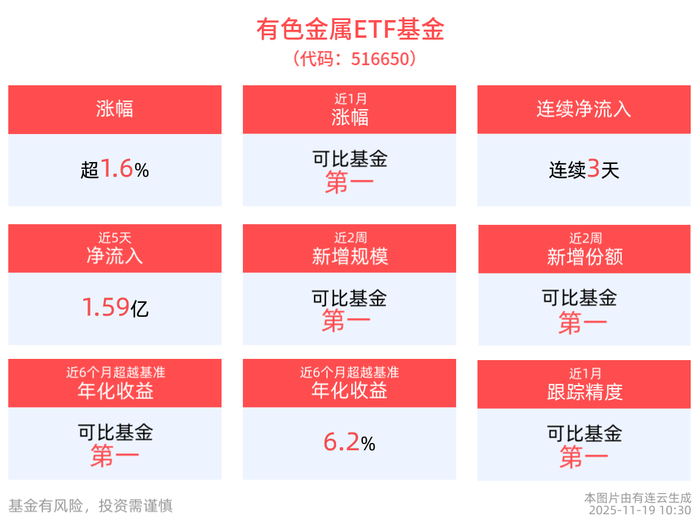
涨超1.6%,有色金属ETF华夏(516650)近3日获资金净申购2.34亿
Xin Lang Cai Jing· 2025-11-19 02:49
Core Viewpoint - The expectation of interest rate cuts has led to a rise in gold-related products, with significant inflows into the non-ferrous metal ETF fund and notable increases in individual stocks within the sector [2] Group 1: Market Performance - As of November 19, 2025, the non-ferrous metal ETF fund (516650) increased by 1.61%, with Tianqi Lithium rising by 6.91% and other stocks like Ganfeng Lithium, Yongxing Materials, and Huayou Cobalt also seeing gains [2] - The gold ETF Huaxia (518850) rose by 1.06%, while the gold stock ETF (159562) increased by 1.77% [2] - Over the past three days, the non-ferrous metal ETF fund has seen a net inflow of 234 million yuan, bringing its latest scale to 1.972 billion yuan as of November 18 [2] Group 2: Fund Performance Metrics - The non-ferrous metal ETF fund has experienced an 83.42% increase in net value over the past two years, ranking 42 out of 2406 index stock funds, placing it in the top 1.75% [2] - The fund's highest single-month return since inception was 27.00%, with the longest streak of consecutive monthly gains being six months and a maximum cumulative increase of 69.57% [2] - The average monthly return during rising months is 9.63%, and the fund has outperformed its benchmark with an annualized excess return of 6.20% over the past six months, ranking 1 out of 2 comparable funds [2] Group 3: Index Composition - The non-ferrous metal ETF fund closely tracks the CSI segmented non-ferrous metal industry theme index, with the top ten weighted stocks as of October 31, 2025, including Zijin Mining, Northern Rare Earth, and others, collectively accounting for 53.58% of the index [3]
黄金早参|小非农数据疲软,降息预期回温,金价止跌回升
Mei Ri Jing Ji Xin Wen· 2025-11-19 02:47
Core Viewpoint - Gold prices experienced a slight decline but rebounded due to rising risk aversion and expectations of a Federal Reserve rate cut, closing at $4,067.40 per ounce on COMEX [1] Economic Data Summary - The ADP weekly employment report indicated an average weekly decrease of 2,500 jobs in the U.S. private sector for the four weeks ending November 1 [1] - The U.S. Department of Labor reported initial jobless claims at 232,000 for the week ending October 18, with continuing claims slightly rising to 1.957 million. The initial claims for the week ending September 20 were revised up from 218,000 to 219,000, and the four-week average was adjusted from 237,500 to 237,750, highlighting weak data that increased market expectations for a rate cut in December [1] Market Analysis - CITIC Futures noted that the high levels of initial and continuing jobless claims, coupled with the prolonged government shutdown, further elevate the risks in the labor market. U.S. stock markets continued to show weakness, while U.S. Treasury bonds slightly strengthened [1] - Attention is focused on the upcoming U.S. GDP and non-farm payroll data releases, with gold and silver expected to experience short-term fluctuations. However, the long-term bullish trend for precious metals remains intact [1] - The ongoing issues of excessive debt issuance and de-globalization are key drivers of the decline in U.S. dollar credibility, positioning gold as the preferred asset for hedging against dollar credit risk [1]
黄金:降息预期回升白银:震荡调整铜:内外库存增加,价格承压
Guo Tai Jun An Qi Huo· 2025-11-19 02:43
1. Report Industry Investment Ratings No specific industry investment ratings are provided in the report. 2. Core Views of the Report - The report presents the trend judgments and fundamental data of various commodities, including precious metals, base metals, energy, chemicals, and agricultural products, on November 19, 2025. These judgments are based on factors such as inventory changes, supply - demand relationships, and macro - industry news [2][5]. 3. Summaries by Commodity Precious Metals - **Gold**: The expectation of interest rate cuts has rebounded. The trend strength is 0, indicating a neutral view. Yesterday, the prices of domestic and foreign gold futures showed different trends, and the inventory of Comex gold decreased [6]. - **Silver**: It is in a state of shock adjustment. The trend strength is 0. The prices of domestic and foreign silver futures also had different performances, and the inventory of Comex silver decreased significantly [6]. Base Metals - **Copper**: The increase in domestic and foreign inventories has put pressure on prices. The trend strength is 0. Peru's copper production increased in September, while China's copper product output in October decreased [10][12]. - **Zinc**: It is in a range - bound shock. The trend strength is 0. The prices of domestic and foreign zinc futures declined, and LME zinc inventory increased [13][14]. - **Lead**: The decrease in inventory limits the price decline. The trend strength is 0. The prices of domestic and foreign lead futures fell, and both domestic and LME lead inventories decreased [17]. - **Tin**: It has fallen from a high level. The trend strength is - 1, indicating a bearish view. The prices of domestic and foreign tin futures decreased slightly, and the inventory of Shanghai tin decreased [20]. - **Aluminum**: It has slightly stabilized. The trend strength is 0. The price of electrolytic aluminum decreased slightly, and the inventory of LME aluminum decreased [23]. - **Alumina**: It is in a range - bound shock. The trend strength is 0. The price of alumina decreased, and the inventory data showed different trends [23]. - **Nickel**: The nickel price has broken through the support level and is under pressure to fluctuate. The trend strength is 0. The prices of domestic and foreign nickel futures declined, and some nickel - related news affected the market [26][27]. - **Stainless Steel**: The weak reality suppresses the steel price, but the downward space is limited. The trend strength is 0. The price of stainless - steel futures decreased, and the market was affected by multiple factors [27]. Energy and Chemicals - **Carbonate Lithium**: It may have a short - term correction. The trend strength is - 1. The prices of carbonate lithium futures decreased, and the inventory of warehouse receipts decreased [32][33]. - **Industrial Silicon**: Organic silicon may cut production to support prices in the future. The trend strength is 0. The price of industrial silicon futures decreased, and the inventory of industrial silicon decreased [37][38]. - **Polysilicon**: It is in a weak shock pattern. The trend strength is - 1. The price of polysilicon futures decreased, and the inventory of polysilicon increased [38]. - **Iron Ore**: The downstream demand space is limited, and the valuation is high. The trend strength is - 1. The price of iron - ore futures increased slightly, and the prices of imported and domestic iron ores decreased [41]. - **Rebar**: It is in a wide - range shock. The trend strength is 0. The price of rebar futures increased, and the inventory of rebar decreased [44][45]. - **Hot - Rolled Coil**: It is in a wide - range shock. The trend strength is 0. The price of hot - rolled coil futures increased slightly, and the inventory of hot - rolled coil increased slightly [45]. - **Silicon Iron and Manganese Silicon**: The market sentiment has weakened, and the alloys are making up for the decline. The trend strength of both is - 1. The prices of silicon - iron and manganese - silicon futures decreased, and the price differences showed different trends [51][52]. - **Coke and Coking Coal**: Both are in a wide - range shock. The trend strength of both is 0. The prices of coke and coking - coal futures decreased, and the prices of spot coking coal and coke were stable [55]. - **Log**: It is in a repeated shock. The trend strength is 0. The prices of log futures showed different trends, and the inventory data was not provided [57][58]. - **Para - Xylene and PTA**: Both are in a single - sided shock market, and it is not recommended to chase high. The trend strength is not provided. The prices of para - xylene and PTA futures decreased [62][64]. - **MEG**: There is still supply pressure, and the trend is weak. The trend strength is not provided. The price of MEG futures decreased [62][64]. Agricultural Products - **Palm Oil**: The short - term negative factors have been fully reflected, and attention should be paid to the inventory reduction process in the producing areas. The trend strength is not provided [5]. - **Soybean Oil**: The price of US soybeans has stabilized, and soybean oil is in a relatively strong shock. The trend strength is not provided [5]. - **Soybean Meal and Soybean No. 1**: Both are in an adjustment shock. The trend strength is not provided [5]. - **Corn**: It is in a shock operation. The trend strength is not provided [5]. - **Sugar**: It is in a range adjustment. The trend strength is not provided [5]. - **Cotton**: The pressure of new cotton listing still suppresses the futures price. The trend strength is not provided [5]. - **Egg**: The near - term is weak, and the far - term is strong, showing a reverse - spread pattern. The trend strength is not provided [5]. - **Live Pig**: The expectation of price increase due to cooling has failed, and the pressure is gradually being released. The trend strength is not provided [5]. - **Peanut**: Attention should be paid to the spot market. The trend strength is not provided [5].