
反内卷政策

Search documents
格林大华期货研究院专题报告:9月制造业PMI略低于荣枯线,服务业PMI小幅扩张
Ge Lin Qi Huo· 2025-09-30 08:02
Group 1: Report Industry Investment Rating - No relevant content found Group 2: Core Viewpoints of the Report - In September, the manufacturing PMI was below the boom-bust line for the sixth consecutive month, showing production expansion and slightly weak demand. The service industry business activity index expanded moderately above the boom-bust line, but the new order index declined from the previous month. It is expected that counter-cyclical adjustment policies, including 50 billion yuan in new policy-based financial instruments, will be implemented in the fourth quarter [5][10]. Group 3: Summary by Related Catalogs Manufacturing Industry - **PMI**: In September, China's manufacturing PMI was 49.8%, below the boom-bust line for six consecutive months, up from 49.4% in the previous month. Large enterprises continued to expand in the prosperity range, medium-sized enterprises remained stable, and the decline of small enterprises narrowed [2][6]. - **Production Index**: The production index in September was 51.9%, up from 50.8% in the previous month, with accelerated production expansion for five consecutive months [2][6]. - **New Order Index**: The new order index in September was 49.7%, up from 49.5% in the previous month, indicating improved market demand, but still below the boom-bust line [2][6]. - **New Export and Import Order Indexes**: The new export order index in September was 47.8%, up from 47.2% in the previous month; the import index was 48.1%, up from 48.0% in the previous month. It is expected that China's exports will continue to grow rapidly in September [2][7]. - **Price Indexes**: The purchase price index of major raw materials and the ex-factory price index in September were 53.2% and 48.2% respectively. The former was in the expansion range for three consecutive months, while the latter declined from August. It is expected that the year-on-year decline of PPI in September will narrow to about 2.3% [3][7]. - **Inventory Indexes**: The raw material inventory index in September was 48.5%, up from 48.0% in the previous month; the finished product inventory index was 48.2%, up from 46.8% in the previous month. The rebound of the finished product inventory index was related to production expansion, and its sustainability depends on future new orders [4][8]. - **Employment and Expectation Indexes**: The employment index in September was 48.5%, up from 47.9% in the previous month, and the production and operation activity expectation index was 54.1%, up from 53.7% in the previous month, indicating a slight improvement in the employment situation and future expectations [9]. Non - Manufacturing Industry - **Overall Non - Manufacturing Business Activity Index**: In September, the non - manufacturing business activity index was 50.0%, down from 50.3% in the previous month [4][9]. - **Construction Industry**: The construction industry business activity index in September was 49.3%, up from 49.1% in the previous month, with a slight recovery but still weak. The new order index was 42.2%, up from 40.6% in the previous month; the employment index was 39.7%, down from 43.6% in the previous month; the business activity expectation index was 52.4%, up from 51.7% in the previous month. The real estate market was still at the bottom, and real estate development investment was expected to contract significantly in September, dragging down the construction industry [4][9]. - **Service Industry**: The service industry business activity index in September was 50.1%, down from 50.5% in the previous month. The new order index was 46.7%, down from 47.7% in the previous month; the employment index remained unchanged at 45.9%; the business activity expectation index was 56.3%, down from 57.0% in the previous month. Industries such as postal, telecommunications, and financial services were in a high - level prosperity range, while industries such as catering, real estate, and cultural and sports entertainment were below the critical point [4][10].
钢材四季度报:成本有支撑,上方空间看政策
Fo Shan Jin Kong Qi Huo· 2025-09-30 07:22
Report Title - Steel Q4 Report: Cost Support, Upside Depends on Policy [1] Report Industry Investment Rating - Not provided in the content Core Viewpoints - The steel fundamentals remain weak with high supply pressure, weak downstream demand for rebar, some support for hot-rolled coil demand, and strong exports. The market is expected to be dominated by macro policies in Q4, with limited downside and upside space depending on policy implementation. Steel is expected to fluctuate strongly within a certain range [7][12] - In Q3, the spot steel price increased by about 5%. The rebar and hot-rolled coil futures showed an "up-down-fluctuation" trend and strengthened slightly, with macro policies dominating the market. The unilateral positions in the steel futures market remained high in Q3 and decreased at the end of the quarter [12] - As of the end of September, the rebar-iron ore ratio was 3.94, down 0.43 compared to the end of December. The hot-rolled coil - rebar spread (01 contract) was 199 yuan/ton, up 86 yuan/ton compared to the end of June [12] Summary by Directory 01 Viewpoint Strategy - **Core**: The steel fundamentals are weak with high supply pressure, weak downstream demand for rebar, and strong exports. The market is expected to be dominated by macro policies in Q4, with limited downside and upside space depending on policy implementation. Steel is expected to fluctuate strongly within a certain range [12] - **Logic**: Q4 is expected to be dominated by macro policies. With policy support at the coal end, the downside space for steel is limited, but the upside depends on policy efforts [12] - **Spot and Futures Market**: In Q3, the spot steel price increased by about 5%. The rebar and hot-rolled coil futures showed an "up-down-fluctuation" trend and strengthened slightly, with macro policies dominating the market. The unilateral positions in the steel futures market remained high in Q3 and decreased at the end of the quarter [12] - **Spread**: As of the end of September, the rebar-iron ore ratio was 3.94, down 0.43 compared to the end of December. The hot-rolled coil - rebar spread (01 contract) was 199 yuan/ton, up 86 yuan/ton compared to the end of June [12] - **Strategy**: Consider interval operations. The rebar 01 contract is expected to trade between 3050 - 3400 yuan/ton, and the hot-rolled coil 10 contract between 3200 - 3500 yuan/ton. Consider buying on dips [12] 02 Macro Level - In Q3, policy expectations dominated the black - sector market. Policies such as the construction of a unified national market, the upcoming release of a steady - growth plan for key industries, and the implementation of the "Anti - involution" policy had different impacts on the market, causing price fluctuations in the black sector [15] 03 Spot and Basis - **Spot Price**: In Q3, the rebar and hot-rolled coil prices showed an "up-down-fluctuation" trend, with a spot price increase of about 5%. Policy expectations and coal price fluctuations were the main drivers of price changes [17] - **Futures Market**: The rebar futures showed an "up-down-fluctuation" trend, with the main contract fluctuating around 3000 - 3400 yuan/ton. The hot-rolled coil futures also showed a similar trend, with stronger terminal demand and greater resistance to price drops [20][31] - **Basis**: The rebar basis fluctuated around 100 yuan/ton, and the hot-rolled coil basis first decreased and then increased, fluctuating around 50 yuan/ton at the end of September [21][31] - **Open Interest**: The rebar futures open interest fluctuated around 3 million lots in Q3 and decreased at the end of the quarter. The hot-rolled coil futures open interest first increased and then decreased [22][34] - **Inter - period Spread**: The rebar futures price curve steepened, and the inter - period spread widened. The hot-rolled coil futures price curve showed a mild Back structure, and the 10 - 1 spread increased [25][40] 04 Spread - **Rebar - Iron Ore Ratio**: As of the end of September, the rebar-iron ore ratio was 3.94, down 0.43 compared to the end of December. There may be opportunities to short the rebar-iron ore ratio in the future [44][45] - **Hot - Rolled Coil - Rebar Spread**: As of the end of September, the hot-rolled coil - rebar spread (01 contract) was 199 yuan/ton, up 86 yuan/ton compared to the end of June. Consider shorting the spread at high levels in the future [47] 05 Supply - **Overall Production**: As of September 26, the cumulative production of five major steel products was 335 million tons, a year - on - year increase of 0.83%. The cumulative rebar production was 83 million tons, a year - on - year increase of 0.05%, and the hot-rolled coil production was 129 million tons, a year - on - year increase of 1.44% [50] - **Regional Production**: In the East China region, the production of sample enterprises decreased in September. In the South region, the rebar production increased slightly, while in the North region, it decreased compared to last year [54] - **Production Process**: The long - process production was basically flat year - on - year, while the short - process production decreased. The iron water production of steel mills remained high, and the short - process electric furnace production was average, with a slight year - on - year decrease in scrap consumption [57][64] - **Cost Comparison**: The blast furnace production was more cost - effective than the electric furnace production this year [67] 06 Demand - **Rebar and Hot - Rolled Coil Demand**: As of the week of September 26, the cumulative apparent demand for rebar was 80.83 million tons, a year - on - year decrease of 4.08 million tons, while that for hot-rolled coil was 124.17 million tons, a year - on - year increase of 1.99 million tons [72] - **Profitability**: The profitability of steel mills remained above 50% in the first three quarters. The profits of blast furnace rebar production, electric furnace production, and hot-rolled coil production first increased and then decreased, with hot-rolled coil having relatively strong profits [74][83] - **Investment and Consumption**: From January to August, real estate investment decreased year - on - year, while infrastructure investment increased slightly. The cement and concrete shipments decreased year - on - year, while the added value of multiple manufacturing industries increased [86][101] - **Exports**: From January to August 2025, China's cumulative steel exports were 77.49 million tons, a year - on - year increase of 10%. The exports of bars and billets increased significantly, while those of plates decreased [104] 07 Inventory - **Overall Inventory**: As of the week of September 26, the factory inventory of five major steel products was 4.21 million tons, a year - on - year increase of 420,000 tons, and the social inventory was 10.89 million tons, a year - on - year increase of 1.77 million tons [108] - **Rebar Inventory**: The rebar inventory pressure was high, with the factory inventory and social inventory increasing year - on - year. The warehouse receipts at Jiangsu Huilong Port put pressure on the near - month contracts [112] - **Hot - Rolled Coil Inventory**: The hot-rolled coil inventory continued to accumulate, with relatively high inventory levels [114]
周度经济观察:总需求维持平稳,风险偏好在抬升-20250930
Guotou Securities· 2025-09-30 06:34
Demand and Price Trends - Total demand remains stable with no significant slowdown observed, indicating a gradual narrowing of economic fluctuations[2] - Industrial enterprise profits in August increased by 20.4% year-on-year, a significant rebound of 21.9 percentage points from the previous month, marking three consecutive months of profit growth[4] - The Producer Price Index (PPI) year-on-year growth is expected to continue rising due to low base effects, supporting profit margins[4] Market Sentiment and Economic Outlook - The manufacturing PMI for September is at 49.8, a slight increase of 0.4 percentage points from the previous month, indicating a broad-based economic recovery[6] - The service sector PMI stands at 50.1, down 0.4 percentage points but still within the expansion zone, reflecting overall stability in the service industry[7] - The upcoming Fourth Plenary Session in October is anticipated to provide investment guidance for related industries, particularly regarding the "14th Five-Year Plan"[11] Bond Market Dynamics - The bond market is expected to face headwinds this year, influenced by stock market gains, tax adjustments, and potential inflationary pressures[14] - Long-term bond yields have recently risen, with the 30-year bond yield reaching its highest level this year, indicating ongoing adjustments in the bond market[13] - The overall sentiment suggests that the bond market is still in a phase of adjustment, with upward risks to yields outweighing downward possibilities[14] U.S. Economic Indicators - The U.S. PCE inflation rate for August is reported at 2.7%, with core PCE at 2.9%, indicating persistent inflationary pressures[16] - The U.S. manufacturing PMI for September is at 52.0, down 1 percentage point, while the services PMI is at 52.9, reflecting resilience in the U.S. economy despite slight declines[18] - Market expectations for U.S. interest rate cuts have slightly decreased, with projections indicating two rate cuts in 2025, occurring in October and December[19]
又有超百亿资金跑步入场,宽基ETF获爆买,券商主题遭弃
Feng Huang Wang· 2025-09-30 05:09
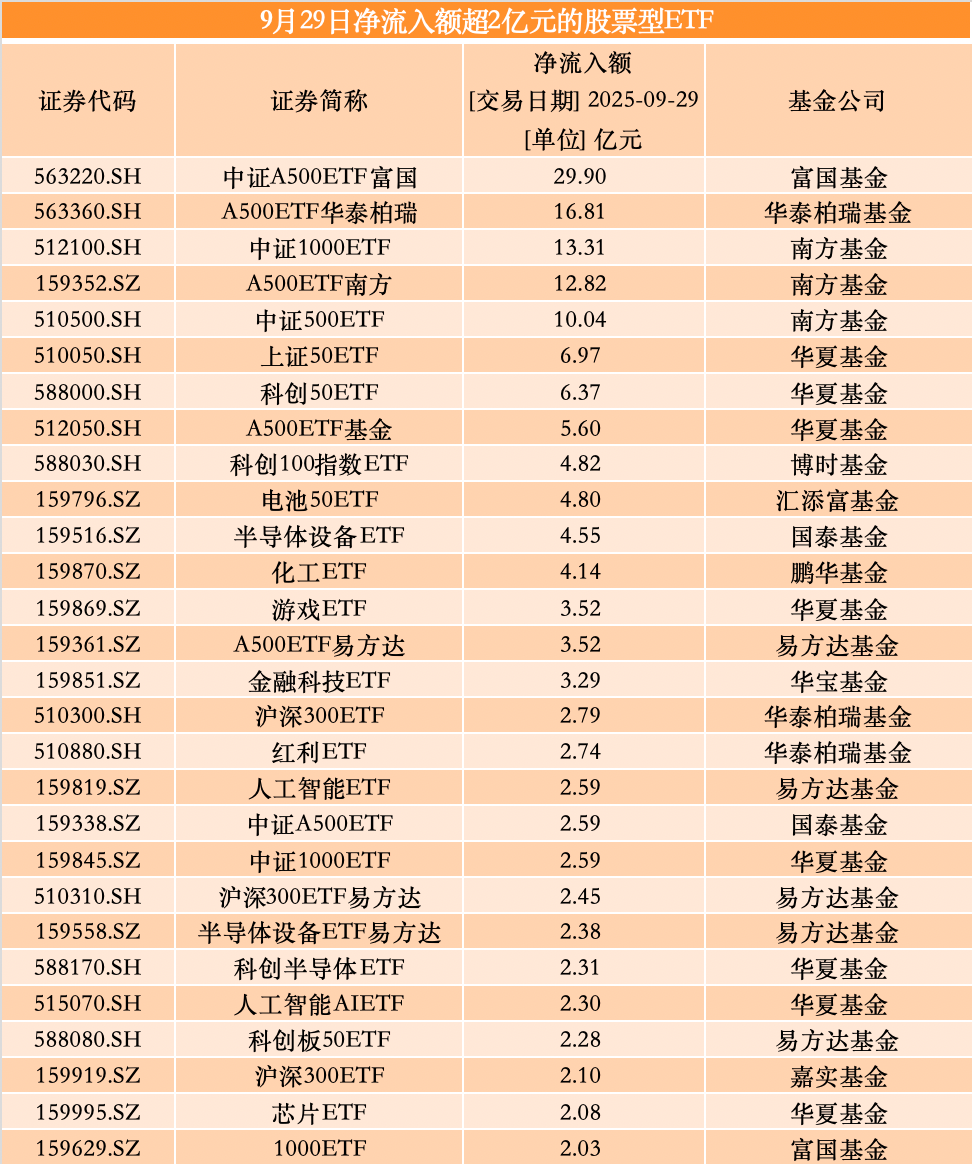
Group 1 - Stock ETFs have seen a strong inflow exceeding 10 billion yuan for two consecutive days, with net inflows of 193.93 billion yuan and 122.69 billion yuan on September 26 and 29 respectively [1] - Broad-based ETFs dominated the inflow rankings, with nine out of the top ten inflows on Monday being broad-based ETFs, while the only sector-themed ETF was related to the battery sector [1][3] - The A500 ETF led the inflow on September 29 with a net inflow of 29.90 billion yuan, followed by several other broad-based ETFs with inflows above 10 billion yuan [3][5] Group 2 - Despite a significant rise in the brokerage sector, many investors chose to take profits, leading to substantial outflows from several brokerage ETFs [2][6] - The top three sectors attracting capital this month have been brokerage, robotics, and batteries [2][8] - The net inflow for the brokerage sector ETF in September reached 109.82 billion yuan, making it the highest among all ETFs [8][9] Group 3 - Sector-themed ETFs such as battery, semiconductor, chemical, gaming, fintech, dividend, and artificial intelligence have also attracted significant capital [4] - The leading sector-themed ETFs by net inflow included the battery theme ETF with 4.80 billion yuan and the semiconductor materials and equipment theme ETF with 4.55 billion yuan [4][5] - Overall, the capital inflow in September has been strong across various sectors, with notable interest in chemicals, non-ferrous metals, semiconductors, consumption, gaming, and dividends [8][9] Group 4 - The market indices collectively rose on September 29, with the Shanghai Composite Index up by 0.9% and the ChiNext Index up by 2.74% [3] - The financial sector saw a significant rally in the afternoon, with major brokerage stocks hitting their daily limits [6][10] - The central bank's meeting emphasized the need for a moderately loose monetary policy to encourage financial institutions to increase credit supply [6][10]

利率“贴地飞行”,券商融资融券业务如何走出“内卷”困局?
Zheng Quan Ri Bao Zhi Sheng· 2025-09-30 04:37
Core Viewpoint - The securities industry is experiencing a severe "price war" in the margin financing and securities lending business, with average financing rates plummeting from a historical high of 8.35% to a range of 5%-5.5%, and some brokers offering rates below 4%, which is approaching their comprehensive funding cost line. Despite this, the overall scale of margin financing is steadily increasing, highlighting a significant disconnect between volume growth and price reduction, representing a typical symptom of the industry's transformation pains [1][2]. Group 1: Current Challenges - The financing rates in the securities industry are on a downward trend, with rates expected to continue decreasing from 8.35% in 2015 to 5%-5.5% by 2024, and some firms offering rates below 4% to high-net-worth clients, intensifying competition [2][3]. - The price war is rooted in structural contradictions and homogeneous competition, with 150 securities firms in the market, leading to fierce resource competition and forcing firms to rely on price cuts to gain market share [3]. - The mismatch between the growth in margin financing balance, which reached 18,505 billion with a year-on-year increase of 24.95%, and the revenue from financing interest, which only grew by 10%, indicates the limitations of the price war [3]. Group 2: Negative Impacts - The price war is hindering industry innovation, as firms are focusing resources on traditional business lines rather than exploring new models, which limits their ability to meet the diverse needs of the real economy [4][5]. - The competitive environment has led to a degradation of service capabilities, with the value of professional services being underestimated and talent retention becoming increasingly difficult due to declining profit margins [6]. - The adverse effects of the price war may result in a misallocation of social economic resources, undermining the financial sector's ability to serve the real economy effectively [7]. Group 3: Systemic Risks - The low financing rate environment is likely to amplify market volatility, as high leverage can lead to forced liquidations during market downturns, negatively impacting liquidity [8]. - The interconnectedness of risks among financial institutions is heightened, as difficulties in short-term financing can lead to asset sell-offs by securities firms, triggering broader market declines [8]. Group 4: Policy and Structural Solutions - The central government has initiated a series of anti-involution policies to regulate market order, emphasizing the need for industry self-discipline and the prevention of "involutionary" competition [11][12]. - A shift in development philosophy is necessary, moving from a focus on scale to value creation, with a comprehensive evaluation system that prioritizes long-term indicators such as customer satisfaction and innovation investment [13]. - Establishing a multi-tiered competitive system based on professional capabilities is essential, allowing firms to transition from price competition to value creation [14]. Group 5: Technological and Regulatory Enhancements - Digital transformation is crucial for reconstructing the business value chain, with firms deploying AI systems and enhancing risk management through big data [15]. - Regulatory guidance and industry self-discipline must work in tandem to establish a healthy market ecosystem, including reasonable interest rate determination and the prohibition of malicious competition [16]. Conclusion - To overcome the challenges posed by the "involutionary" competition in the securities industry, a balance between market efficiency and industry order is required, alongside a strategic focus on long-term value creation [17].



2025年四季度策略报告:供需博弈下的价格探底与反弹路径-20250930
Hong Yuan Qi Huo· 2025-09-30 03:07
1. Report Industry Investment Rating No relevant content provided. 2. Core Viewpoints of the Report - In Q4 2025, the domestic steel market is expected to move forward in the game between weak reality and strong expectations, likely continuing the pattern of weak shocks. Without an increase in domestic demand, the contribution of demand growth mainly depends on external demand. Domestic prices are suppressed by export prices and do not have the driving conditions for a significant rebound. A substantial turnaround requires stronger domestic demand improvement or external positive drivers. Currently, the spot profit of rebar in some northern regions is in deficit, and the motivation for hot metal conversion is insufficient. The high output of hot-rolled coils may be adjusted through profit contraction, so there is a driving force for the spread between hot-rolled coils and rebar to narrow [1][5][60]. 3. Summary According to Relevant Catalogs 3.1. Market Review - In Q3 2025, the prices of the black series soared and then fluctuated in a wide range. The supply-demand structures of different varieties showed differences, and the prices showed significant differentiation. In the raw material sector, the overall demand remained high, and supply determined the price fluctuation range. Coking coal prices were firm due to supply contraction expectations, with a cumulative increase of over 40% in Q3; coke prices were relatively stable, with a cumulative increase of 23%; iron ore prices were stable overall, with the Platts Index rising 12% in Q3. The demand for scrap steel increased, but the cumulative increase in Q3 was only 3%. In terms of finished products, from January to August 2025, both production and sales of crude steel increased, with the supply growth rate exceeding the demand growth rate. External demand contributed the main demand growth, and domestic demand was significantly differentiated. Building materials consumption decreased by 5% year-on-year, while plate consumption increased by 2.5%. Steel direct exports were stronger than expected, with a 9.6% year-on-year increase from January to August, and there were significant changes in export destinations and varieties. Driven by steel mill profits, production remained at a high level, with a cumulative crude steel production growth rate of 4.6% in the first eight months [5]. 3.2. Steel Supply and Demand Analysis 3.2.1. Macro: Policy Intensification to Stabilize Expectations, Economic Momentum to Be Converted - The domestic economy is seeking a balance between policy support and structural transformation, featuring a gradual recovery of domestic demand and continuous pressure on external demand. The GDP growth rate in Q4 is expected to be about 4.6% to support the annual growth target of 5%. On the demand side, there is a differentiation between old and new driving forces. General infrastructure investment maintains high growth, and consumption is expected to recover moderately but lacks strong demand support. External demand faces the risk of negative growth in December due to tariff policy uncertainty in exports to the United States, but diversified trading partners and the advantages of mechanical and electrical products offset some external shocks. On the supply and policy front, industrial production grows rapidly, but the problem of structural overcapacity in the industrial sector remains unresolved. Policy counter-cyclical adjustment is precise, and the CPI is expected to rise to around 0.3% by the end of the year, while the decline of PPI is expected to narrow further [10]. 3.2.2. Steel Demand Analysis - **Real Estate**: From January to August 2025, real estate development investment, construction area, new construction area, sales area, and sales volume all declined year-on-year, and the decline in sales area and volume widened compared to the first half of the year. The supply of new real estate land decreased, and the inventory pressure was high. Therefore, the steel demand for real estate in Q4 2025 is expected to continue to shrink [17][18]. - **Infrastructure**: From January to August 2025, the cumulative growth rate of small-caliber infrastructure investment dropped to 2%, and the single-month decline in August expanded. The improvement of traditional infrastructure demand was limited, mainly due to factors such as debt repayment pressure and reduced consumption intensity. The implementation of physical volume in Q4 needs to be observed. Although the large-caliber infrastructure growth rate is relatively high, which offsets some downward pressure, the overall improvement of infrastructure demand is relatively limited [24]. - **Manufacturing Investment**: In 2025, the central government made comprehensive arrangements for expanding effective investment, and local governments implemented relevant policies to support manufacturing investment. From January to August 2025, the cumulative growth rate of China's manufacturing investment was 5.1%, higher than the overall growth rate of fixed - asset investment but showing a slowdown. The decline in July and August was significant due to factors such as the rapid release of equipment renewal funds in the first half of the year, rising bases, and anti - involution policies. Currently, industrial enterprises are in the active de - stocking stage, and PPI is still in a downward cycle. In Q4 2025, manufacturing investment is expected to continue the downward trend, but demand still has some resilience [31][32]. - **Exports**: From January to August 2025, the cumulative steel export volume was 77.51 million tons, a year-on-year increase of 9.6%, stronger than expected. There were significant changes in export destinations and varieties. Exports to some countries decreased, while exports to Southeast Asia, Africa, and the Middle East increased. The export volume of billets increased significantly, with a year-on-year growth of 292% in the first eight months. It is expected that steel exports will remain at a high level in Q4, but the year-on-year growth rate may decline [36]. 3.2.3. Supply Analysis - From January to August 2025, the cumulative output of pig iron (according to Steel Union data) increased by 3% year-on-year, and the cumulative output of crude steel increased by 0.2% year-on-year. The profitability of steel enterprises improved overall in 2025, but there were significant differences among enterprises. In the first three quarters, steel enterprises' profitability improved due to factors such as falling raw material costs and anti - involution policies. However, in Q4, the industry faces challenges such as weak demand and rising costs [46]. 3.3. Crude Steel Balance Sheet Deduction and Conclusion - The balance sheet data shows that from January to August 2025, the cumulative consumption of crude steel was 628 million tons, an increase of 13.8 million tons, with a cumulative increase of 2.25%; the cumulative production of crude steel was 726 million tons, an increase of 31.93 million tons, with a cumulative increase of 4.6%. The increase in crude steel consumption in the first three quarters was mainly reflected in external demand, and domestic demand was still relatively weak. The supply - demand gap was at a relatively high level in the same period in recent years. Although demand improved seasonally in September, the overall increase was limited. Market - based production cuts in Q4 will lead to a new balance between supply and demand [60].
静待供给端政策明朗
Zhong Xin Qi Huo· 2025-09-30 02:31
1. Report Industry Investment Rating - The report gives an "oscillating" rating for industrial silicon, polysilicon, and lithium carbonate, indicating that the expected price fluctuations for these commodities are within plus or minus one standard deviation in the future 2 - 12 weeks [6][7][10] 2. Core Viewpoints of the Report - In the short - to - medium term, due to the repeated supply expectations, the prices of new energy metals will fluctuate widely. It is necessary to wait for the policy clarity at the end of September. In the long term, the supply of silicon is expected to contract, especially for polysilicon, and the price center may rise. The lithium ore production capacity is still in an upward stage, and the high growth of lithium carbonate supply will limit the upside of lithium prices [1] - For industrial silicon, the loosening of coal prices has led to a decline in its price. For polysilicon, the repeated policy expectations have caused its price to continue high - volatility. For lithium carbonate, as the long holiday and the point of long - short game approach, it is necessary to avoid price fluctuation risks [2] 3. Summary by Related Catalogs 3.1行情观点 3.1.1 Industrial Silicon - **Information Analysis**: As of September 29, the spot prices of industrial silicon fluctuated. The latest domestic inventory increased by 0.5% month - on - month. As of August 2025, the domestic monthly production of industrial silicon was 386,000 tons, a month - on - month increase of 14.0% and a year - on - year decrease of 18.7%. In August, the export volume of industrial silicon increased both month - on - month and year - on - year. The new photovoltaic installed capacity in August decreased both month - on - month and year - on - year [6] - **Main Logic**: The repeated coal prices affect the cost support of industrial silicon, and the resumption progress of large northwest factories has slowed down, so the silicon price continues to oscillate. The supply has been rising from August to September, but the resumption process has slowed down recently. The demand has slightly improved, and the inventory has remained stable [6] - **Outlook**: Before the holiday, the loosening of coal prices led to a decline in silicon prices. Recently, the resumption rhythm of large factories has slowed down, and the industrial silicon price shows short - term oscillation. It is necessary to continuously pay attention to the impact of the resumption rhythm of large northwest factories on supply [6] 3.1.2 Polysilicon - **Information Analysis**: As of a certain time, the N - type polysilicon re - feeding material transaction price was in the range of 49,000 - 55,000 yuan/ton, with an average transaction price of 53,200 yuan/ton, flat week - on - week. The number of polysilicon warehouse receipts increased. In August, the export and import volumes of polysilicon decreased. From January to August 2025, the domestic new photovoltaic installed capacity increased year - on - year. Relevant policies on anti - involution and energy consumption standards were put forward [7] - **Main Logic**: The supply of polysilicon has recovered to over 130,000 tons in August and is expected to remain high in September. In the long - term, it is necessary to pay attention to whether anti - involution policies will limit the supply. The demand for polysilicon may continue to weaken in the future. Overall, there is still pressure on the supply - demand situation, and the price fluctuation has increased [8][9] - **Outlook**: The anti - involution policy has a significant boost to the polysilicon price. It is necessary to pay attention to the policy implementation. If the policy expectation fades, the price may fluctuate in the opposite direction [7] 3.1.3 Lithium Carbonate - **Information Analysis**: On September 29, the closing price of the lithium carbonate main contract increased by 1.43% compared with the previous day, and the total position increased. The spot prices of battery - grade and industrial - grade lithium carbonate decreased by 50 yuan/ton compared with the previous day. A new lithium project was put into production [9][10] - **Main Logic**: The current market has strong supply and demand. There is a supply - demand gap, but the amplitude is less than expected. The supply has new investments, and there is uncertainty in supply. The apparent demand is strong, and the social inventory is decreasing, but the amplitude is less than expected. The warehouse receipts are gradually recovering, suppressing the price. It is recommended to close positions and wait and see [10] - **Outlook**: The short - term supply - demand shows a tight balance, and the long - term surplus and supply recovery expectations suppress the price. It is expected that the price will oscillate in the short term [10] 3.2行情监测 - The report only lists the headings for industrial silicon, polysilicon, and lithium carbonate under this section, but no specific content is provided [12][18][29] 3.3中信期货商品指数 - On September 29, 2025, the comprehensive index of CITIC Futures commodities showed that the commodity index, commodity 20 index, and industrial products index all decreased, with decreases of 0.13%, 0.08%, and 0.50% respectively. The new energy commodity index decreased by 0.53% on that day, 0.22% in the past 5 days, 0.96% in the past month, and 3.50% since the beginning of the year [52][54]
大越期货玻璃早报-20250930
Da Yue Qi Huo· 2025-09-30 02:09
交易咨询业务资格:证监许可【2012】1091号 大越期货投资咨询部 胡毓秀 从业资格证号:F03105325 投资咨询证号:Z0021337 联系方式:0575-85226759 重要提示:本报告非期货交易咨询业务项下服务,其中的观点和信息仅作参考之用,不构成对任何人的投资建议 。 我司不会因为关注、收到或阅读本报告内容而视相关人员为客户;市场有风险,投资需谨慎。 玻璃早报 2025-9-30 每日观点 玻璃: 1、基本面:玻璃生产利润回落,行业冷修高位,开工率、产量下降至历史同期低位;下游深加工 订单整体偏弱,不及往年同期,地产终端需求疲弱;偏空 2、基差:浮法玻璃河北沙河大板现货1148元/吨,FG2601收盘价为1228元/吨,基差为-80元,期 货升水现货;偏空 3、库存:全国浮法玻璃企业库存5935.50万重量箱,较前一周减少2.55%,库存在5年均值上方运 行;偏空 4、盘面:价格在20日线上方运行,20日线向上;偏多 5、主力持仓:主力持仓净空,空增;偏空 6、预期:玻璃基本面疲弱,短期预计震荡运行为主。 影响因素总结 利多: 1、"反内卷"政策影响下,浮法玻璃行业存产能出清预期。 利空: 1 ...
建材行业发布稳增长方案,继续严控水泥玻璃产能 | 投研报告
Zhong Guo Neng Yuan Wang· 2025-09-30 01:56
Core Viewpoint - The Ministry of Industry and Information Technology and five other departments have jointly released the "Construction Materials Industry Stabilization Growth Work Plan (2025-2026)", which outlines five key initiatives to promote industry growth and transformation [1][2]. Group 1: Key Initiatives - The plan emphasizes strengthening industry management to promote survival of the fittest [1][2]. - It calls for enhanced technological innovation in the industry to improve effective supply capacity [1][2]. - The plan aims to expand effective investment to facilitate industry transformation and upgrading [1][2]. - It seeks to stimulate consumer demand to unleash market consumption potential [1][2]. - The initiative includes deepening open cooperation to enhance international development levels [1][2]. Group 2: Industry Specifics - Cement and glass production will be strictly controlled, with a ban on new cement clinker and flat glass capacity, and existing projects must develop capacity replacement plans [2]. - The cement industry is expected to see a decline in capacity under the anti-overproduction policy, with utilization rates significantly improving [3]. - The glass industry is facing a continuous decline in demand due to real estate impacts, but recent policy-driven price increases are leading to inventory replenishment [3]. - The fiberglass sector is experiencing growth driven by demand from the AI industry, with expectations for a significant increase in both volume and price [3]. - The consumer building materials sector has reached a profitability bottom, with strong price increase demands supported by anti-overproduction policies [4]. Group 3: Market Performance - In the past week (September 22-28), the construction materials sector index decreased by 2.11%, ranking 23rd among 31 sub-industry indices [5].
中泰期货晨会纪要-20250930
Zhong Tai Qi Huo· 2025-09-30 01:23
1. Report Industry Investment Ratings No relevant content provided. 2. Core Views of the Report - For stock index futures, consider buying on dips and adopting a range - trading strategy. The A - share market is oscillating upwards, but there is insufficient trading volume after the August rally, so it should be treated with a range - trading mindset [16]. - For treasury bond futures, use a range - trading approach and focus on the odds of short - term bonds. The bond market is likely to be range - bound, with a slightly optimistic outlook based on odds and future fundamentals. Consider reducing positions before the holiday [17][18]. - For the black sector, policies are expected to have a neutral impact on the market. The market may experience a "no - peak season" situation. In the short term, it may adjust, and in the medium term, it will maintain a range - bound trend [18][19]. - For coal and coke, prices may continue to oscillate weakly in the short term, and the demand for finished products during the "Golden September and Silver October" period should be monitored [21]. - For ferroalloys, in the long - term, maintain a short - selling approach on rallies. Hold short positions with high - cost entry over the holiday [22]. - For soda ash and glass, adopt a short - selling approach on rallies for soda ash and a wait - and - see approach for glass [23]. - For aluminum and alumina, it is recommended to wait and see for aluminum. For alumina, short - sell on rallies, while being aware of policy changes in Guinea's ore supply [25]. - For zinc, zinc prices will oscillate weakly after the macro - impact fades, and are expected to have a narrow - range oscillation in the short term due to holidays [26]. - For lithium carbonate, it will operate in a wide - range oscillation without obvious drivers [27]. - For industrial silicon, it oscillates within a range, and it is advisable to buy on dips for far - month contracts at the lower end of the range [28]. - For polysilicon, it will maintain a wide - range oscillation, and cautious operation is recommended [30]. - For cotton, adopt a short - selling approach on rallies and wait and see during the National Day holiday [32]. - For sugar, maintain a short - selling approach in the medium - term and wait and see in the short term [34]. - For eggs, short - sell on dips for near - month contracts and consider a short - near and long - far arbitrage strategy [36]. - For apples, buy on dips with a light position [38]. - For corn, remain on the sidelines for single - side trading and sell out - of - the - money call options for the 01 contract [38]. - For red dates, it is recommended to wait and see [40]. - For hogs, short - sell on rallies for near - month contracts and control positions [41]. - For crude oil, it is likely to shift to a supply - exceeding - demand situation, and consider short - selling on rallies [42]. - For fuel oil, its price will follow the movement of oil prices [43]. - For plastics, it will oscillate weakly in the long - term, with short - term rebounds due to sentiment [45]. - For rubber, be cautious when holding positions as pre - holiday volatility may increase [47]. - For methanol, adopt a range - trading approach with a slightly bullish bias [48]. - For caustic soda, the futures are expected to oscillate [49]. - For asphalt, it will follow the movement of oil prices [50]. - For offset printing paper, it is expected to oscillate, and it is advisable to buy on dips or sell put options near the factory's production cost line [52]. - For the polyester industry chain, it is expected to operate weakly [54]. - For liquefied petroleum gas (LPG), maintain a bearish view in the long - term [55]. - For pulp, the downside space of the futures is limited. Consider buying on dips after the holiday if the spot price stabilizes [56]. - For logs, the market is expected to oscillate. Consider buying on dips if price support is confirmed and downstream orders are good during the peak season [57]. - For urea, use a range - trading approach due to pre - holiday risk - aversion sentiment [58]. - For synthetic rubber, the main contract oscillates weakly, and it is advisable to wait and see [59]. 3. Summary by Relevant Catalogs 3.1 Macro News - The Political Bureau of the CPC Central Committee will hold the Fourth Plenary Session of the 20th CPC Central Committee from October 20th to 23rd to discuss the 15th Five - Year Plan [12]. - The National Development and Reform Commission introduced that new policy - based financial instruments worth 500 billion yuan will be used to supplement project capital [12]. - The US Department of Commerce issued export control rules, and China's Ministry of Commerce firmly opposes this and will safeguard the legitimate rights and interests of Chinese enterprises [12]. - Six departments issued a plan to stabilize the growth of the machinery industry, aiming for an average annual revenue growth of about 3.5% from 2025 to 2026, with revenue exceeding 10 trillion yuan [12]. - The China Household Electrical Appliances Association issued an initiative against unfair competition [12]. - Deepseek released the DeepSeek - V3.2 - Exp model and open - sourced it, while also significantly reducing the official API price by over 50% [13]. - US President Trump and Israeli Prime Minister Netanyahu reached a 20 - point plan to end the Gaza war, pending the approval of Hamas [13]. - Trump threatened to impose a 100% tariff on movies made outside the US and large - scale tariffs on furniture - producing countries [13]. - The value of the US Treasury's 261.5 million ounces of gold reserves has exceeded $1 trillion, and re - evaluating at market prices could release about $990 billion in funds [13]. - Fed officials have different views on interest rate cuts. Some are against it due to concerns about inflation remaining above the target until 2028, while others are open to potential rate cuts but with caution [14]. - In August, China issued local government bonds worth 980.1 billion yuan, and from January to August, the total issuance was 7.6838 trillion yuan [14]. 3.2 Stock Index Futures - The A - share market is oscillating upwards, with brokerage stocks surging in the afternoon. The Shanghai Composite Index rose 0.9%, the Shenzhen Component Index rose 2.05%, and the ChiNext Index rose 2.74%. The daily trading volume was 2.18 trillion yuan. The market should be treated with a range - trading mindset due to insufficient trading volume after the August rally [16]. 3.3 Treasury Bond Futures - The bond market is weak due to the market's digestion of the central bank's monetary policy meeting and the strong stock market. The bond market is expected to oscillate, and positions can be reduced before the holiday [17][18]. 3.4 Black Sector - Policy impact is expected to be neutral. The market may experience a "no - peak season" situation due to limited real demand improvement, high inventory in some varieties, and profit - taking from basis trading. In the short term, it may adjust, and in the medium term, it will range - bound [18][19]. 3.5 Coal and Coke - Prices may continue to oscillate weakly in the short term. Supply is gradually recovering, but "anti - involution" and environmental protection policies may affect the market. The focus will return to supply - demand fundamentals after the Fed's interest rate cut event [21]. 3.6 Ferroalloys - In the long - term, maintain a short - selling approach on rallies. Hold short positions with high - cost entry over the holiday [22]. 3.7 Soda Ash and Glass - For soda ash, short - sell on rallies. Supply is at a historical high, and there may be inventory accumulation pressure after the pre - holiday restocking. For glass, wait and see. The spot market is stable, and attention should be paid to fuel - upgrade and demand improvement [23]. 3.8 Aluminum and Alumina - For aluminum, wait and see due to weak demand and poor inventory performance in September. For alumina, short - sell on rallies as there is high supply and increasing inventory pressure [25]. 3.9 Zinc - Zinc prices will oscillate weakly after the macro - impact fades. In the short term, they are expected to have a narrow - range oscillation due to holidays [26]. 3.10 Lithium Carbonate - It will operate in a wide - range oscillation without obvious drivers, with short - term price support from inventory reduction [27]. 3.11 Industrial Silicon - It oscillates within a range, and it is advisable to buy on dips for far - month contracts at the lower end of the range. The复产 progress of Xinjiang's leading manufacturers is the core supply - demand contradiction [28]. 3.12 Polysilicon - It will maintain a wide - range oscillation, and cautious operation is recommended. Policy progress dominates the market, and there is a contradiction between strong policy expectations and fundamental oversupply [30]. 3.13 Cotton - Adopt a short - selling approach on rallies and wait and see during the National Day holiday. Supply pressure is increasing, and demand is weak. Pay attention to the impact of the crude oil market and international trade tariffs [32]. 3.14 Sugar - Maintain a short - selling approach in the medium - term and wait and see in the short term. The global sugar market is facing oversupply pressure, and domestic supply is expected to increase [34][35]. 3.15 Eggs - Egg prices are under pressure due to high inventory and the post - festival off - season. Short - sell on dips for near - month contracts and consider a short - near and long - far arbitrage strategy [36]. 3.16 Apples - Lightly buy on dips. The new - season apples have a strong expectation of high opening prices. Pay attention to weather conditions in the producing areas [38]. 3.17 Corn - Remain on the sidelines for single - side trading and sell out - of - the - money call options for the 01 contract. The spot price is weak due to increasing supply, but there is some support from the expected supply gap in 2025/26 [38][39]. 3.18 Red Dates - It is recommended to wait and see. The new - season production is controversial, and the market price is stable [40]. 3.19 Hogs - The supply - demand situation is supply - strong and demand - weak. Short - sell on rallies for near - month contracts and control positions [41]. 3.20 Crude Oil - It is likely to shift to a supply - exceeding - demand situation. Consider short - selling on rallies. Pay attention to the progress of US - Russia negotiations and OPEC+ quota adjustments [42]. 3.21 Fuel Oil - Its price will follow the movement of oil prices, and there is high uncertainty in the external market during the holiday [43]. 3.22 Plastics - It will oscillate weakly in the long - term, with short - term rebounds due to sentiment. Supply pressure is high, and demand is relatively weak [45]. 3.23 Rubber - Be cautious when holding positions as pre - holiday volatility may increase. Supply is increasing, and attention should be paid to profit repair and post - holiday weather conditions [47]. 3.24 Methanol - Adopt a range - trading approach with a slightly bullish bias. Port inventory pressure is large but the inventory accumulation rate has slowed down [48]. 3.25 Caustic Soda - The futures are expected to oscillate due to pre - holiday risk - aversion sentiment and weak fundamentals [49]. 3.26 Asphalt - It will follow the movement of oil prices. It has entered the seasonal demand peak season, with inventory decreasing [50][51]. 3.27 Offset Printing Paper - It is expected to oscillate. Consider buying on dips or selling put options near the factory's production cost line [52]. 3.28 Polyester Industry Chain - It is expected to operate weakly due to weakening cost support from falling international oil prices and limited demand during the peak season [54]. 3.29 Liquefied Petroleum Gas (LPG) - Maintain a bearish view in the long - term. Supply is abundant, and demand is unlikely to exceed expectations [55]. 3.30 Pulp - The downside space of the futures is limited. Consider buying on dips after the holiday if the spot price stabilizes. Domestic supply will support the far - month contracts, but the spot market is still weak [56]. 3.31 Logs - The market is expected to oscillate. Consider buying on dips if price support is confirmed and downstream orders are good during the peak season [57]. 3.32 Urea - Use a range - trading approach due to pre - holiday risk - aversion sentiment. The spot market price is stable, and the futures market is oscillating [58]. 3.33 Synthetic Rubber - The main contract oscillates weakly, and it is advisable to wait and see. Downstream procurement has slowed down before the holiday [59][60].