
扩大内需

Search documents
食品饮料行业周报 20251215-20251219:政策重视扩内需提消费 26 年重申看好顺周期方向-20251221
Shenwan Hongyuan Securities· 2025-12-21 13:13
Investment Rating - The report maintains a "Buy" rating for high-end liquor companies and recommends several key stocks in the food and beverage sector [6][8]. Core Insights - The report emphasizes the importance of expanding domestic demand as a strategic initiative for economic stability and security, with government agencies prioritizing this in 2026 [6][8]. - Despite recent price fluctuations in high-end liquor, the report anticipates a recovery in the sector, projecting a potential turning point in fundamentals by Q3 2026 [6][8]. - The report identifies systemic opportunities in consumer goods, particularly in the food sector, with a focus on CPI as a core observation indicator [6][8]. Summary by Sections 1. Weekly Insights on Food and Beverage - The food and beverage sector saw a 1.05% increase last week, with the liquor segment declining by 0.58% [5]. - The report ranks the food and beverage sector 13th among 31 sub-industries in terms of performance [5]. 2. Market Performance of Food and Beverage Segments - The report highlights the recent price movements of key liquor brands, including Moutai and Wuliangye, with Moutai's bottle price increasing by 45 RMB to 1545 RMB [7][30]. - Wuliangye is focusing on optimizing its product matrix and channel strategies to enhance long-term growth [7]. 3. Industry Matters - The report discusses the expected improvement in the supply-demand dynamics of the dairy industry in 2026, recommending stocks like Yili and New Hope Dairy [8][9]. - It also notes the high dividend yield of Hai Tian Wei Ye, projecting a dividend payout of 17.54 billion RMB [9][26]. 4. Valuation Table - The food and beverage sector's dynamic PE is reported at 20.10x, with a premium rate of 24% [30]. - The liquor segment's dynamic PE stands at 18.49x, with a premium rate of 14% [30].






国金策略:单一产业叙事能够带来的收益已经越来越不稳定和难以把握 抓住行情的窄幅波动期布局2026年新主线
Sou Hu Cai Jing· 2025-12-21 12:44
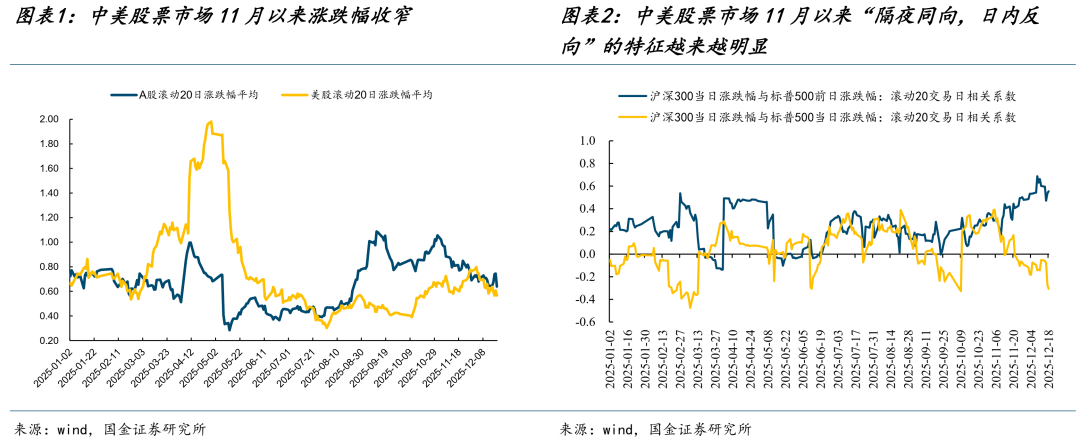
Group 1 - The market status indicates an increased correlation between the US and Chinese markets, with the 20-day rolling correlation of the CSI 300 and S&P 500 rising above the 90th percentile, reflecting a new normal of "overnight alignment and intraday reversal" [2][10][13] - The US core CPI has decreased to 2.6%, the lowest in three and a half years, while the unemployment rate has risen to 4.6%, primarily due to increased labor participation and temporary unemployment, indicating a stable economic environment without significant inflationary pressures [2][10][13] - China's economic fundamentals show a combination of corporate profit bottoming out and a decline in domestic demand, which opens a window for further policy support [2][10][13] Group 2 - The AI industry chain is experiencing a divergence, with broader AI-related assets (copper, lithium, aluminum, energy storage, and electrical equipment) performing better than core AI assets (computing chips, optical modules, PCB) [3][24][25] - Investors are becoming less tolerant of the contradiction between aggressive capital expenditures and the lack of revenue growth in companies within the AI industry chain, leading to a negative correlation between stock performance and capital expenditure as a percentage of revenue [3][24][25] - Commodity prices for copper, aluminum, tin, and lithium carbonate have been rising since late October, driven by demand from AI investments, with near-term contracts for copper and tin outperforming longer-term contracts [3][24][25] Group 3 - The concept of "expanding domestic demand" is emphasized as a strategic move, with a focus on increasing consumer demand supported by income growth and effective investment [4][31][32] - The government plans to enhance the second distribution of income by increasing minimum pension standards and implementing childcare subsidies, while future efforts may focus on optimizing the first distribution through wage reforms [4][31][32] - Historical examples from Japan and the US illustrate that income growth leads to increased service and new-type consumption, suggesting that China's current income growth initiatives could similarly boost consumer spending [4][31][32] Group 4 - The current market environment, characterized by limited macro elasticity and increased industry differentiation, suggests a shift in investment strategy towards tangible demand and domestic policy benefits as the new focus for 2026 [5][42][43] - Recommendations include investing in industrial resource products (copper, aluminum, tin, lithium, crude oil) that benefit from AI investment and global manufacturing recovery, as well as sectors poised for recovery in consumer spending (airlines, hotels, duty-free, food and beverages) [5][42][43] - Non-bank financial institutions (insurance, brokerage) are expected to benefit from capital market expansion and a rebound in long-term asset returns, alongside opportunities in China's equipment export chain and manufacturing sectors [5][42][43]

华源晨会精粹20251221-20251221
Hua Yuan Zheng Quan· 2025-12-21 12:29
证券研究报告 晨会 hyzqdatemark 2025 年 12 月 21 日 请务必仔细阅读正文之后的评级说明和重要声明 投资要点: 资料来源:聚源,华源证券研究所,截至2025年12月19日 华源晨会精粹 20251221 新消费 密集政策提振消费,海南自由贸易港封关运作正式启动——新消费行业周 报:扩大内需是战略之举,消费有关政策频出:中央经济工作会议提出八项明年经 济工作的重点任务,其中第一项重点任务为坚持内需主导,建设强大国内市场。12 月 15 日,《求是》杂志发表文章《扩大内需是战略之举》,文章强调要"牢牢把握 扩大内需这一战略基点",阐明了扩大内需对发展全局的基础支撑作用。商务部等 9 部门发布《关于扩大服务消费的若干政策措施》,提出五方面 19 条举措。商务部、 中国人民银行、金融监管总局联合发布《关于加强商务和金融协同,更大力度提振 消费的通知》。海南自由贸易港全岛封关运作正式启动,中免发布多重礼遇。根据 中免海南战报,12 月 18 日封关首日中免海南销售额超 2.5 亿元,同比增长 90%。 2025 年 1-11 月美容护肤品牌格局:TOP5 品牌主要由珀莱雅、欧莱雅、韩束、兰 蔻、 ...


下周A股,关键时刻!
Sou Hu Cai Jing· 2025-12-21 11:56
Group 1 - The A-share market is showing signs of a rebound, with the Shanghai Composite Index up 0.03%, while the Shenzhen Component Index and the ChiNext Index fell by 0.89% and 2.26% respectively [1] - The retail trade sector has seen a significant increase, with a rise of over 6%, making it the top-performing industry this week [2] - The overall average stock price in the A-share market decreased by 0.15%, but a continuous rally starting Wednesday has sparked market sentiment, indicating the beginning of an upward trend [1][3] Group 2 - The central government has emphasized the importance of expanding domestic demand as a key task for the upcoming year, with domestic demand contributing 71% to economic growth in the first three quarters of this year [2] - The hydrogen energy industry is at a critical commercialization stage, with a focus on green hydrogen production relying on renewable energy sources, which is expected to drive growth in the sector [4] - The non-bank financial sector is currently undervalued, and institutions are optimistic about the performance of brokerage firms as market activity picks up [4]
国金证券:迎接2026:告别单一叙事
Xuan Gu Bao· 2025-12-21 10:21
Group 1: Market Status - The correlation between A-shares and U.S. stocks has increased, with the 20-day rolling correlation of the CSI 300 and S&P 500 rising above the 90th percentile for the year, indicating a new normal of "overnight alignment, intraday reversal" [1][5][38] - Both the U.S. and China are in a phase characterized by limited upward elasticity and reduced downward risk, akin to a "Goldilocks" scenario, with the U.S. core CPI dropping to 2.6%, the lowest in three and a half years [1][8][9] - In China, corporate profitability has bottomed out, and the weakening of domestic demand creates a favorable environment for subsequent policy support [1][8] Group 2: AI Industry Chain - The investment in the AI industry chain is showing two key characteristics: broader macro effects benefiting "pan-AI" assets (copper, lithium, aluminum, energy storage, and electrical equipment) outperforming core AI assets (computing chips, optical modules, PCB) [2][17] - Investors are becoming less tolerant of the contradiction between aggressive capital expenditures and the lack of revenue growth in companies within the AI industry chain, leading to a negative correlation between stock performance and capital expenditure as a percentage of revenue [2][17][18] Group 3: Understanding "Expanding Domestic Demand" - The "income increase" plan aims to enhance net transfer payments to residents by 2025, with a focus on improving initial distribution through wage reforms, particularly in state-owned enterprises [3][25] - The expansion of consumption tax and adjustments in corporate income tax rates are expected to be seen in 2026, which may further stimulate domestic consumption [3][25][28] Group 4: Investment Strategy for 2026 - The current market conditions suggest a shift from a single industry narrative to a dual focus on "physical demand stimulation" and "domestic policy benefits," with recommendations to invest in industrial resource products (copper, aluminum, lithium, oil) and sectors benefiting from consumer recovery (airlines, hotels, food and beverages) [4][38] - Non-bank financial institutions (insurance, brokerage) are expected to benefit from capital market expansion and a bottoming out of long-term asset returns [4][38] - Opportunities are identified in China's equipment export chain and sectors showing signs of recovery in domestic manufacturing [4][38]

食品饮料行业周报:政策重视扩内需提消费26年重申看好顺周期方向-20251221
Shenwan Hongyuan Securities· 2025-12-21 10:12
Investment Rating - The report maintains a positive outlook on the food and beverage industry, particularly emphasizing the strategic importance of expanding domestic demand and consumption [3][8]. Core Insights - The report highlights the importance of expanding domestic demand as a strategic initiative for economic stability and security, with government agencies prioritizing this in their upcoming plans [3][8]. - Despite recent price fluctuations in high-end liquor, the report anticipates a recovery in the market, projecting a potential turning point in fundamentals by Q3 2026 [3][8]. - The report recommends several high-quality liquor companies for long-term investment, including Luzhou Laojiao, Shanxi Fenjiu, Guizhou Moutai, and Wuliangye, while also suggesting attention to other brands [3][8]. - For consumer goods, the report identifies opportunities in sectors like seasoning, frozen foods, and dairy, recommending companies such as Anjuke Foods, Yili, and QD Beer [3][8]. Summary by Sections 1. Weekly Insights on Food and Beverage - The food and beverage sector saw a 1.05% increase last week, with liquor experiencing a slight decline of 0.58% [7]. - The report ranks the food and beverage sector 13th among 31 sub-industries in terms of performance [7]. 2. Market Performance of Food and Beverage Sectors - The report provides detailed price updates for major liquor brands, noting Moutai's bottle price at 1545 RMB, a week-on-week increase of 45 RMB, and Wuliangye's price remaining stable at approximately 780 RMB [9][35]. - The report emphasizes the need for liquor companies to optimize their product matrices and channels to adapt to external pressures [9]. 3. Industry Matters - The report discusses the anticipated improvement in food CPI due to structural demand changes and a shift from price competition to quality competition among companies [3][8]. - It highlights the expected gradual recovery in the dairy sector, with recommendations for Yili and New Dairy [10][11]. 4. Valuation Table - The report notes the current dynamic PE for the food and beverage sector at 20.10x, with a premium rate of 24%, and for liquor at 18.49x, with a premium rate of 14% [35].


A股策略周报20251221:迎接2026:告别单一叙事-20251221
SINOLINK SECURITIES· 2025-12-21 09:39
Market Dynamics - Since November, the correlation between the A-share (CSI 300) and U.S. stock market (S&P 500) has increased, with a 20-day rolling correlation exceeding 90%[3] - The average daily fluctuation of the CSI 300 has narrowed to the 39.7th percentile, while the S&P 500 is at the 33.7th percentile, indicating reduced volatility in both markets[12] Economic Indicators - The U.S. core CPI has decreased to 2.6%, the lowest in three and a half years, while the unemployment rate has risen to 4.6%[3] - Despite the rise in unemployment, the increase is primarily due to higher labor participation and temporary unemployment, not triggering the "Sam's Rule" threshold[15] AI Industry Insights - Recent trends show a divergence in the AI investment chain, with "broad AI" assets (copper, lithium, aluminum) outperforming core AI assets (computing chips, optical modules)[4] - There is a negative correlation between the stock price performance of AI core stocks and their capital expenditure as a percentage of revenue, indicating investor concerns over capital spending not translating into revenue growth[4] Domestic Demand Expansion - The Chinese government emphasizes expanding domestic demand, with a focus on increasing consumer spending and investment driven by income growth[5] - By 2025, measures will be taken to enhance secondary distribution, including raising minimum pension standards and implementing childcare subsidies[5] Future Investment Strategies - Investment strategies should focus on sectors benefiting from physical demand and domestic policy incentives, including industrial resources (copper, aluminum, lithium) and consumer sectors (airlines, hotels, food and beverage)[6] - The report suggests a dual focus on both physical demand and consumption policies as a more reliable investment approach leading into 2026[6]
国金证券:迎接2026,告别单一叙事
Xin Lang Cai Jing· 2025-12-21 09:36
Group 1: Market Status - The correlation between A-shares and U.S. stocks has increased, with the 20-day rolling correlation of the CSI 300 and S&P 500 rising to over 90% since November, indicating a new norm of "overnight same direction, intraday reverse" [2][11][45] - Both the U.S. and Chinese economies are in a phase of "limited upward elasticity and reduced downward risk," with the U.S. core CPI falling to 2.6%, the lowest in three and a half years, and the unemployment rate rising to 4.6% primarily due to increased labor participation and temporary unemployment [2][13][47] - The Chinese economy shows signs of a bottom in corporate profits, while domestic demand is weakening, creating a favorable environment for subsequent policy support [2][13][47] Group 2: AI Industry Chain - The investment in the AI industry chain is showing two notable characteristics: first, "pan-AI" assets (copper, lithium, aluminum, energy storage, and electrical equipment) are performing better than core AI assets (computing chips, optical modules, PCB) [2][18][52] - Investors are becoming less tolerant of the contradiction between aggressive capital expenditures and the lack of revenue growth in companies within the AI industry chain, as evidenced by the negative correlation between stock performance and capital expenditure as a percentage of revenue [2][18][52] - Commodity prices for copper, aluminum, tin, and lithium carbonate have been rising since late October, driven by supply-demand dynamics, with near-term contracts for copper and tin outperforming longer-term contracts [2][19][53] Group 3: Understanding "Expanding Domestic Demand" - The articles published in "Qiushi" magazine emphasize the importance of consumer demand as a primary focus for expanding domestic demand, highlighting the need for a complete domestic demand system [3][24][58] - The strategy includes enhancing secondary distribution to increase residents' net transfer income and optimizing primary distribution to improve labor income, with potential reforms in state-owned enterprises to guide wage adjustments [3][25][58] - Historical examples from Japan and the U.S. show that periods of rising resident income lead to increased service and new-type consumption, indicating that the current "income increase plan" may boost demand for service consumption and technology-driven durable goods [3][27][58] Group 4: Preparing for 2026 - The current market conditions, characterized by limited macro elasticity and increased industry differentiation, suggest a shift in investment strategy towards "physical demand-driven" and "domestic demand policy dividends" as more certain avenues for growth [2][39][40] - Recommendations include focusing on industrial resource products (copper, aluminum, tin, lithium, crude oil, and oil transportation) that benefit from AI investment and global manufacturing recovery, as well as sectors like aviation, hotels, duty-free, and food and beverage that will benefit from increased consumer spending [2][32][39] - The non-bank financial sector (insurance, brokerage) is expected to benefit from capital market expansion and a bottoming out of long-term asset returns, alongside opportunities in China's equipment export chain and domestic manufacturing sectors [2][32][39]
行业周报:消费筑底政策共振,白酒或至底部重视布局-20251221
KAIYUAN SECURITIES· 2025-12-21 09:14
Investment Rating - The industry investment rating is "Positive" (maintained) [1] Core Viewpoints - Domestic demand policies empower consumption, and the liquor industry is entering a deep adjustment period. The food and beverage index increased by 1.0% from December 15 to December 19, ranking 11th among primary sub-industries, outperforming the CSI 300 by approximately 1.3 percentage points. Sub-industries such as baked goods (+8.0%), snacks (+7.5%), and pre-processed foods (+5.6%) performed relatively well. The recent emphasis on expanding domestic demand as a long-term strategy provides clear policy guidance and support for the consumption and food and beverage industries. The current consumption sector is entering a strategic opportunity period with intensive policy support, and the food and beverage industry, as a core sector of essential consumption, is expected to benefit directly from the domestic demand boost. Health, quality, and cost pressure alleviation are core trends, with leading companies showing resilient profitability. The liquor sector is currently in a bottoming phase, with strong brand power and multi-price range layouts expected to see valuation recovery. Dairy products and beer are also expected to experience a bottom reversal due to policy relief and low base effects. The current consumption sector shows bottom characteristics, with policy dividends and fundamental recovery resonating, presenting configuration value [3][10][12]. Summary by Sections Weekly Viewpoints - Domestic demand policies empower consumption, and the liquor industry is entering a deep adjustment period. The food and beverage index increased by 1.0%, outperforming the CSI 300 by approximately 1.3 percentage points. The sub-industries of baked goods, snacks, and pre-processed foods performed well [10][12]. Market Performance - The food and beverage index increased by 1.0%, ranking 11th among 28 industries, outperforming the CSI 300 by approximately 1.3 percentage points. Leading individual stocks included Huanlejia, Zhuangyuan Pasture, and Huangshi Group, while ST Xifa, Richen Shares, and Jinzi Ham saw declines [12][14]. Upstream Data - Some upstream raw material prices have declined. For instance, the price of whole milk powder fell by 18.7% year-on-year, and fresh milk prices decreased by 2.9% year-on-year. The domestic milk price is expected to continue its downward trend in the short term [17][21]. Liquor Industry Data - The international market for Wuliangye has shown strong growth in 2025, with the company focusing on global expansion and local operations. The liquor industry is currently in a deep adjustment phase, with demand decline driving price reductions. Companies are shifting from scale expansion to stock competition, realigning market shares based on actual consumer demand [45][46]. Recommended Portfolio - Recommended stocks include Guizhou Moutai, Shanxi Fenjiu, Ximai Food, Weilong Delicious, and Bairun Shares. Guizhou Moutai is focusing on sustainable development despite short-term demand pressures. Shanxi Fenjiu has high mid-term growth certainty, while Ximai Food is experiencing stable growth in its main business [4][50].
国债期货周报-20251221
Guo Tai Jun An Qi Huo· 2025-12-21 08:42
五 2025 年 12 月 21 日 二 〇 二 国债期货周报 年 度 唐立 投资咨询从业资格号:Z0021100 Tangli2@gtht.com 虞堪 投资咨询从业资格号:Z0002804 yukan@gtht.com 国 泰 君 安 期 货 研 究 所 报告导读: 摘要: 本周国债期货市场超长端有所修复。 请务必阅读正文之后的免责条款部分 1 期货研究 期货研究 1. 周度聚焦与行情跟踪 本周国债期货市场呈现日间温和修复,日内波动加剧的态势,资金面结构性宽松支撑短端表现,长端 修复走势优于短端。央行 18 日在公开市场开展 883 亿元 7 天期逆回购操作,利率维持在 1.40%,并同步进 行 1000 亿元 14 天期逆回购操作。年末前后央行开展 14 天期逆回购,可以有效平滑跨年资金面波动,引导 市场流动性处于较为稳定状态。据新华社消息,中央财办有关负责同志在中央经济工作会议后第一时间接 受中央主要媒体采访时表示,扩大内需是明年排在首位的重点任务。 前期 30-10 较为陡峭,推荐阶段性做平该段曲线,即看好短期超长端修复。 中期因央行货币政策相对克制、通胀预期转变、中长期资金入市导向、十五五政策预期 ...