
反内卷政策

Search documents
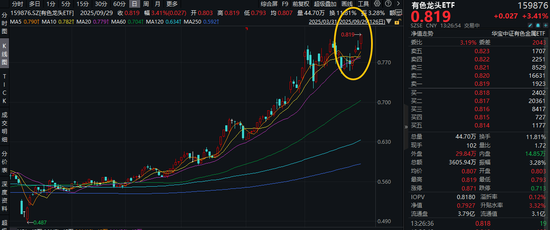
飙涨3%!有色龙头ETF(159876)创4年新高!机构:美联储仍处降息通道,有色金属可能震荡上涨
Xin Lang Ji Jin· 2025-09-29 05:42
9月28日,工信部等八部门印发《有色金属行业稳增长工作方案(2025-2026年)》,其中提到,2025- 2026年,有色金属行业增加值年均增长5%左右,十种有色金属产量年均增长1.5%左右,铜、铝、锂等 国内资源开发取得积极进展,再生金属产量突破2000万吨。 业内人士指出,我国"反内卷"政策的深度推进,将对工业产业链的上游和中游厂商产生积极影响。"反 内卷"已经成为重要的政策导向,有色板块的供需格局正在发生深刻变化。 3、反内卷政策与大型基建项目等形成合力:"反内卷"政策提出后,雅下水电工程等万亿级别的基建项 目启动,直接创造了对有色金属等原材料的巨大需求。 4、供需格局的持续改善:一方面,供给侧的约束驱动着有色金属的商品属性。《稀土开采和冶炼分离 总量调控管理暂行办法》发布,配额更严、环保更硬,稀土管控全面升级,市场瞬间嗅到"越管越稀 缺"的味道。而在需求侧,新能源、电动汽车、光伏、风电等绿色产业快速发展,对铜、铝、锂、稀土 等金属的需求形成强劲支撑。据国际能源署(IEA)预测,预计 2040 年全球新能源关键金属,如锂、 钴、镍等需求将比 2020年增加6倍,特别是用于电动汽车金属需求将至少增长30 ...

镍:底部运行,警惕供给端扰动
Guo Mao Qi Huo· 2025-09-29 05:39
1. Report Industry Investment Rating - Investment view: Range-bound trading [7] 2. Core Viewpoints of the Report - In Q4, the path of the Fed's interest rate cuts remains uncertain, and China's growth-stabilizing policies are expected to be rolled out. Affected by macro events, nickel prices are likely to consolidate at the bottom and are more sensitive to supply-side disturbances. Focus on mining news and macro changes in Q4, and the valuation range of pure nickel can refer to the production cost of integrated electrowon nickel (which fluctuates with ore prices). In terms of operations, short-term range trading is recommended, and combination strategies such as selling out-of-the-money call options can be used to increase returns, while paying attention to risk control [1]. 3. Summary by Relevant Catalogs 3.1 Market Review - In Q1, policies in nickel resource countries stimulated price increases; in Q2, trade conflicts and an intensified surplus led to a sharp decline; in Q3, the fundamentals were stable, and the Fed's interest rate cut in September provided a temporary boost. As of September 26, SHFE nickel closed at 121,380 yuan/ton, up 0.45% from mid-year, and LME nickel was reported at $15,230/ton, up 0.33% [8]. 3.2 Macro Analysis 3.2.1 Fed Interest Rate Cut - The Fed cut interest rates by 25bp in September, but the subsequent path remains uncertain. The economic outlook shows an upward adjustment of GDP growth expectations, while unemployment and inflation expectations are relatively stable [12][13]. - The US labor market has weakened significantly, with non-farm payrolls being persistently weak and the unemployment rate reaching a new high since October 2021. Inflation has been rising steadily, increasing market expectations for further interest rate cuts [21]. 3.2.2 China's Economic Situation - In H2, some macro data showed signs of weakening, including fixed asset investment and social consumption. The government may introduce new incremental measures in Q4, focusing on fiscal stimulus, central bank interest rate cuts, and stabilizing the real estate market [24][27]. - The "anti-involution" policies have been introduced, but their impact on the nickel industry chain is currently limited [28][29]. 3.3 Fundamental Analysis 3.3.1 Supply Side - Indonesia's nickel ore supply is stable, but there are risks of policy disturbances. The premium for nickel ore remains firm, and Indonesia's imports of nickel ore from the Philippines are increasing. The RKAB quota for 2026 will be re-approved in October, attracting market attention [31][32]. - China's nickel pig iron production has declined slightly, while Indonesia's production remains high but with a slowing growth rate. The import of nickel pig iron from Indonesia has increased year-on-year [43][44]. - The import of nickel intermediate products has increased, with a decline in the import of nickel matte. Indonesia's MHP production has increased significantly, while the production of nickel matte has decreased [51][54]. - The production of refined nickel has remained high, with both imports and exports increasing. The cost of integrated electrowon nickel production will be the focus of pure nickel valuation [58][68]. 3.3.2 Demand Side - The growth rate of stainless steel production has slowed down, and the demand has shown some resilience. The social inventory of stainless steel is gradually being depleted [70][80]. - The production of nickel sulfate has remained stable year-on-year, but the low proportion of ternary materials in power batteries has dragged down the demand for nickel. In the long term, solid-state batteries may drive the demand for high-nickel ternary materials [85][88]. - The consumption of nickel in alloy and special steel has maintained a certain growth rate, and attention should be paid to the situation of national stockpiling [92][93]. 3.3.3 Inventory - Global nickel inventory has continued to accumulate, and the spot premium has weakened slightly compared to mid-year [95]. 3.3.4 Supply-Demand Balance - The surplus pattern of primary nickel continues, and attention should be paid to supply-side disturbances in Q4. It is expected that China will have a surplus of 179,800 tons of primary nickel in 2025, and the global surplus will be 246,200 tons [100][102].
国债半年度报告:风险偏好提升,债券吸引力下降
Guo Mao Qi Huo· 2025-09-29 05:38
Report Summary 1. Report Industry Investment Rating No relevant content provided. 2. Core Viewpoints of the Report - The bond market experienced a significant downturn in the second half of 2025, mainly due to the rise of the equity market and commodities, as well as institutional behavior adjustments. However, in the fourth quarter, the bond market is expected to recover, supported by the coordinated efforts of monetary and fiscal policies and the relatively friendly monetary environment [2][37][47]. 3. Summary by Relevant Catalogs 3.1. Sharp Decline of Bond Futures in the Second Half of the Year - In 2025, the Treasury bond futures market was extremely volatile, with five distinct stages. From July onwards, all maturities of Treasury bond futures declined from their highs, and there was no obvious sign of stabilization in the short term. For example, the TL main contract dropped by more than 6% [3]. 3.2. Correction of Premature Pricing 3.2.1. Dominance of the Game between Institutions and the Central Bank - In the first half of the year, the market continued the bullish trend since November 2024. After the Politburo meeting and the Central Economic Work Conference, the market anticipated interest rate cuts and reserve requirement ratio cuts in advance, leading to a rapid decline in bond yields. However, the Central Bank took measures to cool down the market, including strict supervision, tightening of the capital market, and policy implementation, which weakened the bullish sentiment [11][12]. 3.2.2. Asset Rotation and Increased Risk Appetite - **Commodity Market**: In July, the anti - involution policy promoted the rise of certain commodities such as lithium carbonate, polysilicon, coking coal, and coke. The policy was later adjusted, and the enthusiasm in the commodity market subsided [20][24]. - **Equity Market**: Driven by factors such as technological innovation narratives and policy reforms, the domestic stock market had a strong bullish trend from July to September. Major indices such as the Shanghai Composite Index, Shenzhen Component Index, ChiNext Index, and CSI 300 all had significant increases, attracting funds from the bond market [28]. - **Institutional Behavior**: The revision of the regulations on public - offering fund sales fees and the possible cancellation of tax exemptions for public - offering fund dividends affected institutional behavior. Although there was some short - term panic selling, the long - term impact on the market structure was limited [34]. 3.3. Expected Recovery of the Bond Market in the Fourth Quarter - **Insufficient Attractiveness of Bond Yields**: In the past two years, the decline in bond yields was supported by the fundamental situation and the asset shortage environment. However, this year, the emergence of the equity market and the commodity market's bullish trends has led to a diversion of funds from the bond market [37]. - **Fundamentals as the Anchor**: The main negative factor for the bond market is the diversion of funds to risk assets. Although the short - term impact of asset linkage on the bond market is magnified, the market deviation will eventually be corrected. The monetary policy is expected to remain relatively loose, which is beneficial to the bond market [40]. - **Synergistic Efforts of Monetary and Fiscal Policies**: The Ministry of Finance and the Central Bank will cooperate more closely to improve the effectiveness of macro - policies. Considering the current economic situation, the fundamentals are still favorable for the bond market, and the bond market is expected to recover in the fourth quarter [46][47].
华泰证券今日早参-20250929
HTSC· 2025-09-29 05:21
Group 1: Macroeconomic Insights - The Japanese Liberal Democratic Party's presidential election is set for October 4, with significant implications for Japan's political and economic landscape, especially given the current loss of majority seats in both houses [2] - In August, industrial enterprise profits in China rebounded significantly to 20.4% year-on-year, up from -1.5% in July, primarily due to a low base effect from the previous year [2][3] Group 2: Fixed Income and Market Strategy - The current market environment suggests a shift towards mid-cap styles and a focus on sectors with high win rates, such as undervalued traditional sectors and non-bank varieties, as the appeal of chasing tech stocks diminishes [4] - The bond market is experiencing volatility, with the ten-year government bond yield surpassing 1.8%, indicating a critical juncture for the bond market [5] Group 3: Oil and Chemical Industry - The "Stabilization Growth Work Plan for the Petrochemical Industry (2025-2026)" aims to enhance high-end supply and regulate major project construction, which is expected to optimize supply and improve industry conditions [6] - The oil and gas sector is anticipated to see a decline in upstream profitability due to increased production by OPEC+, while downstream sectors are expected to benefit from improved demand and cost conditions [7] Group 4: Utilities and Environmental Sector - The profitability of major thermal power companies is expected to improve in Q3 2025, driven by increased electricity generation during peak summer months [8] - The green electricity sector is poised for growth as national subsidies accelerate, with a focus on cash flow and water price adjustments for environmental companies [8] Group 5: Key Companies - HSBC Holdings is positioned favorably due to its strategic focus on Asia and the recovery of the Hong Kong capital market, benefiting from anticipated interest rate cuts and increased capital inflows [10] - Hengrui Medicine is advancing its international strategy and innovation pipeline, with a target price set at 103.21 CNY for A shares and 114.27 HKD for H shares, reflecting strong growth potential [11]
旺季不旺,钢市震荡延续
Wu Kuang Qi Huo· 2025-09-29 05:04
旺季不旺,钢市震 荡延续 螺纹钢周报 2025/09/27 (黑色研究员) 0775-23375155 陈张滢 从业资格号:F03133652 从业资格号:F03098415 交易咨询号:Z0020771 赵航 (联系人) zhaoh3@wkqh.cn 周度评估及策略推荐 需求端 利润 供给端 期现市场 ◆ 需求端:本周螺纹表需220万吨,前值210万吨,环比+4.8%,同比-13.7%,累计需求8083万吨,同比-4.8%。 本周需求环比小幅上升,受到地产端需求拖累,虽然进入到传统旺季,但螺纹钢的实际需求表现偏弱。 ◆ 进出口:钢坯08月进口4.0万吨。 库存 周度评估及策略推荐 周度要点小结 ◆ 供应端: 本周螺纹总产量206万吨,环比+0%,同比+6.30%,累计产量8319.43万吨,同比+0.05%。长流程产量184万吨,环比+2.23%, 同比+7.48%,短流程产量23万吨,环比-14.96%,同比-2.40%。 本周铁水日均产量为242.36万吨,旺季铁水产量持续维持在240万吨以上水准。利润方面,华东地区螺纹高炉利润维持30元/吨附近,即期 利润小幅回升;谷电利润为-31元/吨,价格表现中性 ...
大越期货玻璃周报-20250929
Da Yue Qi Huo· 2025-09-29 02:34
Report Industry Investment Rating - Not provided Core Viewpoints - Last week, the glass futures first rose and then fell. The closing price of the main contract FG2601 increased by 2.96% compared with the previous week, reaching 1252 yuan/ton. The spot price of white glass sheets in Hebei Shahe was 1148 yuan/ton, up 6.30% from the previous week [3]. - The fundamentals of the glass industry show limited improvement. In the short term, it is expected to mainly operate in a weak and volatile manner [3]. - The main logic is that glass supply has declined to a relatively low level in the same period, and downstream has carried out phased replenishment, leading to a reduction in glass factory inventories. However, the sustainability of subsequent inventory reduction is questionable, and it is expected that glass will mainly operate in a wide - range volatile manner [6]. Summary by Directory Glass Futures and Spot Weekly Market - The closing price of the main contract was 1252 yuan/ton, up 2.96% from the previous week. The spot benchmark price was 1148 yuan/ton, up 6.30%. The main basis was - 104 yuan/ton, down 23.53% [7]. Glass Spot Market - The market price of 5mm white glass sheets in Hebei Shahe, the spot benchmark, was 1148 yuan/ton, up 6.30% from the previous week [12]. Fundamental Analysis - Cost and Profit - Not detailed in the report Fundamental Analysis - Supply - The number of operating float glass production lines nationwide was 225, with an operating rate of 76.01%. The number of operating production lines was at a historical low in the same period [21]. - The daily melting volume of national float glass was 160,700 tons, with the production capacity at the lowest level in the same period in history and showing a stable recovery [23]. Fundamental Analysis - Demand - In June 2025, the apparent consumption of float glass was 4.634 million tons [27]. Fundamental Analysis - Inventory - The inventory of national float glass enterprises was 59.355 million weight boxes, down 2.55% from the previous week, and the inventory was running above the five - year average [42]. Fundamental Analysis - Supply - Demand Balance Sheet - The report provides a float glass annual supply - demand balance sheet from 2017 to 2024E, including data on production, consumption, production growth rate, consumption growth rate, and net import ratio [43]. Influencing Factors Bullish Factors - Under the influence of the "anti - involution" policy, there is an expectation of capacity clearance in the float glass industry [4]. Bearish Factors - The terminal demand in the real estate sector remains weak, and the number of orders from glass deep - processing enterprises is at a historical low in the same period [5]. - The capital collection in the deep - processing industry is not optimistic. Traders and processors are cautious, mainly focusing on digesting raw glass inventories [5]. - The market sentiment of "anti - involution" has subsided [5].
大越期货玻璃早报-20250929
Da Yue Qi Huo· 2025-09-29 02:34
交易咨询业务资格:证监许可【2012】1091号 大越期货投资咨询部 胡毓秀 从业资格证号:F03105325 投资咨询证号:Z0021337 联系方式:0575-85226759 重要提示:本报告非期货交易咨询业务项下服务,其中的观点和信息仅作参考之用,不构成对任何人的投资建议 。 我司不会因为关注、收到或阅读本报告内容而视相关人员为客户;市场有风险,投资需谨慎。 玻璃早报 2025-9-29 每日观点 玻璃: 1、基本面:玻璃生产利润回落,行业冷修高位,开工率、产量下降至历史同期低位;下游深加工 订单整体偏弱,不及往年同期,地产终端需求疲弱;偏空 2、基差:浮法玻璃河北沙河大板现货1148元/吨,FG2601收盘价为1252元/吨,基差为-104元,期 货升水现货;偏空 3、库存:全国浮法玻璃企业库存5935.50万重量箱,较前一周减少2.55%,库存在5年均值上方运 行;偏空 4、盘面:价格在20日线上方运行,20日线向上;偏多 5、主力持仓:主力持仓净空,空增;偏空 6、预期:玻璃基本面疲弱,短期预计震荡运行为主。 影响因素总结 利多: 1、"反内卷"政策影响下,浮法玻璃行业存产能出清预期。 利空: ...
企业利润修复,工业硅区间震荡
Tong Guan Jin Yuan Qi Huo· 2025-09-29 01:53
Report Overview - Report Date: September 29, 2025 [1] - Title: Corporate Profit Recovery, Industrial Silicon Rangeside Fluctuation 1. Report Industry Investment Rating - Not provided in the given content 2. Core Views - Last week, industrial silicon fluctuated within a range. The main reasons were the overall cooling of the domestic industrial product market sentiment, the high - level decline of polysilicon futures with obvious support below, the significant year - on - year increase in the profit growth rate of Chinese industrial enterprises, and the entry of the anti - involution policy effect into the implementation period. The supply side was generally stable, and the demand side had mixed performance. The industrial silicon spot market operated steadily due to the range - bound fluctuation of the futures [2][5][9]. - Overall, China's anti - involution policy effect is in the implementation period, the corporate profits at the silicon material end are continuously recovering, the year - on - year growth rate of industrial enterprise profits has increased significantly, the industrial product market sentiment has cooled but the price center has stabilized. Technically, the 8800 level on the futures chart still has strong support. Although the polysilicon futures' high - level decline slightly dampens short - term sentiment, the futures price is expected to maintain a relatively strong range - bound fluctuation in the short term [2][9] 3. Summary by Directory 3.1 Market Data | Contract | September 26 | September 19 | Change | Change Rate | Unit | | --- | --- | --- | --- | --- | --- | | Industrial Silicon Main Contract | 8960.00 | 9305.00 | - 345.00 | - 3.71% | Yuan/ton | | Oxygen - Blown 553 Spot | 9500.00 | 9350.00 | 150.00 | 1.60% | Yuan/ton | | Non - Oxygen - Blown 553 Spot | 9300.00 | 9100.00 | 200.00 | 2.20% | Yuan/ton | | 421 Spot | 9700.00 | 9600.00 | 100.00 | 1.04% | Yuan/ton | | 3303 Spot | 10550.00 | 10450.00 | 100.00 | 0.96% | Yuan/ton | | Organic Silicon DMC Spot | 11050.00 | 10800.00 | 250.00 | 2.31% | Yuan/ton | | Polysilicon Dense Material Spot | 51.00 | 51.00 | 0.00 | 0.00% | Yuan/ton | | Industrial Silicon Social Inventory | 54.3 | 54.3 | 0 | 0.00% | Ten thousand tons | [3] 3.2 Market Analysis and Outlook - **Macro Aspect**: In August, the total profit of China's above - scale industrial enterprises increased by 20.4% year - on - year, and the cumulative year - on - year growth from January to August was 0.9%. The equipment manufacturing industry played an obvious "ballast stone" role [6]. - **Supply Aspect**: The operating rate in Xinjiang remained at 69%. The output in Sichuan and Yunnan during the wet season continued to decline, and the new production capacity in Inner Mongolia and Gansu was limited. The overall supply was stable. As of September 26, the weekly output of industrial silicon was 95,600 tons, a month - on - month increase of 0.94% and a year - on - year increase of 0.21%. The number of open furnaces in the three major production areas of industrial silicon was 310, and the overall furnace - opening rate was maintained at 38.9% [5][6][9]. - **Demand Aspect**: The quotation center of polysilicon moved up again, but silicon enterprises faced large inventory pressure, and the production cut in October might still be less than expected. The space for silicon wafers to support prices in the future was limited, and the market sentiment weakened. The supply and demand of photovoltaic cells remained in a tight balance, and the demand for high - efficiency cells was good. Leading enterprises at the component end showed signs of reluctant to sell, the centralized price increased slightly, but the terminal tender volume decreased, and some projects continued to postpone construction. The recycling of old photovoltaic components will become an important issue in the industry. The winning bid price range of components disclosed last week was 0.69 - 0.75 yuan/watt [2][5][7]. - **Inventory Aspect**: As of September 26, the national social inventory of industrial silicon remained at 543,000 tons, unchanged from the previous period. The exchange - registered warehouse receipt volume continued to increase. After the exchange introduced the new standard for delivery products, most of the 4 - series warehouse receipts could not be re - registered due to excessive titanium content, and the 5 - series warehouse receipts that met the new standard were actively registered and stored, becoming a new source of warehouse receipt inventory [8] 3.3 Industry News - As of the end of August, the country's cumulative installed power generation capacity was 3.69 billion kilowatts, a year - on - year increase of 18.0%. Among them, the installed capacity of solar power generation was 1.12 billion kilowatts, a year - on - year increase of 48.5%; the installed capacity of wind power was 580 million kilowatts, a year - on - year increase of 22.1%. From January to August, the cumulative average utilization hours of the country's power generation equipment were 2105 hours, 223 hours less than the same period last year [10]. - South Africa added about 928MW of photovoltaic installed capacity in the first quarter of 2025. It is expected that the new installed capacity this year will exceed 1.1GW in 2024. As of mid - 2025, the cumulative photovoltaic installed capacity in South Africa was estimated to be 9457MW. In July this year, the South African government approved six new photovoltaic projects in the seventh - round procurement, with a total installed capacity of 1290MW. The South African market is gradually adopting the scheme of matching energy storage with renewable energy, and the commercial and industrial market has good prospects, while the residential photovoltaic market shows signs of slowing down [11]. - On September 5, the Hebei Provincial Development and Reform Commission issued a notice on the second batch of projects in the 2025 annual development and construction plan for wind power and photovoltaic power generation in Hebei Province. This batch included 76 projects with a total capacity of 7.27107 million kilowatts, including 42 photovoltaic projects with a total scale of 3.12907 million kilowatts and 34 wind power projects with a total scale of 4.142 million kilowatts [11] 3.4 Related Charts - The report includes charts on industrial silicon production, exports, social inventory, Guangzhou Futures Exchange warehouse receipt inventory, weekly production in main production areas, organic silicon DMC production, polysilicon production, and spot prices of various grades of industrial silicon, polysilicon, and organic silicon [13][14][15][17][18]
工业经济释放向好积极信号
Zheng Quan Ri Bao· 2025-09-29 00:56
Core Insights - The profit of industrial enterprises above designated size in China reached 46,929.7 billion yuan in the first eight months, showing a year-on-year increase of 0.9% [1] - August saw a significant recovery with a 20.4% year-on-year profit growth, reversing the 1.5% decline in July [1][2] - The improvement in profits is attributed to macroeconomic policies, the deepening of a unified national market, and a low base from the previous year [1][2] Summary by Category Profit Trends - The profit growth of industrial enterprises turned from a 1.7% decline in the first seven months to a 0.9% increase in the first eight months, ending a continuous decline since May [2] - The operating income of these enterprises grew by 2.3% year-on-year, consistent with the previous seven months, while August's income growth accelerated to 1.9% [2] Performance by Enterprise Size - Profits improved across different enterprise sizes, with private enterprises showing a notable acceleration in profit growth [2] - Medium and small enterprises saw profit increases of 2.7% and 1.5% respectively, while large enterprises experienced a reduced decline of 4.6 percentage points compared to the previous seven months [2] Industry Performance - The equipment manufacturing sector played a crucial role, with profits growing by 7.2% in the first eight months, contributing 2.5 percentage points to the overall profit growth of industrial enterprises [3] - Among the eight industries within equipment manufacturing, seven reported profit growth, with rail, shipping, and aerospace industries seeing increases of 37.3% and 11.5% respectively [3] Structural Changes - In August, industrial profits exhibited a pattern of declining volume but rising prices, indicating a shift in profit distribution favoring upstream industries [4] - The raw materials manufacturing sector saw a profit increase of 22.1%, while consumer goods manufacturing profits turned from a 2.2% decline to a 1.4% increase [3] Future Outlook - Projections indicate that industrial profits will continue to rise in September, supported by a low base from the previous year and ongoing price increases in most industries [4] - However, challenges remain due to insufficient downstream demand, which may hinder profit recovery for downstream enterprises [4]
公募基金规模再创历史新高 股票ETF成吸金主力
Zhong Guo Zheng Quan Bao· 2025-09-28 22:14
Core Insights - The total scale of public funds in China reached a historic high of 36.25 trillion yuan as of the end of August, marking the first time it has surpassed 36 trillion yuan [2][4] - The significant increase in public fund scale, nearly 1.2 trillion yuan in August alone, reflects a notable recovery in investor confidence, particularly in stock funds [1][2] - Stock funds saw a monthly growth of over 600 billion yuan, primarily driven by stock ETFs, while mixed funds faced redemption pressures [1][3] Fund Scale and Composition - As of the end of August, the net asset value of public funds totaled 36.25 trillion yuan, with closed-end funds at 3.72 trillion yuan and open-end funds at 32.53 trillion yuan [2] - Open-end stock fund scale reached 5.55 trillion yuan, up from 4.92 trillion yuan at the end of July, indicating a growth of over 600 billion yuan [2] - Mixed funds increased to 4.16 trillion yuan from 3.83 trillion yuan, showing a growth of over 300 billion yuan [2] ETF Performance - Stock ETFs contributed significantly to the growth, with their scale increasing by 394.2 billion yuan and their shares rising by 24.071 billion [3] - Despite the overall growth in mixed funds, their share decreased, indicating some investors opted for "sell at breakeven" strategies [3] Bond Fund Trends - Bond funds experienced a decline in both scale and share, with negative returns reported for several bond funds in August [4] - However, certain bond ETFs, particularly convertible bond ETFs and 30-year treasury bond ETFs, saw growth, with the former contributing over 21 billion yuan to the scale increase [4] Market Outlook - The public fund scale is expected to continue rising, supported by ongoing inflows of incremental capital and a positive market cycle characterized by increasing returns and stable market conditions [1][6] - The A-share market is anticipated to benefit from macroeconomic improvements and the ongoing development of technology sectors, particularly artificial intelligence [6]