
电解铝

Search documents
2026年金属年度策略:百花盛开
2025-12-08 00:41
Summary of Key Points from Conference Call Records Industry Overview - The conference call discusses the outlook for the non-ferrous metals industry in 2026, predicting a vibrant year with strong performance expected, likely not inferior to 2025. The macroeconomic environment is favorable, with the US economy projected to experience GDP growth and continued liquidity easing, including potential interest rate cuts and expansive fiscal policies. The global manufacturing PMI has rebounded above 50, indicating a positive trend in manufacturing [2][4] Key Insights and Arguments - **Macroeconomic Conditions**: The US is expected to implement two to three interest rate cuts in 2026, with high deficits and loose fiscal policies likely to persist in the short term. This environment is beneficial for most commodities, especially those without severe supply-side excesses [4] - **China's Economic Outlook**: China's export pressures are expected to ease, with a gradual convergence in the real estate market's downward trend. Domestic liquidity is anticipated to align with global trends, creating a favorable environment for commodities, particularly those with supply-side constraints [5] - **Gold Market**: The marginal pricing of gold is changing, with central banks increasing their gold reserves, currently at about 20% of total reserves, which is below the historical median. Gold prices are expected to maintain a stable or upward trend, potentially exceeding $4,800 in 2026 [7] - **Aluminum Market**: Global electrolytic aluminum production is projected to increase by approximately 1.2 million tons in 2026, with demand growth outpacing supply growth. This is expected to lead to further price increases due to low inventory levels [8][9] - **Copper Market**: The global copper supply is expected to increase by about 600,000 tons in 2026, with demand growth projected at 2.7%. Copper prices are anticipated to exceed $12,000, with potential to reach $13,000, driven by low inventory and strong demand [10][11] Additional Important Content - **Steel Industry Dynamics**: The construction sector's demand for steel has decreased, but export demand remains strong. Overall steel demand is expected to be neutral, with a potential slight decline or increase depending on market conditions. The iron ore price is projected to average above $90 per ton, with a slow downward trend [12] - **Investment Strategies**: For the steel sector, it is recommended to focus on leading companies with low valuations and good profitability, while the aluminum sector is seen as undervalued but with high dividend yields. Both sectors are considered worthy of investment [14] - **Concerns about Substitute Materials**: The potential for substitutes like aluminum replacing copper is deemed overstated, as technological advancements and industry standards make such transitions difficult. The market is showing increased interest in non-ferrous metals, indicating a positive outlook for related stocks [13] This summary encapsulates the key points discussed in the conference call, providing insights into the non-ferrous metals industry and its future outlook.
财通证券:春季躁动的十问十答
Xin Lang Cai Jing· 2025-12-07 07:07
Core Viewpoint - The market is transitioning towards a "spring rally" with potential catalysts emerging, particularly as the year-end approaches and new policies are anticipated [2][13]. Group 1: Market Trends and Strategies - The strategy for 2026 emphasizes embracing "Galloping Assets" which are global competitive leaders, indicating a shift towards value reassessment [1][12]. - The A-share market has shown a recovery with the Shanghai Composite Index rising over 10% to above 3800 points [1][12]. - The current market phase is characterized by a period of observation and consolidation, with the potential for a spring rally to begin as early as December [2][13]. Group 2: Spring Rally Insights - The "spring rally" is expected to occur around the Lunar New Year, typically 1-2 weeks prior, with historical data suggesting a strong upward trend during this period [3][5]. - The likelihood of a spring rally varies based on market conditions: high during bottom-stimulus periods, moderate during continuation phases, and limited during downturns [4][6]. - Key indicators for the timing of the rally include significant new positive or negative developments, with potential early triggers in December [6][10]. Group 3: Sector and Style Preferences - The market favors smaller-cap indices like CSI 1000 and CSI 2000, which have shown a nearly 90% success rate with an average excess return of over 4% [6][19]. - Growth and technology sectors are highlighted as having an 80% success rate, also with an average excess return of over 4% [7][19]. - The top-performing industries are expected to be in the first tier: computer, communication, and electronics, with a second tier including machinery, chemicals, and military industries, all showing excess returns of over 3% [8][19]. Group 4: Long-term Investment Directions - The focus for long-term investments includes quality cyclical stocks benefiting from policy expectations in sectors like real estate, consumer goods, and resources [10][20]. - The strategy for the upcoming year includes a focus on "Galloping Assets" that align with China's economic transformation and global competition, particularly in technology, high-end manufacturing, consumption, and resource sectors [10][20].

【股市20251205】
债券笔记· 2025-12-05 12:54
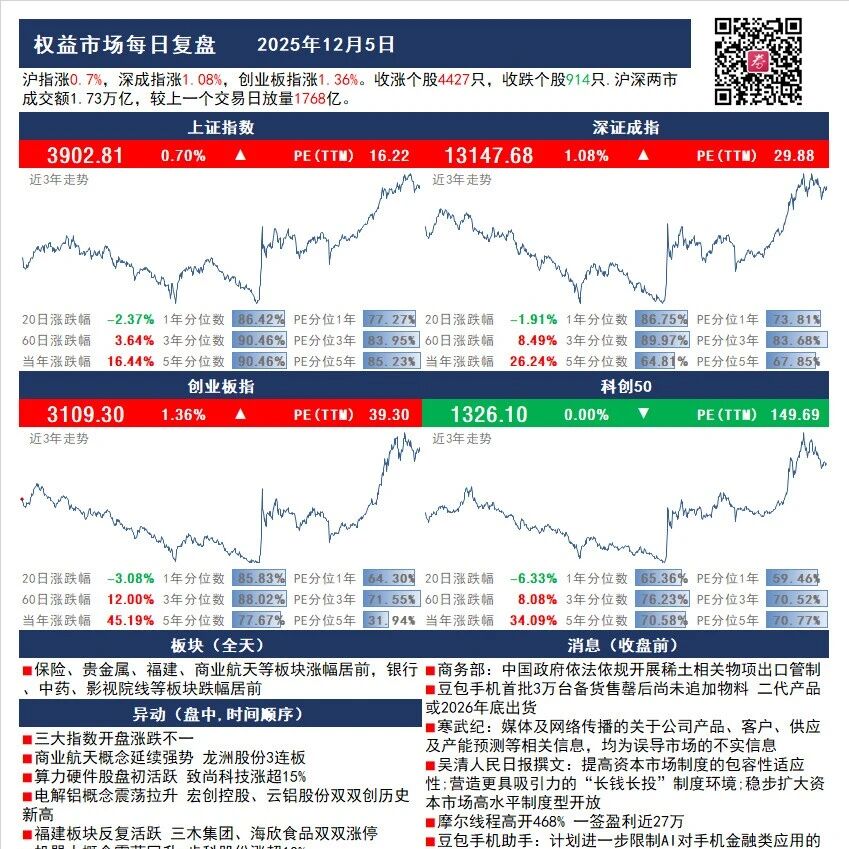
Market Overview - The Shanghai Composite Index rose by 0.7% to 3902.81, while the Shenzhen Component Index increased by 1.08% to 13147.68, and the ChiNext Index gained 1.36% to 3109.30 [1][2] - A total of 4427 stocks closed higher, while 914 stocks closed lower, indicating a positive market sentiment [1][3] - The trading volume in the Shanghai and Shenzhen markets reached 1.73 trillion, an increase of 176.8 billion compared to the previous trading day [1] Performance Metrics - The 20-day performance for the Shanghai Composite Index showed a decline of 2.37%, while the Shenzhen Component Index experienced a decrease of 1.91% [2] - The annual performance for the Shanghai Composite Index is up by 16.44%, and the Shenzhen Component Index has increased by 26.24% [2] - The ChiNext Index has seen a significant annual increase of 45.19% [2] Sector Performance - Sectors such as insurance, precious metals, and commercial aerospace showed strong gains, while traditional sectors like Chinese medicine and film exhibition faced declines [2] - The electric aluminum concept stocks experienced volatility, with companies like Hongchuang Holdings and Yun Aluminum reaching historical highs [2] - The robotics sector saw a rebound, with companies like Boke Technology rising over 10% [2] Notable Stock Movements - The stock of Moer Thread opened high with a 468% increase, leading to significant profits for investors [2] - Companies in the Fujian sector, such as Sanmu Group and Haixin Food, reached their daily limit [2] - The AI glasses concept saw a surge, with Doctor's Glasses rising over 10% [2] Market Sentiment - The overall market sentiment is improving, with a board sealing rate close to 80% [2] - The National Development and Reform Commission has allocated 35.5 billion for investment projects, indicating government support for economic growth [2]




「焦点复盘」创业板指2连涨收复60日线,全市场近百股涨超10%,算力硬件股卷土重来
Sou Hu Cai Jing· 2025-12-05 09:47
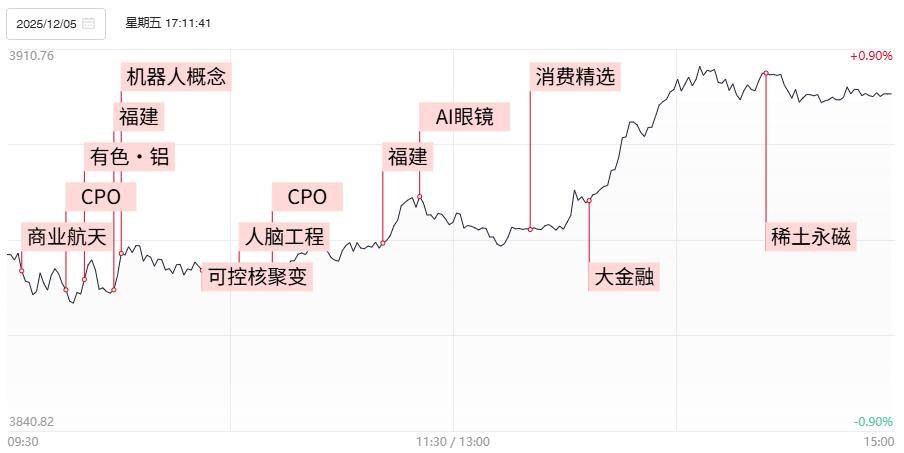
Market Overview - A total of 73 stocks hit the daily limit up, while 21 stocks faced limit down, resulting in a sealing rate of 78%. Notable stocks include Sun Cable and Anji Food with four consecutive limit ups, and Longzhou Co., Guoji Heavy Industry, and Junya Technology with three consecutive limit ups [1][3] - The market showed signs of recovery, with the ChiNext index rising over 1%. The Shanghai and Shenzhen stock exchanges recorded a trading volume of 1.73 trillion yuan, an increase of 176.8 billion yuan compared to the previous trading day [1][9] - The Shanghai Composite Index rose by 0.7%, the Shenzhen Component Index increased by 1.08%, and the ChiNext Index gained 1.36% [1] Stock Performance Analysis - The upgrade rate for consecutive limit-up stocks reached 70%, with seven stocks achieving three or more consecutive limit ups. High-level stocks showed unexpected recovery, with previously halted stocks like Hai Xin Food and Shunhao Co. achieving limit ups again [3][4] - The sectors that performed well included insurance, precious metals, Fujian, and commercial aerospace, while banking, traditional Chinese medicine, and film and television sectors faced declines [1][3] Sector Highlights - The commercial aerospace sector continues to gain momentum, with companies like Longzhou Co. and Aerospace Machinery achieving significant gains. Upcoming launches of new commercial rockets are expected to provide ongoing support for this sector [5] - The optical communication sector remains strong, with companies like Lumentum and Coherent reaching historical highs. The demand for optical chips is projected to grow significantly due to advancements in AI and computing technologies [6][20] - The non-ferrous metals sector is experiencing robust performance, with copper and aluminum prices reaching new highs. The demand for copper is particularly strong, driven by global supply constraints [8][22] Financial Sector Developments - The financial regulatory authority announced adjustments to risk factors for insurance companies, leading to a significant rally in the non-bank financial sector. The insurance sector saw gains of over 5%, with China Ping An nearing previous highs [7] - The fintech sector is expected to grow significantly, with projections indicating that Chinese residents' financial assets will reach 440 trillion yuan by 2030, growing at an annual rate of 8% [30] Consumer Goods and Food Sector - The food and beverage sector is benefiting from government initiatives to expand quality goods and services. Stocks like Xiwang Food and Yuanzi Co. have shown positive performance [33][34] - The home decoration sector is also seeing growth, with significant increases in furniture and appliance sales reported [35][36]

走出低通胀(四):供给侧改革为什么能够成功?
China Securities· 2025-12-03 13:45
Group 1: Supply-Side Reform Background - The supply-side reform aims to address excessive capacity in the midstream and upstream sectors after a decade of expansion in export manufacturing and significant infrastructure investment[1] - In 2015, the capacity utilization rate of industrial enterprises in China fell to 74%, below the international standard of 75% for severe overcapacity[8] - By 2015, 13 out of 14 major industrial sectors were experiencing severe overcapacity, particularly in heavy industries like steel and coal[9] Group 2: Causes of Overcapacity - Overcapacity was primarily driven by excessive external and internal demand expansion, leading to abnormal capacity growth[2] - Local governments, incentivized by GDP growth targets, contributed to overcapacity by supporting state-owned enterprises in upstream investments[2] - The overcapacity issue was exacerbated by repeated construction of heavy industrial projects, driven by local government interests in boosting GDP and tax revenues[10] Group 3: Economic Impact - From 2012 to 2015, domestic industrial prices plummeted, with the Producer Price Index (PPI) recording negative values for three consecutive years[10] - By 2015, the total debt in six overcapacity industries reached 10 trillion yuan, with 8.7 trillion yuan classified as debt[15] - The banking sector faced rising non-performing loan rates, with the total non-performing loan balance reaching 1.2744 trillion yuan by the end of 2015, a 51.2% increase from the previous year[65] Group 4: Capacity Reduction Strategies - The reform included three main strategies: administrative capacity reduction, industry self-discipline with staggered production, and market-driven natural clearance[17][18][79] - Administrative measures focused on controlling new capacity, eliminating outdated capacity, and encouraging enterprise restructuring, particularly in state-dominated sectors like steel and coal[17] - The steel industry saw a reduction of 120 million tons of crude steel capacity from 2016 to 2017, achieving 80% of its capacity reduction target[28] Group 5: Outcomes of Supply-Side Reform - The steel industry's capacity utilization improved significantly, with the industry concentration rising to 60% by 2020[29] - The coal industry eliminated 810 million tons of capacity between 2016 and 2018, exceeding the targets set for the 13th Five-Year Plan[30] - The cement industry's profits increased from 33 billion yuan in 2015 to 154.6 billion yuan in 2018, reflecting improved pricing and profitability[33]
有色钢铁行业周观点(2025年第48周):金铜的跨年行情或将展开,有色布局正当时-20251201
Orient Securities· 2025-12-01 01:43
Investment Rating - The report maintains a "Buy" rating for the non-ferrous and steel sectors, indicating a positive outlook for investment opportunities in these industries [9][10]. Core Viewpoints - The report suggests that a cross-year market for gold and copper may unfold, making it an opportune time to invest in non-ferrous metals [9][10]. - It highlights that the copper supply shortage is expected to continue, which may drive up copper prices, while strict control over smelting capacity could lead to improved profitability for midstream players [9][10]. - The report also emphasizes the bullish outlook for gold prices, projecting a rise to $4,500 per ounce by the end of 2025 and potentially exceeding $5,000 per ounce in 2026 [9][10]. - For the electrolytic aluminum sector, the report suggests that despite recent stock dilution, the overall supply-demand dynamics remain intact, presenting opportunities for investment [9][10]. Summary by Sections Non-Ferrous Metals - The report notes a 3.37% increase in the non-ferrous metals sector, driven by a significant rise in copper prices due to supply constraints and inflation expectations [9][10]. - It highlights the historical high copper premium set by Codelco, which is expected to further tighten supply [9][10]. - The report recommends focusing on investment opportunities in copper, gold, and aluminum sectors [9][10]. Steel Industry - The report indicates a slight decrease in iron and steel production, with rebar consumption at 2.28 million tons, down 1.23% week-on-week but up 1.15% year-on-year [16][21]. - It mentions that overall steel inventory continues to decline, with total social and steel mill inventories down by 2.15% [23][24]. - The profitability of most steel products has significantly improved due to rising costs, with the average price index for common steel rising by 0.42% [26][35]. New Energy Metals - The report states that lithium carbonate production in October 2025 saw a significant year-on-year increase of 67.28%, indicating strong supply growth [39][40]. - It also notes that the production of new energy vehicles continues to grow, with October 2025 production reaching 1.68 million units, up 19.94% year-on-year [43][46]. - The report highlights price increases in lithium and cobalt, with lithium carbonate priced at 93,300 yuan per ton, reflecting a slight decrease of 0.27% week-on-week [49][50].



西部研究月度金股报告系列(2025年12月):冰火转换继续,12月如何布局?-20251130
Western Securities· 2025-11-30 09:22
Group 1 - The current A-share bull market is part of a six-year global liquidity expansion driven by post-2020 monetary easing, with systemic revaluation of key assets such as gold, US tech stocks, and European/Japanese manufacturing [1][11] - The return of cross-border capital to China is expected to systematically reassess the competitive advantages of Chinese manufacturing, particularly in sectors like new energy, chemicals, and medical devices [2][12] - The A-share market is likely to experience volatility in 2026, with either a stagnation of the bull market or a "Davis Double Play" in consumer sectors, as external exports may not drive profits due to high base effects [3][13] Group 2 - The industrialization maturity phase in China has led to a bull market for core assets, driven by improved domestic consumption and the ability of manufacturing to generate national wealth through exports [4][14] - The recommendation for industry allocation focuses on a combination of "existing," "new," and "high" sectors, emphasizing non-ferrous metals, new consumption trends, and high-end manufacturing [5][14] Group 3 - The investment logic for China Hongqiao includes short-term price increases in electrolytic aluminum and long-term growth driven by integrated operations and high dividends [17][19] - For Luoyang Molybdenum, the investment rationale is based on the rising copper cycle and diversified product offerings, with a focus on sustainable growth [20][22] - Huafeng Aluminum is positioned for growth through high-end aluminum processing and international expansion, capitalizing on trends in the automotive sector [25][28] Group 4 - Nanjing Steel's strategy involves creating a fully integrated supply chain and exploring new growth points to stabilize returns on equity [29][32] - Dongfang Tower's investment logic is driven by rising prices of potassium chloride and phosphate rock, with ongoing capacity expansion [33][36] - Luxshare Precision is transitioning to an AI hardware manufacturer, benefiting from increased demand for computing power and AI models [37][40] Group 5 - Great Wall Motors is focusing on high-end SUVs and global expansion, with new model launches expected to drive sales [41][44] - Leap Motor is leveraging competitive pricing and differentiation in the domestic and overseas markets, with new models and subsidies supporting growth [45][48] - Heng Rui Pharmaceutical is advancing its clinical pipeline with over 100 innovative products, aiming for significant growth through international collaborations and new product approvals [49][51] Group 6 - Yifeng Pharmacy is expected to improve its market share through enhanced operational efficiency and strategic store adjustments [54][59] - Dongfang Electric is positioned to benefit from rising global demand for gas turbines, driven by AI-related power needs [60][63]




2家过会1家暂缓丨IPO一周要闻
Sou Hu Cai Jing· 2025-11-30 00:12
Group 1: IPO Review and Approval - This week, the Beijing Stock Exchange (BSE) concluded its IPO review, with 3 companies undergoing scrutiny and 2 successfully passing the review [2] - Yongda Co., Ltd. became the first project this year to have its IPO review postponed, raising market concerns due to ongoing issues regarding the sustainability of its performance and the rationality of its fundraising projects [2] - Yongda has adjusted its fundraising plans twice during the review process, eliminating a liquidity support project and reducing the proposed investment scale for its "Heavy Chemical Equipment Production Base Phase I" project, adding uncertainty to its review [2] Group 2: Companies Approved for IPO - Kunshan Haifiman Technology Group Co., Ltd. was approved for IPO, specializing in high-end audio products under the brand "HIFIMAN," with projected revenues of 1.54 billion yuan in 2022 and a net profit of 360 million yuan [3] - Dalian Meidele Industrial Automation Co., Ltd. also received approval, focusing on intelligent manufacturing equipment, with revenues of 10.31 billion yuan in 2022 and a net profit of 2.22 billion yuan [4] Group 3: Newly Listed Companies - Hai'an Group officially listed on the Shenzhen Stock Exchange, opening with a surge of over 68%, closing at 83.52 yuan per share, with a total market value of 15.532 billion yuan [5] - Innovation Industry, an electrolytic aluminum company, debuted on the Hong Kong Stock Exchange with a first-day increase of 32.76%, focusing on alumina refining and electrolytic aluminum smelting [6] - Nant Technology saw a significant first-day increase of 183.03% on the BSE, closing at 24.51 yuan per share [7] Group 4: Companies Filing for IPO - Kewang Pharmaceutical, founded in 2017, focuses on tumor immunotherapy with a pipeline of 7 major assets, including the core product ES102, which is in clinical development [11] - Mingyu Pharmaceutical, established in 2018, has a core pipeline in the tumor field, including ADC and dual-target antibodies, with a recent valuation of 3.936 billion yuan after a financing round [12] - Baoji Pharmaceutical, founded in 2019, specializes in recombinant biopharmaceuticals and is in the clinical stage with its core pipeline KJ017, aimed at treating complex diseases [13]
电解铝龙头创新实业赴港上市
Xin Lang Cai Jing· 2025-11-27 06:55
Core Viewpoint - Innovation Industry Group Limited, a leading integrated producer of electrolytic aluminum and alumina in China, successfully listed on the Hong Kong Stock Exchange, raising approximately HKD 54.95 billion through the issuance of 500 million shares at HKD 10.99 each, with a significant post-listing price increase of 36.49% to HKD 15 per share [1][2]. Group 1: Company Overview - Innovation Industry was established in 2012 and is one of China's top twelve electrolytic aluminum producers, focusing on alumina refining and electrolytic aluminum smelting [1][2]. - The company has a designed production capacity of 788.1 thousand tons per year for electrolytic aluminum and 1200 thousand tons per year for alumina as of November 6, 2023 [1]. Group 2: Financial Performance - The company reported revenues of RMB 134.9 billion, RMB 138.15 billion, RMB 151.63 billion, and RMB 72.14 billion for the fiscal years 2022, 2023, 2024, and the first five months of 2025, respectively, indicating steady growth [2]. - The net profit for the same periods was approximately RMB 9.13 billion, RMB 10.81 billion, RMB 26.3 billion, and RMB 8.56 billion, showing slight fluctuations [2]. Group 3: Shareholding Structure - After the IPO, the actual controller and major shareholder, Cui Lixin, holds 75% of the shares through Bloomsbury Holding, while public shareholders own 25% [2]. Group 4: Use of Proceeds - Approximately 50% of the net proceeds from the global offering will be used to expand overseas production capacity, including the construction of an electrolytic aluminum smelting plant [3]. - About 40% of the net proceeds is expected to fund green energy projects, including the establishment of green energy power stations [3]. - The remaining 10% will be allocated for working capital and general corporate purposes [3].
百亿并购重组,国家电投整合煤电铝资产,旗下“煤炭航母”浮出水面
3 6 Ke· 2025-11-27 04:00
Core Viewpoint - The asset restructuring valued at 11.149 billion yuan is part of State Power Investment Corporation's strategy to build a coal-electricity-aluminum empire in Inner Mongolia, enhancing its operational efficiency and market position [1][2]. Group 1: Asset Restructuring Details - State Power Investment Corporation plans to acquire 100% equity of Baiyinhu Coal Power Co., Ltd. from its controlling shareholder, Inner Mongolia Energy Co., Ltd., for a total price of 11.149 billion yuan [1]. - The acquisition will be financed through a combination of share issuance and cash payment, along with a fundraising plan of up to 4.5 billion yuan for ongoing projects and working capital [1][2]. - Post-acquisition, the coal production capacity will increase to 63 million tons per year, and aluminum production capacity will exceed 1.26 million tons [2]. Group 2: Strategic Implications - The restructuring is part of a broader strategic adjustment by State Power Investment Corporation, focusing on specialized operations across its listed platforms [2]. - Other subsidiaries are also undergoing transformations, such as Yuanda Environmental Protection acquiring hydropower assets and shifting focus to nuclear power [2]. - The integration aims to create a closed-loop system where coal is converted to aluminum on-site, significantly reducing production costs by 2,300 yuan per ton compared to market prices [2][3]. Group 3: Financial Impact - The acquisition is expected to increase the total assets of State Power Investment Corporation from 54.979 billion yuan to 80.079 billion yuan, with projected revenue growth from 14.464 billion yuan to 19.942 billion yuan by mid-2025 [4]. - Analysts estimate that the transaction could enhance the annual net profit attributable to shareholders by approximately 1.867 billion yuan [5]. - However, Baiyinhu Coal Power Co., Ltd. has a high debt level, with total liabilities reaching 16.9 billion yuan and a debt ratio of 67% as of mid-2025, raising concerns about financial stability [5][6]. Group 4: Industry Trends - The merger reflects an accelerating trend of asset securitization in the power industry, with state-owned enterprises increasingly optimizing their asset structures [7]. - The focus has shifted from merely filling funding gaps to strategically enhancing asset structures, particularly in the renewable energy sector [7]. - The restructuring also indicates a renewed recognition of the value of traditional energy sources, as coal prices stabilize and the role of coal in the new power system is reassessed [7].
