
农产品

Search documents
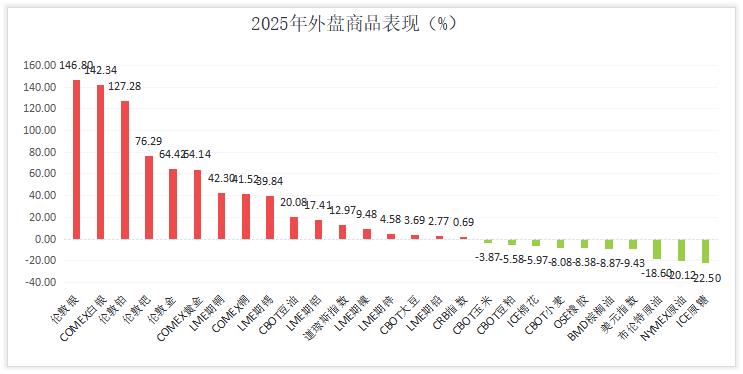
2025年外盘商品:美元创八年最大年跌幅,贵金属成为最大赢家,有色金属全面开花
Wen Hua Cai Jing· 2026-01-05 02:48
Group 1: Stock Market Performance - In 2025, the three major U.S. stock indices achieved double-digit gains, marking the third consecutive year of increases, driven by tariff uncertainties and excitement around AI stocks [3][4] - The S&P 500 index rose by 16.39%, the Nasdaq by 20.36%, and the Dow Jones by 12.97% [4] Group 2: Currency Trends - The U.S. dollar index fell by over 9% in 2025, marking the largest annual decline since 2017, influenced by interest rate cuts and trade policy uncertainties under President Trump [5] - The euro appreciated by over 13% against the dollar during the same period [5] Group 3: Federal Reserve Actions - The Federal Reserve agreed to cut interest rates after extensive discussions on economic risks, with expectations of only one more rate cut in the following year [6][7] Group 4: Precious Metals Performance - Gold experienced its largest annual increase in 46 years, rising approximately 64%, while silver surged by about 147%, marking its strongest annual performance ever [8] - Platinum and palladium also saw significant gains, with platinum increasing over 122% and palladium rising more than 75% [8] Group 5: Commodity Market Trends - LME copper prices rose by 42%, achieving the largest annual increase in 16 years, driven by supply concerns and a weaker dollar [9] - CBOT soybeans recorded their first annual gain in three years, increasing nearly 4% due to China's return to the U.S. market [10] - Oil prices fell nearly 20%, marking the largest annual decline since 2020, influenced by oversupply expectations and geopolitical tensions [11] Group 6: Agricultural Commodities - ICE cotton futures fell by 6% for the fourth consecutive year due to ample global supply and trade uncertainties [12] - ICE raw sugar prices dropped by 22% in 2025, primarily due to increased production leading to a global supply surplus [13]

日度策略参考-20260105
Guo Mao Qi Huo· 2026-01-05 02:46
Group 1: Overall Market Situation - The performance of overseas markets was strong during the holiday, but the geopolitical situation change on Saturday increased the uncertainty of the post - holiday risk - asset trend. Short - term attention should be paid to the impact of overseas events on the risk appetite of domestic equity assets [1] Group 2: Fixed - Income Market - Asset shortage and weak economy are beneficial to bond futures, but the central bank has recently warned of interest - rate risks. Attention should be paid to the Bank of Japan's interest - rate decision [1] Group 3: Non - Ferrous Metals Copper - The industrial situation is weak recently, but the macro sentiment is positive, and the premium of US copper persists, so the copper price has further increased. However, there is a short - term adjustment risk, though the trend is expected to remain unchanged [1] Aluminum - Domestic electrolytic aluminum has accumulated inventory recently, and the industrial driving force is limited. But with positive macro sentiment and the early fermentation of the expected tight supply of aluminum ingots, the aluminum price is expected to remain strong [1] Alumina - The supply side of alumina still has a large release space, and the weak industry pressures the price. But the current price is basically near the cost line, so the price is expected to fluctuate [1] Zinc - The fundamentals of zinc have improved, the cost center has shifted up, and recent negative factors have basically materialized. Market sentiment is volatile, and the zinc price fluctuates [1] Nickel - The macro sentiment has warmed up. News about Indonesia has further boosted market concerns about nickel - ore supply. The global nickel - inventory accumulation speed has slowed down, and the Shanghai nickel price has risen significantly recently with increased positions. The short - term nickel price may be strong, and attention should be paid to Indonesia's policies and macro sentiment. Short - term low - buying is recommended, and excessive chasing of highs should be avoided [1] Stainless Steel - The raw - material nickel - iron price has rebounded, the social inventory of stainless steel has slightly decreased, and steel mills' production in January has increased. The short - term stainless - steel futures are expected to be strong and volatile. Short - term low - buying is recommended, and enterprises should wait for opportunities to sell on rallies [1] Tin - The non - ferrous tin industry association issued an initiative to guide the price back to the normal range, pressuring the tin price. Considering the tense situation in Congo - Kinshasa, there may be further fermentation of tin supply. After a short - term adjustment, the downside space is limited, and low - buying opportunities near the support level are recommended [1] Group 4: Precious Metals and New Energy Precious Metals - The geopolitical situation is tense, and precious - metal prices are still supported, but the VIX of Shanghai silver is still high, and there may still be short - term games. In the long run, the logic of precious metals remains unchanged. Based on the fact that silver may no longer be undervalued compared with gold, priority should be given to low - buying gold in the future [1] Platinum and Palladium - During the New Year's Day holiday, the prices of platinum and palladium in the overseas market rose significantly, which is expected to boost domestic prices. But in the short term, they may still have high volatility. In the medium - to - long term, there is a supply - demand gap for platinum, while palladium tends to have a loose supply. Platinum can be bought on dips or a [long platinum, short palladium] arbitrage strategy can be adopted [1] Industrial Silicon - In the northwest, production increases, while in the southwest, it decreases. The production schedules of polysilicon and organic silicon decreased in December. A capacity storage platform company has been established, and there is a medium - to - long - term expectation of capacity reduction. Terminal installations increased marginally in the fourth quarter. Large enterprises have a strong willingness to support prices and a low willingness to deliver. Short - term speculative sentiment is high [1] Lithium Carbonate - It is the traditional peak season for new energy vehicles, and the demand for energy storage is strong. The supply side has increased production resumption, and there is a short - term rapid increase. Rolling profit - taking of long - spot and short - futures positions can be carried out. The basis and production profit are not high, indicating that the price valuation is not high, and short - selling is not recommended [1] Group 5: Steel and Iron - Related Rebar and Hot - Rolled Coil - Rolling profit - taking of long - spot and short - futures positions can be carried out. The basis and production profit are not high, indicating that the price valuation is not high, and short - selling is not recommended [1] Iron Ore - The near - month contracts are restricted by production cuts, but the commodity sentiment is good, and the far - month contracts still have upward opportunities [1] Ferrous Metals (General) - There is a combination of weak reality and strong expectation. In reality, direct demand is weak, supply is high, inventory is accumulating, and the price is under pressure. In expectation, energy - consumption dual control and anti - involution may disrupt supply [1] Group 6: Building Materials Glass - The supply and demand are supported, the valuation is low, and there are renewed supply disruptions. The price is expected to be strong in the short term [1] Soda Ash - It follows the trend of glass. The supply and demand are acceptable, the valuation is low, the downward space is limited, and it may be under pressure and fluctuate [1] Coking Coal and Coke - The fourth round of spot price cuts has started. After the futures price fell to the level of the fourth - round cut and then rebounded, attention should be paid to whether the futures price can reach a new low during the period from the price - cut announcement to implementation. If the price - cut negative factors cannot drive continuous decline, the futures price is likely to continue to fluctuate widely [1] Group 7: Agricultural Products Palm Oil - The MPOB December data is expected to be negative for palm oil, but it will reverse under themes such as seasonal production cuts, the B50 policy, and US biodiesel. If the oil price gaps up due to geopolitical events, short - selling can be considered [1] Soybean Oil - It follows the trend of other oils in the short term. Waiting for the January USDA report is recommended [1] Rapeseed Oil - Recent news has brought a large rebound to the rapeseed - oil price and the January - May spread, but it is difficult to change the subsequent marginal loosening of the fundamentals. A rebound in sentiment is expected to subside, and short - selling on rallies is recommended [1] Cotton - There is a strong expectation of a domestic new - crop harvest, and the purchase price of seed cotton supports the cost of lint. The downstream operation rate remains low, but the yarn - mill inventory is not high, and there is a rigid restocking demand. The cotton market is currently in a situation of "having support but no driver." Future attention should be paid to the tone of the No. 1 Central Document in the first quarter of next year regarding direct - subsidy prices and cotton - planting areas, the intention of next year's cotton - planting area, weather during the planting period, and the peak - season demand from March to April [1] Sugar - Currently, there is a global sugar surplus, and the domestic new - crop supply has increased. The short - selling consensus is relatively consistent. If the futures price continues to fall, the cost support below is strong, but the short - term fundamentals lack continuous drivers. Attention should be paid to changes in the capital side [1] Corn - The progress of grassroots grain sales of corn is relatively fast. Currently, the inventory levels at ports and downstream are still low, and most traders have not started strategic inventory building. It is expected that the spot price will remain strong in the short term under the restocking demand of the middle and lower reaches, and the futures price is expected to have limited回调 and remain strong and fluctuate later [1] Soybean Meal - Attention should be paid to the adjustment of the January USDA report and the manifestation of Brazil's harvest selling pressure on CNF premiums. The M05 contract is expected to be relatively weak. In the first quarter, the concentrated ownership of imported - soybean cargo rights will bring a domestic supply - structure problem, which supports the M03 contract. The M03 - M05 spread is still expected to be in a positive - arbitrage situation in the short term. Attention should be paid to changes in customs policies, imported - soybean auctions, and targeted policies [1] Pulp - Pulp futures have recently been pulled by the "weak demand" reality and the "strong supply" expectation, with large fluctuations. A wait - and - see approach for single - side trading is recommended, and a January - May reverse - arbitrage strategy can be considered for the spread [1] Logs - Log futures have declined due to the decline in overseas quotes and spot prices. The pressure on the 01 contract is large as it approaches the delivery month, and it is expected to fluctuate weakly [1] Hogs - The spot price has gradually stabilized recently. Supported by demand and with the unsold weight of slaughtered hogs still remaining, the production capacity still needs to be further released [1] Group 8: Energy and Chemicals Crude Oil - There is a risk of oil - price increase due to the conflict between the US and Venezuela. There are fewer maintenance activities, the operating load is high, there are overseas arrivals, and the supply has increased. The downstream demand and operation rate have weakened. In 2026, there will be more new production, further intensifying the supply - demand surplus, and the market expectation is weak [1] Fuel Oil - OPEC+ has suspended production increases until the end of 2026, the uncertainty of the Russia - Ukraine peace agreement has an impact, and the US has sanctioned Venezuelan oil exports [1] Asphalt - The short - term supply - demand contradiction is not prominent, and it follows the trend of crude oil. The "14th Five - Year Plan" rush - work demand is likely to be disproven, the supply of Ma - Rui crude oil is sufficient, and the asphalt profit is high [1] Natural Rubber - The raw - material cost has strong support, the basis is at a low level, and the middle - stream inventory may tend to accumulate [1] BR Rubber - The futures positions have decreased, and the price increase has slowed down. The listing prices of BD/BR have shifted up, and the processing profit of butadiene rubber has gradually recovered. Butadiene rubber maintains high - operation and high - inventory operation, and the spot trading has weakened with general order demand [1] PTA - The PX price is strong, and the floating spread has strengthened. The PTA plants generally maintain a high - load operation, and PX consumption remains stable. Polyester pre - holiday stock - building and sales have improved. The new polyester plants' commissioning has pushed the polyester load to a high level, and PTA consumption remains high [1] Ethylene Glycol (MEG) - It is reported that two MEG plants in Taiwan, China, with a total annual capacity of 720,000 tons, plan to shut down next month due to poor efficiency. During the continuous decline of ethylene glycol, it rebounded rapidly due to supply - side news. Currently, the downstream operation rate of polyester remains above 91%, the demand performance slightly exceeds expectations, and the recent overall polyester sales are relatively high [1] Short - Fiber - The short - fiber price continues to closely follow the cost fluctuations [1] Styrene - The Asian styrene price rebounded briefly after continuous monthly declines, mainly driven by supply - side contraction. Many plants have reduced production or shut down due to maintenance or poor economics. The demand for polymer downstream products such as PS and ABS remains weak. The warming of the commodity - market sentiment has significantly boosted the styrene futures price [1] Urea - The export sentiment has eased slightly, and the limited domestic demand restricts the upside space. There is support from anti - involution and the cost side [1] PE - There are fewer maintenance activities, the operating load is high, and the supply pressure is large. The downstream improvement is less than expected. The propylene monomer price is high, the crude - oil price has risen, and the cost support is strong. There is a risk of oil - price increase due to the US - Venezuela conflict [1] PVC - In 2026, there will be less global new production, and the future expectation is optimistic. There will be fewer subsequent maintenance activities, new production capacity will be released, and the supply pressure will increase. The demand has weakened, and orders are poor [1] LPG - The January CP has risen more than expected, providing strong cost - side support for imported gas. The geopolitical conflicts between the US and Venezuela and in the Middle East have intensified, and the short - term risk premium has increased. The EIA weekly C3 inventory has continued to accumulate, and overseas demand has slowed down periodically. Domestic PDH maintains high - operation and deep - loss operation, with only the rigid demand for civil combustion, and there is overseas olefin - blending demand for oil [1] Group 9: Shipping Container Shipping (European Route) - The price increase in December did not meet expectations, the expectation of peak - season price increase was priced in advance, and the shipping capacity supply in December was relatively loose [1]
加拿大农业部9月份报告解读——油菜籽产量下降需求量增加
Xin Lang Cai Jing· 2026-01-05 02:33
热点栏目 自选股 数据中心 行情中心 资金流向 模拟交易 客户端 卓创资讯菜籽油市场分析师张德强 加拿大油菜籽供应依然充足,虽然2025/26年度产量预测数据有所下调,但是依然高于2024/25年度。国 内企业暂停采购加拿大油菜籽,下游市场对国产油菜籽需求量呈现增加趋势,支撑国产油菜籽价格连续 上涨。据卓创资讯统计,2025年12月份国产油菜籽均价在6255元/吨,较11月份相比上涨1.34%,较2024 年12月份相比上涨5.66%。 2026年1月份下游市场油菜籽节前备货启动,需求量存有增加预期。据卓创资讯预计,1月份下游市场国 产油菜籽需求量在378.26万吨左右,较2025年12月份相比增加5.46%。目前南方多数地区油菜籽剩余量 较少,贸易商上货较为困难,随着供应减少而需求增加,预计1月份国产油菜籽价格将继续上涨,均价 在6286元/吨左右。 新浪合作大平台期货开户 安全快捷有保障 责任编辑:李铁民 【导语】加拿大农业部9月份报告中调整油菜籽多项数据,2025/26年度加拿大油菜籽产量下调,但是需 求量数据上调。2026年新年伊始,国内油菜籽价格暂时稳定。1月份下游市场节前备货将陆续启动,供 应量减 ...

华泰期货:南美丰产预期延续,豆粕价格偏弱震荡
Xin Lang Cai Jing· 2026-01-05 02:07
Group 1: Soybean Meal Market Insights - The futures market saw a decline in soybean meal and rapeseed meal prices, with soybean meal 2605 contract closing at 2749 CNY/ton, down 96 CNY/ton (3.37%) from the previous month [2][14] - In the spot market, soybean meal prices in Tianjin rose to 3110 CNY/ton, an increase of 30 CNY/ton, while prices in Jiangsu and Guangdong also saw increases [2][14] - Brazil's soybean planting progress reached 97.9% as of December 27, 2025, slightly above the five-year average but below last year's level [3][15] Group 2: Domestic Soybean Import and Processing Data - China imported 810.7 million tons of soybeans in November 2025, a decrease of 137.3 million tons from October, but an increase of 95.3 million tons (13.32%) year-on-year [4][15] - Cumulative soybean imports from January to November 2025 reached 10,378.14 million tons, a year-on-year increase of 668.72 million tons (6.89%) [4][15] - The total soybean crushing volume in December 2025 was 906.75 million tons, up 5 million tons (0.55%) from the previous month and up 76.38 million tons (9.20%) year-on-year [4][16] Group 3: Soybean and Meal Inventory Levels - As of December 26, 2025, national soybean inventory stood at 654.44 million tons, down 60.55 million tons (8.41%) month-on-month, but up 64.44 million tons (11.7%) year-on-year [5][16] - The soybean meal inventory increased to 116.75 million tons, up 1.61 million tons (1.35%) from the previous month and up 46.44 million tons (47.19%) year-on-year [5][16] - Major oil mills' soybean meal deliveries reached 408.62 million tons, an increase of 55.9 million tons (15.85%) month-on-month and up 41.51 million tons (11.31%) year-on-year [5][16] Group 4: Corn Market Insights - The corn futures market saw a slight decline, with the 2603 contract closing at 2226 CNY/ton, down 13 CNY/ton (0.58%) [6][18] - In November 2025, corn imports totaled 55.48 million tons, a significant increase of 55.56% month-on-month and 87.50% year-on-year [7][18] - The estimated corn consumption for December 2025 among major processing enterprises is 620 million tons, an increase of 16 million tons from the previous month [7][18] Group 5: Starch Market Insights - In November 2025, corn starch imports were recorded at 274 tons, a decrease of 71.79% month-on-month but an increase of 51.19% year-on-year [8][19] - The total production of corn starch in December 2025 was 139.65 million tons, with an operating rate of 64.4%, reflecting a slight increase from the previous month [8][19] - The average profit for corn starch products in December showed a decline, with Jilin's average profit at -72 CNY/ton, down 168 CNY/ton month-on-month [8][19]

棕榈油:基本面驱动不强,关注原油波动外溢,豆油:单边区间为主,关注月差机会
Guo Tai Jun An Qi Huo· 2026-01-05 02:02
2026 年 01 月 05 日 | | | 【基本面跟踪】 油脂基本面数据 | | | 单 位 | 收盘价 (日盘) | 涨跌幅 | 收盘价 (夜盘) | 涨跌幅 | | --- | --- | --- | --- | --- | --- | --- | | | 棕榈油主力 豆油主力 | 元/吨 元/吨 | 8,584 7,862 | -0.85% -0.20% | | | | | 菜油主力 | 元/吨 | 9,087 | 0.01% | | | | 期 货 | 马棕主力 | 林吉特/吨 | 4,050 | -0.52% | 3,990 | -1.48% | | | CBOT豆油主力 | 美分/磅 | 49.32 | 1.57% | | | | | | 单 位 | 昨日成交 | 成交变动 | 昨日持仓 | 持仓变动 | | | 棕榈油主力 | 手 | 282,429 | -76342 | 368,830 | -20,020 | | | 豆油主力 | 手 | 197,076 | -12,324 | 607,561 | -11,981 | | | 菜油主力 | 手 | 143,317 | -52,601 | 1 ...
大宗商品市场景气水平继续回升 为今年经济持稳向好运行奠定良好基础
Yang Shi Wang· 2026-01-05 01:54
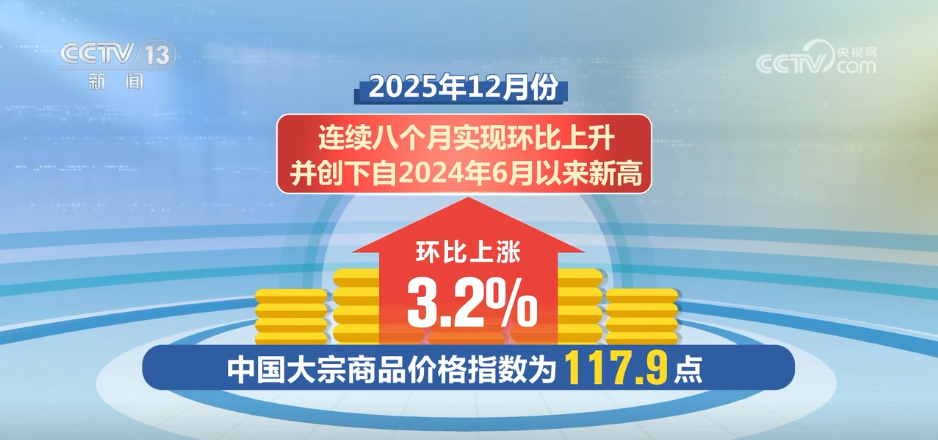
Core Viewpoint - The China Logistics and Purchasing Federation reported that the commodity price index reached 117.9 points in December 2025, indicating a continued recovery in the commodity market and improved supply-demand dynamics, which supports stable economic performance for the year [1][3]. Group 1: Commodity Price Index - The commodity price index for December 2025 was 117.9 points, reflecting a month-on-month increase of 3.2%, marking the eighth consecutive month of growth and the highest level since June 2024 [3]. - Among the 50 monitored commodities, 31 saw price increases in December, with lithium carbonate, refined tin, and apples leading the gains at 15.5%, 11.7%, and 8.5% respectively [5]. Group 2: Market Outlook - Experts predict that the overall commodity market in China will maintain a stable and positive trend in 2025, supported by proactive macroeconomic policies and structural economic upgrades that will create new demand for commodities [7]. - The price index for non-ferrous metals rose significantly by 4.9%, while agricultural products increased by 2.5%. Other indices, including mineral, black metal, and chemical prices, also saw slight increases of 0.8%, 0.4%, and 0.3% respectively [8].
招商期货-期货研究报告:商品期货早班车-20260105
Zhao Shang Qi Huo· 2026-01-05 01:43
1. Report Industry Investment Ratings No investment ratings are provided in the report. 2. Core Views - The commodity futures market shows a complex situation with different trends and investment opportunities in various sectors such as basic metals, black industry, agricultural products, and energy - chemical [1][3][4]. - Different commodities face different supply - demand relationships, and investment strategies vary from commodity to commodity, including strategies like buying on dips, short - term and long - term trading strategies, and waiting and watching [1][3][4]. 3. Summaries by Categories Basic Metals - **Copper**: Market performance on Friday was weak with oscillations. Supply remains tight, and after price adjustment, the discount narrows. The trading strategy is to buy on dips [1]. - **Aluminum**: On Wednesday, the main contract rose 1.60%. Supply capacity increased slightly, and demand weakened. It is expected to oscillate with a slight upward trend [1]. - **Alumina**: On Wednesday, the main contract rose 0.98%. The running capacity of alumina plants is stable, and electrolytic aluminum plants operate at high loads. The price is expected to fluctuate within a range [1]. - **Industrial Silicon**: On Wednesday, the main contract fell 0.62%. Supply and demand are stable, and the market is expected to oscillate between 8400 - 9200 yuan/ton. It is advisable to wait and watch [1]. - **Lithium Carbonate**: LC2605 closed unchanged. Supply increased in December but is expected to decline in January. Demand in the power sector is in the off - season, and it is expected to oscillate at high levels. It is advisable to wait and watch [1][2]. - **Polycrystalline Silicon**: On Wednesday, the main contract rose 0.05%. Supply and demand are in a complex situation. The price is expected to rise, but it is recommended to wait for price corrections to enter the market [2]. - **Tin**: Market performance on Friday was weak with oscillations. Supply is tight, and inventory is decreasing. The trading strategy is to buy on dips [2]. Black Industry - **Rebar**: The main 2605 contract closed at 3122 yuan/ton, down 12 yuan/ton. Supply - demand is weak. It is recommended to wait and watch and try to short the 2605 contract [3]. - **Iron Ore**: The main 2605 contract closed at 789.5 yuan/ton, up 1 yuan/ton. Supply - demand is weak, and it is advisable to wait and watch [3]. - **Coking Coal**: The main 2605 contract closed at 1115 yuan/ton, down 4.5 yuan/ton. Supply - demand is weak. It is advisable to wait and watch and try to short the 09 contract [4]. Agricultural Products - **Palm Oil**: The Malaysian market closed lower. Supply is in seasonal decline but increased year - on - year, and demand decreased. Oils are expected to oscillate weakly with variety differentiation [4]. - **Soybean Meal**: CBOT soybeans are falling. Supply is loose in the near - term and in large supply in the long - term. The trading strategy is to trade the expectation of a bumper harvest in South America [4]. - **Corn**: Futures prices fell, and spot prices were mostly stable. Supply - demand contradiction is not significant, and prices are expected to oscillate [4]. - **Sugar**: ICE and Zhengzhou sugar futures fell. The market is expected to follow the decline of international sugar, and it is recommended to short in the futures market and sell call options [4]. - **Cotton**: ICE cotton futures fluctuated, and Zhengzhou cotton futures oscillated narrowly. It is recommended to buy on dips [5]. - **Eggs**: Futures prices oscillated weakly, and spot prices rose. Supply - demand contradiction is not significant, and prices are expected to oscillate [5]. - **Pigs**: Futures prices oscillated strongly, and spot prices fell. Supply - demand is weak, and prices are expected to oscillate [5]. - **Apples**: Futures prices fell. The total output is low, and the quality is poor. It is recommended to wait and watch [5]. Energy - Chemical - **LLDPE**: The main contract oscillated slightly before the holiday. Supply pressure eases, and demand is in the off - season. In the short - term, it is expected to oscillate, and in the long - term, it is recommended to buy on dips [6]. - **PVC**: V05 rose 0.3%. Supply is high, demand is weak, and it is recommended to conduct reverse arbitrage [7]. - **PTA**: PX supply is high, and PTA supply is tight in the short - term. It is recommended to maintain a long - term long position in PX and look for opportunities to long the processing margin of PTA 05 [7]. - **Glass**: FG05 rose 1.3%. Supply decreased slightly, and demand weakened. It is advisable to wait and watch [7]. - **PP**: The main contract oscillated slightly before the holiday. Supply is increasing, and demand is weak. In the short - term, it is expected to oscillate, and in the long - term, it is recommended to buy on dips [7]. - **MEG**: Supply is high, and inventory is accumulating. It is recommended to short at high prices [7][8]. - **Crude Oil**: There are geopolitical events, but supply is abundant, and demand is in the off - season. It is recommended to short at high prices [8]. - **Styrene**: The main contract oscillated slightly before the holiday. Supply and demand are weak. In the short - term, it is expected to oscillate, and in the medium - term, it is recommended to buy on dips [8]. - **Soda Ash**: sa05 rose 0.6%. Supply is stable, and demand is weak. It is recommended to conduct reverse arbitrage [8].
农产品早报-20260105
Yong An Qi Huo· 2026-01-05 01:36
Group 1: Corn - The market sentiment is relatively weak due to the targeted auction policy, with prices in the southern ports declining. However, farmers in the production areas are still reluctant to sell, resulting in limited supply and firm spot prices in the origin[1]. - The basis has strengthened recently, and the trade from the origin to the port remains inverted. With low downstream inventories, post - New Year seasonal restocking may drive up corn prices[1]. - In the long - term, focus on structural changes, import policies, and domestic auction policies due to the supply gap[1]. Group 2: Starch - In the short - term, the slowdown in deep - processing destocking and weak downstream restocking have led to weak starch quotes. The industry is expected to use price - for - volume strategies to destock before the Spring Festival[2]. - Due to limited raw material cost reduction, the price adjustment space for starch is also limited. After New Year's Day, with the year - end stocking season, starch prices are expected to rise slightly[2]. - In the long - term, downstream consumption rhythm is the key factor for price trends, and post - season inventory destocking will determine starch pricing[2]. Group 3: Sugar - In the short - term, the supply pressure of raw sugar has decreased, and the futures pricing can refer to domestic sugar production costs and spot prices[3]. - In the long - term, if the global sugar surplus increases, the futures price will seek the cost of out - of - quota imports[3]. - Attention should be paid to weather risks and policy changes[3]. Group 4: Cotton - The low initial inventory offsets most of the production increase. Future consumption is the main focus[4]. - With the expansion of domestic textile production, good profits, and favorable tariff policies after the Sino - US meeting, cotton demand is expected to improve next year, making long - term long positions suitable[4]. Group 5: Eggs - The inflection point of egg inventory has occurred, but the base is still high. The speed of inventory decline depends on the chicken culling rhythm[10]. - If chicken culling accelerates, it will speed up capacity reduction. If the spot price remains low before Laba Festival, farmers may cull chickens, which is beneficial to egg prices in the second quarter[10]. Group 6: Apples - The trading atmosphere in the late - Fuji apple production areas is still light. Traders are less interested in purchasing from farmers, and low - price fruits are the main ones sold[15]. - High - quality apples maintain stable prices, while the prices of medium and low - quality apples have weakened. The downstream sales have improved slightly, and the inventory has decreased slightly[15]. - In the short - term, the futures price is expected to remain high and volatile. In the medium - term, due to competition from other fruits, the overall pattern is strong in the near - term and weak in the long - term[15]. Group 7: Pigs - After the New Year's Day holiday, demand has decreased, and the short - term sentiment has weakened. There may still be a supply - demand mismatch in January[15]. - Capacity reduction has improved long - term sentiment, but the improvement of long - term expectations depends on further production and inventory reduction in the near - term. Attention should be paid to factors such as slaughter rhythm, diseases, and policies[15].
船运调查机构SGS:预计马来西亚12月1-31日棕榈油出口量为1000703吨
Xin Hua Cai Jing· 2026-01-05 00:37
Core Viewpoint - The palm oil export volume from Malaysia is projected to increase significantly in December, indicating a positive trend in the palm oil industry [1] Group 1: Export Data - The expected palm oil export volume for Malaysia from December 1 to 31 is 1,000,703 tons [1] - This figure represents a 28.40% increase compared to the export volume of 779,392 tons during the same period last month [1]
法国将加强对进口农产品的检查以回应农民关切
Xin Lang Cai Jing· 2026-01-05 00:10
Core Viewpoint - France is strengthening inspections on imported agricultural products to address concerns from French farmers regarding pesticide residues and unfair competition [1][2] Group 1: Government Actions - The French Prime Minister, Le Cornu, announced that imports containing banned pesticides such as mancozeb, glyphosate, methyl thiophanate, and carbendazim will be suspended from entering the French market [1] - A specialized team will be deployed to conduct stricter inspections to ensure compliance with French health standards [1] - The French Agriculture Minister, Genaval, stated that products like apples, strawberries, and grapes will only be sold in France if they do not contain the aforementioned residues [1] Group 2: Trade Agreements and Farmer Concerns - French farmers are protesting the Mercosur-EU free trade agreement, believing it will lead to an influx of agricultural products from South American countries that could harm French agriculture [1] - Le Cornu emphasized in a public letter to farmers that strong measures will be taken to suspend imports of non-compliant food from South America [1] - The upcoming meeting between Le Cornu and representatives of French agricultural unions will focus on the Mercosur-EU trade agreement and measures to control livestock diseases [2]
