
能源

Search documents
透过豫企百强名单,看到什么?
Sou Hu Cai Jing· 2025-11-13 23:11
Core Insights - The report highlights the transition of enterprises in Henan from being at the bottom of the industrial chain to mastering technology and brand leadership, which is crucial for high-quality development in the region [1][3] - The overall development trend of Henan's top 100 enterprises shows steady growth, with total revenue reaching 2.63 trillion yuan, accounting for 41.4% of the province's GDP, and a profit growth of 20.9% [1][2] - The manufacturing sector stands out with a profit increase of 45%, indicating a recovery in production efficiency and profitability, although innovation remains concentrated among a few leading companies [2][3] Manufacturing Sector - The manufacturing sector's profit growth of 45% outpaces the national average, reflecting improvements in management, cost control, and technological investment [2] - The total number of invention patents has surpassed 13,000, and over 100 international standards have been established, indicating a new competitive edge for Henan's manufacturing [2] - However, the innovation capability is still overly concentrated in a few leading enterprises, with small and medium-sized manufacturers struggling with R&D investment and technological upgrades [2][3] Service Sector - The service sector faces a complex situation, with traditional industries showing weak growth and emerging sectors not yet compensating for the shortfall [2] - New service industries such as modern logistics, cross-border e-commerce, and consumer finance are gaining traction, but the overall ecosystem remains unstable [2] - The success of brands like "Pang Dong Lai" highlights the market power of service innovation, yet the industry still lacks widespread innovation [2] New Growth Drivers - High-growth enterprises in Henan have seen a revenue increase of 45%, with overseas income growing nearly 1.8 times, while strategic emerging industries report a revenue growth of 70% [3] - This data suggests that Henan's economy is forming new growth poles and transitioning from a "follower" to a "catch-up" position [3] - Challenges such as insufficient R&D investment and blind expansion among some enterprises indicate that emerging industries must focus on long-term innovation to sustain growth [3] Future Directions - The evolution of the top 100 enterprises over 21 years reveals that while there is no shortage of companies or growth, there is a lack of systemic support and sustainable innovation [3][4] - The path to becoming a strong economic province requires overcoming challenges related to scale, investment-driven growth, and structural issues [3] - The focus should shift from merely creating large enterprises to nurturing a group of globally competitive innovative companies [3][4]
开放发展的中国,世界的机遇和信心
Ren Min Ri Bao· 2025-11-13 22:10
(一) 中国的发展离不开世界,世界的繁荣也需要中国。开放合作、互利共赢,是解码中国式现代化的一把钥 匙。 11月10日,第八届进博会在上海闭幕。习近平总书记亲自谋划的世界上第一个以进口为主题的国家级展 会,是国际贸易发展史上的一大创举。本届834.9亿美元的按年计意向成交额、138个国家和地区的4108 家企业参展的成绩,均刷新历史纪录。 11月6日,习近平总书记在海南指出:"党中央决定,今年12月18日海南自由贸易港正式启动全岛封关, 这是我国坚定不移扩大高水平对外开放、推动建设开放型世界经济的标志性举措。" 以全面深化改革开放推动高质量发展,集中力量办好自己的事,通过高水平对外开放为世界注入确定性 与稳定性,是习近平新时代中国特色社会主义思想的重要内容。 今天,再次学习领会习近平总书记2018年在首届进博会开幕式上的主旨演讲《共建创新包容的开放型世 界经济》,更加深刻感悟到思想的力量。 "举办中国国际进口博览会,是中国着眼于推动新一轮高水平对外开放作出的重大决策,是中国主动向 世界开放市场的重大举措。" "中国将抓紧研究提出海南分步骤、分阶段建设自由贸易港政策和制度体系,加快探索建设中国特色自 由贸易港进 ...
后巴菲特时代,我们还能学什么?
Jing Ji Guan Cha Bao· 2025-11-13 11:31
Core Insights - The traditional value investing approach championed by Warren Buffett is facing scrutiny in the context of modern economic dynamics and technological advancements [2][4] - Buffett's retirement marks the end of an era, prompting a reassessment of value investing principles in light of the evolving market landscape [2][3] Group 1: Transition in Leadership - Buffett's announcement to step back from writing the annual shareholder letter and speaking at the shareholder meeting signifies a significant transition for Berkshire Hathaway [2] - The passing of Charlie Munger and Buffett's retirement within two years has accelerated the market's adaptation to a Berkshire without its legendary figures [2][3] - The transition to Greg Abel as the successor is designed to provide investors and the new leader with a longer adjustment period [2][3] Group 2: Investment Strategy Evolution - Investors must prepare for a potential shift in Berkshire's investment logic under Abel, who has already shown a more diversified portfolio and shorter holding periods [3][5] - Berkshire Hathaway currently holds over $200 billion in cash reserves, a historic high, but faces challenges in finding quality investment opportunities [3][5] - The company's recent performance has lagged behind the S&P 500, highlighting strategic difficulties and the need for adaptation [3][5] Group 3: Value Investing in a New Era - The rise of technology as a key driver of economic growth necessitates a reevaluation of traditional value investing, which has primarily focused on established sectors [4][5] - Value investing must evolve to incorporate new elements, actively adapting to high valuation norms and technology-led growth [5] - The legacy of Buffett emphasizes the importance of understanding intrinsic value while also expanding the ability to assess technology companies [5][6] Group 4: Lasting Wisdom and Legacy - Buffett's retirement does not signify the end of value investing but rather a transformation and passing of core wisdom to future generations [6] - The principles of reading, critical thinking, and risk assessment remain relevant regardless of technological changes [5][6]


“后4000点”时代的多元配置
Sou Hu Cai Jing· 2025-11-13 10:51
Core Insights - The investment landscape is evolving with a focus on diversified asset allocation, particularly in the context of the upcoming "post-4000 point era" in A-shares, where investors are keen on identifying opportunities and risks in AI technology and other sectors [1] Fragment 1: New World Outline - The three main themes for 2023 are global cycle misalignment, AI technology revolution, and global capital reallocation, while 2024 will focus on the "exceptionalism" of the U.S. and weak domestic prices [2] - By 2025, the themes will shift to global order reconstruction, asset revaluation in China, deepening AI chains, and Federal Reserve interest rate cuts [2][3] - The market is experiencing a reconfiguration due to geopolitical shifts and the AI investment boom, which is expected to drive performance in sectors like optical modules [2] Fragment 2: AI Bubble Debate - The existence of a bubble in AI investments is complex; some level of speculation can drive technological advancement [6][8] - Key risks include the inability to convert capital expenditure into profit, excessive leverage, and tightening monetary policy [8] - Investors should focus on sectors directly benefiting from AI advancements and maintain a diversified approach to mitigate risks [8] Fragment 3: Macro Environment for 2026 - The year 2026 marks the beginning of China's "15th Five-Year Plan," with expectations for a balanced supply-demand dynamic and a focus on technology and industry [9] - The U.S. midterm elections may influence domestic policies, with a potential focus on growth and price stability [11] Fragment 4: Global Manufacturing Cycle - A potential upturn in the global manufacturing cycle is anticipated in 2026, following disruptions caused by tariffs [15] - The supportive environment for this cycle includes fiscal expansion and monetary policy coordination among major economies [15] Fragment 5: Capital Reallocation - The trend of "capital relocation" is significant, with a notable decrease in the ratio of household deposits to A-share market capitalization, indicating ongoing reallocation needs [18] - The current environment favors stable investment products like "fixed income+" and FOFs, which are gaining traction among cautious investors [20]
银河期货每日早盘观察-20251113
Yin He Qi Huo· 2025-11-13 07:02
1. Report Industry Investment Ratings No relevant content provided. 2. Core Views of the Report The report presents a comprehensive analysis of various futures markets, including financial derivatives, agricultural products, black metals, and non - ferrous metals. It indicates that most markets will maintain a volatile trend in the short term, influenced by factors such as supply - demand relationships, policy changes, and macro - economic conditions. For example, the stock index futures market will remain volatile due to sector rotation and capital flow; the agricultural product market shows different trends in different varieties, with some facing supply pressure and others having potential price increases; the black metal and non - ferrous metal markets are affected by factors like raw material costs, production capacity, and international policies [19][20][25]. 3. Summaries by Relevant Catalogs Financial Derivatives Stock Index Futures - Core View: The market is volatile due to sector rotation. Large - cap indexes are stronger than small - cap indexes, and the technology sector shows signs of stabilizing. The short - term market will remain volatile [19][20]. - Trading Strategy: High - low trading in a high - level range; IM/IC long 2512 + short ETF cash - and - carry arbitrage; bullish spread options at low prices [20]. Treasury Bond Futures - Core View: The bond market continues to fluctuate with an obvious stock - bond seesaw effect. The yield downward space is limited, and the 30Y Treasury yield may have a top range of 2.20 - 2.25% [22]. - Trading Strategy: Wait and see for single - side trading; hold short positions on the 30Y - 7Y term spread and try to go long on the T - contract inter - delivery spread [23]. Agricultural Products Protein Meal - Core View: The supply pressure is improving, and the domestic near - month price has support, but the far - month has pressure. Rapeseed meal is expected to fluctuate [25][26]. - Trading Strategy: Wait and see for single - side and arbitrage trading; sell wide - straddle options [26]. Sugar - Core View: International sugar production in major regions may be lower than expected, and the international price has a bottom - grinding trend. The domestic market is expected to fluctuate in the short term and may face downward pressure in the long term [30][31]. - Trading Strategy: Trade in the range for the domestic market; wait and see for arbitrage and options [32]. Oilseeds and Oils - Core View: The increase in oil prices is limited, and they will maintain a volatile trend. The palm oil inventory in Malaysia and China shows different trends, and the supply and demand of soybean oil and rapeseed oil also vary [33][34][35]. - Trading Strategy: Wait and see or trade in a high - low range; wait and see for arbitrage and options [35]. Corn/Corn Starch - Core View: The U.S. corn may fluctuate narrowly, and the domestic corn spot price is strong. The 01 contract is expected to fluctuate strongly, but the upward space is limited [37][38]. - Trading Strategy: Go long on the 12 - contract corn on dips; wait and see for the 01 contract; wait for dips for the 05 and 07 contracts [38]. Live Hogs - Core View: The supply pressure increases, and the overall inventory is high. The short - term price may still face pressure [39][40]. - Trading Strategy: Short a small amount; wait and see for arbitrage; sell wide - straddle options [40]. Peanuts - Core View: The peanut spot price is strong, and the short - term market is expected to fluctuate strongly. The new - season peanut quality is lower, and the oil mill's procurement is limited [42][43]. - Trading Strategy: The 01 contract fluctuates at the bottom, and the 05 contract can try to go long lightly; wait and see for arbitrage; sell pk601 - P - 7600 options [43]. Eggs - Core View: The demand improves slightly, and the egg price rebounds slightly. The current inventory of laying hens is high, and the short - term price increase space is limited [44][45][47]. - Trading Strategy: Wait and see in the short term and consider going long at low prices for far - month contracts; wait and see for arbitrage and options [47]. Apples - Core View: The new - season apple production decreases, and the cold - storage inventory is expected to be low. The market may fluctuate greatly when the new inventory data is released [48][49]. - Trading Strategy: Wait and see; wait and see for arbitrage and options [50]. Cotton - Cotton Yarn - Core View: The new cotton supply increases, and the demand enters the off - season. Considering the macro - economic situation, the short - term cotton price is expected to fluctuate slightly stronger [52]. - Trading Strategy: The U.S. cotton is expected to fluctuate, and the Zhengzhou cotton is expected to fluctuate slightly stronger; wait and see for arbitrage and options [53]. Black Metals Steel - Core View: The raw material cost is under pressure, and the steel price fluctuates in a range. The construction steel production decreases more, and the inventory is still decreasing. The hot - rolled coil performs better than the rebar [57]. - Trading Strategy: Maintain a range - bound trend; go long on the coil - rebar spread at low prices; wait and see for options [58]. Coking Coal and Coke - Core View: The market sentiment cools down, and the price fluctuates and adjusts. The short - term driving force is not obvious, and there may be an opportunity to go long after a pullback in the medium term [59][60]. - Trading Strategy: Wait and see in the short term; go long after a pullback in the medium term; hold a reverse spread for coking coal 1/5; wait and see for options [61]. Iron Ore - Core View: Adopt a bearish approach. The supply is at a high level, and the domestic demand is weak, so the ore price is expected to fluctuate bearishly [62][63]. - Trading Strategy: Go short; wait and see for arbitrage and options [63]. Ferroalloys - Core View: The cost provides some support, and the previous short positions can be reduced. The supply and demand of silicon iron and manganese silicon are weakening on the margin [64][65]. - Trading Strategy: Reduce previous short positions at low prices; wait and see for arbitrage; sell out - of - the - money straddle option combinations [65]. Non - Ferrous Metals Precious Metals - Core View: The short - term strong - side volatile pattern continues. The U.S. government is about to restart, and the market is worried about fiscal stimulus and the change of the Fed's dovish camp, increasing the attractiveness of precious metals [66][68][69]. - Trading Strategy: Hold long positions based on the 5 - day moving average; wait and see for arbitrage; hold collar call option strategies [69]. Copper - Core View: The short - term trend is volatile. The macro - economic situation is favorable, but the supply and demand situation is complex. The copper price is expected to fluctuate in a high - level range [70][71][72]. - Trading Strategy: Wait and see; the long - term trend is bullish, and a low - long strategy can be adopted; the ratio may rebound; wait and see for options [72]. Alumina - Core View: Pay attention to production cuts. The supply and demand are significantly surplus, and the price may rebound after substantial production cuts [73][74][76]. - Trading Strategy: The price fluctuates weakly at the bottom; wait and see for arbitrage and options [76]. Electrolytic Aluminum - Core View: The price is strong due to the resonance of macro - economic and micro - economic factors. The overseas supply - demand is tight, and the domestic demand has resilience [77][78][79]. - Trading Strategy: Maintain a strong trend; wait and see for arbitrage and options [79]. Cast Aluminum Alloy - Core View: The price fluctuates at a high level with the aluminum price. The cost provides support, but the demand is affected by the high price [80]. - Trading Strategy: The price moves strongly with the aluminum price; wait and see for arbitrage and options [80]. Zinc - Core View: Pay attention to the export volume. The supply may be eased, and the price fluctuates in a range. The upward space is limited [82][83]. - Trading Strategy: Trade in a range; hold the SHFE long - LME short arbitrage; wait and see for options [84]. Lead - Core View: Pay attention to the change of domestic social inventory. The supply is recovering, and the demand is weakening, so the price is under pressure [86][87]. - Trading Strategy: Try to short lightly at high prices; wait and see for arbitrage; sell out - of - the - money call options [87]. Nickel - Core View: The cost is loosening, and the price fluctuates weakly. The supply is abundant, and the market is pessimistic about the quota adjustment [88][89]. - Trading Strategy: Short on rebounds; wait and see for arbitrage; sell out - of - the - money call options [89]. Stainless Steel - Core View: The supply and demand are both weak, and the raw materials are under pressure. No specific trading strategy is provided in the given text [90].
摩洛哥推出中小微企业扶持机制
Shang Wu Bu Wang Zhan· 2025-11-13 03:29
Core Viewpoint - Morocco's Prime Minister Akhannouch announced a support mechanism for small and medium-sized enterprises (SMEs), providing subsidies of up to 30% of investment amounts to stimulate economic growth and job creation [1] Group 1: Support Mechanism Details - The subsidy is categorized into three types: long-term employment creation subsidies, regional subsidies, and sector-specific subsidies, which can be combined [1] - The entire process for the support mechanism, including project application, review and approval, investment agreement signing, and financial disbursement, is managed through the Regional Investment Centers (CRI) [1] Group 2: Economic Impact and Employment - SMEs represent over 90% of all enterprises in Morocco and are crucial for wealth generation and job opportunities [1] - Since the implementation of the new investment law in March 2023, the National Investment Committee has approved 250 investment projects totaling $41.4 billion, expected to create 179,000 direct and indirect jobs [1] Group 3: Broader Economic Initiatives - The Moroccan government is implementing various measures to optimize the business environment through the 2023-2026 roadmap, including simplifying investment processes, promoting online business registration, activating the "CRI-Invest" digital platform, and enacting structural tax reforms [1]
能源化工期权:能源化工期权策略早报-20251113
Wu Kuang Qi Huo· 2025-11-13 02:20
Group 1: Report Overview - The report is an energy and chemical options strategy morning report dated November 13, 2025, covering various energy and chemical option varieties [1][2] - The strategy focuses on constructing option portfolio strategies mainly as sellers, along with spot hedging or covered strategies to enhance returns [2] Group 2: Underlying Futures Market Overview - Multiple option varieties are presented, including crude oil, liquefied petroleum gas (LPG), methanol, etc., with details on their latest prices, price changes, trading volumes, and open interest [3] Group 3: Option Factor - Volume and Open Interest PCR - PCR indicators (volume PCR and open interest PCR) for various option varieties are provided, which are used to describe the strength of the underlying asset's market and potential turning points [4] Group 4: Option Factor - Pressure and Support Levels - Pressure and support levels for each option variety are analyzed from the perspective of the strike prices with the largest call and put option open interest [5] Group 5: Option Factor - Implied Volatility - Implied volatility data for different option varieties are presented, including at - the - money implied volatility, weighted implied volatility, and their changes [6] Group 6: Strategy and Recommendations for Each Option Variety Crude Oil - Fundamental analysis shows that U.S. refinery demand has stabilized and rebounded, shale oil production has slightly increased, OPEC exports have risen, and European refinery demand is about to enter the peak season [7] - The market has shown a complex trend of rising and falling in different months. Implied volatility is above the average, and the open interest PCR indicates a weak market. The pressure level is 590, and the support level is 450 [7] - Recommended strategies include constructing a short - biased call + put option combination, and a long collar strategy for spot hedging [7] Liquefied Petroleum Gas - The cost - end crude oil is under supply - surplus pressure and geopolitical disturbances. The LPG market has shown a pattern of over - decline and rebound with resistance [9] - Implied volatility has dropped to below the average, the open interest PCR indicates a weak market, the pressure level is 4550, and the support level is 4200 [9] - Strategies include constructing a neutral - biased call + put option combination and a long collar strategy for spot hedging [9] Methanol - Port and enterprise inventories are high, and the supply is increasing. The market has been in a weak downward trend [9] - Implied volatility is around the historical average, the open interest PCR indicates a weak and volatile market, the pressure level is 2500, and the support level is 2000 [9] - Strategies involve constructing a bear spread with put options, a short - biased call + put option combination, and a long collar strategy for spot hedging [9] Ethylene Glycol - Port and downstream factory inventories are high, and the supply is expected to continue to increase. The market has been weak [10] - Implied volatility is below the average, the open interest PCR indicates strong short - selling power, the pressure level is 4500, and the support level is 4050 [10] - Strategies include constructing a bear spread with put options, a short - volatility strategy, and a long collar strategy for spot hedging [10] Polypropylene - PE and PP inventories at production enterprises, traders, and ports show different trends. The market has been in a weak downward trend [10] - Implied volatility has dropped to around the average, the open interest PCR indicates a weak market, the pressure level is 7000, and the support level is 6300 [10] - Strategies include constructing a bear spread with put options and a long collar strategy for spot hedging [10] Rubber - Exchange rubber warehouse receipts are at a ten - year low, and there is an expectation of inventory accumulation. The market has been in a weak consolidation pattern [11] - Implied volatility has decreased to below the average after a sharp rise, the open interest PCR is below 0.6, the pressure level is 16000, and the support level is 14500 [11] - Strategies include constructing a short - biased call + put option combination [11] PTA - PTA social inventory has increased, and new production capacity is expected to lead to continued inventory accumulation. The market has shown a pattern of rebound with resistance [11] - Implied volatility is above the average, the open interest PCR indicates a volatile market, the pressure level is 4700, and the support level is 4300 [11] - Strategies include constructing a neutral - biased call + put option combination [11] Caustic Soda - The average utilization rate of caustic soda production capacity has increased. The market has been in a weak downward trend [12] - Implied volatility is at a relatively high level, the open interest PCR indicates a weak and volatile market, the pressure level is 3000, and the support level is 2000 [12] - Strategies include constructing a bear spread and a long collar strategy for spot hedging [12] Soda Ash - Soda ash factory inventories have increased. The market has been in a low - level weak consolidation pattern [12] - Implied volatility is at a relatively high historical level, the open interest PCR indicates strong short - selling pressure, the pressure level is 1860, and the support level is 1100 [12] - Strategies include constructing a bear spread, a short - volatility combination, and a long collar strategy for spot hedging [12] Urea - Enterprise inventory is at a high level, and port inventory has decreased. The market has shown a pattern of low - level consolidation and rebound [13] - Implied volatility is around the historical average, the open interest PCR indicates strong short - selling pressure, the pressure level is 1800, and the support level is 1600 [13] - Strategies include constructing a neutral - biased call + put option combination and a long collar strategy for spot hedging [13]
FICC日报:市场避险情绪升温,关注美国10月CPI数据-20251113
Hua Tai Qi Huo· 2025-11-13 02:13
Report Summary 1. Report Industry Investment Rating No industry investment rating information is provided in the report. 2. Core View of the Report - Amid rising market risk - aversion, focus on the US October CPI data. In the commodity market, during the current inflation - expectation game phase, pay attention to non - ferrous metals and precious metals with high certainty. Consider buying precious metals and non - ferrous metals on dips [2][4][5]. 3. Summary by Related Catalogs Market Analysis - In the domestic market, positive news has emerged, but the economic foundation needs further consolidation. The "15th Five - Year Plan" proposal was released on October 28, and the average GDP growth rate during the 15th Five - Year Plan period is expected to be around 5%. On October 30, the China - US economic and trade teams reached a three - aspect consensus, and China officially postponed tariffs on November 5. In October, the national manufacturing PMI was 49, a 0.8 decline from the previous month. China's October exports (in US dollars) decreased by 1.1% year - on - year, compared with an 8.3% increase in the previous value. China's October CPI increased by 0.2% year - on - year, and the core CPI reached the highest level since March 2024. The PPI increased month - on - month for the first time this year. On November 12, the A - share market adjusted with a slight decline in the three major indices, the bond market rose across the board, most commodities fell, and precious metals rose [2]. - In the US, the liquidity risk has temporarily eased. The Fed cut interest rates by 25BP as expected and announced the end of balance - sheet reduction on December 1. On November 10, the US Senate voted to pass the "Continuing Appropriations and Extensions Act". The US October ISM manufacturing index dropped to 48.7%, shrinking for eight consecutive months. The ADP private - sector employment in October decreased by 45,000, the largest decline in two and a half years. There are uncertainties regarding the Fed chair candidate and future tariff policies [3]. Commodity Analysis - In the black sector, it is still dragged down by downstream demand expectations, and focus on the "anti - involution" situation. The long - term supply limitation in the non - ferrous sector has not been alleviated, and it has been boosted by the global easing expectation recently. The medium - term supply of the energy sector is considered to be relatively loose as OPEC + announced an additional production increase of 137,000 barrels per day in November. In the chemical sector, the "anti - involution" space of methanol, caustic soda, urea and other varieties is worth attention. In the agricultural products sector, with the China - US peace talks, pay attention to China's procurement plan for US goods and next year's weather forecast. For precious metals, after the short - term sharp adjustment risk is cleared, consider buying on dips [4]. Strategy - For commodities and stock index futures, consider buying precious metals and non - ferrous metals on dips [5]. A - Share Market - The A - share market recovered after hitting the bottom, with the three major indices slightly declining. More stocks fell than rose, and over 3500 stocks in the Shanghai, Shenzhen and Beijing stock markets closed down. The trading volume was 1.96 trillion yuan. At the close, the Shanghai Composite Index fell 0.07%, the Shenzhen Component Index fell 0.36%, and the ChiNext Index fell 0.39% [6]. US Tariff and Economic News - US Treasury Secretary Bessent said that there will be major tariff news in the next few days, and tariff dividends are under discussion. Trump mentioned a $2000 tax refund for families with an annual income of less than $100,000. Bessent also said that the economic situation was good before the government shutdown, and he expects real income to rebound in the first and second quarters of next year [3][6].
高股息“港港好”?连续9日吸金,港股通红利ETF(159220)11月12日场内大涨1.91%,又双叒叕创收盘价新高!
Xin Lang Ji Jin· 2025-11-13 01:39
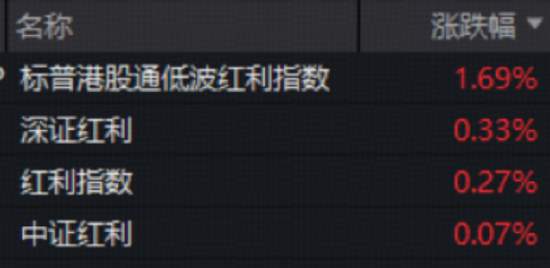
Market Overview - On November 12, A-shares experienced fluctuations, with the Shanghai Composite Index hovering around the 4000-point mark, while Hong Kong stocks strengthened, with the Hang Seng Index rising by 0.85% [1] - The Hong Kong Dividend ETF (159220), which passively tracks the S&P Hong Kong Low Volatility Dividend Index, surged by 1.91%, outperforming mainstream dividend indices in A-shares [1] Performance Metrics - The S&P Hong Kong Low Volatility Dividend Index increased by 1.69%, while other indices such as the Shenzhen Dividend Index and the CSI Dividend Index saw smaller gains of 0.33% and 0.07%, respectively [2] - The Hong Kong Dividend ETF has achieved a new closing price high for six consecutive trading days since November 5, indicating strong momentum in dividend assets [2] Fund Inflows and Investor Behavior - The Hong Kong Dividend ETF has seen a net inflow of funds for nine consecutive days, driven by significant buying from southbound funds, which recorded a net inflow of HKD 66.53 billion on November 10, with total net inflows exceeding HKD 1.3 trillion for the year [3][4] - The ETF's transparency, low fees, and trading convenience have made it increasingly popular among investors [3] Index Composition and Dividend Potential - The S&P Hong Kong Low Volatility Dividend Index includes a mix of large-cap and mid-cap stocks, with over half of its constituents being state-owned enterprises, which are expected to benefit from favorable policies related to state-owned enterprise market value management [4] - In the first half of 2025, 713 Hong Kong companies announced dividends totaling HKD 812.7 billion, a year-on-year increase of 31.35%, indicating a strong dividend-paying trend in the market [4] Dividend Yield Comparison - As of the end of October 2025, the Hong Kong Dividend ETF's underlying index had a dividend yield of 5.54%, significantly higher than the yields of the CSI Dividend Index (4.80%), CSI Low Volatility Dividend Index (4.74%), and Shanghai Dividend Index (5.31%) [6]
早盘速递-20251113
Guan Tong Qi Huo· 2025-11-13 01:16
Group 1: Hot News - "Fed Whisperer" Nick Timiraos said the internal division in the Fed has cast a shadow over the rate - cut path, with such a degree of division having few precedents in Fed Chair Powell's nearly eight - year tenure [2] - China Securities Regulatory Commission Vice - Chairman Li Ming stated that on the investment side, efforts will be made to continuously improve the market ecosystem for long - term investment, promote the implementation of the plan to boost the entry of medium - and long - term funds into the market, strengthen strategic force reserves and market - stabilizing mechanism construction, enhance the internal stability of the capital market, and prevent sharp market fluctuations [2] - The China Photovoltaic Industry Association issued a statement on the 12th, clarifying that "all the rumors on the Internet are false information" and vowing to fight against malicious short - selling of the photovoltaic industry [2] - Malaysian trade and industry officials said Malaysia's crude palm oil production in 2025 will increase by 3.4% year - on - year to a record 20 million tons [2] - Citi expects copper prices to continue to rise to an average of $12,000 per ton by the second quarter of 2026 ($14,000 per ton in a bullish scenario), and to trade at around $11,000 per ton for the rest of this year [2] Group 2: Key Focus - Key commodities to focus on are low - sulfur fuel oil, soda ash, coking coal, Shanghai copper, and Shanghai gold [3] Group 3: Night - session Performance - Non - metallic building materials had a night - session increase of 3.32%, precious metals 29.95%, oilseeds 9.49%, non - ferrous metals and soft commodities 2.66% and 23.18% respectively, coal, coke, and steel ore 12.44%, energy 2.91%, chemicals 10.95%, grains 1.20%, and agricultural and sideline products 3.90% [3] Group 4: Asset Performance Equity - The Shanghai Composite Index had a daily decline of 0.07%, a monthly increase of 1.15%, and a yearly increase of 19.34%; the SSE 50 had a daily increase of 0.32%, a monthly increase of 1.09%, and a yearly increase of 13.39%; the CSI 300 had a daily decline of 0.13%, a monthly increase of 0.11%, and a yearly increase of 18.07%; the CSI 500 had a daily decline of 0.66%, a monthly decline of 1.20%, and a yearly increase of 26.50%; the S&P 500 had a daily increase of 0.06%, a monthly increase of 0.16%, and a yearly increase of 16.48%; the Hang Seng Index had a daily increase of 0.85%, a monthly increase of 3.92%, and a yearly increase of 34.21%; the German DAX had a daily increase of 1.22%, a monthly increase of 1.77%, and a yearly increase of 22.46%; the Nikkei 225 had a daily increase of 0.43%, a monthly decline of 2.57%, and a yearly increase of 28.00%; the UK FTSE 100 had a daily increase of 0.12%, a monthly increase of 2.00%, and a yearly increase of 21.27% [5] Fixed - income - The 10 - year Treasury bond futures had a daily increase of 0.02%, a monthly decline of 0.15%, and a yearly decline of 0.37%; the 5 - year Treasury bond futures had a daily increase of 0.03%, a monthly decline of 0.09%, and a yearly decline of 0.54%; the 2 - year Treasury bond futures had a daily increase of 0.01%, a monthly decline of 0.07%, and a yearly decline of 0.49% [5] Commodity - The CRB Commodity Index had a daily decline of 1.43%, a monthly increase of 0.04%, and a yearly increase of 2.00%; WTI crude oil had a daily decline of 4.10%, a monthly decline of 3.83%, and a yearly decline of 18.60%; London spot gold had a daily increase of 1.68%, a monthly increase of 4.79%, and a yearly increase of 59.85%; LME copper had a daily increase of 0.65%, a monthly increase of 0.05%, and a yearly increase of 24.09%; the Wind Commodity Index had a daily increase of 0.37%, a monthly increase of 1.50%, and a yearly increase of 32.59% [5] Other - The US Dollar Index had a daily change of 0.00%, a monthly decline of 0.25%, and a yearly decline of 8.30%; the CBOE Volatility Index had a daily change of 0.00%, a monthly decline of 0.92%, and a yearly decline of 0.40% [5]