
军工

Search documents
军工行业周报:军工板块上涨,国际地缘冲突升级
GUOTAI HAITONG SECURITIES· 2026-03-01 07:25
Investment Rating - The report assigns an "Overweight" rating to the defense industry [5] Core Insights - The defense sector is experiencing a long-term positive trend, supported by the 20th National Congress of the Communist Party's emphasis on achieving the centenary military goals and modernizing national defense [8][9] - The defense industry index rose by 4.83% from February 23 to February 28, outperforming the broader market by 2.85 percentage points [9][13] - The geopolitical situation is escalating, with significant military actions reported in the Middle East, including attacks on approximately 30 targets in Iran [2][24] Summary by Sections Industry Performance - The defense industry index increased by 4.83%, ranking 8th out of 29 sectors, while the Shanghai Composite Index rose by 1.98% and the ChiNext Index by 1.05% [13][14] - The CSI Defense Index performed the best among indices, with a rise of 5.02%, ranking 1st out of 10 [17][18] Major News - Multiple military exercises are being conducted across various regions, including the Southern Theater Command's first flight training after the Spring Festival [9][23] - Internationally, the situation in the Middle East is tense, with significant military actions reported, including attacks on Iranian government facilities [24][23] Investment Recommendations - Recommended stocks include: 1. Assembly: AVIC Shenyang Aircraft (中航沈飞), AVIC Xi'an Aircraft (中航西飞), Aero Engine Corporation of China (航发动力), and High De Infrared (高德红外) 2. Components: AVIC Optoelectronics (中航光电), Zhimin Technology (智明达), Shaanxi Huada (陕西华达), and Ruichuang Micro-Nano (睿创微纳) 3. Subsystems: Aerospace Electronics (航天电子), Guorui Technology (国睿科技), and AVIC Onboard (中航机载) 4. Materials and Processing: Jiachitech (佳驰科技), AVIC High-Tech (中航高科), and West Materials (西部材料) [10][11]


两会前瞻:政策延续及新的变化
Yin He Zheng Quan· 2026-03-01 07:18
Group 1 - The economic goals for 2026 are set to be more pragmatic, with GDP growth target adjusted to 4.5-5.0%, CPI target maintained at around 2%, and urban unemployment rate around 5.5% [4][5][6] - The macroeconomic policy is expected to maintain continuity, with a focus on enhancing the synergy between fiscal and monetary policies, emphasizing support for consumption, investment in people, and social welfare [2][6][8] - The government aims to expand domestic demand as a primary task, promoting a virtuous cycle between supply and demand through new demand leading to new supply [8][12] Group 2 - The A-share market is anticipated to be driven by policy catalysts, with a focus on industry themes and opportunities, characterized by rapid style switching and policy hot spots rotation [16][17] - Key investment themes include the "anti-involution" concept driven by improved supply-demand dynamics and industry profit recovery, as well as technology growth sectors such as semiconductors, AI, and new energy [17][22] - The "anti-involution" index has significantly outperformed the CSI 300 index, indicating strong market interest in sectors that focus on quality and efficiency improvements [22][27]
军工行业周报:军工板块上涨,国际地缘冲突升级-20260301
GUOTAI HAITONG SECURITIES· 2026-03-01 06:17
Investment Rating - The report assigns an "Accumulate" rating for the defense industry [5] Core Insights - The defense sector is experiencing a long-term positive trend, supported by the 20th National Congress of the Communist Party's emphasis on achieving the centenary goal of building a strong military and modernizing national defense [8][9] - The defense industry index rose by 4.83% from February 23 to February 28, outperforming the broader market by 2.85 percentage points [9][13] - The report highlights significant international geopolitical tensions, including attacks on approximately 30 targets within Iran, which may impact defense spending and investment opportunities [2][24] Summary by Sections Industry Performance - The defense industry index increased by 4.83%, ranking 8th out of 29 sectors, while the Shanghai Composite Index rose by 1.98% and the ChiNext Index by 1.05% [13][14] - The CSI Defense Index performed the best among indices, with a 5.02% increase, ranking 1st out of 10 [17][18] Major News - The report notes ongoing military training exercises in multiple regions, including the Southern Theater Command's first flight training after the Spring Festival [9][23] - Internationally, the situation in the Middle East has escalated, with significant military actions reported in Iran and ongoing tensions in Ukraine and Pakistan [24][23] Investment Recommendations - Recommended stocks include: 1. Assembly: AVIC Shenyang Aircraft (600760), AVIC Xi'an Aircraft (002389), Aero Engine Corporation of China (600893), and GD Infrared (002414) [10] 2. Components: AVIC Optoelectronics (002179), Zhimin Technology (688002), Shaanxi Huada (301517), and Unisplendour (002049) [10] 3. Subsystems: Aerospace Electronics (600879), Guorui Technology (600562), and AVIC Onboard (600372) [10] 4. Materials and Processing: Jiachih Technology (688708), AVIC High-Tech (600862), and West Materials (688122) [10]

日本企业被中国纳入管控清单意味着什么?
Western Securities· 2026-03-01 06:04
Group 1: Export Control Measures - China has included 40 Japanese entities in its export control list, with 20 entities directly involved in enhancing Japan's military capabilities[19] - The export control measures are a response to Japan's increased defense spending and military exports, which have reached record levels[2] - The measures are not temporary but were planned since January 2026, with a formal announcement made on January 6, 2026, prohibiting dual-use items to military users in Japan[20] Group 2: Impact on Japanese Entities - The impact on domestic Japanese companies is overall limited, as the defense and military industries of China and Japan are significantly decoupled[28] - The entities on the control list primarily focus on defense sectors, while those on the observation list include aerospace and electronics, indicating a broader scope[21] - Japanese defense stocks, particularly Mitsubishi Heavy Industries, experienced a decline, with shares dropping by 3.6% following the announcement[29] Group 3: Political Context - The recent electoral victory of Prime Minister Fumio Kishida has facilitated a more aggressive defense policy, with the ruling party holding over two-thirds of the seats in the House of Representatives[27] - Kishida's government is expected to push for constitutional amendments to enhance military capabilities, reflecting a shift away from post-war pacifism[31] - The geopolitical tension in the region may lead to further restrictive measures from China in sectors like rare earths and seafood, as part of a systematic countermeasure strategy[3]
三月延续震荡偏强,成长占优
Huajin Securities· 2026-02-28 10:24
Group 1 - The report indicates that the A-share market is likely to experience a strong oscillation in March, continuing the spring market trend, influenced by policies and external events, with a rising impact of fundamentals after the Two Sessions [7][10] - Historical data shows that in the past 16 years, the Shanghai Composite Index has only risen in March in 7 years, highlighting the volatility of the market during this period [7][10] - The report suggests that March's market performance will be primarily driven by policy expectations, external events, and liquidity conditions, with a potential for positive sentiment following the Two Sessions [7][10] Group 2 - The report emphasizes that sectors related to technology growth and certain cyclical industries are expected to outperform in March, with a focus on small and mid-cap stocks [26][28] - Historical analysis indicates that growth and consumption styles have often led the market in March, driven by policy support and industry trends [28][30] - The report identifies high-growth sectors such as automotive, machinery, and electronics as likely to perform well in March, with a recommendation to accumulate positions in these areas [26][28] Group 3 - The report highlights that March may see a continuation of weak economic recovery, with consumer confidence and retail sales expected to improve due to supportive policies [20][21] - It notes that the profitability of cyclical industries, particularly in metals and chemicals, is likely to rise, contributing to overall earnings growth in the A-share market [21][22] - The report anticipates that the issuance of special bonds may increase in March, further supporting infrastructure investment and economic activity [20][26]
未来十大趋势,大运来了!
Sou Hu Cai Jing· 2026-02-27 17:04
Group 1 - Autonomous driving technology is expected to experience explosive growth in the next one to two years, significantly improving urban travel experiences by alleviating traffic congestion caused by human driving differences [3] - The development of humanoid robots is set to liberate humans from tedious and dangerous labor, with potential applications in logistics and elder care, combining AI and precision mechanics for enhanced emotional interaction [3] - AI large models are showing capabilities that may surpass human experts in drug development and target discovery, with the potential to tackle complex diseases like cancer and ALS in the next five to ten years, possibly extending human lifespan to 120 years [3] Group 2 - AI is evolving towards general large models, expected to replace over 90% of existing applications across various service scenarios, necessitating increased regulation and value guidance [5] - The demand for raw materials such as copper, aluminum, and rare earths will continue to rise due to the reliance of AI on powerful computing, with China's green electricity capacity surpassing coal power and a surge in energy storage needs [5] - The real estate sector is entering a new development phase characterized by significant "80/20" differentiation, where core urban assets remain strong while 80% of the population continues to leave cities, leading to a lack of fundamental support in those markets [5] Group 3 - The aging population and declining birth rates are accelerating trends in the "silver economy" and health industries, while also driving the rapid rise of pet economy, single economy, emotional value consumption, and cost-effective consumption [7] - The complex global geopolitical landscape is intensifying great power competition, leading to a new arms race and highlighting the importance of strategic resources such as aerospace, communication satellites, and rare earths in modern warfare [7] - Biotechnology is revolutionizing the food industry with scalable production of basic nutrients like mushroom protein and synthetic starch, potentially replacing traditional agriculture and contributing to carbon neutrality and ecological restoration [7] Group 4 - China has established a dominant position in global photovoltaic, new energy vehicles, and power battery sectors, with future advancements in domestic AI large models, GPU chips, and super applications expected to accelerate breakthroughs and form a more complete self-controlled industrial chain [9] - The article aims to provide trend references based on public information and industry observations, emphasizing the importance of maintaining a learning and open mindset to better understand changes and embrace the future [9]


盘后,两桩大事!
Xin Lang Cai Jing· 2026-02-27 16:07
Group 1 - The U.S. and Iran are on the brink of conflict, with heightened tensions following failed negotiations and threats from Iranian leadership regarding uranium enrichment activities [1] - If a military conflict occurs, it could disrupt oil supplies through the Strait of Hormuz, significantly impacting international oil prices and causing instability in the Middle East [1] - A potential quick conflict may have a limited impact on the A-share market, while a full-scale war could have deeper implications [1] Group 2 - The China Securities Regulatory Commission (CSRC) held a meeting with eight foreign investment institutions to discuss investment opportunities [2] - The focus is on the "14th Five-Year Plan," which aims to develop six future industries, reform the investment and financing system, and support differentiated development for foreign investments [3] - The overall strategy emphasizes prioritizing technology, future industries, IPO reforms, and attracting foreign capital [4] Group 3 - The small metals sector has seen explosive growth, with tungsten prices rising by 66% and ammonium paratungstate reaching a historical high of 1.1 million yuan per ton [5] - The U.S. plans to utilize AI models to set reference prices for key minerals, increasing market attention on strategic metals like germanium, gallium, antimony, and tungsten [5] - The surge in small metals prices has also positively impacted related chemical sectors, such as phosphorus chemicals and TDI [5] Group 4 - The demand for computing power in China has surged, with domestic large model token usage exceeding that of the U.S. for several weeks, highlighting rapid growth in AI inference demand [6] - European cloud service providers are entering a price increase cycle, with some services seeing price hikes of up to 38%, further driving the demand for domestic computing power [6] - The overall industry is entering a "full-chain inflation" cycle, with high certainty in performance for sectors benefiting from tight supply and demand [7] Group 5 - The commercial space industry is approaching a peak launch period, with multiple reusable rockets set to launch in March, supported by ongoing development of the Hainan commercial space launch site [7] - Over 20 provinces in China have outlined plans for the commercial space industry, with increasing capital inflow and record financing in the private rocket sector [7] - The space photovoltaic sector is also showing signs of recovery, closely linked to the expansion of related overseas companies [7]
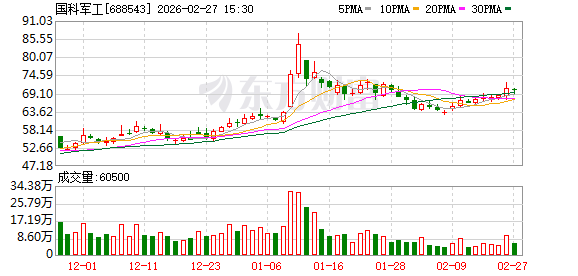
国科军工:2025年度业绩快报公告
Zheng Quan Ri Bao· 2026-02-27 13:39
Group 1 - The company, Guokai Military Industry, announced that it expects to achieve an operating revenue of 1,410.34 million yuan in 2025, representing a year-on-year growth of 17.10% [2] - The net profit attributable to the parent company's shareholders is projected to be 247.51 million yuan, reflecting a year-on-year increase of 24.55% [2]

新余国科:2月27日召开董事会会议
Mei Ri Jing Ji Xin Wen· 2026-02-27 07:59
Group 1 - The company Xinyu Guoke announced the convening of its fourth board meeting on February 27, 2026, to discuss the expected daily related transactions for the year 2026 [1] - The meeting took place at the company's office building in Xinyu City, specifically in the Xianv Lake District [1] Group 2 - In February, China's AI usage surpassed that of the United States for the first time, indicating a significant growth in domestic computing power demand [1] - Four major AI models from China ranked among the top five globally, showcasing the country's advancements in AI technology [1]

国防ETF(512670)冲击6连涨,燃气轮机概念再度活跃
Xin Lang Cai Jing· 2026-02-27 02:32
Group 1 - The gas turbine concept is experiencing renewed activity, with AIDC entering a period of rapid growth. The demand for electricity capacity driven by AI in the U.S. is projected to have a CAGR of approximately 55% from 2025 to 2028, with cumulative demand exceeding 150 GW over the next three years [1] - According to Huatai Securities, overseas manufacturers' production capacity is fully booked until the end of 2029. As capacity is released, new orders are expected to increase both in quantity and profitability. The top manufacturers' expansion will not be realized until after 2027, and a supply-demand gap of over 30% will strengthen the trend of demand overflow in the short term [1] - As of February 27, 2026, the CSI Defense Index (399973) rose by 0.31%, with constituent stocks such as BaoTi Co., Ltd. increasing by 10.00%, Triangle Defense by 7.42%, and others showing significant gains. The Defense ETF (512670) also increased by 0.47%, marking its sixth consecutive rise [1] Group 2 - As of January 30, 2026, the top ten weighted stocks in the CSI Defense Index (399973) include Aerospace Electronics, Aero Engine Corporation, AVIC Shenyang Aircraft, AVIC Optoelectronics, Ruichuang Micro-Nano, Filihua, AVIC Xi'an Aircraft, Western Superconducting, AVIC Onboard, and Zhenlei Technology, collectively accounting for 42.4% of the index [2]