
证券业

Search documents
【笔记20260211— 她真的,我哭死】
债券笔记· 2026-02-11 10:55
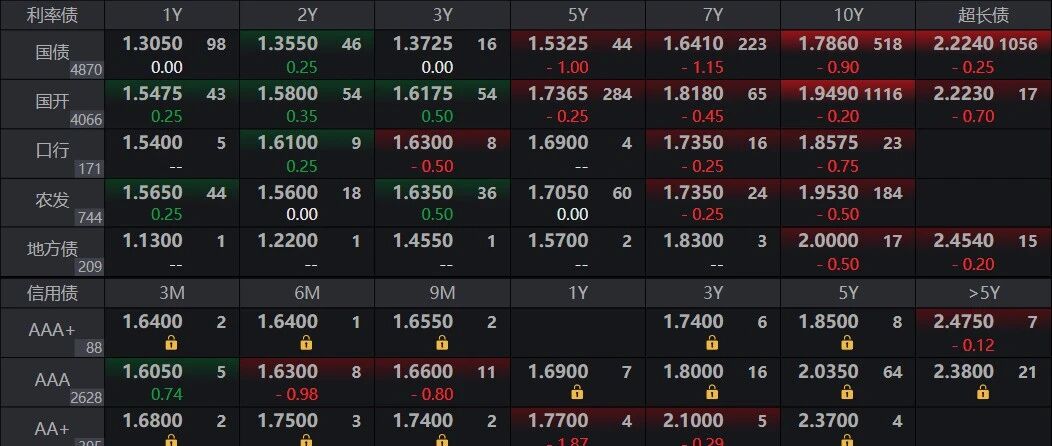
Core Viewpoint - The article emphasizes the importance of basing market predictions on factual data rather than speculative or imagined scenarios [1][2]. Group 1: Market Conditions - The January inflation data met expectations, leading to a slight increase in the stock market and a balanced funding environment, with interest rates slightly declining [6]. - The central bank conducted a total of 4,785 billion yuan in reverse repos, with a net injection of 4,035 billion yuan after 750 billion yuan in 7-day reverse repos matured [4][6]. - The interbank funding rates remained stable, with DR001 around 1.37% and DR007 around 1.54% [4]. Group 2: Bond Market Insights - The central bank mentioned improving the regular operation mechanism for government bond trading, which is expected to stabilize interest rates and reduce volatility [7]. - The 10-year government bond yield decreased from 1.857% to 1.786% since January 14, indicating a positive sentiment in the bond market [7]. - The bond market is described as providing unexpected benefits to bondholders, with the sentiment remaining stable [7].

央行:2025年两市日均成交额17045.4亿元 同比增加61.9%
智通财经网· 2026-02-11 10:45
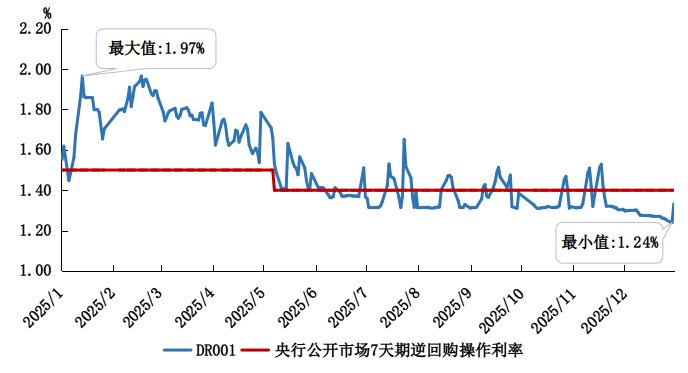
Monetary Market Performance - In 2025, the average daily transaction volume of interbank lending was 3610.7 billion yuan, a decrease of 12.1% compared to 2024 [2] - The average daily transaction volume of bond repurchase in the interbank market was 69,000 billion yuan, an increase of 3.0% compared to 2024 [2] - The year-end balance of interbank lending was 10,000 billion yuan, while the year-end balance of bond repurchase was 120,000 billion yuan [2] - The weighted average interest rate for overnight pledged repos (DR001) was 1.46%, down 19 basis points from 2024 [2] - The average daily spread between DR001 and the central bank's 7-day reverse repo rate was 7 basis points [2] Bond Market Performance - In 2025, net financing for government bonds was 138,000 billion yuan, an increase of 25,000 billion yuan compared to 2024 [5] - The total transaction volume in the cash market was 425.3 trillion yuan, an increase of 1.4% compared to 2024 [5] - The year-end yield for 10-year government bonds was 1.85%, with a spread of 51 basis points between 10-year and 1-year government bond yields, narrowing by 8 basis points from the end of 2024 [5] Derivatives Market Performance - The transaction volume of the RMB derivatives market in the interbank market was 58.5 trillion yuan, an increase of 58.6% compared to 2024 [8] - The transaction volume of government bond futures was 97.0 trillion yuan, an increase of 43.9% compared to 2024 [8] - The closing price of the 10-year government bond futures main contract was 107.9 yuan, down 1.0% from the end of 2024 [8] Commercial Paper Market Performance - The acceptance amount of commercial bills was 42.7 trillion yuan, while the discount amount was 33.9 trillion yuan [9] - The acceptance balance of commercial bills was 21.2 trillion yuan, an increase of 7.2% compared to the end of 2024 [9] Stock Market Performance - By the end of 2025, the Shanghai Composite Index closed at 3968.8 points, an increase of 18.4% compared to the end of 2024 [12] - The Shenzhen Component Index closed at 13525.0 points, an increase of 29.9% compared to the end of 2024 [12] - The average daily transaction volume of both markets was 17,045.4 billion yuan, an increase of 61.9% compared to 2024 [12] Holder Structure of Interbank Bond Market - As of the end of 2025, there were 3923 institutional members in the interbank bond market, all of which were financial institutions [13] - The top 50 investors in corporate credit bonds held 53.4% of the total holdings, mainly concentrated in state-owned commercial banks, public funds, and insurance financial institutions [13]
金融市场流动性与监管动态周报:融资资金加速流出,资金面边际好转-20260211
CMS· 2026-02-11 09:31
Core Insights - The report indicates a continued trend of net capital outflow in the secondary market, with a significant narrowing of ETF outflows but an expansion in financing capital outflows. The central bank emphasizes the need for flexible and efficient use of various policy tools to maintain ample liquidity and relatively loose social financing conditions [2][4]. Liquidity Analysis - The central bank's fourth-quarter monetary policy execution report highlights the importance of maintaining liquidity and social financing conditions. It discusses topics such as fiscal-financial coordination and green finance [4][9]. - The report notes a net outflow of funds in the secondary market, with a decrease in financing balance and a net sell-off of financing capital amounting to 516 billion [4][26]. - The average weekly trading volume of A-shares decreased to 24,066.54 million, indicating reduced market activity [3]. Market Sentiment - The report shows a decline in trading activity, with an increase in equity risk premiums. The VIX index rose, reflecting a decrease in risk appetite in overseas markets [4][41]. - Various style indices and major industry turnover rates decreased, indicating a shift in market dynamics [4][46]. Sector Preferences - The construction materials, social services, and construction decoration sectors saw significant net inflows, while sectors like non-ferrous metals and food and beverage experienced notable outflows [4][50]. - The report highlights that the highest net inflows were observed in the electronic, communication, and non-bank financial sectors, while the electronic sector faced the largest net outflow [4][51]. Fund Supply and Demand - Fund supply saw a reduction in newly established equity public funds, with a net outflow of 60.8 billion from stock ETFs. The total financing balance for A-shares was reported at 26,470.5 billion [3][26]. - On the demand side, the report notes a decrease in IPO financing to 14.0 billion, with a significant increase in the market value of restricted stock unlocks [4][33]. Investor Preferences - The report identifies that the highest net purchases were made in stocks like SMIC and Hunan Gold, while significant net sales were recorded for stocks like NewEase and Kweichow Moutai [4][52]. - The ETF market showed mixed results, with significant net redemptions in broad-based ETFs, while sector-specific ETFs like technology and healthcare saw net subscriptions [4][55].
资讯早班车-2026-02-11-20260211
Bao Cheng Qi Huo· 2026-02-11 01:32
1. Report Industry Investment Rating No relevant content provided. 2. Core Viewpoints of the Report - The economy in early 2026 shows a complex situation. The GDP growth rate slows down, and the manufacturing and non - manufacturing PMIs fluctuate. The consumer price index and producer price index have different trends, and the investment and consumption data also show certain changes. In the commodity market, there are adjustments in futures contract rules and price fluctuations in various commodities. The financial market has changes in monetary policy, bond market, and exchange rate market, and the stock market shows different trends in A - shares and Hong Kong stocks [1][38][39]. 3. Summary According to the Directory 3.1 Macro Data - GDP growth rate in Q4 2025 was 4.5%, down from 4.8% in the previous quarter and 5.4% in the same period last year [1]. - In January 2026, the manufacturing PMI was 49.3%, slightly up from 49.0% in the previous month, and the non - manufacturing PMI: business activity was 49.4%, down from 50.1% in the previous month [1]. - In December 2025, social financing scale was 2207.5 billion yuan, down from 3529.9 billion yuan in the previous month and 2853.7 billion yuan in the same period last year [1]. - CPI in December 2025 was 0.8% year - on - year, up from - 0.3% in the previous month, and PPI was - 1.9% year - on - year, up from - 2.3% in the previous month [1]. 3.2 Commodity Investment Reference 3.2.1 Comprehensive - Dalian Commodity Exchange adjusted the daily price limit and trading margin levels of various futures contracts from February 12, 2026 [2]. - Bank of China adjusted the margin ratios of gold and silver deferred contracts from February 11 [2]. - On February 10, 41 domestic commodity varieties had positive basis, and 27 had negative basis [3]. - The China Futures Association drafted a management rule for stress testing of futures companies' trading and settlement systems and solicited public opinions [3]. - Heraeus Limited was approved as an overseas standard gold ingot provider by the Shanghai Gold Exchange and can trade and deliver since February 5, 2026 [4]. - Fed officials Logan and Hamark said the Fed's policy stance was close to neutral and there might be no need for further rate cuts if inflation fell and the labor market remained stable [4]. 3.2.2 Metals - On February 11, spot gold reached $5050, up 0.53% for the day, and spot silver reached $81 per ounce, up 0.81% for the day [5]. - Chow Tai Fook may adjust the price of gold products in mid - March, with an expected increase of 15% - 30% for fixed - price products [5]. - The price of indium has reached a more than ten - year high, up more than 55% since last September [5]. - In December, Codelco's copper production increased by 3.7% year - on - year to 181,400 tons, while the copper production of Collahuasi Mine decreased by 12.1% year - on - year to 36,200 tons [6]. - As of February 10, 2026, the holdings of SPDR Gold Trust decreased by 0.34 tons to 1079.32 tons [6]. - On February 9, tin and copper inventories reached new highs, while aluminum, zinc, and lead inventories decreased [6][7]. 3.2.3 Coal, Coke, Steel, and Minerals - The White House will hold a coal - related event on Wednesday [8]. - The US Trade Representative is conducting negotiations on key minerals, including with Mexico and India, and expects to finalize an agreement with Indonesia in the next few weeks. Japan and the US will discuss a project supported by a $550 - billion investment tool [8][9]. 3.2.4 Energy and Chemicals - Zhoushan was approved to carry out the mixed - export business of marine bio - fuel oil [9]. - The US Energy Information Administration predicted that US natural gas production would reach a record high in 2026, while demand would remain stable. It also provided forecasts for oil demand and prices [9][10]. 3.2.5 Agricultural Products - Beef prices showed a slight upward trend as the Spring Festival approached. Egg prices declined due to sufficient supply and weakening demand [11]. - The US Department of Agriculture's February forecast for US soybean production, ending stocks, and yield in the 2025/2026 season remained unchanged from January [12]. - Bangladesh will purchase soybeans, wheat, cotton, and corn. Brazil's February exports of soybean meal and soybeans are expected to increase [13]. - The India Cotton Association expects the cotton supply in the 2025 - 26 season to be 42.8 million bales [14]. 3.3 Financial News Compilation 3.3.1 Open Market - On February 10, the central bank conducted 311.4 billion yuan of 7 - day reverse repurchase operations, with a net injection of 205.9 billion yuan [15]. - On February 10, the Ministry of Finance and the central bank conducted a 150 - billion - yuan central treasury cash management commercial bank time - deposit auction, with an interest rate of 1.73% [15]. 3.3.2 Important News and Information - The central bank will continue to implement a moderately loose monetary policy, use policy tools flexibly, and normalize treasury bond trading operations [16]. - The 21st session of the 14th National People's Congress Standing Committee will be held from February 25 - 26, with multiple draft laws to be reviewed [17]. - The market regulatory authority approved a batch of important national standards in various fields [17]. - Five ministries jointly issued a guide for the construction of the science and technology service industry standard system [18]. - In January 2026, investment in digital economy - related fields was active, and consumption increased [18]. - Fiscal expenditure is shifting from infrastructure to "new - quality productivity" [19]. - The focus of the real estate market in 2026 is to stabilize the market, reduce inventory, strengthen housing security, and promote urban renewal [20]. - In 2025, the national social logistics volume increased by 5.1% year - on - year, with significant growth in the logistics volume of industrial robots and new - energy vehicles [20]. - Local debt resolution is in a critical stage, and some areas have completed debt - clearing tasks [20]. - Some real - estate enterprises have new financing activities, but the financing environment has only "point - like improvement" [21]. - Banks have issued a large number of large - denomination certificates of deposit, with a short - term trend and differentiated product strategies [21]. - The wealth management scale of large - scale wealth management companies declined in January 2026, but there are positive expectations for the future [22][23]. - Small and medium - sized banks have raised deposit interest rates at the beginning of the year [23]. - Tianjin's first batch of ESG - standardized bonds for financial leasing were issued [23]. - Alphabet issued a 750 - million - pound 100 - year bond, with over 7 - fold over - subscription [24]. - According to CME's "FedWatch", the probability of the Fed cutting interest rates in March is 21.6%, and the probability of maintaining the interest rate is 78.4% [24]. - Japan's national debt reached a record high at the end of 2025 [25]. - Ray Dalio warned that the US is in the "fifth stage" of the imperial cycle and recommended holding 5% - 15% of gold in the investment portfolio [26]. - There were various bond - related events, including credit rating adjustments and disciplinary actions [27]. - Overseas credit rating agencies adjusted the credit ratings of some Chinese real - estate enterprises [28]. 3.3.3 Bond Market Summary - The inter - bank bond market showed narrow fluctuations, with government bonds performing better than policy - financial bonds. The money market interest rates mostly increased [29][31]. - The exchange - traded bond market had active trading, with some bonds rising and some falling. The convertible bond index declined [29][30]. - The yields of European and US government bonds declined [33]. 3.3.4 Exchange Rate Express - The on - shore RMB against the US dollar rose 155 points to 6.9129 at the close on February 11. The RMB central parity rate against the US dollar was raised by 65 points [34]. - The US dollar index rose slightly, and most non - US currencies fell [34]. 3.3.5 Research Report Highlights - CITIC Securities believes that the liquidity of urban investment bonds will continue to differentiate, and 3 - 5 - year urban investment bonds have high cost - performance [35]. - CITIC Securities points out that the consumption during the Spring Festival and the policy from local two sessions are the focuses in Q1, and the industrial destocking speed after March and the implementation of new industrial policies are crucial for the annual economic recovery [35]. - Xingzheng Fixed - Income suggests that investors focus on the coupon strategy for Chinese - funded US - dollar bonds in 2026 and pay attention to the yields of offshore urban investment dim - sum bonds and bonds of banks and financial services sectors [36]. - Yangtze River Fixed - Income believes that the spread changes of local bonds are affected by market trading and policies, and there are differences in liquidity and trading preferences among different provinces [36]. 3.3.6 Today's Reminder - On February 11, 280 bonds were listed, 74 bonds were issued, 75 bonds were due for payment, and 89 bonds were due for principal and interest repayment [37]. 3.4 Stock Market News - On February 11, the A - share market showed narrow fluctuations, with the Shanghai Composite Index rising 0.13%, the Shenzhen Component Index rising 0.02%, and the ChiNext Index falling 0.37%. AI application stocks and some concept stocks were active, while photovoltaic and consumer stocks were weak [38]. - The Hong Kong Hang Seng Index rose 0.58%, and AI application stocks and innovative drug concept stocks rose. Southbound funds had a small net purchase, and Tencent Holdings was sold [39]. - Foreign institutions are optimistic about Chinese assets, believing that China has a complete industrial chain, strong innovation ability, and attractive valuations [39].
四大证券报精华摘要:2月11日
Xin Hua Cai Jing· 2026-02-11 00:55
Group 1: Insurance and Investment - Insurance capital is increasingly participating in private equity funds, with companies like Tianjin Lanqin Equity Investment Partnership being established and major insurers like Taikang Life involved as partners [1] - Since 2026, leading insurers such as China Life and Xinhua Insurance have launched new projects in private equity, driven by a policy environment encouraging long-term investments [1] - The need for asset-liability matching in a low-interest-rate environment is pushing insurers to seek private equity investments to enhance long-term returns [1] Group 2: Market Trends and Investor Sentiment - Over 60% of private equity firms plan to heavily invest in A-shares as the Spring Festival approaches, with an average estimated position of 75.68% during the holiday [2] - Public funds are increasingly accumulating positions in the consumer sector, with notable fund managers investing significantly in leading pet companies, indicating a rebound in consumer stocks [3] Group 3: Bond Market Developments - The yield on 10-year government bonds has fallen below 1.8%, indicating a return of the bond market's safe-haven attributes amid improved liquidity and insurance capital allocation [4] - The bond market is experiencing a structural recovery, with differing opinions on the potential for further interest rate declines [4] Group 4: Private Equity Growth - The number of private equity firms managing over 10 billion yuan has reached a record high of 122, with 10 new firms entering this category since December 2025 [5] Group 5: Monetary Policy and Financing - The People's Bank of China emphasizes the continued implementation of a moderately loose monetary policy, utilizing various tools to maintain liquidity and favorable financing conditions [6] Group 6: Corporate Financing and Regulations - New refinancing regulations have been introduced to support quality listed companies and enhance the flexibility of financing for technology innovation enterprises [7] - Many listed companies are actively exploring refinancing opportunities to strengthen their core competitiveness [7] Group 7: Local Government Debt Management - Local governments are making significant progress in clearing hidden debts, with at least 34 cities reporting advancements in their debt clearance tasks since 2026 [8] Group 8: IPO Market Improvements - The quality of IPO applications in the A-share market has improved significantly, with stricter regulations leading to better compliance and transparency among applicants [9] Group 9: Robotics Industry Developments - The humanoid robotics sector is accelerating its capital market activities, with several companies initiating IPO processes as the industry transitions from technology validation to commercialization [10] Group 10: Housing Market Policies - Various cities, including Chongqing, are implementing policies to stimulate housing consumption, such as providing subsidies and enhancing loan support for homebuyers [11] Group 11: Telecommunications Infrastructure - The Ministry of Industry and Information Technology has set a timeline for enhancing low-altitude communication networks, with major telecom companies actively preparing for this development [12][13]
每日债市速递 | 银行间市场资金面整体偏紧
Wind万得· 2026-02-10 23:10
Group 1: Market Operations - The central bank conducted a 7-day reverse repurchase operation on February 10, with a fixed rate of 1.40%, totaling 311.4 billion yuan, resulting in a net injection of 205.9 billion yuan for the day after accounting for 105.5 billion yuan in reverse repos maturing [3]. Group 2: Funding Conditions - The interbank market is experiencing a tight funding environment, with the weighted average rate of DR001 rising over 9 basis points to above 1.36%. Overnight rates for non-bank institutions using credit bonds as collateral have increased to above 1.6% and 1.65% for overnight and cross-period funding, respectively [5]. - The latest overnight financing rate in the U.S. is reported at 3.64% [5]. Group 3: Interbank Certificates of Deposit - The latest transaction rate for one-year interbank certificates of deposit among major banks is around 1.59%, showing a slight increase from the previous day [7]. Group 4: Government Bonds and Futures - The closing prices for government bond futures show a slight increase, with the 30-year and 10-year main contracts rising by 0.01%, while the 5-year and 2-year contracts remained unchanged [13]. Group 5: Fiscal Policy Changes - In response to increasing fiscal revenue and expenditure contradictions, there is a notable shift in China's fiscal spending structure, with more funds being directed towards human capital and a decline in infrastructure investment. This indicates a transition from traditional infrastructure to new productive capacities [14]. Group 6: Global Macro Insights - By the end of 2025, Japan's government debt is projected to reach 134.2 trillion yen, marking an increase of 24.5 trillion yen from the previous year, setting a new historical record [16]. - The U.S. White House announced that India will purchase over 500 billion USD worth of American products, including energy and agricultural goods, while reducing tariffs on various U.S. industrial products [16]. Group 7: Bond Market Developments - Fitch Ratings upgraded Vanke's long-term foreign and local currency issuer ratings from "RD" to "CC" [18]. - The first batch of ESG standardized bonds for financing leasing in Tianjin has been issued [18]. - After the refinancing policy, the first issuance in the Shanghai market is from Zhongke Shuguang, planning to issue up to 8 billion yuan in convertible bonds [18].

金价:大家提前做好准备,明后两天,金价可能迎关键变盘?
Sou Hu Cai Jing· 2026-02-10 23:08
Core Viewpoint - The gold market is experiencing significant changes, with international gold prices surpassing the psychological threshold of $5000 per ounce, and domestic gold prices remaining high, indicating a potential directional shift in the near future [1][3]. Group 1: Market Dynamics - Recent volatility in gold prices has been notable, with a historical high of $5598.75 per ounce on January 29, followed by a sharp decline of over $1100 within three trading days, a drop exceeding 21% [3]. - The market is currently characterized by intense competition between buyers and sellers at the $5000 mark, with profit-taking pressures from previous gains and ongoing support from central bank purchases and geopolitical risks [3]. - Financial institutions are showing caution by raising thresholds for gold accumulation services and increasing risk assessment requirements, reflecting concerns over high gold prices [3]. Group 2: Consumer Behavior - Despite high prices, demand for gold remains strong ahead of the Spring Festival, with notable increases in prices for gold jewelry and investment bars [3]. - Different purchasing strategies are recommended based on consumer intent, with suggestions for cautious buying regardless of whether the purchase is for gifting or long-term investment [7]. Group 3: Pricing and Investment Strategies - The traditional valuation framework for gold is being challenged, with analysts frequently adjusting target prices due to the evolving market dynamics [5]. - The current market environment necessitates a clear understanding of investment goals, with recommendations for a disciplined approach to purchasing gold as a long-term asset [5][9]. - Banks are promoting gold-related financial products, which typically have low investment thresholds and short durations, catering to varying risk appetites among investors [9]. Group 4: Historical Context and Future Outlook - Since the low of $1614 per ounce in September 2022, gold prices have increased by over 246%, indicating a strong bull market that has exceeded many analysts' expectations [10]. - Increased market volatility is a concern, influenced by international dynamics, monetary policy, and market sentiment, suggesting that investors should monitor volatility as a key indicator for future investment decisions [10].

广发基金管理有限公司关于以通讯方式召开广发国证粮食产业交易型开放式指数证券投资基金基金份额持有人大会的第二次提示性公告
Xin Lang Cai Jing· 2026-02-10 19:01
Group 1 - The announcement is regarding the convening of a communication-based meeting for the holders of the Guangfa National Grain Industry Exchange-Traded Fund (ETF) [1][2] - The fund was approved for registration on January 12, 2024, and officially commenced operations on August 8, 2024 [2] - The meeting aims to discuss the proposal for the continuous operation of the fund [4][31] Group 2 - The voting period for the meeting is set from February 11, 2026, to March 10, 2026, at 15:00 [2][5] - Holders must submit their votes and required documents to the designated recipient during the voting period [3][9] - The meeting will be conducted via communication methods, allowing for both paper and telephone voting [6][10] Group 3 - The rights registration date for participants in the meeting is February 10, 2026 [5] - Each fund share represents one vote in the meeting [23] - The proposal requires approval from holders representing at least half of the total fund shares to be valid [26] Group 4 - If the meeting does not meet the required quorum, a second meeting may be convened [27][28] - The fund management company is responsible for the organization and execution of the meeting [29] - The announcement includes details about the voting process and the necessary documentation for participation [20][21]

申万菱信基金管理有限公司关于以通讯方式召开申万菱信安泰广利63个月定期开放债券型证券投资基金基金份额持有人大会的公告
Xin Lang Cai Jing· 2026-02-10 19:00
Meeting Overview - The meeting will be held via communication method to discuss the adjustment of the fund's income distribution principles and the removal of investment portfolio restrictions [1][26] - Voting period is from February 14, 2026, to March 16, 2026, at 17:00 [1][9] - The meeting's equity registration date is February 13, 2026 [4] Voting Methods - Paper ballots can be submitted by mail or in person, with specific instructions for individual and institutional investors [5][6] - Telephone voting is available for individual fund holders, with a dedicated customer service hotline for participation [9][10] - Online voting can be conducted through the official WeChat mini-program "申小顾" for individual fund holders [11][12] Meeting Agenda - The main agenda includes the proposal to adjust the fund's income distribution principles and amend the fund contract and custody agreement [2][27] - Detailed explanations of the proposed amendments are provided in the attachments [26][32] Voting Validity - Each fund share carries one vote, and all shares have equal voting rights [15] - Validity of votes is determined by the completeness and clarity of the submitted ballots [16][19] - The meeting resolution requires at least half of the voting rights to be present for approval [20] Additional Information - The meeting is organized by Shenwan Hongyuan Fund Management Co., Ltd., with the custodian being Shanghai Pudong Development Bank [21] - Investors can access the meeting announcement and related documents on the fund management company's website [22][24]

新疆上市公司协会举办银企座谈会 搭建常态化对接平台
Zhong Zheng Wang· 2026-02-10 12:27
Core Insights - The Xinjiang Listed Companies Association held a successful meeting to enhance communication between listed companies and financial institutions, aiming to facilitate precise matching of funding supply and demand [1][2] Group 1: Meeting Overview - The meeting was guided by the Xinjiang Securities Regulatory Bureau and attended by over 120 participants, including executives from 50 listed companies and representatives from 10 financial institutions [1] - The meeting emphasized the importance of deepening core business, improving financing channels, maintaining compliance, and enhancing technological innovation [1] Group 2: Financial Institutions' Contributions - Financial experts from various institutions provided insights on macroeconomic trends and policy directions, offering practical strategies for listed companies to leverage capital tools for development [2] - Seven financial institutions presented tailored financing services and credit products to address the specific needs of listed companies, aiming to optimize their financing structures [2] Group 3: Future Initiatives - The Xinjiang Listed Companies Association plans to regularly conduct effective communication activities focused on the actual needs of listed companies, enhancing collaboration between capital markets and financial services to boost economic development in Xinjiang [2]