非银金融

Search documents
牛市整固蓄力期的经验
Tianfeng Securities· 2025-09-21 11:13
Group 1: Market Insights from 2014-2015 Bull Market - The market style during the bull market from 2014 to 2015 showed a pattern of "rapid rise - retreat and bottoming," with the market crowding degree reaching a low of around 20% in early July 2025 and peaking at 30% in early September 2025 [1][10] - In the first phase of the 2014-2015 bull market, financial and stable styles led the gains, but during the consolidation phase, they significantly underperformed, while growth styles gradually took the lead [1][15] - The first phase saw non-bank financials, banks, construction decoration, steel, and real estate sectors leading the gains, but all fell to the lower ranks during the adjustment phase [2][18] Group 2: Current Economic Data - In August 2025, key economic indicators showed a marginal decline, with industrial value added growing by 5.2% year-on-year, below the expected 5.75% [3][27] - Social consumption in August increased by 3.4% year-on-year, also lower than the expected 3.82%, indicating a slowdown in consumer spending [3][36] - Fixed asset investment growth was only 0.5% in August, down from 1.6% in July, reflecting a continued decline in investment activity [3][43] Group 3: Industry Performance - In the current consolidation phase, industries such as communication, electronics, and power equipment have maintained strong performance, while the non-ferrous metals sector has seen a decline [2][23] - The coal sector has improved significantly, rising from 28th to 9th place in terms of performance during the adjustment phase, indicating a recovery in previously lagging industries [2][23] - The top-performing industries during the current phase include communication, electronics, and power equipment, with communication showing a gain of over 40% [2][23]
牛市震荡期前后的风格变化
Xinda Securities· 2025-09-21 09:58
Core Conclusions - The report indicates that after a peak in turnover rate during a bull market, there is often a period of sideways consolidation, with fast bull markets experiencing shorter consolidation periods and slow bull markets experiencing longer ones [2][3][9] - It is noted that after consolidation in a bull market, there is a high probability of a change in market style, particularly between large-cap and small-cap stocks, although the transition between growth and value styles does not follow a clear pattern [2][3][8] Market Style Changes During Bull Markets - In the slow bull market period from July to October 2020, the market style shifted from small-cap growth to large-cap growth after a consolidation phase lasting three and a half months. Strong sectors before the consolidation included food and beverage and electric equipment, while electronics and computers weakened afterward [3][11] - Historical examples from the fast bull market of 2005-2007 show that prior to the consolidation periods in June-August 2006, January-February 2007, and June-July 2007, the market styles were small-cap growth, large-cap value, and small-cap value respectively, transitioning to large-cap growth, small-cap value, and large-cap value after the consolidations [3][14][15][16] Current Market Assessment - The report suggests that the current market is likely in the mid-stage of a bull market, with expectations of continued upward movement in the fourth quarter following a narrow consolidation in September. The market is becoming less sensitive to current earnings, and structural profit-making effects have been observed for nearly a year [17][18] - The report highlights that the recent increase in turnover rates and concentrated trading in certain sectors may lead to adjustments, but it does not foresee significant negative impacts, maintaining a bullish outlook for the market [18][21] Sector Allocation Recommendations - The report recommends reallocating within the financial sector from banks to non-bank financials, as the latter is expected to show increased performance elasticity in the context of a rising bull market [22][23] - It also suggests focusing on sectors such as electric equipment, non-ferrous metals, and chemicals, with an emphasis on the potential for cyclical stocks to perform well in the coming months due to expected policy support for demand stabilization [22][23]
板块分化加剧双创指数强于大盘指数
Zhe Shang Qi Huo· 2025-09-21 07:31
Report Investment Rating - No investment rating information is provided in the given content Core Viewpoints - Technology remains the main driving force, with the recent volatility of high - flying technology blue - chips increasing significantly, and sectors such as solid - state batteries and energy storage taking over to gain strength. There is still room for the revaluation of Chinese assets, but its sustainability requires the support of macro - policies. It is recommended to enter the futures index market on pullbacks [3] - It is advisable to focus on allocating to technology - growth sectors with earnings certainty, such as semiconductors and AI computing power, and also pay attention to the rotation allocation value of low - valuation defensive sectors like finance, securities, and consumption [6] Summary by Directory Market Performance - This week, domestic stock indices were mainly volatile, with the ChiNext and STAR Market indices remaining strong. The Shanghai Composite Index fell by 1.30%, the Shenzhen Component Index rose by 1.14%, the ChiNext Index rose by 2.34%, and the STAR 50 Index rose by 1.84%. In terms of global indices, the Nasdaq rose by 2.22%, the S&P 500 rose by 1.22%, and the Hang Seng Tech Index rose by 5.09% [15][19] - Among the Shenwan first - tier industries, sectors such as coal, power equipment, and electronics rose significantly, while sectors such as banks, non - ferrous metals, and non - bank finance led the decline [19] Liquidity - In August, the growth rate of social financing declined, and the "scissors gap" between M1 and M2 narrowed. The difference in August was 2.8 percentage points, indicating an increase in the activation of funds. The policies to stabilize the market effectively boosted market confidence, which is beneficial for the short - term economic activity [17][18] - As of September 19, 2025, the capital interest rate (DR007) remained at a low level, and the net MLF investment in July was 40 billion yuan. The yield of the 10 - year Treasury bond was around 1.7%. The total social financing in August increased less year - on - year, with the new social financing in August at 2.57 trillion yuan, a year - on - year decrease of 483 billion yuan. The year - on - year growth rate of the social financing stock dropped to 8.8%, 0.2 percentage points lower than at the end of last month [20] Trading Data and Sentiment - The number of new accounts opened in January was 1.57 million, in February was 2.88 million, in March was 3.06 million, in April dropped to 1.92 million, in May continued to drop to 1.555 million, in June slightly rose to 1.6464 million, in July was 1.9636 million, and in August was 2.6503 million [28] - The average daily trading volume of the two markets (MA5) rebounded above 2.5 trillion yuan, and the liquidity supported the index. The single - day trading volume within the week exceeded 3 trillion yuan, and the divergence intensified [28] Index Valuation - As of September 19, 2025, the latest PE of the Shanghai Composite Index was 16.36, with a percentile of 81.41; the latest PE of the SSE 50 was 22.10, with a percentile of 84.90. Among the major stock indices, the valuation percentiles of the CSI 1000, CSI 500, and SSE 204.5 were close to 50% [37] Index Industry Weights (as of 2025/6/30) - For the SSE 50, the weights of the banking, non - bank finance, and food and beverage sectors were relatively high, at 21.34%, 15.48%, and 13.88% respectively. The electronics industry became the fourth - largest weighted industry [46][47] - For the CSI 300, the weights were relatively dispersed. The top three weighted industries were banking, non - bank finance, and electronics [46][47] - For the CSI 500, the top three weighted industries were electronics, pharmaceutical biology, and non - bank finance [47][51] - For the CSI 1000, the top three weighted industries were electronics, pharmaceutical biology, and computer [47][51] Other Overseas and Domestic Policy Tracking - The United States is about to enter another interest - rate cut cycle, with a 25 - basis - point cut in September. According to CME data, as of September 18, the probability of another interest - rate cut by the Fed in October is nearly 80%, and there are still two expected cuts within the year [52] - In 2025, the government work report and the Two Sessions in March set the economic growth target at 5%, the CPI increase at around 2%. A moderately loose monetary policy was implemented, with timely reserve - requirement ratio cuts and interest - rate cuts to ensure sufficient bond liquidity. A more proactive fiscal policy was implemented, with a planned deficit ratio of around 4% and the issuance of ultra - long - term special treasury bonds worth 1.3 trillion yuan [53] - At the State Council Information Office press conference on May 7, 2025, the reserve - requirement ratio was cut by 0.5 percentage points, the policy interest rate was lowered by 0.1 percentage points from 1.56% to 1.4%, and the provident - fund interest rate was lowered by 0.25 percentage points. A 500 - billion - yuan re - loan for service consumption and elderly care was established, and support was provided for Central Huijin to play the role of a "stabilization fund" [53]
A股投资策略周报:国庆前后融资变化规律及A股日历效应如何?-20250921
CMS· 2025-09-21 03:33
Group 1 - The financing trend around the National Day holiday typically shows a pattern of "contraction before the holiday and explosion after" [1][5][12] - Historical data indicates that the A-share market generally experiences a calendar effect, with a tendency for major indices to rebound after the holiday [5][14][22] - The probability of major indices such as the Shanghai Composite Index, CSI 300, and CSI 1000 rising after the National Day holiday exceeds 60% based on the past decade [5][14][22] Group 2 - Key sectors that are expected to perform well post-holiday include computer, communication, and electronics, with banks, non-bank financials, and automobiles also showing strong performance in the following weeks [5][18][21] - The financing balance has shown a significant increase, with a net inflow of 558.3 billion yuan since July, indicating that financing has become a major driving force for market growth [7][9][28] - The current financing balance reached 2.39 trillion yuan, which is above historical highs, although it still represents only 2.54% of the A-share market's circulating value [9][10][28] Group 3 - The Federal Reserve's recent interest rate cut of 25 basis points is part of a preventive easing strategy, which historically leads to higher probabilities of A-share and Hong Kong stock market gains [6][25][26] - The report suggests a continued focus on growth-oriented sectors, particularly in solid-state batteries, AI computing, humanoid robots, and commercial aerospace [1][25][28]
下周,科技成长风格仍为主线
Sou Hu Cai Jing· 2025-09-21 01:55
Market Overview - Global liquidity easing expectations have risen, boosting risk appetite and leading technology growth to drive global market performance [1] - Major stock indices have generally risen, with US indices reaching historical highs; the Nasdaq increased by 2.21%, S&P 500 by 1.22%, and Dow Jones by 1.05% [1] - The Hong Kong stock market saw a significant rebound in the technology sector, with the Hang Seng Technology Index rising by 5.09%, marking the largest weekly gain of the year [1] A-share Market Dynamics - The A-share market displayed a clear "growth strong, cycle weak" characteristic, with funds continuously flowing into growth sectors [2] - The ChiNext Index rose by 2.34%, and the STAR 50 Index increased by 1.84%, while the Shanghai Composite Index fell by 1.30% [2] - The trading volume in the Shenzhen market was higher than in the Shanghai market, indicating concentrated capital inflow into growth tracks [2] Sector Performance - In the A-share market, the coal sector led gains with a rise of 3.51%, followed by power equipment, electronics, and automotive sectors, each exceeding 2.9% [2] - The financial sector faced pressure, with banks, non-ferrous metals, and non-bank financials declining over 3.5% [2] - In the concept sectors, photolithography machines, optical modules, semiconductor equipment, and automotive parts saw index increases exceeding 5% [3] Commodity Market Trends - The commodity market exhibited a "strong energy, weak metals" pattern, with iron ore rising by 1.13% and INE crude oil increasing by 1.55% [3] - Precious metals faced pressure, with SHFE gold declining by 0.35% due to a stronger dollar and rising real interest rates [3] - Industrial metals generally weakened, with SHFE copper and INE international copper dropping by 0.93% and 1.16%, respectively [3] Policy and Economic Signals - Domestic and international signals of easing have been released, with the Federal Reserve lowering interest rates by 25 basis points for the first time this year [3] - The People's Bank of China conducted a 600 billion yuan reverse repurchase operation to maintain reasonable liquidity [3] - The joint issuance of the "Automobile Industry Stabilization Growth Work Plan" by eight departments aims to promote the development of smart connected vehicles [3]
A股,这一纪录,再刷新!
Zheng Quan Shi Bao· 2025-09-20 23:52
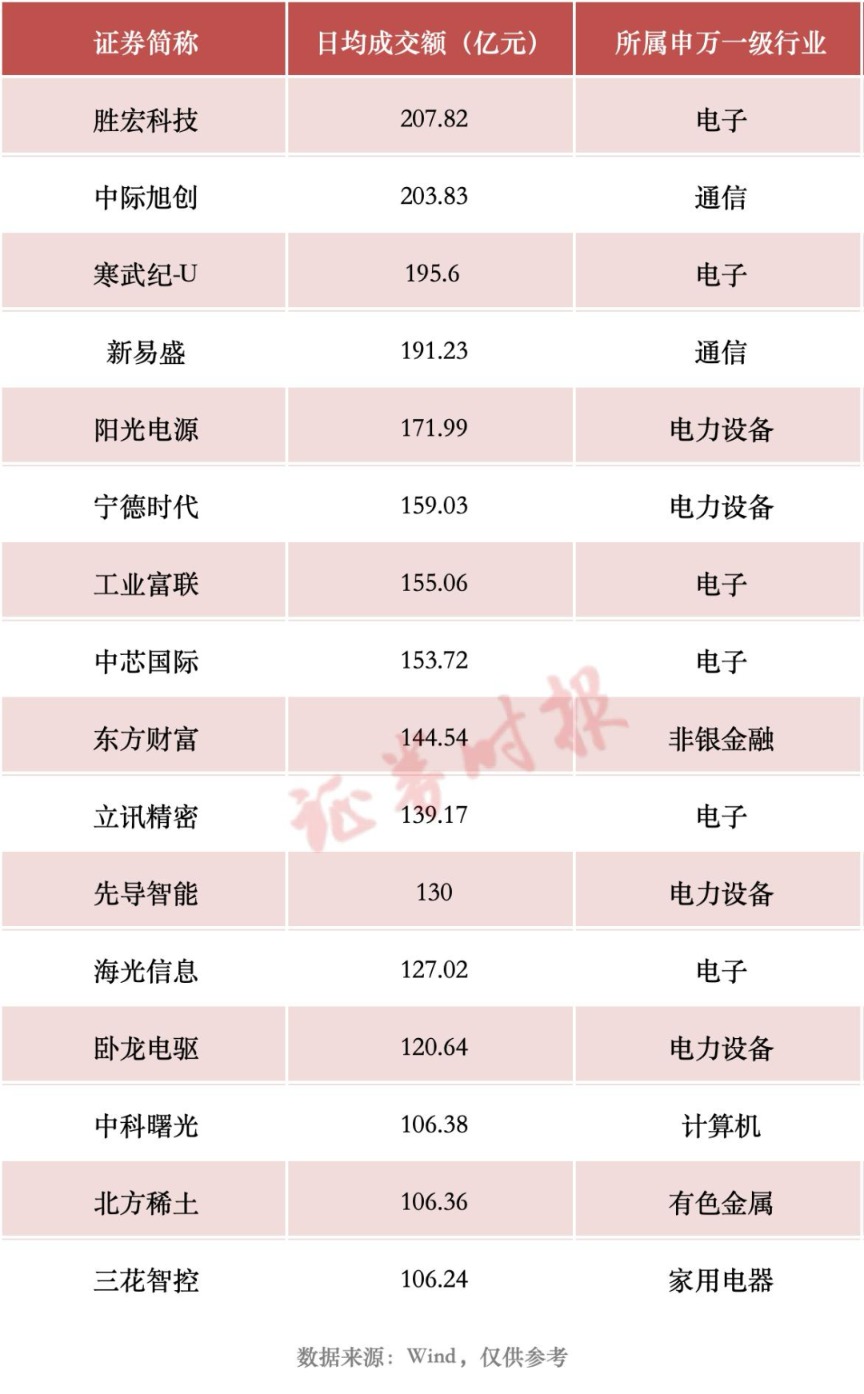
A股成交额连续28个交易日超2万亿元。 9月19日,A股市场成交额(为表述方便,本文所指A股市场成交额,为沪深北三市全市场股票成交额之和)约2.35万亿 元,环比有所减少,但仍在2万亿元之上,维持了相对较高的水平。 | 证券简称 | 日均成交额(亿元) | 所属申万一级行业 | | --- | --- | --- | | 胜宏科技 | 207.82 | 电子 | | 中际旭创 | 203.83 | 通信 | | 寒武纪-U | 195.6 | 电子 | | 新易盛 | 191.23 | 通信 | | 阳光电源 | 171.99 | 电力设备 | | 宁德时代 | 159.03 | 电力设备 | | 工业富联 | 155.06 | 电子 | | 中芯国际 | 153.72 | 电子 | | 东方财富 | 144.54 | 非银金融 | | 立讯精密 | 139.17 | 电子 | | 先导智能 | 130 | 电力设备 | | 海光信息 | 127.02 | 电子 | | --- | --- | --- | | 卧龙电驱 | 120.64 | 电力设备 | | 中科曙光 | 106.38 | 计算机 | | 北 ...

基金研究周报:美股新高,黄金续涨(9.15-9.19)
Wind万得· 2025-09-20 22:30
Market Overview - The A-share market exhibited a structurally differentiated pattern driven by policy expectations and technology themes from September 15 to September 19, with the Shanghai Composite Index and Shanghai 50 under pressure, while the ChiNext Index and STAR 50 showed strong performance, indicating continued market preference for technology sectors [2] - The ChiNext 50 led with a 2.84% increase, and the STAR 50 rose by 1.84%, reflecting concentrated capital allocation in areas like new energy batteries, energy storage, and semiconductors [2] - The Shanghai Composite Index fell by 1.30%, while the Shenzhen Index rose by 1.14%, and the ChiNext Index increased by 2.34% [2] Industry Performance - The average decline across Wind's primary sectors was 0.57%, with 60% of the Wind Top 100 concept indices showing gains [2] - Coal, electric equipment, and electronics performed relatively well, with increases of 3.51%, 3.07%, and 2.96% respectively, while non-bank financials, non-ferrous metals, and banking sectors saw significant declines of 3.66%, 4.02%, and 4.21% respectively [2] Fund Issuance - A total of 55 funds were issued last week, including 27 equity funds, 6 mixed funds, 21 bond funds, and 1 QDII fund, with a total issuance of 748.28 billion units [3][15] Global Market Review - Global asset classes showed a structurally active pattern, with U.S. stock indices continuing their strong performance; the Nasdaq rose by 2.21%, the S&P 500 surpassed 6500, and the Dow Jones reached 46000, reflecting optimism about the resilience of tech giants' earnings and a soft landing for the economy [3] - European stock markets displayed mixed results, while most Asian markets closed higher, with the Hang Seng Tech Index leading with a 5.09% increase, benefiting from marginal improvements in China's internet sector policies [3] Commodity Market - Gold prices on COMEX reached a new high of $3700 per ounce, driven by rising expectations of interest rate cuts by the Federal Reserve, while silver prices also increased [4] Domestic Fund Market - Market sentiment remained active, with trading volumes fluctuating; the average daily trading volume was approximately 2.3 trillion yuan, slightly down from previous levels [7]

A股市场运行周报第59期:上证“回退”中枢震荡,控弹性、调结构、勿追高-20250920
ZHESHANG SECURITIES· 2025-09-20 12:00
Core Views - The market experienced a pullback this week, with increased volatility, primarily due to the weakness in the large financial sector and divergence in broad indices. The Shanghai Composite Index has not achieved the expected upward movement and is now in a "central oscillation" phase, with previous low points at 3732 and 3702 providing effective support [1][2][3] - It is anticipated that the Shanghai Composite will continue to consolidate for 1-2 weeks, with the potential to challenge the maximum amplitude since 2015 (5178-2440) at the 0.618 level in Q4 2025, contingent on smooth market rotation [2][3] Weekly Market Overview - Major indices showed a mixed performance, with the Shanghai Composite, Shanghai 50, and CSI 300 down by 1.30%, 1.98%, and 0.44% respectively, while growth indices like the CSI 500 and CSI 1000 saw slight increases of 0.32% and 0.21% [10][53] - The technology sector dominated, with significant gains in hard technology-related industries such as electric new energy, electronics, and communications, which rose by 3.61%, 2.75%, and 1.01% respectively. In contrast, the financial sector faced declines, with banks and non-banking financials down by 4.09% and 3.80% [13][54] - Market sentiment improved with an increase in average daily trading volume to 2.49 trillion yuan, and the margin trading balance continued to rise, reaching 2.40 trillion yuan [21][27] Market Attribution - Key events influencing the market included a consensus reached between China and the U.S. regarding the TikTok issue, a 25 basis point rate cut by the Federal Reserve, and stable economic performance in China for August, with industrial value-added growth at 5.2% year-on-year [51][52] Future Market Outlook - The Shanghai Composite Index is expected to undergo a consolidation phase for 1-2 weeks, with previous low points providing support. The market's ability to form a healthy rotation among sectors will be crucial for future upward movement [2][55] - The recommendation is to maintain current positions and consider increasing allocations post-adjustment, particularly favoring real estate, infrastructure, and social services while reducing exposure to technology and media sectors [3][56]
9月19日深证国企股东回报R(470064)指数涨0.16%,成份股徐工机械(000425)领涨
Sou Hu Cai Jing· 2025-09-20 01:47
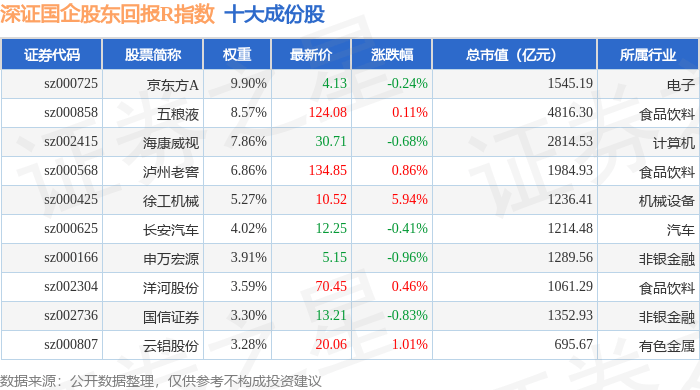
资金流向方面,深证国企股东回报R(470064)指数成份股当日主力资金净流出合计11.92亿元,游资资 金净流出合计940.03万元,散户资金净流入合计12.01亿元。成份股资金流向详情见下表: 证券之星消息,9月19日,深证国企股东回报R(470064)指数报收于2221.85点,涨0.16%,成交275.25 亿元,换手率1.08%。当日该指数成份股中,上涨的有26家,徐工机械以5.94%的涨幅领涨,下跌的有23 家,中油资本以4.5%的跌幅领跌。 深证国企股东回报R(470064)指数十大成份股详情如下: | 证券代码 | 股票简称 | 权重 | 最新价 | 涨跌幅 | 总市值(亿元) | | 所属行业 | | --- | --- | --- | --- | --- | --- | --- | --- | | sz000725 | 京东方A | 9.90% | 4.13 | -0.24% | | 1545.19 | 电子 | | sz000858 | 五粮液 | 8.57% | 124.08 | 0.11% | | 4816.30 | 食品饮料 | | sz002415 | 海康威视 | 7.86% | ...

两融余额再创新高 哪些行业受资金青睐?
天天基金网· 2025-09-19 10:11
Core Insights - Since August 2025, the margin trading balance in the A-share market has consistently surpassed significant thresholds, reaching a historical high of 2.4 trillion yuan by September 17, 2025 [1][4]. Group 1: Margin Trading Balance Trends - The margin trading balance has seen rapid growth, breaking through multiple key levels: 2 trillion yuan on August 5, 2.1 trillion yuan on August 18, 2.2 trillion yuan on August 26, 2.3 trillion yuan on September 8, and finally 2.4 trillion yuan on September 17 [4]. - As of September 18, 2025, the margin trading balance accounted for 2.53% of the A-share market's circulating market value, showing a slight increase but remaining stable compared to historical averages [4]. Group 2: Sector Preferences in Margin Trading - Recent data indicates that financing funds have shown a clear preference for high-growth sectors, with electronics, power equipment, telecommunications, non-bank financials, and computers leading in net buying amounts [5]. - The trend suggests that despite the absolute scale of margin trading exceeding previous highs, the proportion of margin trading to circulating market value and trading volume remains at historical mid-levels since 2016 [5]. Group 3: Market Environment and Liquidity - The continuous increase in margin trading balance reflects an elevated risk appetite in the current market, indicating a generally loose liquidity environment in the A-share market [5]. - Since September of the previous year, the overall liquidity in the A-share market has improved, with a significant increase in market transaction levels, supported by various capital market participants through actions like increasing holdings and buybacks [5].