
铜

Search documents
黄金白银均刷新历史新高,有色金属也或迎盈利改善
Xuan Gu Bao· 2026-01-25 14:45
Group 1: Market Trends - Spot silver increased over 7%, reaching approximately 103 USD/ounce [1] - Spot gold rose by 1%, peaking at about 4988 USD/ounce [1] - London copper surged by 3.4%, hitting 13187.50 USD/ton, close to its historical high earlier this month [1] - London tin rose by 9.5% and London nickel increased by 4.2% [1] Group 2: Investment Recommendations - Southwest Securities' metal research team suggests focusing on four main lines: 1. Expansion of the denominator: Long-term bullish outlook on gold, with attention to Federal Reserve rate cut expectations and marginal changes in trade wars. The high gold-silver ratio indicates significant upward momentum for silver, making silver targets a priority [1] 2. Improvement of the numerator: A decline in alumina prices by 2025 will significantly enhance the unit profitability of electrolytic aluminum, with aluminum profits expected to remain high, though short-term demand weakness may lead to price declines for both copper and aluminum [1] 3. Key advantageous minerals such as rare earths, antimony, and tungsten are expected to perform better [1] 4. Supply-side disruptions due to anti-involution trends may present opportunities in the lithium carbonate sector [1] Group 3: Company Developments - Shandong Gold is actively increasing its resource reserves through multiple equity and exploration rights acquisitions since 2023 [2] - Xinyi Silver Tin's subsidiary, Yinman Mining, is one of the largest silver production mines in China, while its tin concentrate output ranks second nationally. Yubang Mining has the largest single silver mine reserves in Asia [2]


铜行业周报(20260119-20260123):COMEX铜价对LME铜价溢价处2025年8月以来低位-20260125
EBSCN· 2026-01-25 12:09
要点 本周小结: 2026 年供需偏紧仍支持铜价上行。截至 2026 年 1 月 23 日,SHFE 铜收盘价 101340 元/吨,环比 1 月 16 日+0.57%;截至 2026 年 1 月 23 日,LME 铜收盘价 13129 美元/吨,环比 1 月 16 日+2.54%。(1)宏观:市场对美联储 2026 年 1 月不降息已经基本定价。(2)供需:TC 现货价续创新低,显示铜精 矿现货采购依然紧张;线缆企业开工率本周环比回升,但国内社会库存继续增长, 铜价大涨对需求有压制;但展望 2026 年,供需依然偏紧,继续看好铜价上行。 库存:国内铜社库环比+2.9%,LME 铜库存环比+16.9%。(1)港口铜精矿库存: 截至 2026 年 1 月 23 日,国内主流港口铜精矿库存 71.9 万吨,环比上周+4.1%。 (2)全球电解铜库存:截至 2026 年 1 月 23 日,全球三大交易所库存合计 96.0 万吨,环比 1 月 16 日+6.2%。截至 1 月 22 日,LME 铜全球库存 17.2 万吨,环 比+16.9%;SMM 铜社会库存 33.0 万吨,环比 1 月 16 日+2.9%。截至 ...




有色金属周报:避险情绪发酵,贵金属价格冲高-20260125
Ping An Securities· 2026-01-25 11:49
Investment Rating - The industry investment rating is "Outperform the Market" (maintained) [1][58]. Core Viewpoints - Precious Metals - Gold: The price of precious metals has surged due to heightened risk aversion, with the COMEX gold futures contract reaching $4983.1 per ounce, an increase of 8.3% month-on-month. The SPDR Gold ETF saw a 0.1% increase to 1087 tons. Factors such as the U.S. imposing tariffs on European countries opposing its claim over Greenland and potential sales of U.S. Treasury bonds by Europe have contributed to this trend. The weakening dollar credit is expected to continue, supporting the upward trend in gold prices [4]. - Industrial Metals: There is optimism regarding the upward trend in industrial metal prices, particularly copper, aluminum, and tin, driven by tightening supply and increasing demand [5]. Summary by Sections 1. Precious Metals - Gold: As of January 23, the COMEX gold futures price reached $4983.1 per ounce, reflecting an 8.3% increase. The SPDR Gold ETF holdings increased by 0.1% to 1087 tons. The ongoing U.S. debt issues and central bank gold purchases are expected to support gold prices in the long term [4]. 2. Industrial Metals - Copper: As of January 23, the SHFE copper futures price rose by 0.57% to 101340 yuan per ton. Domestic copper social inventory was 330,200 tons, while LME copper inventory was 171,700 tons. The tightening supply expectations and the anticipated Fed rate cuts are expected to drive copper prices higher [6]. - Aluminum: The SHFE aluminum futures price increased by 1.5% to 24290 yuan per ton. Domestic aluminum social inventory was 743,000 tons. The market is expected to see stable prices with a tightening supply-demand balance [6]. - Tin: The SHFE tin futures price rose by 6% to 429,600 yuan per ton. Domestic social inventory was 10,678 tons. Supply concerns due to geopolitical issues and increasing demand from AI technology are expected to keep tin prices elevated [6]. 3. Investment Recommendations - The report suggests focusing on the following sectors: - Gold: Continued uncertainty in overseas macro conditions supports gold's safe-haven attributes. Recommended stock: Chifeng Jilong Gold Mining. - Copper: Domestic demand recovery and tightening supply are expected to support copper prices. Recommended stock: Luoyang Molybdenum. - Aluminum: The strong supply-demand dynamics are expected to drive aluminum prices higher. Recommended stock: Tianshan Aluminum [7][55].
有色金属大宗金属周报(2026/1/19-2026/1/23):库存累积,铜铝价格高位震荡-20260125
Hua Yuan Zheng Quan· 2026-01-25 09:03
Investment Rating - The investment rating for the non-ferrous metals industry is "Positive" (maintained) [4] Core Views - The report highlights that copper prices are experiencing high-level fluctuations amidst inventory accumulation, with short-term price adjustments expected to be limited due to the financial attributes of copper supported by rising gold prices. The supply-demand balance for copper may shift from tight equilibrium to shortage in the medium to long term, driven by insufficient capital expenditure in copper mines and frequent supply disruptions. The report suggests monitoring companies such as Zijin Mining, Luoyang Molybdenum, Jiangxi Copper, and others [5] - For aluminum, the report notes that both alumina and aluminum prices are under pressure due to high inventory levels. The short-term outlook for aluminum prices is expected to remain stable amidst high demand, particularly in the air conditioning and consumer goods sectors [5] - Lithium demand remains strong despite seasonal trends, with lithium carbonate prices entering an upward cycle driven by supply-demand reversal. The report recommends focusing on companies with high self-sufficiency in lithium resources [5] - Cobalt prices are expected to continue rising due to tight raw material supply, with the report suggesting companies like Huayou Cobalt and others for investment [5] Summary by Sections 1. Industry Overview - The report provides insights into macroeconomic indicators, including the U.S. core PCE price index and unemployment claims, which align with expectations [9] - Key announcements include Zijin Mining's completion of the second phase of the Jilong Copper Mine, significantly increasing its production capacity [10] 2. Market Performance - The non-ferrous metals sector outperformed the Shanghai Composite Index, with a weekly increase of 6.03% compared to the index's 0.84% rise [11] - The report lists the top-performing stocks in the sector, highlighting significant movements in various sub-sectors [11] 3. Valuation Changes - The report notes that the TTM PE for the non-ferrous metals sector is 33.82, with a change of 1.79, while the PB is 4.18, reflecting a significant premium over the broader market [20][23]


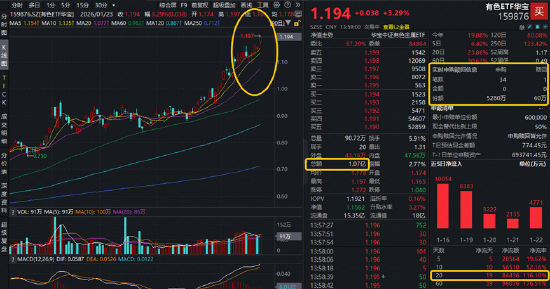
史诗级黄金牛市!金价直逼5000美元大关!白银有色四连板,有色ETF华宝(159876)飙涨3.5%放量突破上市高点
Xin Lang Cai Jing· 2026-01-23 06:18
Core Viewpoint - The non-ferrous metal sector is experiencing a strong rally, with the popular ETF, Huabao Non-Ferrous ETF (159876), reaching a historical high and significant trading volume, indicating potential investment opportunities [1][11]. Group 1: Market Performance - The non-ferrous metal sector has shown a robust performance, with the Huabao Non-Ferrous ETF (159876) rising by 3.29% and achieving a trading volume of 1.07 billion yuan, surpassing the previous day's total [1][9]. - Major stocks in the sector, such as Baiyin Non-Ferrous and Tongling Non-Ferrous, have seen significant gains, with Baiyin Non-Ferrous up by 9.97% and Tongling Non-Ferrous by 9.94% [2][14]. - The overall market sentiment is positive, with the non-ferrous metal sector leading among 31 primary sub-industries in the A-share market [5][13]. Group 2: Gold Price Surge - International gold prices have surged, with spot gold reaching 4,950 USD per ounce, marking a new historical high, while COMEX gold futures peaked at 4,970 USD per ounce [2][10]. - The rise in gold prices is attributed to factors such as geopolitical tensions, U.S. risks, and central bank gold purchases, which are expected to support gold prices in the future [3][13]. Group 3: Investment Trends - The Huabao Non-Ferrous ETF has seen a net subscription of 52.2 million units, accumulating 844 million yuan over the past 20 days, indicating strong investor interest [1][11]. - The ETF covers a wide range of metals, including copper, aluminum, gold, rare earths, and lithium, allowing investors to capture various market cycles [6][16]. - Analysts predict that the demand for basic metals like copper, aluminum, and tin will continue to perform well due to emerging needs in AI, electricity, and new energy sectors [3][13].


有色早报-20260122
Yong An Qi Huo· 2026-01-22 02:16
Group 1: Report Industry Investment Rating - No relevant content provided Group 2: Report Core Views - For copper, the price pulled back in the second half of the week, and the market sentiment cooled. In the short - term, negative factors are released, but the price is expected to rise in the medium - term as the fundamentals feature limited supply and increasing demand [1] - For aluminum, the basis and downstream processing fees are low, with continuous inventory accumulation. Domestic demand has short - term support, and overseas active restocking may support the price [1] - For zinc, the domestic fundamentals are average, but the market is optimistic about its allocation flexibility, and attention should be paid to reverse arbitrage and positive arbitrage opportunities [2] - For nickel, the short - term fundamentals are weak, and there is a game between short - term policies and fundamentals [3] - For stainless steel, the fundamentals remain weak, and the price is mainly driven by nickel price in the short - term [3] - For lead, the price oscillates at a high level. Supply is expected to increase, demand is weakening, and the price is expected to oscillate between 17100 - 17600 next week [5] - For tin, the price fluctuates greatly, and is affected by capital sentiment. Short - term volatility may decline, and attention can be paid to internal - external positive arbitrage opportunities [8] - For industrial silicon, the supply - demand is balanced and loose. The price is expected to oscillate with cost in the short - term and at the bottom of the cycle in the medium - to long - term [11] - For lithium carbonate, the short - term supply - demand is close to balance. The absolute price is affected by futures market expectations and sentiment, and a spot - futures resonance market may occur [13] Group 3: Summary by Metal Copper - **Price and Inventory**: The copper price pulled back in the second half of the week. The LME inventory increased by 3100, and the SHFE warehouse receipts decreased by 2612 [1] - **Market Analysis**: US tariff issues and high inventories in the US triggered concerns. In the short - term, negative factors are released, and the inventory may accumulate faster before the Spring Festival but decline quickly after the festival. The medium - term outlook is positive [1] Aluminum - **Price and Inventory**: The aluminum price declined. The LME inventory increased by 24175, and the SHFE inventory remained unchanged [1] - **Market Analysis**: The basis and processing fees are low, and the inventory is accumulating. Domestic demand has short - term support from photovoltaic, and overseas active restocking may support the price [1] Zinc - **Price and Inventory**: The zinc price decreased. The LME inventory decreased by 450, and the SHFE inventory remained unchanged [2] - **Market Analysis**: Supply is affected by TC decline and smelter operations, and demand is weak. The market is optimistic about its allocation flexibility, and attention should be paid to arbitrage opportunities [2] Nickel - **Price and Inventory**: The nickel price dropped. The LME inventory decreased by 72 [3] - **Market Analysis**: Supply decreased slightly, demand is weak, and there is a game between short - term policies and fundamentals [3] Stainless Steel - **Price and Inventory**: The stainless steel price declined slightly. The inventory decreased slightly from a high level [3] - **Market Analysis**: Supply is high, demand is mainly for rigid needs. The price is mainly driven by nickel price in the short - term [3] Lead - **Price and Inventory**: The lead price oscillated at a high level. The inventory increased by 1.3 tons to 3.25 tons [5] - **Market Analysis**: Supply is expected to increase, demand is weakening, and the price is expected to oscillate between 17100 - 17600 next week [5] Tin - **Price and Inventory**: The tin price fluctuated greatly. The LME inventory increased by 250 [8] - **Market Analysis**: The price is affected by capital sentiment. Short - term volatility may decline, and attention can be paid to internal - external positive arbitrage opportunities [8] Industrial Silicon - **Price and Inventory**: The basis of different grades changed, and the warehouse receipts increased by 384 [11] - **Market Analysis**: Supply and demand are balanced and loose. The price is expected to oscillate with cost in the short - term and at the bottom of the cycle in the medium - to long - term [11] Lithium Carbonate - **Price and Inventory**: The price fluctuated. The warehouse receipts increased by 975 [13] - **Market Analysis**: The short - term supply - demand is close to balance. The absolute price is affected by futures market expectations and sentiment, and a spot - futures resonance market may occur [13]
《有色》日报-20260122
Guang Fa Qi Huo· 2026-01-22 01:52
Report Industry Investment Ratings No information about industry investment ratings is provided in the reports. Core Views Tin - Short - term tin prices are highly volatile due to market sentiment, so cautious participation is advised. In the medium - to - long - term, the supply side is gradually recovering, but considering the low elasticity of the supply side and the long - term narrative of the AI arms race, a low - buying strategy for tin prices is recommended [2]. Industrial Silicon - The spot price of industrial silicon is stable, and the futures price fluctuates, rising after a decline. The production in January and February is expected to decrease. The demand side is likely to decline slightly in January. The price of industrial silicon is expected to fluctuate, with the main price range between 8200 - 9200 yuan/ton. Attention should be paid to the changes in production on the demand side [3]. Polysilicon - The average spot price of polysilicon and the price of silicon wafers have declined. The demand expectation has improved, and component production may increase slightly, which is conducive to inventory digestion. However, polysilicon and silicon wafer prices are under pressure due to high inventory. The monthly average production in the first quarter is expected to drop to about 80,000 tons. The price may be supported at the 48,000 yuan/ton level, and even at 45,000 yuan/ton considering full - cost support [4]. Copper - Market speculative sentiment has eased, and copper prices fluctuated. Geopolitical factors affect market expectations of copper tariffs. The global visible inventory has reached a high level in recent years, and the return of COMEX copper inventory may ease the supply pressure in non - US regions. In the short term, copper prices may return to fundamental pricing, and in the long term, the price bottom center is expected to gradually rise. Attention should be paid to the CL premium and LME inventory changes, with support at 97500 - 98500 [5]. Zinc - Market speculative sentiment has eased, and zinc prices adjusted. The shortage of zinc ore supports prices, and the import window for zinc ore has opened. The supply pressure of refined zinc has been relieved. High zinc prices have suppressed demand, and the downstream operating rate has weakened. Zinc prices are expected to fluctuate in the short term, with support around 23,800. Attention should be paid to zinc ore TC and refined zinc inventory changes [9]. Aluminum - The alumina market showed a weak and volatile trend, with an oversupply situation. Alumina prices are expected to fluctuate widely around the industry's cash - cost line, with the main contract reference range of 2600 - 2900 yuan/ton. The aluminum market is in a high - level volatile pattern. Although macro and policy expectations are positive, the fundamentals are under pressure, with supply increasing and demand being suppressed. Aluminum prices are expected to remain volatile at a high level in the short term, with the main contract reference range of 23000 - 25000 yuan/ton [12]. Nickel - The nickel futures market was volatile. Macro factors and the situation of Indonesian nickel ore quotas affect the market. The overall spot transaction of refined nickel is average. The prices of nickel ore and nickel iron have increased. The demand for stainless steel in the off - season is weak, and the market cost is relatively limited. The inventory pressure has increased. The nickel price is expected to fluctuate widely, with the main contract reference range of 138000 - 148000 [13]. Aluminum Alloy - Cast aluminum alloy prices fluctuated at a high level, with cost being the main driving factor. The supply of scrap aluminum is still tight, and the fundamentals show a situation of weak supply and demand in the off - season. The social inventory has decreased slightly. The ADC12 price is expected to continue the high - level volatile pattern in the short term, with the main contract reference range of 22000 - 23500 yuan/ton [15]. Stainless Steel - Stainless steel prices showed a narrow - range fluctuation and then a late - session rally. Macro factors and raw material supply expectations affect the market. The raw material prices are expected to rise, the supply is relatively loose, and the demand is weak. The social inventory is decreasing, but the demand in the off - season is still insufficient. Stainless steel prices are expected to be strongly volatile in the short term, with the main contract reference range of 14200 - 15000 [16]. Lithium Carbonate - Lithium carbonate futures prices rose sharply. News about lithium concentrate auctions and mine supply fluctuations affected the market sentiment. The production is slightly increasing, and the supply is expected to decline during the pre - holiday maintenance period. The downstream demand shows certain resilience. Social inventory decreased last week. Lithium carbonate prices are expected to be strongly volatile in the short term, but chasing the rise requires attention to volatility and liquidity risks [20]. Summary by Directory Tin - **Spot Price and Basis**: SMM 1 tin rose 0.22% to 395,750 yuan/ton, and the LME 0 - 3 premium increased 14.82% to - 92.00 dollars/ton. The import loss was - 7117.93 yuan/ton, a decrease of 1.99% [2]. - **Monthly Fundamental Data**: In December, tin ore imports increased 16.81% to 17,637 tons, SMM refined tin production decreased 0.06% to 15,950 tons, and refined tin exports increased 41.84% to 2763 tons [2]. - **Inventory Changes**: SHEF inventory increased 37.69% to 9549.0 tons, and social inventory increased 36.07% to 10,175.0 tons [2]. Industrial Silicon - **Spot Price and Basis of Main Contracts**: The price of East China oxygen - passing SI5530 industrial silicon remained unchanged at 9250 yuan/ton, and the basis decreased 6.93% [3]. - **Monthly Fundamental Data**: National industrial silicon production decreased 1.15% to 39.71 million tons, and Xinjiang's production increased 6.46% to 25.29 million tons. The national operating rate decreased 0.35% to 64.59% [3]. - **Inventory Changes**: Xinjiang's factory - warehouse inventory increased 2.91% to 14.83 million tons, and social inventory increased 0.54% to 55.50 million tons [3]. Polysilicon - **Spot Price and Basis**: The average price of N - type granular silicon decreased 7.34% to 50,500 yuan/ton, and the N - type material basis increased 5.49% [4]. - **Monthly Fundamental Data**: Polysilicon production increased 0.79% to 11.55 million tons, and silicon wafer production decreased 19.26% to 43.90 million tons [4]. - **Inventory Changes**: Silicon wafer inventory decreased 5.53% to 24.78 million tons, and polysilicon warehouse receipts increased 1.54% to 4620.00 [4]. Copper - **Price and Basis**: SMM 1 electrolytic copper decreased 0.66% to 100,060 yuan/ton, and the LME 0 - 3 increased to 101.84 dollars/ton [5]. - **Fundamental Data**: In December, electrolytic copper production increased 6.80% to 117.81 million tons, and imports decreased 4.02% to 26.02 million tons. The domestic mainstream port copper concentrate inventory increased 7.81% to 69.04 million tons [5]. - **Inventory Changes**: Domestic social inventory increased 12.27% to 32.94 million tons, and SHFE inventory increased 18.26% to 21.35 million tons [5]. Zinc - **Price and Basis**: SMM 0 zinc ingot decreased 0.53% to 24,210 yuan/ton, and the import loss decreased to - 1851 yuan/ton [9]. - **Fundamental Data**: In December, refined zinc production decreased 7.24% to 55.21 million tons, and imports decreased 51.94% to 0.88 million tons [9]. - **Inventory Changes**: China's seven - region zinc ingot social inventory increased 3.13% to 12.20 million tons, and LME inventory decreased 0.40% to 11.2 million tons [9]. Aluminum - **Price and Spread**: SMM A00 aluminum increased 0.13% to 23,710 yuan/ton, and the alumina (Shandong) average price decreased 0.19% to 2560 yuan/ton [12]. - **Fundamental Data**: In December, alumina production decreased 1.08% to 743.94 million tons, and domestic electrolytic aluminum production decreased 3.97% to 363.66 million tons [12]. - **Inventory Changes**: China's electrolytic aluminum social inventory increased 2.60% to 74.90 million tons, and LME inventory increased 5.01% to 50.7 million tons [12]. Nickel - **Price and Basis**: SMM 1 electrolytic nickel decreased 0.99% to 144,900 yuan/ton, and the LME 0 - 3 decreased 2.15% to - 200 dollars/ton [13]. - **Cost and New - Energy Material Prices**: The cost of integrated MHP to produce electrowon nickel increased 1.09% to 112,237 yuan/ton, and the average price of battery - grade nickel sulfate decreased 0.22% to 33,375 yuan/ton [13]. - **Supply - Demand and Inventory**: China's refined nickel production increased 26.10% to 31,400 tons, and SHFE inventory increased 3.28% to 48,180 tons [13]. Aluminum Alloy - **Price and Spread**: The price of SMM aluminum alloy ADC12 remained unchanged at 23,850 yuan/ton, and the Foshan crushed primary aluminum scrap price difference increased 0.80% to 2509 yuan/ton [15]. - **Fundamental Data**: In December, the production of recycled aluminum alloy ingots decreased 6.16% to 64.00 million tons, and the production of primary aluminum alloy ingots increased 0.46% to 30.41 million tons [15]. - **Inventory Changes**: The weekly social inventory of recycled aluminum alloy ingots decreased 1.41% to 4.89 million tons [15]. Stainless Steel - **Price and Basis**: The price of 304/2B (Wuxi Hongwang 2.0 coil) increased 1.40% to 14,500 yuan/ton, and the price of Philippine laterite nickel ore 1.5% (CIF) increased 0.89% to 51 dollars/wet ton [16]. - **Fundamental Data**: China's 300 - series stainless steel crude steel production increased 0.92% to 176.32 million tons, and stainless steel imports increased 29.32% to 14.50 million tons [16]. - **Inventory Changes**: The 300 - series social inventory (Wuxi + Foshan) decreased 1.47% to 45.07 million tons [16]. Lithium Carbonate - **Price and Basis**: The average price of SMM battery - grade lithium carbonate increased 3.93% to 158,500 yuan/ton, and the average price of lithium spodumene concentrate CIF increased 2.52% to 2035 dollars/ton [20]. - **Fundamental Data**: In December, lithium carbonate production increased 4.04% to 99,200 tons, and demand decreased 2.50% to 130,118 tons [20]. - **Inventory Changes**: In December, lithium carbonate total inventory decreased 12.23% to 56,664 tons, and downstream inventory decreased 7.21% to 38,998 tons [20].
国泰君安期货商品研究晨报-20260122
Guo Tai Jun An Qi Huo· 2026-01-22 01:35
Report Industry Investment Ratings No specific industry investment ratings are provided in the report. Core Views of the Report - The report provides a comprehensive analysis of various commodities in the futures market, including precious metals, base metals, energy, agricultural products, and chemical products. It assesses the market trends, supply - demand dynamics, and price movements of each commodity, and gives corresponding trading suggestions and trend intensities [2][34][73]. Summaries by Related Catalogs Precious Metals - **Gold**: Reached a new high. The prices of domestic and international gold showed an upward trend, and the trading volume and positions had certain changes. Trump's speech and related events had an impact on the market. The trend intensity is 1 [5]. - **Silver**: Subject to tariff expectation fluctuations. The prices had minor changes, and the market was affected by Trump's remarks and geopolitical events. The trend intensity is 1 [5]. - **Platinum**: Traded in a high - level range. The prices and trading data had specific changes, and the trend intensity is 0 [30]. - **Palladium**: Faced upward pressure due to the callback of gold and silver. The prices and related data showed certain characteristics, and the trend intensity is 0 [29]. Base Metals - **Copper**: The risk sentiment slightly recovered, supporting the price. The prices of domestic and international copper, trading volume, positions, and inventory data had changes. The "15th Five - Year Plan" investment of the State Grid and other events affected the market. The trend intensity is 0 [10]. - **Zinc**: Had support at the lower level. The prices, trading volume, positions, and inventory data showed specific changes, and the market was affected by Trump's speech. The trend intensity is 1 [13]. - **Lead**: The decrease in LME inventory supported the price. The prices, trading volume, positions, and inventory data had corresponding changes, and the market was influenced by Trump's remarks. The trend intensity is 0 [17]. - **Tin**: Attention should be paid to the resumption of production in Myanmar. The prices, trading volume, positions, and inventory data showed certain characteristics. The trend intensity is - 1 [20]. - **Aluminum**: Oscillated around 24,000. The prices, trading volume, positions, and inventory data of electrolytic aluminum, alumina, and aluminum alloy had changes. The market was affected by various factors, and the trend intensities of aluminum, alumina, and aluminum alloy are 1, 0, and 1 respectively [24]. - **Nickel**: The repeated remarks from Indonesia disturbed the sentiment, and the nickel price fluctuated widely. The prices, trading volume, positions, and inventory data showed specific changes, and the market was affected by Indonesian policies. The trend intensity is 0 [34]. - **Stainless Steel**: The price was supported by the contradiction in the ore end and the increase in nickel - iron prices. The prices, trading volume, positions, and inventory data had corresponding changes. The trend intensity is 0 [34]. Energy - **Crude Oil**: The price was affected by the tense situation in Iran and the uncertainty of the geopolitical situation, showing an upward trend [72]. - **Coke and Coking Coal**: Affected by both macro and micro factors, they oscillated weakly. The prices, trading volume, positions, and inventory data showed specific changes, and the market was affected by coal price trends and steel production. The trend intensities of coke and coking coal are 0 [58]. - **Power Coal**: The market sentiment was weak, and the price had a short - term weak adjustment. The prices showed a downward trend, and the market was affected by production and import data. The trend intensity is not clearly stated [62]. Agricultural Products - **Palm Oil**: Affected by multiple factors, it oscillated strongly in the short term. The prices, trading volume, positions, and inventory data showed specific changes, and the market was affected by production and demand expectations. The trend intensity is 1 [154]. - **Soybean Oil**: Due to the lack of themes in US soybeans, the rebound height was limited. The prices, trading volume, positions, and inventory data had corresponding changes. The trend intensity is 1 [154]. - **Soybean Meal**: After the overnight rise of US soybeans, the domestic soybean meal might follow the upward trend. The prices, trading volume, positions, and inventory data showed specific changes, and the market was affected by US - China relations and South American harvest progress. The trend intensity is 1 [159]. - **Soybean**: The market atmosphere improved, and the price might oscillate. The prices, trading volume, positions, and inventory data had specific changes. The trend intensity is 0 [159]. - **Corn**: Oscillated strongly. The prices, trading volume, positions, and inventory data showed specific changes, and the market was affected by spot price trends. The trend intensity is 0 [162]. - **Sugar**: Mainly showed a weak operation. The prices, trading volume, positions, and inventory data had corresponding changes, and the market was affected by production and import data at home and abroad. The trend intensity is - 1 [166]. - **Cotton**: Oscillated strongly. The prices, trading volume, positions, and inventory data showed specific changes, and the market was affected by spot trading and cotton textile enterprise conditions. The trend intensity is 1 [170]. - **Egg**: The sentiment weakened. The prices, trading volume, positions, and inventory data had specific changes. The trend intensity is 0 [176]. - **Live Pig**: The spot price weakened, and the peak - season expectation decreased. The prices, trading volume, positions, and inventory data showed specific changes. The trend intensity is - 2 [179]. - **Peanut**: Oscillated. The prices, trading volume, positions, and inventory data had corresponding changes. The trend intensity is 0 [183]. Chemical Products - **P - Xylene (PX)**: The tense situation in Iran and the rebound of oil prices supported the PX valuation. The prices, trading volume, positions, and inventory data showed specific changes, and the market was affected by supply - demand dynamics and oil price trends. The trend intensity is 1 [69]. - **Purified Terephthalic Acid (PTA)**: Attention should be paid to reducing the processing margin. The prices, trading volume, positions, and inventory data had corresponding changes, and the market was affected by supply - demand dynamics and oil price trends. The trend intensity is 1 [69]. - **Monoethylene Glycol (MEG)**: The downward space was limited. The prices, trading volume, positions, and inventory data showed specific changes, and the market was affected by supply - demand dynamics and oil price trends. The trend intensity is 1 [69]. - **Rubber**: Oscillated. The prices, trading volume, positions, and inventory data had corresponding changes, and the market was affected by inventory and supply - demand dynamics. The trend intensity is 0 [75]. - **Synthetic Rubber**: With the stabilization of butadiene, the price rebounded. The prices, trading volume, positions, and inventory data showed specific changes, and the market was affected by butadiene prices and inventory. The trend intensity is 0 [78]. - **Linear Low - Density Polyethylene (LLDPE)**: The import in December exceeded expectations, and the upstream quotation was loose. The prices, trading volume, positions, and inventory data had corresponding changes, and the market was affected by supply - demand dynamics and raw material prices. The trend intensity is - 1 [81]. - **Polypropylene (PP)**: The production ratio remained low, and the profit repair was limited. The prices, trading volume, positions, and inventory data showed specific changes, and the market was affected by supply - demand dynamics and raw material prices. The trend intensity is - 1 [84]. - **Caustic Soda**: The price still faced pressure. The prices, trading volume, positions, and inventory data had corresponding changes, and the market was affected by supply - demand dynamics and cost factors. The trend intensity is - 1 [86]. - **Paper Pulp**: Oscillated. The prices, trading volume, positions, and inventory data showed specific changes, and the market was affected by supply - demand dynamics and raw material prices. The trend intensity is 0 [91]. - **Glass**: The price of the original sheet was stable. The prices, trading volume, positions, and inventory data had corresponding changes, and the market was affected by supply - demand dynamics. The trend intensity is - 1 [96]. - **Methanol**: Oscillated. The prices, trading volume, positions, and inventory data showed specific changes, and the market was affected by supply - demand dynamics and raw material prices. The trend intensity is 0 [99]. - **Urea**: Oscillated and had support at the lower level. The prices, trading volume, positions, and inventory data had corresponding changes, and the market was affected by supply - demand dynamics and inventory. The trend intensity is 0 [104]. - **Styrene**: Oscillated strongly. The prices, trading volume, positions, and inventory data showed specific changes, and the market was affected by export and supply - demand dynamics. The trend intensity is 0 [107]. - **Soda Ash**: The spot market changed little. The prices, trading volume, positions, and inventory data had corresponding changes, and the market was affected by supply - demand dynamics. The trend intensity is - 1 [109]. - **Liquefied Petroleum Gas (LPG)**: Supported by the heating demand, the price was firm. The prices, trading volume, positions, and inventory data showed specific changes, and the market was affected by supply - demand dynamics and international prices. The trend intensity is 1 [112]. - **Propylene**: The spot market maintained a tight balance. The prices, trading volume, positions, and inventory data had corresponding changes, and the market was affected by supply - demand dynamics. The trend intensity is 0 [112]. - **Polyvinyl Chloride (PVC)**: Oscillated weakly. The prices, trading volume, positions, and inventory data showed specific changes, and the market was affected by supply - demand dynamics and cost factors. The trend intensity is - 1 [119]. - **Fuel Oil**: Remained strong in the short term, and the fluctuation continued to increase. The prices, trading volume, positions, and inventory data showed specific changes, and the market was affected by supply - demand dynamics and oil price trends. The trend intensity is 1 [122]. - **Low - Sulfur Fuel Oil**: Followed the upward trend mainly, and the price difference between high - sulfur and low - sulfur in the overseas spot market continued to shrink. The prices, trading volume, positions, and inventory data had corresponding changes, and the market was affected by supply - demand dynamics and oil price trends. The trend intensity is 1 [122]. Shipping - **Container Freight Index (European Line)**: It was in a temporary oscillating market. The prices, trading volume, positions, and inventory data showed specific changes, and the market was affected by supply - demand dynamics, geopolitical situations, and export policies. The trend intensity is 0 [124]. Fibers - **Short - Fiber**: It was in a short - term oscillating market, and the processing margin was at a low level. The prices, trading volume, positions, and inventory data showed specific changes, and the market was affected by supply - demand dynamics and raw material prices. The trend intensity is 0 [142]. - **Bottle - Chip**: It was in a short - term oscillating market. The prices, trading volume, positions, and inventory data had corresponding changes, and the market was affected by supply - demand dynamics and raw material prices. The trend intensity is 0 [142]. Paper - **Offset Printing Paper**: It was recommended to wait and see. The prices, trading volume, positions, and inventory data showed specific changes, and the market was affected by supply - demand dynamics and raw material prices. The trend intensity is 0 [145]. Aromatics - **Pure Benzene**: Oscillated strongly. The prices, trading volume, positions, and inventory data showed specific changes, and the market was affected by supply - demand dynamics and benzene - related events. The trend intensity is 0 [150].
券商晨会精华 | 重视硅光和CPO链投资机会
智通财经网· 2026-01-22 01:04
在今日券商晨会上,中信建投认为,铜价上涨走势未定;开源证券认为,重视硅光和CPO链投资机会; 中信证券认为,医保新政出台,医疗器械迎来行业性投资机遇。 市场冲高回落,沪指午后一度翻绿。沪深两市成交额2.6万亿,较上一个交易日缩量1771亿。盘面上, 市场热点快速轮动,全市场超3000只个股上涨。从板块来看,贵金属概念全天领涨,四川黄金、招金黄 金涨停。芯片产业链爆发,华天科技、龙芯中科、至正股份等十余股涨停。锂矿概念震荡反弹,盛新锂 能、大中矿业、国城矿业涨停。油气概念表现活跃,惠博普、洲际油气涨停。下跌方面,大消费板块集 体走弱,白酒方向领跌。银行板块震荡下跌,农业银行跌近3%。截至收盘,沪指涨0.08%,深成指涨 0.7%,创业板指涨0.54%。 中信建投:铜价上涨走势未定 今年铜价大涨,由供应扰动、需求增长及贸易流向变化推动,后续走势存不确定性。供应端,去年印 尼、智利矿山事故及智利铜矿罢工致供应中断,南美铜矿产量占比下滑,新项目审批滞后、加工费低迷 进一步收紧供应。需求端,新能源转型、AI基建带动铜消费,电动汽车、数据中心需求突出。贸易 端,美国拟加征关税,促使交易商向美出口,推高其他地区供应紧张。 ...
日度策略参考-20260121
Guo Mao Qi Huo· 2026-01-21 07:29
Report Industry Investment Ratings - Bullish: Palm oil, soybean oil [1] - Bearish: Industrial silicon [1] - Neutral: Most other industries are rated as "oscillating" [1] Core Views of the Report - Policy aims to achieve a "slow bull" in the stock market, with short - term oscillations in the stock index and long - term opportunities for long - position layout. Asset shortage and weak economy benefit bond futures, but short - term interest rate risks are signaled by the central bank [1]. - Different metals and commodities have various trends. For example, copper prices are in high - level oscillations, aluminum prices are falling from high levels, and nickel prices are in high - level oscillations with supply concerns and inventory constraints [1]. - Precious metals are supported by geopolitical and trade tensions, but the suspension of key - mineral tariff hikes by the US may cause price fluctuations. Platinum and palladium are expected to have wide - range oscillations in the short term, and a long - term strategy of buying platinum and shorting palladium can be considered [1]. - In the agricultural and energy - chemical sectors, different products are affected by factors such as supply - demand relationships, policies, and international situations, resulting in different price trends and investment strategies [1]. Summary by Related Catalogs Macro Finance - Stock index: Policy cools market speculation, with short - term oscillations and long - term opportunities for long - position layout [1] - Bond futures: Asset shortage and weak economy are beneficial, but short - term interest rate risks are signaled by the central bank, and the Japanese central bank's interest - rate decision should be monitored [1] Non - ferrous Metals - Copper: Downstream demand is under pressure, and with the suspension of key - mineral tariffs by the US, short - term copper - hoarding concerns are alleviated, and prices are in high - level oscillations [1] - Aluminum: Limited industrial drivers and weakening macro sentiment lead to aluminum prices falling from high levels [1] - Alumina: Supply exceeds demand in the domestic market, and prices are under pressure, but they are near the cost line and expected to oscillate [1] - Zinc: The cost center is stable, but inventory pressure is evident, and prices fluctuate within a range due to repeated macro sentiment [1] - Nickel: The 2026 RKAB target of Indonesian nickel ore is about 260 million wet tons, but the supply is still tight. Global nickel inventory accumulation may restrict price increases, and short - term prices are in high - level oscillations. Short - term long - position trading on dips is recommended, but over - chasing highs should be avoided [1] - Stainless steel: The price of raw - material nickel iron is rising, social inventory is slightly decreasing, and steel - mill production in January is increasing. Futures prices are in high - level oscillations, and short - term long - position trading on dips is recommended [1] - Tin: Short - term macro sentiment is repeated, and prices have corrected. However, due to the fragile supply of tin ore, there is still upward momentum, and low - buying opportunities should be monitored [1] Precious Metals and New Energy - Gold and silver: Geopolitical and trade tensions boost prices, and they are expected to be strong in the short term, but price fluctuations may be intense due to the suspension of key - mineral tariff hikes by the US [1] - Platinum and palladium: Geopolitical and trade tensions support prices, but the suspension of key - mineral tariff hikes by the US may suppress price drivers. Short - term wide - range oscillations are expected, and a long - term strategy of buying platinum and shorting palladium can be considered [1] Industrial and Building Materials - Industrial silicon: Production increases in the northwest and decreases in the southwest, and the planned production of polysilicon and organic silicon in December decreases [1] - Polysilicon: It is in the off - season for new energy vehicles, but energy - storage demand is strong, and there is a battery export rush with a large increase in price [1] - Lithium carbonate: Expectations are strong, but the spot market is weak, and the upward momentum is insufficient [1] - Rebar and hot - rolled coil: High production and inventory suppress price increases, and the transmission of futures price increases to the spot market is not smooth. Unilateral long positions should be closed, and cash - and - carry arbitrage can be considered [1] - Iron ore: There is obvious upward pressure, and chasing highs is not recommended [1] - Coke and coking coal: If the "capacity reduction" expectation continues to ferment, there may be room for price increases, but the actual increase is difficult to judge, and large fluctuations after a significant increase require caution [1] - Glass: Short - term market sentiment is warming, and supply - demand provides support, but medium - term supply exceeds demand, and prices are under pressure [1] - Soda ash: It follows glass prices, and medium - term supply - demand is looser, with prices under pressure [1] Agricultural Products - Palm oil: The purchasing rhythm of major consuming countries is starting, production areas are expected to reduce production and inventory, and with the possibility of biodiesel themes fermenting, prices are expected to oscillate strongly [1] - Soybean oil: It has a strong fundamental situation, and long - position allocation in oils is recommended, and a strategy of buying soybean oil and shorting other oils can be considered [1] - Rapeseed oil: Tariff - adjustment expectations for Canadian rapeseed and customs - clearance expectations for Australian rapeseed are bearish, but it is difficult to decline smoothly, and it is recommended to wait and see due to large recent price fluctuations [1] - Cotton: There is strong domestic new - crop production expectation, but the purchase price of seed cotton supports the cost of lint. Downstream operation rates are low, but yarn - mill inventory is not high, and there is rigid restocking demand. Future factors such as the central government's No.1 Document in the first quarter of next year, planting - area intentions, weather during the planting period, and peak - season demand should be monitored [1] - Sugar: There is a global surplus and an increase in domestic new - crop supply, and there is a consensus among short - sellers. If prices continue to fall, there is strong cost support, but there is a lack of continuous short - term fundamental drivers, and changes in the capital side should be monitored [1] - Corn: The grain - selling progress in Northeast China is fast, port inventory is low, and there is restocking demand before the festival. Short - term spot prices are firm, and futures prices are expected to oscillate within a range [1] - Soybeans: As the Brazilian harvest progresses, the CNF premium reflects the selling pressure of a bumper harvest. Dry weather in Argentina should be monitored, and short - term prices are expected to oscillate weakly [1] - Pulp: Affected by the decline in the commodity macro - environment, prices have fallen but remain within the oscillation range. Due to large short - term commodity - sentiment fluctuations, it is recommended to wait and see cautiously [1] - Logs: Spot prices have shown signs of bottom - rebounding, and the further decline in futures prices is limited. However, the January overseas offer has slightly decreased, and there is a lack of upward - driving factors, with prices expected to oscillate between 760 - 790 yuan/m³ [1] - Hogs: Spot prices are gradually stabilizing, demand provides support, and production capacity still needs to be further released [1] Energy and Chemicals - Crude oil: OPEC+ has suspended production increases until the end of 2026, the uncertainty of the Russia - Ukraine peace agreement, and US sanctions on Venezuelan oil exports affect prices [1] - Fuel oil: Short - term supply - demand contradictions are not prominent and follow crude - oil prices. The "14th Five - Year Plan" rush - work demand is likely to be falsified, and the supply of Marey crude oil is sufficient, with high asphalt profits [1] - Shanghai rubber: Raw - material cost support is strong, the futures - spot price difference has rebounded significantly, and mid - stream inventory has increased significantly [1] - BR rubber: There is a phased correction, high - price spot transactions are blocked, the cost of butadiene has strong bottom - support, overseas cracking - unit production capacity is cleared, and the domestic market is expected to benefit in the long term. The market will return to fundamental - driven in the short term [1] - PTA: The PX market has risen rapidly, and the market is expected to tighten in 2026. Domestic PTA maintains high - level operation, and the high gasoline spread supports aromatics [1] - Ethylene glycol: Two sets of MEG plants in Taiwan, China, plan to shut down next month. Prices have rebounded rapidly due to supply - side news, and downstream polyester operation rates are above 90% [1] - Short - fiber: Prices continue to closely follow cost fluctuations [1] - Styrene: The supply - demand fundamentals have improved, futures prices have rebounded rapidly, the Asian market has stabilized, and the price difference between styrene and benzene has widened, with inventory being depleted [1] - Urea: Export sentiment has eased, there is limited upward space due to insufficient domestic demand, and there is support from anti - involution and cost [1] - PVC: Global production is expected to be low in 2026, but the current fundamentals are poor. The cancellation of export tax - rebates may lead to a rush to export, and differential electricity prices in the northwest may force out inefficient production capacity [1] - LPG: The February CP is expected to rise, the cost of imported gas is strongly supported, the geopolitical conflict in the Middle East has cooled, inventory is being depleted, domestic PDH maintains high - level operation but is in deep loss, and the heating market is expected to start [1] Others - Container shipping on the European route: It is expected to peak in mid - January, pre - festival restocking demand still exists, and airlines are still cautious in their trial re - flights [1]