
美容护理

Search documents
美容护理行业:创健医疗重组胶原蛋白植入剂获批,林清轩通过港交所上市聆讯
Jianghai Securities· 2025-12-29 09:51
Investment Rating - Industry rating: "Accumulate" (maintained) [7] Core Insights - The approval of the cross-linked recombinant collagen implant by Chuangjian Medical on December 23, 2025, marks a significant addition to the recombinant collagen industry, which is expected to expand further [7] - Lin Qingxuan has passed the Hong Kong Stock Exchange listing hearing, potentially becoming the first high-end domestic skincare stock in Hong Kong [7] - The "oil-based skincare" brand Afu released the industry's first technical standard for functional skincare products on December 8, 2025, supporting the standardized development of the "oil-based skincare" sector [7] Summary by Sections Industry Performance - Over the past 12 months, the industry has shown a relative return of -21.5% compared to the CSI 300 index, with absolute returns of -4.52% [3] Key Events - Chuangjian Medical's recombinant collagen implant is composed of cross-linked recombinant collagen hydrogel and is approved for facial dermal filling to correct moderate to severe dynamic wrinkles [7] - Lin Qingxuan's core product, camellia oil essence, has seen its revenue share increase from 31.5% in 2022 to an expected 45.5% in the first half of 2025, maintaining its position as the top-selling facial essence oil in China for 11 consecutive years [7] Investment Recommendations - The successful approval of Chuangjian Medical's product is expected to enhance industry growth, with a recommendation to monitor the product's market performance post-launch [7] - The sales of essence oils across major online platforms are projected to exceed 9.5 billion yuan from March 2024 to February 2025, with facial essence oils experiencing a 36% growth, indicating a strong market demand [7]
华泰期货:股指连续上行,股指期货整体增仓
Xin Lang Cai Jing· 2025-12-29 02:20
市场分析 企业利润下滑。宏观方面,全国政协十四届四次会议将于2026年3月4日在北京召开,十四届全国人大四 次会议将于3月5日召开,审查"十五五"规划纲要草案列入2026年全国人代会建议议程。数据方面,1-11 月份,全国规模以上工业企业实现利润总额66268.6亿元,同比增长0.1%;11月份,规模以上工业企业 利润同比下降13.1%。海外方面,美国第三季度实际GDP初值年化季环比大幅增长4.3%,远超市场预期 的增长3.3%,增速创两年来最快。 作者: 汪雅航 来源:华泰期货 热点栏目 自选股 数据中心 行情中心 资金流向 模拟交易 客户端 股指上行。现货市场,A股三大指数连续上行,上证指数收盘涨1.88%收于3963.68点,创业板指涨 3.90%。行业方面,板块指数涨多跌少,有色金属、国防军工、电力设备、电子行业领涨,美容护理、 社会服务、银行行业跌幅居前。日均成交额回升至1.95万亿元,两融余额增加超400亿元。央行发布 《中国金融稳定报告(2025)》指出,下一步,证监会等相关部门将着力健全有利于"长钱长投"的制度 政策环境,显著提高各类中长期资金实际投资A股的规模和比例;多措并举推动上市公司质量 ...


【策略】多重支撑护航,春季行情行稳致远——策略周专题(2025年12月第4期)(张宇生/郭磊)
光大证券研究· 2025-12-28 23:04
Core Viewpoint - The A-share market has shown strong performance recently, with major indices experiencing significant gains, particularly in small-cap growth stocks, while certain sectors have underperformed [4][6]. Market Performance - Major A-share indices, including the CSI 500 and ChiNext, have seen substantial increases, while the Shanghai Composite Index and CSI 300 have had smaller gains [4]. - The current valuation levels of indices like the Sci-Tech 50 and Wind All A are relatively high, with PE (TTM) percentiles above 85% since 2010 [4]. - The small-cap growth style has outperformed, with sectors such as non-ferrous metals and defense industries leading the gains, while beauty care and social services have lagged [4]. Important Events - The People's Bank of China has introduced a one-time credit repair policy, which will not display overdue information in personal credit reports for eligible individuals [5]. - The housing and urban-rural development meeting has set priorities for real estate development in 2026, with Beijing optimizing its real estate policies [5]. - The EU has extended economic sanctions against Russia for an additional six months, and Japan has finalized its budget for the 2026 fiscal year, reaching a historical high [5]. Market Outlook - The A-share market is expected to continue its upward trend, supported by favorable policies and increased capital inflows [6][7]. - Historical trends indicate a "spring rally" in the A-share market, with expectations for sustained economic growth and policy support to bolster market confidence [7]. - Focus on growth and consumer sectors is recommended, with particular attention to TMT and advanced manufacturing during the spring rally, as well as the commercial aerospace sector [7].

保持仓位参与做多 关注成长板块
Xin Lang Cai Jing· 2025-12-28 22:35
Group 1 - The core viewpoint of the articles indicates that various industry sectors are showing mixed performance, with metals, military, power equipment, and electronics sectors leading in gains, while consumer and stable sectors like beauty care, social services, banking, and coal are experiencing slight declines [1] - The non-ferrous metals sector is performing strongly, and the military sector is also showing overall strength, driven by the robust performance of the energy storage and battery supply chain, which positively impacts the power equipment sector [1] - Specific sub-industries such as semiconductors, PCBs, and optical modules are experiencing upward trends, while certain consumer sectors are seeing minor declines [1] Group 2 - The recommendation is to maintain a certain level of positions for long positions until upward pressure is confirmed, with a focus on growth sectors that have strong certainty, such as AI computing hardware, domestic semiconductor equipment, and innovative drugs [2] - Attention should be given to cyclical sectors like industrial and energy metals, which are expected to have improved supply-demand dynamics next year, while caution is advised in the precious metals sector due to potential price corrections [2] - Non-bank financial sectors with strong beta attributes may be worth monitoring, while the consumer sector should focus on discretionary consumption sub-sectors [2]
Z世代重塑消费新逻辑 公募“掘金”赛道新机遇
Zheng Quan Shi Bao· 2025-12-28 17:56
Core Insights - The public fund investment methodology in the consumer sector is undergoing a significant transformation, moving away from traditional frameworks centered on leading brands to a focus on emerging consumer demands driven by the Z generation [1][2][3] Group 1: Consumer Trends - The Z generation, comprising over 260 million individuals in China, represents 20% of the total population but contributes 40% of consumer spending, driving a market worth over 5 trillion yuan [3] - This demographic prioritizes emotional value and product quality over price-performance ratio, leading to a rise in niche markets such as health products, pet care, and experiential consumption [2][3] - The shift in consumer behavior indicates a dual-track new normal in the consumption industry, characterized by rational material consumption and luxurious spiritual consumption [2][5] Group 2: Investment Opportunities - Investment strategies should focus on high-growth sectors that align with the preferences of the Z generation, such as health food, beauty services, and innovative wellness products [4][6] - The recovery of high-end consumption is expected to accelerate, with a focus on sectors that require less capital investment and have optimized competitive landscapes [4][5] - Companies that possess strong local brand barriers and align closely with the new generation's consumption needs are likely to stand out in the evolving market landscape [3][6] Group 3: Market Dynamics - The consumer confidence index in China is showing signs of recovery, with a K-shaped recovery pattern emerging, where high-end consumption is rebounding faster than mid-to-low-end consumption [4][5] - The supply-demand dynamics in various sectors are shifting, with some areas experiencing oversupply while others are stabilizing, leading to a concentration of competition among leading brands [5][6] - The investment landscape is expected to benefit from the ongoing structural changes in consumer behavior, necessitating a reevaluation of traditional investment frameworks [7][8]

光大证券:多重支撑护航 春季行情行稳致远
Xin Lang Cai Jing· 2025-12-28 08:12
Group 1 - A-shares showed strong performance this week, with major indices generally rising, particularly the CSI 500, ChiNext Index, and the Small and Medium 100, while the Shanghai Composite and CSI 300 had smaller gains [1][6] - The current valuation of the Sci-Tech 50 and Wind All A indices is relatively high, with their PE (TTM) percentile exceeding 85% since 2010, as of December 26, 2025 [1][6] - Small-cap growth style outperformed this week, with significant gains in sectors such as non-ferrous metals and defense, while sectors like beauty care and social services saw declines [1][6] Group 2 - The A-share market is expected to continue its upward trend, supported by favorable policies and increased capital inflows, with historical patterns indicating a "spring rally" [3][8] - The trading volume has increased, surpassing 2 trillion yuan on Friday, with a total weekly turnover of 9.83 trillion yuan, marking a six-week high [3][8] - Policy support is anticipated to boost market confidence and attract various types of capital, with a focus on growth and consumption sectors, particularly TMT and advanced manufacturing during the "spring rally" [4][9] Group 3 - Recent policy developments include the People's Bank of China announcing a one-time credit repair policy, and the housing and urban-rural development meeting outlining real estate priorities for 2026 [2][7] - The issuance of L3 level autonomous driving vehicle licenses in Beijing marks a significant step in the automotive industry, alongside the 2025 Computing Power Internet Conference held in Chengdu [2][7] - The EU has extended economic sanctions against Russia for six months until July 31, 2026, and Japan has finalized its budget for the 2026 fiscal year, setting a new historical high [2][7]

看懂这些,把握跨年行情
私募排排网· 2025-12-28 00:00
Group 1 - The core viewpoint of the article emphasizes that the "cross-year market" period is characterized by significant industry rotation and style switching rather than a straightforward market trend, with historical patterns indicating mixed performance across indices [2][4]. - Over the past decade, major broad-based indices have shown an average decline during the cross-year period, with the average returns for the CSI 500, CSI 1000, and National 2000 indices in January being -4.71%, -6.67%, and -6.68% respectively, indicating a win rate below 50% [2][4]. - The Shanghai Composite 50 and CSI 300 indices have shown average returns of -0.72% and -1.54% in January, with a win rate of 50% over the last ten years, suggesting a relatively stronger performance compared to smaller indices [2][4]. Group 2 - The article highlights that the characteristics of the cross-year market are not indicative of a general beta market trend, but rather a "defensive December and strong differentiation in January" structure, with defensive sectors performing better in December [7][12]. - In January, the banking sector has consistently outperformed other sectors, maintaining a position among the top five in terms of monthly returns, except for 2020 and 2023 [7][12]. - The average returns for most sectors in January have been negative, with many sectors showing win rates of only 30-40%, indicating a lack of broad-based gains and a tendency for performance differentiation [7][12]. Group 3 - Historical statistics suggest that the cross-year phase is not a favorable period for quantitative long strategies to achieve excess returns, but rather exposes differences in strategy concentration, drawdown control, and volatility adaptation [12]. - For investors holding quantitative long private equity funds, the focus during the cross-year period should be on assessing the ability of their products to maintain net value stability in a volatile and differentiated environment [12]. - From an asset allocation perspective, it is advisable to consider complementary configurations of styles and assets to smooth out portfolio volatility, particularly given the banking sector's relative strength in January [12].

全面复盘:史上5轮PPI回升的股债表现【国盛宏观熊园团队】
Xin Lang Cai Jing· 2025-12-26 14:58
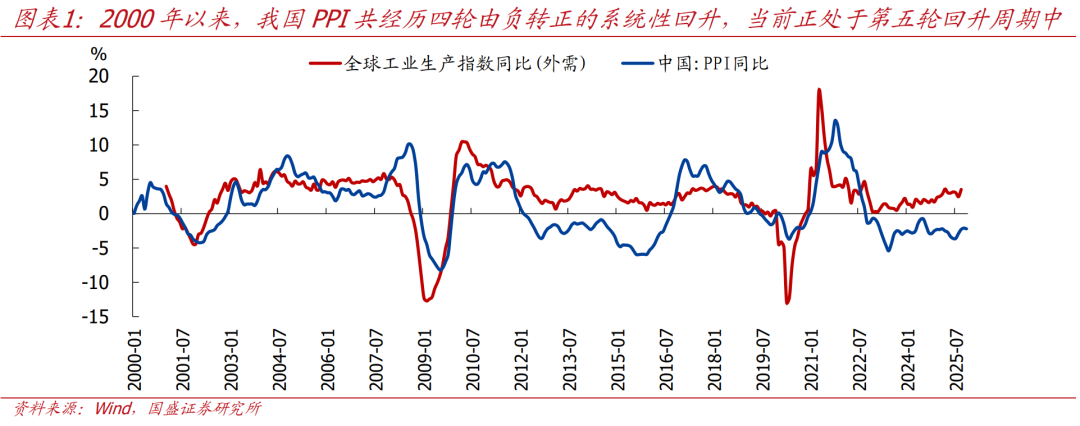
Core Viewpoint - The article discusses the recovery trend of China's Producer Price Index (PPI) since July 2025, predicting a narrowing year-on-year decline in PPI for 2026, with the next six months likely being the fastest recovery period. Historical analysis of past PPI recovery phases is used to identify potential investment opportunities in the stock and bond markets for 2026 [2][3]. Group 1: Historical PPI Recovery Phases - Since 2000, there have been five rounds of PPI recovery in China, with the current phase being the fifth. The PPI has transitioned from negative to positive during these periods, with significant economic events influencing these changes [15][22]. - The first round (2002-2004) saw PPI rise from -4.2% to 8.4%, driven by global economic recovery and domestic urbanization [4][16]. - The second round (2009-2010) experienced a rise from -8.2% to 7.1%, supported by the global financial crisis response and domestic stimulus measures [5][17]. - The third round (2015-2017) saw PPI increase from -5.9% to 7.8%, influenced by supply-side reforms and monetary policies [6][19]. - The fourth round (2020-2021) had PPI rise from -3.7% to 13.5%, primarily due to supply-side factors and global commodity price increases [7][20]. - The current phase (2025-present) has seen PPI recover from -3.6% to -2.2%, with expectations for further recovery in 2026 [8][21]. Group 2: Stock Market Performance During PPI Recovery - Historical analysis indicates that during the first phase of PPI recovery, A-shares typically show an upward trend, with small-cap growth stocks outperforming [3][6]. - In the second phase, as PPI rises from its bottom to positive territory, the stock market experiences a more balanced performance across growth, consumption, and cyclical sectors, with notable performances in electronics, communication, and consumer goods [3][8]. - The third phase, when PPI turns positive, often leads to high-level market fluctuations, with value stocks gaining an advantage over growth stocks [3][7]. Group 3: Bond Market Dynamics - The bond market's response to PPI recovery is influenced by various factors, including growth expectations and liquidity conditions, rather than solely by inflation [10][11]. - Historical data shows that during PPI recovery phases, the 10-year government bond yield may face upward pressure, but this is not always synchronized with PPI movements [10][11]. - A stable liquidity environment and lack of sustained demand improvement can prevent significant upward trends in bond yields, even during periods of PPI recovery [11][12]. Group 4: Outlook for 2026 - The PPI is expected to narrow its year-on-year decline in 2026, with the next six months likely being the fastest recovery period, driven by policies aimed at stabilizing coal and steel prices, as well as rising demand for lithium and copper [12][13]. - The stock market is anticipated to have upward potential, with growth, consumption, and cyclical sectors all presenting investment opportunities, particularly in undervalued sectors such as food and beverage, home appliances, and non-ferrous metals [12][13]. - The bond market is expected to remain in a state of fluctuation, with a continued focus on monetary easing, although significant adjustments in bond yields are not anticipated [13].
商社美护行业周报:海南自贸港正式封关,服务零售增速环比提速-20251224
Guoyuan Securities· 2025-12-24 08:16
Investment Rating - The industry maintains a "Recommended" rating, focusing on new consumption sectors such as beauty care, IP derivatives, and gold jewelry [5][28]. Core Insights - The market performance for the week of December 15-20, 2025, showed significant gains in the retail, social services, and beauty care sectors, outperforming the overall market with increases of +6.66%, +2.66%, and +2.87% respectively [2][14]. - The total retail sales of consumer goods from January to November 2025 reached 45.61 trillion yuan, a year-on-year increase of 4%. In November alone, retail sales totaled 4.39 trillion yuan, growing by 1.3% year-on-year, which was below market expectations [3][22]. - The service consumption growth rate outpaced that of goods retail, with service retail sales increasing by 5.4% year-on-year from January to November 2025 [3][22]. Summary by Sections Market Performance - The beauty care, retail, and social services sectors ranked first, fourth, and third among 31 primary industries, respectively, during the week [2][14]. - Specific sub-sectors such as general retail, hotel and catering, and professional chains saw notable increases of +9.67%, +8.40%, and +5.06% [15]. Key Industry Data and News - The retail sales of consumer goods in November 2025 showed a modest increase, with categories like communication equipment and jewelry performing well, while automotive and home appliances faced challenges due to high base effects and subsidy reductions [3][22]. - The Ministry of Commerce initiated a two-year pilot program for new consumption models in 50 cities, aiming to stimulate consumption through various innovative approaches [3][22]. Investment Recommendations - The report suggests focusing on companies in the beauty care and new consumption sectors, recommending specific stocks such as Shangmei Co., Juzhi Biotechnology, and Marubi Biotechnology [5][28].


每日投资策略-20251224
Zhao Yin Guo Ji· 2025-12-24 03:33
Market Performance - Hang Seng Index closed at 25,774, down 0.11% for the day but up 28.49% year-to-date[1] - Shanghai Composite Index closed at 3,920, up 0.07% for the day and 16.95% year-to-date[1] - US Dow Jones closed at 48,442, up 0.16% for the day and 13.86% year-to-date[1] Sector Performance - Hang Seng Financial Index at 49,069, up 0.58% for the day and 39.65% year-to-date[2] - Hang Seng Industrial Index at 13,970, down 0.55% for the day and up 24.18% year-to-date[2] - Hang Seng Real Estate Index at 17,858, up 0.56% for the day and 19.75% year-to-date[2] Capital Flows and Market Trends - Southbound capital net inflow of HKD 611 million, with Alibaba, Meituan, and Zijin Mining as top net buys[3] - A-shares in social services, beauty care, and retail saw the largest declines, while power equipment, building materials, and electronics led gains[3] - Anticipation of a spring market in early 2024, with technology and consumer sectors expected to outperform[3] Economic Indicators - US GDP growth at an annualized rate of 4.3% in Q3, the highest in two years[3] - Core PCE inflation at 2.9%, indicating persistent inflationary pressures[3] - Consumer confidence index declined for the fifth consecutive month, while the job market shows improvement[3]