
TMT

Search documents
投资策略专题:当春季躁动遇上估值慢牛
KAIYUAN SECURITIES· 2025-12-08 14:41
Group 1 - The report indicates that the upcoming spring rally is likely to occur earlier than usual due to significant adjustments in November and a late Spring Festival, suggesting a favorable environment for early positioning in December [1][25][39] - Historical data shows that growth-type spring rallies account for nearly 60% of past spring market trends, driven primarily by liquidity easing and technology policy expectations [2][55] - The cyclical spring rally, while less frequent, still holds strong predictive value, with approximately 40% of past rallies characterized by inventory replenishment and inflation expectations [2][60] Group 2 - The report emphasizes that both technology and cyclical sectors can thrive simultaneously, suggesting a dual-driven approach to investment strategies [4][48] - Key sectors for investment include technology (military, media, AI applications) and cyclical industries (solar, chemicals, steel), which are expected to benefit from improving PPI and anti-involution policies [4][60] - The report highlights that the spring rally is not confined to the spring season, as it can be influenced by macroeconomic expectations, liquidity improvements, and institutional behavior [25][34] Group 3 - The report outlines that the spring rally typically features a strong focus on high beta stocks, with significant sector rotation reflecting the market's anticipation of economic trends and policy directions [49][55] - It notes that the performance of growth stocks is particularly sensitive to liquidity conditions and technology policy, making them prime candidates for investment during the spring rally [56][59] - The cyclical rally is characterized by a recovery in resource prices and manufacturing sectors, driven by inventory replenishment and improving economic conditions [60]
苍原资本:12月中下旬“春躁”可能提前启动 均衡配置成长和周期
Sou Hu Cai Jing· 2025-12-08 05:51
Group 1 - The A-share market has shown a continuous volume contraction rebound, with improved funding conditions due to the warming expectations of the Federal Reserve's interest rate cuts and enhanced effectiveness of domestic fundamental pricing [1] - Recent improvements in the TMT and upstream resource sectors have been notable, with a focus on AI chains, pricing chains, capital goods, consumer goods, and infrastructure chains [1] - The upcoming "spring restlessness" in mid to late December may lead to an early start, balancing growth and cyclical investments, with a mid-term view favoring large financials and certain high-value consumer stocks as core choices for asset revaluation in China [1] Group 2 - The market is experiencing a rotation of volatility and structural opportunities, with traditional manufacturing and resource sectors being undervalued in terms of global pricing power [3] - Since the "9.24 market" last year, the overall market has seen a systematic increase in financing, with a net increase of 1.11 trillion yuan, significantly surpassing the total issuance of public and private bullish products since October of the previous year [3] - Major broad-based indices and thriving sectors have achieved most of their gains during these two market waves, while other periods have been relatively flat, with effective gains seen in quant-driven micro-accounts, insurance-driven banks, and price-driven non-ferrous metals [3] Group 3 - The market remains in an upward trend supported by funding and policy, with expectations for the A-share market to continue its bull run next year, supported by valuation and profit stabilization [4] - Easing geopolitical risks and renewed expectations of Federal Reserve interest rate cuts are likely to bring a pre-spring restlessness rally to the A-share market, with upcoming U.S.-China policy expectations being a key factor [4] - The AI sector is expected to continue its momentum under the 2026 U.S.-China interest rate cycle and strengthening AI trends, with a focus on "scarcity" in energy and power, as well as dual development in AI applications and ecosystem construction [4]



【机构策略】12月中下旬“春躁”可能提前启动 均衡配置成长和周期
Zheng Quan Shi Bao Wang· 2025-12-08 01:33
Group 1 - The A-share market continues to rebound with reduced trading volume, supported by improved funding conditions and effective domestic fundamental pricing [1] - The recent improvement in TMT and upstream resource sectors indicates potential investment opportunities, particularly in AI chains, price increase chains, capital goods, consumer goods, and infrastructure [1] - The market is expected to experience structural opportunities and fluctuations before any significant changes in domestic demand, with traditional manufacturing and resource sectors being undervalued [1][2] Group 2 - The overall market remains in an upward trend supported by funding and policy, with expectations for a bull market to continue into next year [2] - Geopolitical risks are easing, and the renewed expectations of Federal Reserve interest rate cuts may trigger a spring rally in the A-share market [2] - The AI sector is anticipated to continue its growth, with a focus on critical areas such as energy storage and power, as well as applications driven by AI interaction and ecosystem development [2]


华泰证券:春季躁动提前的能见度上升
Xin Lang Cai Jing· 2025-12-08 01:01
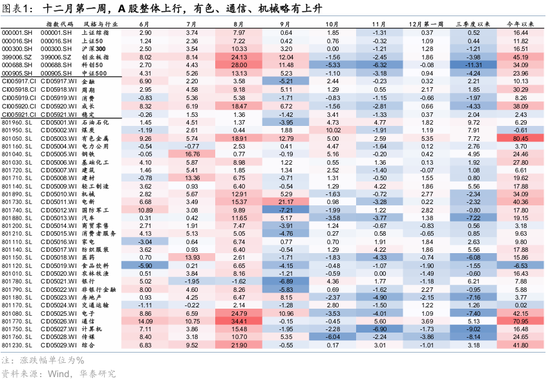
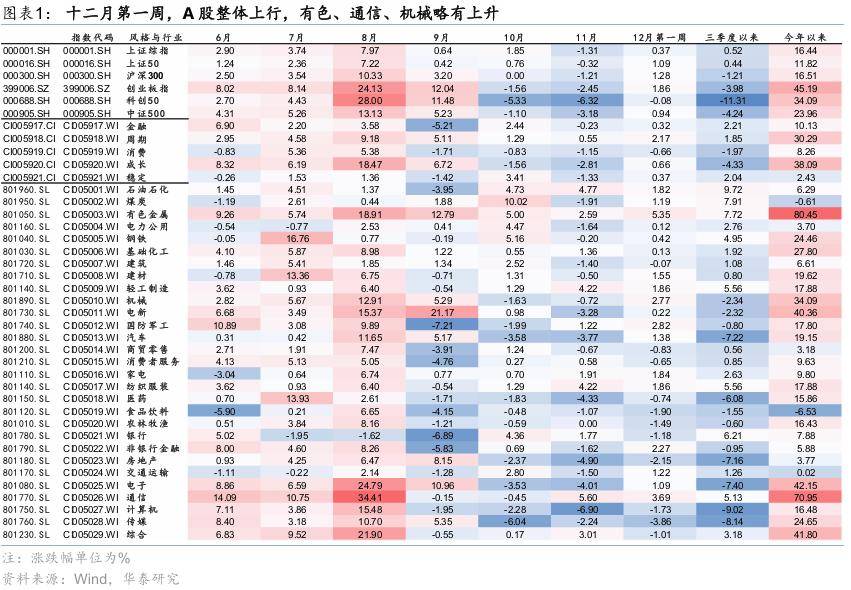
Core Viewpoint - The A-share market continues to rebound with reduced trading volume, supported by improved liquidity conditions and expectations of policy easing ahead of the Central Economic Work Conference [1][16]. Group 1: Funding Observation - Recent improvements in the funding environment include a slight recovery in margin trading balances and a decrease in the scale of net outflows from foreign capital [2][17]. - New equity funds have seen a slight decrease in shares, but the estimated positions of ordinary stock and mixed equity funds have increased [2][19]. - The number of newly issued ETFs has significantly increased, with 22 currently being issued, 10 awaiting issuance, and 11 pending approval [2][19]. Group 2: Economic Tracking - The overall industry prosperity index continued to decline in November, influenced by holiday effects on October production data [3][19]. - Key sectors showing improvement include TMT, upstream resources, and public industries, with notable recovery in AI applications, commodity prices, and consumer goods [3][19]. - Specific areas of focus include the AI chain, price increase chain, capital goods, consumer goods, and infrastructure chains [3][19]. Group 3: Policy Outlook - Expectations for policy changes are rising ahead of the December Political Bureau meeting and the Central Economic Work Conference, with anticipated focuses on proactive macro policies and expanding domestic demand [4][19]. - Historical data suggests a higher probability of market increases in the week leading up to the Central Economic Work Conference, particularly in sectors like consumer services and home appliances [4][19]. Group 4: Investment Strategy - The market is currently in a phase of recovery, with potential for a "spring surge" starting in mid-December [5][20]. - A balanced allocation between growth and cyclical sectors is recommended, with a focus on high-value consumption and financial sectors as long-term investment choices [5][20]. - Key sectors to watch include aviation equipment, AI chains, and power equipment for growth, while non-ferrous metals and certain chemicals are highlighted for cyclical investments [5][20].
中国信用 2026 年展望:利好、稳健与风险-China Credit 2026 Outlook_ The good, the solid and the ugly
2025-12-08 00:41
Summary of Key Points from J.P. Morgan's China Credit 2026 Outlook Industry Overview - **China Credit Market**: The report emphasizes a selective approach to investing in China credits, highlighting a spectrum of risk from high-quality TMT (Technology, Media, and Telecommunications) companies to solid SOEs (State-Owned Enterprises) and struggling property firms [1][5][10]. Core Insights Economic Outlook - **2025 Growth**: The Chinese economy is projected to grow approximately 5% year-on-year in 2025, supported by strong exports and fiscal expansion despite high U.S. tariffs [5][10]. - **2026 Forecast**: A slowdown to 4.4% growth is anticipated in 2026 due to weaker exports and consumption, with real estate investment expected to contract by 10% [5][11]. China TMT Sector - **Top Picks**: J.P. Morgan recommends Alibaba '35s/'54s and Weibo '30s as top picks due to their solid balance sheets and improving fundamentals [1][5][66]. - **Investment Cycle**: TMT companies are in a heavy investment cycle focusing on AI and new initiatives like food delivery, with Alibaba aggressively expanding its market share [29][30]. - **Competitive Landscape**: Intense competition in food delivery is noted, particularly with Alibaba's expansion impacting Meituan's profitability [30][68]. China SOE Sector - **Defensive Exposure**: China National Chemical is recommended for defensive exposure, with strong demand expected to absorb any potential spread widening from U.S. sanctions [5][66]. - **Spread Compression**: SOE credits have seen significant spread compression, with the JACI China single-A Corporate Index tightening to a 10-year low [78][79]. China Property Sector - **Cautious Sentiment**: The property market remains fragile, with Vanke's bond extension raising concerns. Longfor is the only company rated as Overweight due to its solid balance sheet and transformation to a rental model [1][5][66]. - **Market Risks**: Investor sentiment is expected to remain weak, and banks may tighten funding to private developers [5][66]. Additional Important Insights - **Technical Support**: The report notes that technical factors are supportive of China credits, with limited supply expected to continue into 2026 [5][15]. - **Valuation Trends**: China credits have experienced strong compression, with the JACI China IG Corp Index tightening significantly over the past year [15][16]. - **Funding Strategies**: TMT companies are exploring alternative funding channels, including exchangeable bonds and CNH bonds, to leverage lower costs and increased demand [44][66]. Conclusion - **Investment Strategy**: The report advocates for a selective investment strategy in China credits, focusing on high-quality TMT names and defensive SOEs while remaining cautious in the property sector due to ongoing risks and market fragility [1][5][66].





春季躁动的10问10答
2025-12-08 00:41
Summary of Conference Call Notes Industry Overview - The notes discuss the investment market dynamics leading up to the end of the year, highlighting cautious investor behavior due to assessment and demand return drift, resulting in low market trading volume [1][2] - The potential for a spring market rally is analyzed, with historical data indicating that a trend upward typically begins about two weeks before the Spring Festival, with gains often exceeding 10% [1][3] Key Insights and Arguments - The spring market rally is expected to be a continuation pattern this year, suggesting that the overall index has more than 10% upside potential [1][3] - The timing of the spring rally is influenced by market sentiment and catalysts; if strong catalysts such as resolution of overseas interest rate cuts or positive domestic policy announcements occur in December, the rally may start earlier [1][4][5] - Small-cap stocks and technology sectors are expected to perform well during the spring rally, with the TMT (Technology, Media, Telecommunications) sector showing high win rates and elasticity [1][6] - Defensive strategies are favored before the holiday, while a clearer upward trend is anticipated post-holiday, emphasizing the importance of focusing on technology and high-end manufacturing sectors during the spring rally [1][6] Long-term Investment Recommendations - Long-term investors are advised to focus on "Galloping Assets," which are traditional industry leaders with global competitive advantages, benefiting from rising external demand and supportive domestic manufacturing policies, currently at relatively low valuations [1][7] - During the year-end window, attention should be given to low crowding stocks and quality dividends from insurance capital influx, as well as cyclical stocks, with a positive outlook for assets benefiting from external demand and the key tasks of the 14th Five-Year Plan [1][7]
华泰证券:12月中下旬“春躁”可能提前启动,均衡配置成长和周期
Sou Hu Cai Jing· 2025-12-07 23:59
Group 1: Core Insights - The funding environment has improved, with signs of recovery in allocation-type funds and a reduction in insurance risk factors potentially leading to increased equity asset allocation [2][4] - Recent trends indicate a marginal slowdown in trading funds, while private equity registrations have slowed to 178, but product issuance and positioning are expected to accelerate [2][3] Group 2: Economic Trends - The TMT sector, upstream resources, and public industries have shown significant improvement in economic sentiment over the past three months, with AI applications, price increases in commodities, and capital goods leading the way [3][4] - The construction PMI has strengthened, indicating a positive outlook for the infrastructure chain, while consumer goods such as cinema, cosmetics, and dairy products are also experiencing a recovery [3][4] Group 3: Policy Outlook - Anticipation of policy changes ahead of the December Political Bureau and Central Economic Work Conference is rising, with expectations for more proactive macro policies and a focus on expanding domestic demand [4] - Historical data suggests a higher probability of market gains leading up to the Central Economic Work Conference, particularly in sectors like consumer services and home appliances [4] Group 4: Investment Strategy - The market is currently in a phase of recovery, with potential for a "spring rally" to begin in late December, emphasizing a balanced allocation between growth and cyclical sectors [4] - Key sectors to focus on include aviation equipment, AI chains, and power equipment for growth, while non-ferrous metals and certain chemicals are highlighted for cyclical investments [4]
摩根大通黄健:技术迭代加速 资本配置效率将影响创新成败
2 1 Shi Ji Jing Ji Bao Dao· 2025-12-07 08:53
Group 1 - The core viewpoint of the articles emphasizes the deep interconnection between technological development and capital market transformation, highlighting how advancements in technology, particularly artificial intelligence, are reshaping the financial industry and capital markets [1] - Historical context is provided, illustrating that significant technological breakthroughs have often been supported by precise capital allocation, from the steam engine to the internet and now to artificial intelligence [1] - The article notes that the cycle of technological iteration has shortened from years to months, making capital allocation efficiency a critical variable for the success of innovation [1] Group 2 - Morgan Stanley's specific practices include assisting Xiaomi in completing a $5.5 billion "old-to-new" Hong Kong stock placement, marking the largest stock placement transaction in the global TMT sector since April 2021 [2] - The company has also supported several Chinese tech firms in issuing various bonds overseas, providing comprehensive services throughout their lifecycle [2] - Morgan Stanley aims to leverage its global network and local business platform to act as a bridge between Chinese and global markets, offering full financial services to clients, particularly in the tech sector [2]


慧博云通:12月5日召开董事会会议
Mei Ri Jing Ji Xin Wen· 2025-12-05 12:28
每经头条(nbdtoutiao)——秒光、售罄!银行大额存单成稀缺资源,2%以上产品很难抢,有的门槛高 达1000万元!专家:存款利率或长期下行 (记者 曾健辉) 每经AI快讯,慧博云通(SZ 301316,收盘价:44.34元)12月5日晚间发布公告称,公司第四届第十二 次董事会会议于2025年12月5日以通信表决的方式召开。会议审议了《关于批准本次交易相关加期审计 报告、备考审阅报告的议案》等文件。 2025年1至6月份,慧博云通的营业收入构成为:TMT占比59.06%,金融占比30.83%,其他行业占比 10.11%。 截至发稿,慧博云通市值为179亿元。 ...
A股2026年策略展望:盈科而进
Huajin Securities· 2025-12-05 02:49
Core Views - The report suggests that 2026 may witness a structural recovery in earnings, leading to a slow bull market in A-shares, driven by technology and cyclical sectors, despite high valuations [5][17] - The main theme for 2026 is expected to be a continuation of loose liquidity and a structural recovery in earnings, with potential for strong performance in technology and cyclical industries [6][37] Macroeconomic Environment - The macroeconomic outlook for 2026 indicates that the Federal Reserve may continue to lower interest rates, maintaining a loose liquidity environment domestically [19][24] - Exports are anticipated to face high base pressure but may still show resilience, particularly in high-tech products and emerging markets [26][27] - Infrastructure investment growth is expected to stabilize and recover, supported by proactive fiscal policies and increased issuance of special bonds [28] - Real estate investment growth is likely to remain weak, although policies may ease, leading to a gradual stabilization in housing prices and sales [30] - Manufacturing investment growth is projected to stabilize and recover, driven by policies promoting new productive forces and equipment upgrades [32] Industry Allocation - The report recommends focusing on technology growth and cyclical growth as the main allocation themes for 2026, with specific attention to sectors such as TMT (Technology, Media, and Telecommunications), electric new energy, machinery, pharmaceuticals, non-ferrous metals, chemicals, military industry, and non-bank financials [7] - Large-cap and small-cap stocks are expected to perform relatively well, with a tilt towards cyclical styles [7] Earnings Recovery - Earnings in the technology and cyclical sectors are expected to continue rising, contributing positively to overall A-share performance [37][39] - The report highlights that fiscal policy support may enhance corporate earnings growth, similar to past instances of fiscal stimulus [39]