
金融

Search documents
年度最后非农今夜揭晓:仅增4万?市场准备好迎接降息发令枪
Sou Hu Cai Jing· 2025-12-16 08:02
Core Viewpoint - The upcoming U.S. non-farm payroll report is expected to show a significant slowdown in job growth, with an anticipated increase of only 40,000 jobs compared to 119,000 in September, and an unemployment rate projected to remain at a four-year high of 4.4% [1] Group 1: Economic Indicators - Recent data indicates a cooling labor market, with various indicators such as JOLTS job openings, ADP private employment, and ISM manufacturing/services employment components showing reduced labor demand [3] - The temporary federal government shutdown at the end of September to early October may have delayed hiring for some government contractors, potentially impacting November's data [3] - The latest private employment data for November shows a decline of 32,000 jobs, the largest drop in over two and a half years, primarily due to layoffs in small businesses [4] Group 2: Labor Market Dynamics - Job openings have risen to the highest level in five months, reaching 7.67 million, while layoffs increased to 1.85 million in October, the highest since early 2023 [4] - The average hourly wage growth is expected to be 3.6% year-over-year, reflecting a slowdown in wage growth due to a softening job market [1][7] - The number of initial jobless claims has seen the largest increase in nearly four and a half years, although this may not indicate a substantial weakening of the job market [10] Group 3: Federal Reserve Implications - The Federal Reserve recently lowered the benchmark overnight interest rate by 25 basis points to a range of 3.50%-3.75%, but officials may pause further cuts while seeking clearer signals regarding the labor market and inflation [12] - A weak non-farm payroll report could significantly increase market expectations for further rate cuts in January, while unexpectedly strong data may lead the Fed to maintain a cautious approach [12] - The anticipated weak employment report could trigger a classic macro trading pattern, leading to a weaker dollar, stronger gold and U.S. Treasuries, and a structured rise in U.S. equities [13]


华创证券张瑜:中游供需矛盾进一步改善——11月经济数据点评
Xin Lang Cai Jing· 2025-12-16 07:02
Group 1 - The core analysis focuses on the supply-demand contradiction, particularly in the midstream sector, where the demand-investment growth differential has increased to 7.6% in November, up from 6.4% in the previous month, indicating a potential shift from "strong supply, weak demand" to "weak supply, strong demand" [1][4][30] - The methodology involves calculating the difference between demand growth and investment growth, with a positive differential suggesting that supply-demand contradictions are easing, which may lead to price stabilization in the future [3][32] - Current observations indicate that while midstream demand growth has slightly decreased to 8.9% in November from 9.3% in October, midstream investment growth has also declined to 1.3%, resulting in a continued upward trend in the demand-investment growth differential since May 2024 [4][33] Group 2 - Historical data suggests that the midstream demand-investment growth differential is likely to remain positive, with expectations for the midstream Producer Price Index (PPI) to stop declining and potentially rise in 2026 [2][31] - In November, the midstream PPI showed a month-on-month increase of 0.04%, marking the first positive change since June 2024, indicating a potential upward trend in midstream profitability [5][34] - The analysis of November's economic data reveals a weakening supply side, with industrial production growth at 4.8% and service sector production index at 4.2%, while consumer demand and investment remain weak [43][45] Group 3 - The real estate sector continues to face challenges, with property sales area down 17.3% year-on-year in November, and real estate investment declining by 30.3% [20][26] - Employment remains stable, with the urban survey unemployment rate holding steady at 5.1% in November, indicating a relatively stable labor market despite economic pressures [43][45] - Consumer retail sales growth has slowed to 1.3% in November, down from 2.9% in October, reflecting ongoing challenges in consumer spending [17][43]
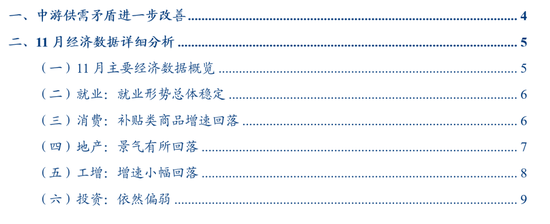
中游供需矛盾进一步改善——11月经济数据点评
一瑜中的· 2025-12-16 06:56
Core Viewpoint - The article emphasizes the improvement of supply-demand contradictions in the midstream sector, indicating a potential shift from "strong supply and weak demand" to "weak supply and strong demand" in the coming years [2][3]. Group 1: Midstream Supply-Demand Analysis - The analysis method involves measuring the difference between demand growth and investment growth, where a positive difference indicates alleviation of supply-demand contradictions [2][5]. - Key indicators include upstream demand from material exports and construction investment, midstream demand from machinery exports and equipment investment, and downstream demand from labor-intensive product exports [5][12]. - In November, the midstream demand growth was 8.9%, slightly down from 10.3% in September, while midstream investment growth was 1.3%, down from 4.2% in September, leading to a demand-investment growth difference of 7.6% [6][13]. Group 2: Future Projections - Historical data suggests that the midstream demand-investment growth difference is likely to remain positive, with expectations for the midstream PPI (Producer Price Index) to stop declining and potentially rise by 2026 [3][14]. - The midstream PPI showed a month-on-month increase of 0.04% in November, marking the first positive change since June 2024, indicating a potential upward trend in midstream ROE (Return on Equity) [7][14]. Group 3: November Economic Data Overview - In November, industrial production growth was 4.8%, while service sector production index growth was 4.2%, indicating a slight weakening in supply-side performance [19]. - Consumer retail sales growth was 1.3%, down from 2.9% in October, while exports rebounded to a growth of 5.9% from a decline of 1.1% [19][21]. - Real estate sales area decreased by 17.3% year-on-year, and fixed asset investment saw a decline of 12.0% in November [19][22]. Group 4: Employment and Price Trends - The urban unemployment rate remained stable at 5.1%, with a slight decrease in the unemployment rate for migrant agricultural workers to 4.4% [23]. - The CPI (Consumer Price Index) rose to 0.7% year-on-year, while the PPI fell by 2.2%, indicating ongoing deflationary pressures in the economy [21][22].

港股市场估值周报:2025.12.08-2025.12.14-20251216
Zhe Shang Guo Ji Jin Rong Kong Gu· 2025-12-16 05:59
Valuation of Hong Kong Stock Market - The Hang Seng Composite Index (HSCI) and Hang Seng Index (HSI) are key indicators of market valuation[8][12] - The Hang Seng Technology Index (HSTECH) reflects the valuation trends in the tech sector[16][18] Industry Valuation Levels - The PE (TTM) valuation shows that the utilities sector is undervalued, with a percentile below 20%[23] - Consumer discretionary, consumer staples, healthcare, information technology, and utilities are below the 50th percentile in PE valuation[23] - High valuation sectors (above 50%) include energy, materials, industrials, financials, and telecommunications[23] - No sectors are currently undervalued based on PB (LF) valuation, with consumer staples, information technology, utilities, and real estate below the 50th percentile[27] - Energy, materials, industrials, consumer discretionary, healthcare, financials, and telecommunications are above the 50th percentile in PB valuation[27] AH Share Premium/Discount Levels - The Hang Seng AH Share Premium Index shows fluctuations in premium levels over time, with historical averages and standard deviations noted[33]
2025 年 11 月经济数据点评:分化延续,政策需加力
GUOTAI HAITONG SECURITIES· 2025-12-16 05:43
Economic Overview - The national economy in November 2025 showed characteristics of "stable production, differentiated consumption, and pressured investment" with industrial production recovering to normal levels after holiday disruptions[8] - The industrial added value in November grew by 4.8% year-on-year, a slight decrease of 0.1 percentage points from the previous month, indicating a marginal slowdown in growth[10] - Fixed asset investment from January to November decreased by 2.6% year-on-year, with November's monthly growth rate at -12.0%, although this was a slight improvement from the previous month[30] Production Insights - New industries continue to show resilience, with automotive manufacturing and transportation equipment leading in production growth, while traditional sectors face challenges[11] - The production index for services grew by 4.2% year-on-year in November, a decrease of 0.4 percentage points from October, reflecting seasonal adjustments post-holiday[14] Consumption Trends - Retail sales in November grew by only 1.3% year-on-year, marking the sixth consecutive month of decline, with large-scale retail sales dropping by 2.0%[20] - The promotional season's impact was limited, with online retail growth slowing from 8.1% to 5.4%, indicating weaker consumer demand[23] Investment Dynamics - Manufacturing investment showed signs of marginal improvement, particularly in high-tech sectors, despite an overall negative growth trend[31] - Real estate investment remains under pressure, with sales area and sales value down by 17.3% and 25.1% year-on-year, respectively, reflecting ongoing market adjustments[34] Risk Factors - External uncertainties are increasing, and domestic demand may decline more than expected, posing risks to economic stability[36]
巴西ETF逆势上涨,跨境ETF迎来快速发展期,规模已逼近万亿元大关
Ge Long Hui· 2025-12-16 04:46
Group 1: Brazilian ETF Performance - Brazilian ETFs are rising against the market trend, tracking the IBOVESPA ETF index, which includes around 80 representative companies from Brazil's mining, agriculture, finance, and energy sectors [1] - The current price-to-earnings ratio of the IBOVESPA index is 10.51, positioned at the 43.46th percentile over the past decade, while the dividend yield stands at 7%, at the 73.31st percentile [1] Group 2: Cross-Border ETF Growth - The cross-border ETF market is experiencing rapid growth, with the total number of ETFs reaching 200 and a combined scale of 927.857 billion, indicating strong expansion momentum [2] - Global liquidity easing expectations have led to robust performance in risk assets, attracting more investors to participate in global markets through cross-border ETFs [2] Group 3: Investment Considerations for Cross-Border ETFs - Key factors for investing in cross-border ETFs include the tracking index, liquidity, and premium rate, which significantly influence long-term investment returns [3] - The largest cross-border ETF, the Hong Kong Internet ETF, has a concentrated holding structure, which increases its elasticity [3] - Liquidity is crucial, as insufficient liquidity can lead to price distortions and significant price impacts when large funds enter or exit [3]
深圳部署!稳妥做好重点企业风险处置
Zhong Guo Zheng Quan Bao· 2025-12-16 04:31
Group 1 - The Shenzhen Municipal Financial Office emphasizes the importance of financial work in Shenzhen, particularly in the context of the 14th Five-Year Plan, and aims to align actions with the central government's economic assessments [1] - The meeting highlights the need to effectively manage financial risks, particularly focusing on key enterprises and real estate companies, while implementing a tailored approach for small financial institutions [2] - There is a strong commitment to enhancing the quality of financial services, particularly in supporting technological innovation and high-quality industrial development, with a focus on creating a globally influential industrial financial center [3] Group 2 - The meeting calls for a robust regulatory framework to prevent financial risks, including strict measures against illegal financial activities and improved collaboration among departments [2] - The financial system's party-building efforts are emphasized, aiming to strengthen the political and organizational functions of grassroots party organizations within the financial sector [3] - The strategic focus for 2026 includes balancing development and safety, with plans to support small and medium-sized enterprises, expand domestic demand, and enhance innovation in capital formation [3]
打造科技金融“强引擎”
Jin Rong Shi Bao· 2025-12-16 03:32
超大型风渔融合网箱平台——"伏羲一号"正式投产,高新技术企业培育和科技成果转化跑出"加速度", 创新岛研发迈入2.0模式……当前,广东汕尾创新浪潮奔涌,科技动能澎湃,而在这背后,金融正悄然 汇聚成推动区域发展的强大引擎。 近年来,中国人民银行汕尾市分行紧扣地方产业特色和科技创新需求,通过创新"一项服务"、强化"一 个抓手"、做优"一种模式",持续提升科技金融服务的精准性和实效性,为汕尾高质量发展注入"硬 核"动力。截至今年上半年末,全市科技贷款余额410.69亿元,同比增长26.6%。 创新"一项服务" 打破政金企信息壁垒 "作为一家扎根汕尾的企业,我们曾为融资辗转反侧,股权、债权、担保、租赁……每一条路似乎都隔 着'玻璃门',看得见却难打通。直到'股贷担保租'联动服务队的出现,真正打通了我们企业和金融行业 的'最后一公里'。"海丰县润宝印刷科技有限公司相关负责人激动地说道。 "股贷担保租"联动服务队是在中国人民银行汕尾市分行指导下,由建行汕尾市分行、太平洋财产保险汕 尾分公司等五家机构成立的,专门为科技企业提供股权融资、信贷支持、风险担保、保险保障、设备租 赁等全链条、定制化金融服务的专业团队。 联动服务队 ...
申万金工ETF组合202512
Shenwan Hongyuan Securities· 2025-12-16 03:30
Report's Investment Rating for the Industry The provided content does not mention the industry investment rating. Core Views of the Report - The report constructs multiple ETF portfolios, including macro industry, macro + momentum industry, core - satellite, and trinity style rotation portfolios, to capture investment opportunities and manage risks in the ETF market [1][5]. - It combines macro - based and momentum - based methods to form complementary strategies, aiming to improve the performance of the portfolios [12]. - The trinity style rotation model uses macro liquidity as the core to build a long - term style rotation model and selects ETFs based on the model's results [6]. Summary by Relevant Catalog 1. ETF Portfolio Construction Methods 1.1 Based on Macro Method - Calculate the macro - sensitivity scores of economic, liquidity, and credit for industry - themed ETFs, and adjust the scores according to the latest indicators. Select the top 6 industry - themed indices and corresponding largest - scale ETFs for equal - weight allocation [1][7]. - Traditional cyclical industries are sensitive to the economy, TMT is sensitive to liquidity, and consumption is sensitive to credit. State - owned enterprises and ESG - related themes have low sensitivity to liquidity and credit [5]. 1.2 Trinity Style Rotation - Build a long - term style rotation model centered on macro liquidity, including growth/value, market capitalization, and quality models. Combine the results of the three models to get the final style preference [6]. - Screen ETFs with high exposure to the target style, control industry exposure, and set allocation limits to obtain the ETF allocation model [6]. 2. Macro Industry Portfolio - Select industry - themed ETFs that have been established for over 1 year and have a current scale of over 200 million. Calculate and adjust sensitivity scores, and remove liquidity scores if there is a significant divergence between liquidity and credit. Then select the top 6 industry - themed indices and corresponding largest - scale ETFs for equal - weight allocation [7][8]. - Currently, with economic forward - looking indicators rising and liquidity and credit indicators tightening, the portfolio is value - oriented with high proportions of banks and cyclical sectors. The December 2025 holdings include Huabao CSI Bank ETF, Cathay CSI Coal ETF, etc. [9]. - The portfolio has large fluctuations and outperformed the benchmark significantly in November 2025 [11]. 3. Macro + Momentum Industry Portfolio - Combine macro - based and momentum - based methods. Use clustering to group industry - themed indices and select the product with the highest 6 - month return from each group for equal - weight allocation [12]. - The December 2025 holdings include Huabao CSI Bank ETF, Cathay CSI Coal ETF, and others. The battery and metal industries selected by momentum have increased [15]. - The portfolio has performed well this year and outperformed the CSI 300 significantly in November 2025 [16]. 4. Core - Satellite Portfolio - Design a "core - satellite" portfolio with the CSI 300 as the core to address the high volatility and rapid industry rotation of industry - themed ETFs [18]. - Calculate macro - sensitivity scores for domestic broad - based, industry - themed, and Smart Beta ETFs, construct three stock portfolios, and weight them at 50%, 30%, and 20% respectively [18]. - The December 2025 holdings include Huatai - Peregrine CSI 300 ETF, Huaxia SSE 50 ETF, etc. The portfolio has been stable this year and outperformed the index almost every month, including in November 2025 [21][23]. 5. Trinity Style Rotation ETF Portfolio - The model currently favors small - cap growth + high - quality segments. The factor exposures and historical performance are presented in the report [24]. - The December 2025 holdings include Southern CSI 500ETF, Southern CSI 1000ETF, etc. [30].
新世纪期货交易提示(2025-12-16)-20251216
Xin Shi Ji Qi Huo· 2025-12-16 03:18
Report Industry Investment Ratings - Iron ore: Oscillating, with a weakening trend [2] - Coking coal and coke: Oscillating [2] - Rolled steel and rebar: Oscillating [2] - Glass: Weakening [2] - Soda ash: Weakening [2] - Shanghai Stock Exchange 50 Index Futures/Options: Oscillating [4] - CSI 300 Index Futures/Options: Oscillating [4] - CSI 500 Index Futures/Options: Rebounding [4] - CSI 1000 Index Futures/Options: Rebounding [4] - 2-year Treasury bonds: Oscillating [4] - 5-year Treasury bonds: Oscillating [4] - 10-year Treasury bonds: Consolidating [4] - Gold: Oscillating with an upward bias [6] - Silver: Oscillating with an upward bias [6] - Logs: Consolidating at the bottom [6] - Pulp: Oscillating with an upward bias [7] - Offset paper: Weakly oscillating [7] - Edible oils: Oscillating with a downward bias [7] - Soybean meal: Oscillating with a downward bias [7] - Rapeseed meal: Oscillating with a downward bias [7] - Soybeans No. 2: Oscillating with a downward bias [7] - Live pigs: Weakening [8] - Rubber: Oscillating with a downward bias [11] - PX: Widely oscillating [11] - PTA: Oscillating [11] - MEG: Weakly oscillating [11] - PR: On the sidelines [11] - PF: On the sidelines [11] Core Viewpoints - The iron ore market features a "loose supply, low demand, and port inventory accumulation" situation, with prices expected to oscillate weakly. The implementation of the steel export license management system is a definite negative for raw materials [2]. - The coal and coke market was affected by the lack of incremental policy information after the Central Economic Work Conference, and the change from supply - side policy expectation to demand - side negative expectation due to the steel export policy. However, some short - term factors provide support [2]. - The steel market, including rolled steel and rebar, is affected by the steel export policy and weak domestic demand, with prices expected to oscillate at a low level [2]. - The glass and soda ash markets are facing weak demand, and the future depends on cold - repair progress and macro factors [2]. - The financial market, including stock index futures/options and Treasury bonds, is influenced by economic data and policy signals. The market shows different trends such as oscillation, rebound, and consolidation [4]. - The precious metals market, with gold and silver, is supported by the central bank's gold - buying behavior, de - dollarization, and geopolitical risks in the long - term, but short - term factors like the Ukraine peace talks and economic data can cause fluctuations [6]. - The wood and pulp market, including logs, pulp, and offset paper, has different supply - demand situations. Logs are expected to consolidate at the bottom, pulp may normalize to a supply - demand - balanced situation, and offset paper is expected to oscillate weakly [6][7]. - The edible oils and meal market, including various oils and meals, is affected by factors such as US soybean policies, South American soybean production expectations, and domestic supply - demand relationships, with prices oscillating weakly [7]. - The live pig market has stable supply, some improvement in demand, but overall prices are expected to decline [8]. - The soft commodity and polyester market, including rubber and various polyester products, has different supply - demand and price trends. Rubber is expected to oscillate weakly, and polyester products show various trends such as wide - range oscillation, weak oscillation, and sidelining [11]. Summary by Related Catalogs Black Industry - Iron ore: In 2026, global mines will add 64 - 65 million tons, with a growth rate far exceeding that of crude steel. Current iron - making water production is decreasing quarterly, and steel mills' maintenance expectations are rising. The implementation of the steel export license management system is a negative for raw materials. Look for opportunities to short on rebounds [2]. - Coking coal and coke: After the Central Economic Work Conference, there was a lack of incremental policy information. The steel export policy shifted market expectations from supply - side policy benefits to demand - side negatives. However, pre - holiday downstream replenishment demand, year - end coal mine production reduction expectations, and the "anti - involution" strategy provide some support [2]. - Rolled steel and rebar: The steel export license management system requires a downward adjustment of next year's steel export expectations. Domestic demand, especially in the real estate sector, is weak. Prices are expected to oscillate at a low level [2]. - Glass and soda ash: Glass prices are weakening, with low processing orders and high inventory. The cold - repair plan of some glass factories is being delayed. Soda ash is also in a weak situation, and the future depends on cold - repair progress and macro factors [2]. Financial - Stock index futures/options: On the previous trading day, major stock indices showed declines. The publication of President Xi Jinping's article emphasizes the importance of expanding domestic demand. Economic data such as fixed - asset investment, industrial added value, and retail sales show the current economic situation [4]. - Treasury bonds: The yield of 10 - year Treasury bonds increased by 1bp, and the central bank conducted reverse - repurchase operations. The market trend shows a slight rebound [4]. Precious Metals - Gold and silver: The pricing mechanism of gold is shifting from being centered on real interest rates to central bank gold - buying. Gold has strong support from factors such as de - dollarization,避险需求, and central bank purchases in the long - term. Short - term factors like the Ukraine peace talks and economic data can cause price fluctuations [6]. Wood and Pulp - Logs: Port daily shipment volume and national daily delivery volume are decreasing. Import volumes from New Zealand and domestic imports are also decreasing. Port inventory is decreasing, and prices are running weakly. It is expected to consolidate at the bottom [6]. - Pulp: Spot market prices are weakening, but cost support is increasing. The paper industry has low profitability and high inventory, with poor demand. Under the influence of positive factors, prices are trending upward, but may return to a supply - demand - balanced situation [7]. - Offset paper: Spot market prices are stable. There is still supply pressure, and demand is weak overall. Prices are expected to oscillate weakly [7]. Edible Oils and Meal - Edible oils: US soybean crushing is at a high level, but the renewable energy blending obligation in 2026 is uncertain. Malaysian palm oil exports are decreasing, and domestic oil supply is abundant. Prices are expected to oscillate weakly [7]. - Meal: Global soybean inventory is relatively loose. US soybean has no export advantage, and the market has high expectations for South American soybean harvest. Domestic soybean meal supply is abundant, and prices are expected to oscillate weakly [7]. Agricultural Products - Live pigs: The average trading weight shows different trends in the north and south. The settlement price is falling, and terminal demand growth is limited. Although slaughtering rates are increasing, prices are expected to decline [8]. Soft Commodity and Polyester - Rubber: Different rubber - producing regions have different supply situations. Demand is affected by tire enterprise capacity utilization. Inventory is accumulating seasonally, and prices are expected to oscillate weakly [11]. - Polyester: PX prices are widely oscillating due to factors such as crude oil inventory and supply - demand relationships. PTA, MEG, PR, and PF show different price trends based on their respective supply - demand and cost situations [11].