军工

Search documents
华金证券:十月慢牛趋势不变,风格难改 | 投研报告
Zhong Guo Neng Yuan Wang· 2025-10-12 02:48
Core Viewpoint - The main factors influencing the A-share market in October are policies and external events, liquidity, and fundamentals, with historical data indicating a tendency for the market to be volatile during this month [2][3]. Policy and External Events - Positive policies and external events are crucial for potential A-share market gains, as seen in years like 2010, 2015, and 2020 when the Shanghai Composite Index rose in October following the implementation of the "Five-Year Plans" [2][3]. - Conversely, tightening policies or negative external shocks could lead to a weaker A-share market [2]. Liquidity - Liquidity is a significant factor affecting the A-share market in October; a loose liquidity environment may boost the market, as evidenced by events like the anticipated QE2 in 2010 and interest rate cuts by the central bank in 2015 [2][3]. - A tightening liquidity scenario could result in weaker market performance [2]. Earnings Reports - The third-quarter earnings reports are expected to have a substantial impact on the A-share market in October, with a potential structural recovery in profitability anticipated [3][5]. Current Market Outlook - The A-share market is likely to continue a slow bullish trend in October, supported by positive policy expectations and a potentially loose liquidity environment [3]. - Historical trends suggest that sectors related to technology and cyclical industries may outperform in October, particularly those aligned with the "14th Five-Year Plan" [4][5]. Sector Allocation - The technology and cyclical sectors are expected to remain favored in October, with recommendations to accumulate positions in technology, core assets, and cyclical industries [4][5]. - Specific industries such as computing, media, military, and new energy are projected to show strong earnings growth, while sectors with high economic activity are likely to be concentrated in technology and cyclical industries [5].
中国终于放大招了,对稀土出口进行最大力度管制,西方国家完蛋了
Sou Hu Cai Jing· 2025-10-11 19:37
Core Viewpoint - China has implemented strict controls on rare earth exports, particularly regarding smelting technology, which could significantly impact Western countries' industrial capabilities [1][8]. Group 1: Importance of Rare Earth Elements - Rare earth elements are essential for modern technology and are referred to as "industrial vitamins" [1]. - These elements are crucial for manufacturing high-tech products, including electronic components used in various industries [1][3]. Group 2: Military Applications - Rare earth elements are vital for both civilian and military applications, such as chips, guidance systems, and radar components [3]. - China's abundant rare earth resources enhance its military capabilities, allowing for advanced technologies like the GaN (Gallium Nitride) active phased array radar used in aircraft like the J-10C [3][6]. Group 3: Comparison with Western Technologies - The U.S. military aircraft, such as the F-35, lag behind Chinese counterparts in radar technology due to a lack of access to essential rare earth materials like gallium [5][6]. - Most F-35s are equipped with standard radar systems, while Chinese drones and military aircraft utilize advanced radar technologies, showcasing a significant technological gap [6][8]. Group 4: Global Demand and Supply Dynamics - The current global geopolitical climate has increased demand for rare earth elements, particularly in military applications, as countries ramp up production capabilities [8]. - China's decision to tighten rare earth export controls could severely hinder Western military production, impacting their ability to engage in conflicts [8].

申万宏源:短期风险偏好驱动资产和顺周期资产可能调整 中期
智通财经网· 2025-10-11 12:16
Core Viewpoint - The report from Shenwan Hongyuan indicates that short-term disturbances from US-China trade tensions may lead to adjustments in risk-sensitive and cyclical assets, while stable capital market expectations are essential. The report suggests focusing on sectors such as banking, rare earths, military, and agriculture, with a positive outlook for technology stocks in Q4 2025, particularly in overseas computing power, semiconductors, and robotics [1][9]. Summary by Sections US-China Trade Tensions - The re-emergence of US-China trade tensions has led to a significant decline in global risk assets, with a notable drop in risk appetite. However, the current A-share index is at a higher midpoint compared to April, indicating market adaptability and learning effects [2][11]. - The adjustment in the A-share market is expected to be less severe than in April, with a potential for a short-term pulse adjustment without a pessimistic outlook [2][3]. Technology Sector Analysis - The technology sector is not expected to experience sustained or deep adjustments. The overall market needs to break through, primarily led by technology stocks. Key factors include ongoing advancements in AI both domestically and internationally, and an improvement in short-term cost-effectiveness for technology stocks [3][5]. - Recent adjustments in heavily weighted technology stocks are attributed to concerns over high valuations in semiconductor leaders and the impact of rising trade tensions. However, these adjustments are not expected to have a lasting effect [4][6]. Market Outlook - The report maintains a positive mid-term outlook for the Hong Kong stock market, which is expected to benefit from global monetary easing and the development of new economic industries. The report emphasizes the importance of the "anti-involution" trend as a key structural factor for transitioning from a structural bull market to a comprehensive bull market [1][9]. - The anticipated peak for the A-share market may occur in the spring of 2026, with potential challenges related to demand verification and supply dynamics. However, the overall sentiment remains optimistic for Q4 2025, with expectations for a continued bull market as conditions improve over time [8][9].

十月慢牛趋势不变,风格难改
Huajin Securities· 2025-10-11 10:53
Group 1 - The core factors influencing the October market trends are policies, external events, and liquidity [4][11][18] - The A-share market is expected to continue a slow bull trend in October, driven by positive policy expectations and a potential easing of liquidity [7][11][18] - Historical data shows that in 15 years since 2010, the Shanghai Composite Index has risen in October 8 times, often influenced by significant policy announcements [4][5][11] Group 2 - In October, technology and cyclical sectors are expected to outperform, with a focus on growth-oriented industries related to the "14th Five-Year Plan" [21][22][30] - The disclosure of Q3 earnings reports is likely to favor technology and cyclical sectors, as historically, industries with strong earnings tend to perform well in October [22][25] - The current Fed rate cut cycle is anticipated to benefit technology growth and certain cyclical industries, with historical trends indicating that high-growth sectors perform better during such periods [30][34] Group 3 - The calendar effect suggests that technology sectors such as computers, automobiles, home appliances, and electronics are likely to lead in performance during October [36] - The expected structural recovery in earnings for the A-share market is supported by a low base effect from the previous year, particularly in exports and retail sales [18][20] - Key sectors expected to benefit from policy support include communication, machinery, electronics, and new energy, while real estate investment is likely to remain weak [18][20]
10月度金股:聚焦高质量发展组合-20251011
Soochow Securities· 2025-10-11 10:50
Group 1 - The report predicts that the index will maintain a fluctuating upward trend in October, supported by positive overseas market performance and domestic monetary policy adjustments [1][2] - The focus remains on high-quality development sectors, particularly technology growth, as indicated by recent government articles emphasizing economic policy [2][3] - The report highlights the importance of macroeconomic factors over valuation metrics in determining market trends, especially in the context of the current weak dollar environment [2][3] Group 2 - The investment strategy emphasizes a core focus on self-sufficient chip production, alongside sectors benefiting from price increases and favorable market conditions [3][4] - The recommended stocks include companies like Haiguang Information, Kunlun Wanwei, and Zhaoyi Innovation, which are positioned to benefit from the ongoing trends in technology and AI [4][9] - The report outlines financial projections for the recommended stocks, indicating expected growth in revenue and net profit for the years 2025 to 2027 [67] Group 3 - Haiguang Information is expected to see steady growth in CPU and DCU product revenues due to the domestic push for AI capabilities [12][13] - Kunlun Wanwei is advancing its AI business across the entire industry chain, with significant developments in AI applications and models [15][16] - Zhaoyi Innovation is projected to achieve substantial revenue growth driven by its competitive position in the NOR and DRAM markets, particularly benefiting from the AI wave [20][21] Group 4 - Aerospace Electronics is positioned for rapid growth in the commercial aerospace sector, focusing on satellite internet and drone systems [31][32] - High Energy Environment is benefiting from rising metal prices and a stable resource recycling operation, with significant profit contributions expected [36][37] - Northern Huachuang is set to gain from increased domestic equipment adoption and the expansion of semiconductor production lines [42][43] Group 5 - Heng Rui Pharmaceutical is accelerating its internationalization process with a robust pipeline of innovative drugs, expected to yield significant licensing revenues [54][55] - Ningde Times is projected to maintain strong growth in battery production, driven by increasing demand in energy storage and electric vehicles [58][59] - Shanghai Washba is focusing on solid-state battery technology, with anticipated significant profit growth from its recent acquisitions and expansions [63][64]




美国军工企业炒作:中美冲突酝酿了近50年,如今是一场“持久战”
Guan Cha Zhe Wang· 2025-10-11 06:35
Core Viewpoint - Anduril Industries' leadership expresses concerns over the U.S. defense manufacturing supply chain's reliance on China, advocating for a decoupling and re-industrialization to secure critical resources like rare earths and semiconductors [1][5]. Group 1: Company Insights - Anduril Industries is the largest among U.S. defense tech startups, focusing on AI and autonomous software to modernize military capabilities amid increasing competition with China [3]. - The company anticipates its revenue to double this year, exceeding $2 billion, with a projected 400% increase in production [3]. - Anduril's executives view China as a significant competitor, with the CTO acknowledging China's overall production capacity superiority, while asserting that the U.S. excels in software development [3]. Group 2: Industry Trends - Investment in the U.S. defense technology sector surged to nearly $20 billion in Q2, a 200% increase year-over-year, driven by geopolitical tensions and optimism regarding procurement policy reforms [5]. - The establishment of new U.S. defense manufacturing facilities is part of a high-cost initiative aimed at enhancing domestic production capabilities in response to concerns over the drone arms race with China [4]. - Recent Chinese regulations on rare earth exports, effective December 1, will require foreign companies to obtain approval for items containing Chinese components, further complicating the supply chain dynamics [5][6].
今年以来,哪些品种达到过高估?|第409期直播回放
银行螺丝钉· 2025-10-10 13:55
Core Viewpoint - The current market trend is reminiscent of the 2013-2017 period, characterized by a similar economic backdrop and policy responses, with signs of recovery in certain sectors [3][13][14]. Group 1: Market Comparison - The current market situation shares similarities with the 2013-2017 period, including a low fundamental backdrop and declining corporate profits [13]. - Both periods experienced stimulus policies, with recent measures in 2024 including significant interest rate cuts [14]. - The market style rotation observed in 2024-2025 mirrors that of 2013-2015, with financial stocks leading the rally followed by small-cap and growth stocks [15][21]. Group 2: Sector Performance - Small-cap and growth styles have led the market this year, while value and consumer sectors have lagged behind [22]. - Specific indices that reached high valuations include the banking index, Hong Kong pharmaceutical index, and ChiNext index, among others [24][25][37]. - The Hong Kong pharmaceutical index saw significant profit growth, with a year-on-year increase of 172.89% in Q1 2025, followed by a 59.75% increase in Q2 [31]. Group 3: Investment Insights - The core source of long-term returns for index funds is the growth in corporate earnings, rather than valuation changes [46]. - Historical data shows that the index levels at market bottoms have increased over time, indicating underlying profit growth [48][50]. - The current market dynamics suggest that while some sectors may appear overvalued, the potential for earnings growth remains a key driver for future returns [56].

坚守or切换?
Huaan Securities· 2025-10-10 13:42
Market Overview - The overall market experienced a significant decline on October 10, with the Shanghai Composite Index falling by 0.94% and the ChiNext Index dropping by 4.55%. The total trading volume for the A-share market was 2.53 trillion, a slight decrease of 5.2% from the previous trading day [1] - There was a notable divergence in industry performance, with previously strong sectors like electronics (-4.71%), power equipment (-4.46%), and computers (-3.70%) leading the declines, while weaker sectors such as building materials (1.92%), coal (1.37%), and textiles (1.30%) saw gains [1] Market Dynamics - The sharp decline in the growth technology sector coincided with recent strong gains, indicating a risk-off sentiment among investors. The market structure shifted towards a broader decline in previously high-performing sectors, driven by profit-taking and event-driven impacts [2] - Several brokerage firms adjusted the margin financing rates for high static P/E ratio stocks to 0%, particularly affecting stocks in the electronics, computing, and related sectors that had seen significant price increases. This led to widespread declines in these stocks [2] Export Controls and Commodity Prices - Export controls on lithium batteries and artificial graphite negative materials raised concerns about the sustainability of export demand, resulting in declines in battery stocks and related energy metal stocks [3] - A significant drop in precious metal futures led to a corresponding decline in precious metal stocks. Following a period of rapid price increases, the market showed signs of overheating, culminating in a sharp correction [3] Long-term Market Outlook - The underlying support for a medium to long-term market uptrend remains intact, driven by the heightened focus of decision-makers on the capital market and the ongoing liquidity inflow amid an asset shortage [4] - The recent measures to adjust margin financing rates aim to curb speculative behavior and promote more rational investment decisions, suggesting a potential return to a more stable market environment [5] Key Investment Themes - The primary investment theme for the medium to long term is the establishment of a new growth industry cycle, particularly in AI computing infrastructure and its applications. Key sectors to watch include TMT, computing (CPO/PCB/liquid cooling/fiber optics), robotics, gaming, software, and military industry [6] - The second key theme focuses on sectors with strong fundamental support, including power equipment (wind power/storage/batteries/power supply), non-ferrous metals (rare earths/precious metals), and machinery (construction machinery). These sectors are expected to benefit from high demand and favorable market conditions [6]
逆势飙涨,风格开始切换
3 6 Ke· 2025-10-10 13:04
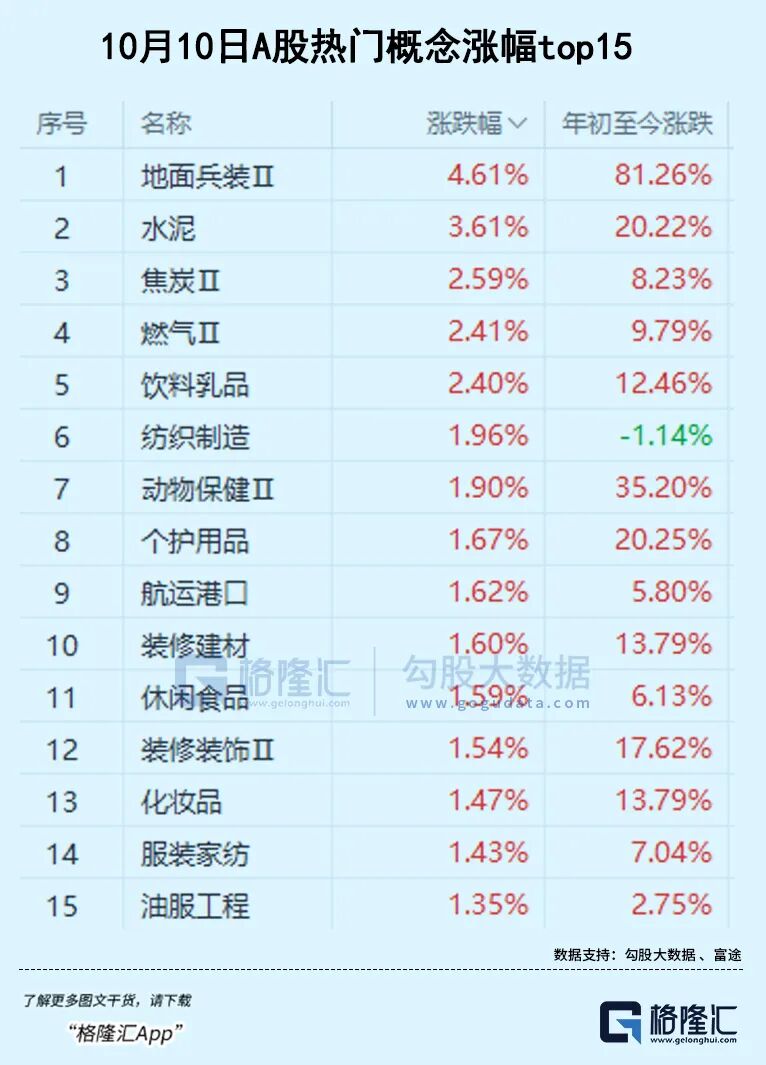
Market Overview - A-shares experienced a significant divergence, with major indices declining, particularly in the semiconductor, storage chip, and solid-state battery sectors, leading to the Shanghai Composite Index dropping by 0.94% and the ChiNext Index falling by 4.55%, marking its largest single-day decline in nearly six months [1][3] - Conversely, sectors such as military industry, public utilities, traditional consumption, and cement materials saw notable gains, with the military sector rising nearly 5%, contributing to most of the stocks hitting the daily limit up [1] Sector Performance - The military sector showed strong performance, with stocks like Jieqiang Equipment and Beifang Changlong rising over 10% [8][10] - Other sectors that performed well included cement, which increased by 3.61%, and beverage and dairy products, which rose by 2.40% [2] Technology Sector Decline - The technology sector faced a broad sell-off, with significant declines in popular stocks such as SMIC, which fell by 7.89%, and Haiguang Information, which dropped by 8.23% [3][6] - The decline in technology stocks was attributed to a shift in market focus and a reduction in leverage for certain stocks, as several brokerages adjusted the financing rates for stocks like SMIC to zero [6] Military Industry Outlook - The military industry is expected to enter a new growth cycle, driven by the "14th Five-Year Plan" and the anticipation of new orders, with a projected increase in military trade volume to $45 billion by 2025, representing a 30% year-on-year growth [17][18] - The military sector's performance is supported by a combination of strong order backlogs and accelerated delivery schedules, with companies like AVIC Chengfei expected to deliver a significant number of orders in the coming quarters [15][19] Investment Sentiment - Institutional investors have begun to increase their allocation to the military sector after a prolonged period of underweighting, indicating a shift in sentiment towards this sector [11][20] - The military sector's valuation remains attractive, with most companies trading at a price-to-earnings ratio below 35 times, considering the expected recovery in industry demand from 2025 to 2027 [20]
主力资金 | 2股尾盘获主力资金逆市抢筹
Sou Hu Cai Jing· 2025-10-10 11:45
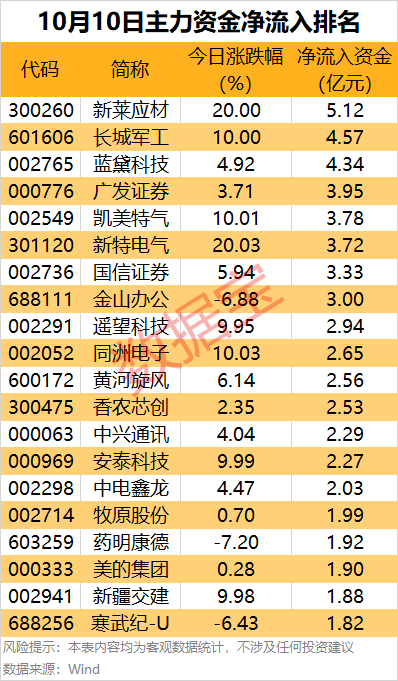
Group 1: Market Overview - The pharmaceutical and biotechnology sector received the highest net inflow of main funds, amounting to 520 million yuan [1] - The total net outflow of main funds from the Shanghai and Shenzhen markets reached 92.96 billion yuan, with the ChiNext board experiencing a net outflow of 41.57 billion yuan [1] - Among the 18 sectors, the construction materials sector had the highest increase of 1.92%, while 13 sectors saw declines, with electronics and power equipment dropping over 4% [1] Group 2: Key Stocks and Fund Flows - New Lai Materials, a photolithography concept stock, topped the net inflow list with 512 million yuan, experiencing a 20% increase [2][3] - Longcheng Military Industry followed with a net inflow of 457 million yuan, also seeing a 10% increase [2][3] - Other notable stocks with significant net inflows include Blue Dai Technology (434 million yuan), GF Securities (395 million yuan), and Kaimeite Gas (378 million yuan) [3] Group 3: Major Outflows - Major stocks facing significant net outflows include Luxshare Precision and CATL, each with outflows exceeding 3 billion yuan [4][5] - Other companies with substantial outflows include Sunshine Power, Oriental Fortune, and Shenghong Technology, each with outflows over 2.1 billion yuan [4][5] - A total of over 220 stocks experienced net outflows exceeding 1 billion yuan, with 21 stocks seeing outflows over 10 billion yuan [3] Group 4: End-of-Day Trends - At the end of the trading day, two stocks saw net inflows exceeding 100 million yuan, with Xiangnong Chip leading at 124 million yuan [6][7] - The net outflow at the end of the day was 15.074 billion yuan, with the ChiNext board contributing 6.469 billion yuan to this total [6] - Notable stocks with significant end-of-day outflows include CATL and Zhongji Xuchuang, each with outflows exceeding 500 million yuan [8][9]