
能源

Search documents
抵制美国货!“印度制造”能突围吗?
Guo Ji Jin Rong Bao· 2025-08-18 11:01
Group 1: Trade Tensions and Economic Impact - Trade tensions have cast a shadow over the Indian industry, with the U.S. imposing a total of 50% tariffs on Indian goods, marking the highest tariff rate on a trading partner [1][4] - The latest data shows India's trade deficit widened to $27.35 billion in July, the highest in eight months, with imports growing faster than exports [4] - The potential impact of U.S. tariffs could lead to a 60% drop in India's exports to the U.S., dragging down GDP by approximately 1 percentage point [4] Group 2: Modi's Vision for "New India" - Prime Minister Modi, in his 103-minute Independence Day speech, emphasized the vision of a "self-reliant India," aiming to reduce dependence on imports and promote local manufacturing [1][5] - The "Make in India" initiative, launched in 2014, aims to increase the manufacturing sector's contribution to GDP to 25% by 2025, positioning India as a global manufacturing hub [6] - Modi's government is committed to not sacrificing farmers' interests for trade agreements, highlighting agriculture and industry as core national strategies [5][6] Group 3: Negotiation Stalemate - The core issues in U.S.-India negotiations revolve around U.S. demands for India to open its agricultural and dairy markets, which the Indian government has deemed a "red line" [2] - India relies on energy imports for 9% of its GDP, with over 30% of its energy supply coming from Russian oil, complicating U.S. demands to sever ties with Russia [2] - Indian officials argue that it is unfair for the U.S. and EU to continue purchasing Russian goods while penalizing India [2] Group 4: Domestic Response and Resistance - There is a growing wave of resistance against U.S. products in India, with brands like Apple and Starbucks becoming targets of boycotts [1][6] - The "local awakening forum," linked to the ruling party, is promoting the use of domestic brands over American ones, reflecting a significant grassroots movement [6] - Social media campaigns are amplifying the message of self-reliance, with calls to replace foreign products with local alternatives [6]
大宗商品周度报告:中美经济数据偏弱,商品短期或震荡运行-20250818
Guo Tou Qi Huo· 2025-08-18 10:19
Report Industry Investment Rating No relevant content provided. Core Viewpoints - The commodity market may fluctuate in the short - term due to weak Sino - US economic data. The oil and fat sector may be relatively strong, while the precious metals sector may adjust with fluctuations. Each sub - sector has different trends based on their own fundamentals and macro - economic factors [1]. - The non - ferrous sector may face pressure due to weak Sino - US economic data and low demand during the off - season. The black sector may fluctuate, with attention on the limit - production intensity near the military parade. The energy sector may see oil prices fluctuate weakly, and the chemical sector has different trends for different products [2]. - The agricultural sector has different trends for different products. The oil and fat sector may fluctuate strongly, while the rapeseed sector may face pressure [3]. Summary by Relevant Catalogs Market Performance - The commodity market rose slightly by 0.52% last week, with agricultural products leading the rise at 1.25%. Non - ferrous and energy - chemical sectors rose by 0.99% and 0.59% respectively, while precious metals and black sectors fell by 1.23% and 0.27% respectively [1][5]. - The top - gainers were palm oil (5.11%), soda ash (4.73%), and cotton (2.32%), and the top - losers were fuel oil (2.71%), methanol (2.55%), and eggs (2.3%) [1]. - The 20 - day average volatility of the commodity market decreased slightly, with the agricultural and black sectors showing an upward trend in volatility. The overall market scale decreased slightly, and the out - flowing funds were mainly concentrated in the precious metals sector [1]. Sector Outlook - **Precious Metals**: The sector declined significantly last week. With the cooling of risk - aversion sentiment, it may adjust with fluctuations in the short - term [1]. - **Non - ferrous Metals**: Sino - US economic data is weak, and the demand is at a low level during the off - season. The sector may face pressure in the short - term [2]. - **Black Metals**: The apparent demand for rebar continued to decline, and inventory accumulation accelerated. The sector may fluctuate in the short - term, with attention on the limit - production intensity near the military parade [2]. - **Energy**: The market's expectation of a loose supply - demand relationship is strengthened, and the oil price may fluctuate weakly in the short - term [2]. - **Chemical Industry**: The terminal demand for polyester products is expected to rebound, and the valuation of PX is improving. The glass price is supported by cost, while soda ash may face pressure [2]. - **Agricultural Products**: The USDA August report is positive for US soybeans. The oil and fat sector may fluctuate strongly in the short - term, while the rapeseed sector may face pressure [3]. Commodity Fund Overview - Gold ETFs had an overall decline of 1.28%, and the total commodity ETFs had a decline of 0.51%. Different commodity ETFs had different performance in terms of net value, yield, scale, share change, and trading volume [38].
沪指创近十年新高,A股总市值首超百万亿!这个板块成最大功臣,还有多少资金在路上?
Mei Ri Jing Ji Xin Wen· 2025-08-18 10:13
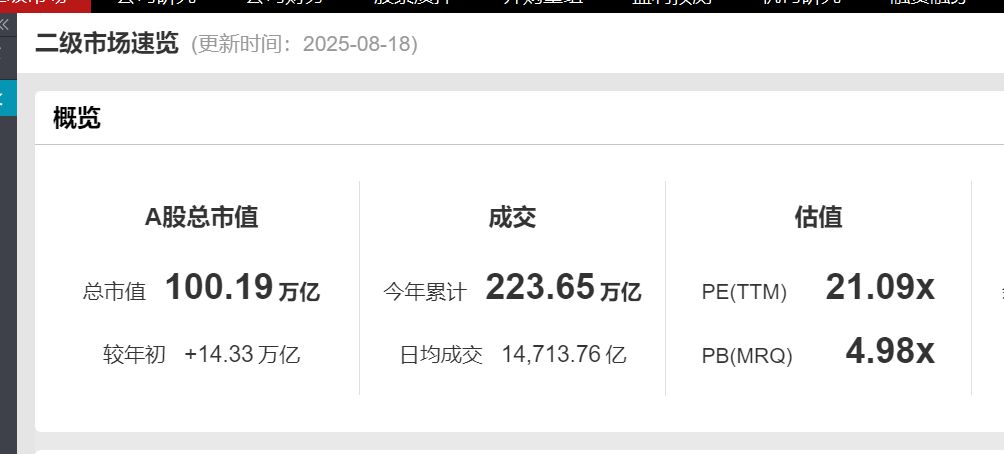
Core Viewpoint - The A-share market has reached a historic milestone, with the total market capitalization surpassing 100 trillion yuan for the first time, driven by significant increases in various sectors, particularly the information technology sector [1][8]. Market Performance - On August 18, the Shanghai Composite Index opened high and broke through the previous high of 3731.69 points, marking a ten-year high since August 2015 [1]. - The total market capitalization of A-shares reached 100.19 trillion yuan, an increase of 14.33 trillion yuan since the beginning of the year [1]. - The total trading volume for the year has reached 223.65 trillion yuan, with an average daily trading volume of 1.47 trillion yuan [1]. Sector Performance - The information technology sector has seen a market capitalization increase of 11.55% since August, making it the largest contributor to the overall market capitalization growth [7]. - Other sectors such as materials and industrials also experienced significant growth, with market capitalization increases of 7.10% and 6.54%, respectively [7]. - The financial sector maintained a strong position with a market capitalization of 177.02 trillion yuan, reflecting a 3.39% increase [7]. Investor Behavior - There is a notable influx of retail investors into the market, although their overall participation remains cautious due to a prevailing "fear of heights" sentiment [8][9]. - New individual investor accounts have shown marginal improvement since May, but the absolute numbers remain low, indicating a lack of significant capital inflow from retail investors [8][9]. - The trend of "capital migration" among residents is expected to continue, with a decrease in the attractiveness of low-interest savings and financial products, potentially leading to increased investment in the stock market [10]. Future Outlook - Institutional funds are anticipated to continue flowing into A-shares, with foreign capital shifting from net selling to net buying [10]. - The report suggests focusing on three investment directions: technology sectors such as consumer electronics and AI software, new consumption trends, and thematic investments like commercial aerospace and brain-computer interfaces [10].

全球紧盯!杰克逊霍尔年会倒计时,鲍威尔讲话或聚焦五大主题
智通财经网· 2025-08-18 07:49
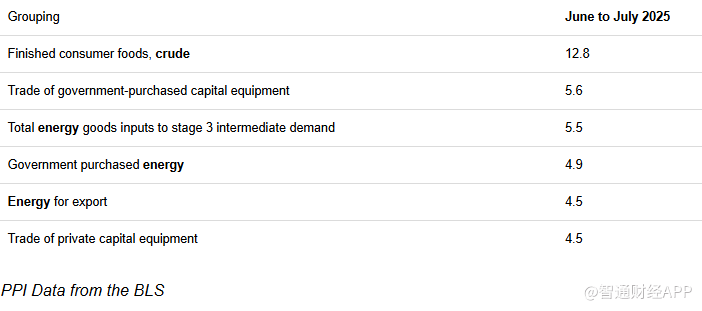
Grouping 1 - The Jackson Hole Global Central Bank Conference in 2025 will focus on the labor market amidst transformation, with Fed Chair Jerome Powell likely addressing inflation, rising producer prices, and a weak job market [1] - The Producer Price Index (PPI) rose by 0.9% month-over-month in July, with service prices increasing by 1.1%, marking the largest increase since March 2022 [1][2] - Companies like Nike and Adidas are raising prices to offset additional tariff-related costs, indicating a trend among large retailers to pass on costs to consumers [4] Grouping 2 - The Consumer Price Index (CPI) increased by 0.2% month-over-month in July, with a year-over-year increase of 2.7%, driven by rising energy service prices [5] - The energy sector has seen significant price fluctuations, with companies like Talen Energy and Vistra Energy experiencing substantial year-to-date price increases [5] - The employment market remains weak, with only 73,000 non-farm jobs added in July, and adjustments to previous employment data leading to concerns about future job reports [8][9] Grouping 3 - Powell may discuss the impact of artificial intelligence on the labor market, as major tech companies have made significant layoffs while investing heavily in AI [12] - The market anticipates a 90% probability of a 25 basis point rate cut by the Fed in September, which could benefit small-cap stocks most affected by tariffs [13]
巴菲特Q2持仓大换血:神秘仓位揭晓,地产、医疗入局,减持苹果、银行股释放何种信号?
Jin Rong Jie· 2025-08-18 07:33
Group 1 - Berkshire Hathaway's Q2 2025 13F filing reveals significant investment adjustments, indicating a strategic response to the U.S. economic structure and market risks [1] - The previously secretive position of nearly $5 billion is identified as a stake in Nucor (NUE), with 6.61 million shares valued at approximately $857 million, reflecting a bullish outlook on the steel industry due to infrastructure investments and manufacturing recovery [2] - New positions in real estate and healthcare stocks, including UnitedHealth (UNH) and Lennar (LEN), suggest a focus on long-term housing demand and stability in essential sectors [3] Group 2 - Increased holdings in energy and consumer sectors, such as Chevron (CVX) and Pool Corp (POOL), highlight a dual strategy of cash flow stability and consumer demand [4][5] - Core positions in companies like Coca-Cola (KO) and American Express (AXP) remain unchanged, indicating a commitment to brands with strong cash flow [6] - The exit from T-Mobile (TMUS) and reductions in positions in Bank of America (BAC) and Apple (AAPL) signal a cautious approach towards high-valuation sectors amid macroeconomic uncertainties [7] Group 3 - The overall investment strategy reflects a rotation away from financial and tech sectors towards industrial, healthcare, and real estate, emphasizing defensive and cash flow-oriented investments [8] - The focus on industrial stocks like NUE suggests a bet on manufacturing recovery and infrastructure cycles, while healthcare investments enhance defensive positioning [8]


工农基建多领域开花 中国与金砖经贸合作大有看点
Zhong Guo Chan Ye Jing Ji Xin Xi Wang· 2025-08-18 07:27
Group 1 - Indonesia officially became a member of BRICS at the beginning of 2025, with a total of 20 member and partner countries by the end of June [1] - In the first half of the year, China's trade with other BRICS countries reached 6.11 trillion yuan, a year-on-year increase of 3.9%, accounting for 28.1% of China's total trade [1] - The expansion of the BRICS cooperation mechanism is seen as a significant step for the Global South, promoting industrial transformation and trade growth [1] Group 2 - BRICS countries are leveraging their comparative advantages in various sectors, achieving notable results in trade cooperation in industrial, agricultural, and infrastructure fields [2] - In agriculture, China imported palm oil and rapeseed oil from other BRICS countries, with a year-on-year increase of 13.7%, and exports of agricultural machinery grew by 34.7% [2] - The cooperation in the infrastructure sector is accelerating, with significant increases in China's exports of road rollers and concrete mixers to other BRICS countries [3] Group 3 - The "Smart Customs" demonstration center for BRICS countries was launched on June 30, providing a platform for sharing customs experiences and facilitating trade policy understanding [4] - The center offers resources in multiple languages and includes sections on trade data, customs news, and enterprise services, enhancing communication among BRICS customs [4] - A dual-language curriculum has been established to support capacity building and cooperation among BRICS customs, showcasing China's smart customs practices [4] Group 4 - Future efforts will focus on accelerating customs capacity building and cooperation among BRICS countries, supporting trade exchanges effectively [5]
4400只个股都在涨
Bei Jing Ri Bao Ke Hu Duan· 2025-08-18 04:29
Core Points - The Shanghai Composite Index reached a ten-year high of 3741.29 points on August 18, marking the highest level since August 2015 [1] - The total market capitalization of A-share companies surpassed 100 trillion yuan for the first time in history, reaching a new record [1] - Agricultural Bank of China leads the A-share market with a market capitalization of 2.19 trillion yuan, followed by Industrial and Commercial Bank of China at 2.02 trillion yuan [1] Market Performance - The Shanghai Composite Index increased by 1.18% to 3740.50 points, while the Shenzhen Index rose by 2.25% and the ChiNext Index surged by 3.63% [1] - The total trading volume in the Shanghai and Shenzhen markets reached 17,467 billion yuan, a significant increase of 4,196 billion yuan compared to the previous day [1] - Over 4,400 stocks in the market experienced gains, indicating a broad-based rally [1] Sector Highlights - Sectors such as film and television media and liquid cooling servers saw notable increases in stock prices [1] - China Shenhua Energy, a major state-owned enterprise with a market capitalization of 700 billion yuan, announced the resumption of its stock trading, leading to a temporary price surge [1] Financing Activity - As of August 15, the balance of margin financing and securities lending reached 20,626 billion yuan, setting a new ten-year high [1] - The trading volume for margin financing on that day hit 2,479 billion yuan, marking the highest level for the year [1]



中证全指自由现金流指数,投资价值如何?|第399期精品课程
银行螺丝钉· 2025-08-18 04:01
Core Viewpoint - The article discusses the concept of the Free Cash Flow Index, its characteristics, and how it differs from dividend and value indices, emphasizing its relevance in investment strategies [1][10][64]. Group 1: Free Cash Flow Index Overview - The Free Cash Flow Index is a strategy index closely related to the investment philosophies of Warren Buffett and Benjamin Graham, focusing on selecting stocks with the highest free cash flow rates [10][19]. - Free cash flow is defined as the cash available after necessary operational expenses and capital expenditures, which can be freely allocated by the company [14][19]. - The Free Cash Flow Rate is calculated as free cash flow divided by enterprise value, where enterprise value is the total market capitalization plus total liabilities minus cash and cash equivalents [17][19]. Group 2: Comparison with Other Indices - The Free Cash Flow Index differs from dividend and value indices in that it includes companies with high free cash flow that may not necessarily pay dividends or have low valuation metrics [22][23]. - Dividend and value indices tend to focus on traditional industries, while the Free Cash Flow Index can include emerging industry leaders with strong cash flows but low dividend payouts [23][25]. - The Free Cash Flow Index is more selective, excluding companies with high leverage that may show high dividend yields but low free cash flow [24][25]. Group 3: Index Characteristics and Performance - The China Securities Index for Free Cash Flow was launched in December 2024, and it selects the top 100 stocks with the highest cash flow rates from the broader market, excluding financial and real estate sectors [31][32][64]. - The index has shown a historical annualized return of 14.12% from December 31, 2013, to August 6, 2025, with a total return of 18.88% when including dividends, significantly outperforming the broader market index [40][41][64]. - The index's composition is heavily weighted towards industries such as industrials, materials, and consumer staples, with a concentration of over 50% in the top ten holdings [34][37][64]. Group 4: Future Outlook and Strategy - The Free Cash Flow Index is considered a valuable addition to investment strategies, particularly for investors looking to diversify away from financial-heavy indices [61][64]. - The index's methodology and focus on cash flow make it suitable for pairing with traditional dividend and value indices, providing a balanced approach to investment [61][64].

CDP气候变化总监:气候行动正从公关宣传转向核心商业战略
Xin Lang Cai Jing· 2025-08-18 03:14
Core Viewpoint - Climate action and economic growth are mutually reinforcing rather than opposing forces, with companies increasingly viewing environmental sustainability as a necessary risk management measure and a source of competitive advantage [4][5][6]. Group 1: Climate Action and Economic Growth - Scientific evidence supports the reality of climate change, and companies are recognizing the importance of integrating climate considerations into their core operations [4][5]. - The market acknowledges that avoiding climate change responses is the real conflict, with a significant portion of companies disclosing climate-related data through CDP [6][7]. - Companies that strategically manage climate risks can transition from risk mitigation to seizing opportunities, identifying over $16 trillion in climate-related opportunities [7]. Group 2: Industry Perspectives on Decarbonization - Industries can be categorized into three groups: those at risk of obsolescence, those in a balanced state, and those critical for survival, such as energy and agriculture [8][9]. - The energy sector is expected to undergo significant transformation, presenting substantial opportunities, while also facing challenges related to emotional resistance and financial timelines [9][10]. Group 3: Climate Data Disclosure - The evolution of climate-related data disclosure reflects a shift from data collection to strategic focus, with simplification aimed at enhancing credibility [4][10][11]. - Many companies are prepared to implement sustainability reporting directives, and there is a growing recognition of the importance of coherent data over sheer volume [11][12]. Group 4: China's Climate Action Progress - Chinese companies are increasingly participating in CDP disclosures, with a 6.3% growth in the number of companies disclosing from 2023 to 2024 [12]. - However, only 19% of Chinese companies have set climate targets, which is below the global average of 33%, indicating a need for improvement in target-setting practices [12][13]. Group 5: Future of Climate Governance - Recent fluctuations in climate action enthusiasm among some companies are viewed as temporary, reflecting deeper issues that are being addressed [14][15]. - Companies are internalizing climate risks into their core strategies, driven by investor expectations and public opinion, moving beyond mere compliance to proactive engagement [15][16]. Group 6: Support for Renewable Energy Initiatives - The recognition of China's Green Electricity Certificates (GECs) by the RE100 initiative marks a significant development, with CDP continuing to play a technical partnership role in supporting this transition [17].

宝城期货资讯早班车-20250818
Bao Cheng Qi Huo· 2025-08-18 02:45
1. Macroeconomic Data Overview - GDP growth in Q2 2025 was 5.2% year - on - year, slightly lower than the previous quarter's 5.4% but higher than the same period last year's 4.7% [1] - In July 2025, the manufacturing PMI was 49.3%, down from 49.7% in the previous month and 49.4% in the same period last year [1] - The non - manufacturing PMI for business activities in July 2025 was 50.1%, down from 50.5% in the previous month but slightly higher than 50.2% in the same period last year [1] 2. Commodity Investment Reference 2.1 General - In July 2025, the national industrial added value above designated size increased by 5.7% year - on - year, and the total retail sales of consumer goods increased by 3.7% year - on - year. From January to July, national fixed - asset investment increased by 1.6% year - on - year, with real estate development investment down 12% [2] - The central bank will implement a moderately loose monetary policy, and the effects of the implemented policies will further emerge [2] - The CSRC approved the registration of options on fuel oil, petroleum asphalt, and pulp at the Shanghai Futures Exchange, as well as the registration of futures and options on offset printing paper [2] 2.2 Metals - The first - batch of total control indicators for rare earth mining and smelting separation in 2025 have been issued to relevant companies, and it is expected that these indicators may no longer be publicly announced [5] - In July 2025, global physical gold ETFs had an inflow of $3.2 billion, and the total assets under management reached a record high of $386 billion [5] 2.3 Coal, Coke, Steel, and Minerals - In early August 2025, coal prices in China showed an all - round increase, with the price of coke rising by nearly 10% [7] - In July 2025, China's industrial raw coal production was 380 million tons, a year - on - year decrease of 3.8%; crude oil production was 18.12 million tons, an increase of 1.2%; natural gas production was 21.6 billion cubic meters, an increase of 7.4% [8] 2.4 Energy and Chemicals - China's Sinopec discovered a large - scale deep - seated shale gas field with newly proven geological reserves of 124.588 billion cubic meters [10] - Indonesia expects its oil production to reach 610,000 barrels per day in 2026 and its natural gas production to reach 984,000 barrels per day [10] 2.5 Agricultural Products - On August 15, 2025, the average price of live pigs was 13.76 yuan/kg, a weekly increase of 0.36%, while the average price of 15 - kg piglets was 28.87 yuan/kg, a weekly decrease of 5.03% [12] - As of early August 2025, the purchase of summer wheat in China exceeded 80 million tons, faster than last year [12] 3. Financial News Compilation 3.1 Open Market - This week, 711.8 billion yuan of reverse repurchases will mature in the central bank's open market, and 22 billion yuan of treasury cash time deposits will mature on Tuesday and Wednesday [13] - On August 15, the central bank conducted 238 billion yuan of 7 - day reverse repurchase operations, with a net investment of 116 billion yuan [13] 3.2 Key News - The central bank will implement a moderately loose monetary policy, focusing on promoting a reasonable recovery of prices and optimizing the credit structure [14] - In July 2025, the national industrial added value above designated size increased by 5.7% year - on - year, and the total retail sales of consumer goods increased by 3.7% year - on - year [15] 3.3 Bond Market Summary - The bond market was weak, with most yields of major interest - rate bonds in the inter - bank market rising, and most treasury bond futures closing down [20] - The CSI Convertible Bond Index rose 0.90% to 475.25 points, with a trading volume of 103.1 billion yuan [20] 3.4 Foreign Exchange Market - The on - shore RMB against the US dollar closed at 7.1823, down 93 basis points from the previous trading day [23] - The US dollar index fell 0.36% to 97.8509, and most non - US currencies rose [23] 3.5 Research Report Highlights - Guosheng Fixed - Income believes that the central bank emphasizes promoting a reasonable recovery of prices, and current credit delivery focuses more on quality [24] - Huatai Fixed - Income believes that the economic data in July were slightly volatile, and the "fixed - income +" strategy is favored [24] 4. Stock Market News - As of August 15, 2025, 310 stocks had more than doubled in price this year, excluding new listings [28] - China Securities recommends focusing on five strong industries: innovative drugs, resources, communications, military, and gaming [28] - As of August 15, 2025, 936 out of 1,785 funds established in 2021 had a net value above 1, accounting for 52.44% [29]