
债券

Search documents
大类资产早报-20250905
Yong An Qi Huo· 2025-09-05 05:09
Report Information - Research Team: Guanyi'an Futures Research Center Macro Team [1] - Report Date: September 5, 2025 [1] Global Asset Market Performance 10 - Year Treasury Yields of Major Economies - On September 4, 2025, yields varied widely across countries, e.g., the US was 4.162%, Japan 3.589%, and China 1.806% [2] - Recent changes showed mixed trends, with some yields rising and others falling over different time - frames (latest, one - week, one - month, one - year) [2] 2 - Year Treasury Yields of Major Economies - Yields on September 4, 2025, such as the US at 3.660%, the UK at 3.944%, and Germany at 1.961% [2] - Changes over different periods also showed a mix of increases and decreases [2] Dollar Exchange Rates Against Major Emerging Economies' Currencies - On September 4, 2025, exchange rates were as follows: Brazil 5.447, South Africa zar 17.779, etc. [2] - Exchange rates had different percentage changes over various time - spans, with some appreciating and others depreciating [2] Performance of Major Economies' Stock Indices - On September 4, 2025, indices like the S&P 500 was 6502.080, the Nikkei was 42580.270, etc. [2] - Indices showed different trends in terms of daily, weekly, monthly, and yearly changes [2] Credit Bond Indices - Different credit bond indices (US investment - grade, Eurozone investment - grade, etc.) had varying percentage changes over different time periods [2][3] Stock Index Futures Trading Data Index Performance - Closing prices on September 4, 2025: A - share was 3765.88, CSI 300 was 4365.21, etc. [4] - All indices had negative percentage changes on that day, e.g., A - share - 1.25%, CSI 300 - 2.12% [4] Valuation - PE (TTM) values and their环比 changes were provided for several indices, such as CSI 300 (13.85, - 0.16) and S&P 500 (27.06, 0.28) [4] Risk Premium - Risk premium values and their环比 changes were given for some indices, e.g., S&P 500 (- 0.47, 0.01) and Germany's DAX (2.38, - 0.01) [4] Fund Flows - Latest and 5 - day average fund flow values were negative for most segments, e.g., A - shares (- 1326.31, - 1317.62) [4] Trading Volume - Latest trading volume and环比 changes were presented for different markets, e.g., Shanghai and Shenzhen stock markets (25442.57, 1801.71) [4] Basis and Spread of Main Contracts - Basis and spread percentages were provided for IF, IH, and IC contracts, e.g., IF (- 15.81, - 0.36%) [4] Treasury Futures Trading Data Futures Closing Prices and Changes - Closing prices on September 4, 2025, for T00 was 108.350, TF00 was 105.815, etc. [5] - All had positive percentage changes, e.g., T00 0.15%, TF00 0.09% [5] Money Market Interest Rates - Interest rates for R001, R007, and SHIBOR - 3M were 1.3577%, 1.4622%, and 1.5500% respectively, with R001 having a - 10.00 BP daily change [5]
美债长端“逆行”背后藏了什么玄机?
Sou Hu Cai Jing· 2025-09-05 04:19
Core Viewpoint - The article discusses the unexpected rise in 30-year U.S. Treasury yields despite expectations of interest rate cuts by the Federal Reserve, attributing this phenomenon to seasonal factors, global market influences, and structural anxieties regarding inflation and debt levels [4]. Group 1: Seasonal Factors - September is a peak month for corporate bond issuance in the U.S., leading to a diversion of funds away from Treasury bonds, which results in decreased demand for U.S. government debt [4]. - Traders returning from vacation are busy reallocating their portfolios, contributing to a temporary lack of interest in U.S. Treasuries, which are perceived as "discounted" assets [4]. Group 2: Global Market Influences - European long-term bonds have seen a decline, with the UK’s 30-year government bond yield reaching its highest level since 1998, creating a domino effect that negatively impacts U.S. Treasury yields [4]. Group 3: Structural Anxieties - Rising tariffs are increasing costs, leading companies to pass on these expenses to consumers, which is expected to drive inflation higher in the coming months, as noted in the Beige Book [4]. - Investors are demanding higher yields to hedge against inflation risks, especially with the U.S. planning to issue $1 trillion in new debt in the third quarter, nearly half of which will be long-term bonds, exacerbating concerns about rising debt levels [4]. - In the short term, if the Federal Reserve signals a series of rate cuts, yields may decrease; however, inflation and debt levels are seen as the primary long-term drivers of market behavior [4].


美债收益率跳水!帮主郑重:非农前夜,这三个信号你必须看懂!
Sou Hu Cai Jing· 2025-09-05 04:08
Group 1 - The core point of the article highlights a significant drop in U.S. Treasury yields, particularly the 10-year yield falling by 5.6 basis points to 4.16%, marking the largest decline since disappointing non-farm payroll data in August [1] - The market is anxiously awaiting the upcoming non-farm payroll data, with a 99.4% probability of a Federal Reserve rate cut in September, leading to concerns that poor data might prompt the Fed to act sooner than expected [3] - Recent actions by the U.S. Treasury, including a Q3 refinancing plan that reduced long-term debt issuance by $50 billion, have provided temporary relief to the market, although future debt issuance could increase by $2 trillion due to Trump's fiscal plans [3] Group 2 - Foreign investments are increasing in the U.S. Treasury market, with net inflows of $12.7 billion in August, particularly from China and Japan, indicating that institutional investors see value in the current yield environment [3] - September is expected to be a volatile month for the bond market, with $310 billion in corporate bonds set to be issued, potentially diverting significant capital [4] - The article warns that upcoming changes in tariff policies could elevate inflation expectations, reminiscent of last October's spike in Treasury yields, which caused substantial losses for investors [4]

资金面整体均衡偏松,股市下挫提振债市走强
Dong Fang Jin Cheng· 2025-09-05 04:07
Report Summary Investment Rating No investment rating for the industry is provided in the report. Core Viewpoints On September 3, the overall liquidity was balanced and slightly loose; the stock market decline boosted the bond market; the convertible bond market stopped falling and closed higher, with most convertible bond issues rising; yields on U.S. Treasuries across all maturities generally declined, and yields on 10 - year government bonds of major European economies generally decreased [1]. Section Summaries 1. Bond Market News - **Domestic News**: The joint working group of the Ministry of Finance and the central bank held its second meeting to discuss issues related to the bond market. Since May, over 1.02 trillion yuan of science - innovation bonds have been issued. The 2nd private enterprise bond financing training class was held in Wuxi. As of June 30, 2025, the total management scale of 460 mother funds was 3484.5 billion yuan, a 23.7% decrease from the end of 2024 [3][4]. - **International News**: In July, U.S. JOLTS job openings dropped to a 10 - month low, with significant decreases in healthcare, retail, and leisure & hospitality sectors. The ratio of job openings to the number of unemployed fell to 1, hovering at the lowest level since 2021. Recruitment increased by 41,000 to 5.308 million, and layoffs reached the highest level since September last year [6]. - **Commodities**: On September 3, WTI October crude oil futures fell 2.47% to $63.97 per barrel, Brent November crude oil futures fell 2.23% to $67.60 per barrel, COMEX gold futures rose 0.82% to $3621.80 per ounce, and NYMEX natural gas prices rose 2.71% to $3.071 per ounce [7]. 2. Liquidity - **Open - Market Operations**: On September 3, the central bank conducted 229.1 billion yuan of 7 - day reverse repurchase operations at a fixed - rate and quantity - tender method, with an operating rate of 1.40%. With 379.9 billion yuan of reverse repurchases maturing on the same day, the net withdrawal of funds was 150.8 billion yuan [9]. - **Funding Rates**: On September 3, the overall liquidity was balanced and slightly loose. DR001 decreased by 0.01bp to 1.314%, and DR007 increased by 0.40bp to 1.442% [10]. 3. Bond Market Dynamics - **Interest - Rate Bonds**: - **Spot Bond Yields**: On September 3, the bond market strengthened. The yield of the 10 - year Treasury active bond 250011 decreased by 2.00bp to 1.7475%, and the yield of the 10 - year CDB active bond 250215 decreased by 2.15bp to 1.8460% [13]. - **Bond Tenders**: Details of the issuance scale, winning yields, and other information of multiple bonds such as 25贴现国债54 were provided [14]. - **Credit Bonds**: - **Secondary - Market Transaction Anomalies**: On September 3, 5 industrial bonds had a price deviation of over 10%, including "15 宏图 MTN001" down over 97% and "H9 龙控 01" up over 100% [14]. - **Credit Bond Events**: Multiple companies had events such as bank loan defaults, subsidiary bankruptcies, and cancellation of bond issuances [15]. - **Equity and Convertible Bond Indexes**: - **Equity Market**: On September 3, the A - share market showed divergence. The ChiNext Index rose 0.95%, while the Shanghai Composite Index and Shenzhen Component Index fell 1.16% and 0.65% respectively. The full - day trading volume was 2.4 trillion yuan [16]. - **Convertible Bond Market**: On September 3, the convertible bond market stopped falling and closed higher. The CSI Convertible Bond Index, Shanghai Convertible Bond Index, and Shenzhen Convertible Bond Index rose 0.26%, 0.23%, and 0.28% respectively. The trading volume was 85.809 billion yuan, a decrease of 19.905 billion yuan from the previous trading day [16]. - **Convertible Bond Tracking**: On September 3, "伟 22 转债" announced no downward revision of the conversion price, and "宏辉转债" announced early redemption, among other announcements [20]. - **Overseas Bond Markets**: - **U.S. Bond Market**: On September 3, yields on U.S. Treasuries across all maturities generally declined. The 2 - year yield decreased by 5bp to 3.61%, and the 10 - year yield decreased by 6bp to 4.22%. The 2/10 - year yield spread narrowed by 1bp to 61bp, and the 5/30 - year yield spread narrowed by 2bp to 121bp. The 10 - year TIPS break - even inflation rate decreased by 1bp to 2.40% [21]. - **European Bond Market**: On September 3, yields on 10 - year government bonds of major European economies generally declined. For example, the German 10 - year yield decreased by 5bp to 2.74% [24]. - **Chinese - Issued U.S. Dollar Bonds**: Price changes of Chinese - issued U.S. dollar bonds as of the close on September 3 were presented, including the daily changes, credit entities, and other information of multiple bonds [26].
股债跷跷板下信用债的"攻守道"
INDUSTRIAL SECURITIES· 2025-09-05 03:21
Report Industry Investment Rating No relevant content provided. Core Viewpoints of the Report - Since mid - July 2025, the credit bond trend has generally shown an "M" shape. Short - term bonds are more resilient than long - term bonds. Compared with previous "stock - strong and bond - weak" market conditions, this credit bond adjustment has different characteristics, mainly due to fewer significant negative factors. In the current situation where the equity market trend is not clear, it is recommended to adopt a medium - short - duration credit sinking strategy, and then consider a credit bond duration - extension strategy when market warming signals are observed [3][13][16]. Summary According to the Table of Contents 1. The credit bond trend has generally shown an "M" shape since mid - July - From July 21 to August 29, 2025, short - term bonds were more resilient than long - term bonds. One - year short - term urban investment bonds and bank ordinary bonds performed better, with yield adjustments of about 4 - 7BP and little widening of credit spreads. Five - year and above urban investment bonds and secondary perpetual bonds had more significant declines, and urban investment bonds performed poorly [3][14]. - The reasons for the credit bond adjustment were mainly the strong performance of the equity market suppressing the bullish sentiment in the bond market. The short - term bonds were more resilient because the popularity of "fixed income +" funds increased, and short - duration bonds could provide coupon income and reduce portfolio volatility [16]. 2. Differences between this credit bond adjustment and previous "stock - strong and bond - weak" market conditions - Different from previous adjustments, this credit bond adjustment had a smaller amplitude compared with interest - rate bonds and previous credit bond adjustments. The short - term yield increase was smaller, and short - term credit spreads were partially compressed, while they widened significantly in the past [3]. - The reasons for these differences were that in addition to the "stock - bond seesaw" effect, the previous two rounds were also affected by factors such as redemption pressure and liquidity tightening, while there were no significant negative factors in this round [3]. 3. Outlook for credit bonds - Previous bond market adjustments caused by the "stock - bond seesaw" effect usually ended when the stock market entered a correction. Either credit bonds or interest - rate bonds might recover first. - Currently, with the equity market trend still unclear, it is recommended to focus on a medium - short - duration credit sinking strategy and pay attention to short - term credits with coupons. When market warming signals are observed, a credit bond duration - extension strategy can be considered [3][37].
机构择券思路多,国债ETF5至10年(511020)近5个交易日净流入3163.48万元
Sou Hu Cai Jing· 2025-09-05 01:43
Group 1 - The core viewpoint indicates that the 10-year active bond yield has fallen below 1.75%, suggesting that chasing higher yields is not recommended, but long-term bonds can still be swapped to 25T6 [1] - The new bond 250220 is being issued, and if its interest rate is 4-5 basis points higher than 250215, it may be worth considering [1] - The selection strategy for bonds focuses on specific maturities: 3Y and 10Y for government bonds, 4-5Y and 10Y for policy bank bonds, and 5Y and 7Y for agricultural development bonds [1] Group 2 - The 10-year government bond 250016 has slightly higher value, but its cost-effectiveness is average compared to policy bank bonds and 30-year bonds [2] - The 30-year bond 25T6 is currently 4 basis points higher than 25T5 and 8 basis points higher than 25T2, with expectations of a stock scale reaching 3100-3200 million yuan [2] - The liquidity of 25T6 is gradually improving, and it is likely to become the next main bond after its issuance on Friday [2] Group 3 - As of September 4, 2025, the 5-10 year government bond ETF index has risen by 0.05%, with the ETF price at 117.11 yuan [2] - The trading volume for the 5-10 year government bond ETF was 11.02 billion yuan, indicating active market trading [3] - The latest scale of the 5-10 year government bond ETF reached 15.09 billion yuan, marking a six-month high [4] Group 4 - The latest share count for the 5-10 year government bond ETF reached 12.8875 million shares, also a six-month high [5] - The net inflow of funds into the 5-10 year government bond ETF was 31.6348 million yuan over the last five trading days [5] - The 5-10 year government bond ETF has shown a net value increase of 21.70% over the past five years [5] Group 5 - The management fee for the 5-10 year government bond ETF is 0.15%, and the custody fee is 0.05% [6] - The tracking error for the 5-10 year government bond ETF over the past month is 0.032%, indicating close tracking of the index [7] - The index reflects the overall performance of active bonds with maturities of 5, 7, and 10 years [7]
美国国债意外成为赢家 “债券义警”暂时销声匿迹-美股-金融界
Jin Rong Jie· 2025-09-05 00:34
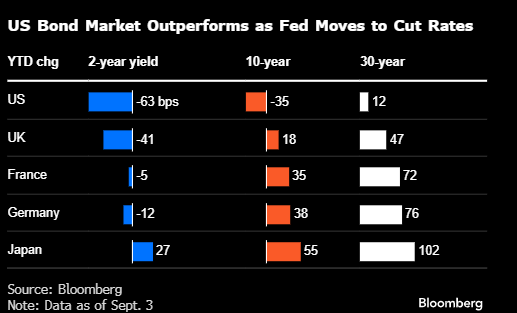
Group 1 - The U.S. Treasury market has shown remarkable resilience despite various pressures, including rising debt and aggressive tariff policies, unlike other countries' bond markets which have suffered due to fiscal concerns [1] - Year-to-date, the yield on 10-year U.S. Treasuries has decreased by over 0.3 percentage points, making it the only major bond market with a decline in 10-year yields [1][3] - The volatility of the U.S. bond market has been decreasing since April, with key volatility indicators nearing their lowest levels in three years [1] Group 2 - Recent data indicates a slowdown in job growth, which has contributed to a decline in 10-year Treasury yields, falling below 4.17% for the first time since early May [3] - Concerns regarding the independence of the Federal Reserve are reflected in rising inflation swap rates, which have reached a two-year high [5] - Despite concerns about the Fed's independence, U.S. bond investors have not shown significant alarm, allowing the Trump administration to breathe easier regarding the 10-year yield target [5] Group 3 - The U.S. Treasury Secretary hinted at limiting long-term bond issuance if buyer demand weakens, while data does not support claims of foreign capital fleeing U.S. assets, indicating strong demand for U.S. Treasuries [7] - The perception of the U.S. as a safe haven persists, with 5% being seen as a ceiling for 30-year Treasury yields, despite various challenges [8] - Market participants remain skeptical about the potential political influence on the Fed, with expectations that any new appointments will not drastically alter monetary policy [9] Group 4 - There is speculation that the White House may push the Fed to resume bond purchases, particularly long-term bonds, as a means to lower borrowing costs [10] - The current balance in the U.S. bond market is fragile, and without fiscal discipline from politicians, investors may express dissatisfaction through market actions [10] - The emergence of "bond vigilantes" in Europe and Japan could soon be mirrored in the U.S. if fiscal issues are not addressed [10]
9月利率策略展望:债券研究
GOLDEN SUN SECURITIES· 2025-09-05 00:23
Group 1 - The bond market experienced a volatile upward trend in August, with the yield curve steepening further. The market's high expectations for "anti-involution" policies were adjusted after the Politburo meeting at the end of July, combined with a weak fundamental backdrop [1][11] - In August, the 10-year government bond yield rose to 1.84%, an increase of 13.4 basis points from the end of July. The yields for 10-year policy bank bonds and other government-related bonds also saw similar increases [11][12] Group 2 - The significant rise in the stock market over the past two months has exerted pressure on the bond market, but this effect is expected to weaken in September. The continuous decrease in non-bank positions and the increase in allocation by institutional investors will gradually reduce the stock market's suppression of the bond market [2][15] - The manufacturing PMI for August was reported at 49.4%, remaining below the threshold, indicating a weak economic environment. The relative value of bonds has improved significantly from a fundamental perspective, suggesting that if the stock market continues to rise, the adjustment space for current interest rates is limited [2][15] Group 3 - Industrial product prices have been declining, and market expectations for "anti-involution" policies are returning to fundamentals, which may ease pressure on the bond market. The South China Industrial Products Index fell from a high of 3824 points on July 25 to 3602 points by September 3, reflecting a decrease in aggressive buying sentiment [3][19] - The bond market may revert to fundamental pricing as the weak recovery in the economy continues. The manufacturing PMI remains below the threshold, and various investment growth rates have significantly declined, indicating a weak demand environment [4][20] Group 4 - The liquidity in the market is expected to remain loose, with a decrease in fiscal deposits likely to supplement market liquidity. As of August 31, the net financing progress for government bonds was 69.4%, and for local bonds, it was 74.7%. If no new fiscal budget is introduced, the subsequent bond supply will decrease year-on-year [5][26] - The central bank has increased its support for the liquidity environment since 2025, which is expected to limit liquidity shocks at the end of the quarter. The average R007 rate at the end of June only increased by 2 basis points compared to May, indicating a stable liquidity environment [5][26] Group 5 - The bond market's earlier excessive gains have been gradually digested, and the yield curve is expected to normalize. The significant widening of the yield spread between 10-year and 1-year bonds has improved the relative value of long-term bonds [6][39] - The bond market is anticipated to gradually recover in September, with a recommendation for a barbell strategy to increase allocations. The adjustment limits for 10-year and 30-year government bonds are projected to be around 1.8% and 2.1%, respectively [7][43]
美债收益率再度飙升的长短期因素
2 1 Shi Ji Jing Ji Bao Dao· 2025-09-04 22:05
Core Viewpoint - The recent surge in U.S. Treasury yields is attributed to a combination of short-term triggers, such as a court ruling against the government's tariff policies, and long-term structural issues related to the deteriorating fiscal situation of the U.S. government [1][2][3]. Group 1: Short-term Triggers - The U.S. 10-year Treasury yield reached approximately 4.293% and the 30-year yield soared to 4.988% after a court ruling deemed most of the global tariff policies implemented by the Trump administration illegal [1]. - The ruling allows the tariffs to remain in place until October 14, giving the government time to appeal, which may lead to increased bond issuance due to the growing fiscal deficit [1]. Group 2: Long-term Fiscal Issues - The total U.S. federal debt stands at $36.21 trillion, accounting for 123% of GDP, significantly exceeding the IMF's warning threshold of 90% [2]. - For the fiscal year 2024, the government is projected to have a deficit of $1.9 trillion, with interest payments on the debt reaching $882 billion, a 155.65% increase from fiscal year 2020 [2]. - The 2017 Tax Cuts and Jobs Act has led to a significant reduction in corporate tax revenue, contributing to the fiscal imbalance [2]. Group 3: Structural Factors - The issuance of U.S. Treasuries has increased, particularly in the long-term segment, with an estimated net issuance of $590 billion in the fourth quarter, of which $447 billion is long-term debt [4]. - Demand for U.S. Treasuries is weak, primarily supported by foreign central banks and domestic financial institutions, leading to a mismatch in the supply and demand dynamics [4]. - The Federal Reserve's stance is shifting under political pressure, with an increasing number of committee members open to the idea of interest rate cuts, which could further impact Treasury yields [4][5].
超长地方债的逆势行情
SINOLINK SECURITIES· 2025-09-04 12:56
Group 1: Report Industry Investment Rating - Not provided in the content Group 2: Core Views of the Report - The supply and trading of local government bonds are tracked, including the rhythm of primary supply and the characteristics of secondary trading [3][4] Group 3: Summary by Directory 1. Primary Supply Rhythm - Last week (August 25 - 29, 2025), local government bonds issued a total of 351.6 billion yuan, with 187.98 billion yuan in new special bonds and 62.62 billion yuan in refinancing special bonds. "Ordinary/Project Income" and "Special New Special Bonds" are the main investment areas for special bond funds. As of August 29, 2025, special refinancing special bonds issued 55.04 billion yuan in August, accounting for 5.6% of the monthly local bond issuance scale [3][10] - In terms of issuance pricing, the average issuance interest rate of 20 - year local bonds has significantly increased. The spreads between the issuance interest rates of 20 - year and 10 - year local bonds and the same - term treasury bonds have continuously widened to 26.3BP and 18.8BP, especially the 20 - year variety has a faster increase rate, while the issuance spread of 30 - year local bonds has narrowed to 21.9BP [3][17] - In August, Anhui, Zhejiang, Hebei and other places are the main regions for local bond issuance. Anhui's issuance scale exceeds 80 billion yuan, Hunan's issuance scale of local bonds over 20 years reaches 34.1 billion yuan, and the average coupon rates of local government bonds in Ningxia and Gansu are higher than 2.3% [3][19] 2. Secondary Trading Characteristics - The index of local government bonds over 10 years has risen against the trend. Last week, the indexes of 7 - 10 - year and over 10 - year local bonds decreased by 0.03% and increased by 0.23% respectively. The defensive property of 7 - 10 - year varieties is better than that of the same - term treasury bonds and credit bonds, while the increase of over 10 - year varieties is slightly lower than that of the same - term treasury bonds [4][23] - Government bonds in Shandong, Guangdong and other provinces have relatively active transactions, but the trading volume in Shandong and Sichuan has decreased significantly compared with the previous period. In terms of trading income, the average income of local government bonds in mainstream regions is basically above 2.2%, and the income in regions with increased trading volume exceeds 2.23% [4][23]