
交通运输

Search documents
国内高频 | 出行强度保持高位(申万宏观·赵伟团队)
赵伟宏观探索· 2025-07-07 11:28
Group 1: Industrial Production - Industrial production remains relatively stable, with a high furnace operating rate holding steady at 0.7% year-on-year [2][5][9] - Chemical production shows signs of recovery, with operating rates for soda ash, PTA, and polyester filament increasing by 1.9 percentage points to -3.5%, 0.4 percentage points to 2.2%, and 0.5 percentage points to 4.2% respectively [2][17] - However, the operating rate for automotive semi-steel tires has significantly declined, down 7.7 percentage points to -9.0% [2][17] Group 2: Construction Industry - Asphalt production shows marginal improvement, with a year-on-year increase of 2.2 percentage points to 6.8% [2][41] - Cement shipment rates remain low, down 1.8 percentage points to -4.2% year-on-year, while the national grinding operating rate is up 0.6 percentage points to -1.3% [2][29] Group 3: Demand Trends - Real estate transactions have significantly decreased, with average daily transaction area for new homes down 37.8% year-on-year to 32.7% [2][53] - Freight volumes related to exports have declined, with port cargo throughput down 3% year-on-year to 0.6% [2][62] - Conversely, travel intensity remains high, with the national migration scale index up 0.3 percentage points to 14.5% [2][74] Group 4: Price Trends - Agricultural product prices have generally decreased, with prices for eggs, fruits, vegetables, and pork down by 2.2%, 0.8%, 0.5%, and 0.3% respectively [3][104] - Industrial product prices have seen a slight increase, with the South China industrial price index rising by 0.3% [3][116] - The metal price index increased by 1.8%, while the energy and chemical price index fell by 1% [3][116] Group 5: Transportation and Logistics - Railway freight volume has increased, up 0.9 percentage points to 3.3% year-on-year, while port cargo throughput has decreased [2][62] - Domestic flight operations have increased, with domestic flights up 1.9% year-on-year to 3.4% [2][74] Group 6: Consumer Behavior - Movie attendance has slightly decreased, down 2.6 percentage points to 5.7% year-on-year, but box office revenue has increased by 0.3% [2][80] - Automobile sales have shown a significant recovery, with retail and wholesale volumes up 9% to 26.7% and 23.8% to 48.7% respectively [2][80] Group 7: Export Trends - Container shipping prices have decreased, with the CCFI composite index down 1.9% [2][92] - The freight rate for the US West Coast has dropped significantly, down 10.5% [2][92]


国内高频 | 出行强度保持高位(申万宏观·赵伟团队)
申万宏源宏观· 2025-07-07 08:27
Group 1: Industrial Production - Industrial production remains relatively stable, with a high furnace operating rate holding steady at 0.7% year-on-year [2][5][9] - Chemical production shows signs of recovery, with operating rates for soda ash, PTA, and polyester filament increasing by 1.9 percentage points, 0.4 percentage points, and 0.5 percentage points respectively [2][17] - The automotive sector experiences a significant decline, with the operating rate for semi-steel tires dropping by 7.7 percentage points to 9.0% [2][17] Group 2: Construction Industry - Asphalt production shows marginal improvement, with a year-on-year increase of 2.2 percentage points to 6.8% [2][41] - Cement shipment rates remain low, down 1.8 percentage points to 4.2% year-on-year, indicating weak demand [2][29] - The national grinding operating rate for cement is up 0.6 percentage points to -1.3% year-on-year, but overall demand remains subdued [2][29] Group 3: Demand Trends - Real estate transactions have significantly declined, with average daily transaction area for new homes down 37.8% year-on-year [2][53] - The freight volume related to domestic demand shows a slight increase, while port cargo throughput related to exports has decreased by 3% [2][62] - Travel intensity remains high, with the national migration scale index up 0.3 percentage points to 14.5% year-on-year [2][74] Group 4: Price Trends - Agricultural product prices have generally decreased, with eggs, fruits, vegetables, and pork prices down by 2.2%, 0.8%, 0.5%, and 0.3% respectively [3][104] - Industrial product prices show a slight increase, with the Nanhua Industrial Price Index rising by 0.3% [3][116] - The metal price index increased by 1.8%, while the energy and chemical price index fell by 1% [3][116] Group 5: Transportation and Logistics - Railway freight volume has increased by 0.9 percentage points to 3.3% year-on-year, while port cargo throughput has decreased [2][62] - Domestic flight operations have increased by 1.9% year-on-year, indicating a recovery in travel [2][74] - Container shipping prices have declined, with the CCFI composite index down by 1.9% [2][92]

热点思考 | 居民如何“反内卷”?(申万宏观·赵伟团队)
申万宏源宏观· 2025-07-07 08:27
Group 1 - The phenomenon of "involution" is most pronounced among young people, with average weekly working hours increasing by over 4 hours in the past five years. The average weekly working hours for employees aged 25-34 rose from 46.7 hours in 2018 to 50.8 hours in 2023 [3][28] - The average daily working time in China increased by 21 minutes from 2018 to 2023, reaching 48.3 hours per week, while the time spent on purchasing goods and services dropped from 80 minutes per day to 43 minutes per day [2][9] - The "involution" trend is particularly evident in the manufacturing and productive service sectors, while the real estate and life service sectors have seen a decrease in working hours [2][21] Group 2 - Current policies to combat "involution" focus on encouraging flexible work arrangements and paid leave, but these measures primarily address symptoms rather than the root causes of prolonged working hours [4][35] - The root cause of "involution" is the uneven distribution of employment across industries, with excessive employment in manufacturing leading to "involution" and insufficient employment in the service sector [4][48] - There is a significant employment gap in the life service sector, with a potential to absorb more jobs, as the wage growth in this sector (18.1%) outpaces that of manufacturing (10.7%) [5][61] Group 3 - The long-term direction for combating "involution" involves aligning supply structures with changing demand structures, particularly as consumer demand trends towards services [6][85] - Global experiences indicate that as GDP per capita reaches between $10,000 and $30,000 and urbanization rates hit 70%, the proportion of service consumption in total consumption increases by approximately 0.6% annually [6][86] - The aging population is expected to drive service consumption, with each 1% increase in the aging rate correlating with a 1.3% increase in service consumption share [6][93]

方正富邦中证全指自由现金流ETF联接十问十答
Zhong Guo Jing Ji Wang· 2025-07-07 06:36
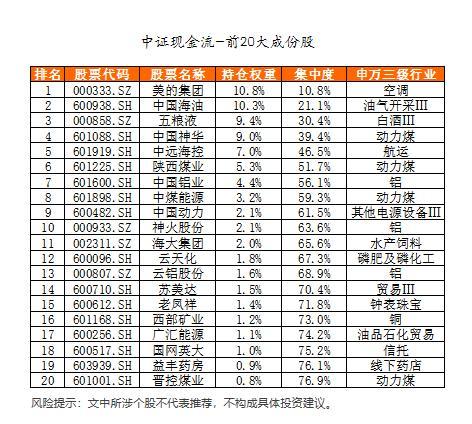
Core Viewpoint - The article discusses the upcoming launch of the Fangzheng Fubon CSI All-Share Free Cash Flow ETF, highlighting its investment strategy focused on companies with strong free cash flow generation capabilities and the advantages of investing in this ETF [1][20]. Group 1: Free Cash Flow Concept - Free cash flow is defined as the cash available for distribution after accounting for capital expenditures and working capital needs, illustrated through a small business example [3][4]. Group 2: Index Characteristics - The Fangzheng Fubon CSI All-Share Free Cash Flow ETF tracks the CSI All-Share Free Cash Flow Index, which selects stocks based on free cash flow yield, focusing on industries like coal, transportation, and consumer goods [4][5]. - The index excludes sectors with high cash flow volatility, such as finance and real estate, ensuring a more stable and sustainable cash flow profile [4]. Group 3: Index Performance Highlights - The CSI All-Share Free Cash Flow Index has significantly outperformed major indices, achieving a return of 342.88% from December 31, 2013, to June 9, 2025, compared to 62.08% for the Shanghai Composite Index [6][8]. - The index also boasts a high dividend yield of 4.8%, indicating strong profitability and financial health among its constituent companies [8][9]. Group 4: Investment Advantages - The ETF offers lower investment thresholds, allowing participation with as little as 1 yuan, making it accessible for retail investors [13]. - It supports regular investment plans, appealing to investors looking for systematic investment strategies [13]. Group 5: Target Investor Profile - The ETF is suitable for risk-averse investors seeking stable cash flow, those looking to balance their portfolios, and investors aiming to capture policy-driven opportunities in high free cash flow companies [15][16][18]. Group 6: Current Market Context - The article emphasizes the importance of free cash flow in the current economic landscape, where companies with strong cash flow are better positioned to navigate uncertainties and capitalize on growth opportunities [18][19].





正信期货股指期货周报:股指周报:美国关税豁免本周到期,不确定性引发市场避险-20250707
Zheng Xin Qi Huo· 2025-07-07 06:12
Report Industry Investment Rating - Not provided in the document Core Viewpoints - The expiration of the 90 - day US tariff exemption this week brings uncertainty. The impact of tariff policies on the market remains uncertain, and it's necessary to guard against the negative emotional impact of Trump's extreme pressure. The domestic economy is entering a seasonal recovery window, and the market expects positive signals from the Politburo meeting at the end of July [4]. - In the medium - term, real estate sales are seasonally rising at a low level, the service industry is structurally differentiated and seasonally warming up in summer. Consumption is boosted by fiscal subsidies, and the manufacturing's rush - to - export is ending, with a possible decline in the third quarter. Domestic anti - involution policies may reverse the commodity supply - demand balance and lead to a rebound in prices [4]. - Domestically, liquidity is generally loose, while overseas, it is marginally tightening. The US dollar index is expected to rebound from oversold levels. The domestic stock market will receive incremental funds, but the pressure of share unlocks remains [4]. - After a short - term rebound, the valuations of various indices are still at a historically neutral to high level, and the attractiveness of allocation funds is average [4]. - The stock market may rise in an oscillating manner in the third quarter. It is recommended to actively go long on stock index futures after sharp declines due to tariff policy shocks this week. In terms of style, first go long on IC and IM, then on IF and IH, or conduct an arbitrage strategy of going long on IM and short on IF [4]. Summary by Directory 1. Market Review - **Global Stock Market Performance**: Last week, US stocks led the rise, and the Hang Seng Technology Index led the decline. The performance order is Nasdaq > S&P 500 > CSI 300 > Shanghai Composite Index > FTSE Emerging Markets > German Stock Market > Nikkei 225 > STAR 50 > Hang Seng Technology [8]. - **Industry Performance**: Steel led the rise, and comprehensive finance led the decline. The order is Steel > Bank > Building Materials > Medicine... > Transportation > Comprehensive > Computer > Comprehensive Finance [12]. - **Futures Basis and Spread Changes**: The basis rates of the four major stock index futures (IH, IF, IC, and IM) changed by 0.22%, 0.3%, 0%, and - 0.05% respectively last week, with the discounts of IF and IH significantly narrowing. The inter - period spread rates (current month and next month) of the four major stock index futures changed by - 0.05%, - 0.23%, - 0.27%, and - 0.31% respectively, with the inter - period discounts of IF, IC, and IM slightly widening. The inter - period spread rates (next quarter and current month) changed by - 0.05%, - 0.31%, - 0.44%, and - 0.48% respectively, with the long - term discounts of IF, IC, and IM significantly widening [15][16]. 2. Fund Flows - **Margin Trading and Stabilizing Funds**: Last week, margin trading funds flowed in 19.71 billion yuan, reaching 1.86 trillion yuan. The proportion of margin trading balance to the circulating market value of the Shanghai and Shenzhen stock markets decreased by 0.01% to 2.26%. The scale of passive stock ETF funds was 302.83 billion yuan, an increase of 13.89 billion yuan from last week, and the share was 199.171 billion shares, with a redemption of 1.48 billion shares from last week [25]. - **Industrial Capital**: In the first week of July, equity financing was 3.67 billion yuan, with 1 company. Among them, IPO financing was 640 million yuan, private placement was 0 yuan, and convertible bond financing was 3.03 billion yuan. The scale of equity financing declined significantly. The market value of stock unlocks last week was 90.83 billion yuan, an increase of 33.28 billion yuan from the previous week, remaining at the second - highest level this year [28]. 3. Liquidity - **Money Supply**: Last week, the central bank's OMO reverse repurchase expired 202.75 billion yuan, with a reverse repurchase of 65.22 billion yuan, resulting in a net money withdrawal of 137.53 billion yuan. After the end of the quarter, the open - market operations recovered liquidity. MLF had a net injection for four consecutive months, and the overall liquidity supply was neutral [30]. - **Money Demand**: Last week, the net money demand for national debt was 19.993 billion yuan, for local debt was 4.361 billion yuan, and for other bonds was 34.787 billion yuan. The total net money demand in the bond market was 59.141 billion yuan, remaining at a high level [33]. - **Fund Price**: DR007, R001, and SHIBOR overnight rates changed by - 27.4bp, - 9.9bp, and - 5.8bp respectively, reaching 1.42%, 1.36%, and 1.31%. The issuance rate of inter - bank certificates of deposit decreased by 5.9bp, and the CD rate issued by joint - stock banks dropped by 8.1bp to 1.59%. The overall fund price was oscillating at a low level [36]. - **Term Structure**: Last week, the yield curve flattened. The central bank's liquidity recovery in the open market made the short - end stronger, and the credit spread between national debt and policy - bank bonds widened at the long - end [40]. - **Sino - US Interest Rate Spread**: As of July 4th, the US 10 - year bond rate increased by 6.0bp to 4.35%, the inflation expectation increased by 4.0bp to 2.33%, and the real interest rate increased by 2.00bp to 2.02%. The inversion of the Sino - US interest rate spread widened by 6.40bp to - 270.78bp, and the offshore RMB appreciated by 0.11% [43]. 4. Macroeconomic Fundamentals - **Real Estate Demand**: As of July 3rd, the weekly transaction area of commercial housing in 30 large - and medium - sized cities seasonally recovered to 3.329 million square meters, but was still at a low level compared to the same period in 2019. Second - hand housing sales seasonally declined to the lowest level in the past seven years. The overall real estate market sales were weak, and more incremental policies were expected [46]. - **Service Industry Activity**: As of July 4th, the subway passenger volume in 28 large - and medium - sized cities remained high, with a daily average of 83.58 million passengers, a year - on - year increase of 1.2% and a 32.5% increase compared to the same period in 2021. The service industry's economic activity seasonally recovered in summer. The Baidu Hundred - City Traffic Congestion Delay Index remained flat compared to last week, at a neutral level in the past three years [50]. - **Manufacturing Tracking**: Last week, the manufacturing capacity utilization rate declined across the board. The capacity utilization rate of steel mills decreased by 0.54%, that of asphalt increased by 0.2%, that of cement clinker enterprises decreased by 6.7%, and that of coke enterprises decreased by 0.18%. The average operating rate of the chemical industry chain related to external demand decreased by 0.45% compared to last week [52]. - **Goods Flow**: Both goods flow and passenger flow remained at relatively high levels. The number of civil aviation flights for summer tourism consumption increased strongly, while highway transportation was relatively weak, with limited growth, and there was a risk of a second seasonal decline from July to August [57]. - **Import and Export**: In terms of exports, the logic of rush - to - export after the Sino - US trade talks continued. The port cargo throughput and container throughput rebounded after a short - term decline. From July to August, it was necessary to guard against the risk of a second decline due to renewed trade frictions after the expiration of the 90 - day US tariff exemption [60]. - **Overseas Situation**: The US May non - farm payrolls report slightly exceeded expectations, but the structure implied a cooling signal. The US non - farm employment showed certain resilience, and the service industry PMI rebounded unexpectedly. The market's expectation of the Fed's interest - rate cuts in 2025 was reduced to 2 times, with a cut of about 25 - 50bp, and the probability of a rate cut in July dropped to 4.7% [62][66]. 5. Other Analyses - **Valuation**: The stock - bond risk premium last week was 3.35%, a 0.06% decrease from last week, at the 68.8% percentile. The foreign - capital risk premium index was 4.24%, a 0.21% decrease from last week, at the 24.3% percentile, indicating a low level of foreign - capital attractiveness. The valuations of the Shanghai 50, CSI 300, CSI 500, and CSI 1000 indices were at the 79.9%, 72.9%, 78.2%, and 60.3% percentiles in the past five years respectively, and the attractiveness of each index's valuation decreased marginally [69][74]. - **Quantitative Diagnosis**: According to seasonal rules, the stock market is in a seasonally oscillating and rising period with structural differentiation in July. The growth style is relatively dominant, and the cyclical style first rises and then falls. In general, the market is likely to rise in July. Pay attention to the opportunities of going long on IC and IM on pullbacks, short - term shorting on sharp rises of IF and IH, and medium - term long - term on sharp declines. This week, the market is greatly disturbed by the uncertainty of US tariff policies. If there are negative impacts, pay attention to going long on the growth style on sharp declines [77]. - **Financial Calendar**: This week's financial calendar includes China's June CPI and PPI data, and attention should be paid to whether prices have stabilized and rebounded. Overseas markets should focus on the US Treasury auctions and the progress of the Trump administration's tariff policy negotiations with other countries [79]
1—5月份,广东规上服务业营业收入同比增长7.5%
news flash· 2025-07-07 03:42
Core Insights - Guangdong's service industry revenue for the first five months reached 2.37 trillion yuan, reflecting a year-on-year growth of 7.5% [1] Revenue Growth by Sector - Transportation, warehousing, and postal services experienced a year-on-year growth of 9.3% [1] - Information transmission, software, and IT services grew by 8.3% [1] - Real estate (excluding real estate development) saw an increase of 2.6% [1] - Rental and business services also grew by 9.3% [1] - Scientific research and technical services had a growth of 1.8% [1] - Water, environment, and public facilities management declined by 1.9% [1] - Resident services, repair, and other services decreased by 1.6% [1] - Education sector grew by 5.7% [1] - Health and social work experienced a decline of 1.1% [1] - Cultural, sports, and entertainment sectors grew by 4.8% [1]
债券动态跟踪报告:银行转债陆续退市,如何选择底仓品种
Ping An Securities· 2025-07-07 03:02
Report Industry Investment Rating No relevant content provided. Core Viewpoints - The balance of bank convertible bonds may shrink by approximately 10 billion yuan this year, and by the end of 2025, it may be around 9 billion yuan. If other commercial banks can follow the example of state - owned banks' low - PB private placements, there may be a possibility of supplementary supply of bank convertible bonds [3][4]. - The replacement bottom - position varieties should have the characteristics of high rating, low volatility, and high capital capacity. It is recommended to pay attention to AAA - rated convertible bonds in non - banking finance and general public utilities for low - volatility and high - rating, and photovoltaic equipment and pig - breeding convertible bonds for large capital capacity [3][40]. - For photovoltaic equipment convertible bonds, it is recommended to screen leading individual bonds and leave room for rating downgrades. When the convertible bond price is low, gradually build a position [2][22]. Summary by Relevant Catalogs 1. The balance of bank convertible bonds may shrink by about 10 billion yuan this year - As of June 30, 2025, there were 10 bank convertible bonds in the market, with a balance of 13.49 billion yuan, a decrease of 7 bonds and 11.1 billion yuan compared with the end of 2023. If the relevant convertible bonds are all delisted, the balance of bank convertible bonds will further shrink by 10.13 billion yuan to 8.98 billion yuan by the end of 2025 compared with the end of 2024 [4]. - The shrinkage of bank convertible bond scale may be irreversible in the short term. It is necessary to observe the progress of bank capital replenishment. Currently, the policy supports state - owned large - scale banks to replenish core tier - one capital. This year, the private placement prices of four state - owned big banks were lower than 1 - time PB, about 0.7 - time PB. There are bank convertible bonds totaling 2.9 billion yuan that have been announced but not issued, and the current PB multiples of the underlying stocks are between 0.5 - 0.7 times [4]. 2. The replacement bottom - position varieties should have three characteristics: high rating, low volatility, and high capital capacity - Before 2024, bank convertible bonds mainly served as bottom - position allocation varieties, with limited contribution to returns. Since 2024, due to the strengthening of the dividend style, bank convertible bonds have advantages in both returns and volatility. After bank convertible bonds exit the market, investors may return to the pre - 2024 investment model, and the difficulty of participation has increased. Some investors may leave the convertible bond market [13]. - The replacement bottom - position varieties should have high rating, low volatility, and high capital capacity. Configuration is the primary function, and individual bond elastic returns are a by - product [13]. 3. Low - volatility and high - rating: AAA - rated convertible bonds in non - banking finance and general public utilities - As of June 30, there were 4 non - banking finance convertible bonds, with 3 AAA - rated ones having a total scale of 1.46 billion yuan. They belong to the same large - finance industry as bank convertible bonds, with low risks of underlying stock delisting and credit default. After a sharp rise, it is not recommended to chase the high. When the convertible bond price returns to around 110 - 115 yuan, it may be a good bottom - position allocation buying point [17]. - The so - called "general public utilities" include public utilities and transportation. There are 3 AAA - rated convertible bonds in this sector, with a balance of 1 billion yuan. The advantage is a long remaining term, and the disadvantage is a relatively high current convertible bond price and insufficient defense against underlying stock decline [18][20]. 4. Large capital capacity: Photovoltaic equipment and pig - breeding convertible bonds - Photovoltaic equipment and pig - breeding are both strong - cycle industries. The current balance of photovoltaic equipment convertible bonds is 6.08 billion yuan, and the balance of pig - breeding convertible bonds is 2.72 billion yuan. The photovoltaic equipment sector's net profit turned negative in 2024, and the pig - breeding sector may have passed the most difficult period, but the pig price has been falling since August 2024 [21]. - The advantages of photovoltaic equipment convertible bonds are low prices and high capital accommodation. It is recommended to screen leading individual bonds and leave room for rating downgrades. The advantage of pig - breeding convertible bonds is mainly large capital capacity, and it is necessary to pay attention to the marginal changes in the pig price [22].
培育发展交通运输新质生产力
Jing Ji Ri Bao· 2025-07-06 21:44
Group 1 - The core viewpoint of the articles emphasizes the significant advancements in China's transportation infrastructure, including the installation of over 890,000 kilowatts of clean energy capacity and the completion of 35,000 charging stations, alongside a railway electrification rate of 75.3% [1] - The transportation sector is recognized as a foundational and strategic industry in the national economy, benefiting from the integration of advanced technologies such as digital information and artificial intelligence, which provide a platform for new productive forces [1][2] - The focus is shifting from traditional scale expansion to innovation-driven development, necessitating upgrades to existing infrastructure and the cultivation of new business models to meet emerging consumer demands [1][2] Group 2 - There is a strong emphasis on technological innovation within the transportation sector, advocating for the development of smart transportation and logistics through the integration of big data, the internet, and artificial intelligence [2] - The transportation industry serves as a testing ground for advanced technologies and a platform for the incubation of new industries, highlighting its role in enhancing the quality of life for the public [2] - To achieve high-quality development, the sector must prioritize innovation and reform, leveraging modern information technologies to enhance the intelligence of transportation systems [2] Group 3 - High-quality development in the transportation sector also requires a commitment to green development, with a focus on achieving carbon peak targets and promoting low-carbon transportation methods [3] - The industry is encouraged to adopt a philosophy of ecological priority and green development, integrating environmental protection into all aspects of transportation [3] - There is a call for structural adjustments within the transportation sector to promote green travel and the use of new energy, alongside efforts to enhance the management of aging infrastructure [3]
总投资额突破10万亿元!多地密集发布向民间资本推介项目清单!
Sou Hu Cai Jing· 2025-07-06 13:45
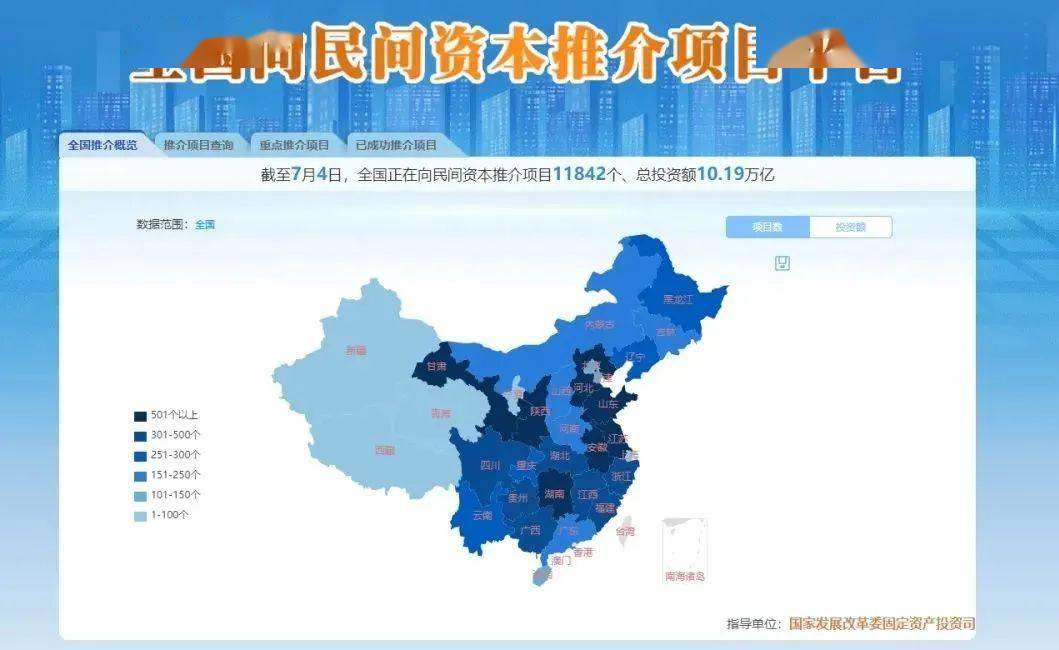
Group 1 - The core viewpoint emphasizes the importance of promoting the sustainable, healthy, and high-quality development of the private economy as a major long-term policy of the state [1] - As of July 4, there are 11,842 projects being promoted to private capital with a total investment of 10.19 trillion yuan [1] - The National Development and Reform Commission (NDRC) has organized the introduction of over 3,200 new projects to private capital, involving a total investment exceeding 3 trillion yuan, focusing on key areas such as transportation, energy, and new infrastructure [3][4] Group 2 - The implementation of the "Private Economy Promotion Law" since May 20 aims to ensure fair competition and promote investment financing, allowing private economic organizations to participate equally in various sectors [3] - The number of items in the "Market Access Negative List (2025 Edition)" has been reduced from 117 to 106, further relaxing market access restrictions [4] - Local governments have recently published project lists for private capital, with Beijing releasing 119 key projects totaling approximately 124.4 billion yuan, and Henan Province announcing 75 major projects with a total investment of 33 billion yuan [5][6] Group 3 - The current wave of project promotion signals a deepening of market-oriented reforms and optimization of resource allocation, aiming to attract private enterprises to enhance project construction and operational efficiency [7] - The focus on attracting private capital is particularly significant in areas such as technological innovation and new infrastructure, where private investment is seen as a crucial driver for industrial upgrading and high-quality economic development [7]
固定收益周报:关注股债性价比何时重回偏向债券-20250706
Huaxin Securities· 2025-07-06 11:04
1. Report Industry Investment Rating The document does not provide the industry investment rating. 2. Core Viewpoints of the Report - The Chinese economy is in a marginal de - leveraging process. The growth rate of the real - sector debt is expected to decline, and the government aims to stabilize the macro - leverage ratio. The large - scale debt resolution is beneficial for the overall economy [1][17]. - In the short term, the stock - bond ratio may fluctuate, but in the long run, it tends to favor bonds. The stock style tends to favor value stocks, and the bond configuration window is open, but the trading space is limited [16][22]. - During the de - leveraging cycle, the stock - bond ratio favors equities to a limited extent, and value stocks are more likely to outperform. The recommended investment portfolio includes the Dividend Index (40% position), the Shanghai 50 Index (40% position), and the 30 - year Treasury Bond ETF (20% position) [7][16][23]. 3. Summary by Relevant Catalogs 3.1 National Balance Sheet Analysis - **Liability Side**: In May 2025, the real - sector debt growth rate was 8.9%, down from 9.0% previously. It is expected to decline to around 8% by the end of the year. The government debt growth rate is expected to rise to 15.3% in June and then decline to around 12.5% by the end of the year. The money market has been loosening recently, but it is unlikely to remain so [1][17][18]. - **Asset Side**: The physical volume data in May was weaker than in April. The annual nominal economic growth target is around 4.9%. It remains to be seen whether this will be the central target for the next 1 - 2 years [5][19]. 3.2 Stock - Bond Ratio and Stock - Bond Style - Last week, the money market continued to loosen. The stock market was bullish, and the bond market was stable. The stock - bond ratio favored stocks, but the equity style shifted to value stocks. The short - and long - term bond yields were relatively stable [6][21]. - In the long run, during the de - leveraging cycle, the stock - bond ratio favors bonds, and the equity style favors value stocks. Currently, long - term bonds have a slightly higher cost - performance ratio than value - type equity assets [7][22]. 3.3 Industry Recommendation 3.3.1 Industry Performance Review - This week, the A - share market rose, with the Shanghai Composite Index up 1.4%, the Shenzhen Component Index up 1.25%, and the ChiNext Index up 1.5%. Among the Shenwan primary industries, steel, building materials, banks, pharmaceutical biology, and comprehensive sectors had the largest increases, while computer, non - bank finance, beauty care, transportation, and commercial retail sectors had the largest declines [28]. 3.3.2 Industry Crowding and Trading Volume - As of July 4, the top five crowded industries were electronics, computer, pharmaceutical biology, power equipment, and machinery equipment, while the bottom five were comprehensive, beauty care, petroleum and petrochemical, coal, and real estate. - This week, the top five industries with increased crowding were pharmaceutical biology, public utilities, electronics, machinery equipment, and building materials, while the top five with decreased crowding were non - bank finance, computer, banks, national defense and military industry, and automobiles. - The average daily trading volume of the whole A - share market slightly decreased compared to last week. Steel, building materials, agriculture, forestry, animal husbandry, and fishery, pharmaceutical biology, and coal had the highest trading volume growth rates [30][31]. 3.3.3 Industry Valuation and Earnings - This week, among the Shenwan primary industries, steel, banks, building materials, pharmaceutical biology, and media had the largest increases in PE(TTM), while computer, non - bank finance, beauty care, transportation, and commercial retail had the largest declines. - As of July 4, 2025, industries with high 2024 full - year earnings forecasts and relatively low current valuations compared to history included coal, petroleum and petrochemical, transportation, beauty care, and consumer electronics [35][37]. 3.3.4 Industry Prosperity - **External Demand**: It generally recovered. The global manufacturing PMI rose from 49.5 to 50.3 in June, and most major economies' PMIs increased. The CCFI index decreased by 1.92% week - on - week. Port cargo throughput increased. South Korea's export growth rate rose from - 1.3% in May to 4.3% in June, and Vietnam's export growth rate slightly decreased from 21% in April to 20.7% in May [39]. - **Domestic Demand**: The second - hand housing price remained flat last week, and quantity indicators showed mixed trends. Highway truck traffic increased. The capacity utilization rate of ten industries rebounded in May and continued to rise in June. Automobile trading volume was at a relatively high level in the same period of history, new - home trading volume was at a historical low, and second - hand home trading volume declined seasonally [39]. 3.3.5 Public Fund Market Review - In the first week of July (June 30 - July 4), most active public equity funds underperformed the CSI 300. As of July 4, the net asset value of active public equity funds was 3.55 trillion yuan, slightly down from 3.66 trillion yuan in Q4 2024 [55]. 3.3.6 Industry Recommendation - During the de - leveraging cycle, the stock - bond ratio favors equities to a limited extent, and value stocks are more likely to outperform. Dividend - type stocks should generally have three characteristics: no balance - sheet expansion, good earnings, and survival. - Based on these characteristics and the under - allocation situation in the public fund quarterly reports, the recommended A + H dividend portfolio includes 20 A + H stocks, and the A - share portfolio includes 20 A - share stocks, mainly concentrated in industries such as banks, telecommunications, petroleum and petrochemical, and transportation [9][59].