
非银金融

Search documents
民生研究:2025年8月金股推荐
Minsheng Securities· 2025-07-30 06:13
Group 1: Stock Recommendations - The report recommends 10 stocks and 3 ETFs based on a top-down approach for August allocation [1] - Lu'an Huanneng is highlighted for its high spot coal ratio, significant earnings elasticity, and low PB valuation [1][8] - Huayou Cobalt benefits from integrated layout advantages, stable incremental profit from wet nickel production, and a significant decrease in cobalt imports in June [1][8] - Geely Automobile's privatization of Zeekr will enhance resource integration and decision-making efficiency, with an adjusted annual sales target of 3 million vehicles [2][8] - Cambrian is positioned to benefit from the increasing demand for AI chips and has plans for hardware and software platform development [2][8] - SMIC is advancing in domestic computing capabilities with improved yield rates and is expected to benefit from the semiconductor cycle [2][8] - North Navigation is a leader in the long-range fire industry, experiencing rapid demand recovery and implementing stock incentives [3][8] - Shengquan Group is a leading supplier in high-frequency resin, expected to see rapid growth due to PCB industry demand [3][8] - CITIC Securities is well-positioned in the financial sector with a solid market position and ample IPO reserves [3][8] - Jiao You International focuses on cross-border mineral logistics, particularly in Africa, ensuring efficient and secure transportation [3][8] - China Jinmao has made significant impairment provisions and is on track to meet its sales target [4][8] Group 2: ETF Recommendations - Recommended ETFs include Military Industry ETF, TMT ETF, and Chemical ETF, reflecting sectoral strengths [4][10] - The Military Industry ETF has a total net value of 171.45 billion yuan with a year-to-date growth rate of 14.33% [10] - The TMT ETF shows a year-to-date growth rate of 12.27% and a total net value of 5.02 billion yuan [10] - The Chemical ETF has a total net value of 33.81 billion yuan with a growth rate of 9.22% [10] Group 3: Financial Data Highlights - Lu'an Huanneng's EPS is projected to be 0.65 yuan in 2025, with a PE ratio of 23 [9] - Huayou Cobalt's EPS is expected to rise to 3.11 yuan in 2025, with a PE ratio of 15 [9] - Geely Automobile's EPS is forecasted at 1.61 yuan in 2025, maintaining a PE ratio of 11 [9] - Cambrian is projected to have an EPS of 3.04 yuan in 2025, with a high PE ratio of 234 [9] - SMIC's EPS is expected to reach 0.64 yuan in 2025, with a PE ratio of 144 [9] - North Navigation's EPS is projected at 0.17 yuan in 2025, with a PE ratio of 104 [9] - Shengquan Group's EPS is expected to be 1.53 yuan in 2025, with a PE ratio of 21 [9] - CITIC Securities is projected to have an EPS of 1.56 yuan in 2025, with a PE ratio of 19 [9] - Jiao You International's EPS is expected to be 1.49 yuan in 2025, with a PE ratio of 8 [9] - China Jinmao's EPS is projected at 0.12 yuan in 2025, with a PE ratio of 11 [9]





上半年财政收入数据的几个不寻常
Sou Hu Cai Jing· 2025-07-30 05:16
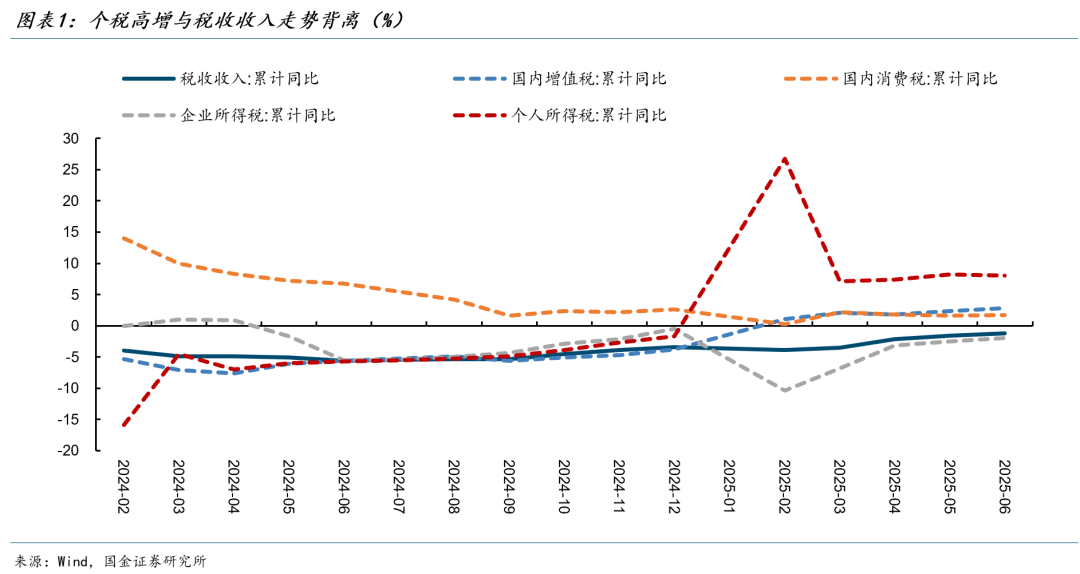
Group 1 - The core viewpoint of the articles highlights the significant increase in individual income tax (IIT) revenue, which is primarily attributed to improved tax collection efficiency and enforcement, rather than an increase in residents' disposable income [1][5][10] - In the first half of the year, individual income tax revenue grew by 8% year-on-year, while urban residents' per capita disposable income only increased by 4.7%, indicating a disparity between income growth and tax revenue [5][10] - The increase in individual income tax is mainly driven by high-income earners, with those earning over 1 million yuan annually contributing over 50% of the total IIT revenue, despite representing only 1% of the total filers [5][10] Group 2 - The divergence between value-added tax (VAT) and corporate income tax (CIT) is notable, with VAT revenue increasing by 2.8% while CIT revenue decreased by 1.9% in the first half of the year [12][13] - This divergence is attributed to "involution" competition leading to increased revenue without corresponding profit growth, as well as one-time factors affecting CIT collection early in the year [12][13] - The overall corporate income tax revenue was negatively impacted by a reduction in tax payments from central financial enterprises, which accounted for a significant portion of the decline [13] Group 3 - Non-tax revenue experienced a decline, with a year-on-year growth of only 3.7% in the first half of the year, and a negative growth rate observed since May [17][18] - The slowdown in non-tax revenue growth is linked to diminishing support from the monetization of state-owned assets and improvements in the business environment leading to reduced administrative fees and penalties [17][18] - The revenue from state-owned resource asset usage, which constitutes a significant portion of non-tax revenue, is expected to face challenges as easily monetizable assets have already been utilized [18]

30个行业获融资净买入 26股获融资净买入额超1亿元
Zheng Quan Shi Bao Wang· 2025-07-30 02:31
Group 1 - On July 29, 30 out of 31 primary industries in the Shenwan index received net financing inflows, with the pharmaceutical and biotechnology sector leading at a net inflow of 3.437 billion [1] - Other industries with significant net financing inflows included electronics (1.712 billion), banking (1.462 billion), power equipment (851 million), defense and military (747 million), food and beverage (671 million), non-bank financials (669 million), telecommunications (602 million), and non-ferrous metals (556 million) [1] Group 2 - A total of 2008 individual stocks received net financing inflows on July 29, with 191 stocks having inflows exceeding 30 million [1] - Among these, 26 stocks had net inflows exceeding 100 million, with Xinyi Technology leading at 1.14 billion [1] - Other notable stocks with high net inflows included Cambrian (780 million), WuXi AppTec (356 million), Guotai Junan (257 million), Minsheng Bank (241 million), Yili (219 million), Huatai Securities (202 million), Shanghai Electric (202 million), and Fosun Pharma (199 million) [1]





港股非银(513750)获融资买入1.01亿元,近三日累计买入4.28亿元
Jin Rong Jie· 2025-07-30 00:28
融券方面,当日融券卖出0.00万股,净卖出0.00万股。 本文源自:金融界 7月29日,沪深两融数据显示,港股非银(513750)获融资买入额1.01亿元,居两市第199位,当日融资偿 还额0.95亿元,净买入574.35万元。 最近三个交易日,25日-29日,港股非银(513750)分别获融资买入0.87亿元、2.41亿元、1.01亿元。 作者:智投君 ...
A股定增暖流涌动
2 1 Shi Ji Jing Ji Bao Dao· 2025-07-30 00:00
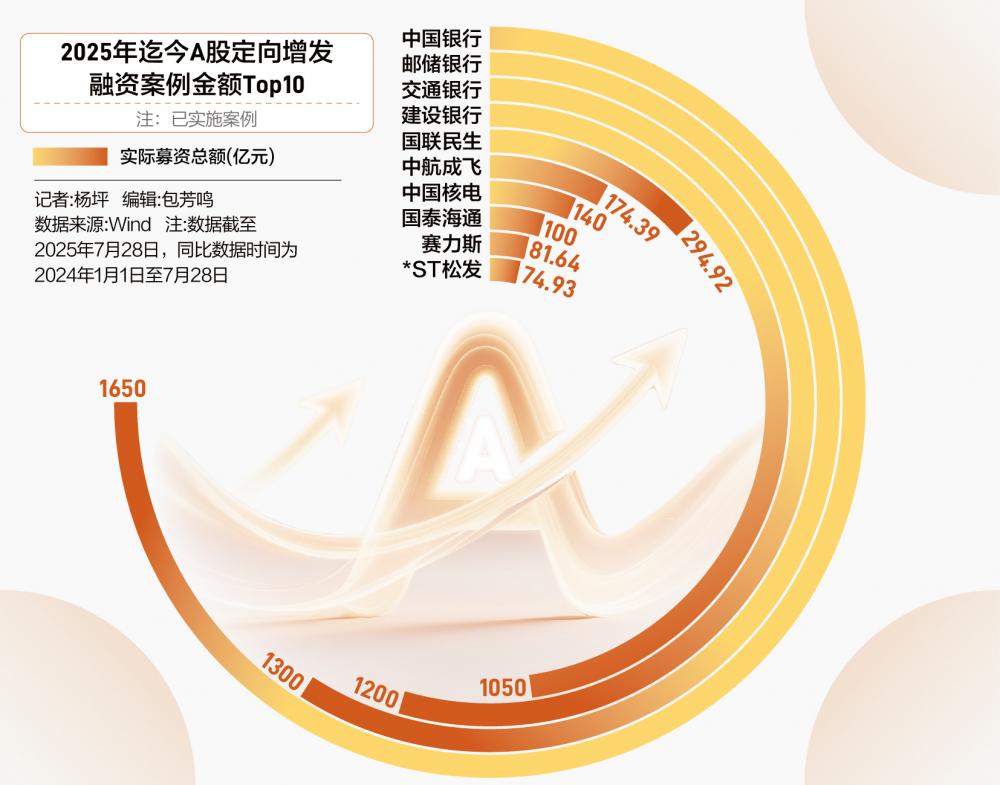
Group 1 - The A-share market has seen a significant increase in equity financing, with 172 companies raising a total of 823.51 billion yuan, a year-on-year increase of 371.52% [1] - Among these, 90 companies completed private placements, raising 722.30 billion yuan, up 543.73% year-on-year, while 25 companies issued convertible bonds, raising 40.56 billion yuan, a 53.53% increase [1] - Major state-owned banks, including Bank of China, Postal Savings Bank, and others, have raised over 1 trillion yuan each for capital replenishment, with Bank of China leading at 165 billion yuan [1][4] Group 2 - The surge in private placements is supported by regulatory measures aimed at increasing long-term capital inflows into the market, including a joint policy issued by six departments [3] - The proportion of financing for mergers and acquisitions has risen significantly, with 16 out of 90 private placements being used for asset acquisitions [3] - The manufacturing and high-tech industries are the primary drivers of private placements, with significant participation from sectors such as chemicals, hardware, and machinery [3] Group 3 - Financial institutions have raised a total of 520 billion yuan, with government support for state-owned banks to issue special bonds for capital replenishment [4] - Securities firms have also engaged in private placements to strengthen their capital, with notable fundraising efforts from Tianfeng Securities and Guotai Junan [5] - The simplified procedures for small and medium enterprises have gained popularity, allowing quicker access to funds, with 11 out of 90 private placements utilizing this method [6] Group 4 - Numerous companies are planning new private placements, with 352 companies updating their refinancing plans this year, a 162.69% increase from last year [7] - The Shenzhen Stock Exchange has introduced guidelines to enhance financing flexibility for companies meeting "light asset" and "high R&D" criteria, benefiting over 200 companies in strategic emerging industries [8] - The overall private placement fundraising scale is expected to exceed 1 trillion yuan this year, driven by improved market conditions and corporate profitability [9]
年内南下资金净买入8420亿港元 净买入额刷新历史纪录,配置重心逐步向创新药和大消费倾斜
Shen Zhen Shang Bao· 2025-07-29 17:22
【深圳商报讯】(记者钟国斌)今年以来,南下资金持续加仓港股。据数据统计,今年1月1日至7月29 日,南下资金净买入8420亿港元,超越2024年全年8079亿港元,刷新历史纪录。自开通以来,南下资金 累计净买入达45397.93亿港元。 业内人士指出,在今年港股市场"赚钱效应"明显增强的背景下,南下资金仅用7个月便完成对历史峰值 的突破,表明内地资金对港股市场的配置需求进入爆发式增长阶段。 值得注意的是,今年以来南下资金单日净流入超百亿港元的现象频繁出现。数据显示,今年以来的135 个交易日中,南下资金单日净流入超百亿港元的交易日有33天,占比24.44%。其中,有9个交易日南向 资金单日净流入超200亿港元,4月9日南下资金净买入港股355.86亿港元,为史上单日净买入最高金 额。 从净买入股票来看,近3个月,南下资金净买入前十名分别为美团-W、建设银行、盈富基金、中芯国 际、信达生物、中国移动、中国人寿、石药集团、比亚迪、众安在线,净买入金额介于358.72亿港元至 25.17亿港元之间。 记者统计发现,截至7月29日,南下资金持股比例超过10%的个股404只,南下资金持股比例超过30%的 个股139只, ...
策略周报:资金透视,交易型资金热度仍在-20250729
HTSC· 2025-07-29 14:05
Core Insights - The report indicates that trading funds remain active, providing support for A-shares, with a notable increase in financing balance, reaching a high not seen since 2020, and a new peak in fund activity since 2025 [2][3] - There is a slight recovery in allocation funds, with public funds showing signs of increased positions since mid-July, and passive foreign capital experiencing significant net inflows [2][5] - The consensus among funds is shifting towards technology and healthcare sectors with lower crowding, particularly in areas like medical devices and semiconductors [2][6] Weekly Fund Overview - Retail investors saw a net inflow of 99.9 billion yuan, with significant interest in non-bank financials and basic chemicals, while outflows were noted in pharmaceuticals and automotive sectors [13][19] - Financing funds recorded a net inflow of 447 billion yuan, with active trading levels rising to 10.4%, particularly in sectors like metals and healthcare [19][34] - Public funds have shown a slight increase in equity positions, with 194 billion yuan in new equity fund issuance last week [34][45] Fund Flow Observations - The report highlights that passive foreign capital has been the main driver of net inflows, with a significant increase in passive foreign capital inflow reaching 95 billion yuan [5][61] - The net outflow from ETFs was 18 billion yuan, with broad-based ETFs experiencing a larger outflow of 112.9 billion yuan, although sector-specific inflows were noted in construction and basic materials [45][94] - The number of newly registered private equity funds reached a record high for the year, indicating potential future capital support [55] Market Positioning - The report emphasizes a consensus among various funds to invest in technology and healthcare sectors, particularly in less crowded areas such as medical devices and AI-related sectors [6][55] - The report also notes a marginal decline in long-term insurance capital's market entry ratio, indicating a cautious approach among insurance companies [57][58] - The average collateral ratio in the financing market has increased, suggesting a more secure borrowing environment [28][29]
兴业期货日度策略-20250729
Xing Ye Qi Huo· 2025-07-29 12:51
1. Report Industry Investment Ratings - Index: Bullish [1] - Treasury Bonds: Sideways [1] - Gold: Sideways, with a bullish pattern for silver [4] - Non - ferrous Metals (Copper): Sideways [4] - Non - ferrous Metals (Aluminum and Alumina): Sideways for alumina, cautious and bearish short - term, long - term bullish for aluminum [4] - Non - ferrous Metals (Nickel): Sideways [4] - Lithium Carbonate: Sideways [6] - Silicon Energy: Sideways [6] - Steel and Ore (Threaded Steel): Bullish pattern [6] - Steel and Ore (Hot - Rolled Coil): Bullish pattern [6] - Steel and Ore (Iron Ore): Sideways pattern [7] - Coking Coal and Coke (Coking Coal): Sideways [7] - Coking Coal and Coke (Coke): Sideways [7] - Soda Ash/Glass (Soda Ash): Sideways pattern [7] - Soda Ash/Glass (Float Glass): Sideways pattern [7] - Crude Oil: Sideways [9] - Methanol: Bullish [9] - Polyolefins: Sideways [9] - Cotton: Sideways and bullish [9] - Rubber: Cautiously bullish [9] 2. Core Views of the Report - The overall upward trend of the stock index is clear, and there are opportunities to go long on dips; the bond market is affected by sentiment and the stock - commodity market, with reduced upward pressure but high uncertainty [1] - Gold is in a high - level sideways pattern, and silver has strong support. It is recommended to hold short - put option positions and go long on silver [4] - The copper market is affected by the US copper tariff policy, with high uncertainty and a sideways pattern [4] - Alumina is affected by sentiment in the short - term, with a medium - term surplus pattern; aluminum has clear supply constraints and a relatively stable long - term bullish strategy [4] - Nickel lacks directional drivers and is in a sideways pattern, and the short - call option position can be held [4] - The long - term logic of "anti - involution" in the steel and ore market remains valid, but short - term factors are differentiated. Each variety has different supply - demand situations and corresponding strategies [6][7] - The soda ash market has a supply surplus, and the glass market has a relatively better fundamental situation. It is recommended to hold the long - glass and short - soda ash strategy [7] - The crude oil market is affected by geopolitical factors, with a risk premium increase and a sideways pattern [9] - Methanol has price support, and it is recommended to sell put options [9] - Polyolefins have a low basis, and the futures may continue to fluctuate [9] - Cotton prices may fluctuate in a moderately bullish range before September - October [9] - Rubber is in a situation of both supply and demand increasing, with a sideways price trend [9] 3. Summaries According to Related Catalogs 3.1 Stock Index - On Monday, the A - share market had a narrow - range consolidation, with the ChiNext remaining strong and the trading volume slightly decreasing. The stock index futures were in a high - level consolidation, and the discount of IC and IM widened again [1] - The "anti - involution" sentiment in the market cooled down, and the market returned to a state of rapid sector rotation. The macro - level is affected by Sino - US economic and trade talks, and the fundamental long - term logic of corporate profit repair remains unchanged. The upward trend of the stock index is clear, and attention should be paid to the opportunity to go long on dips [1] 3.2 Treasury Bonds - The bond market rebounded across the board, and the upward pressure on the bond market decreased. The central bank made large - scale net injections, and the liquidity was abundant. The bond market is affected by sentiment and the stock - commodity market in the short - term, with high uncertainty [1] 3.3 Gold and Silver - Gold is in a high - level sideways pattern, lacking short - term drivers. If it pulls back to the lower edge of the operating range since June, short - term long positions can be considered. The gold - silver ratio continues to converge, and silver has strong price support. It is recommended to hold short - put option positions and go long on silver [4] 3.4 Non - ferrous Metals Copper - The Shanghai copper market is mainly affected by the US copper tariff policy. The medium - long - term supply of the mining end is tight, and the short - term import demand depends on policies. The market has high uncertainty and is in a sideways pattern [4] Aluminum and Alumina - Alumina is affected by sentiment in the short - term, with a medium - term surplus pattern. The short - term demand for aluminum is cautious, but the supply constraints are clear, and the long - term bullish strategy is relatively stable [4] Nickel - The supply of nickel has a tight situation in Indonesia's mines and abundant production capacity of nickel iron and intermediate products. The demand is in the off - season. The market "anti - involution" sentiment cooled down, and the nickel price lacks directional drivers, remaining in a sideways pattern. The short - call option position can be held [4] 3.5 Lithium Carbonate - The exchange adjusted the handling fee and daily opening limit, and the long - position sentiment in the lithium carbonate futures market weakened. The supply pattern has limited improvement, and there is still inventory accumulation pressure. Attention should be paid to the mining license approval results of key mines in Jiangxi in early August [6] 3.6 Silicon Energy - The silicon energy market has limited new orders for polysilicon, and downstream procurement is cautious. The industrial silicon market is mainly driven by polysilicon in the early stage, and the fundamental situation has not improved substantially, with the bullish sentiment fading [6] 3.7 Steel and Ore Threaded Steel - The spot price of threaded steel continued to decline, and the basis strengthened significantly. The regulatory tightening cooled the market, and the short - term supply contraction probability is low. The price has strong support, and it is recommended to hold the short - put option position [6] Hot - Rolled Coil - The spot price of hot - rolled coil continued to decline, and the basis also strengthened significantly. The short - term supply contraction probability is low. The price has support, and it is recommended to wait and see [6] Iron Ore - The short - term supply of iron ore is relatively stable, and the long - term price is under pressure. The 9 - 1 positive spread strategy can be patiently held, and the arbitrage opportunity of going long on coking coal and short on iron ore in the 01 contract can be grasped after the sentiment stabilizes [7] 3.8 Coking Coal and Coke Coking Coal - The exchange upgraded risk - control measures, and the coking coal futures price fell sharply. The supply tightening expectation exists, and the fundamentals support the price, but short - term unilateral participation requires caution [7] Coke - The coke spot market is bullish, but the futures price is affected by the decline of coking coal and shows a sideways decline [7] 3.9 Soda Ash and Glass Soda Ash - The soda ash market has a supply surplus, and the demand is affected by "anti - involution". The inventory decreased recently, and attention should be paid to the warehouse receipt pressure. It is recommended to wait and see for new orders and hold the long - glass and short - soda ash strategy [7] Float Glass - The glass market has a relatively better fundamental situation, with continuous inventory reduction. It is recommended to go long on dips or sell put options and hold the long - glass and short - soda ash strategy [7] 3.10 Crude Oil - Geopolitical factors have become the short - term focus of the market, and the risk premium has increased. The OPEC+ may increase production in September. The demand - side support has weakened, and the market is in a sideways pattern [9] 3.11 Methanol - The port inventory of methanol is expected to increase, and the start - up rate of northwest coal - chemical plants is expected to rise. The futures price is higher than the spot price, and it is recommended to sell put options [9] 3.12 Polyolefins - The basis of polyolefins is low, and the futures may pull back. In August, both supply and demand are expected to increase, and the futures will continue to fluctuate [9] 3.13 Cotton - The short - term supply of cotton is tight, and the demand is relatively stable. There is a possibility of additional quotas. Before September - October, the cotton price may fluctuate in a moderately bullish range [9] 3.14 Rubber - The port inventory of rubber is increasing again, and the supply and demand are both increasing. The price is in a sideways pattern, and attention should be paid to the production increase rate in Southeast Asian producing areas [9]
A股活水来!定增金额大增544%,简易程序成企业“及时雨”
2 1 Shi Ji Jing Ji Bao Dao· 2025-07-29 12:27
Group 1 - The A-share market has seen a significant increase in equity financing, with 172 companies raising a total of 823.51 billion yuan, a year-on-year increase of 371.52% [1] - Among these, 90 companies completed private placements, raising 722.30 billion yuan, up 543.73% year-on-year, while 25 companies issued convertible bonds, raising 40.56 billion yuan, a 53.53% increase [1] - Major state-owned banks, including Bank of China, Postal Savings Bank, and others, have raised over 1 trillion yuan each for capital replenishment, with Bank of China leading at 165 billion yuan [1][3] Group 2 - The surge in private placements is supported by regulatory measures aimed at increasing long-term capital inflows into the market [2] - The "merger and acquisition" policy has led to a significant rise in financing for mergers and acquisitions, with 16 out of 90 private placements being used for asset acquisitions [3] - The financial sector has dominated the fundraising landscape, with major banks collectively raising 520 billion yuan, supported by government initiatives to issue special bonds [3] Group 3 - Several securities firms have also engaged in private placements to enhance their capital strength, with a total of 45.49 billion yuan raised this year [4] - The simplified procedures for small and medium enterprises have gained popularity, allowing quicker access to necessary funds [4][5] - A total of 352 companies updated their refinancing plans this year, a 162.69% increase from last year, with a significant portion being technology firms seeking to bolster working capital [6] Group 4 - The Shenzhen Stock Exchange has introduced guidelines to enhance financing flexibility for companies classified as "light asset" and "high R&D input," allowing them to bypass certain restrictions [7] - Over 200 companies are expected to meet these new standards, primarily in strategic emerging industries such as information technology and biomedicine [7] - The overall fundraising scale for private placements is projected to exceed 1 trillion yuan this year, driven by improved market conditions and corporate profitability [8]



势如破竹,固收加规模强势增长
GUOTAI HAITONG SECURITIES· 2025-07-29 12:05
1. Report Industry Investment Rating No relevant content provided. 2. Core Viewpoints of the Report - In Q2 2025, the scale of fixed - income plus funds continued to grow, and the inflow of funds was expected to continue due to the bond market under - allocation and the upward movement of equities. Convertible bond funds and fixed - income plus funds still had strong support [4][6]. - Brokers significantly increased their positions in convertible bonds, while public funds and insurance funds actively reduced their positions on the whole. The behavior of brokers was different from that of public funds and insurance funds, with brokers more likely to increase positions in a bull market and the latter reducing positions when the convertible bond valuation was high [10][12]. - Public funds continued to reduce their positions in bank convertible bonds and sought bottom - position substitutes. Other convertible bonds in the financial sector and those in the public utilities sector received certain increases in positions [19]. 3. Summary According to Relevant Catalogs 3.1. Growth of Fixed - Income Plus Fund Shares with Market Support - In Q2 2025, fixed - income plus funds had a net subscription of 56.41 billion shares. Among them, first - tier bond funds had a net subscription of 52.548 billion shares, second - tier bond funds had a net subscription of 7.774 billion shares, and partial - debt hybrid funds had a net redemption of 3.68 billion shares, with the net redemption volume further decreasing compared to Q1 2025. Convertible bond funds had a net redemption of 2.164 billion shares, slightly higher than that in Q1 2025 but with relatively low net redemption pressure compared to Q4 2024 [4][6]. - In Q2 2025, the positions of convertible bond funds and fixed - income plus funds in equity - related assets decreased slightly. The reasons might include the tariff event in early April, profit - taking in May and June, and the reduction in the scope of investable targets in the convertible bond market [8]. 3.2. Public Funds and Insurance Funds Reduce Positions Marginally, while Brokers Increase Positions in Convertible Bonds - Brokers significantly increased their positions in convertible bonds in February, March, May, and June 2025, while public funds and insurance funds actively reduced their positions when the convertible bond valuation was high. With the convertible bond market hitting a new high and the equity market at a relatively high level, there was a need to be cautious about possible valuation drops [10][12]. - From January to June 2025, the positions of funds, insurance, and social security in convertible bonds decreased, while those of brokers' self - operation and asset management increased. The positions of convertible bond ETFs had net outflows in April and May and recovered significantly after late June [12][13][15]. 3.3. Analysis of Public Fund Holdings - In terms of industry distribution, public funds continued to reduce their positions in bank convertible bonds in Q2 2025 due to the forced redemption of Nanyin Convertible Bond, Hangyin Convertible Bond, Qilu Convertible Bond, and the approaching maturity of Pufa Convertible Bond. Other convertible bonds in the financial sector and those in the public utilities sector received certain increases in positions [19]. - Public funds increased their positions in some high - elasticity varieties such as those in the electronics, computer, communication, pharmaceutical, and food and beverage sectors, which might benefit from the structural market of technology, medicine, and consumption sectors. The positions in convertible bonds of the basic chemical and building materials industries also increased [21]. - In addition to financial bottom - position convertible bonds such as bank convertible bonds, public funds increased their positions in high - prosperity and high - elasticity targets such as Outong Convertible Bond, Wentai Convertible Bond, Shenma Convertible Bond, and Hengbang Convertible Bond [26].