
家电

Search documents
餐饮、潮玩及家电行业周报-20251207
Haitong Securities International· 2025-12-07 12:31
Investment Rating - The report assigns an "Outperform" rating to several companies including Pop Mart, Anta Sports, Huazhu Hotels, and Haidilao, while Budweiser APAC is rated "Neutral" [1]. Core Insights - The report highlights significant developments in the F&B sector, including Naixue's Tea announcing Gao Yuanyuan as its brand spokesperson and Mixue piloting a breakfast menu in select locations [6][7]. - The consumer goods trade-in program has driven sales exceeding RMB 2.5 trillion from January to November, benefiting over 360 million people [6]. - Haier Smart Home and LG Chem have established a joint laboratory to enhance their strategic cooperation in new product development [6]. Weekly Performance Summary - Key performers in the F&B sector include Tongqinglou (+9.3%) and DPC Dash (+4.6%), while underperformers include Yum China (-4.0%) and Xiaocaiyuan (-4.3%) [2][7]. - In the home appliance sector, TCL Electronics (+8.5%) and Roborock (+6.6%) showed strong performance, while Marssenger Kitchenware (-4.6%) and Zhejiang Meida (-6.9%) lagged [2][7].
行业ETF配置模型2025年超额16.4%
GOLDEN SUN SECURITIES· 2025-12-07 10:20
Quantitative Models and Construction Methods 1. Model Name: Industry Mainline Model (Relative Strength Index, RSI) - **Model Construction Idea**: The model aims to identify leading industries by calculating their relative strength index (RSI) over different time frames[1][9] - **Model Construction Process**: 1. Use primary industry indices as configuration targets, totaling 31 primary industries 2. Calculate the price changes over the past 20, 40, and 60 trading days for all industries, obtaining the cross-sectional rankings of these changes, then normalize all rankings to get RS_20, RS_40, and RS_60 3. Calculate the average of these three rankings to get the final industry relative strength index: $$ RS = \frac{RS_{20} + RS_{40} + RS_{60}}{3} $$ 4. If an industry shows an RS signal greater than 90% before the end of April, it is likely to be a leading industry for the year[9] - **Model Evaluation**: The model effectively identified leading industries in 2024, such as coal, power and utilities, home appliances, banks, oil and petrochemicals, communications, non-ferrous metals, agriculture, forestry, animal husbandry, and fishery, and automobiles[1][9] 2. Model Name: Industry Rotation Model (Prosperity-Trend-Crowding Framework) - **Model Construction Idea**: The model uses a three-dimensional framework of prosperity, trend, and crowding to recommend industry allocations[1][2][6] - **Model Construction Process**: 1. Define two industry rotation schemes: "strong trend-low crowding" and "high prosperity-strong trend" 2. Allocate industry weights based on the framework: Media 16%, Agriculture, Forestry, Animal Husbandry, and Fishery 15%, Non-bank Financials 12%, Computers 12%, Home Appliances 9%, Coal 9%, Building Materials 7%, Banks 7%, Light Industry Manufacturing 7%, Retail 6% 3. Recommend ETFs tracking indices such as CSI Steel, CSI Agriculture, Securities Companies, Communication Equipment, CSI Media, Sub-segment Chemicals, CS Artificial Intelligence, Animation Games, Sub-segment Machinery, All Information, Building Materials, etc.[2][6][15] - **Model Evaluation**: The model performed well in 2025, with an excess return of 16.4% relative to the CSI 800 index and 4.2% relative to the Wind All A index[2][6][18] 3. Model Name: Left-Side Inventory Reversal Model - **Model Construction Idea**: The model aims to capture the reversal of industries in distress by analyzing sectors with low inventory pressure and long-term analyst optimism[24] - **Model Construction Process**: 1. Identify sectors currently or previously in distress with potential for inventory replenishment 2. Analyze sectors with low inventory pressure and long-term analyst optimism 3. Recommend sub-sectors such as cloud services, other light industries, oil service engineering, components, agricultural chemicals, animal husbandry, consumer electronics, special materials, and biomedicine[24][25] - **Model Evaluation**: The model achieved an absolute return of 25.4% in 2025, with an excess return of 5.4% relative to the industry equal weight index[24][27] Model Backtest Results 1. Industry Mainline Model (RSI) - **Absolute Return**: Various industries showed significant returns after the RSI signal appeared, such as banks (32.1%), communications (24.0%), home appliances (25.8%), and automobiles (12.8%)[10][12] 2. Industry Rotation Model (Prosperity-Trend-Crowding Framework) - **Annualized Return**: 21.7% - **Excess Annualized Return**: 13.8% - **Information Ratio (IR)**: 1.5 - **Maximum Drawdown**: -8.0% - **Monthly Win Rate**: 67% - **Excess Return in 2023**: 7.3% - **Excess Return in 2024**: 5.7% - **Excess Return in 2025**: 4.2%[13][14] 3. Left-Side Inventory Reversal Model - **Absolute Return in 2023**: 13.4% - **Excess Return in 2023**: 17.0% - **Absolute Return in 2024**: 26.5% - **Excess Return in 2024**: 15.4% - **Absolute Return in 2025**: 25.4% - **Excess Return in 2025**: 5.4%[24][27]
——《2025/12/1-2025/12/5》家电周报:石头科技发布黑五战报,莱克电气公告参与认购投资基金-20251207
Shenwan Hongyuan Securities· 2025-12-07 09:50
Investment Rating - The report indicates a positive investment outlook for the home appliance sector, with a recommendation to focus on undervalued stocks with high dividends and stable growth potential [3][4]. Core Insights - The home appliance sector index outperformed the CSI 300 index, rising by 1.8% compared to the 1.3% increase in the CSI 300 [3][4]. - Key companies such as Lek Electric, Stone Technology, and Huaxiang Co. led the gains, while companies like Yitian Intelligent and Zhejiang Meida faced declines [3][8]. - Stone Technology reported significant sales growth during the Black Friday period, with a 41% increase in vacuum cleaner sales and a 361% increase in washing machine sales in Europe [3][12]. - The report highlights three main investment themes: 1. **Self-Electric**: The reversal of real estate policies is expected to benefit the white goods sector, which is characterized by low valuations and high dividends [3]. 2. **Exports**: Companies like Ousheng Electric and Dechang Co. are recommended due to their stable profitability and expanding customer orders [3]. 3. **Core Components**: The demand for key components is expected to exceed expectations, with recommendations for companies like Huaxiang Co. and Shun'an Environment [3]. Industry Dynamics - The report notes a decline in domestic sales for major appliances in October 2025, with air conditioning production down by 27.9% year-on-year and sales down by 20.1% [34]. - Refrigerator production and sales also saw declines, with production down by 9.8% and sales down by 6.11% [40]. - Washing machine production remained stable with a slight decline of 0.2%, but exports increased by 6.41% [43]. - The report emphasizes the impact of rising raw material prices, particularly copper and aluminum, which have increased by 22.52% and 7.50% year-on-year, respectively [14]. Data Observations - The home appliance sector's performance in October showed a mixed picture, with air conditioning and refrigerator sales declining, while washing machine exports increased [34][40][43]. - The report provides detailed statistics on the sales performance of various appliances, indicating a challenging market environment for domestic sales [34][40][43].




【广发宏观团队】促消费有哪些政策空间
郭磊宏观茶座· 2025-12-07 09:21
Group 1 - The article emphasizes the importance of boosting consumer spending as a key macroeconomic policy direction for 2026 and beyond, with specific policy spaces identified for short, medium, and long-term strategies [1][4][5] - Short-term policy measures include extending and expanding direct subsidies, consumer loan interest subsidies, and implementing paid staggered vacations to enhance consumer experience and demand [1][2][3] - Medium-term strategies focus on accelerating consumption tax reform, upgrading consumption infrastructure, leveraging new technologies for product and scene development, and promoting employment-friendly development [4][5] - Long-term perspectives involve improving income distribution systems, enhancing social security, and optimizing consumption through population growth and international demand activation [5][6] Group 2 - The article discusses the impact of the anticipated U.S. interest rate cuts on global markets, leading to a risk-on sentiment and a recovery in stock prices, particularly in technology and materials sectors [6][7][8] - Despite a mixed U.S. economic data landscape, market sentiment remains optimistic, with expectations of a 25 basis point rate cut by the Federal Reserve in December [7][15] - The article highlights the performance of various asset classes, noting a significant rise in copper prices and a stable demand for gold, while U.S. Treasury yields have shown volatility [9][10][12] Group 3 - The article outlines recent policy changes in housing provident fund regulations aimed at supporting housing consumption, including increased withdrawal limits and expanded usage scenarios [27][28][29] - It notes that various regions are implementing measures to optimize housing fund policies, aligning them with population policies and enhancing support for high-quality housing [27][28][29] - The article also mentions the broader context of economic recovery efforts, including the promotion of durable goods consumption and the integration of artificial intelligence in consumer sectors [35][36]


浙商证券:冗余时刻还未结束 目标不变、守株待兔
Xin Lang Cai Jing· 2025-12-07 09:14
来源:浙商证券 配置方面,基于"冗余时刻区间震荡,设定目标守株待兔"的判断:择时方面,建议持仓等待,切勿追涨 杀跌、垫高自身成本,同时根据不同宽基指数的"左脚"分类设定目标(例如上证指数9 月4 日低点或前 期跳空缺口,恒生科技指数近期低点或年线),伺机出击、分批介入。行业配置和个股方面,建议关注 明显滞涨且份额扩张的券商板块,短期可以关注走势顺畅且历史上在12 月胜率较高的家电,留意医 药、消费、AI 应用板块中相对低位的标的,同时关注年线上方的低位滞涨个股。 风险提示 国内经济修复不及预期;全球地缘政治存在不确定性。 责任编辑:郭栩彤 来源:浙商证券 本周市场继续反弹,但双向波动有所增大。展望后市,考虑到今年三季度市场涨幅较大、强势标的多数 还在冲高回落后的修复过程中,加之近期未出现引领大盘上涨的宏大叙事和领涨行业,因此我们预计后 市大概率维持区间震荡格局。配置方面,基于"冗余时刻区间震荡,设定目标守株待兔"的判断:择时方 面,建议持仓等待,切勿追涨杀跌、垫高自身成本,同时根据不同宽基指数的"左脚"分类设定目标(例 如上证指数9 月4 日低点或前期跳空缺口,恒生科技指数近期低点或年线),伺机出击、分批介入 ...

错失牛市!消费板块后市如何走?
证券时报· 2025-12-07 09:07
年内A股在科技板块的提振下开启了迈向4000点的征程,但亦有部分板块未能搭上车。 多只重仓消费股的基金净值迄今为止遗憾告负,在传统消费持续不景气的背景下,部分高位加仓新消费的基金 也在个股的回撤中折损净值。 多名基金经理认为,"旧消费"在经历了长达四年的回撤后,估值已回归合理区间;新消费面临的则是高景气度 与高估值并存的现状。此外,在个股遴选中,部分基金经理提及"出海"这一关键词,并认为国产消费品牌在国 际竞争中潜力巨大,海外营收若能放量,对应当前估值水平有不少增长空间。 多只消费主题基金"躲牛市" 年内的科技牛市中,五年前的"核心资产"多数缺席,白酒、家电以及银行等板块多数涨幅有限,其中消费类个 股更是表现平平。据Wind数据,年初至今"酒类指数"跌幅超过6%,"零售指数"跌超2%,成为为数不多的下跌 板块。 因此,在多只科技股催生的"翻倍基"榜单中,还有部分消费主题产品跌幅超过10%,占据跌幅靠前位置。 以 华东某公募旗下消费主题基金 为例,上半年的两个季度内,该基金重仓股中包括了贵州茅台、五粮液和美 的集团等传统消费股,上半年跌幅达17%,下半年虽转向了消费电子但依旧走势一般。 "旧消费"不景气的同时, ...

计划增持金额同比增长25% 沪市公司用真金白银稳定市场预期
Zhong Guo Jing Ying Bao· 2025-12-07 08:49
Core Viewpoint - The Shanghai Stock Exchange has actively promoted the "Quality Improvement, Efficiency Enhancement, and Return to Shareholders" initiative this year, with listed companies and major shareholders responding positively to regulatory calls through "increases in holdings and buybacks" to enhance investor returns and stabilize market expectations [1] Summary by Category Increase in Holdings - From January to November, 210 companies on the Shanghai Stock Exchange disclosed new increase plans, with a total planned increase amount of 649.84 billion, representing a 25.43% increase compared to 518.10 billion in the same period last year [1] - Among these, 177 companies on the main board disclosed new increase plans, with a total planned increase amount of 628 billion, a 27% increase from 493 billion in the previous year [1] - Notable companies with significant planned increases include China Yangtze Power (40 billion to 80 billion), China Petroleum (28 billion to 56 billion), and China National Offshore Oil Corporation (20 billion to 40 billion) [1] Share Buybacks - From January to November, 252 companies on the Shanghai Stock Exchange disclosed new buyback plans, with a total planned buyback amount of 671.67 billion [1] - On the main board, 163 companies disclosed new buyback plans, with a total planned buyback amount of 582 billion [1] - Major companies with substantial planned buybacks include Kweichow Moutai (15 billion to 30 billion), Sany Heavy Industry (10 billion to 20 billion), and Haier Smart Home (10 billion to 20 billion) [1]




家电周报:石头科技发布黑五战报,莱克电气公告参与认购投资基金-20251207
Shenwan Hongyuan Securities· 2025-12-07 08:12
Investment Rating - The report maintains a positive outlook on the home appliance sector, with the sector index outperforming the CSI 300 index, increasing by 1.8% compared to the 1.3% rise of the CSI 300 [4][5]. Core Insights - The report highlights significant sales growth for Stone Technology during the Black Friday period, with a 41% increase in vacuum cleaner sales and a 361% increase in floor washing machines in Europe [4][13]. - Luck Electric announced its participation in a private equity fund, investing 20 million yuan, which represents 62.40% of the total subscription amount, focusing on equity investment in Shenzhen Cloud Leopard Intelligent Co., a semiconductor company [4][14]. - The report identifies three main investment themes: 1. White goods benefiting from favorable real estate policies and low valuations, recommending companies like Hisense, Midea, and Gree [4]. 2. Export-driven companies like Ousheng Electric and Dechang Co. are expected to see revenue growth due to large customer orders [4]. 3. Core components in the white goods sector are expected to see increased demand, with recommendations for companies like Huaxiang and Shun'an [4]. Data Observations - In October 2025, the air conditioning sector saw a total production of 10.13 million units, a year-on-year decrease of 27.90%, with domestic sales down 21.30% [4][36]. - The refrigerator sector reported a production of 8.27 million units, down 9.8% year-on-year, with domestic sales decreasing by 10.76% [4][42]. - The washing machine sector experienced a slight production decrease of 0.2%, but exports increased by 6.41% [4][46]. - The report notes that raw material prices for copper and aluminum have risen, with copper prices up 22.52% year-on-year [4][16].

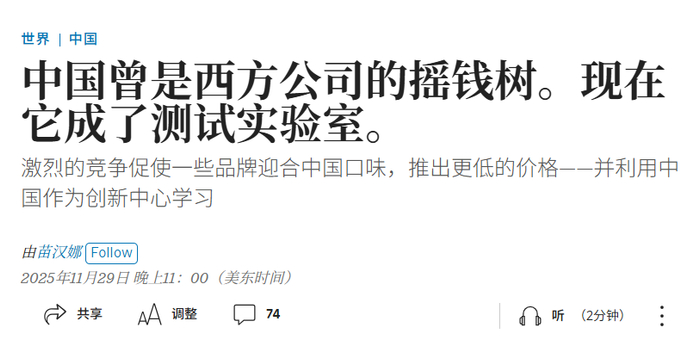
美媒发现可怕事实:能在中国市场胜出的企业,就能在全球“大杀四方”
Xin Lang Cai Jing· 2025-12-07 07:27
来源:军哥漫谈 11月29日,美媒《华尔街日报》的一篇报道揭示了一个引人深思的现象:中国市场已经成为全球竞争最 激烈的练兵场。 能在这里胜出的企业,往往具备了在全球市场脱颖而出的能力。 这一观点的背后,是中国市场角色的根本性变化,以及本土品牌的全面崛起。 《华尔街日报》表示,过去几十年,中国市场曾是外资企业的"摇钱树"。 改革开放后,大批国际品牌进入中国,从家电到汽车,从奢侈品到快消品,几乎每个领域都能看到它们 的身影。 星巴克、耐克、苹果等品牌曾在中国市场轻松赚得盆满钵满。 然而,随着中国经济的快速发展和本土品牌的强势崛起,这种局面已经发生了根本性变化。 如今的中国市场,已成为全球竞争最为激烈的战场。 外资企业不仅要面对本土品牌的强势竞争,还需要适应中国消费者日益挑剔的需求。 能够在这样残酷的环境中生存并胜出的企业,显然拥有极强的竞争力。 中国本土品牌的崛起并非偶然,而是多种因素共同作用的结果。 首先,中国连续多年蝉联世界第一大制造业国家,制造业的综合实力为本土品牌提供了强大的技术和生 产支撑。 以新能源汽车为例,比亚迪、蔚来、小鹏等品牌不仅在国内市场站稳脚跟,还逐步走向国际市场,与特 斯拉等国际巨头展开正 ...
财通证券:春季躁动的十问十答
Xin Lang Cai Jing· 2025-12-07 07:07
Core Viewpoint - The market is transitioning towards a "spring rally" with potential catalysts emerging, particularly as the year-end approaches and new policies are anticipated [2][13]. Group 1: Market Trends and Strategies - The strategy for 2026 emphasizes embracing "Galloping Assets" which are global competitive leaders, indicating a shift towards value reassessment [1][12]. - The A-share market has shown a recovery with the Shanghai Composite Index rising over 10% to above 3800 points [1][12]. - The current market phase is characterized by a period of observation and consolidation, with the potential for a spring rally to begin as early as December [2][13]. Group 2: Spring Rally Insights - The "spring rally" is expected to occur around the Lunar New Year, typically 1-2 weeks prior, with historical data suggesting a strong upward trend during this period [3][5]. - The likelihood of a spring rally varies based on market conditions: high during bottom-stimulus periods, moderate during continuation phases, and limited during downturns [4][6]. - Key indicators for the timing of the rally include significant new positive or negative developments, with potential early triggers in December [6][10]. Group 3: Sector and Style Preferences - The market favors smaller-cap indices like CSI 1000 and CSI 2000, which have shown a nearly 90% success rate with an average excess return of over 4% [6][19]. - Growth and technology sectors are highlighted as having an 80% success rate, also with an average excess return of over 4% [7][19]. - The top-performing industries are expected to be in the first tier: computer, communication, and electronics, with a second tier including machinery, chemicals, and military industries, all showing excess returns of over 3% [8][19]. Group 4: Long-term Investment Directions - The focus for long-term investments includes quality cyclical stocks benefiting from policy expectations in sectors like real estate, consumer goods, and resources [10][20]. - The strategy for the upcoming year includes a focus on "Galloping Assets" that align with China's economic transformation and global competition, particularly in technology, high-end manufacturing, consumption, and resource sectors [10][20].
