消费

Search documents
南向资金今日成交活跃股名单(12月29日)
Zheng Quan Shi Bao Wang· 2025-12-29 15:03
Group 1 - The Hang Seng Index fell by 0.71% on December 29, with southbound capital totaling HKD 115.16 billion, comprising HKD 55.87 billion in buying and HKD 59.29 billion in selling, resulting in a net sell of HKD 3.14 billion [1] - The southbound trading through Stock Connect (Shenzhen) had a total turnover of HKD 44.21 billion, with buying at HKD 20.56 billion and selling at HKD 23.65 billion, leading to a net sell of HKD 3.08 billion [1] - The southbound trading through Stock Connect (Shanghai) recorded a total turnover of HKD 70.95 billion, with buying at HKD 35.31 billion and selling at HKD 35.64 billion, resulting in a net sell of HKD 0.33 billion [1] Group 2 - Among the actively traded stocks, Alibaba-W had the highest turnover at HKD 66.55 billion, followed by Tencent Holdings at HKD 60.71 billion and SMIC at HKD 51.50 billion [1] - The top net buying stock was China Merchants Bank with a net buy of HKD 9.71 billion, closing up by 1.07%, while the highest net sell was China Mobile with a net sell of HKD 14.50 billion, closing down by 1.21% [1] - The stocks with continuous net selling included China Mobile and Tencent Holdings, with cumulative net sells of HKD 86.54 billion and HKD 20.18 billion respectively [2]






[12月29日]指数估值数据(A股港股回调;港股IPO融资大幅提升,对投资有什么影响;免费领5星级好书)
银行螺丝钉· 2025-12-29 14:05
Core Viewpoint - The article discusses the recent fluctuations in the A-share and Hong Kong stock markets, highlighting the implications of market conditions on IPO financing and investment opportunities. Group 1: Market Performance - A-shares experienced a significant rebound last week, rising by 2.7%, leading global markets, but faced a pullback today [3] - Both large, mid, and small-cap stocks in the A-share market declined today [2] - The Hong Kong stock market saw a similar trend, with the Hang Seng Index dropping by 0.71% after an initial rise [6][7] Group 2: IPO Financing and Market Conditions - Hong Kong's IPO financing has become the highest globally this year, with a total of HKD 316.6 billion, nearing the total of the previous three years [8][27] - In bear markets, low market valuations and high dividend yields create favorable conditions for investors to buy quality stocks, but discourage founders from selling shares [10][12] - In contrast, bull markets see a significant increase in financing amounts, with A-share financing in the first eight months of this year exceeding three times that of the same period last year [24][25] Group 3: Investment Strategies - The article emphasizes that during bear markets, the total dividend payout in A-shares for 2024 is projected to reach CNY 2.4 trillion, surpassing total financing [16][17] - In bull markets, the investment value of stocks tends to decline as valuations rise, necessitating profit-taking strategies [19][20] - Investors are encouraged to focus on stocks with strong cash flow and dividend yields, particularly during bear markets, as these tend to be more resilient [39][41] Group 4: Market Outlook - The market is expected to fluctuate between a low of 5.4 stars and a high of around 4.1 stars in 2025, indicating potential investment opportunities [46] - The article suggests that investing during undervalued periods is the best protection for investors against market risks [46][42]

明年,“国补”继续!范围标准优化!
Sou Hu Cai Jing· 2025-12-29 08:27
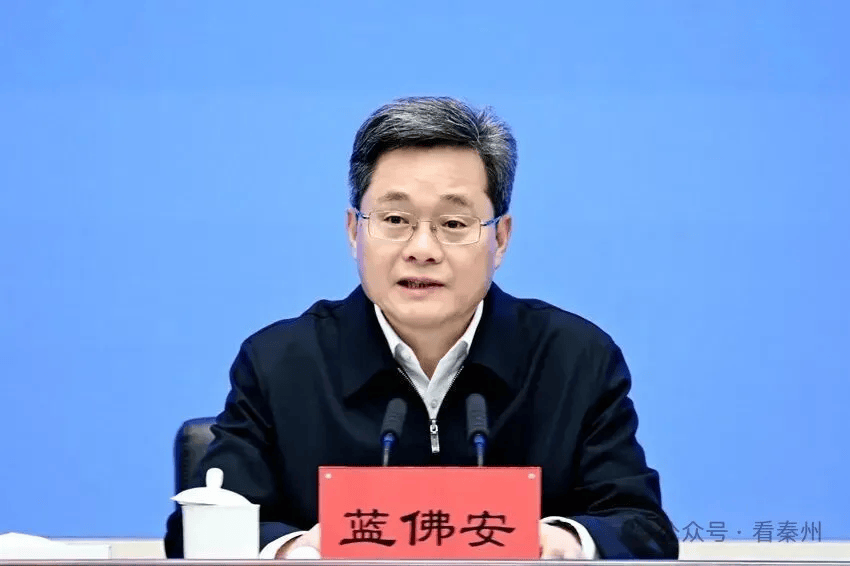
会议指出,2026年继续实施更加积极的财政政策。一是扩大财政支出盘子,确保必要支出力度。二是优化政府债券工具 组合,更好发挥债券效益。三是提高转移支付资金效能,增强地方自主可用财力。四是持续优化支出结构,强化重点领 域保障。五是加强财政金融协同,放大政策效能。 全国财政工作会议12月27日至28日在北京召开。财政部部长蓝佛安表示,明年财政将大力提振消费。深入实施提振消费 专项行动,继续安排资金支持消费品以旧换新,调整优化补贴范围和标准。 ...
2026年宏观经济形势展望:增长动能巩固,名义增速修复
Shanxi Securities· 2025-12-29 07:26
Economic Growth Outlook - China's economy is expected to maintain a reasonable growth rate of around 5% in 2026, with overall economic growth risks decreasing[2] - The decline in real estate investment is anticipated to narrow, supported by proactive policies aimed at stabilizing the housing market[3] - Consumption, infrastructure investment, and manufacturing upgrades are expected to be the main drivers of growth, with these sectors projected to grow faster than in 2025[2] Inflation and Price Trends - CPI is expected to show moderate improvement, driven by rising pork and service prices, while PPI is projected to narrow its decline and potentially rebound by Q4 2026[3] - The overall price level recovery will be gradual, characterized by "moderate recovery and structural differentiation," contributing to further nominal economic growth[3] Policy Environment - The macroeconomic policy will continue to be "proactive and effective," emphasizing coordination and flexibility, with increased counter-cyclical adjustments[2] - Fiscal policy is expected to remain "more proactive," with a projected deficit rate of around 4% and a deficit scale of approximately 5.9 trillion yuan[61] - Monetary policy will maintain an "appropriately loose" stance, with expectations of a 0.5 percentage point reduction in the reserve requirement ratio[67] Risks and Challenges - Potential risks include policy underperformance, unstable consumer expectations, escalating US-China strategic tensions, and geopolitical conflicts[4]
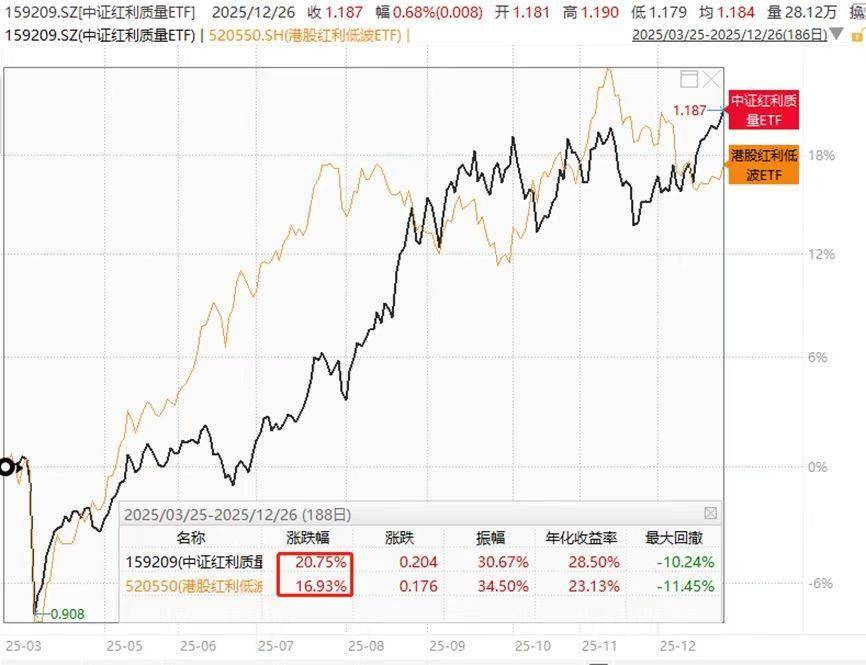
今年A股最强的红利,已涨幅超20%——兼论当下的红利投资策略
Sou Hu Cai Jing· 2025-12-29 03:28
Group 1 - The core viewpoint is that dividend assets are gaining attention in the current market due to their certainty of returns and defensive characteristics, especially in a rising valuation environment and declining risk-free interest rates [1] - The market shows structural characteristics where some blue-chip stocks have limited price increases but offer attractive dividend yields of 3%-4% combined with annual growth expectations of 5%-10% [1] - Traditional dividend ETFs have seen their dividend yields exceed 5% again, significantly higher than the domestic ten-year government bond yield of less than 2% [1] Group 2 - Among various dividend strategies, the CSI Dividend ETF (515080.SH) is a classic high-dividend representative focusing on energy and finance, currently offering a dividend yield over 5% and demonstrating strong defensive characteristics in bear markets [2] - The CSI Dividend Quality ETF (159209.SZ) emphasizes "growth" and "profit quality," focusing on consumer and pharmaceutical sectors, with its total return index rising over 20% this year, led by Kweichow Moutai as its largest weighted stock [2] - The Hong Kong Dividend Low Volatility ETF (520550.SH) focuses on "high dividends" and "stability," with its total return index increasing over 28% this year, making it an ideal defensive choice during market fluctuations [3] Group 3 - For conservative investors, a combination of "A-share Dividend Quality (growth offensive) + Hong Kong Dividend Low Volatility (high-yield defensive)" is recommended, achieving dual diversification across markets and strategy factors [5] - Both products are characterized by low fees and monthly dividends, making them suitable for long-term holding to smooth out volatility and secure predictable returns [5]
12.29盘前速览 | 八连阳逼近年关,有色与卫星共舞,市场期待“元旦红”
Sou Hu Cai Jing· 2025-12-29 01:30
Macroeconomic Dynamics - Industrial enterprise profits in November decreased by 13.1% year-on-year, indicating a weakening of overall domestic demand despite strong export performance [1] - The Federal Reserve's December meeting minutes are expected to reveal significant internal divisions, with Trump potentially designating a new Fed chair in the first week of January [1] - The 14th National People's Congress will convene for its fourth session on March 5, 2026, in Beijing [1] Satellite Internet - The commercial rocket industry is subject to new detailed listing rules under the Sci-Tech Innovation Board, requiring successful orbital launches of reusable rockets [1] - The market interest has expanded to materials related to satellite technology, including packaging, solid rocket engine materials, perfluoropolyether lubricants, coatings, and lightweight materials [1][2] Artificial Intelligence - Overseas data centers are seeking jet engine turbines and fossil fuel generators as alternative power sources due to difficulties in grid access and rising costs [5] - ZJ is rumored to procure 400 e Ascend AI chips next year, with the first batch expected to be delivered at a scale of 10 billion [6] - Huawei announced plans to launch Ascend AI chips in South Korea next year, offering a "full-stack" solution [7] - The timeline for Artificial General Intelligence (AGI) has been pushed to the 2030s, but AI adoption is expected to accelerate, with significant revenue breakthroughs anticipated in 2026 [9] New Energy - CATL plans to apply sodium batteries on a large scale in 2026 across various sectors, including battery swapping, passenger vehicles, commercial vehicles, and energy storage, indicating a "sodium-lithium dual-star" trend [9] - The battery production schedule in January is expected to remain active despite being traditionally a slow season, with positive impacts on processing fees due to positive electrode maintenance [10] - Domestic demand for lithium batteries is projected to decline significantly in early 2026 compared to Q4 [11] - A new narrative in photovoltaics links it to commercial aerospace, particularly in "space computing" energy demand [12] Robotics - The Ministry of Industry and Information Technology has established a standardization technical committee for humanoid robots and embodied intelligence [9] Autonomous Driving - The first fully vehicle-compliant unmanned logistics vehicle is set to launch in early next year [9] Market Observation - On Friday, trading volume reached 2.16 trillion, with an increase of 235.7 billion, resulting in an eight-day consecutive rise in indices. The sectors leading the gains included non-ferrous metals, electric power equipment, and steel [9] - The technology sector experienced fluctuations, potentially awaiting adjustments in satellite market conditions and index corrections before resuming upward momentum [9] - Market sentiment remains high, but caution is advised regarding the rhythm of continuous increases and changes in trading volume [9]
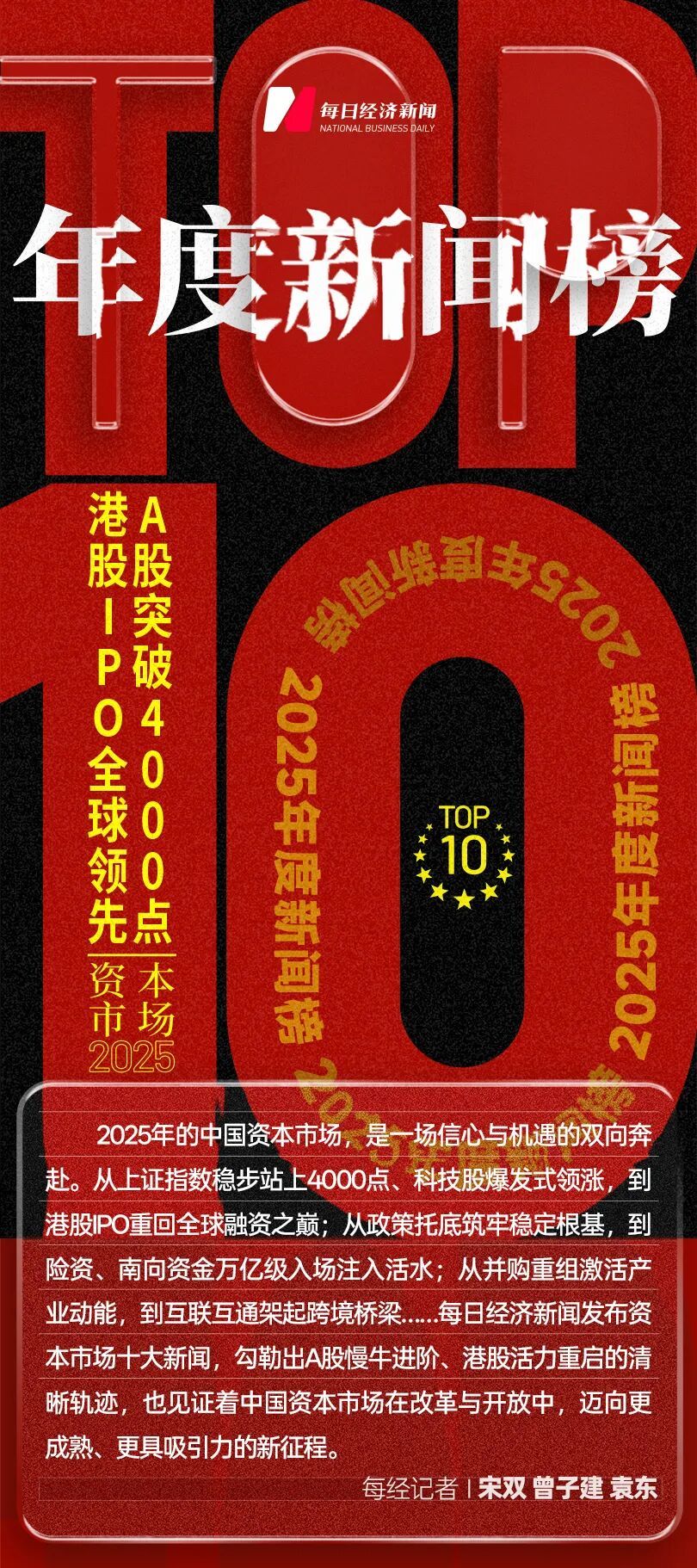
2025资本市场十大新闻出炉!A股突破4000点,港股强势回归
Mei Ri Jing Ji Xin Wen· 2025-12-28 22:47
Group 1 - The core viewpoint of the article highlights the dual momentum of confidence and opportunity in China's capital market in 2025, marked by the Shanghai Composite Index surpassing 4000 points and a resurgence in Hong Kong IPOs [2][3] - The A-share market is experiencing a "slow bull" phase, with the Shanghai Composite Index reaching a ten-year high and trading volumes frequently exceeding 3 trillion yuan [3][5] - The central government is playing a stabilizing role through the Central Huijin Investment and the People's Bank of China, which provides sufficient re-lending support, creating a "dual insurance" model for market stability [5][6] Group 2 - Insurance capital is increasing its allocation to A-shares, with the Financial Regulatory Bureau approving a 60 billion yuan pilot quota for long-term investments, and large state-owned insurance companies allocating 30% of new premiums to A-share investments [6][7] - The implementation of the revised "Major Asset Restructuring Management Measures" has led to a significant increase in the number of major asset restructurings, with 90 new cases in the Shanghai market and 109 in the Shenzhen market [8][9] - The listing of domestic GPU companies has sparked a record-breaking enthusiasm for new stock subscriptions, with the first domestic GPU stock, Moore Threads, achieving a first-day increase of 468.78% and a subscription multiple of 1572 times [10] Group 3 - The Hong Kong stock market has seen a strong recovery, with IPO fundraising reaching approximately 260 billion HKD, marking its return to the top of global financing [11][12] - Southbound funds have net inflows exceeding 1.28 trillion yuan, indicating strong liquidity support for the Hong Kong market and a recognition of valuation advantages by mainland investors [13][14] - The Hong Kong government has proposed multiple reforms to enhance market vitality and competitiveness, including shortening the stock settlement cycle and improving the "same share different rights" listing regulations [14][15]
中部六省“十五五”谋变:提效向绿扩需 重塑中国腹地增长极
Shang Hai Zheng Quan Bao· 2025-12-28 19:10
Core Viewpoint - The central six provinces of China are strategically planning their "14th Five-Year" initiatives to enhance efficiency and promote green expansion, aiming to establish a modernized growth model in the region [1] Group 1: Agricultural Development - The six provinces prioritize national food security in their planning, focusing on technological empowerment, green transformation, brand enhancement, and industry integration to redefine the modern connotation of "fish and rice country" [2] - Each province is breaking traditional agricultural paradigms by shifting towards a full industry chain layout, with initiatives such as Hubei's focus on high-quality agricultural production zones and Henan's goal of becoming a national base for quality grain and oil production [2] Group 2: Energy Transition - Energy transition is viewed as a key strategy for building a modern industrial system, with provinces like Shanxi aiming to evolve from a coal province to an energy powerhouse by integrating coal with new energy sources [3] - The construction of new energy systems is a priority, with various provinces planning to develop clean energy sources such as wind, solar, and biomass, alongside innovative energy technologies like controlled nuclear fusion [3] Group 3: Consumption and Economic Circulation - The term "consumption" appears frequently in the planning documents, indicating a strong focus on stimulating domestic demand as part of the new development pattern [4] - New consumption trends are emerging from the region, with cities experiencing rapid growth in retail sales, and initiatives to promote new economic activities such as e-sports and cultural tourism [4][5]
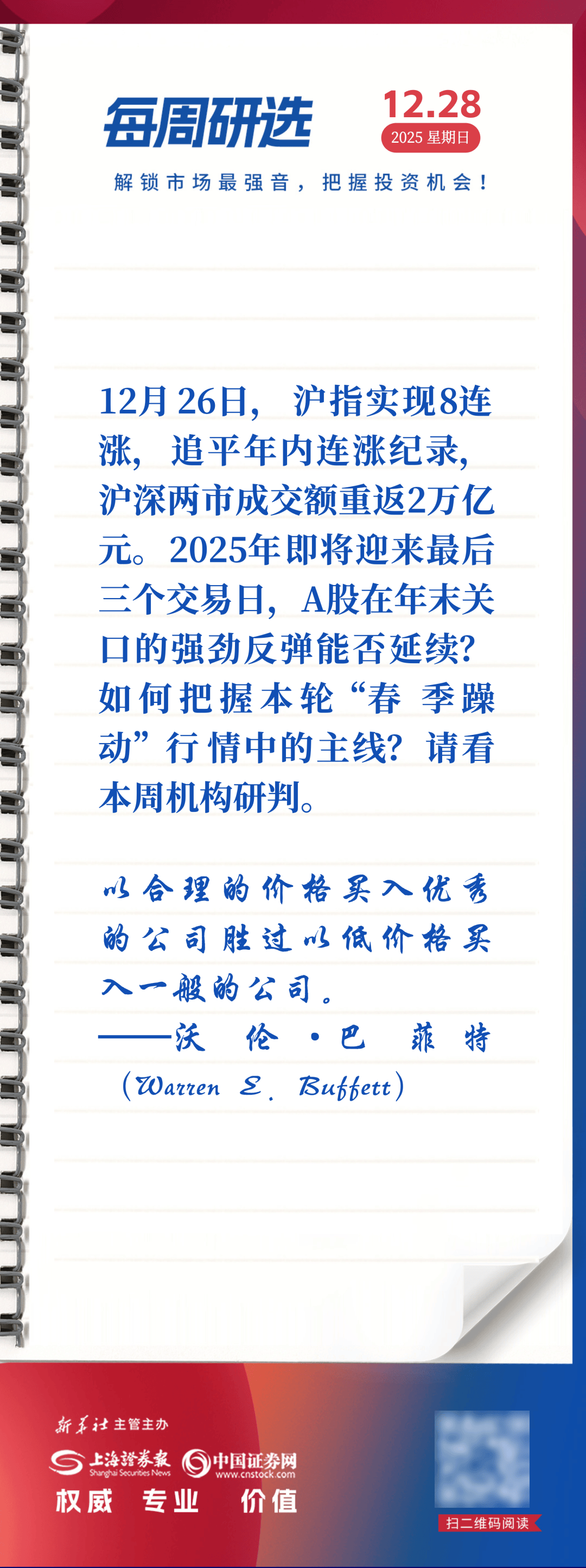
年末关口的强劲反弹能否延续?丨每周研选
Sou Hu Cai Jing· 2025-12-28 16:13
Core Viewpoint - The A-share market is experiencing a strong year-end rebound, with the Shanghai Composite Index achieving an eight-day consecutive rise, and trading volume in the Shanghai and Shenzhen markets returning to 2 trillion yuan, indicating a potential "spring rally" in the near future [4][6]. Group 1: Market Trends - The A-share market is showing signs of a "small rally" as it approaches the year-end, with significant trading volume and a notable rise in sectors such as non-ferrous metals, lithium mining, and commercial aerospace [8]. - The recent upward movement in the index is primarily driven by cyclical sectors, particularly non-ferrous metals, reflecting a recovery in market risk appetite [9]. - The current market environment is characterized by a "bottom consolidation" phase, preparing for a potential rally before the Spring Festival, rather than a full-blown upward trend [9]. Group 2: Capital Flow and Investment Strategies - Institutional buying power is expected to strengthen, driven by favorable policy expectations and a stable economic backdrop, with a notable increase in inflows into stock ETFs [10]. - The weak dollar and the appreciation of the RMB are enhancing the attractiveness of Chinese assets, leading to increased foreign investment [10]. - There is a strong willingness among various funds to enter the market, particularly as the new year approaches, indicating a potential continuation of the "spring rally" [11]. Group 3: Sector Focus and Investment Opportunities - High-growth sectors such as optical modules, PCB, and short-term supply-constrained areas like optical chips and high-speed copper cables are recommended for investment [12]. - The "price increase" narrative is acting as a catalyst for the current rally, with significant inflows into broad-based ETFs and a focus on sectors like chemicals and new energy materials [13]. - The consumption sector is also highlighted as a potential area for investment, given its relative underperformance this year and the supportive policy environment [16].
【十大券商一周策略】A股跨年行情已经启动,新的主线浮出水面
Xin Lang Cai Jing· 2025-12-28 15:19
Core Viewpoint - The A-share market is expected to experience a spring rally driven by liquidity, policy expectations, and structural opportunities, with a focus on sectors like AI, commercial aerospace, and non-bank financials [5][10][12]. Group 1: Market Trends and Predictions - 39 out of 360 industry/theme ETFs reached new highs in December, with communication and non-ferrous metals being traditional favorites, while new themes like commercial aerospace are gaining traction [3]. - The A-share market is showing signs of a spring rally, supported by liquidity and positive policy expectations, with a focus on sectors such as technology and advanced manufacturing [5][10]. - The market is expected to maintain a high risk appetite due to favorable conditions, including a weak dollar and the upcoming Chinese New Year and Two Sessions [11][16]. Group 2: Sector Focus and Investment Opportunities - Key sectors to watch include AI, commercial aerospace, and non-ferrous metals, which are expected to benefit from structural changes and increased demand [10][12]. - The manufacturing sector, particularly in chemicals and engineering machinery, is showing signs of recovery and is expected to benefit from the shift in global competition [3][4]. - Non-bank financials, including insurance and brokerage firms, are positioned to benefit from the anticipated capital inflows and improved asset returns [9][12]. Group 3: Currency and Economic Factors - The appreciation of the RMB is expected to lower import costs and enhance domestic purchasing power, benefiting sectors reliant on imports and domestic consumption [7][9]. - The potential for significant capital inflows due to RMB appreciation could lead to a revaluation of Chinese assets, creating a favorable environment for investment [7][9]. - The overall economic environment is improving, with expectations of continued liquidity support and a stable policy backdrop, which is conducive to market growth [5][10].