铜

Search documents
有色钢铁行业周观点(2025年第52周):共识开始凝聚,共同见证历史-20251229
Orient Securities· 2025-12-29 01:01
Investment Rating - The report maintains a "Positive" investment rating for the non-ferrous and steel industry in China [6]. Core Views - Consensus is beginning to form, marking a historical moment. The non-ferrous sector saw significant gains, particularly a 3.69% increase on a single day. The previously noted lagging performance of gold, copper, aluminum, and iron equities is gaining market recognition. Looking ahead, the report anticipates that commodity prices may continue to reach historical highs in 2026, suggesting active monitoring of investment opportunities in related sectors [9][13]. Summary by Sections Non-Ferrous Metals - Precious Metals: The long-term debt cycle is entering its late stage, with soaring physical prices reflecting a fundamental reaction to the erosion of trust in fiat currency systems. On December 26, silver prices surged by 10.47% in London and 11.15% on COMEX, indicating a systemic re-evaluation of asset values. The report forecasts continued record-breaking prices for precious metals in 2026, recommending a focus on investment opportunities in this sector [14]. - Copper: Labor disputes may exacerbate supply shortages, with expectations for rising copper prices and smelting fees. A potential strike at the Mantoverde copper mine could impact production, with an estimated output of around 30,000 tons of copper concentrate in 2025. The report also notes that the National Development and Reform Commission is encouraging consolidation in the copper smelting industry, which may improve smelting fees. The outlook remains positive for copper prices and smelting fees in 2026 [15]. - Aluminum: The National Development and Reform Commission may promote mergers and acquisitions among alumina producers, with aluminum prices expected to reach new highs due to the copper-aluminum price ratio effect. The report highlights the potential for steady profit growth in electrolytic aluminum enterprises and the acceleration of aluminum substitution for copper in air conditioning applications [16]. Steel Industry - Supply and Demand: The report indicates a slight increase in pig iron production, while steel demand is showing marginal weakness. The weekly consumption of rebar was reported at 2.03 million tons, reflecting a significant decrease of 2.86% week-on-week and 7.70% year-on-year [17][19]. - Inventory: Both social and steel mill inventories have decreased overall, with a slight accumulation in medium and heavy plates. Total inventory was reported at 8.73 million tons, down 3.74% week-on-week [22]. - Profitability: Cost differentiation is noted, with a recovery in steel profitability. The report states that the cost of long-process rebar has slightly decreased by 0.43%, while short-process costs have decreased by 0.13%. The profitability for long-process rebar has increased by 16 CNY per ton [29][32]. - Steel Prices: Overall steel prices have seen a slight decline, with the general steel price index decreasing by 0.28%. The report highlights that the price of cold-rolled steel has decreased by 0.58% week-on-week [36]. New Energy Metals - Supply: In November 2025, China's lithium carbonate production surged by 84.78% year-on-year, reaching 82,300 tons. The report also notes a slight increase in hydroxide lithium production [40]. - Demand: The production and sales of new energy passenger vehicles in November 2025 maintained significant year-on-year growth, with production at 1.771 million units, up 17.89% year-on-year [44]. - Prices: Prices for lithium, cobalt, and nickel have all increased. The average price for battery-grade lithium carbonate reached 120,400 CNY per ton, reflecting a week-on-week increase of 16.89% [49].
中信证券:以震荡市思维应对跨年行情
Xin Lang Cai Jing· 2025-12-28 08:45
Core Insights - In December, 39 out of 360 industry/theme ETFs reached new highs, primarily in the communication, non-ferrous metals, and military (aerospace) sectors, indicating strong market consensus on these areas [2][11] - Established sectors like communication and non-ferrous metals are seen as core investment themes, while emerging sectors such as commercial aerospace are gaining traction amid market volatility [1][3] Group 1: Performance of ETFs - The communication ETFs saw an average increase of 10% since October, with an annual average increase of 91.5% [2][12] - Non-ferrous metal ETFs experienced an average increase of 20.1% since October, with an annual average increase of 95.2% [2][12] - Military and aerospace ETFs had an average increase of 18.7% since October, with satellite ETFs rising by an average of 34.5% [2][12] Group 2: Emerging Investment Themes - Commercial aerospace is viewed as an active investment choice during market fluctuations, similar to previous low-altitude themes, driven by narratives around US-China space infrastructure competition [3][4] - The commercial aerospace sector, while promising, does not match the scale of humanoid robotics or low-altitude economies, indicating a more modest growth potential [4][14] Group 3: Under-the-Radar Sectors - Sectors like chemicals and engineering machinery are quietly rising and have reached new annual highs, reflecting China's manufacturing competitiveness and pricing power [5][15] - These sectors are characterized by low media attention and fragmented industry discussions, making them susceptible to being overlooked despite their potential for profit margin improvement [5][15] Group 4: Anti-Inflation Trends - Sectors related to anti-inflation, such as new energy and steel, are showing signs of recovery, with market sensitivity to supply dynamics increasing [6][16] - Recent supply chain disruptions in the new energy sector have led to positive stock price reactions, indicating market expectations for tangible supply reductions [6][16] Group 5: Investment Strategy - The current market strategy emphasizes structural opportunities in a volatile market, focusing on sectors with low heat and concentration but increasing attention and potential for long-term ROE improvement, such as chemicals, engineering machinery, and new energy [7][17] - The strategy also includes monitoring the trend of RMB appreciation, with sectors like brokerage and insurance being positioned as both offensive and defensive choices [7][17]

有色金属行业研究:有色金属周报:能源金属价格齐飞,看好股票后续补涨-20251228
SINOLINK SECURITIES· 2025-12-28 07:59
Group 1: Copper - LME copper price increased by 2.21% to $12,133.0 per ton, while Shanghai copper rose by 5.95% to 98,700 yuan per ton [1] - Domestic copper inventory increased by 14.96% week-on-week, with total inventory up by 88,200 tons year-on-year [1] - High copper prices are suppressing market demand, leading to a decline in operating rates for domestic wire and cable enterprises [1] Group 2: Aluminum - LME aluminum price rose by 0.03% to $2,956.50 per ton, and Shanghai aluminum increased by 0.99% to 22,400 yuan per ton [2] - Domestic electrolytic aluminum ingot inventory recorded 617,000 tons, with a week-on-week increase of 17,000 tons [2] - The overall operating rate of downstream aluminum processing enterprises decreased by 0.6 percentage points to 60.8% due to weak orders and high aluminum prices [2] Group 3: Gold - COMEX gold price increased by 3.24% to $4,505.4 per ounce, with SPDR gold holdings rising by 15.73 tons to 1,068.27 tons [3] - Geopolitical risks are influencing the gold market, leading to a strong oscillation pattern [3] - The market is anticipating significant developments in international relations that could impact gold prices [3] Group 4: Rare Earths - The price of praseodymium and neodymium oxide increased by 3.33% this week [4] - China's rare earth permanent magnet exports in November increased by 12% month-on-month and 28% year-on-year, reaching a historical high for the same period [4] - The expectation of more relaxed export policies is boosting demand forecasts for rare earths [4] Group 5: Lithium - The average price of lithium carbonate increased by 6.94% to 103,400 yuan per ton, while lithium hydroxide rose by 3.22% to 89,800 yuan per ton [5] - Lithium production increased to 22,200 tons this week, with a slight rise in output [5] - The supply-demand balance remains stable, with strong demand from the new energy sector supporting high prices [5] Group 6: Antimony - Antimony price decreased by 1.85% this week, attributed to profit-taking by speculative funds [4] - The outlook remains positive for antimony prices due to expected recovery in exports and stable demand [4] - Resource scarcity and reduced production from overseas mines are expected to support upward price trends [4] Group 7: Tin - Tin price decreased by 1.07% this week, with inventory increasing by 4.72% [4] - Supply disruptions in major overseas tin mining regions are contributing to price fluctuations [4] - The long-term outlook for tin remains positive due to expected demand growth in sectors like semiconductors and photovoltaics [4] Group 8: Nickel - LME nickel price increased by 7.0% to $15,700 per ton, while Shanghai nickel rose by 12.0% to 125,000 yuan per ton [5] - Nickel market sentiment turned optimistic due to potential supply tightening from Indonesia [5] - Current market dynamics reflect a balance between strong expectations and weak demand realities [5]
有色金属大宗金属周报(2025/12/22-2025/12/26):供给偏紧逻辑持续演绎,铜价强势突破创历史新高-20251228
Hua Yuan Zheng Quan· 2025-12-28 05:53
Investment Rating - The investment rating for the non-ferrous metals industry is "Positive" (maintained) [4] Core Viewpoints - The supply tightness logic continues to unfold, with copper prices breaking through historical highs. This week, copper prices increased significantly, with London copper rising by 3.22%, Shanghai copper by 5.95%, and New York copper by 6.71%. London copper surpassed $12,000 per ton, while Shanghai copper exceeded ¥100,000 per ton. Supply-side concerns are heightened due to potential strikes at Chilean copper mines, which could exacerbate the tight supply situation. The report suggests focusing on companies such as Zijin Mining, Luoyang Molybdenum, Jiangxi Copper, and others [5][4] Summary by Sections 1. Industry Overview - The non-ferrous metals sector outperformed the market, with the Shanghai Composite Index rising by 1.88% and the non-ferrous sector increasing by 6.43%, outperforming the index by 4.54 percentage points. Lithium, copper, and tungsten sectors showed the highest gains, while rare earths and tin lagged behind [11][12] 2. Industrial Metals 2.1 Copper - London copper prices rose by 3.22%, Shanghai copper by 5.95%, and New York copper by 6.71%. London copper inventory decreased by 2.10%, while Shanghai inventory increased by 16.59%. The smelting fee was reported at -$44.9 per ton, indicating a loss in copper smelting profits [26][23] 2.2 Aluminum - London aluminum prices increased by 0.48%, and Shanghai aluminum prices rose by 1.57%. Inventory levels for both London and Shanghai aluminum saw slight increases. The price of alumina fell by 2.36%, while aluminum smelting profits rose by 5.70% to ¥6,402 per ton [37][37] 2.3 Lead and Zinc - London lead prices increased by 0.63%, and Shanghai lead prices rose by 3.00%. London zinc prices rose by 0.75%, while Shanghai zinc prices increased by 0.52%. Smelting processing fees decreased by 6.25% to ¥1,500 per ton, with mining profits rising to ¥10,004 per ton [51][51] 2.4 Tin and Nickel - London tin prices fell by 1.26%, while Shanghai tin prices decreased by 0.26%. Conversely, London nickel prices rose by 5.82%, and Shanghai nickel prices increased by 9.33%. Nickel iron prices rose by 2.23%, with domestic nickel iron enterprises reporting profits of ¥5,955 per ton [64][64] 3. Energy Metals 3.1 Lithium - Lithium prices saw significant increases, with lithium spodumene rising by 13.05% to $1,490 per ton, and lithium carbonate increasing by 14.59% to ¥111,900 per ton. However, the smelting profit margins for lithium were negative [80][80] 3.2 Cobalt - Cobalt prices also increased, with MB cobalt rising by 0.20% to $24.50 per pound, and domestic cobalt prices increasing by 5.45% to ¥445,000 per ton. The profit margins for domestic smelting plants rose significantly [93][93]
综合晨报-20251226
Guo Tou Qi Huo· 2025-12-26 02:20
Report Summary 1. Report Industry Investment Ratings There is no information about industry investment ratings in the provided content. 2. Core Views - The overall market shows a mixed trend with various factors influencing different commodities. Geopolitical events, supply - demand dynamics, and macro - economic conditions are the main drivers of price movements. For example, geopolitical conflicts often provide short - term price support, but in the long run, supply - demand fundamentals play a dominant role [1][21]. - Many commodities are in a state of supply - demand adjustment, with some facing oversupply (e.g., alumina), while others have potential supply shortages (e.g., nickel in the future). Market sentiment and expectations also have a significant impact on prices, such as the impact of减产 expectations on polycrystalline silicon [5][12]. 3. Summary by Commodity Energy - **Crude Oil**: Due to attacks on Russian ports and slow repairs, Kazakhstan's December CPC crude exports will hit a 14 - month low. US shale oil production remains high despite reduced drilling. Geopolitical conflicts may cause short - term price rebounds, but the long - term trend is towards a lower price center due to loose supply [1]. - **Fuel Oil & Low - Sulfur Fuel Oil**: High - sulfur fuel oil rose sharply, mainly driven by geopolitical news. However, in the medium term, supply is abundant. Low - sulfur fuel oil is expected to remain weak as supply increases [20]. - **Asphalt**: Supply - demand is marginally loose. Geopolitical conflicts boost prices from the cost side, but it will eventually return to a price - pressured pattern due to supply - demand [21]. Metals - **Precious Metals**: Supported by the Fed's easing prospects and geopolitical risks, domestic precious metals are strong. Volatility is high in the short term [2]. - **Base Metals** - **Copper**: Domestic spot supply - demand gives copper price adjustment pressure, but raw material shortages may be transmitted to refined copper. It is recommended to take partial profits on long positions [3]. - **Aluminum**: The fundamentals have limited contradictions. It follows the rise of other metals, and long positions can be held with the 40 - day line as support [4]. - **Alumina**: Supply is in excess, and the price is weak until significant production cuts occur [5]. - **Zinc**: The bottom support is strong, and the price range is expected to be 22,800 - 23,800 yuan/ton in January [7]. - **Lead**: It fluctuates in the range of 17,000 - 17,500 yuan/ton under the game of cost and consumption [8]. - **Nickel & Stainless Steel**: Policy news has a major impact. Wait for market disturbances to end and take a short - term wait - and - see approach [9]. - **Tin**: Pay attention to the MA10 moving average. There are risks at high levels, and it is recommended to configure out - of - the - money put options for spring contracts [10]. - **Lithium Carbonate**: The price is strongly oscillating, and the fundamentals are generally strong [11]. Chemicals - **Polypropylene & Plastic & Propylene**: Propylene supply is loose, and the prices of polyethylene and polypropylene are under downward pressure [26]. - **PVC & Caustic Soda**: PVC may run in a low - level range, and caustic soda is expected to have limited upward space [27]. - **PX & PTA**: PX has a strong expected pattern, and PTA's upward drive comes from PX. Keep a long - term long - allocation idea [28]. - **Ethylene Glycol**: It oscillates at a low price, and the supply - demand may improve in the second quarter [29]. Agricultural Products - **Soybeans & Soybean Meal**: The trading logic returns to concerns about US soybean exports and South American production expectations. Soybean meal will follow the trend of US soybeans [34]. - **Vegetable Oils**: The macro - sentiment is improving, and the fundamentals of palm oil are less bearish. Pay attention to South American crop weather [35]. - **Rapeseed & Rapeseed Oil**: The supply of rapeseed is in excess globally. Adopt a short - selling strategy on rebounds in the medium term and a wait - and - see strategy in the short term [36]. - **Corn**: The futures contract may oscillate weakly in the short term. Pay attention to the selling progress in the Northeast and auctions [38]. - **Pigs**: The futures price of the main contract is expected to be weak in the first half of next year [39]. - **Eggs**: Take a long - term long - position view, but beware of rapid price increases due to capital front - running [40]. - **Cotton**: The domestic cotton market is supported by factors such as fast sales and low commercial inventory. Adopt a long - position strategy when the price is low [41]. - **Sugar**: The international sugar market supply is sufficient, and the domestic sugar price rebound may be limited [42]. - **Apples**: The market is bearish, and a short - position strategy is recommended [43]. Others - **Industrial Silicon**: Driven by the expectation of concentrated production cuts in the North, the futures price may maintain an oscillating pattern [13]. - **Rebar & Hot - Rolled Coil**: The supply pressure is gradually relieved, but the downstream demand is still weak. The market may continue to oscillate [13]. - **Iron Ore**: The supply is abundant, and the demand is at a low level. The short - term trend is expected to be oscillating [14]. - **Coke & Coking Coal**: The supply of carbon elements is sufficient, and the demand has some resilience. The prices are likely to oscillate [15][16]. - **Silicon Manganese & Silicon Ferrosilicon**: Adopt a long - position strategy when the price is low [17][18]. - **Container Shipping Index (Europe Line)**: The spot price has risen, but there may be price fluctuations in the future. Pay attention to shipping companies' strategies during the Spring Festival [19]. - **Urea**: The supply - demand situation has improved marginally, and the market is strongly oscillating [22]. - **Methanol**: In the short term, the price may oscillate weakly in a range, and a long - position strategy for the 5 - 9 spread can be considered in the long term [23]. - **Pure Benzene**: It oscillates at the bottom. Consider a long - position strategy for the month - spread in the medium term [24]. - **Styrene**: The supply pressure is difficult to reverse, and the market purchases are mainly for rigid demand [25]. - **Paper Pulp**: The short - term upward space is limited, and the port inventory is decreasing. Adopt a wait - and - see strategy [45]. - **Stock Index**: The A - share market is rising, and the index futures are also up. Pay attention to the relationship between the US dollar, precious metals, and domestic policies [46]. - **Treasury Bonds**: The long - term interest rate has risen significantly, and the yield curve is likely to become steeper [47].
广发早知道:汇总版-20251226
Guang Fa Qi Huo· 2025-12-26 01:12
Report Industry Investment Rating No relevant content provided. Core Viewpoints of the Report The report offers a comprehensive analysis of various futures markets, including financial derivatives, precious metals, shipping indices, non - ferrous metals, black metals, agricultural products, and energy chemicals. It details the current market situation, influencing factors, and future outlooks for each category, and provides corresponding trading strategies. Summary by Directory Daily Selections - **Copper**: High copper prices have suppressed terminal demand, leading to significant spot discounts and inventory accumulation. Upward drivers include further deterioration of overseas inventory structure and improved interest - rate cut expectations; downward drivers are weak demand. Suggest a light - position holding of a protective put option portfolio [2]. - **PP**: The basis weakens, and trading improves. Pay attention to the expansion of PDH profits [3]. - **Coking Coal**: Spot coal prices vary, and the upside of the futures price is limited. Switch to short - selling on rallies [3]. - **Soybean Meal**: South American harvest expectations suppress prices, but cost supports the downside. Concerns about customs policies affect domestic supply. Be cautious in short - term operations [4]. - **Silver**: Supply tightness and capital drive prices to maintain a strong - side oscillation. Hold long positions, and reduce or lock positions before the Spring Festival [5]. Financial Derivatives Stock Index Futures - **Market Performance**: A - share indices rise, and the basis of the four major stock index futures contracts is repaired. The short - term negative factors are exhausted, and the index rebounds [7][8][9]. - **News**: Beijing eases housing purchase restrictions, and the US raises IPO liquidity thresholds [8][9]. - **Funding**: A - share trading volume is stable, and the central bank conducts net injections [9]. - **Operation Suggestion**: Try a bull - spread strategy on the CSI 300 index [9]. Treasury Bond Futures - **Market Performance**: Treasury bond futures decline, and short - term bonds are relatively strong [10]. - **Funding**: The central bank's reverse - repurchase operations result in net injections, and the funding rate is seasonally up but controllable [10]. - **Operation Suggestion**: Consider going long on the T contract on pullbacks and participate in the 2603 contract cash - and - carry arbitrage and basis - widening strategies [12]. Precious Metals - **Market Review**: Overseas markets are closed for holidays. Some precious metals experience price adjustments, with platinum strengthening and palladium once hitting the daily limit down [13][15]. - **Outlook**: The medium - to - long - term price of precious metals has an upward trend, but short - term fluctuations exist. Adopt a long - position strategy on dips [16]. Shipping Index (European Line) - **Index**: SCFIS and SCFI indices show an upward trend [19]. - **Fundamentals**: Container capacity increases, and demand in the eurozone and the US is weak [19]. - **Logic**: The futures contract is in a consolidation phase, with limited drivers, and is expected to oscillate in the short term [19]. Non - Ferrous Metals - **Copper**: High prices suppress demand, and the price is expected to oscillate strongly in the short term. Hold protective put options [24]. - **Alumina**: The market is oversupplied, and the price is expected to oscillate around the cash - cost line [26]. - **Aluminum**: The market is in a state of macro - positive expectations versus fundamental pressure, and the price is expected to oscillate widely [29]. - **Aluminum Alloy**: High costs and weak demand limit price movements, and the price is expected to oscillate in a high - level range [31]. - **Zinc**: TC stabilizes, demand is weak, and the price is expected to oscillate weakly [36]. - **Tin**: Supply is improving, and the price is expected to oscillate at a high level. Adopt a wait - and - see approach [40]. - **Nickel**: The market is affected by expectations of tightened ore supply, and the price is expected to oscillate strongly [42]. - **Stainless Steel**: The market is in a state of strong expectations versus weak reality, and the price is expected to oscillate and adjust [46]. - **Lithium Carbonate**: The market is in a state of high - level oscillation, with strong capital sentiment. The price is expected to oscillate widely [50]. - **Polysilicon**: The price is in a high - level oscillation, with demand weakness. Adopt a wait - and - see approach [53]. - **Industrial Silicon**: The price is expected to oscillate at a low level. Pay attention to production - cut implementation [55]. Black Metals - **Steel**: Steel production is cut, and inventory is reduced. The price is expected to oscillate. Consider exiting the 1 - 5 positive spread and looking for opportunities to go long on the 5 - month iron - ore ratio [57][58]. - **Iron Ore**: Supply is at a high level, and demand is weak. The price is expected to oscillate. Adopt a short - term range - trading strategy on the 05 contract [60]. - **Coking Coal**: Supply may decrease, and demand is weak. Switch to short - selling on rallies [66]. - **Coke**: The third price cut is implemented, and the price is expected to decline. Switch to short - selling on rallies [70][71]. - **Silicon Iron**: Supply is reduced, and demand is stable. The price is expected to oscillate in a range [73]. - **Silicon Manganese**: High inventory suppresses price rebounds, and the price is expected to run weakly. Consider short - selling when the price rebounds above the Ningxia spot cost [76]. Agricultural Products - **Soybean Meal and Rapeseed Meal**: South American harvest expectations suppress prices, and customs policies affect domestic supply. Be cautious in short - term operations [79]. - **Pigs**: Seasonal demand supports the market, and the price is expected to oscillate strongly in the short term [81]. - **Corn**: Supply and demand are balanced, and the price is in a stalemate. Pay attention to selling sentiment and policy releases [84]. - **Sugar**: The international market is bearish, and the domestic market may have limited rebounds. Adopt a bearish - on - rebounds strategy [85]. - **Cotton**: US cotton oscillates at the bottom, and domestic cotton prices are expected to rise. The supply pressure is released, and the long - term outlook is optimistic [88]. - **Eggs**: Supply pressure is high but eases marginally. Near - month contracts are expected to oscillate at the bottom [92]. - **Oils**: Palm oil may continue to rise but also faces downward risks. Soybean oil and rapeseed oil have different market situations. Adopt corresponding strategies according to different varieties [93][95][96]. - **Jujubes**: The price rebounds. Pay attention to sales in the distribution areas. Consider selling call options [97]. - **Apples**: The price oscillates. Consider closing long positions [98]. Energy Chemicals - **PX**: Valuation increases, and downstream feedback is negative. The upside is limited. Reduce long positions on rallies and consider long - term low - buying [100]. - **PTA**: Follow PX trends, and the upside is limited. Reduce long positions on rallies and consider long - term low - buying [102]. - **Short - Fiber**: Supply is high, and demand is weak. Follow raw - material fluctuations [104]. - **Bottle Chips**: Supply is expected to increase, and processing fees may be compressed. Adopt the same strategy as PTA and short - sell processing fees on rallies [106]. - **Ethylene Glycol**: Supply is expected to decrease, but the cost support is limited. The price is expected to oscillate. Adopt a 5 - 9 reverse - arbitrage strategy [108]. - **Pure Benzene**: Supply is stable, and demand is weak. The price is expected to oscillate in a range [109]. - **Styrene**: Supply and demand both increase, and the price is expected to oscillate in a range [111]. - **LLDPE**: Supply and demand are weak. Go long on the 2605 contract in the short term [113]. - **PP**: Pay attention to the expansion of PDH profits [3]. - **Methanol**: The market is expected to balance in the first quarter of next year. Pay attention to the contraction of MTO05 [114]. - **Caustic Soda**: Supply and demand are under pressure, and the price is expected to decline [116]. - **PVC**: Supply is expected to increase, and demand is weak. The price is expected to decline after a rebound [117]. - **Soda Ash**: Supply is stable, and demand is weak. Short - sell on rallies [120]. - **Glass**: The price is under pressure. Adopt a wait - and - see approach [120]. - **Natural Rubber**: The price is driven by macro - sentiment, but the fundamentals are weak. Try short - selling around 15700 [122]. - **Synthetic Rubber**: The price is expected to oscillate strongly in the short term. Avoid short - selling the BR2602 contract [124][125].
白银涨势重起:申万期货早间评论-20251226
申银万国期货研究· 2025-12-26 00:35
Core Viewpoint - The article discusses the current market trends and economic indicators, highlighting the mixed signals in various sectors, including precious metals, stock indices, and crude oil, while emphasizing the potential for policy support and market recovery in the near future [1][2][3][4]. Precious Metals - Silver prices have surged to a historical high, driven by lower-than-expected U.S. CPI data, which stands at 2.7% year-on-year, below the anticipated 3.1% [2][17]. - The overall downtrend in CPI provides room for interest rate cuts, supporting the long-term upward trend in precious metals due to factors like weakened dollar credit and central bank gold purchases [2][17]. Stock Indices - U.S. stock markets were closed, but previous trading saw an increase in stock indices, particularly in the defense and military sectors, with a total market turnover of 1.94 trillion yuan [3][10]. - The financing balance increased by 10.127 billion yuan, indicating a positive outlook for A-shares, supported by policy backing, capital influx, and industrial empowerment [3][10]. Crude Oil - Crude oil prices saw a slight increase of 0.38%, with Saudi Arabia's average daily crude oil exports reaching a two-and-a-half-year high of 7.1 million barrels in October, up from 6.46 million barrels in September [4][13]. - Despite geopolitical tensions and potential sanctions on Russia, the overall trend for crude oil remains downward [4][13]. Economic Indicators - The U.S. non-farm payroll data showed a mixed picture, with an addition of 64,000 jobs, surpassing the expected 50,000, but the unemployment rate rose to 4.6% [2][17]. - The People's Bank of China is expected to maintain a moderately loose monetary policy to support economic stability and reasonable price recovery [7][12]. Industry News - The Shenzhen Stock Exchange issued a notice to Sunflower regarding its asset acquisition plan, indicating ongoing corporate activities and market dynamics [8]. Shipping Index - The European shipping index showed fluctuations, with expectations for price stability as shipping companies prepare for increased demand ahead of the Lunar New Year [30].


综合晨报-20251225
Guo Tou Qi Huo· 2025-12-25 02:16
gtaxinstitute@essence.com.cn 综合晨报 2025年12月25日 【原油】 继美国接连扣押油轮后,目前委内瑞拉海域有十余艘满载油轮正等待船东的新指示。俄罗斯黑海塔 口码头遇袭,恶劣天气导致维修进度缓慢,哈萨克斯坦12月CPC混合原油出口将降至14个月最低水 平。美国页岩油行业钻井与压裂活动虽降至数年新低,然而由于产量调整存在时滞,美国原油产量 仍维持在年内高位。她缘冲突多发引发市场对原油供应中断担忧,然基本面宽松主基调未改,地缘 扰动更倾向于提供阶段性反弹动力。 (责金属) 【铜】 隔夜铜价震幅扩大,沪铜加权减仓,海外资金圣诞休市。国内现货背离加大,昨日上海铜贴水扩至 310元,短线国内现货供求给予铜价更大调整压力。但同时需求淡季下,原料紧张可能向国内精铜传 导,且价差利于出口。一季度合约多配需求持续性强,前期多单持有依托位上调到9.4万,同时建议 设置主动止盈位。 【铝】 隔夜沪铝回落。铝市基本面矛盾依然有限,社库窄幅波动,表观需求并无亮眼表现。近期宽松交易 延续,贵金属和有色多品种创新高,沪铝跟涨为主,圣诞节假期来临资金有离场迹象,沪铝在前高 位置仍具备阻力、多头背靠40日线持有 ...
楚江新材涨2.00%,成交额3.25亿元,主力资金净流入1877.20万元
Xin Lang Cai Jing· 2025-12-25 02:07
Core Viewpoint - Chujiang New Materials has shown significant stock performance with a year-to-date increase of 55.37%, indicating strong market interest and potential growth in the materials sector [1][2]. Group 1: Stock Performance - As of December 25, Chujiang New Materials' stock price reached 12.74 CNY per share, with a trading volume of 3.25 billion CNY and a market capitalization of 20.676 billion CNY [1]. - The stock has experienced a 6.88% increase over the past five trading days, a 12.25% increase over the past 20 days, and a 33.68% increase over the past 60 days [1]. - The company has appeared on the "Dragon and Tiger List" once this year, with a net buy of 38.189 million CNY on October 16 [1]. Group 2: Company Overview - Chujiang New Materials, established on December 21, 2005, and listed on September 21, 2007, is located in Wuhu City, Anhui Province, and specializes in the research, processing, and sales of non-ferrous metal materials, particularly copper [2]. - The company's revenue composition includes 96.79% from copper-based materials, 2.09% from high-end equipment and carbon fiber composite materials, and 1.12% from steel-based materials [2]. - The company operates within the non-ferrous metals industry, specifically in industrial metals and copper, and is involved in sectors such as carbon fiber, fuel cells, and low-altitude economy [2]. Group 3: Financial Performance - For the period from January to September 2025, Chujiang New Materials reported a revenue of 44.191 billion CNY, reflecting a year-on-year growth of 13.29%, and a net profit attributable to shareholders of 355 million CNY, marking a substantial increase of 2089.49% [2]. - The company has distributed a total of 1.36 billion CNY in dividends since its A-share listing, with 479 million CNY distributed over the past three years [3]. Group 4: Shareholder Information - As of September 30, 2025, the number of shareholders increased to 72,300, a rise of 67.75%, while the average number of circulating shares per person decreased by 35.84% to 22,327 shares [2]. - Notable changes in institutional holdings include Hong Kong Central Clearing Limited entering as the fifth-largest shareholder with 20.339 million shares, while several funds reduced their holdings [3].

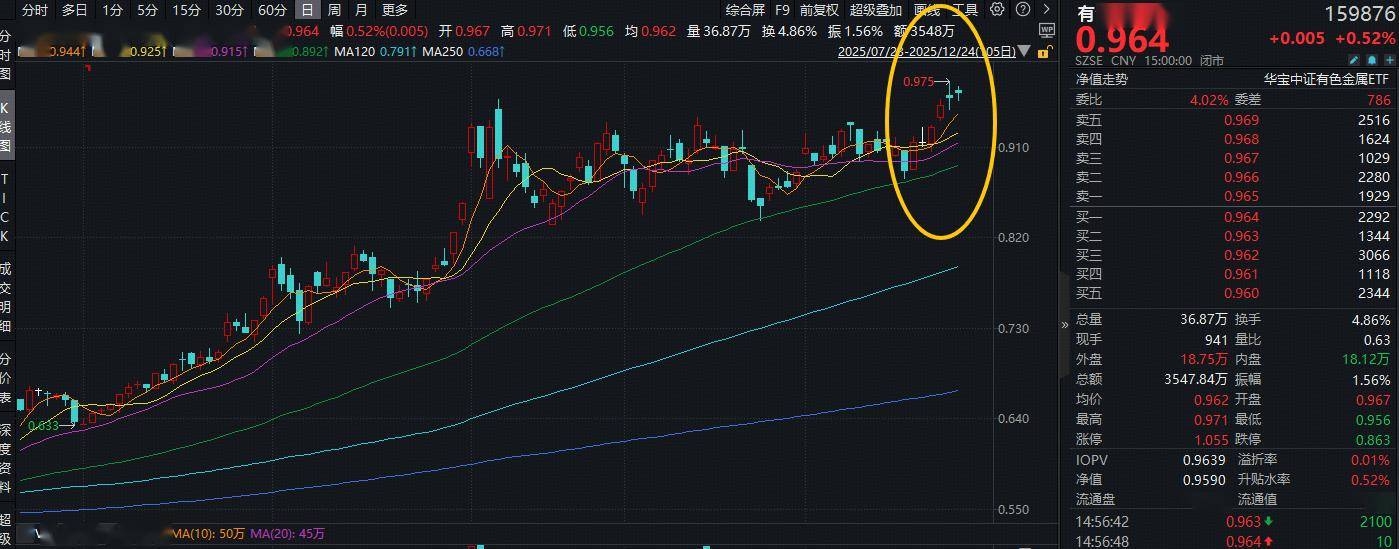
ETF盘前资讯|新高又新高!金、铜携手狂飙,资金积极抢筹!有色ETF华宝(159876)单日吸金981万元
Sou Hu Cai Jing· 2025-12-25 01:53
Group 1: Gold Market Insights - Gold prices have reached an all-time high of $4500 per ounce, with a cumulative increase of over 70% this year [1] - Factors driving gold prices include geopolitical tensions between the US and Venezuela, potential conflicts involving Iran and Israel, uncertainties from the Russia-Ukraine conflict, a weakening dollar, and rising expectations of interest rate cuts by the Federal Reserve [1] - Analysts from Dongfang Jincheng believe gold prices will remain in an upward trend due to rising US debt risks, strong global central bank demand for gold, and ongoing interest rate cuts in the US [1] Group 2: Copper Market Dynamics - Copper futures have surpassed $12,000 per ton for the first time, driven by supply disruptions from mine shutdowns, surging industrial demand, concerns over potential copper tariffs, and expectations of monetary easing from the Federal Reserve [1] - The price of copper has increased by over 38% this year, potentially marking the largest annual gain since 2009 [1] - Citigroup forecasts that in a bullish scenario, copper prices could reach $15,000 per ton as a result of a weaker dollar and further interest rate cuts, attracting more investors [2] Group 3: Broader Non-Ferrous Metals Outlook - The non-ferrous metals sector offers diverse investment strategies, including precious metals like gold for hedging, and strategic metals like lithium and rare earths benefiting from technological advancements [2] - Analysts from CITIC Securities and Zhongtai Securities expect the non-ferrous metals sector to continue its bullish trend, driven by rigid supply-demand dynamics and geopolitical tensions [2] - The Huabao ETF, which covers a wide range of non-ferrous metals, has seen significant inflows, indicating investor confidence in the sector's future performance [2][4]