金融

Search documents
中国最大的支柱产业曝光,已经取代房地产,未来甚至会超越美国
Sou Hu Cai Jing· 2026-02-08 23:46
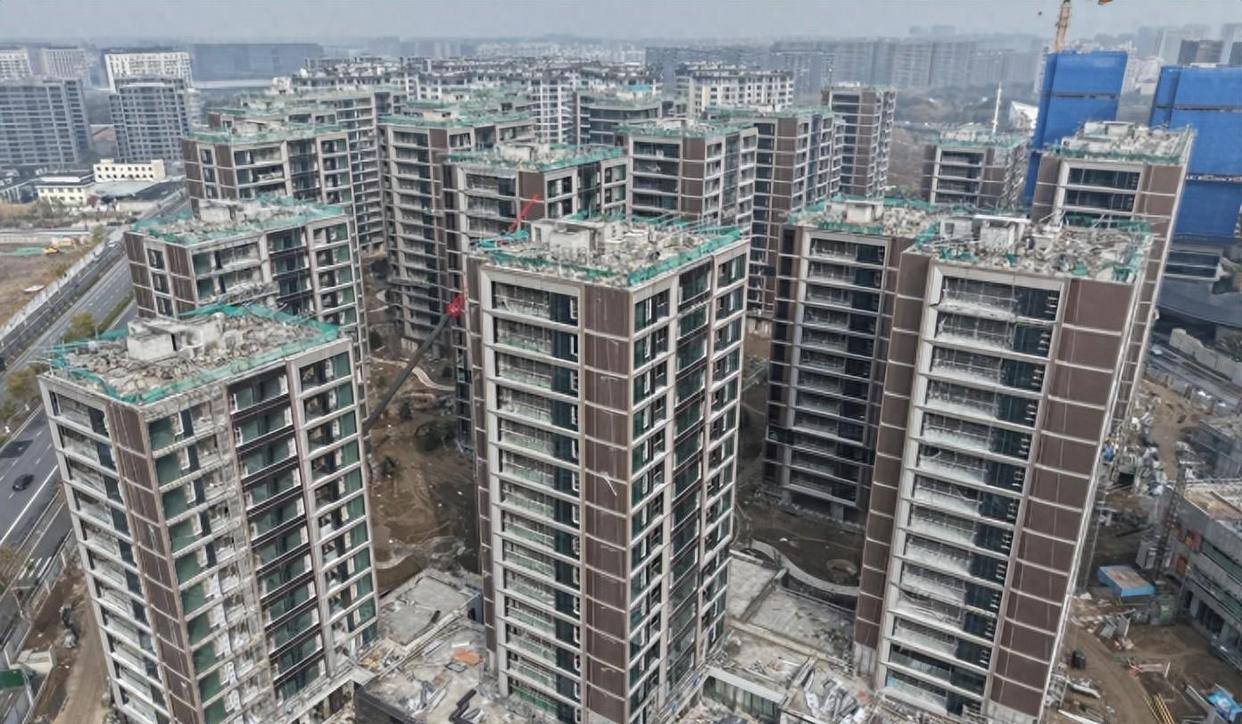
新王加冕,大势已定 曾经呼风唤雨的楼市"霸主",如今的情况真是惨不忍睹啊。烂尾楼的阴影没散去,断供潮的恐慌还在蔓延,房价一路阴跌犹如钝刀割肉,坏消息接连不断, 就像多米诺骨牌一样接踵而至。 那段只要闭着眼睛买房就能实现财富自由的黄金岁月,好像一夜之间已经藏进了泛黄的旧日历里。 最近这几年,房地产行业逐渐式微,中国的主要经济支柱也在发生转变,眼下看来,整个经济结构似乎在悄然改变。 而且,这个在潜移默化中影响人们生活方式的产业,将来很可能会让美国远远落在后面。 这个产业其实就是科技和数字经济,而它跟我们这些普通人关系挺大的。毕竟,从你我日常用的手机、网购,到工作、学习,都离不开它的支撑。 这些新兴的产业正在逐步改变我们的生活方式,有时候感觉像是在悄悄地把日子变得更方便、更智能。 很多国人仍旧陷在房产这片泥潭里,面对每个月的还贷账单,唉声叹气。有的人甚至发出感叹:"要不是靠房地产,又还能靠什么支撑中国这艘大船的经 济?" 可是,就在大家对着满目疮痍的楼市废墟感慨叹息的时候,一组令人震惊的数字却在暗潮中快速上升,不断冲击着人们的心理。 你以为经济引擎停摆了?其实,一位全新的万亿级"隐形巨头"早已经悄悄地接过接力棒了。 ...

A股分析师前瞻:兼具胜率与赔率,策略分析师普遍看好持股过节
Xuan Gu Bao· 2026-02-08 13:49
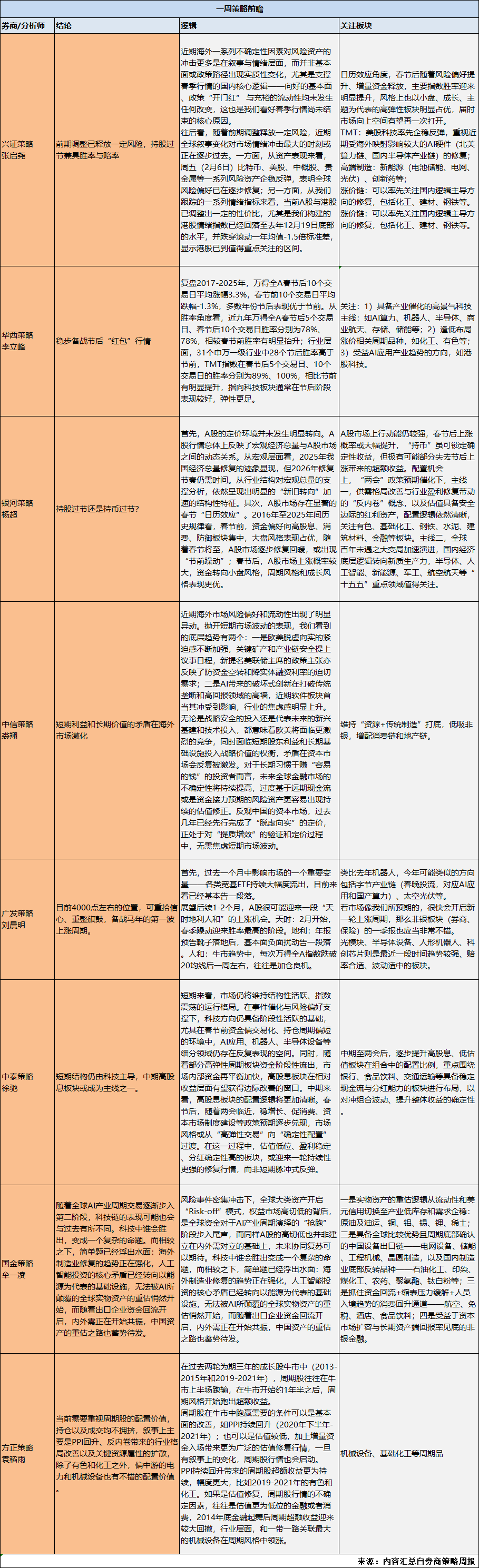
本周各家券商策略分析师讨论的焦点在于是否持股过节,整体偏向乐观。 华西策略李立峰团队也指出,可稳步备战节后"红包"行情。 其复盘2017-2025年,万得全A春节后10个交易日平均涨幅3.3%,春节前10个交易日平均跌幅-1.3%,多数年份节后表现优于节 前。从胜率角度看,近九年万得全A春节后5个交易日、春节后10个交易日胜率分别为78%、78%,相较春节前胜率有明显抬升; 行业层面,31个申万一级行业中28个节后胜率高于节前,TMT指数在春节后5个交易日、10个交易日的胜率分别为89%、100%, 相比节前有明显提升,指向科技板块通常在节后阶段表现较好,弹性更足。 银河策略杨超团队称,A股市场上行动能仍较强,春节后上涨概率或大幅提升,"持币"虽可锁定确定性收益,但极有可能部分失 去节后上涨带来的超额收益。以2016年至2025年间历 史规律看,春节前,资金偏好向高股息、消费、防御板块集中,大盘风格表现占优,随着春节将至,A股市场逐步修复回暖,或 出现"节前躁动";春节后,A股市场上涨概率较大,资金转向小盘风格,周期风格和成长风格表现更优。 广发策略刘晨明团队指出,目前4000点左右的位置,占据天时地利人和。 ...
晚间公告|2月8日这些公告有看头
第一财经网· 2026-02-08 10:57
Major Events - Shenjian Co., Ltd. reported that its revenue from the commercial aerospace application field accounted for less than 1% of total revenue, with aerospace-related revenue at 1.39 billion yuan, representing 7.59% of total revenue for Q3 2025 [1] - Jinfutech is in the planning stage for a share acquisition, with uncertainty regarding the transaction's completion and integration risks due to the differing industries involved [2] - Yongtai Technology plans to acquire a 25% stake in Yongtai High-tech from CATL, with stock trading suspended [3] - Ruili Kemi is planning to acquire a 16% stake in Wuhan Kede Si, with stock trading also suspended [4] - Yunlu Co., Ltd. announced the lifting of detention measures on its chairman, allowing him to resume normal duties [5] - Guolian Minsheng intends to increase its investment in Minsheng Securities by 200 million yuan, with funds sourced from a specific stock issuance [6] - Zhongsheng Pharmaceutical's subsidiary has reported positive results from two Phase III clinical trials for its innovative drug, Anladiwei [7] - Mingguan New Materials has decided to terminate its investment in a solar panel production project due to industry overcapacity and declining profitability [8] - Sichuan Changhong plans to transfer 58.33% of its data company to its controlling shareholder for 33.1245 million yuan, as the data company ceased operations in 2023 [9] Shareholding Changes - Linyang Energy's controlling shareholder plans to increase its stake by 50 million to 100 million yuan within 12 months [10] - Anlu Technology's shareholders plan to collectively reduce their holdings by up to 4% [11] - Zhongfu Shenying's controlling shareholder intends to reduce its stake by up to 3% [12] Major Contracts - Sairisi signed a cooperation agreement with the Shapingba District Government in Chongqing to establish a new company with shared ownership [13] - Singshan Co., Ltd. signed a restructuring investment agreement with investors, potentially changing its controlling shareholder [14] - Tianceng Zikong's subsidiary received a notification to supply passenger car seats, with an expected project lifecycle revenue of 2.3 billion yuan [15]






48小时万亿蒸发,高盛用Claude杀死人类会计!亲手埋葬软件帝国
Sou Hu Cai Jing· 2026-02-08 07:51
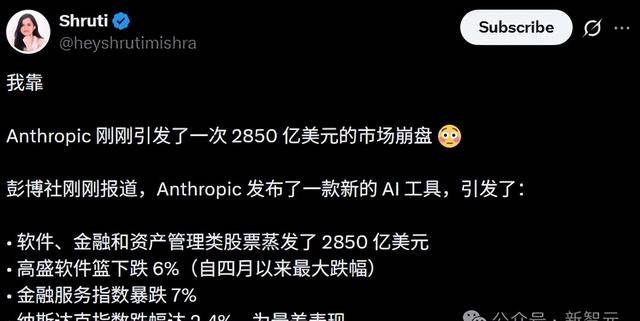
两三天前,软件股突然崩了。Anthropic在1月底放出Claude Cowork的插件更新,本来只是个小新闻,结 果华尔街一下就炸锅了。这些插件让AI直接干活,不用再靠传统软件的界面和账号。投资者一看,觉 得SaaS公司那种按人头收费的模式要完蛋了。 要是一个AI代理就能顶十个员工,企业干嘛还买那么多软件席位?市场开始抛售,Salesforce、Adobe这 些巨头股价直线往下掉。恐慌从硅谷传到纽约,交易员们盯着屏幕,手忙脚乱地卖出持仓。 崩盘从2月3日开始加速。那天Anthropic的工具正式引发卖盘,软件指数重挫6%。金融服务股也跟着遭 殃,下跌近7%。总市值损失很快就堆到2850亿美元。欧洲和亚洲市场没跑掉,次日开盘继续跌。 投资者担心AI代理会取代浅层工具,那些只包装业务流程的软件最先倒霉。像合同签署和客户支持, 本来靠DocuSign和Zendesk,现在AI自己就能搞定。整个行业开始反思,软件的价值是不是从界面转向 了数据底座。 高盛这时候跳出来补刀。2月6日,他们公布跟Anthropic合作半年,用Claude模型建AI代理,专攻交易对 账和客户审查。这些代理能读海量记录,套用规则,找出问题, ...
宏观经济观察系列(十三):新春政策十大动向
Western Securities· 2026-02-08 05:59
Economic Goals - GDP growth targets for most provinces are set around 5%, with Sichuan and Hubei at approximately 5.5%, and Tibet exceeding 7%[8] - Guangdong's growth target is set between 4.5% and 5%[8] Diplomatic Engagements - Frequent diplomatic activities include meetings between Chinese and foreign leaders, with expectations for upcoming meetings between China and the US, Germany, and others[9] Macro Policy Direction - The macro policy emphasizes "stability while seeking progress" and aims to promote a reasonable recovery in prices, focusing on domestic circulation and the real economy[10] Investment Strategy - Investment will focus on both physical and human capital, with an emphasis on increasing the proportion of investments in people's livelihoods[13] Consumer Growth - Expanding domestic demand is prioritized, with initiatives to support consumption upgrades and new growth points in service consumption[15] Unified Market Development - Key sectors such as electricity, transportation, technology, and data are targeted for breakthroughs in the construction of a unified national market[20] Agricultural Modernization - The focus shifts to agricultural modernization, emphasizing food security and improving agricultural quality and efficiency[21] Energy Transition - The dual control of energy consumption is transitioning to carbon emissions control, with a planned investment of 4 trillion yuan in the new power system during the 14th Five-Year Plan[22] Technological Innovation - Local governments are encouraged to develop new productive forces, with a focus on building international technology innovation centers in key regions[23] Urban Development - A multi-level modern urban system is being constructed, with efforts to enhance the capital metropolitan area and promote regional coordinated development[24]
基金研究周报:消费板块走强,大宗商品回调(2.2-2.6)
Sou Hu Cai Jing· 2026-02-08 00:39
Market Overview - The A-share market faced overall pressure last week, with major indices declining, particularly the Sci-Tech 50, which dropped by 5.76%, while the ChiNext Index and ChiNext 50 fell by 3.28% and 3.68% respectively, indicating significant pullback pressure on growth sectors [1] - In contrast, the Shanghai 50 and CSI Dividend indices showed relative resilience, with declines of less than 1%, reflecting a defensive stance in value sectors [1] - The Wande Micro-Cap Index rose by 1.86%, highlighting a shift in funds towards small-cap stocks, despite overall market caution and reduced risk appetite [1] Industry Performance - The Wande primary industry indices displayed notable divergence, with daily consumer goods leading with a gain of 2.87%, followed by industrials, consumer discretionary, and financials, which rose by 1.14%, 0.77%, and 0.71% respectively [1][10] - Conversely, information technology, materials, and communication services experienced the largest declines, falling by 4.86%, 4.52%, and 3.53% respectively, indicating a preference for defensive consumer sectors over technology growth stocks [1][10] Fund Issuance - A total of 40 funds were launched last week, including 16 equity funds, 8 mixed funds, 7 bond funds, and 9 FOFs, with a total fundraising amount of 30.859 billion units [1][17] Fund Performance - The Wande All-Fund Index decreased by 1.19% last week, with ordinary equity funds dropping by 2.06% and equity-mixed funds declining by 2.39%, while bond funds remained stable [5] - The overall performance of equity funds was under pressure, contrasting with the stable performance of the bond market [1][5]
56.24亿元金融活水赋能青海工业经济冲刺“开门红”
Xin Lang Cai Jing· 2026-02-07 17:44
Group 1 - The event held on February 5, organized by the Qinghai Provincial Department of Industry and Information Technology and the People's Bank of China Qinghai Branch, resulted in a significant outcome of 5.624 billion yuan in intended credit cooperation, providing strong financial momentum for the industrial economy in Qinghai [1] - A total of 15 financial institutions and 53 industrial enterprises reached cooperation agreements, demonstrating a commitment to the principle of "finance for enterprises" and laying a solid foundation for a win-win situation among government, banks, and enterprises [1] - As of the end of December 2025, the balance of industrial loans in Qinghai exceeded 229.1 billion yuan, with an increase of 22.2 billion yuan compared to the beginning of the year, reflecting a year-on-year growth of 10.7% and accounting for 28.2% of the total loan balance [1] Group 2 - The Qinghai Provincial Department of Industry and Information Technology aims to address multiple challenges in financial support for industrial development, focusing on key policies such as the 1.25% re-lending rate and substantial re-lending amounts for private enterprises and technological innovation [2] - The department emphasizes a problem-oriented approach to enhance the quality and level of work, guiding financial institutions to leverage their advantages in funding, technology, and industry-finance cooperation [2] - Continuous efforts are being made to ensure that financial resources flow into the real economy, contributing to the transformation and upgrading of Qinghai's industrial sector and the optimization of its economic structure [2]
乘势而上 攻坚决胜 上海未来五年这样干!
Xin Lang Cai Jing· 2026-02-07 12:33
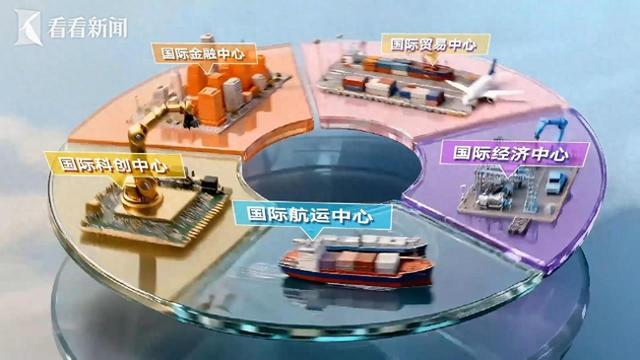
Core Viewpoint - The Shanghai Municipal People's Congress has approved the 15th Five-Year Plan, marking the beginning of a comprehensive implementation phase for Shanghai's development blueprint over the next five years. The economic growth target is set at around 5% during this period, with a focus on enhancing the core functions of five major centers: economy, finance, trade, shipping, and technology innovation [1][16]. Economic Development - Shanghai aims to enhance the overall competitiveness of its modern industrial system, targeting an annual growth rate of over 10% for the manufacturing output of three leading industries: integrated circuits, biomedicine, and artificial intelligence during the 15th Five-Year Plan [3]. - The total output value of strategic emerging industries in Shanghai's manufacturing sector is expected to exceed 50% of the total industrial output by 2030 [3]. Financial Sector - Shanghai plans to explore the pilot launch of RMB foreign exchange futures trading and actively promote the establishment of an international financial asset trading platform, aiming for a total financial market transaction volume exceeding 450 trillion yuan by 2030 [5]. International Trade - The city will strengthen its hub functions and expand offshore trade, with a target of achieving an average annual offshore trade volume of over 100 billion USD in the next five years [7]. - Shanghai aims to collaborate in building a world-class port and airport cluster in the Yangtze River Delta, with a goal of reaching a 55% water-to-water container transfer ratio at Shanghai Port by 2030 [7]. Technological Innovation - The plan emphasizes enhancing original innovation and tackling key core technologies, particularly in fields such as embodied intelligence biomanufacturing and brain-computer interfaces, while accelerating the development of disruptive technologies like photonic chips and controlled nuclear fusion [9]. Social Development - The plan includes specific measures to improve residents' well-being, such as increasing the proportion of nursing beds in elderly care institutions to over 75% and enhancing support for childbirth and parenting services [11][20]. - Shanghai aims to provide 250,000 to 270,000 units of affordable rental housing to attract talent and reduce living costs [13]. Cultural and Tourism Development - The city will focus on cultivating its cultural brand and aims to become a world-renowned tourist city, targeting over 50 million inbound tourists by 2030 [14]. Summary of Goals - The GDP growth target is set at around 5%, with a focus on maintaining the industrial value-added ratio above 20% and ensuring that strategic emerging industries account for over 50% of the total [16]. - The digital economy's core industry is expected to contribute around 20% to the regional GDP by 2025, up from 14% [18].
美国家庭疯狂收割华尔街,新的一年,我们该如何闷声发大财?
Sou Hu Cai Jing· 2026-02-07 11:13
阅读须知:本文内容所有信息和数据,均为作者查阅官方信息和网络已知数据整合解析,旨 在让读者更清晰了解相应信息,如有数据错误或观点有误,请文明评论,作者积极改正! (创作不易,一篇文章需要作者查阅多方资料,整合分析、总结,望大家理解) 2026年谁在"闷声发大财"?答案真不是谁喊得响、谁敢All in,而是谁能真正看清大盘该赌谁、什么时 候赌、怎么赌。 过去十年,真正赚钱的人,大多都做了一件事,看起来像在蛰伏,其实是在理解时代。 时代最贵的,是趋势。而"趋势"这东西,从来不靠运气,它是个绕不过宏观数据、政策红利、资产结构 甚至社会情绪的系统工程。 美国家庭疯狂收割华尔街,那么普通人如何在短视频红利退潮、中美家庭投资策略分化、以及全球资产 波动的大背景下,找到自己的"闷声发财"路径? 先说最热的词,大A三年"肉眼可见的挣扎",不少散户开始转向海外配置。 QDII从2007年开闸到今天,已经有了不少的规模,几百只基金产品,就是为海外投资而生的"合法通 道"。关键在于,有人已经悄悄靠它"跑赢大盘"。 但大家注意,这只是财富路线的一段。真正重要的是,我们正在告别一个单一市场逻辑,进入一个"多 元分叉的全球博弈时代"。 ...

缩量缓跌、情绪筑底,A股节前正在发生这些变化|周观A股(2.2-2.6)
和讯· 2026-02-07 08:31
01 涨跌速览 本周 股市场整体承压运行,主要指数普遍收跌,结构性分化特征进一步加剧。 数据显示,全市场 41 个主要指数中仅有 2 个实现周度上涨,其余指数 不同程度下行。科创 50 、创业板指跌幅居前,大盘价值风格相对稳健,小微盘股跌势有所放缓,而中盘股成为本轮调整的重点区域。 从市场整体表现看,本周并未出现系统性恐慌性下跌,但风险偏好持续回落,节前资金谨慎特征显著。 行业层面,本周 A 股延续明显轮动特征。 日常消费、工业等防御性和早周期板块表现相对占优,成为资金阶段性避险的重要方向;与此同时,信息技 术、材料等前期涨幅较大的成长板块出现明显回调,科技与资源类板块调整压力集中释放。 个股层面,周涨幅居前的标的以超跌小盘股和部分消费防御类个股为主 ;而周跌幅榜中,贵金属、科技板块个股集中回调,此前高估值、高弹性方向的 去风险过程仍在延续。 户 外 缩量缓跌、情绪筑底, 节前市场进入防守与观望阶段 行业轮动:消费防御领涨, 成长板块深度回调体调整 本周A股行业轮动日常消费、工业等防御性与早周期板 块领涨,信息技术、材料等前期热门成长板块大幅回调。 行业周涨跌幅 (%) 2026.02.02 - 2026.0 ...