资源品

Search documents
六大私募展望2026:股市仍有较好机会,成长与价值风格趋于均衡
中国基金报· 2025-12-21 10:46
Core Viewpoint - The Chinese stock market is expected to have good opportunities in 2026, with A-shares and H-shares likely to maintain an upward trend, and a balance between growth and value styles is anticipated [3][10]. Group 1: Market Performance in 2025 - The market in 2025 showed significant structural performance, with sectors like non-ferrous metals, communication, and electronics performing well due to tightening supply-demand relationships and advancements in AI technology [5][6]. - The A-share and H-share markets exceeded initial expectations, with actual returns surpassing 20%, driven by a recovery in valuations and a strong performance in technology and small-cap stocks [6][7]. Group 2: Economic Outlook for 2026 - The domestic GDP is expected to maintain stable growth, supported by a resilient export outlook and ongoing fiscal and monetary policies [10][11]. - The stock market in 2026 will shift from valuation recovery to being driven by earnings and performance, with opportunities in technology, cyclical, consumer, and manufacturing sectors [10][12]. Group 3: Investment Opportunities - Key investment opportunities for 2026 include the AI industry chain, advanced manufacturing with real technological barriers, and traditional industry leaders with strong balance sheets and cash flows [14][15]. - The focus will be on sectors benefiting from policy support and industry optimization, particularly in technology innovation and traditional industries undergoing upgrades [14][15]. Group 4: Market Dynamics and Stock Selection - The differentiation between "old economy" and "new economy" stocks is expected to narrow, with both types of stocks showing potential for balanced performance [18][19]. - The market is transitioning from a narrative-driven approach to one focused on fundamental performance, emphasizing the importance of earnings realization in stock selection [20][21]. Group 5: Cautionary Notes - Investors should be wary of stocks that lack earnings support and those that have shown signs of bubble formation, focusing instead on undervalued quality companies [22][23].


收评:沪指涨超1%,保险、券商板块拉升,半导体板块强势
Sou Hu Cai Jing· 2025-12-17 07:30
Market Performance - Major stock indices in the two markets rose significantly, with the Shanghai Composite Index increasing by 1.19% to 3870.28 points, the Shenzhen Component Index rising by 2.4%, and the ChiNext Index surging by 3.39% [1] - The total trading volume in the Shanghai and Shenzhen markets reached 1.8345 trillion yuan [1] Sector Performance - The insurance and brokerage sectors saw notable gains, while semiconductor, non-ferrous metals, pharmaceuticals, and lithium mining sectors also performed strongly [1] - Active concepts included CPO, Apple-related, and solid-state battery sectors [1] Investment Outlook - Huaxi Securities indicated that with the recent Federal Reserve meeting and the domestic Central Economic Work Conference, an influx of incremental funds into the market is expected [1] - Regulatory adjustments have lowered the investment risk factors for insurance funds and proposed expanding capital space and leverage limits for quality securities firms, which is beneficial for medium to long-term capital inflow and market activity [1] - The combination of potential Federal Reserve interest rate cuts and a strong renminbi is favorable for foreign capital allocation towards Chinese assets [1] Sector Recommendations - Suggested focus on growth sectors benefiting from industrial policy support, such as domestic substitution, robotics, aerospace, innovative pharmaceuticals, and energy storage [1] - Attention should also be given to cyclical sectors benefiting from "anti-involution" policies, including chemicals, energy metals, and resource products [1] - Deepening consumption policies may provide short-term catalytic opportunities in the consumer sector [1]
十大机构看后市:A股市场延续震荡特征,科技占优的条件依然未变
Xin Lang Cai Jing· 2025-12-14 07:59
Group 1 - The core focus of the Central Economic Work Conference is to expand domestic circulation, similar to last year, but with significant differences in expectations and pricing for domestic and foreign demand stocks [10][11] - There is a strong performance expectation for overseas exposure stocks, but the difficulty in valuation increases, while domestic demand stocks have potential for valuation recovery if they exceed expectations [10][11] - The market is expected to see a short-term positive trend following the conference, with historical data indicating that the market style tends to perform well in the week following the conference [12] Group 2 - The spring market is anticipated to be a small-scale rally, with a focus on short-term price-performance opportunities in technology and cyclical sectors [13][14] - Key themes from the conference include commercial aerospace, robotics, and other sectors related to the ocean economy and energy security [13][14] - The investment strategy should focus on sectors benefiting from supply-side reforms and consumer demand stimulation, particularly in services and non-durable goods [13][14] Group 3 - The market is characterized by volatility, with a recommendation to adopt a cautious approach and wait for better entry points [16][17] - Specific sectors to watch include brokerage firms, home appliances, and mechanical equipment, with a focus on stocks that are currently undervalued [16][17] - The policy environment is expected to support structural adjustments and "anti-involution" measures, creating opportunities in social services and resource sectors [16][17] Group 4 - The investment outlook for 2026 suggests a shift from valuation-driven to earnings-driven market dynamics, with continued monetary easing expected [18] - Key narratives for the future include AI technology, safety, and industry expansion, which are anticipated to provide medium to long-term investment certainty [18] - Asset allocation strategies should focus on passive investments for risk diversification and active management for capitalizing on market trends [19]
A股市场投资策略周报:政策基调初步明晰,市场延续震荡特征-20251211
BOHAI SECURITIES· 2025-12-11 09:58
Market Review - In the past five trading days (December 5 to December 11), major indices showed mixed performance; the Shanghai Composite Index slightly decreased by 0.06%, while the ChiNext Index increased by 3.14% [3] - The trading volume increased, with a total of 9.30 trillion yuan traded, resulting in an average daily trading volume of 1.86 trillion yuan, which is an increase of 205.98 billion yuan compared to the previous five trading days [11] Economic Data - In November, exports increased by 5.9% year-on-year, significantly rebounding from October, influenced by a lower base, stable external demand, and the end of holiday disruptions [26] - The Consumer Price Index (CPI) rose by 0.7% year-on-year in November, while the Producer Price Index (PPI) decreased by 2.2% year-on-year [28] Policy Insights - The Central Political Bureau of the Communist Party of China held a meeting on December 8, outlining the economic work for 2026, emphasizing a more proactive fiscal and monetary policy [34] - The meeting highlighted the importance of expanding domestic demand and optimizing supply, indicating a focus on structural adjustments and the continuation of "anti-involution" policies [34] Investment Strategy - The A-share market continues to exhibit a volatile characteristic, with a positive outlook driven by policy support and liquidity expectations [36] - Investment opportunities are identified in the TMT sector and robotics due to ongoing AI capital expansion and domestic substitution processes [36] - The energy storage demand and solid-state battery industrialization present investment opportunities in the power equipment and non-ferrous metals sectors [36] - The banking sector is also highlighted as a potential area for investment due to the low interest rate environment and the return of public fund holdings to performance benchmarks [37]
股指期货:事件驱动,关注靴子落地
Guo Tai Jun An Qi Huo· 2025-12-08 00:51
H | | O 2025年12月8日 擊件驱动 投资咨询从业资格号: Z0011222 maolei@gtht.com 报告导读: 1、市场回顾与展望:上周A股市场延续上涨,但涨幅较前一周略有收窄。板块方面,有色金属、通 信、国防军工居涨幅榜前三;传媒、房地产、美容护理居跌幅榜前三。节奏来看,上周周中股市一度有所 回落,仅有部分结构行情表现 -- 譬如受到有色拉升传导带动的资源品行情。不过到周五在大金融等顺周 期板块的带动之下,推动情绪改善,对指数全周录得正收益贡献较大。驱动方面,周末消息面公布证券业 协会会员大会召开,透露出一系列改革举措,包括"对优质机构运当松绑,适度打开资本空间与杠杆限 制;证券公司要提供有利于长期投资、价值投资的产品";此外媒体报道基金公司薪酬总额将与产品业 绩、投资者盈亏挂钩等,有效解释了上周五非银金融板块涨幅居第一的原因。 后期来看,①本周将进入到年底12月份重磅政策会议的召开时间节点。按照惯例,政治局会议将在 上中旬召开、针对"十五五"规划的开局之年,2026年整体政策定调,包括在货币和财政方面的走向, 将成为市场关注的重中之重。若政策积极程度超预期、将有效带动情绪上行。2海外方 ...
渤海证券研究所晨会纪要(2025.12.05)-20251205
BOHAI SECURITIES· 2025-12-05 00:25
Market Review - In the past five trading days (November 28 to December 4), major indices mostly rose, with the Shanghai Composite Index slightly up by 0.01% and the ChiNext Index up by 1.19% [2] - The trading volume decreased, with a total of 8.27 trillion yuan traded, averaging 1.65 trillion yuan per day, a decrease of 145.3 billion yuan compared to the previous five trading days [2] - Among the sectors, non-ferrous metals, telecommunications, and defense industries saw the highest gains, while media, beauty care, and computer sectors experienced the largest declines [2] Policy Insights - On December 3, the Deputy Director of the Central Financial Office emphasized the necessity of accelerating the construction of a financial powerhouse to promote high-quality development [3] - Key directions for capital market development include enhancing inclusivity and adaptability, and improving the coordination between investment and financing functions [3] - The focus will be on building a stable long-term investment ecosystem and increasing financing support for key industries and technologies during the 14th Five-Year Plan period [3] Strategy Insights - The A-share market is entering a phase of oscillation and waiting, with an emphasis on policy and technology as key themes for future investment [4] - Investment opportunities are identified in the TMT sector and robotics due to ongoing capital expansion by domestic and international cloud vendors and the acceleration of domestic computing power substitution [4] - The power equipment and non-ferrous metals industries are highlighted as having investment potential due to high global energy storage demand and the ongoing industrialization of solid-state batteries [4] - There are also opportunities in social services and resource sectors driven by policy adjustments focusing on structural changes and "anti-involution" [4] - The banking sector is noted for its investment potential due to a low interest rate environment and a shift in public fund holdings towards performance benchmarks [4]
招商证券:12月有望发动指数级别上行的跨年行情
Zhong Guo Jin Rong Xin Xi Wang· 2025-12-01 01:21
投资机会方面,如果指数上行则关注非银金融,除此之外,主要交易机会围绕中央经济工作会议等可能 会有的政策方向,重点关注涨价资源品、服务消费和科技领域自主可控。 转自:新华财经 编辑:林郑宏 新华财经上海12月1日电 招商证券研报分析认为,展望12月,市场在经历了三个月的震荡蓄势后,终于 要选择方向,而选择向上突破发动跨年行情的概率较高。结合三季报,十五五规划,增量资金和投资者 结构以及全球宏观环境变化,12月市场将会发动指数级别上行的跨年行情。 资金面方面,2025年1月实施了印发《关于推动中长期资金入市工作的实施方案》要求提升商业保险资 金A股投资比例,新增保费投入A股比例要提升,而每年一季度都是保险开门红,新增保费配置股票需 求增加,12月是提前布局的时机。而美元指数重新走弱和人民币汇率走强为外资重新流入提供了基础。 过去两整年基金业绩普遍较高,进入年底年初居民存款增加较多,居民配置权益基金的概率加大。12月 容易形成各路增量资金的共振,从而形成经典的跨年行情。 ...

六大机构,最新研判
Zhong Guo Zheng Quan Bao· 2025-11-30 14:32
国家航天局已于近期设立商业航天司,相关业务正在逐步开展,标志着我国商业航天产业迎来专职监管 机构,未来将持续推动我国商业航天高质量发展,产业链有望全线受益。 机构后市投资观点 在经历震荡调整后,本周A股三大股指呈现小幅反弹趋势,但整个11月三大股指均收跌。展望即将到来 的12月行情,机构认为,或以结构性行情为主,市场即将迎来重要政策时间窗口,美联储议息会议表态 对全球市场流动性的潜在影响也值得关注。 在具体配置上,红利等防御性板块配置关注度升温,AI应用、资源品、医药生物、新消费方向投资机 会值得重视。面对波动行情,建议从中长期视角布局,利用市场的短期波动,以更合理的价格买入长期 看好的公司。 影响后市投资大事件 11月PMI上升0.2个百分点 国家统计局11月30日发布数据显示,11月份,制造业采购经理指数(PMI)为49.2%,比上月上升0.2个 百分点。11月份,生产指数和新订单指数分别为50.0%和49.2%,分别比上月上升0.3个百分点和0.4个百 分点。11月份,高技术制造业PMI为50.1%,连续10个月位于临界点以上。 央行召开打击虚拟货币交易炒作工作协调机制会议 11月28日,中国人民银行召 ...
渤海证券研究所晨会纪要(2025.11.28)-20251128
BOHAI SECURITIES· 2025-11-28 05:24
晨会纪要(2025/11/28) 编辑人 崔健 022-28451618 SAC NO:S1150511010016 cuijian@bhzq.com 渤海证券研究所晨会纪要(2025.11.28) 宏观及策略研究 业绩支撑中枢上移,产业、政策助推结构性行情——A 股市场 2026 年年度投 资策略报告 工企利润短期波动,后续关注政策部署——2025 年 1-10 月工业企业效益数据 点评 行业研究 把握创新与出海机遇,关注新技术空间——医药生物行业 2026 年度投资策略 报告 大模型厂商发力 C 端应用,关注 AI 应用商业化落地——计算机行业周报 证 券 研 究 报 告 靳沛芃(研究助理,SAC NO:S1150124030005) 晨 会 纪 要 请务必阅读正文之后的声明 渤海证券股份有限公司具备证券投资咨询业务资格 1 of 7 晨会纪要(2025/11/28) 宏观及策略研究 业绩支撑中枢上移,产业、政策助推结构性行情——A 股市场 2026 年年度投资策略报告 宋亦威(证券分析师,SAC NO:S1150514080001) 严佩佩(证券分析师,SAC NO:S1150520110001) 1、 ...
周期攻略|能与人工智能并列的主线是?
Xin Lang Cai Jing· 2025-11-25 10:14
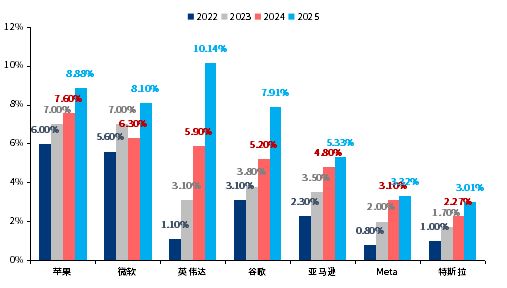
Core Insights - The artificial intelligence (AI) industry received a positive boost with NVIDIA's Q3 revenue reaching $57 billion, a 62% year-on-year increase, leading to a significant stock price surge of over 6% in after-hours trading [1] - The concentration of AI-related stocks in the S&P 500 has reached historical highs, with the "Big Seven" tech companies accounting for 47% of the index [1][3] - Despite the promising financial data, the capital market history indicates that revolutionary technologies often come with inherent risks and uncertainties [3] Investment Opportunities - The demand for industrial resources is expected to rise as AI technologies require substantial physical resources for training and operation, suggesting a potential investment opportunity in resource commodities [4][5] - The International Energy Agency (IEA) predicts that global data centers will require 945 TWh of electricity by 2030, with China's data center electricity consumption growing at a compound annual growth rate of 18% [6] - Historical economic cycles, such as the Kondratiev wave, suggest that technological revolutions like AI can lead to increased demand for commodities, similar to past industrial booms [8][10] Market Dynamics - The current macroeconomic environment resembles the 1970s stagflation, where despite technological advancements, inflationary pressures could lead to a bull market for commodities like oil and gold [11][12] - The investment logic for resource commodities is supported by the dual drivers of AI and energy transition, indicating a potential long-term value reassessment [15] - The cyclical nature of resource investments highlights the importance of recognizing fundamental value anchors rather than chasing every technological trend [15]