
地产

Search documents
中庚基金刘晟:坚守价值投资 以选股阿尔法应对波动
Shang Hai Zheng Quan Bao· 2025-11-02 14:37
Core Viewpoint - The core viewpoint emphasizes the importance of stock selection alpha as a key support for navigating market cycles and achieving long-term returns through a low-valuation value investment strategy [1][2]. Group 1: Investment Strategy - The investment strategy is centered around low-valuation value investing, focusing on "valuation + fundamentals" to identify high cost-performance targets [2][3]. - The company maintains a balanced approach in asset and industry allocation, avoiding excessive deviation while leveraging stock selection alpha to convert previous negative excess returns into positive ones [2][3]. - The investment team evaluates valuation levels, implied returns, and risk-reward characteristics of targets, adjusting positions when risk-reward ratios become unbalanced [3]. Group 2: Market Outlook - The company views both A-shares and Hong Kong stocks as part of Chinese equity assets, highlighting the value of scarce assets in Hong Kong and the significant discounts (up to 50%) of certain stocks compared to A-shares [4]. - The focus areas for investment include sectors with strong growth potential such as new energy, AI, and pharmaceuticals, as well as attractive pricing in domestic demand sectors like steel structures and real estate [5]. - The company acknowledges potential short-term market adjustments but maintains a long-term perspective, emphasizing high implied returns and a cautious approach to emerging industries and market opportunities [5].
招商证券:A股自由现金流上行趋势确立 Q3收入和盈利端均改善
智通财经网· 2025-11-01 10:26
Core Insights - The overall profitability and revenue of A-share listed companies improved in Q3 2025, driven by low base effects, supply-demand structure improvements, and price increases [1][2][3] Profitability Analysis - The net profit growth rate for A-share companies expanded, with quarterly growth rates of 3.2%, 1.2%, and 11.6% for Q1, Q2, and Q3 respectively, leading to cumulative growth rates of 3.2%, 2.3%, and 5.2% [2] - Non-financial oil and petrochemical sectors showed quarterly net profit growth rates of 4.5%, -0.1%, and 5.3%, with cumulative growth rates of 4.5%, 2.3%, and 3.0% [2] Revenue Trends - A-share companies experienced a continuous improvement in revenue growth, with quarterly growth rates of -0.3%, 0.4%, and 3.6% for Q1, Q2, and Q3 respectively, resulting in cumulative growth rates of -0.3%, 0.1%, and 1.1% [2] - Non-financial oil and petrochemical sectors had quarterly revenue growth rates of 0.5%, 0.9%, and 3.5%, with cumulative growth rates of 0.5%, 0.8%, and 1.6% [2] Sector Performance - The increase in A-share profitability in Q3 2025 was attributed to several factors, including policy-driven supply-demand optimization, stable industrial product prices, strong demand in the technology sector, and robust export growth [3] - The main boards, ChiNext, and STAR Market all showed significant improvements in profitability, with the STAR Market leading in profit growth [4] Key Industry Insights - Resource products, information technology, and financial real estate sectors saw improved profitability, with information technology leading in growth rates [5] - The net asset return (ROE) for non-financial and oil sectors showed marginal recovery, supported by improved total asset turnover and net profit margin [5] Cash Flow and Capacity Expansion - Free cash flow as a percentage of revenue has steadily increased, with operating cash flow showing positive year-on-year growth [6][7] - The capital expenditure growth rate has declined after peaking in Q2 2023, indicating a relatively low willingness for capital expansion [6] Focus Areas for Future Growth - Industries with high or improving performance in Q3 2025 include TMT (telecommunications, semiconductors, consumer electronics), high-end manufacturing, and certain resource products [7]

“老登”不行了,可能意味着一个时代的落幕
雪球· 2025-11-01 03:55
Core Viewpoint - The article discusses the decline of traditional industries in the A-share market, highlighting a shift in investment focus from established sectors like liquor and real estate to emerging technology stocks, indicating a broader change in market dynamics and investment strategies [5]. Group 1: Decline of Traditional Industries - The decline of traditional industries is fundamentally due to a systematic shrinkage of usage scenarios, with sectors like liquor and real estate facing structural challenges as consumer habits and market conditions evolve [8]. - The liquor industry is experiencing changes in drinking habits among younger consumers, while the real estate sector is hindered by a fundamental reversal in supply-demand dynamics [8]. - Although these industries still hold value, their profitability and growth potential have been reassessed, leading to a sentiment of inevitability regarding their decline [8]. Group 2: Challenges Faced by "Old Investors" - Investors, referred to as "Old Investors," face challenges by equating industry beliefs with investment truths, clinging to outdated notions such as the perpetual value of liquor and real estate without recognizing the shifts in consumer behavior and market trends [11]. - The real risk lies not in the obsolescence of industries but in the rigidity of thinking among investors [12]. Group 3: Effective Investment Strategies - Instead of fixating on the survival of specific industries, investors should return to the essence of investing by adhering to proven strategies, such as dividend strategies that focus on dynamically adjusting to capture high-yield stocks across various sectors [14]. - Cash flow strategies emphasize the importance of understanding a company's real cash-generating capabilities, particularly in traditional retail, where digital transformation can lead to improved cash flow [15]. - A diversified asset allocation strategy, incorporating stocks, bonds, and commodities, serves as a stabilizing force in navigating market changes while managing risk [15]. Group 4: Adapting to Change - The ultimate investment principle is to evolve with the times, as exemplified by Berkshire Hathaway's gradual investment in technology giants like Apple, reflecting respect for emerging trends rather than a betrayal of value investing [18]. - To avoid becoming "Old Investors," it is crucial to maintain an open mindset, understanding both the transformation opportunities in traditional industries and the underlying logic of emerging sectors [18]. - The transition from traditional industries to new sectors signifies not just the decline of a group but the inevitable evolution of an era, emphasizing the need to embrace change to seize investment opportunities [18].


豫园股份:加速去化地产项目 出海和大豫园板块等价值未来会逐步释放
Quan Jing Wang· 2025-10-31 15:21
Core Viewpoint - The company is currently undergoing a strategic transformation, focusing on asset liquidation in real estate projects while emphasizing a leaner operational model to enhance long-term value in its core consumer segments, particularly in gold and jewelry business [1] Group 1: Strategic Transformation - The company is in a strategic transformation phase, implementing the top strategy of "leaning down and lightening up" while accelerating the liquidation of real estate projects to recover funds [1] - The gold and jewelry segment is actively transforming through new product matrices, refined operations, increased proportion of piece-rate products, and cost reduction in the supply chain [1] Group 2: Financial Performance - The revenue decline in the jewelry business has narrowed year-on-year, with gross margins showing continuous improvement both year-on-year and quarter-on-quarter, reflecting the effectiveness of refined operational management [1] Group 3: Business Philosophy and Global Strategy - The company adheres to the top concept of "Oriental Lifestyle Aesthetics," driving dual engines of industrial operation and investment, with a portfolio of 19 time-honored Chinese brands and several leading global brands [1] - In the context of the new domestic and international dual circulation pattern, the company is accelerating its global layout to promote the aesthetics of Eastern life and aims to become a leading family happiness consumption industry group globally [1]

每日钉一下(为啥有的红利指数百分位位置比较高但还在低估呢?)
银行螺丝钉· 2025-10-31 13:56
Core Viewpoint - The article discusses the reasons behind the discrepancies in dividend indices' percentile rankings and their valuation, emphasizing that percentile data serves as a reference rather than a definitive measure of value [2][3]. Group 1: Changes in Dividend Index Rules - The dividend index rules have undergone significant changes over the past decade, impacting the percentile rankings and valuations of stocks within these indices [5]. - The first major change occurred in 2013, where the selection method shifted from "dividend yield stock selection, market capitalization weighting" to "dividend yield stock selection, dividend yield weighting," leading to a more balanced representation across sectors [6]. - A second major adjustment took place around 2022, increasing the requirements for sample stocks regarding dividend stability and continuity, influenced partly by the issues faced by real estate companies [7]. Group 2: Impact of Real Estate Sector on Dividend Indices - The real estate sector's practices of high short-term dividends led to inflated dividend yields, which were unsustainable and resulted in significant losses when these companies faced financial difficulties [8]. - Following the rule changes, the requirement for consistent high dividends has mitigated the issues previously caused by real estate stocks, leading to an overall improvement in the valuation metrics of the dividend indices [9]. Group 3: Interpretation of Percentile Data - Percentile data should be viewed as a tool for identifying anomalies rather than a sole basis for investment decisions, as extreme percentile values may indicate underlying issues worth investigating [10].

社保基金2025三季报持仓动向曝光:重仓高端制造与周期龙头,新进基建新能源消费标的
Mei Ri Jing Ji Xin Wen· 2025-10-31 11:57
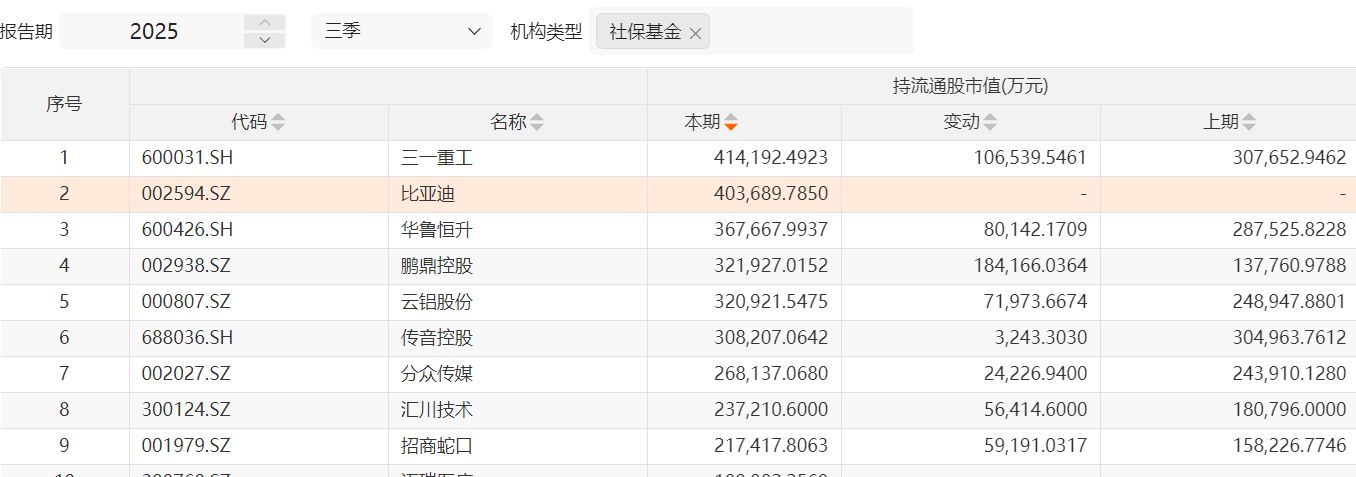
Core Insights - The Social Security Fund's stock holdings as of Q3 2025 indicate a significant investment trend, with a total of 604 stocks in its top ten shareholders, amounting to 10.775 billion shares and a market value of 210.52 billion yuan [1] Group 1: Major Holdings - Sany Heavy Industry and BYD are the top two holdings, with market values of 4.142 billion yuan and 4.037 billion yuan respectively [2] - Sany Heavy Industry reported a revenue of 66.104 billion yuan for the first three quarters of 2025, a year-on-year increase of 13.27%, and a net profit of 7.136 billion yuan, up 46.58% [3] - BYD's revenue reached 566.27 billion yuan, a 13% year-on-year growth, with R&D expenses of 43.75 billion yuan, a 31% increase compared to the previous year [3] Group 2: Sector Trends - The Social Security Fund has increased its investment in cyclical sectors, with Hualu Hengsheng holding a market value of 3.677 billion yuan, despite a decline in its performance [3] - Hualu Hengsheng's revenue for the first three quarters was 23.552 billion yuan, down 6.46%, and net profit decreased by 22.14% to 2.374 billion yuan [3] Group 3: Diversified Portfolio - The Social Security Fund's portfolio reflects a balance between emerging growth sectors and traditional value, investing in new energy, industrial automation, and consumer electronics while also exploring cyclical resilience in chemicals, real estate, and non-ferrous metals [5] - The fund has also established long-term holdings in certain stocks, with the longest being in Zhongnan Media since Q1 2012, indicating a strategy focused on long-term capital [6] Group 4: New Investments and Reductions - In Q3 2025, the Social Security Fund initiated positions in 189 new stocks, with China Metallurgical Group leading at 1.003 billion shares [7] - The fund's reduction in holdings has primarily targeted the energy and real estate sectors, reflecting a shift in market sentiment regarding these industries [8]
国泰海通|策略:Q3主动基金动向:大幅加仓AI硬件
国泰海通证券研究· 2025-10-31 10:39
Core Insights - The report indicates that active funds have significantly increased their holdings in A-shares, particularly in the TMT (Technology, Media, and Telecommunications) sector, while reducing exposure to consumer and banking sectors [1][2][4] - The total market value of active equity funds and stock ETFs reached a record high of 7.23 trillion yuan, reflecting a 21.7% quarter-on-quarter increase [1] - The active equity fund stock position rose to 85.6%, with a concentration ratio (CR20) increasing by 6.3% [1] Fund Allocation - Active funds have notably increased their allocation to the TMT sector, particularly in electronics and communications, while reducing exposure to consumer goods and financial sectors [2] - The electronics sector's allocation reached 25.5%, surpassing the previous high of 20.3% during the 2021 bull market [1][4] - The report highlights a significant increase in allocations to the semiconductor, battery, and gaming industries, driven by strong AI capital expenditures [2] Hong Kong Stock Market - The allocation to Hong Kong stocks has slightly decreased, with a total heavy position of 381.8 billion yuan, reflecting a decrease in the proportion of active fund investments to 18.7% [3] - Active funds have increased their investments in sectors such as trade, pharmaceuticals, and non-ferrous metals, while reducing exposure to social services and light industry [3] Market Trends - The report suggests that the fund issuance may soon reach a turning point, with historical data indicating that fund recovery and index breakthroughs are critical for accelerating new fund launches [4] - As of late October 2025, the proportion of actively managed equity funds with positive returns over various time frames has reached high levels, indicating a potential positive feedback loop for fund issuance and market performance [4]

宏观日报:中美贸易冲突暂缓-20251031
Hua Tai Qi Huo· 2025-10-31 02:55
Industry Overview Production and Service Industries - In the production industry, through the Kuala Lumpur consultations between China and the US, the US will cancel the 10% so - called "fentanyl tariff" on Chinese goods, continue to suspend the 24% reciprocal tariff on Chinese goods for one year, suspend the implementation of the 50% penetrative export control rule announced on September 29 for one year, and suspend the implementation of the Section 301 investigation measures on China's maritime, logistics, and shipbuilding industries for one year. China has also adjusted its counter - measures accordingly. Consensus was also reached on fentanyl anti - drug cooperation, expanding agricultural product trade, and handling individual cases of relevant enterprises. The results of the Madrid economic and trade consultations were further confirmed, with the US making positive commitments in investment and other fields, and China will properly resolve the TikTok - related issue with the US [1] - In the service industry, 500 billion yuan of new policy - based financial instruments have been fully invested, expected to drive total project investment of over 7 trillion yuan. The instruments mainly support areas such as technological innovation, expanding consumption, and stabilizing foreign trade. The new policy - based financial instruments of the China Development Bank, the Export - Import Bank of China, and the Agricultural Development Bank of China support 1054, over 360, and 881 projects respectively, and are expected to drive total project investment of 3.85 trillion yuan, over 1.3 trillion yuan, and over 1.93 trillion yuan respectively [1] Upstream, Mid - stream, and Downstream - **Upstream**: Black - glass prices have dropped significantly; in agriculture, palm oil prices have fallen while pork prices have risen slightly; in the energy sector, liquefied natural gas prices have continued to rise [2] - **Mid - stream**: In the chemical industry, PX开工率 has remained stable; in infrastructure, the asphalt开工率 has declined [2] - **Downstream**: In the real estate sector, the sales of commercial housing in second - and third - tier cities have seasonally declined; in the service sector, the number of domestic flights has increased [2] Price Indexes - **Agriculture**: On October 30, the spot price of corn was 2148.6 yuan/ton, down 1.18% year - on - year; the spot price of eggs was 6.2 yuan/kg, up 1.15% year - on - year; the spot price of palm oil was 8850.0 yuan/ton, down 2.81% year - on - year; the spot price of cotton was 14846.5 yuan/ton, up 0.27% year - on - year; the average wholesale price of pork was 18.0 yuan/kg, up 1.30% year - on - year [36] - **Non - ferrous Metals**: On October 29, the spot price of copper was 87773.3 yuan/ton, up 3.24% year - on - year; the spot price of zinc was 22272.0 yuan/ton, up 1.76% year - on - year; the spot price of aluminum was 21176.7 yuan/ton, up 1.11% year - on - year; the spot price of nickel was 122116.7 yuan/ton, down 0.20% year - on - year [36] - **Ferrous Metals**: On October 29, the spot price of iron ore was 810.0 yuan/ton, up 1.94% year - on - year; the spot price of wire rod was 3340.0 yuan/ton, up 1.29% year - on - year; the spot price of glass was 13.9 yuan/square meter, down 5.33% year - on - year [36] - **Non - metals**: On October 30, the spot price of natural rubber was 14958.3 yuan/ton, up 1.07% year - on - year; the China Plastic City price index was 778.3, down 0.03% year - on - year [36] - **Energy**: On October 30, the spot price of WTI crude oil was 60.5 US dollars/barrel, up 3.38% year - on - year; the spot price of Brent crude oil was 64.9 US dollars/barrel, up 3.72% year - on - year; the spot price of liquefied natural gas was 4338.0 yuan/ton, up 8.72% year - on - year; the coal price was 809.0 yuan/ton, up 0.50% year - on - year [36] - **Chemical Industry**: On October 29, the spot price of PTA was 4554.8 yuan/ton, up 3.15% year - on - year; the spot price of polyethylene was 7135.0 yuan/ton, up 0.82% year - on - year; the spot price of urea was 1627.5 yuan/ton, up 3.50% year - on - year; the spot price of soda ash was 1210.0 yuan/ton, up 0.53% year - on - year [36] - **Real Estate**: On October 30, the cement price index nationwide was 137.2, up 2.16% year - on - year; the building materials composite index was up 1.53% year - on - year; the national concrete price index was 91.0, down 0.19% year - on - year [36]
英大证券晨会纪要-20251031
British Securities· 2025-10-31 02:21
Market Overview - The A-share market is currently experiencing a tug-of-war around the 4000-point mark, with significant fluctuations and differing opinions among investors [2][9][10] - The recent index movements are driven primarily by a few large-cap technology stocks, leading to a disparity in returns between retail investors and the index [10][12] - Current policies indicate a supportive stance, with liquidity remaining reasonably ample, suggesting potential for the index to challenge the 4000-point level again [10][12] Investment Strategy - The report suggests a cautious approach to investment, emphasizing the importance of controlling positions while balancing short-term defense and medium-term layout [3][11] - Key investment themes include: - **Technology Growth**: Focus on sectors such as AI, semiconductors, and robotics, supported by government policies and strong quarterly performances [3][11] - **High Dividend Defensive Stocks**: Sectors like banking, public utilities, and transportation are highlighted for their ability to provide safety margins during market volatility [3][11] - **Cyclical Sectors**: Areas such as photovoltaics, batteries, and rare earths are expected to benefit from policy changes aimed at reducing competition and improving profitability [3][11] Sector Performance - The energy metals and battery sectors have shown strong performance, with significant gains noted in recent trading sessions [7][8] - The quantum technology sector is also gaining traction, driven by government initiatives aimed at fostering future industries [8]
雅戈尔时尚股份有限公司 2025年第三季度报告
Zheng Quan Ri Bao· 2025-10-30 23:13
Core Viewpoint - The company reported a decline in revenue and net profit for the first nine months of 2025, primarily due to the exit from the real estate business and challenges in the fashion segment's transformation [5][6]. Financial Performance - For the first nine months of 2025, the company achieved revenue of 677,723.53 million yuan, with a net profit attributable to shareholders of 234,913.65 million yuan, representing year-on-year declines of 19.32% and 6.48% respectively [5]. - The fashion segment generated revenue of 503,749.91 million yuan, showing a year-on-year growth of 9.86%, driven by the consolidation of the BONPOINT brand and rapid growth in multi-brand operations [6]. - The net profit for the fashion segment was 20,767.76 million yuan, which decreased by 43.52% year-on-year due to increased costs and expenses [6]. Business Strategy - The company is advancing its "large store strategy," opening 140 new self-operated stores while closing 115 and adjusting 93, resulting in a net increase of 25 self-operated stores and an increase in operational area of 3.12 million square meters [7]. Real Estate Segment - The real estate segment did not launch new projects in the first nine months of 2025, achieving pre-sales of 75,059.29 million yuan and recognizing revenue of 173,175.41 million yuan, with net profit down 70.58% and 54.41% year-on-year respectively [8]. Investment Business - The investment business continued to undergo structural adjustments, achieving a net profit attributable to shareholders of 202,413.77 million yuan, reflecting a year-on-year increase of 3.87% [9]. Profit Distribution - The company proposed a cash dividend of 0.08 yuan per share for the first half of 2025, with a total distribution amounting to 365,781,256.16 yuan based on the total share capital [12][14]. Upcoming Events - The company will hold a performance briefing on November 19, 2025, to discuss the third-quarter results and address investor questions [18][19].
