建材

Search documents
资讯日报:日元强劲反弹;金价首次升破每盎司5000美元-20260126
Guoxin Securities Hongkong· 2026-01-26 12:57
Market Overview - The Hang Seng Index closed at 26,750, up 0.45% for the day and 4.37% year-to-date[3] - The Nikkei 225 Index rose 0.29% to 53,847, with a year-to-date increase of 6.97%[3] - The S&P 500 Index ended at 6,916, with a slight increase of 0.03% and a year-to-date gain of 1.02%[3] Commodity and Currency Insights - Gold prices reached a historic high, surpassing $5,000 per ounce, driven by geopolitical tensions[13] - The Japanese yen rebounded strongly, with significant daily gains, as the market anticipates potential government intervention[13] Sector Performance - The commercial aerospace sector saw significant gains, with JunDa shares rising over 51% following the launch of six platforms aimed at accelerating satellite development[9] - The photovoltaic sector also performed well, with notable increases in stocks like KaiSheng New Energy (up 14.44%) and Xinyi Solar (up 11.15%) due to support from Tesla's CEO for solar energy development[9] U.S. Market Dynamics - The U.S. stock market showed mixed results, with the Nasdaq and S&P 500 slightly up, while the Dow Jones fell nearly 0.6%[9] - Notable individual stock movements included Goldman Sachs dropping nearly 4% and Nvidia rising 1.5%[10] Economic Indicators - Japan's core CPI for December 2025 rose 2.4%, aligning with expectations, while the manufacturing PMI for January 2026 increased to 51.5, indicating expansion[13]
策略周报(20260119-20260123)-20260126
Mai Gao Zheng Quan· 2026-01-26 11:50
Market Liquidity Overview - R007 increased from 1.5137% to 1.5360%, a rise of 2.23 basis points; DR007 rose from 1.4430% to 1.4935%, an increase of 5.05 basis points. The spread between R007 and DR007 narrowed by 2.82 basis points [9] - The net outflow of funds this week was 250.36 billion yuan, with net inflow decreasing by 167.59 billion yuan compared to last week. Fund supply was -184.25 billion yuan, while fund demand was 66.12 billion yuan [13] Industry Sector Liquidity Tracking - Most sectors in the CITIC first-level industry index saw gains, with the building materials sector leading at a weekly increase of 9.18%. Other sectors like petroleum and petrochemicals, and steel also experienced slight increases. The banking and telecommunications sectors led the declines, with decreases of 2.69% and 1.68% respectively [18] Style Sector Liquidity Tracking - Most style indices increased, with cyclical and growth styles leading at 4.64% and 1.81% respectively. The financial style was the only one to decline, down by 1.50%. Growth style accounted for 58.15% of the average daily trading volume, making it the most active sector [3]
新华解码丨发展绿色生产力 零碳工厂怎么建?
Xin Hua She· 2026-01-26 11:46
Core Viewpoint - The article discusses the development of zero-carbon factories in China, emphasizing the need for technological innovation and systematic measures to reduce carbon emissions, as outlined in the recent guidelines issued by multiple government departments [1][3]. Group 1: Zero-Carbon Factory Construction - The "14th Five-Year Plan" suggests the construction of zero-carbon factories and parks to promote green transformation in the manufacturing sector [1]. - Zero-carbon factories focus on minimizing carbon emissions through technology, structural adjustments, and management optimization rather than achieving absolute zero emissions [1]. - The construction of zero-carbon factories is seen as a new development model that drives the green transformation and enhances efficiency in the manufacturing industry [1]. Group 2: Guidelines and Implementation - The guidelines include overall requirements, main objectives, construction paths, and work requirements, outlining a roadmap for zero-carbon factory construction [3]. - From 2026, a selection of zero-carbon factories will be initiated, with specific industries targeted for development by 2027 and further expansion by 2030 [3]. - The guidelines prioritize industries with urgent decarbonization needs and lower difficulty in achieving carbon reduction, allowing for a phased approach to implementation [3]. Group 3: Key Challenges and Solutions - There are significant differences in understanding zero-carbon factories, with challenges such as inconsistent evaluation requirements and weak carbon emission accounting foundations [2]. - The guidelines emphasize the need for a robust carbon emission accounting management system to provide accurate data for emission reduction strategies [4]. - Collaborative carbon reduction across the entire supply chain is crucial, with a focus on analyzing carbon footprints and managing zero-carbon supply chains [4]. Group 4: Standards and Support - The construction of zero-carbon factories requires a solid foundation of standards and regulations, with efforts to develop general requirements and industry-specific guidelines [5]. - The China Electronic Technology Standardization Institute is working on establishing national standards for zero-carbon factories, including carbon footprint monitoring [5]. - Strengthening standard compliance and guiding enterprises to meet these standards will support the cultivation of benchmark zero-carbon factories [5].
2026年总量与政策年度展望:风至势起,进而有为
Guoyuan Securities· 2026-01-26 11:11
Group 1 - The core viewpoint of the report emphasizes the need for a systematic reshaping of macro governance paradigms through "three rebalances," aiming to establish a new starting point for high-quality development in 2026, which is the first year of the 14th Five-Year Plan [1] - The report identifies the main contradiction in the economy as "strong supply and weak demand," highlighting the necessity for policies to focus on expanding domestic demand while addressing structural issues [2][3] - The macroeconomic policy framework for 2026 is expected to prioritize internal demand, reform, and innovation, aiming for high-quality development while balancing external and internal factors [3] Group 2 - In 2025, the economic operation showed a steady improvement supported by proactive macro policies, with industrial production demonstrating resilience and a shift towards high-tech industries [2][12] - The report notes that the external demand has been stronger than internal demand, with exports playing a significant role in supporting economic stability [3][33] - The investment landscape remains challenging, particularly in real estate, while manufacturing investment is buoyed by equipment renewal policies [2][3] Group 3 - The economic outlook for 2026 suggests a moderate GDP growth target of around 5%, with growth driven by improvements in domestic demand and supply efficiency [4] - Price indicators are expected to show a mild upward trend, with PPI likely to recover due to improved supply-demand dynamics and global manufacturing inventory cycles [4][33] - The market dynamics are shifting from liquidity-driven growth to profit-driven growth, particularly in the midstream manufacturing sector, which is expected to see significant profit recovery [4][33]
工信部、生态环境部等五部委联合下发零碳工厂建设指导意见!
Xin Lang Cai Jing· 2026-01-26 11:10
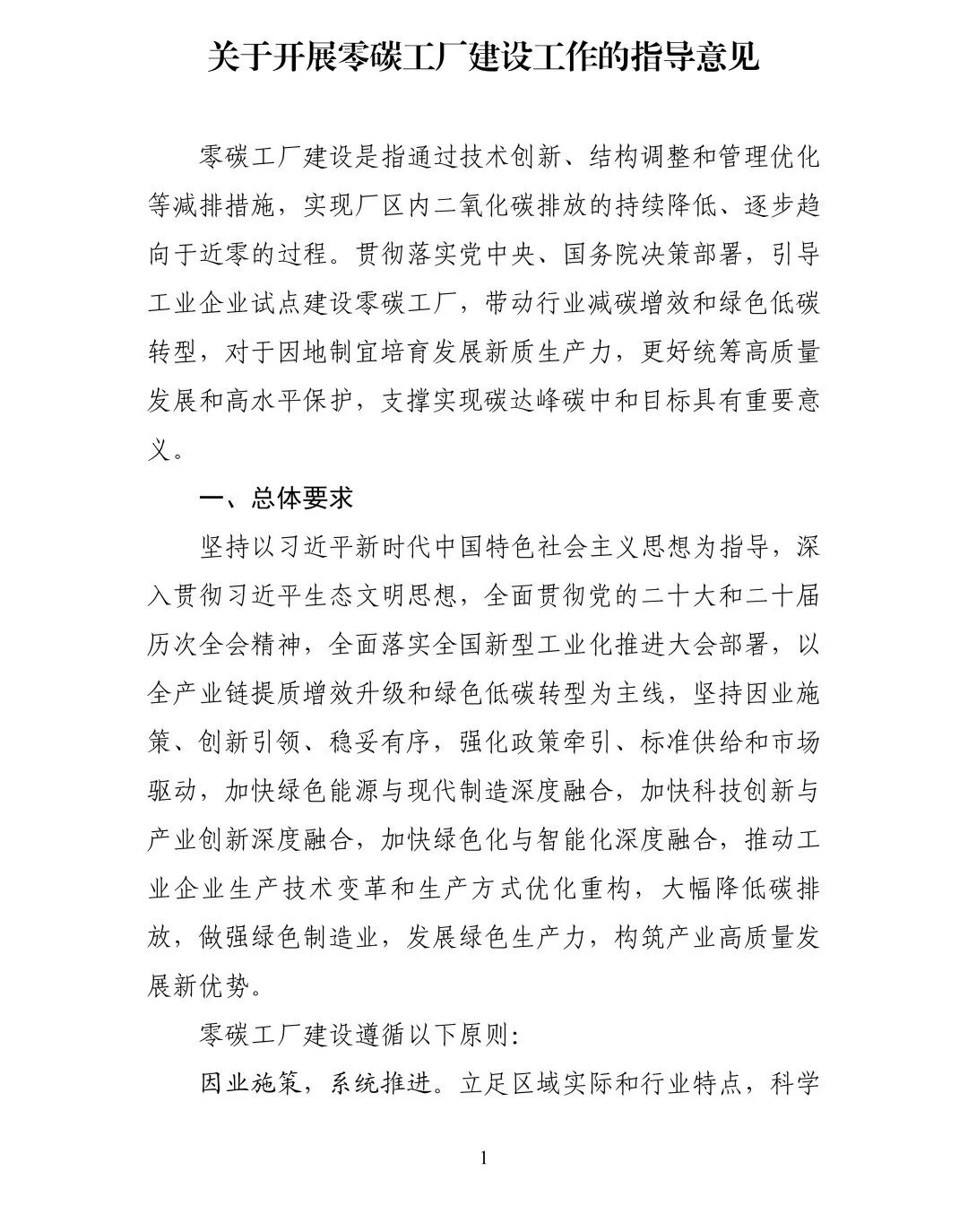
Core Viewpoint - The document outlines the guidelines for the construction of zero-carbon factories in China, emphasizing the importance of reducing carbon emissions through technological innovation, structural adjustments, and management optimization, aiming for near-zero emissions in industrial operations [1][5][21]. Group 1: Overall Requirements - The initiative is guided by Xi Jinping's thoughts on ecological civilization and aims to integrate green energy with modern manufacturing, promoting technological and industrial innovation to significantly reduce carbon emissions [6][22]. - The construction of zero-carbon factories will follow principles such as tailored strategies based on industry characteristics, innovation-driven approaches, and a focus on transparency and standardization in carbon accounting [7][23]. Group 2: Main Goals - The plan includes a phased approach, prioritizing industries with urgent decarbonization needs and lower difficulty levels, with a target to select a batch of zero-carbon factories by 2026 [8][24]. - By 2027, the initiative aims to establish zero-carbon factories in sectors like automotive, lithium batteries, photovoltaic, electronics, light industry, machinery, and computing facilities, creating an ecosystem that supports energy supply, technology research, and financial backing [9][25]. Group 3: Construction Pathways - A carbon emission accounting management system will be established to provide accurate data for zero-carbon factory construction, including direct and indirect emissions from production activities [10][26]. - The initiative encourages the development of green energy sources such as distributed solar, wind, and biomass power, promoting the use of integrated energy systems and green hydrogen applications [11][27]. - There will be a focus on enhancing energy efficiency and optimizing production processes to achieve significant reductions in carbon emissions, with a push for advanced energy-saving technologies and practices [12][28]. Group 4: Collaborative Efforts - The document promotes zero-carbon supply chain management, encouraging the procurement of green products and the adoption of low-carbon logistics to enhance collaborative decarbonization across the industry [13][29]. - The use of digital technologies such as IoT and big data will be emphasized to create smart carbon management systems, enabling precise measurement and control of energy consumption and emissions [14][30]. Group 5: Implementation Requirements - Local industrial and information departments are tasked with developing specific implementation plans for zero-carbon factory construction, fostering collaboration among government, enterprises, and markets [15][31]. - A comprehensive standard system will be established to guide the management and evaluation of zero-carbon factories, ensuring alignment with international standards and promoting transparency in carbon emissions reporting [16][32].

分析人士:顺周期板块“后劲”更足
Qi Huo Ri Bao· 2026-01-26 07:51
Group 1 - The A-share market has entered a phase of oscillation and adjustment after an initial strong upward trend, with active trading but increased regulatory measures to temper speculation [1][2] - Analysts suggest that the market's future direction will depend on the strength of economic recovery and improvements in corporate earnings [1][4] - The current regulatory stance aims to prevent excessive market growth that could lead to bubble risks, promoting a high-quality "slow bull" market instead [1][2] Group 2 - Despite some technology stocks reaching historical high valuations, the overall valuation of A-shares remains at a neutral level, with the total A-share index P/E ratio at 23.5, lower than the S&P 500's 30.0 and Nasdaq's 42.0 [2] - Recent market trends show that small-cap stocks are outperforming large-cap blue-chip stocks, driven by economic recovery and liquidity conditions favoring growth sectors aligned with national strategies [2][3] - The influx of liquidity from relaxed monetary policies and increased household deposits is expected to support the stock market, with a significant portion of deposits potentially shifting to higher-yielding financial products [3] Group 3 - The market is currently characterized by strong liquidity drivers, while the economic fundamentals are still stabilizing, indicating that improvements in corporate earnings and market style rotation are contingent on further domestic demand policies and clearer economic signals [4]
连续3日“吸金”,港股通央企红利ETF天弘(159281)盘中获净申购2200万份,标的指数股息率近6%
2 1 Shi Ji Jing Ji Bao Dao· 2026-01-26 06:52
Group 1 - The Hong Kong stock market experienced a decline, with the Hang Seng Index down by 0.2%, while the Central Enterprises Dividend Index rose by 1.08% [1] - Among the constituents of the Central Enterprises Dividend Index, China Merchants Energy surged over 6%, China Railway increased by over 5%, and China National Offshore Oil, China National Building Material, and China Shenhua all rose by over 4% [1] - The Tianhong Central Enterprises Dividend ETF (159281) recorded a trading volume exceeding 63 million yuan, with a net subscription of 22 million shares during the session [1] Group 2 - CICC indicated that the dividend sector presents phase-specific and structural opportunities amid increasing external uncertainties or a pullback in growth styles, highlighting a "seesaw" effect between dividend and technology growth styles [2] - Demand for capital allocation is expected to support the dividend sector, including the shift of long-term funds from insurance and bank wealth management towards equity assets, as well as the transition of household deposits to dividend assets [2] - The overall dividend payout ratio in the A-share market has increased to 45%, providing fundamental support for the dividend style, alongside continuous encouragement from capital market policies for dividend-oriented strategies [2]





——金属周期品高频数据周报(2026.1.19-2026.1.25):取向硅钢价格创2018年以来新低水平-20260126
EBSCN· 2026-01-26 06:49
Investment Rating - The report maintains a rating of "Overweight" for the steel and non-ferrous metals sectors [5] Core Insights - The report highlights that the price of oriented silicon steel has reached its lowest level since 2018, indicating potential market challenges [2] - The liquidity indicators show that gold prices have reached a historical high, with the London gold spot price at $4,981 per ounce, reflecting strong demand [11] - The report suggests that the steel sector's supply may be reasonably constrained in the medium to long term, which could lead to a recovery in profitability to historical average levels [4] Summary by Relevant Sections Liquidity - The BCI small and medium enterprise financing environment index for January 2026 is at 50.27, up 6.62% month-on-month [11] - The M1 and M2 growth rate difference was -4.7 percentage points in December 2025, down 1.60 percentage points month-on-month [11] - The current London gold price is $4,981 per ounce, reflecting an 8.31% increase from the previous week [11] Infrastructure and Real Estate Chain - The blast furnace capacity utilization rate in January is expected to be at its highest level for the same period in five years [20] - The national blast furnace capacity utilization rate is 85.51%, up 0.03 percentage points week-on-week [39] - The report notes that the prices of titanium dioxide and glass are at low levels, with titanium dioxide priced at 13,300 yuan per ton, up 0.76% week-on-week [76] Industrial Products Chain - The operating rate of semi-steel tires is at 74.56%, up 1.12 percentage points [2] - The report indicates that the price of electrolytic aluminum is 24,130 yuan per ton, reflecting a 0.54% increase [2] - The price of tungsten concentrate is 543,000 yuan per ton, up 6.37% from the previous week [2] Valuation Metrics - The Shanghai Composite Index decreased by 0.62%, while the best-performing sector was oil and petrochemicals, which increased by 7.71% [4] - The PB ratio of the steel sector relative to the Shanghai and Shenzhen markets is currently at 0.51, with a historical high of 0.82 [4] Export Chain - The new export orders PMI for China in December was 49.00%, up 1.4 percentage points month-on-month [3] - The CCFI composite index for container shipping rates is at 1,208.75 points, down 0.09% [3] - The U.S. crude steel capacity utilization rate is 75.90%, up 0.20 percentage points [3]
春季行情仍在途,注意总体赚钱效应已逼近高位
Zheng Quan Shi Bao Wang· 2026-01-26 05:44
Group 1 - The core viewpoint is that the current market is experiencing a spring rally, characterized by a recovery in market confidence and a focus on sectors that are not heavily weighted in broad-based ETFs, particularly in consumer and real estate chains [2][3][4][10] - The liquidity environment is a key driver of the current spring rally, supported by new insurance premiums entering the market and the return of overseas funds due to the appreciation of the RMB [4][7] - The market is expected to see a structural bull market with alternating phases of upward and sideways movements, with the current phase transitioning from the second to the third upward segment [6][12][14] Group 2 - Investment opportunities are identified in sectors with strong earnings forecasts, particularly in AI hardware, batteries, pharmaceuticals, steel, and non-bank financials [5][9][11] - The focus on "technology + resource products" is emphasized, with sectors such as semiconductors, AI, new energy, and chemicals being highlighted for their growth potential [7][9] - The market is advised to pay attention to the performance of cyclical stocks and the impact of regulatory policies on market dynamics, particularly in the context of the anticipated earnings reports from listed companies [10][12][13]
南方基金:持续大涨!黄金突破4990美元!
Sou Hu Cai Jing· 2026-01-26 05:21
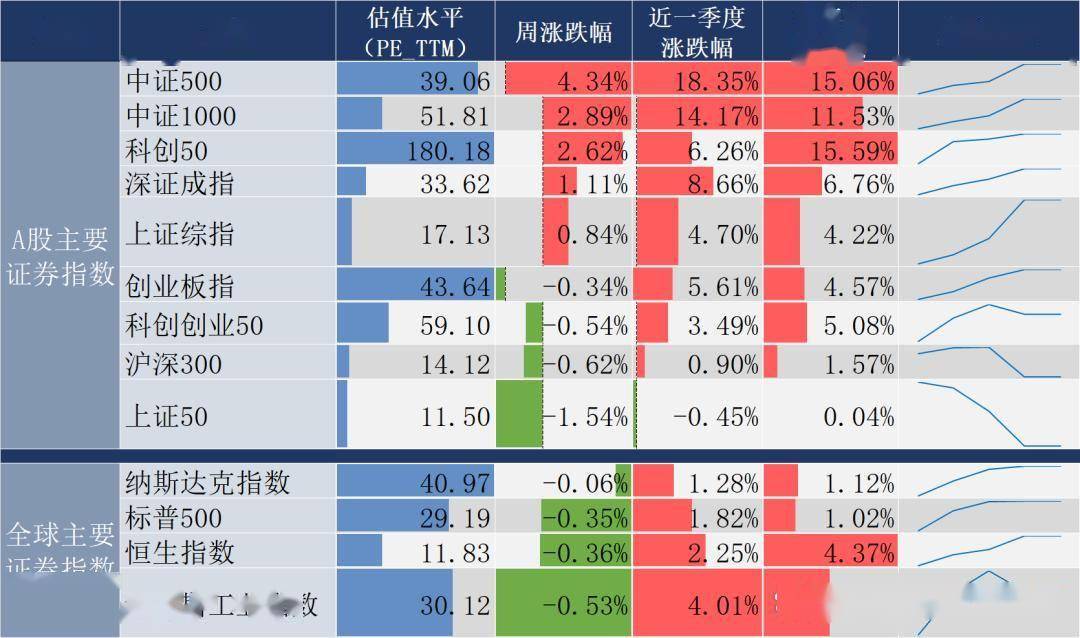
Market Performance - The overall market rose last week, but major indices showed mixed performance, with the CSI 500 and STAR 50 leading gains, while the CSI 300 and SSE 50 experienced slight declines [1] - The CSI 500 index had a weekly increase of 4.34%, with a year-to-date rise of 18.35% [2] - The STAR 50 index recorded a weekly increase of 2.62% and a year-to-date rise of 6.26% [2] Sector Performance - The construction materials, oil and petrochemicals, and steel indices were among the top gainers, with weekly increases of 9.18%, 7.76%, and 6.99% respectively [3] - The banking, communication, and food and beverage indices were among the largest decliners, with weekly declines of 2.69%, 1.68%, and 1.57% respectively [3] Global Market Trends - Gold prices surged significantly, reaching a historical high of over $4,990, with an increase of over 8% last week [4] - The U.S. stock market saw a capital outflow of nearly $17 billion amid geopolitical tensions and tariff threats, but rebounded after the withdrawal of tariff threats [10][11] Investment Insights - Foreign asset management firms are increasingly optimistic about artificial intelligence as a long-term investment theme, expecting continued structural opportunities [14] - The market is anticipated to maintain a trend of gradual upward movement, supported by policy measures aimed at stabilizing the economy [14] - Investment recommendations include focusing on technology growth, large financials, and consumer sectors, particularly in low-priced and low-inventory stocks [15][16][17]