美容护理

Search documents
美护商社行业周报:黄金税收新政落地,泡泡玛特中东首店开业-20251104
Guoyuan Securities· 2025-11-04 10:42
Investment Rating - The report maintains an "Overweight" rating for the industry, with a focus on new consumption sectors such as beauty care, IP derivatives, and gold jewelry [5][32]. Core Insights - The report highlights the recent tax policy changes regarding gold, which exempts value-added tax for standard gold transactions, potentially boosting market activity [3][22]. - The beauty care sector shows mixed performance, with some companies reporting significant revenue growth while others face declines [4][25]. - The report emphasizes the importance of domestic brands in the beauty market, with notable rankings in the Douyin beauty list indicating a shift towards local products [22][23]. Market Performance - During the week of October 27 to October 31, 2025, the retail trade, social services, and beauty care sectors experienced changes of +1.63%, +0.45%, and -2.21% respectively, ranking 8th, 17th, and 30th among 31 primary industries [13][15]. - The cosmetics sector faced a decline of -2.57%, while segments like trade and e-commerce performed well with increases of +3.44% and +2.97% [15][18]. Key Company Announcements - Shanghai Jahwa reported a revenue of 4.961 billion yuan for the first three quarters of 2025, a year-on-year increase of 10.8%, with a net profit growth of 149.1% [25]. - Proya Cosmetics achieved a revenue of 7.098 billion yuan, reflecting a modest growth of 1.89% [25]. - The opening of Pop Mart's first store in the Middle East marks a significant expansion for the brand [29]. Investment Recommendations - The report suggests focusing on companies such as Shiseido, Giant Bio, Marubi, Runben, Proya, Chaohongji, and Furuida as potential investment targets within the recommended sectors [5][32].





锦波生物(920982):2025年三季报点评:推广费用增加,三季度业绩承压
Jianghai Securities· 2025-11-04 10:33
Investment Rating - The investment rating for the company is "Buy" (maintained) [4] Core Views - The company reported a revenue of 1.296 billion yuan for the first three quarters of 2025, representing a year-on-year increase of 31.10%. The net profit attributable to shareholders was 568 million yuan, up 9.29% year-on-year [4][8] - The sales strategy for functional skincare products includes a focus on proprietary brands and targeted development of raw materials for major clients [8] - The company has successfully registered a new injectable-grade recombinant human collagen material, marking a significant breakthrough in high-end biomedical materials in China [8] Financial Performance Summary - For Q3 2025, the company achieved a revenue of 437 million yuan, with a year-on-year increase of 13.36% but a quarter-on-quarter decrease of 11.22%. The net profit for Q3 was 176 million yuan, down 16.24% year-on-year and 21.17% quarter-on-quarter [4] - The gross margin for the first three quarters of 2025 was 90.80%, a decrease of 1.57 percentage points year-on-year, while the net margin was 43.58%, down 9.02 percentage points year-on-year [8] - The company’s revenue projections for 2025-2027 are 2.041 billion yuan, 2.803 billion yuan, and 3.695 billion yuan, respectively, with year-on-year growth rates of 41.4%, 37.4%, and 31.8% [8][10] Valuation and Investment Recommendations - The current market valuation corresponds to a P/E ratio of 28.9 for 2025, 20.8 for 2026, and 15.5 for 2027 [8][10] - The company is positioned as a leader in the recombinant collagen market and is continuously expanding into new application areas [8]
浙商早知道-20251104
ZHESHANG SECURITIES· 2025-11-03 23:33
Market Overview - On November 3, the Shanghai Composite Index rose by 0.55%, the CSI 300 increased by 0.27%, the STAR Market 50 fell by 1.04%, the CSI 1000 rose by 0.42%, the ChiNext Index increased by 0.29%, and the Hang Seng Index rose by 0.97% [3][4] - The best-performing sectors on November 3 were Media (+3.13%), Coal (+2.52%), Oil & Petrochemicals (+2.28%), Steel (+1.9%), and Banking (+1.33%). The worst-performing sectors were Non-ferrous Metals (-1.21%), Home Appliances (-0.66%), Conglomerates (-0.39%), Automotive (-0.36%), and Beauty & Personal Care (-0.35%) [3][4] - The total trading volume for the A-share market on November 3 was 21,329 billion yuan, with a net inflow of 5.472 billion HKD from southbound funds [3][4] Key Insights - The annual macroeconomic report predicts that in 2026, the equity market will continue to exhibit a structural trend of low volatility dividends intertwined with technological growth. China's industrial policy is expected to strengthen, and the A-share market aims for technological growth [5] - The market outlook indicates a fundamental bull market, with no change in viewpoint. The driving factor is the meeting between China and the U.S. at APEC [5]
股指 调整后仍具备上行动能
Qi Huo Ri Bao· 2025-11-03 03:43
Group 1: Market Overview - The market experienced a pullback after a rally, with small-cap stocks gaining strength while large-cap stocks weakened [1] - Major indices showed divergence, with the STAR Market 50 index leading the decline at 3.2%, while the CSI 1000 index led the gains at 1.18% [1] Group 2: Manufacturing Sector - The October manufacturing PMI fell to 49.0%, a decrease of 0.8 percentage points, indicating contraction due to pre-holiday demand release and external factors [2] - Production and new orders indices also declined, with production at 49.7% (down 2.2 points) and new orders at 48.8% (down 0.9 points) [2] - High-tech manufacturing, equipment manufacturing, and consumer goods industries maintained expansion with PMIs of 50.5%, 50.2%, and 50.1% respectively [2] Group 3: U.S. Federal Reserve Policy - The Federal Reserve lowered the benchmark interest rate by 25 basis points to a range of 3.75% to 4.00%, marking the second consecutive cut [3] - The Fed's statement indicated a moderate expansion in economic activity and persistent high inflation, with employment growth slowing [3][4] - Despite hawkish signals from Powell, there remains room for further rate cuts, which could lead to a return to a low-interest-rate environment globally [4] Group 4: Economic Outlook - The U.S. economy is showing signs of "stagflation," with employment risks increasing, but the likelihood of significant inflation remains low [4] - China's economy has been stabilizing since Q4 of last year, supporting the potential for RMB appreciation and increased foreign capital inflow [4][5] - Overall, despite recent market adjustments, the fundamentals remain supportive, with improving corporate earnings and a favorable outlook for the manufacturing sector [5]
沪指重返4000点,10月经济数据预测
SINOLINK SECURITIES· 2025-11-03 03:22
Market Performance - The Shanghai Composite Index has returned to 4000 points after ten years, with a peak of 4025.7 points reached last Thursday[6] - The power equipment sector led the market with a 4.29% increase, while the communication sector fell by 3.59%[6] Financial Data - The margin trading balance has surpassed 2.5 trillion yuan, indicating a shift in risk appetite for leveraged funds[6] - Northbound trading volume increased by 19% to an average of 265.7 billion yuan, with stock ETFs seeing a net inflow of 760 million yuan[6] Economic Indicators - Industrial added value growth is expected to decline to approximately 5.5% year-on-year in October[4] - The Consumer Price Index (CPI) is projected to decrease by 0.1% year-on-year, while the Producer Price Index (PPI) is expected to drop by 2.2%[4] Investment Trends - Retail sales growth is anticipated to slow to around 1% due to weakened consumption in sectors like automobiles[4] - Export growth is forecasted at 2.5% for October, facing challenges from high base effects[4] Credit and Investment - New credit issuance is expected to remain weak, with an estimated 300 billion yuan in new loans for October[4] - Infrastructure and manufacturing investment growth is projected to rebound but will still show a cumulative decline of about 0.8%[4]
A股11月迎关键变盘?最新机构解读来了!
Sou Hu Cai Jing· 2025-11-02 16:30
Market Overview - A-shares showed mixed performance in October, with the Shanghai Composite Index rising by 1.85%, while the Shenzhen Component and ChiNext Index fell by 1.10% and 1.56% respectively [1][3] - The market experienced significant fluctuations, with the Shanghai Composite Index briefly surpassing 4000 points, marking a ten-year high, before undergoing adjustments [1][3] Sector Performance - The cyclical sectors, including coal, steel, and non-ferrous metals, performed strongly with monthly gains of 10.02%, 5.16%, and 5.00% respectively [3] - Conversely, the media, beauty care, and automotive sectors faced notable declines [3] Trading Activity - October saw a robust trading environment with total transaction volume exceeding 36 trillion yuan, and 10 trading days recorded over 2 trillion yuan in turnover [3] - Margin trading showed optimistic sentiment, with the margin balance reaching 24,990.86 billion yuan, an increase of 1,027.90 billion yuan in October [3] Economic Indicators - Manufacturing output in October grew by 5.4% year-on-year, while the service sector production index increased by 6.3%, the highest growth rate this year [9] - Infrastructure investment, manufacturing investment, and retail sales all showed accelerated growth [9] Policy and Market Outlook - The upcoming November is expected to witness a concentration of policy effects and verification of fourth-quarter earnings, with a potential easing of U.S.-China trade tensions [7][11] - The "14th Five-Year Plan" emphasizes high-quality development and technological self-reliance, which is anticipated to guide investment directions in November [7][11] Investment Strategy - Analysts suggest an overweight position in sectors such as machinery, TMT (Technology, Media, Telecommunications), electric power equipment, and non-ferrous metals for November [13] - The focus on innovation and technology is expected to drive growth in the economy, with high-dividend consumer stocks also being highlighted as worthy of attention [13][15]

财信证券宏观策略周报(11.3-11.7):风格再平衡,关注低估且滞涨方向-20251102
Caixin Securities· 2025-11-02 10:57
Group 1 - The report emphasizes a style rebalancing in the market, focusing on undervalued and stagnant sectors as institutional funds tend to take profits from high-valuation stocks and shift towards low-valuation sectors during the fourth quarter [4][7][16] - The report highlights that the manufacturing PMI for October decreased by 0.8 percentage points to 49.0, indicating a contraction in the manufacturing sector, with both production and new orders indices showing declines [8][9] - The report notes that profits of industrial enterprises above designated size increased by 3.2% year-on-year from January to September, with September alone seeing a profit growth of 21.6%, driven by high-tech manufacturing and equipment manufacturing sectors [9][10][11] Group 2 - The report identifies key investment areas, including high-dividend large-cap blue chips such as banks and utilities, new consumption sectors like health and cultural tourism, and sectors benefiting from the "anti-involution" policy such as steel and photovoltaic [4][16] - The report discusses the ongoing reforms in the capital market, particularly the deepening of the ChiNext reform and the enhancement of the Beijing Stock Exchange's role as a capital market hub [12] - The report mentions the positive developments in US-China trade negotiations, which may enhance market resilience and provide a favorable environment for A-share performance [13][14]
下周,风格切换,警惕科技高位波动
Sou Hu Cai Jing· 2025-11-02 03:26
Core Insights - The North Exchange 50 Index has significantly outperformed the A-share market, rising by 7.52%, marking the largest weekly gain since September, driven by favorable policies from the North Exchange [1][2] - The A-share market is experiencing a structural shift, with funds moving from high-valuation defensive sectors to mid and small-cap growth stocks [1][2] - The Asia-Pacific region has shown strong performance, with the Nikkei 225 Index up by 6.31% and the Korean Composite Index up by 4.21%, benefiting from technical breakthroughs and foreign capital inflows [1] A-share Market Summary - The North Exchange 50 Index's rise of 7.52% contrasts with the underperformance of large-cap indices, as the Shanghai Composite Index only saw a slight increase of 0.11% [2] - Trading activity was robust, with total A-share turnover reaching 11.63 trillion yuan, averaging 2.33 trillion yuan daily, a significant increase of 527.9 billion yuan week-on-week [2] - Main funds have shifted away from technology sectors, with net outflows of 644.43 billion yuan from electronics and 284.18 billion yuan from communication equipment, while sectors like media and pharmaceuticals saw net inflows [2] Hong Kong Market Summary - The Hong Kong market experienced an overall decline, with the Hang Seng Index down by 0.97% and the Hang Seng Technology Index down by 2.51%, primarily due to weakness in the semiconductor and electronics sectors [3] - Despite the decline, there was a net inflow of 27.5 billion HKD from southbound funds, indicating confidence in undervalued sectors such as banks and oil [3] - The A-share market is showing signs of a cyclical recovery in consumption, while technology stocks are undergoing a correction [3] Industry and Concept Analysis - In the A-share market, the power equipment sector rose by 4.29%, and non-ferrous metals by 2.56%, driven by rising product prices and supportive manufacturing policies [3] - The PVDF index, rare earths, and artificial intelligence sectors saw significant gains, benefiting from the improving outlook of the new energy industry and accelerated AI applications [3] - Conversely, the semiconductor and third-generation semiconductor sectors faced notable corrections due to previous overextensions and technical sell signals [3] Market Outlook - The market is expected to continue its structural trend, with a focus on mid-cap growth stocks supported by policy initiatives and a marginally easing liquidity environment [4] - The A-share index is projected to oscillate between 3900 and 4000 points, while the North Exchange 50 Index's performance will depend on policy implementation and trading volume [4] - In the Hong Kong market, continued inflows from southbound funds and potential recovery in technology stock valuations are anticipated to support the Hang Seng Technology Index [4]
【中国银河固收】转债策略更新 | 权益市场震荡冲高,风格切回稳健低波
Xin Lang Cai Jing· 2025-10-31 11:37
Core Insights - The report highlights the performance of three investment strategies: Low Price Enhancement, Improved Dual Low, and High Price High Elasticity, which recorded returns of 1.3%, 0.5%, and 0.7% respectively during the last period, outperforming the benchmark return of 0.3% [1] - Year-to-date, these strategies have achieved returns of 17.4%, 28.2%, and 52.2%, with cumulative excess returns of 0.3%, 11.2%, and 35.2% compared to the benchmark return of 17.0% [1] - The equity market experienced fluctuations, with the Wind All A and CSI Convertible Bonds rising by 1.5% and 0.3% respectively, indicating a resurgence of low volatility strategies [1] Low Price Enhancement Strategy - The latest holdings include new entries such as Jinggong Convertible Bond (Construction Decoration), Shangyin Convertible Bond (Bank), and Yangfeng Convertible Bond (Basic Chemicals) among others [2] - The adjustment rationale is based on the strong performance of the low price index (1.4%) and the resurgence of low volatility strategies, with a focus on stable or improving performance and reasonable premium rates [3] Improved Dual Low Strategy - The latest holdings feature new entries like Shangyin Convertible Bond (Bank) and Zhonghuan Convertible Bond (Environmental Protection) [4] - Adjustments were made due to the upward movement of the dual low index (0.4%), with a focus on stocks with improved performance or stable operations while avoiding those with high redemption progress [5] High Price High Elasticity Strategy - The latest holdings include new entries such as Wankai Convertible Bond (Basic Chemicals) and Shuiyang Convertible Bond (Beauty Care) [6] - The strategy's adjustments were influenced by the decline in high price index returns (-1.5%) and the need to manage redemption risks while maintaining a balanced industry allocation [7]


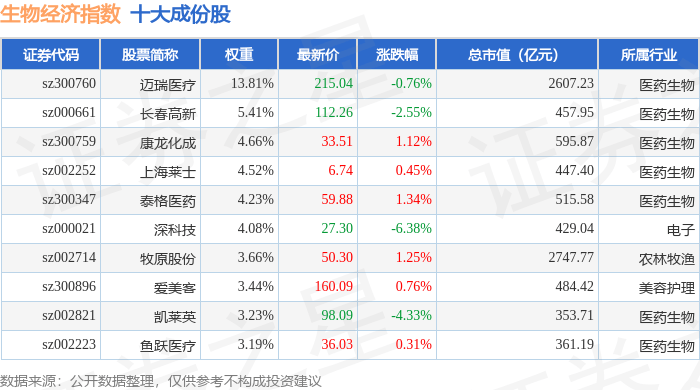
10月31日生物经济(970038)指数涨0.77%,成份股华兰疫苗(301207)领涨
Sou Hu Cai Jing· 2025-10-31 10:51
Core Insights - The Biotech Index (970038) closed at 2279.35 points, up 0.77%, with a trading volume of 28.709 billion yuan and a turnover rate of 1.85% [1] - Among the index constituents, 41 stocks rose, with Hualan Vaccine leading at a 17.88% increase, while 8 stocks fell, with Deep Technology leading the decline at 6.38% [1] Index Performance - The Biotech Index saw a net inflow of 140 million yuan from institutional investors, while retail investors contributed a net inflow of 210 million yuan, and there was a net outflow of 350 million yuan from speculative funds [1] Top Constituents - The top ten constituents of the Biotech Index include: - Mindray Medical (sz300760) with a weight of 13.81%, latest price at 215.04, and a decrease of 0.76% [1] - Changchun High-tech (sz000661) with a weight of 5.41%, latest price at 112.26, and a decrease of 2.55% [1] - Kanglong Chemical (sz300759) with a weight of 4.66%, latest price at 33.51, and an increase of 1.12% [1] - Other notable constituents include Muyuans (sz002714) and Aimeike (sz300896) with respective weights of 3.66% and 3.44% [1] Capital Flow Details - Detailed capital flow for key stocks includes: - Mindray Medical saw a net inflow of 26.2 million yuan from institutional investors [2] - Muyuans had a net inflow of 203 million yuan from institutional investors [2] - Hualan Vaccine experienced a net inflow of 74.8 million yuan from institutional investors [2]